A little more from Jewish newspaper archives

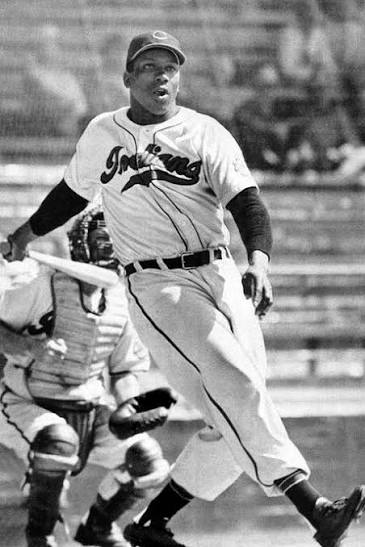
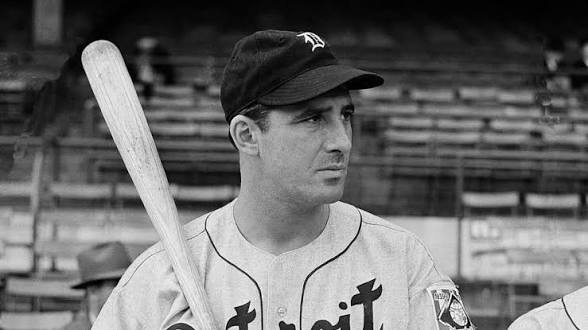
Hank Greenberg

Here’s a little companion piece to my last post about Jewish journalist Haskell Cohen and the archives of The Jewish Advocate and The Jewish Exponent. To complement that previous article, I’ll look at a few of the editorials the two newspapers wrote over the years about baseball, race, bigotry and integration.

I’ll forgo a lot of my own blather and just feature direct quotes from the editorial pages of the two illustrious publications. First from The Advocate:

April 10, 1947, about Opening Day

“To people, visiting our shores for the first time, the shouting and yelping of fans at a baseball game might seem an incredible display of mass hysteria and a useless waste of human energy. But to us of America the crowd at a baseball game is America.

“It has been said by educators that the key to the elimination of prejudice among the youth lies in the playground. Let children of all races, creeds and faiths play together and they will grow to understand each other and respect each other. If that is the truth, then baseball is the best example of that verity.

“As this season opens there are a number of Jewish players on several major and minor league teams. But a sign of the times is the expected inclusion of a Negro on Brooklyn’s baseball club. A sport that can break such barriers is a wholesome contribution to American life.”

April 12, 1951, about that year’s start to the baseball season

“And yet, there is another under-current of the game – the gathering of men and women and children of all colors and races and faiths under one roof in tribute to artists of the game whether they be white or black or Jewish or Christian We know of no study estimating the value and influence of baseball in breaking down racial and religious barriers. But no one who ever visited a great ball park can ever cease wondering at the basic amity of the fans, at least while the ballgame is in progress.

“There were times when big league baseball was only a white man’s game. But since courageous and imaginative Branch Rickey dared the innovation of Negro players, the game has taken on a truly national character.”

July 12, 1951, in response to an ugly, violent incident of bigotry-driven heckling and trash-talking at Comiskey Park

“One of the greatest baseball traditions is the right of fans to freely boo and applaud. But when a bunch of rowdies abuse that prerogative by venting abuse against ballplayers merely because they are Jews or Negroes, the national game is facing a situation it must eradicate at once if it is to survive within our democratic pattern. …

The hoodlums who vituperate Jewish and Negro players are not baseball fans. They are fanners – fanners of hatred and racial bigotry.”

“Baseball is our national game, and it is, therefore, painful to see its precincts transformed into an avenue of bigotry. Fortunately it can be said that the game is largely free of the evil of which we are now complaining. What the rowdies did was not only anti-Jewish but anti-American as well. The hoodlums who vituperate Jewish and Negro players are not baseball fans. They are fanners – fanners of hatred and racial bigotry.”

Here’s now a few from The Jewish Exponent:

April 20, 1951

“The story of widespread prejudice against Negroes in organized baseball is well known. Five years ago it would have been unthinkable to suggest that Negroes could make their way into the baseball picture. But few remember that 30 years ago the same hostility was felt toward Jewish ballplayers. Every method calculated to keep the Jew away from Big League diamonds was employed – but, of course, to little avail.”

July 13, 1951, concerning the same incident of bigotry at a White Sox game mentioned above

“Ordinarily, sportsmanship and tolerance go hand in hand. These virtues apply equally to players and spectators. That, at least, is what we like to think. But experience has proved that this is not true. …

“ … Scarcely more than four years ago, one Big League manager [likely Ben Chapman] was cautioned for making gestures about Hank Greenberg’s ‘Jewish nose.’ This same manager made life miserable for Jackie Robinson when the great Negro star broke into [organized] baseball. Today, both Robinson and Greenberg are still in the Major Leagues while that manager is down in the lowly minors – perhaps not even low enough for him.

“Can it be that after the ‘color line’ has been broken down in baseball, there still is resentment over a ballplayer’s religion? Why should this be in view of the tremendous examples of fair play, decency, integrity and athletic ability exhibited day in and day out over a period of years by the Greenbergs and the Robinsons?

“Apparently such unsavory practices as ‘throwing a game,’ hitting below the belt and downright cheating must move over to make room for a bosom companion – prejudice.”

“Apparently such unsavory practices as ‘throwing a game,’ hitting below the belt and downright cheating must move over to make room for a bosom companion – prejudice.”

Aug. 21, 1953, in a piece by sportswriter Bill Wolf

“The ugly face of race prejudice has once again been seen in sports, this time in major league baseball. The victims: Dodger catcher Roy Campanella and infielder Jackie Robinson.

“While the incidents do not involve any Jewish players, they are of paramount interest to Jewish sports fans. For as it has been demonstrated time and again, when racial attacks are made on Negroes, the danger of anti-Semitic incidents increases.

“Fans will recall the incident a number of years ago, when Sid Gordon was the target of anti-Semitic remarks in St. Louis. Two years before that St. Louis players had also hurled insults at Jackie Robinson. Bigotry is a common enemy of all who seek democracy in sports.”

Legendary writer connects Jews with Black baseball

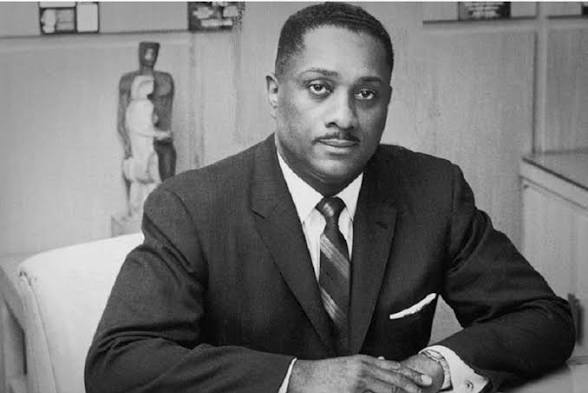
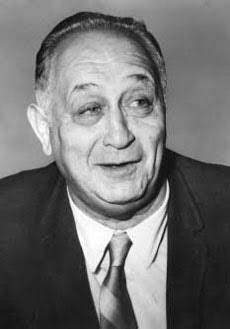
Haskell Cohen

So today we have another installment of “cool stuff from various databases.” (I previously did a couple such posts here and here.) I perused a few of them and came across ones compiling the archives of two Jewish newspapers: The Jewish Advocate, based in Boston, and The Jewish Exponent, based in Philadelphia.

I decided to search these archives for articles and commentaries about Negro League baseball, integration of the sport, and race issues in general in the national pastime. I found some pretty good stuff, and I noticed one trend in particular: the columns and articles of Haskell Cohen.

Cohen was an extremely deft, incisive reporter and scribe who’s most well known for his key involvement in the growth and strengthening in the 1950s and ’60s, serving as the nascent league’s publicity director for nearly two decades. He also created the NBA All-Star Game, which he modeled after the MLB All-Star contest.

But he was also a prolific journalist, including as sports editor for the Jewish Telegraphic Agency, a news wire service, for 17 years, and as a contributing editor to several magazines, such as Parade and Spot.

In addition, Cohen founded the United States Committee Sports for Israel (now Maccabi USA); served as the first chairman of the International Jewish Sports Hall of Fame’s selection committee (he’s also an IJSHOF inductee); and was a member of the Naismith Basketball Hall of Fame board of trustees, and the U.S. Olympic Basketball Committee.

But for our purposes here, we’ll focus on the reporting and commentaries he provided for the Jewish Telegraphic Agency and various newspapers and similar publications. Through the archives of The Jewish Advocate and The Jewish Exponent, I first collected some columns he wrote for the JTA, then branched out a bit from there.

One running theme in Cohen’s columns was covering the activities of several Jewish executives, promoters and owners in Black baseball, particularly Abe Saperstein of Chicago, Philadelphia’s Eddie Gottlieb, and Syd Pollock of New York, all of whose involvement in Black ball circles, especially as promoters, was somewhat controversial at the time, and continues to be somewhat today. 

Eddie Gottlieb

(Supporters argued that the influence and financial backing they brought to the table was a positive for the Negro Leagues, while critics asserted that the Jewish executives bumped African-American promoters and executives from crucial roles in the sport, exploited Black talent, and siphoned revenue that could have been going to Black-owned teams and promotion services.)

In September 1946, Cohen reported on the financial difficulties being then experienced by Saperstein in Black baseball promotions, including the quick folding of the West Coast Negro Baseball Association, a short-lived league that Saperstein oversaw with Olympic hero Jesse Owens. However, Cohen added that Saperstein hoped to turn things around when he took his Black all-star team to Hawaii for an extended tour. (For more on that Hawaii tour, check out this article.)

In a column from June of the following year, Cohen noted the attendance of Gottlieb and Pollock at the joint meetings of Negro American League and Negro National League in New York City. Cohen also often also reported on Saperstein’s connections as a scout with the Cleveland Indians (now the Guardians), whose owner, Bill Veeck, paid Saperstein to comb the ranks of Black baseball for potential talent for the MLB team; Cohen asserted in a November 1948 column that it was Saperstein who bird dogged Satchel Paige for Veeck and the Indians.

Cohen then, in July 1950, reported that it was now Gottlieb who was promoting Paige; Cohen wrote that “Paige is now under contract to Eddie Gottlieb, who is securing $1,500 to $3,000 weekly for the aged pitcher’s services.”

But Cohen was also willing to take Jewish sports executives to task, such as in July 1945, when he sharply criticized the antics of the Cincinnati Clowns, including relatively harsh words in particular for the team’s owner, Pollock.

“Sid [sic] [has] a funny team but his burlesque of Negro people, for gag purposes, is in very bad taste,” Cohen wrote. “… Sid [sic] is beginning to tone down on this stuff and if he goes all the way in refining his talent[,] the Clowns are really going to come into their own as one of the nation’s funniest ball clubs.”

With that, we’ll use a nice segue to Cohen’s occasional mention of who, at that time, was the biggest Jewish name in baseball – Hank Greenberg, of course. In December 1949, Cohen reported how Veeck had sold his interests in the Indians, and the columnist pondered what role, if any, Saperstein would retain with the club, including his activity as a scout of Negro League talent.

But the main thrust of Cohen’s piece was how Greenberg was going to stay on as the general manager for the team, as opposed to the original plan for the Hebrew Hammer, which called for him to be team president.

Hank Greenberg

Then, in February 1951, after the integration of organized baseball had gotten well underway, Cohen quoted Greenberg discussing the latter’s view of racism and bigotry in baseball, particularly in Cleveland, where, Greenberg said, open-mindedness and acceptance were the rule. Cohen quoted Greenberg saying:

“We in Cleveland have adopted the motto that ability counts, not race, color or creed. It is only natural, therefore, that the Cleveland Indians lead the way by judging players on performance only. Our daily lineup includes two Irishmen, an Englishman, a Scotsman and two Mexicans, Protestants, Catholics and Jews, Negroes and Whites and all Americans who work and play together in perfect harmony. This speaks for itself.”

A few years earlier, in May 1947 – just a month or so after Jackie Robinson had stepped on the field for the Brooklyn Dodgers – Cohen noted in a JTA column that Greenberg, and Jews in general, had been steadfast in their support of Robinson. Penned Cohen:

“Jewish baseball fans in Flatbush are keeping a wary eyer open watching the progress of Jackie Robinson, Negro first baseman with the Brooklyn Dodgers. Since the Brooks do not have a Jewish player on the roster, the many Jewish inhabitants of the batty baseball borough, have more or less adopted the colored lad. His every movement on the field and at bat are applauded by the fans who are predominantly of Jewish extraction.”

Cohen added that since his Brooklyn debut, Robinson “has been finding the going rather tough in more ways than one. … As yet, he has not been accepted by members of the league, not even by his own teammates.” However, the scribe continued, Greenberg was one of the solitary figures in the majors “who has extended a welcome hand …”

The scribe added that during a recent contest between the Dodgers and Greenberg’s Pittsburgh Pirates, Robby and Greenberg had collided on a play, soon after which Greenberg had asked Jackie if he’d been hurt in the incident. Robinson said he was OK, and, according to Cohen, “Greenie then remarked, ‘Stay in there, you’re doing fine, keep your chin up.’ These were the first words of encouragement Robinson had heard since the beginning of the season. He told newspapermen: ‘I always knew Mr. Greenberg was a gentleman. Class always tells.’”

In addition to Jewish publications and wire services, Cohen occasionally even did a little stringing for The Pittsburgh Courier, one of the most prominent African-American newspapers of the day.

For example, he covered a Baltimore Elite Giants doubleheader sweep over the New York Black Yankees at Yankee stadium with an article in the May 26, 1945, issue of The Courier; and in the Sept. 4, 1948, edition of the paper, Cohen reported that two members of the Negro National League’s New York Cubans – pitcher Jose Santiago and future National Baseball of Famer Oresto Minoso, later, of course dubbed Minnie – had been sold to the Cleveland Indians for an undisclosed amount.

Minnie Minoso

Finally, Cohen contributed a lengthy feature article to Spot Magazine in July 1942, about none other than legendary Josh Gibson. In the piece, Cohen detailed Gibson’s career trajectory, achievements and impacts on Black baseball. Because Josh’s exploits have already been well chronicled elsewhere and, as we know, quite numerous, I won’t refer to Cohen’s reporting on that subject. I’ll just wrap up this post with a hefty quote from the first section of Cohen’s article, and I think Cohen’s words will speak for themselves:

“When then isn’t [Gibson] in the National or American League, catching for the World Champion Yankees, the Dodgers or one of the other pennant contenders? An unwritten law of the majors bans from its fields all colored – a prissy prohibition that is out of line with big time baseball’s reputation for sportsmanship. Thousands of fans, both famous and humble, have strenuously objected to Jim Crowism on the diamond, pointing out that it is ironical to find discrimination in America’s national game, that the big leagues deprive themselves of much valuable talent, and that it’s not quite logical for a sport that had a Black Sox scandal to exclude representatives of a race that boasts such outstanding sportsmen as Joe Louis, Henry Armstrong and Jesse Owens. Be that as it may and many another colored star can’t play with white boys.

“After 12 years in colored baseball, and at the age of 30, Gibson has compiled so many records with his hickory stick that it is doubtful if the great Babe himself did any better.”

Ironic twists of fate for Goree’s killers

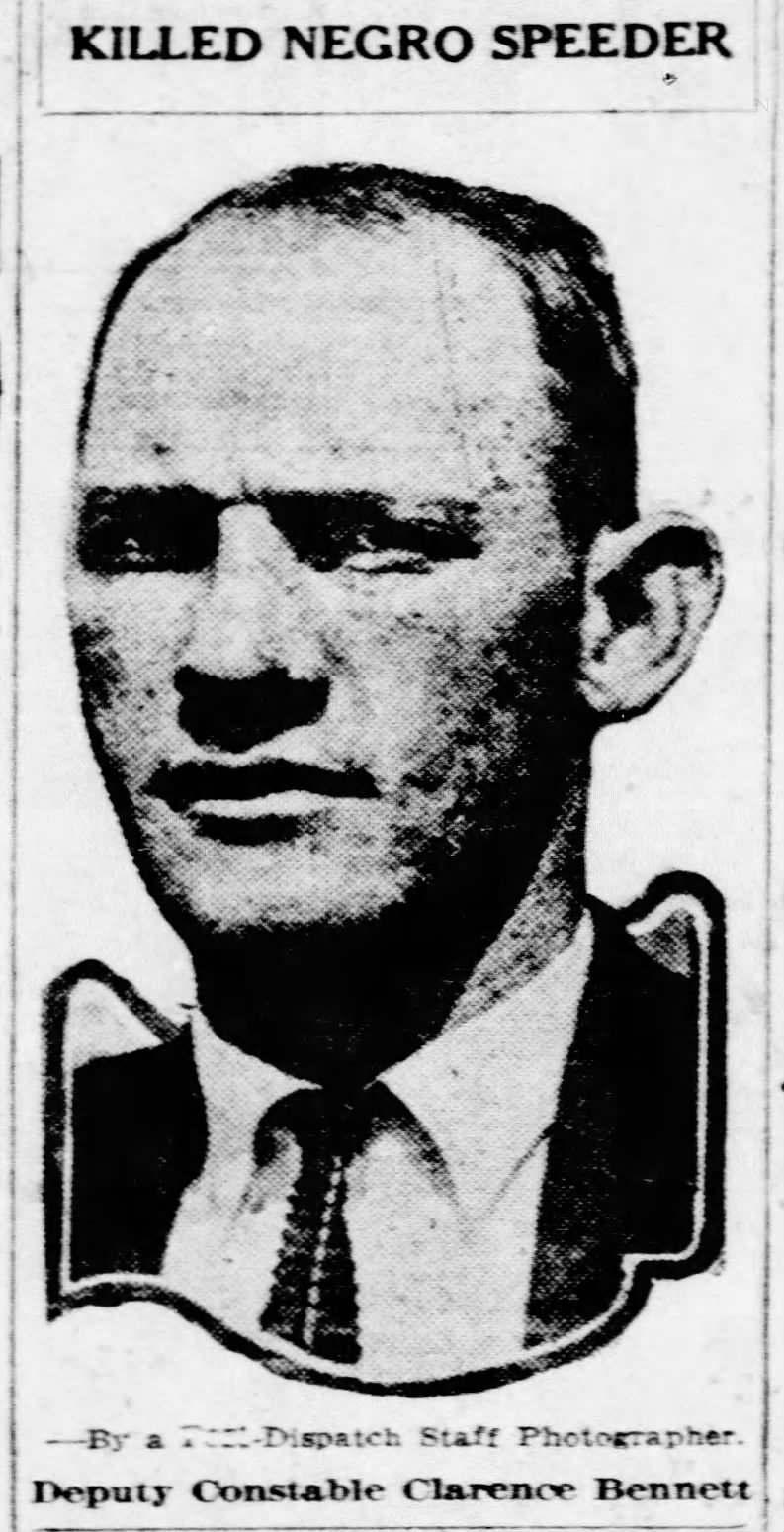
St. Louis Post-Dispatch, Oct. 3, 1925

Karma. Existential justice. Reaping what you sow. Bad juju.

Whatever you want to call it, it seems like it might have been at play following the law-enforcement lynching of African-American baseball team owner Fred Goree a century ago.

The two deputies who speciously pulled over Goree’s new Cadillac – in a fairly obvious case of “driving while Black” – walked him from the car, and beat him to death, later claiming that it was Goree who began attacking them.

When St. Louis (Missouri) County deputy constable Clarence Edgcombe “Pat” Bennett and a companion, Charles Schuchmann, murdered Goree on Aug. 1, 1925, as Goree and friends were in the St. Louis area for a game featuring the Chicago Independents, Goree’s team, the two officers just might have invited fate to turn against them.

After an investigation, a St. Louis County coroner’s jury exonerated Bennett directly and Schuchmann implicitly of any blame for the killing of Goree; the jury apparently believed Bennett when the deputy testified that Goree attempted to grab Bennett’s gun when the baseball owner was shot. This despite the testimony and assertions of other witnesses that Goree’s skull was, in fact, crushed and he was actually on the ground when he was shot.

Even though the deputy constables escaped the legal system more or less unscathed, the universe, perhaps, wasn’t quite pleased.

Because within four years, both Bennett and Schuchmann ended up the victims of gun violence – the former having his jaw shattered when shot in the face by alleged robbers, the latter dying from what Schuchmann’s death certificate called a “gunshot wound in head [during an] unavoidable accident.”

Bennett was born in St. Louis in 1895 to Clarence Edgcombe “Clay” Bennett Sr., a foreman at a printing press, and the former Amelia Graham. Clarence Jr. was one of 11 children in a family that at first lived in the City of St. Louis but later moved to St. Louis County.

(It’s important to note that St. Louis County was at the time and still is separate and distinct from the City Of St. Louis, which split off from the county in the 1870s. This fact made it a bit challenging to do research for this series on Fred Goree.)

Clarence Jr. – for the sake of clarity, I’ll refer to Bennett Jr. as Pat from here on out – as a cook in the Army during WWI; he was reportedly wounded and gassed during battle while a part of the 138th Infantry, Missouri National Guard.

Bennett became a deputy constable in 1922, roughly three years before killing Fred Goree. He was appointed a deputy sheriff in 1936 by St. Louis County then-Sheriff-elect A.J. Frank, under whom Bennett served until 1941. Bennett unsuccessfully ran for St. Louis County Sheriff in 1952 as a Republican while he was working as an ironworks foreman. Bennett had also previously and unsuccessfully run for justice of the peace in St. Ferdinand Township in 1930.

Pat Bennett’s World War II draft card

Bennett married Emma Lovern (or LaVerne) Hartung (nee 1906) in 1925 in Bond County, Ill., which is just over the Mississippi River from St. Louis. The couple lived in St. Ferdinand Township, part of St. Louis County, for much of their lives and had one child, a daughter, Donna Rose, who was born in 1931.

The family later moved to the City of Jennings in St. Louis County.

Pat and Lovern then moved to the TampaSt. Petersburg area in Florida, where Pat died in 1971 at the age of 75. (Lovern then might have moved back to the St. Louis area, where she died in 2001.)

Perhaps significantly, Pat’s obituaries (from both the St. Louis Post-Dispatch and the Tampa Bay Times) make no mention of his career in law enforcement.

And it’s back to his time as a constable we now go, because what happened to him after the murder of Fred Goree is pretty stunning – namely, being shot in the face while reportedly fighting with a trio of robbers.

According to reports in the Post-Dispatch and Globe-Democrat newspapers, the incident occurred in the wee hours of the morning on May 12, 1926, when Pat Bennett, accompanied by his brother, Grant (who was unarmed and not a constable officer), reportedly witnessed three suspicious men approach another vehicle that was parked on the side of the road and that contained two men and two women.

The Bennetts reportedly grew suspicious of the trio of men as the three men approached the other, parked vehicle and allegedly searched the two couples. The brothers – Pat had his gun in his hand – got out of their vehicle and attempted to sneak up on the suspected robbers, who nevertheless allegedly saw the Bennetts. One of the suspects shot twice, with one of the bullets hitting Pat in the face. The alleged robbers abandoned their car and fled on foot, while Grant Bennett and the occupants of the other vehicle (the potential robbery victims) assisted the wounded Pat and took him to get treatment. The car used by the suspects allegedly had been stolen from in front of a residence earlier in the night.

The bullet had struck Pat Bennett in the nose and split into three fragments, two of which lodged in his jaw. The third exited his left cheek. He was reported by the Post-Dispatch in serious condition at St. Mary’s Hospital.

Both the article in the Post-Dispatch and the one in the Globe-Democrat mentioned the previous year’s incident in which Goree was killed and noted that Pat Bennett had been exonerated in the killing.

The only follow-up information that I could find about the 1926 incident was from an article in the May 15, 1926, issue of the St. Louis Star and Times newspaper, which reported that one suspect, Raymond Hogan, in the shooting of Pat Bennett had been arrested. Hogan was the son of notorious gangster Edward J. “Jellyroll” Hogan. I wasn’t able to find any further information about Hogan’s case.

As of the May 15 article, Pat Bennett was still in critical condition at the hospital, but he obviously recovered eventually and continued his career in law enforcement.

Schuchmann wasn’t so lucky, however. 

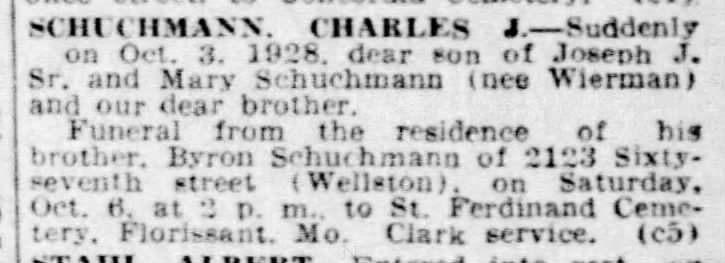
St. Louis Post-Dispatch, Oct. 4, 1928

Before we get into his fate, let’s take a quick look at Charles J. Schuchmann’s personal background. He was born on Sept. 1, 1907, the seventh child of Joseph J. “Jesse” Sr. and Mary (nee Weirman or Wierman) “Dolly” Schuchmann, who had nine children total (five boys, four girls). 

The Schuchmann family traced back to the Baden-Wurttemberg region of what is now Germany; numerous members of the clan emigrated from there to the U.S. in the early-to-mid-19th century. Several Schuchmanns worked as either butchers or grocers/food peddlers; on the federal Census, Jesse was listed as a butcher in the 1900 and 1910 editions, and as a “huckster” in 1920 and 1930 (specifically selling vegetables in the latter).

Charles’ maternal grandmother was the former Louisa (or Louise) Dehatre, part of the DeHatre family of St. Louis. The DeHatres were one of the earliest families to settle in the area, stretching back to the late 1700s, and they owned several prominent businesses in and around St. Louis.

Charles Schuchmann’s precise role in Goree’s death is somewhat unclear, but by most accounts he was actively involved. According to Bennett’s testimony in a coroner’s inquiry following Goree’s murder, Goree had reached for Bennett’s gun during a scuffle during the roadside stop.

“The negro was getting the best of me,” Bennett told the coroner’s jury, as reported by the St. Louis Post-Dispatch, “and I called to Schuchmann for help. He ran to me and struck Goree twice on the head. Goree’s grip on the revolver relaxed and I told Schuchmann not to hit him again.”

Bennett testified that the gun then went off in the scuffle, with the shot reportedly striking Goree. The deputy said that he (Bennett) succeeded in wresting the gun from Goree and shot at the victim twice, both hitting Goree, who died a little while later while receiving treatment.

However, the St. Louis Argus, an African-American newspaper, reported a different account of what actually transpired. 

“The reports of several eye witnesses of the slaying … have given plain evidence of a case of cold-blooded murder … and local white dailies failed to present facts to show that [Bennett] was in the wrong,” stated the Aug. 7, 1925, issue of the Argus.

The newspaper cited testimony by Goree’s two companions in the Buick, Frenchie Henry and Harold Gauldin, that directly contradicted the accounts of Schuchmann and Bennett.

The trio of Black men – who were on their way from the St. Louis area to Effingham, Ill., to pick up members of Goree’s team who’d been stranded in the latter city on their way to the team’s scheduled game in the St. Louis suburbs – weren’t the aggressors in the confrontation, Henry, Gauldin and other witnesses said.

The witnesses reportedly stated that Bennett seemed drunk and became infuriated when Goree pleaded with Bennett to let the team owner make arrangements for the safe retrieval of the players in Effingham. The witnesses further reported that upon losing his temper and calling Goree a “damn n*****,” Bennett drew his gun – the white men had testified that Goree had suddenly reached for Bennett’s gun out of the blue – and when Goree grabbed hold of the gun in self-defense, it went off during the ensuing struggle.

According to the witnesses, Bennett then did call to Schuchmann for help, and Schuchmann did rush to Bennett’s aid. But while Bennett had testified that Schuchmann had “struck Goree twice in the head” before stopping on Bennett’s order, the witnesses gave a starkly different account. Stated the Argus:

“[T]he youth came and beat Goree over the head with a black jack for a period which Gauldin estimated lasted three minutes [itals mine].” The article further asserted that post-mortem examination found 15 lacerations on Goree’s head and that “his skull was crushed.”

The Argus stated that according to their witnesses, Goree then appeared to lose consciousness, at which time Bennett dismissed Schuchmann back to the patrol car and proceeded to shoot Goree’s prone, unconscious body twice.

While the coroner’s just obviously and basically dismissed Gauldin’s and Henry’s accounts out of hand, the pair’s statements paint a much more damning picture of Schuchmann’s role in the murder.

That is especially galling given that exactly why Schuchmann was accompanying Bennett isn’t clear. He was just shy of his 18th birthday and, evidently, not connected with the Constable’s Office or law enforcement in any discernable way, or at least not at that point. He apparently did, in fact, become a deputy St. Louis County deputy constable, which was his listed occupation on his death certificate a little more than three years later.

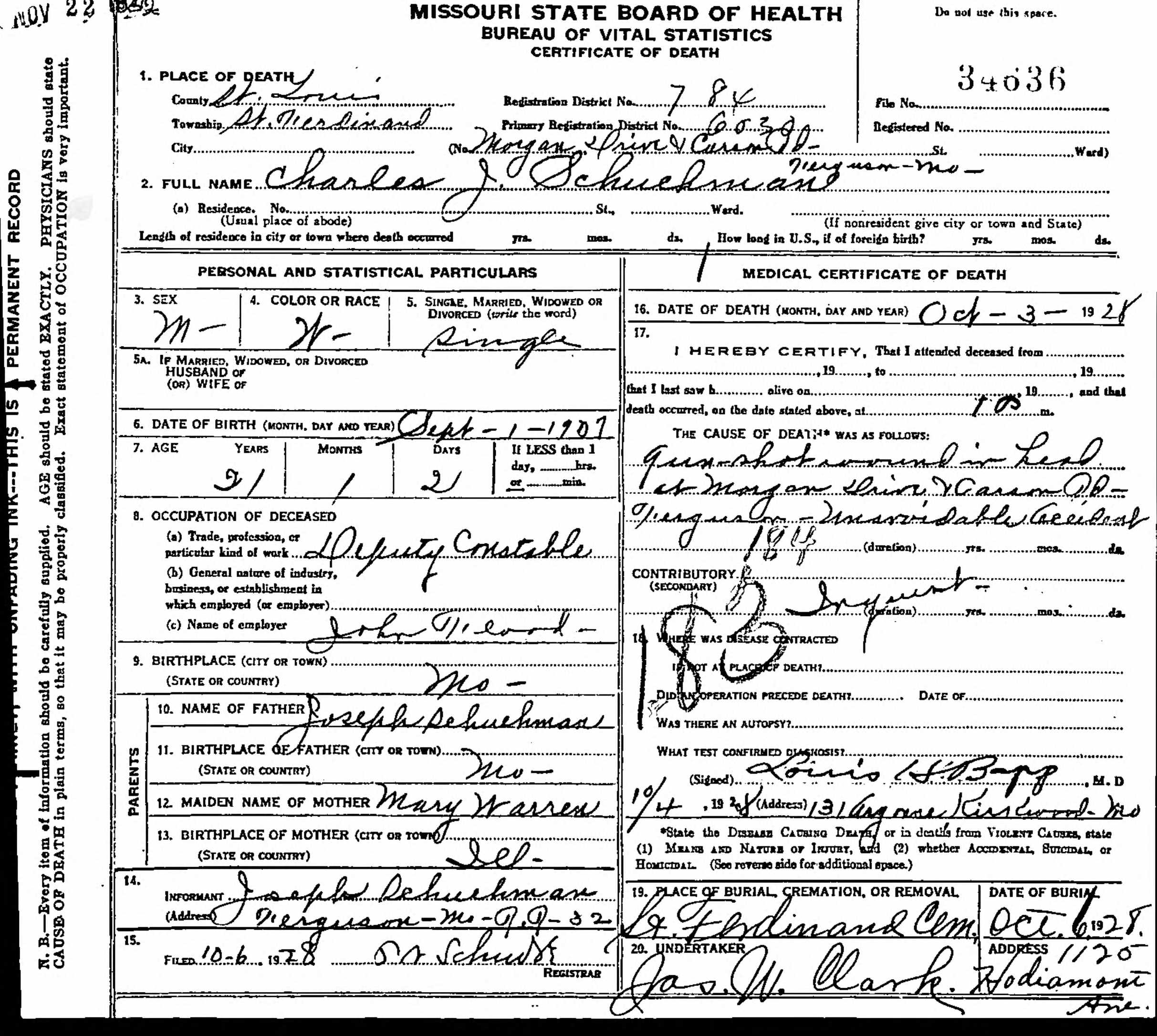
Charles Schuchmann’s death certificate

In fact, Schuchmann was a deputy for the St. Ferdinand Township constable’s office, a position you would think would require a decent knowledge of firearm safety, but apparently Schuchmann missed that day of training because he appears to have been quite careless in the incident that killed him.

According to ctestimony from Charles Schuchmann’s younger brother, Jesse Jr., the two brothers, along with a third brother, Phillip, were target practicing with their revolvers near the Schuchmann home in St. Louis County, during which Phil and Jesse placed a bottle on a tree stump and were shooting at it. At some point, Charles approached the stump to examine if a bullet had hit the bottle (it hadn’t), apparently doing so right when Jesse had squeezed off a shot.

Since I don’t own, shoot or know much about guns – I think the last time I used a firearm was 40-ish years ago at the rifle ranch at Boy Scout summer camp (I enjoyed archery a lot more than those stupid rifles) – I’ll quote directly from the account in the St. Louis Globe-Democrat of Oct. 4, 1928:

“As [Charles] spoke and before he had time to move away, the pistol which Jesse held was discharged and the bullet struck Charles in the mouth. Jesse said he was not aware that an automatic pistol was self-cocked and had not realized he was pressing on the trigger.”

Charles was rushed to a hospital but was DOA – he was 21 years old – and Jesse was held on bond for an inquest the following day. The 24-year-old Jesse was cleared of any guilt when the coroner’s jury ruled the shooting an accident.

Charles was buried in St. Ferdinand Cemetery in Florissant, a suburb in St. Louis County. His death certificate listed a date of death as Oct. 3, 1928, and gave the cause of death as “gun-shot wound in head … unavoidable accident.” It might not have been avoidable, but it does seem like it was careless, at least more so than what a law-enforcement officer would display.

So, again, whether what happened to Clarence Bennett and Charles Schuchmann, respectively, was a matter of karma or simple coincidence probably depends on each reader’s more existential beliefs in how life operates. Do you think they were cases of poetic justice or just coincidence?

Alex Albritton’s brief major-league career

New York Age, Sept. 15, 1923.

This post represents the closing of the book, several months overdue, on the Alexander Albritton saga that saw Albritton go from Negro League pitcher to tragic victim at a psychiatric hospital.

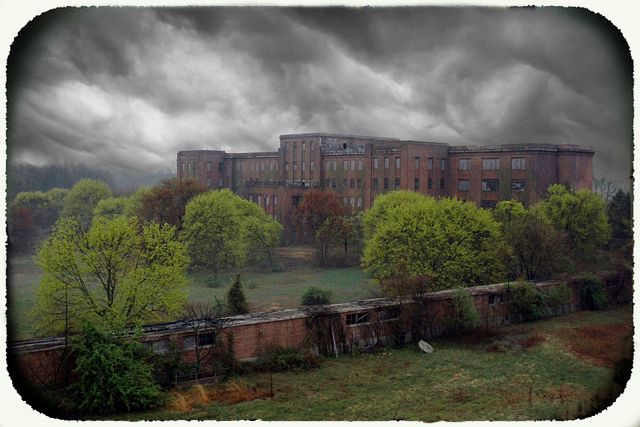
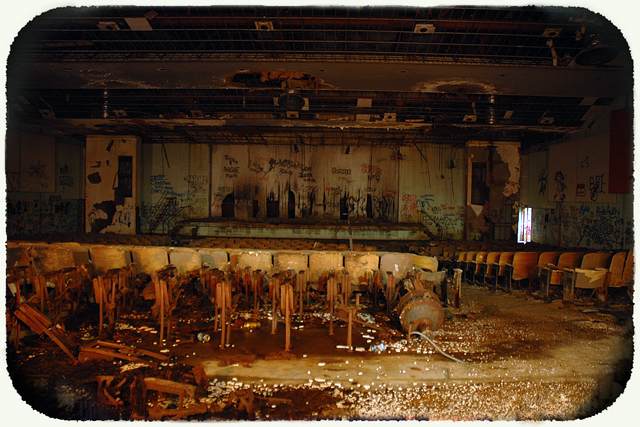
Albritton, who pitched for several African-American baseball teams during the segregated era in the 1920s before seemingly having a nervous breakdown and being committed to the horrific Philadelphia State Hospital, a notoriously inhumane psychiatric facility, where he was beaten to death by an orderly in 1940.

In addition to the article I wrote in 2014 for the Philadelphia Inquirer, I’ve discussed Albritton’s life, career and death on this blog several times, such as here. But this current post is a continuation of the one here in which I examined his actual performances on the baseball diamond.

In the baseball-centric Albritton post, I initially concluded that, despite a significant career as a pro and semipro pitcher, he was never an official major-leaguer because he never pitched in any official league games, i.e. games between teams in the same league that counted to league standings.

However, after I’d drafted my post, my SABR friend Kevin Deon Johnson emailed me that my conclusion – that Alex Albritton was never a major-league player – wasn’t accurate. Kevin, it turns out, did find several official league contests in which Albritton competed, meaning that yes, Albritton was, in fact, a major league pitcher.

Kevin found nine such games that took place between 1923 and 1925, all in the Eastern Colored League. Four of the games were from the 1923 season, while Albritton was hurling for the Baltimore Black Sox. Then three of them happened in 1924, when he took the mound for the short-lived Washington Potomacs. The final two contests took place in 1925, while Alexander pitched for the recently-moved Wilmington Potomacs.

Across those nine contests, Kevin’s spreadsheet shows, Albritton went 0-2, with one save. His only complete game came on Oct. 7, 1923, when Albritton pitched for the Black Sox against the Hilldale Club. The Darbyites tagged Albritton for 11 hits and eight runs over the nine innings, with Alex picking up the loss in the 8-3 contest.

Albritton was hung with his other major-league loss on Aug. 25, 1923, against the New York Lincoln Giants, when he pitched four innings, gave up four runs (all earned) and got tagged for five hits.

He then notched his sole major-league save a couple weeks later, on Sept. 9, 1923, versus the Lincoln Giants after hurling for a single inning during the contest, which the Black Sox ended up winning, 12-8.

One of the reasons I had trouble identifying Albritton in game coverage was that he frequently went under different names in articles and in box scores. At times, box scores for the games in which he played as an official major leaguer listed him as “Allbritton,” with two Ls; as “Britton”; or even just “Britt.” One article identified him as “Al Britton.”

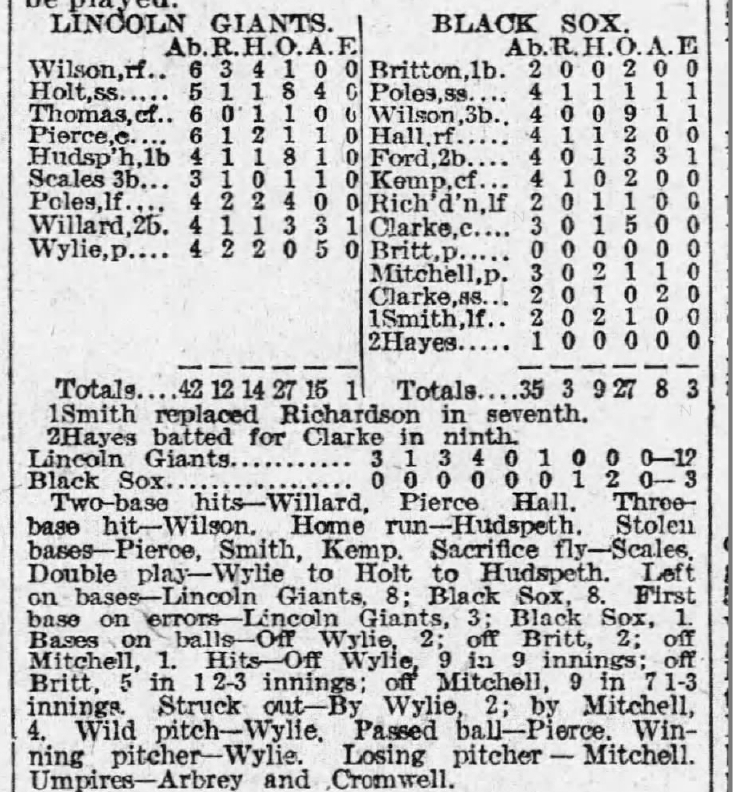
Baltimore Sun, Aug. 26, 1923. Notice Albritton’s abbreviated name at first base and George Britt as a pitcher for the Black Sox.

To make extra sure that all of these names and spellings referred to the same person, Alexander Albritton, I double checked with Kevin Johnson, who told me via email that there were Negro Leaguers with those shorter surnames, such as George Britt and John Britton. 

And in fact, George Britt, as a utility player, did suit up for the Black Sox while Albritton did in the early to mid-1920s. Moreover, to muddle things up even more, Alex Albritton’s common nickname was “Britt,” while apparently George was listed in game reports as “Britton.” (Fortunately for our purposes, John Britton played professionally in the 1940s and ’50s, well after the primes of Alex Albritton and George Britt.)

All of that confusion can make it even more challenging to parse through box scores and game reports, a task already made difficult by the lack of comprehensive record keeping and reporting during the heyday of the Negro Leagues.

Now, tangential to the spelling of his name in game coverage was his relative versatility on the diamond; many times boxscores had him playing first base, for instance, on days he wasn’t starting on the mound.

Here’s an example … in the Baltimore Sun’s Aug. 26, 1923, coverage of a clash between the Lincoln Giants and Black Sox (the former won, 12-3), the Baltimore section of the score listed a “Britton” leading off and playing first base for the Black Sox. However, “Britton” only had two at bats.

Then, further down in the chart, a pitcher named “Britt” is listed but shows no at bats or other hitting statistics. These listings could be interpreted to mean, say, that Alexander Albritton started the game at first base but was later called on in relief on the mound. Or it could be read to mean that George Britt pitched in relief but Albritton manned the initial sack for much or all of the game.

Other moniker oddities: during the summer 1924, the Wilmington Evening Journal, in its box scores of Washington Potomacs games, listed Albritton as Albritt, particularly when he pitched. Meanwhile, the Harrisburg papers referred to him in box scores as Britton.

Thus ends my haphazard, somewhat comprehensive retelling of the tale of Alexander Albritton, a man whose fortunes shined for a brief stanza of time before everything turned horribly, horribly wrong and tragically fatal. I wish I, and we, knew more about exactly how his life crumbled and his mind decayed, about the man who ended Albritton’s life, about Alexander’s all-too-brief career as a major-league pitcher, about the decrepit, horrific, inhumane institution in which his life was snuffed out by madness and medical malpractice.

Another character in the Fred Goree story

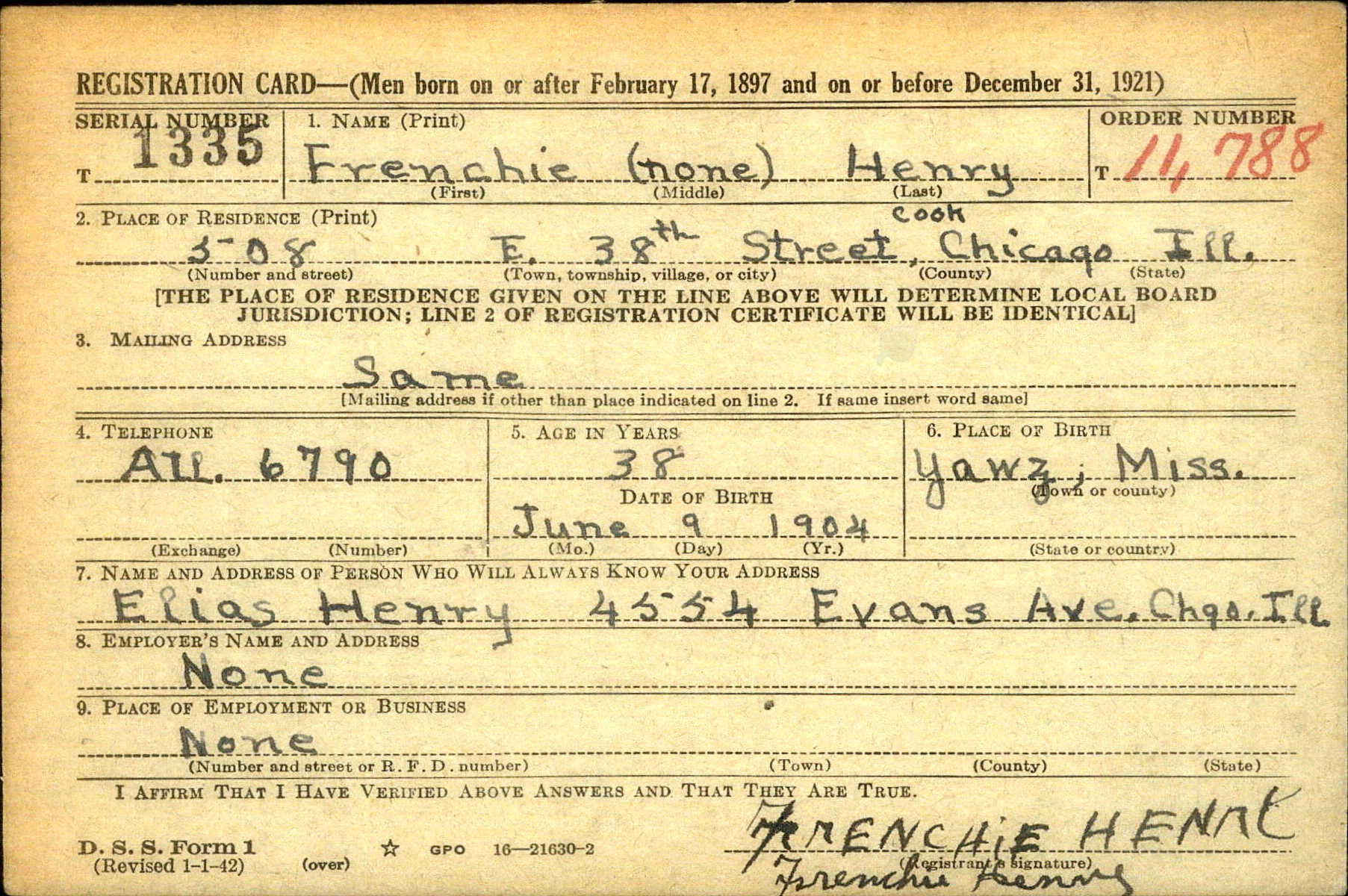
Frenchie Henry’s World War II draft card.

Before any more time passed since my previous post about the 100th anniversary of the lynching of African-American baseball team owner Fred Goree by two law-enforcement officers on Aug. 1, 1925, in St. Louis County, Missouri, I wanted to return to the subject, as promised.

One of the subjects surrounding the Goree tragedy on which I wanted to explore is the other people involved in the story. Revolving around the two main actors – Goree himself and the man who primarily committed the murder, St. Louis County deputy constable Clarence Bennett – was a small cast of side characters.

At the top of that cast list is Frenchie (or Frenchy) Henry, who was accompanying Goree in the latter’s new Buick when Goree was pulled over for very specious “official” reasons (but more likely for “DWB,” or Driving While Black), which led to his murder.

Because Goree was driving to a game scheduled near St. Louis for the baseball team he owned (likely the Chicago Independents), it’s been assumed that Frenchie Henry was a player on the Independents, but I haven’t been able to confirm that. (That inability to nail down Henry as a player is largely the result of the lack of clarity or dearth of information about the Chicago Independents team itself, a topic I explored in my previous post.)

So who was Frenchie Henry? His story begins in the Deep South town of Yazoo City, Miss., where he was born in June 1906 (some sources say 1904) to parents Anderson and Mollie (or Mary) (nee Grant) Henry. At different times, Anderson worked as a farm laborer or a carpenter.

Pre-Civil War Census slave schedules show several slaveholders with the last name of Henry in Yazoo County; the white Henrys might have belonged to the same family, with a man named Dixon (or Dickson) Henry as a patriarch. It’s likely that Anderson Henry, or at least his parents, were owned by one of the slaveholding white Henrys.

An Anderson Henry appears in the 1870 Mississippi state census in Hinds County, which is adjacent to Yazoo County, although if that was our Anderson Henry, he would have been around just 15 years old. Mary Grant is listed in Yazoo County in the 1880 U.S. Census. 

While Anderson Henry and his family lived in Yazoo County for maybe a couple decades, they at some point moved, with young Frenchie in tow, to Montgomery County, Mississippi, eventually settling in the county seat of Winona, which at the time was about half the size of Yazoo City, population-wise. (In 1920, Yazoo City had about 5,200 people.) Frenchie was one of a whopping 17 siblings, 11 of them apparently older than him, and five younger.

Also living in Yazoo City at the time was the Moore family, which included Cora Lee, Frenchie Henry’s future wife, who was born around 1907 to Edward and Maggie (nee Tillman) Moore. Edward worked as a brick mason. Given that Yazoo City was a relatively small town/city at the time, it seems likely that Frenchie and Cora knew each other as kids.

Downtown Yazoo City today.

Like the Henrys, the Moores had left Yazoo City by the time of the 1920 Census, which has them listed in the Mississippi Delta city of Clarksdale in Coahoma County. Clarksdale was arguably the locus of early blues history, lore and tradition, including, just outside of town, the intersection of Highways 61 and 49, where Robert Johnson allegedly sold his soul to the devil in exchange for musical genius. (A few years ago I did an interview with author Michael Lortz about his book, “Curveball at the Crossroads,” which tells a variation of the Johnson crossroads legend.)

Sometime between 1920 and 1930 – likely before 1925, when the Goree tragedy took place –  Frenchie (and, apparently, one or more of his siblings) joined the Great Migration and moved to Chicago, where he likely met Fred Goree and began playing on Goree’s baseball team(s). It was in this decade that Cora Moore headed north to the Windy City as well.

I wasn’t able to find Frenchie taking part in any more baseball activity beyond Goree’s Chicago Independents, unfortunately. As far as what he did for employment, I’m also not really sure. According to media coverage from the Goree murder, Henry worked at that time as a car washer for the Pullman train company. His World War II draft card, which was signed Feb. 16, 1942, states that he was unemployed at the time, while the 1940 Census, when he was still living in Chicago, lists him as a “cement worker.”

Now, what precisely happened to Frenchie and Cora Henry in the 1920s and ’30s is, well, unclear. Like I stated earlier, I wasn’t able to find any definitive, or even circumstantial, evidence that Frenchie was involved in baseball besides being with a team owner at the time that said owner died. (Also remember that I haven’t found any further concrete evidence – besides the coverage of his murder – of Goree’s involvement in the sport, and I’ve likewise found only scant mentions of any team called the Chicago Independents or some variation of that name. I detailed those media references in my previous post.)

However, regarding Frenchie’s personal and/or non-baseball activities during that nearly two-decade span, there does appear to be a fascinating, and maybe even unseemly, possibility.

The 1930 Federal Census seems to have no listing for Cora and Frenchie living together in Chicago. However, it does list a Cora L. Henry, born in Mississippi in roughly 1907, residing by herself in Chicago at a boarding house on Bowen Avenue. She’s listed as married and working as a houseworker for a private family.

So I think it’s safe to say that that is indeed Cora Lee Henry. But what about Frenchie? Where was he? In another example of a recurring theme here, I found no Frenchie (or Frenchy or French) Henry in Chicago in the 1930 Census.

But … I did turn up one Frank Henry listed as a 23-year-old (so born in about 1907) African American from Mississippi. Given that Frenchie is a somewhat common nickname for Frank (or, less regularly, vice versa), this could very well be our friend, Frenchie Henry.

But then why is he listed separately from Cora Lee?

Because Frank Henry was living in the Cook County House of Correction.

That’s right: Frenchie might have been incarcerated.

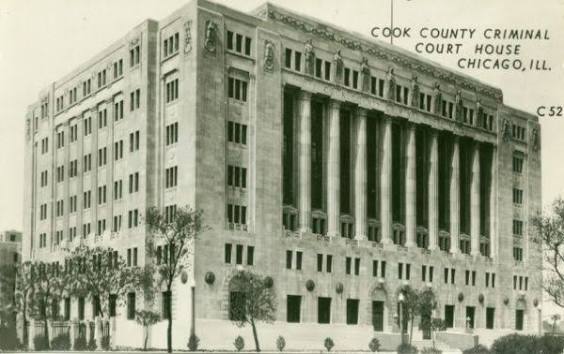
Cook County Jail, circa 1920s.

On the other hand, though, I’ve come across no articles or other documents that call him Frank, so maybe the jailbird Frank Henry isn’t, in fact, Frenchie. (But just as an aside, there was a Frank Henry in Chicago at the same time who, let’s just say, ran afoul of the law once and again. He worked as an undertaker with several funeral parlors and allegedly stole some money from the Elks Club. He then was accused of embezzlement from a funeral home, but the case was eventually thrown out. Whether or not this Frank Henry was the one in Cook County jail, I’m not sure conclusively. However, I’m reasonably sure that the undertaker Frank Henry was not, in fact, our ol’ Frenchie.)

Regardless of the status of their relationship in 1930 – or Frenchie’s legal situation – Frenchie and Cora had their first child, daughter Pauline, in 1932, followed by four more children, all daughters – Dorothy, Cora Lee, Yvonne and Betty.

By 1940, Frenchie and Cora were back together and living on St. Lawrence Avenue in the Windy City, and by the time Frenchie Henry registered for the World War II draft in February 1942, he was living at 508 E. 38th St. His older brother, Elias Henry – and not, notably, Cora, his wife – was listed as the person who would always know Frenchie’s address.

That curiosity might make the fact that the 1950 federal Census denotes only Cora with their five daughters, and Cora’s marital status is listed as separated and living on Chicago’s 38th Street – seemingly right next door to where Frenchie was living in 1942. I couldn’t find Frenchie in the 1950 U.S. Census, unfortunately. 

But there’s something else strange, however. The 1940 Census seemingly lists Cora Lee and her daughters twice in different locations in Chicago. In addition to the one I already mentioned, Cora and the girls – and, notably, not Frenchie – are placed living on St. Lawrence Avenue, just a block down from where the 1940 Census also lists the whole family, including Frenchie. 

All these different but strangely similar addresses seemingly cloud the picture of Frenchie Henry’s time in Chicago, and we can add that to the already substantial list of other mysteries, like how Frenchie connected with Fred Goree; what Frenchie did for a living; and if he played any further baseball besides Goree’s Independents.

The elder Cora Lee Henry died in September 1984, after serving many years as a community rights activist, according to an obituary article in the Oct. 2, 1984, Chicago Defender. Her community efforts included working with the Ida B. Wells tenant organization, the Parent-Teacher Association and the Maryland Avenue Baptist Church, the last of which she did missionary work for, according to the article. The story also noted that she was a graduate of Wendell Phillips High School, Chicago’s first major high school for African-American students.

(Interestingly, the Defender piece noted that Cora moved to Chicago when she was 8, which would have made it around 1915, but the 1920 Census lists Cora still living with her family in Clarksdale, Miss.)

Chicago Defender, Feb. 1, 1977

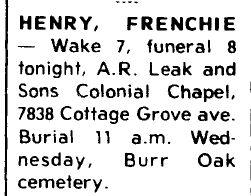
But what happened to Frenchie Henry himself? I couldn’t find much info at all about the latter years of his life, just that he died on Jan. 28, 1977, more than seven years before his wife. Unlike Cora Lee, Frenchie didn’t get much of a sendoff when he passed, just a standard, eight-line, block obituary in the Feb. 1, 1977, issue of the Defender.

He was buried in Alsip, IllinoisBurr Oak Cemetery, a somewhat famous burial ground that includes the graves of dozens of African-American athletes, musicians, artists, politicians and other famous figures, including a bunch of Negro Leaguers, some of whose graves received markers through the Negro League Baseball Grave Marker Project.

Several of Frenchie’s siblings joined him in Chicago at varying points. As stated, Elias Henry, who was a few years older than Frenchie, moved to the Windy City and apparently remained close with his little bro. Elias worked at Carnegie Illinois Steel, located in Joliet, Ill., at one point, and he also was employed as a laborer at what a Census taker called a “food manufacturer.” Elias lived in Chicago with his wife, Roberta, for most of his life, but he died in Detroit, Mich., in 1974 at age 72.

Another older brother, James, spent the majority of his life in Mississippi (including a stint in Bolivar County, Miss.) with his wife, Mattie, but he died in Chicago in 1964 at 60 years old. Frenchie’s oldest sibling – and the first of Anderson and Mary’s children – Elizabeth married the Georgia-born Frank Harris and lived, like James Henry, for a while in Bolivar County before the couple moved to Chicago before 1930. Elizabeth died in the Windy City in 1957 at the age of 71. In addition, Alberta Henry got married (I’m not sure to whom) and divorced and lived in Winona before moving to Chicago, where she died in 1979 at 81.

A poet, his father and Black baseball

“The Negro league’s like a light somewhere. Back over your shoulder. As you go away. A warmth still, connected to laughter and self-love. The collective black aura that can only be duplicated with black conversation or music.”

— Imamu Amiri Baraka, in his autobiography

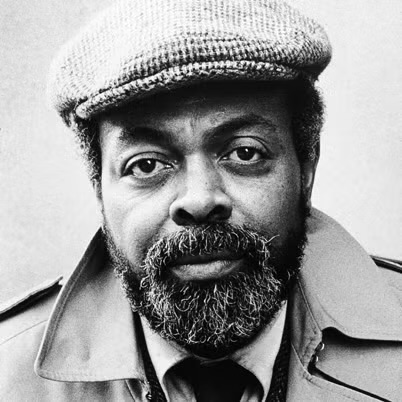
Imamu Amiri Baraka

Here’s another quick placeholder post based on random databases that caught my eye while I work on longer projects. This one is about Imamu Amiri Baraka, an influential and often controversial poet, author, thinker and cultural commentator, often dubbed the poet laureate of the Black Arts Movement and a key figure in the overall Black Power Movement.

The database in question is Baraka’s career and personal papers. I first learned about Baraka more than 20 years ago during my time in grad school at Indiana University when I was working on what I had hoped would be a dual master’s in journalism and African-American Studies. (That never came to be, sadly. The School of Journalism was recalcitrant the entire way and in effect blocked me from finishing the AAS half of my degree. And actually, if there’s anyone who knows a relatively simple, low-cost way of finishing my AAS master’s, please let me know!) My professors Fred McElroy (RIP), John McCluskey and Portia Maultsby were keys to my education about Baraka.

The papers in the online archive include interviews with Baraka and other people close to him and involved in the Black Arts Movement and Black Power Movement. One such Q&A was conducted in January 1986 by Komozi Woodard, a prolific author who’s currently a history professor at Sarah Lawrence College.

At one point in the interview, Baraka discusses his childhood watching Newark Eagles games and seeing the players in person.

(Editor’s note: I’m quoting these interviews more or less verbatim from the digital versions that exist in the Baraka papers. The text is probably from a direct transcription, so the grammar isn’t great and many of the names and places aren’t included or are spelled incorrectly.)

Here’s one excerpt:

BARAKA: … [W]hen there was black baseball before integration killed black baseball and our players began to play with those other folks, Newark was the world champions, the last year of the black baseball league Newark Eagles were the world champions.* Down at [left blank, but presumably Ruppert] Stadium, the bloods took the seats, these cushions they were sitting on and threw them all out in the field. But it was a hotel called the Grand Hotel on Market Street, a black owned hotel on West Market Street; right there now where they are going to build the vocational school, right across from there right in the Grand Hotel where all the baseball players and the fast light people used to hang out. My father used to take me there because we used to go see black baseball every Sunday. Whenever the Eagles were in town we would go down there. And afterwards they would go up there and have a little drink and he would walk me around. This is Monty Irving [sic] this is Larry Doby, Pat Patterson and I got to meet all those …” **

(*The Eagles actually won the title in 1946, two seasons before the second Negro National League’s demise in ’48.)

(**Baraka expanded on these thoughts in his autobiography. For more info on that, see the end of this post.)

Ruppert Stadium

The database’s files also feature an interview conducted by Woodard of Honey Ward, a friend of Baraka’s and an influential Black rights and urban-renewal advocate in his own right. Ward was born in Key West, Fla., but he and his family moved to Newark when he was 2. Here’s an excerpt of that interview:

KOMOZI: Were there a lot of black sports institutions in Newark at that time?

HONEY: Well you had your oldtimers, you had baseball like the Homestead Grays and the Newark Eagles and you had the Kansas City Monarchs that Satcho [sic] Paige came out. Marvin Irwin [sic] played with the Newark Eagles. Larry Doby came out of a black team. Jackie Robinson even played in the black league. The New York Black Yankees and down in [Ruppert] Stadium which is torn down which was owned by the Newark Bears [a longtime white minor-league team] … . My father would take us down on Sundays to see, Ray Dandridge’s father [?] they were baseball players. I remember seeing Satcho Paige playing down there on Sundays, it was all black.

KOMOZI: Were there a lot of people down there?

HONEY: Yeah, the blacks would go down there and watch black baseball because at that time baseball was jim crowed too. Blacks were [not] allowed to play in the majors, the white majors.

Baraka’s papers included references to other authors’ works that themselves mention Black baseball. In notes on Robert C. Weaver’s 1948 book, “The Negro Ghetto,” Baraka lays out this direct quote from Weaver’s book:

“Newark’s deterioration dates from the 1930s, at a time when there was often-repeated praise for the fine department stores, the great insurance companies, the excellent schools, the cleanliness of Broad Street, the influence of its newspapers, and even the vaunted abilities of the Newark Bears, the finest minor league team that baseball had ever seen. [The] [I]nept, politic-ridden [sic] government did little to stem the tide of decline after World War II.”

The database documents also include brief references to baseball in general as a potential source of political activism and focus of efforts toward racial and social justice. Particularly, Baraka’s commitment to communism and Marxism appears to have led him to write his own work as well as examine and cite the texts of other communists in America. And, quite naturally, baseball inevitably, if briefly or tangentially, intersects with such topics. (For example, one of the most passionate and forceful advocates of integration in major league baseball was Lester Rodney, the sports editor of the communist newspaper The Daily Worker, who played a key but somewhat unsung role in the successful entrance of African Americans into Organized Baseball.)

Thus, it’s not surprising that Baraka’s papers, for example, feature a copy of a 1933 essay, “The Struggle for the Leninist Position on the Negro Question in the U.S.A.,” by Harry Haywood, a lifelong, staunch Stalinist/Maoist thinker, writer and activist.

In the essay, Haywood outlines, point by point, the communist platform as a means toward racial and social equality and justice, and one of the points involves sports and athletics, including baseball. In the essay, Haywood wrote that communists demand:

“The right of Negro athletes to participate in all athletic games with white athletes, including rowing, swimming, inter-collegiate basketball, football, major league baseball, etc.; against Jim-Crow policies of the AAU in swimming pools, etc.”

Harry Haywood

Also found in the Baraka archives are issues of “Main Trend,” a publication of Baraka’s Student Organization for Black Unity (SOBU) and Youth Organization for Black Unity (YOBU) from 1978-81. One of the editions features an article titled, “Baseball Belongs to the People,” which goes through the history of the national pastime – from its professionalization and early attempts at players’ unions in the 19th century, through the reserve clause, commercialization of the sport, segregation and desegregation, and the advent of free agency.

Overall, the article heavily criticizes the team owners and other powers-that-be – the piece dubs them “the capitalists” – in the sport for exploiting both the players and the fans to maximize profit and enrich the owners’ own coffers.

“The history of professional baseball cannot be separated from the history of capitalist exploitation in the U.S.,” the article stated.

However, the article also stresses that for as long as capitalists have allegedly tried their damnedest to treat baseball as their own personal piggy bank, “the people” – the players and fans – have been resisting and fighting for their rights and their share of the proverbial baseball pie. It concludes:

“So long as there is exploitation in baseball there is resistance to exploitation. And it is up to us to support this resistance. Us – be people who invented baseball and who fill the rosters of every team in the major leagues. Us – the most exploited and most revolutionary class in capitalist society.

Baseball belongs to the people!” [italics in original].

As part of its analysis and repudiation of extreme, unjust capitalism in the national pastime, the article notes that during the late 19th century and into the 20th, as the owners were tightening their grip on the game, “[I]t was during this period that racism ‘triumphed’ [quotes in original] in professional baseball, as the owners refused to hire black players, condemning them to the Negro Leagues until Jackie Robinson broke the color barrier in 1947.”

The piece also refers to the court fight of Curt Flood, a Black player who unsuccessfully challenged the major leagues’ stifling reserve clause. It also asserts that “racism is still rampant, despite all the black and Spanish players,” citing lingering pay inequality and the hostility Reggie Jackson received at the time for supposedly getting notorious Yankees manager Billy Martin fired.

**Now, back to Baraka discussing the influence the Negro Leagues had on him and on the African-American community as a whole in, “The Autobiography of LeRoi Jones/Amiri Baraka,” originally published in 1984. (LeRoi Jones was his original name.)

In the book, Baraka further recalls his experiences with his father at Newark Eagles games, and explains why the team, and Black baseball in general, had so much impact on him and the Black public.

“Very little in my life was as heightened (in anticipation and reward) for me as that,” he stated. “What was that? Some black men playing baseball? No, but beyond that, so deep in fact it carried and carries memories and even a politics with it that still makes me shudder.

“But coming down through that would heighten my sense because I could dig I would soon be standing in that line to get in, with my old man. But lines of all black people! Dressed up like they would for going to the game, in those bright lost summers. Full of noise and identification slapped greetings over and around folks. ’Cause after all in that town of 300,000 that 20 to 30 percent of the population (then) had a high recognition rate for each other. They worked together, lived in the same neighborhoods, went to church (if they did) together, and all the rest of it, even played together.

“The Newark Eagles would have your heart there on the field, from what they was doing. From how they looked. But these were professional ball players. Legitimate black heroes. And we were intimate with them in a way and they were extensions of all of us, there, in a way that the Yankees and Dodgers and what not could never be!

“We knew that they were us – raised up to another, higher degree. Shit, and the Eagles, people knew, talked to before and after the game. …

Leon Day

“That was the year they had Doby and Irvin and [Lennie] Pearson and [Bob] Harvey and Pat Patterson, a schoolteacher, on third base, and Leon Day was the star pitcher, and he showed out opening day! But coming into that stadium those Sunday afternoons carried a sweetness with it. The hot dogs and root beers! (They have never tasted that good again.) A little big-eyed boy holding his father’s hand.

“There was a sense of completion in all that. The black men (and the women) sitting there all participated in those games at a much higher level than anything else I knew. In the sense that they were not excluded from either identification with or knowledge of what the Eagles did and were. It was like we all communicated with each other and possessed ourselves at a more human level than was usually possible out in cold whitey land.

“Coming in that stadium with dudes and ladies calling out, ‘Hey, Roy, boy he look just like you.’ Or: ‘You look just like your father.’ Besides that note and attention, the Eagles there were something we possessed. It was not us as George Washington Carver or Marian Anderson, some figment of white people’s lack of imagination, it was us as we wanted to be and how we wanted to be seen being looked at by ourselves in some kind of loud communion.”

Baraka further describes the Eagles, the Negro Leagues and the Black community a fair amount, but I’ll close with his thoughts about Jackie Robinson and integration overall. He was conflicted, to say the least:

“But you know, they can slip in on you another way, Bro. Sell you some hand magic, or not sell you, but sell somebody somewhere some. And you be standin’ there and all of a sudden you hear about – what? – Jeckie Rawbeanson. I could tell right away, really, that the dude in the hood had been at work. No, really, it was like I heard the wheels and metal wires in his voice, the imperfected humanoid, his first words ‘Moy nayhme is Jeckie Rawbeanson.’ Some Ray Bradbury shit they had mashed on us. I knew it. A skin-covered humanoid to bust up our shit.

“I don’t want to get political and talk bad about ‘integration.’ Like what a straight-out trick it was. To rip off what you had in the name of what you ain’t never gonna get. So the destruction of the Negro National League. The destruction of the Eagles, Greys [sic], Black Yankees, Elite Giants, Cuban Stars, Clowns, Monarchs, Black Barons, to what must we attribute that? We’re going to the big leagues. Is that what the cry was on those Afric’ shores when the European capitalists and African feudal lords got together and palmed our future. ‘WE’RE GOING TO THE BIG LEAGUES!’

“So out of the California laboratories of USC, a synthetic colored guy was imperfected and soon we would be trooping back into the holy see of racist approbation. [Robinson actually attended UCLA, not USC.] So that we could sit next to drunken racists by and by. And watch our heroes put down by slimy cocksuckers who are so stupid they would uphold Henry and his Ford and be put in chains by both while helping to tighten ours.

“Can you dig that red-faced backwardness that would question whether Satchel Paige could pitch in the same league with … who?

“For many, the Dodgers could take out some of the sting and for those who thought it really meant we was getting in America. (But that cooled out. A definition of pathology in blackface would be exactly that, someone, some Nigra, who thunk they was in this! Owow!) But the scarecrow J. R. for all his ersatz ‘blackness’ could represent the shadow world of the Negro integrating into America. A farce. But many of us fell for that and felt for him, really. Even though a lot of us knew the wholly artificial disconnected thing that Jackie Robinson was. Still when the backward Crackers would drop black cats on the field or idiots like Dixie Walker (who wouldn’t even a made the team if Josh Gibson or Buck Leonard was on the scene) would mumble some of his unpatented Ku Klux dumbness, we got uptight, for us, not just for J. R.”

What do you think of Baraka’s controversial take on Jackie Robinson and integration?

The FBI’s paranoid history even includes a national hero

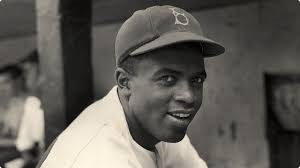
Jackie

I looked through the list of the databases available to me for a quick post while I continue to work on some bigger projects, and the one featuring the FBI’s declassified files and documents from the agency’s decades-long surveillance of the Civil Rights Movement caught my eye.

It’s pretty well known that the longtime and infamous FBI Director J. Edgar Hoover – everybody’s pal, my friend and yours – and his agents kinda had it in for everyone from Dr. Martin Luther King Jr. to Malcolm X to Ralph Abernathy to Huey Newton.

One of the central foci of the chillingly omniscient was the supposed “communist infiltration” of the Civil Rights Movement, including Dr. King’s Southern Christian Leadership Conference, or SCLC, as well as the reactionary, bigoted pushback – like the countless bombings and bomb threats – from white segregationists.

So, on a lark, I decided to search through these declassified files to see which famous sporting figures might happen to pop up. I especially looked for Jackie Robinson in them, given his participation in and support of the Civil Rights Movement.

And, wouldn’t you know it, his name does, in fact, pop up a few times in the FBI’s surveillance files.

Now, he doesn’t appear too often, indicating that he seemingly wasn’t a primary focus of the surveillance, but he is in there, unfortunately.

Many of these instances center around his appearances at official SCLC meetings or conventions, including the organization’s 1962 annual national meeting, held that year in Birmingham, Ala., from Sept. 25-28.

In the days leading up to the convention, one confidential FBI communication indicated that Robinson was scheduled to be one of the speakers, along with leading Civil Rights lights Fred Shuttlesworth and Adam Clayton Powell. The surveillance team also stated that their were no demonstrations scheduled by the organizers of the meeting.

Communications after the conclusion of the convention reported that no violence of major incidents occurred during the gathering, and that everything proceeded peacefully. In one memo, an agent described Robinson’s appearance as a speaker: “Jackie Robinson spoke at SCLC banquet night of [Sept. 25] and indicated he wanted President Kennedy to take action in Civil Rights.”

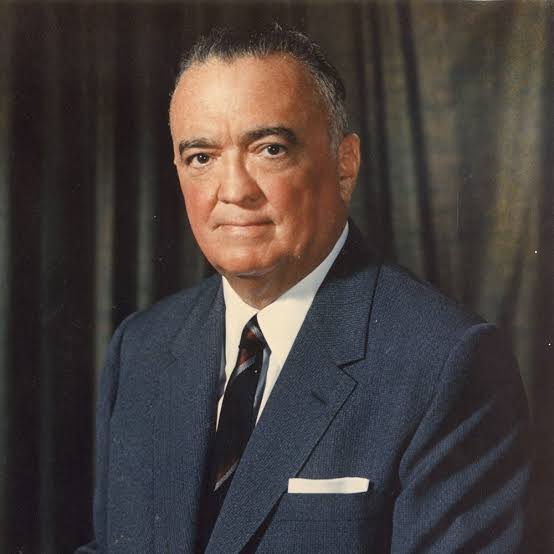
J. Edgar Hoover

However, an ensuing document reporting on the gathering including much of Jackie’s speech verbatim – it covers roughly two full pages of single-line text, seemingly indicating that the agents focused extra attention on the former baseball great.

In his speech, Robinson urged attendees to support and donate to the effort to rebuild several Black churches that had recently been burned down by segregationists.

“It has been tough for me not to hit back [on news of the burnings],” Jackie said. “Anyone who would burn a church is the lowest type of individual in the world. They must be stopped for America’s sake. …

“My mother told me a long time ago not to go South,” he added. “I kept her advice for a long time. I don’t believe I could turn the other cheek down here. At least that was the way I felt when I saw those burned churches in Sasser, Georgia. … This is all of our fight.”

Those last comments are particularly interesting given that, when he debuted with the Brooklyn Dodgers and throughout his on-field career, he did, in fact, figuratively turn the other cheek while enduring horrific abuse from fans and other players, because he knew that he simply had to do so if he was to succeed, both as a player and a sociocultural trailblazer and bellwether.

Jackie then urged President Kennedy to actively join the fight for justice: “I am not interested in the President’s talk, what we need is action.”

He added that “[T]hey should not worry so much about sending the Peace Corps to Africa, they should send it to Birmingham, Alabama and Mississippi. There are many backward people here. I don’t believe we will continue to permit these people to deny us our privileges and opportunities.”

He expressed his support for the Freedom Riders and obliquely criticized Bull Conner. Robinson concluded his speech:

“Even though I have lost many awards because of my stand, I have not lost my self respect. They tell me that Birmingham is the worst city in the United States. I was born in Georgia but I got away quick. I have seen the love and admiration people have for Dr. King in New York. They have asked him many questions, but have not been able to twist him up. I am sorry we can’t participate more.”

The declassified archive of FBI surveillance documents also included brief references to Jackie in its reportage on the 1964 SCLC Convention, held from Sept. 26-Oct. 2 of that year in Savannah, Ga. The interdepartmental memorandums stressed that organizers of the SCLC gathering had received bomb threats warning of attacks on the convention. However, the agents later reported that the meeting proceeded without incident.

The references to Robinson in the documents were brief and included a notation that a story that had just appeared in the Savannah Morning News; the memo reported that the article had stated that Robinson had criticized Adam Clayton Powell for not being active enough in the Civil Rights fight, to the detriment of the Movement.

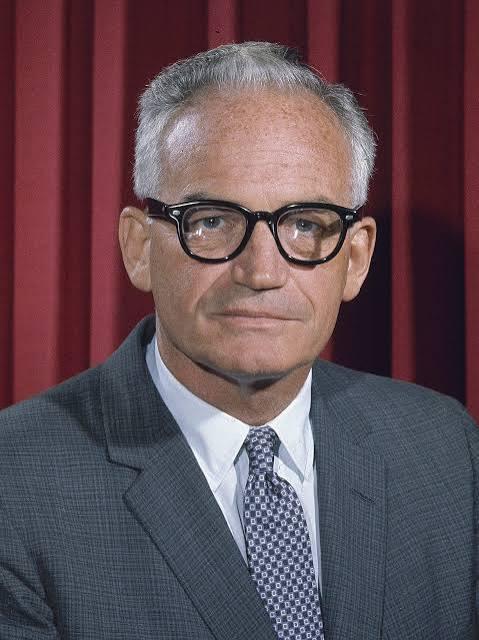
Barry Goldwater

The surveillance reportage also stated that news coverage of Jackie’s speech at the 1964 convention had sharply condemned Republican presidential candidate Barry Goldwater and that he had “implored the nation’s Negroes to defeat” the GOP candidate. Such statements are key, given the fact that Jackie had previously supported Republican positions and candidates, including Richard Nixon in the 1960 presidential election.

Many of the other references to Robinson in the FBI files centered somewhat around his conflicts with and criticisms by leaders of the Nation of Islam, the Black Muslim organization popularized most prominently by Malcolm X.

Jackie and the Nation did not, shall we say, get along. The former, as reflected in the FBI communications and memorandums, believed the latter was hateful against whites, and Robinson was staunchly opposed to the Nation’s militant advocacy of Black separatism and use of violence in the face of white violence.

For their part, Malcolm X and/or the Nation’s leader, Elijah Muhammad, frequently leveled criticisms toward Robinson, and the FBI’s agents were sure to note it. For example, the federal surveillance documents reported that, on March 9, 1964 – one day after he broke from the Nation of Islam – Malcolm appeared on a news show in New York City and was interviewed extensively by commentator Joe Durso, who at one point in the interview asked Malcolm what the Malcolm thought about Jackie Robinson calling the Muslim leader “a threat to integration.” Malcolm responded by referring to Robinson’s association with then-New York Governor Nelson Rockefeller, a Republican who later became vice president under Gerald Ford.

“Jackie Robinson has just become a part of Governor Rockefeller’s political machine,” Malcolm said, as quoted in the FBI report, “and it is his job to make Negroes think that Nelson Rockefeller is the Saviour [sic] who will lead us to the promised land of integration.”

And, reported FBI agents to their superiors, Elijah Muhammad stated on an October 1965 news program in Chicago that “such prominent [B]lack men Dr. Ralph Bunche, Jackie Robinson and the like only serve the white man and do nothing to better their [B]lack brothers.”

One of the battlegrounds, as it were, of this verbal conflict between Jackie and the Nation was the new media powerhouse that was television. Robinson occasionally appeared on TV news programs that featured a panel of guests discussing the Nation of Islam, Muhammad and Malcolm X, and when Jackie did make those appearances, he was included in the FBI’s surveillance reports. 

The declassified archives, for example, include an interdepartmental FBI memorandum describing the now-infamous five-part documentary series on WNTA-TV by broadcast news greats Mike Wallace and Louis Lomax that was broadcast for a week in July 19. The FBI report noted that Jackie Robinson took part in the discussion panel.

Called “The Hate That Hate Produced,” the series examined the burgeoning Black nationalist movements, with much of the focus on the Nation of Islam. (I haven’t seen the series, but from what I gather, it was biased, one-sided and purposefully sensationalistic and inflammatory.)

Malcolm X

Finally, the FBI files include a few articles/commentaries written by Robinson and published in various newspapers that were part of the back-and-forth between Jackie and Malcolm in the press. Malcolm X at the time was a lightning rod for controversy, and because of his radicalism, the FBI focused a massive amount of its surveillance on him.

Robinson’s published missives frequently came after Malcolm X had in the media recently vociferously criticized Jackie and other mainstream Civil Rights figures, including, for example, an interview Malcolm gave to reporters in May 1963, and the FBI was quick to note it in one of the agency’s voluminous reports on Malcolm’s words and activities.

In his comments to the journalists, Malcolm asserted that the majority of African Americans who took part in a recent protest in Birmingham rejected Dr. King’s message of non-violence, and the FBI memo noting the statements by reporting that “in the interview … subject had attacked Martin Luther King, Jackie Robinson and [boxing champion] Floyd Patterson as unwitting tools of white liberals.”

One ensuing piece by Robinson, published in the Dec. 14, 1963, issue of the Amsterdam News came in the form of an open letter to Malcolm in which Robinson defends his own record on Civil Rights and the social justice effort, and vociferously criticizes Malcolm’s militancy.

Other published commentaries by Robinson, however, quite significantly came after Malcolm’s March 1964 break with the Nation of Islam, his rejection of Black separatism and the softening of his criticism toward whites. One such column by Jackie, coming in early May 1964, continued to harshly criticize Malcolm, and it blamed prolific media coverage of Malcolm’s earlier, more militant activity and statements, as well as a lack of pushback from society as a whole, for the elevation of Malcolm to hero status.

Then, a July 1964 article published a couple more months later expressed Robinson’s confusion with Malcolm’s break from the Nation of Islam and rejection of hate and violence. In the piece, Jackie wondered where exactly Malcolm now stood on Civil Rights and challenged him to more concretely and decisively state what he now believed. Seven months later, Malcolm X was assassinated.

That’s all I could find in the online archives of the FBI’s declassified surveillance project that targeted Black leaders. But what I did find in the files about Jackie Robinson – who today is almost universally revered as a national hero and beloved by many millions of people in America and beyond – was a little chilling, but it also wasn’t exactly surprising.

The presence of Robinson’s name scattered through these archives perhaps reflects how disturbingly far-reaching and all-consuming that the racist, paranoia-driven federal surveillance effort was. As millions of Americans of all races, ethnic backgrounds, genders, ages, orientations and identities were fighting for social justice and egalitarianism, others were seeing “Reds” around every corner and afraid that society was completely collapsing because of it.

I won’t attempt to make parallels between the Hoover-fueled, half-century-long surveillance of Black Americans and the chaos and reactionary splitting at the seams currently engulfing our society and tearing us asunder.

But feel free to do so on your own, of course …

Home Plate Don’t Move will never be placed behind a paywall, but we certainly welcome donations to the effort. To give to Home Plate Don’t Move and its staff — well, me, the staff is me — go here if you’d want. Thanks, and continued thanks for reading!

Tragedy, nomadic life in the Albritton family

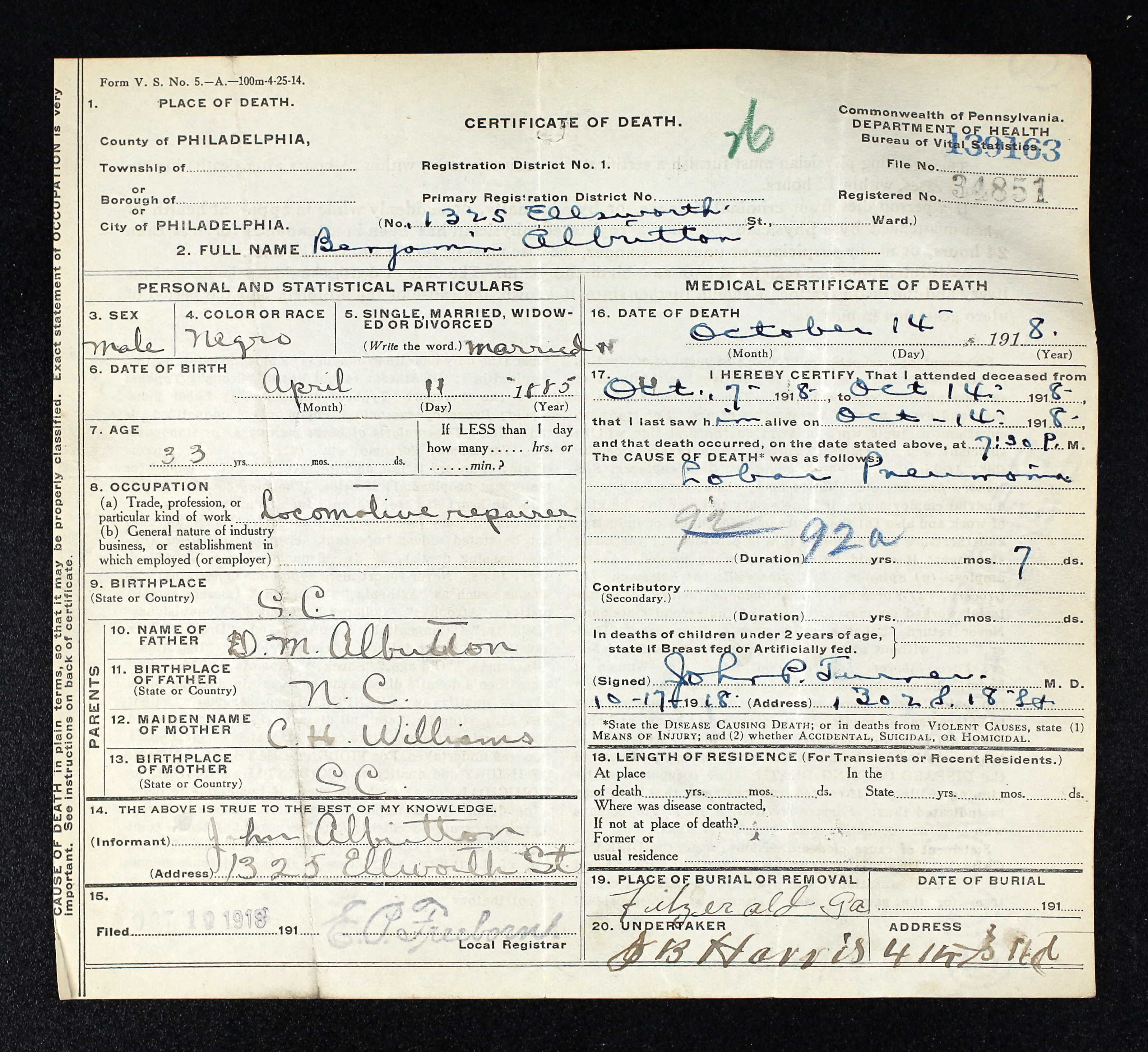
Benjamin Albritton’s Pennsylvania death certificate.

Well, I’ve done it once again. I’ve gone down a research rabbit hole and am trying to climb my way back out by writing and posting a couple more pieces about Alex Albritton that are hopefully not ridiculously long. (Past ones are here, here and here.)

As of late, i.e. the last week or two, the particular rabbit hole down which I’ve plummeted has been investigating Albritton’s family, including his ancestral roots and where he came from. However, the idea for this post originally germinated when I happened to notice that a black cloud seemed to follow the family.

As in, several of Alexander’s relatives also either died tragically young, or were involved in some pretty grim stuff.

Let’s begin with Alex’s older brother, Benjamin Davis Albritton, who was born in South Carolina but made his way to Philadelphia after several years in Georgia with the rest of the family. In Philly, Benjamin worked as a locomotive repairer for a railroad company, which is one of the coolest jobs I’ve come across in all my Negro League research.

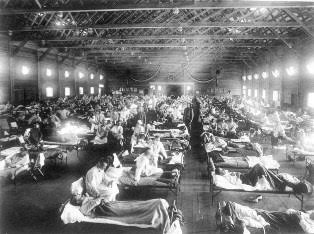
But Benjamin’s life was also short – he died on Oct. 14, 1918, at the age of 33. His death certificate lists cause of death as lobar pneumonia, a severe type of lung infection. However, the deadly Spanish flu pandemic at the end of the 1910s was in full force by October 1918, and, given that many of the deaths in the pandemic actually resulted from a secondary infection of lobar pneumonia, Benjamin Albritton was very likely a victim of the Spanish flu pandemic.

A Spanish flu hospital ward during the height of the pandemic.

Another of Alexander Albritton’s sons, Ralph – in fact, his first-born child – was at an even younger age at death than Benjamin was – Ralph was only 19 on May 10, 1935, when he was struck down by percardial effusion, or a build up of fluid in the pericardium, the sac around the heart. Ralph worked as a bricklayer at the time, according to his death certificate. I don’t have much more information about Ralph or his death.

Then there’s the case of Alex Albritton’s namesake, Alexander J. Albritton, who died at the fairly young age of 46 on Dec. 9, 1963. While that death age isn’t as saddening as 19 or 33, it’s the flippant way in which the Philadelphia medical examiner at the time filled out Alex Jr.’s death certificate. In particular, cause of death was limited to “not determined,” and manner of death stated as “presumably natural.” The coroner also couldn’t be bothered to find of Alexander Jr.s Social Security number, which simply a question mark filling in that space.

Next was John Clarke Jr., Alexander Albritton’s grandson; he was the son of Alex’s daughter Ruth Albritton and her husband, John Clarke Sr. John Jr. was only 16 in early December 1960, when he was stabbed in the heart with a penknife by 18-year-old Luther Dockery during a brawl reportedly instigated by Dockery. At the time, John Jr. was a sophomore at Edward W. Bok Technical High School, a vocational school in Philadelphia.

(It might be worth noting that Luther Dockery apparently liked stabbing people, because roughly two years before he killed John Clarke Jr., he stabbed another young man, this time in a gang fight, and was given probation.)

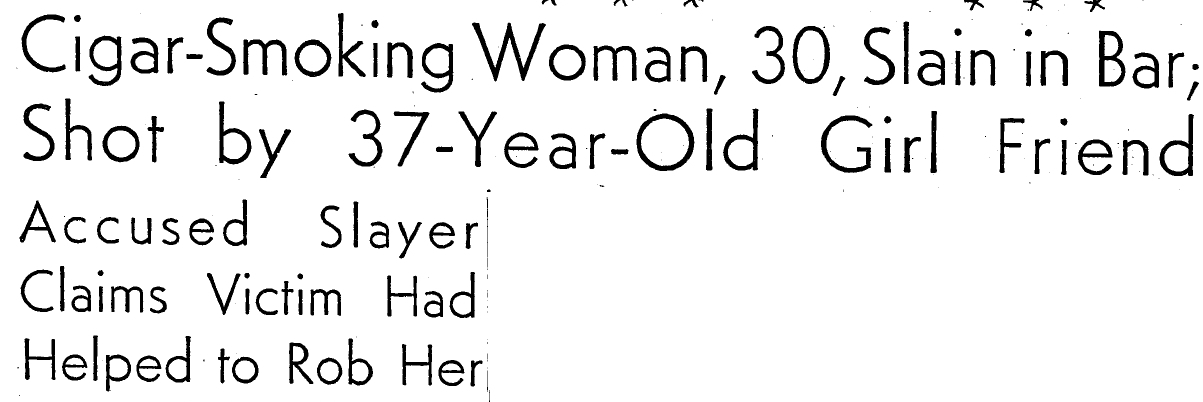
But members of the Albritton family weren’t just victims of tragedies – they sometinmes were the perpetrators, beginning with Frances Albritton, another of Alex Albritton’s children. In September 1966, 37-year-old Frances stormed into Herb’s Friendly Bar in the Glenwood section of Philadelphia and fatally shot Rita Widner (or Wynder) in the chest, then wounded Widner’s husband and a bystander.

The women reportedly had an earlier altercation that resulted in Frances, reportedly nicknamed Goldie, holding a significantly angry grudge against Widner. Roughly three months after the shooting, a jury convicted Frances of the killing. I was unable to find out any further information about what happened to Frances following the murder and conviction.

But 28 years before Frances committed her crime, her older brother (and therefore Alexander’s son) Joseph allegedly shot and killed Martin “Gutty” Supplee, who was apparently somewhat of a star on the local Philadelphia basketball scene.

The reason for the shooting seems to have been a little hazy and more than a bit unsavory; according to the Sept. 22, 1938, Philadelphia Tribune, Albritton had reportedly hit it big in a “numbers” drawing but was then assaulted and robbed by Supplee and Supplee’s friend, Matthew Fields, who were unhappy that Albritton wouldn’t split the winnings with them.

The alleged attack and thievery left Albritton hungry for revenge, so, after searching for his attackers for three hours, stated the Tribune, he walked into a tap-room bar where the alleged robbers were hanging out and shot Supplee in the head and wounded Fields with a shot to the leg. Albritton reportedly absconded after the shooting and couldn’t immediately be found.

Philadelphia Tribune, Sept. 27, 1966

But Fields, after going to the hospital for treatment to his shot leg, said he and Supplee didn’t assault or rob Albritton, while Supplee’s mother alleged that “Albritton thought he was bad – a gangster. He killed my husband for nothing.”

Unforttunately, I was unable to find out any further information from after the initial media coverage of Supplee’s murder, so I don’t know if, when or how Alexander Jr. was caught and what subsequently happened to him as a result of Supplee’s death.

With the subject of organized crime and numbers running, we actually circle back to Alex Albritton Jr., who also seems to have dabbled in similar illicit matters. In September 1950, Alexander Jr. was sentenced to six months in the county prison for gambling-related charges.

All of these incidents, early deaths and instances of violence combine to make one wonder if the Albritton family was cursed in some way, beginning, of course, with Alex Albritton Sr., a baseball star who ended up dying violently in a notorious psychiatric hospital. Having run through that depressing family tree, let’s take a little look at where the Albrittons came from and how they made their way to Philadelphia. 

We can begin with Alexander Albritton Sr.’s parents, D. Matthew Albritton and Charlotte H. Albritton (nee Williams). They’re listed in the 1880 Census as living in Charleston, S.C., but while Charlotte was apparently born in South Carolina, Matthew’s birth place is stated as North Carolina.

Given that Matthew was roughly 27 years old as of 1880, his approximate birth year of 1857 would have him, a person of color, likely born into slavery. I found several slaveholders with the last name of Albritton in Pitt County, N.C., in the 1860 Census.

Then, in the 1870 Census, I discovered a 17-year-old Black man living in Pitt County with a name that appears to be, at least on the Census sheet, Mort or Most Albritton, but could very well be Mat or Matt Albritton, living in the community of Pactolus in Pitt County.

The 1870 Census sheet that includes what might have been Matthew Albritton listed (near the top of the sheet).

Meanwhile, Charlotte Williams was living in Fairfield County, S.C., with her parents, John and Sylvia, and family after being born in roughly 1862. She apparently married D. Matthew Albritton in 1880; however, I don’t know how Matthew and Charlotte came to meet – or, perhaps more precisely, how Matthew ended up in South Carolina to marry Charlotte.

The couple were living in Charleston County, S.C., as of the 1880 federal Census, which listed no children for them at that time. But sometime between 1880 and the 1900 Census – the vast majority of the 1890 Census records were destroyed by fire in 1921 – Matthew and Charlotte moved to Irwin County, Ga. According to the 1900 records, the couple had four children, including 8-year-old Alexander, the youngest of the quartet. But while Alex’s three older siblings (John, Benjamin Davis and Edith) were born in South Carolina, Alexander himself was born in Florida – specifically, the town of Live Oak, Fla., in Suwannee County.

The family then shifted to Ben Hill County, also in Georgia; the 1910 Census also indicates that Matthew and Charlotte have three children with them, including the youngest, Alexander.

However, Matthew appears to have died between 1910 and 1920 – the ’20 Census has Charlotte living alone aside from one boarder in Ben Hill County, and her marital status is stated as widowed.

Meanwhile, Alexander in 1920 is by now living in Philadelphia, with his wife, Marie (nee Brooks), and their two sons, Ralph and Alexander Jr. The family is stated as living just a couple doors down on Ellsworth Street from Alex Sr.’s brother, John, and John’s wife, in what appears to actually be a largely Italian neighborhood. (What’s odd, though, is that while John’s last name is spellecdcorrectly, Alex is listed as Alek Albrim, for some weird reason.) After that, the Albrittons rermained in Philadelphia.

The one remaining primary to the Albritton family puzzle is Marie, Alexander Sr.’s eventual wife. According to multiple sources, Marie Brooks was born in March 1902 to John and Addie Brooks in Georgia; the family lived in Muscogee County before Marie struck out on her own and apparently rented a room in Dougherty County, Ga., in 1920.

She and Alex Sr. married in the mid-1910s, when Marie was still only roughly 15 and Alexander was 19. I’m not sure how Alexander and Marie met. From what I can ascertain, Alex and Marie’s first two kids, Ralph and Alexander Jr., were born in Georgia, before the family moved north, while the rest of their offspring – they had five additional children – were born in Pennsylvania. 

The 1940 Census sheet on which Marie and those last five kids lists Marie as widowed, meaning the document was filled out after Alex Sr.’s tragic death. Marie appears to have eventually moved to East Orange, N.J., at some point later, dying there in August 1975. 

The horror and tragedy of Byberry hospital

A great photo of Byberry in 2012 by Chandra Lampreich for an article on the “Hidden City” Web site about Philadelphia’s urban landscape.

This post was originally designed to be part of my previous one about the details of Alexander Albritton’s death and the blanks that still need to be filled in more than eight decades later. The idea was to segue from the grim specifics of the death of one patient at Philadelphia State Hospital, commonly known as Byberry hospital, into a discussion of the horrific conditions in general at Byberry and the myriad tragedies that took place there in its long, troubled history.

But the post just grew longer and longer, and potentially more tedious. Plus the stuff in this new post doesn’t directly involve Alexander, but instead subjects kind of tangential to him. So I decided to break this off into a sort of postlude or sidebar to the previous, main post about Albritton’s death.

**********

Warning: This post contains information and photos that might be disturbing to some readers.

In the larger view, Alexander Albritton’s tragic death served to underscore the fact that Philadelphia State Hospital, commonly known as Byberry, was rife with deplorable conditions that most likely led to Albritton’s death – and the deaths and suffering of countless others.

Albritton’s violent demise prompted a local military veterans leader to publically call on the four Black members of the state legislature from Philadelphia to demand an investigation into the conditions at Byberry.

The question soon became how, exactly, the conditions at the hospital were such that a single attendant was monitoring an entire ward; why the injuries that caused Albritton’s death went undiagnosed and untreated for two-plus days; and how and why Albritton ended up dead, sitting on a bunch, unnoticed?

Some of the most piercing criticism was leveled by Deputy Coroner Vincent Moranz, who told the Philadelphia Tribune that the “(t)his system is obviously undermanned and underpaid. If there were more attendants, it would not be necessary for one attendant to take such strenuous measures in handling persons like Albritton.”

Moranz added that Weinand was “the victim of a system which fails to provide proper supervision over its charges.” The Tribune also noted that Genevieve Davis, the supervising nurse general at the hospital, stated (it’s unclear exactly when and where she gave this testimony) that the facility only had three doctors and seven nurses caring for more than 1,000 patients.

The Pittsburgh Courier reported on a recent report stating that recently, Byberry had been seeing a death every week to 10 days, and it took only an astonishingly short time for another questionable, violent death to occur at the institution; less than an hour after Albritton was found dead, 61-year-old Francis Hughes succumbed to injuries suffered about a month earlier in a scuffle with Alfred Gilmore, 46, that took place roughly 24 hours after the latter was admitted to the hospital.

The tragic pattern continued seemingly ad infinitum throughout the hospital’s history, both before and after Albritton’s death, from the facility’s opening in 1911 and the closure of its last buildings and wards in 1990. In June 1938, the Philadelphia Inquirer published an investigation by reporter John McCullough, who toured both Byberry and Norristown State Hospital, another large psychiatric facility in Pennsylvania. In comparing the two hospitals, McCullough gave a largely positive review of Norristown, but leveled substantial criticism at Byberry, which he said featured such apathy and disregard toward patients by the staff, the facility seemed like it was in the diseased “dark ages” compared to Norristown.

About a month after the Inquirer’s article, the state legislature released its own, scathing study of Byberry, dubbed the Shapiro Report, which, another Inquirer article stated, “literally crawl[s] with ghastly detail of incompetence and mismanagement and their selfish perpetuation, coercive administration and medical irresponsibility, professional misconduct, and bland and persistent toleration of mistreatment and the lack of treatment of the 5400 helpless inmates.”

In particular, the report mercilessly ripped into hospital superitendent Wilbur Rickert, who was described as grossly incompetent and infuriatingly indifferent to the suffering of thousands of patients.

An editorial in the July 22, 1938, issue of the Inquirer did not pull any punches on that last count, asserting that Rickert had made a “disgraceful botch” of administration at the beleaguered facility.

From a 1946 report by the Pennsylvania Department of Welfare.

“The Legislative Committee minces no words about the superintendent’s unfitness,” the editorial stated, “and upon his shoulders it places full responsibility for conditions that are made up of inefficiency, cruelty, intrigue and barbarity reminiscent of the dark ages. It is an appalling line of soiled linen that the report stretches in public view. It is not pretty to look at, but it has to be seen if the full story of Byberry and its shame is to be comprehended.”

The report also strongly recommended that the state take over the administration of the hospital from the city, a move the Inquirer’s editorial page praised and raised hope for a radical rectification of the terrors at Byberry.

This firestorm came less than two years before Alex Albritton was fatally beaten within Byberry’s walls, and in the dozen or so years following the former baseball pitcher’s death, the continuous line of tragedies did not abate immediately after state takeover.

In January 1941, in fact, Time magazine published an article about Byberry, to report on the progress, and lack of further progress, under Woolley, the man who had been appointed by the state to “clean up” the nighmarish conditions at the facility.

The Time story largely painted Woolley in a favorable light, describing him as a beleaguered administrator hamstrung by paltry funding and a swelling patient population that had reached about 5,800 against a capacity of less than half that. Woolley stated that while some progress had been made, the conditions were still embarassingly dire.

“When I came here Byberry was a medieval pest house,” the magazine quoted him as saying. “It’s now the equal of an 18th-Century insane asylum. It’s a disgrace to any community or government which calls itself civilized.”

Nearly 80 years ago, in 1946, Life Magazine – at the time the country’s premier general-interest publication – ran a lengthy expose of the nation’s psychiatric wards and mental hospitals, including those in Pennsylvania. Referring to the facility by the nickname given to it by its patients – “The Dungeon” – reporter Albert Q. Maisel wrote that “[i]n Philadelphia the sovereign Commonwealth of Pennsylvania maintains a dilapidated, overcrowded, undermanned mental ‘hospital’ known as Byberry.”

In July 1988 – roughly two years before Byberry closed completely and for good – the Inquirer ran a comprehensive investigative package detailing all the social, cultural, economic and political factors that created the hospital’s horrors.

Included in the reporting was a necrology – a list, far from complete, of dozens of violent deaths and suicides ending in 1970. The distressing listing included 28 such incidents in the 11 years following Albritton’s death, culminating in February 1951, when four female patients were killed in a fire caused by arson on the part of other inmates. (Following the fatal fire, the hospital declared it would, in addition to investigating the blaze, examine 10 other recent deaths at the asylum.)

That section of the necrology included two male orderlies – one dishonorably discharged from the Navy, the other a former prizefighter dubbed “the Slugger of Byberry” – being convicted of the manslaughter of a patient; at least five suicides; and six patients whose bodies were discovered in various places after going missing from between two days to a month.

Byberry’s history did include occasional periods of improvement, thanks to developments like new building construction, other infrastructure projects, and the introduction of newer, more holistic and humane treatment practices. Some accounts reported that the situation improved gradually after state takeover. But dark stretches and horrific tragedies consistently continued to take place throught Byberry’s often macabre history. 

From the 1946 state report.

The Ancient History/Ancient Myths Facebook page includes a short essay on Byberry and pointedly states how the notorious hospital “didn’t just confine the mentally ill—it locked away the vulnerable, the unwanted, and the forgotten. Overcrowded, understaffed, and poorly managed, it became a dumping ground where basic human rights were routinely violated. Patients were often left unclothed, unfed, or shackled in filth.”

The essay summed up the hospital’s social significance and historical legacy, stating:

“Byberry wasn’t just a failure of mental health treatment—it was a mirror held up to a society that chose to look away. A place where suffering was hidden, silenced, and normalized. Its eventual closure in the 1990s came far too late for those who endured its cruelty. Today, the ruins of Byberry stand as a decaying reminder of how institutions, left unchecked, can become prisons of torment rather than places of healing.”

In the Inquirer’s article from 1988, writer William Ecenbarger eloquently described the lingering, seemintely infinite impact had on the City of Philadelphia, the Commonwealth of Pennsylvania, and the nation’s mental-health system:

“… It was opened in 1907 and operated much of the time on the theory that circumstances that would drive a sane person mad might drive a mad person into sanity.

“Byberry. Like the Holocaust, it is impossible to amend, impossible to accept. … Perhaps we should allow it to stand out there on Route 1 as a reminder that in a bureaucracy, there is no problem too big to be avoided; that the humans given responsibility for other humans cannot sit back and admire their intentions; that injustice always walks softly – and we must listen for it carefully.

“Byberry. It pulls you in and wrings you out like a rag. It’s a lake where all the world’s tears have flowed. The history of Byberry reads as though it were written by Dante, and then rewritten by Kafka with Poe looking over his shoulder. Byberry’s story is freighted with tragedy. All institutions fall short of the aspirations of those who create them, but seldom in the 20th century has this occurred with such devastating effect on its guiltless residents. There are a few heroes, and they’re not hard to spot. And like all true stories, this one has no end.”

The inside of Byberry years after its closing. Another shot by Lampreich for “Hidden City.”

**********

Let’s digress a little and look into who the other person in the scuffle that killed Albritton was.

Frank (sometimes stated Franklin) Lewis Wienand (some documents and articles say Weinand) was born on Jan. 26, 1913, in Gladwyne, Pa., in Montgomery County to Charles Wienand, an electrical engineer for a paper company, and Martha Wienand, nee Righter, a housewife. Frank was a third-generation German-American; his paternal grandparents immigrated to the United States from Deutschland, probably between 1881 and 1884. (Montgomery County is adjacent and located to the north and northeast of Philadelphia County.) I wasn’t able to find out much about Martha Righter Wienand, other than she died in 1973. (Charles died in 1944.)

The family – including Charles Sr., Martha, Frank and younger brothers Charles Jr. and William Lloyd – apparently shuttled back and forth between Montgomery County, Pa., and Philadelphia during Frank’s childhood. Frank was the oldest of the three boys.

By 1940, Frank was living in Bucks County, Pa., adjacent to Philadelphia County to the northwest, and commuting to work at Byberry Hospital. His wife, Mary Stella Wienand (nee Herner), was also an attendant at the hospital and was a second-generation Polish-American. However, it must be noted that there exists discrepancies between various documents about Frank Wienand’s adult life, not the least of which is the different spellings of his name. Most of the contemporaneous articles I’ve found spell it Weinand, while many official documents, as well as a large family tree on Ancestry.com, spell it Wienand. Some sources list it as Wienant and Weinard, too.

Frank Weinand’s birth certificate.

In Frank and Mary’s listing from the 1940 federal Census, dated April 9, 1940, two months after Albritton’s death, the couple is living in the Bucks County township of Middletown. However, on Frank Wienand’s World War II draft card, which is dated Oct. 16, 1940 – roughly eight months after the death at Frank’s hands of Alex Albritton – Frank reported that he lived in the borough of Langhorne, in Bucks County, and was still employed at Byberry.

After all the furor and, presumably, legal wrangling over Albritton’s death and the abhorrent conditions at Byberry – although criticism of the hospital would continue as long as it remained open, and even long after – Wienand seems to have had a relatively normal life.

Frank and Mary apparently had three children at some point – Frank Jr., Robert and Terry – and they were members of Langhorne Presbyterian Church for a while. There are scattered indications that the couple lived in Penndel and Hulmeville, additional boroughs in Bucks County. In 1962, Frank was called to jury duty in Bucks County, and his residence was listed as Penndel.

Mary Wienand died in December 1968 at the age of 61 from a heart attack. However, I’ve been unable to pin down for certain where and on what date Frank himself passed away; most likely he died in Langhorne, but while his Social Security records state that he died in December 1980, his precise date of death has eluded me. Those Social Security records list his last place of residence as Langhorne. (One curious detail from the federal records says Frank’s Social Security number was issued in Texas before 1951. I’ve found no other evidence that he lived in Texas or had any solid connection to the Lone Star State at any time.)

Details of a death, but questions remain

Alexander Albritton’s second death certificate.

To continue the Alexander Albritton story, I wanted to write a little about the event that makes his saga as intriguing as it is – the particularly tragic way he died.

His violent, horrific death at Byberry State Hospital in Philadelphia is, quite understandably, a discomforting, even disturbing subject to broach, let alone examine in detail. To do so, truthfully speaking, can feel particularly macabre or morbid.

But maybe Albritton’s death – including the at times graphic details – must be examined because it embodies some of the uncomfortable realities about life in decades and centuries past.

In Alex’s case, we find a severely mentally ill Black man killed during a violent altercation with a white hospital orderly who was ostensibly acting as an authority figure.

In Albritton’s situation, we have a death with questionable, unclear circumstances of a patient at a now-shuttered psychiatric institution that had a notorious reputation for deplorable conditions, overcrowding and abusive treatment of helpless, captive, suffering patients – a reality that, sadly, was endemic to mental hospitals in times past.

That, to me, is why the details of the death of Alexander Albritton, a major-league pitcher who played with and against some of the greatest baseball players and managers of all time, are worth examining – and questioning.

According to the Feb. 8, 1940, issue of the Philadelphia Tribune, Albritton’s wife, Marie, said he had been hospitalized “following a nervous breakdown” in January 1939, a little more than a year before his death in Byberry on Feb. 3, 1940, just nine days short of his Feb. 12 birthday. (The year of his birth varies; his World War I draft card gives it as 1894, while the 1900 Census states 1892. The 1910 Census indicates 1893, the 1930 Census asserts 1896, and his death certificate states that he was 42 when he died, indicating he was born in 1897.)

The Tribune article reported that, according to Byberry officials, the 160-pound Albritton, who had been committed to the hospital’s violent ward, “had delusions that he possessed much money, that he was the father of President Roosevelt [I’m assuming FDR, who was president at the time], and that God was always speaking to him …”.

The Feb. 10, edition of the Pittsburgh Courier asserts that Albritton “was found [on Feb. 3] sitting upright on a stool, stone dead, hastened to eternity by his injuries, at Byberry … .”

The paper further stated that he was found as such at 2 p.m. by an attendant, and that the superintendent of the hospital, Dr. H.C. Woolley, said that Byberry physicians had examined Albritton previously, right after learning of the patient’s Feb. 1 altercation with Frank Weinand, a white orderly who reportedly outweighed the former baseball player by 70 pounds.

That initial exam “found nothing wrong” with Albritton, and at an ensuing exam, at 1 p.m. on Feb. 3, “Albritton was stripped for a routine examination and still nothing was found wrong with him … .”

The Philadelphia Tribune, meanwhile, reported that when examined by staff right after the fight, Albritton “made no complaint. He had a few bruises but when [hospital staff] applied a cold pack to quiet his nerves, they were unable to obtain a coherent story from him.”

The paper said hospital officials reported that, apparently on Feb. 3, Albritton “again became violent. Wrapped in sheets to quiet him this time, he calmed down. Two hours later he was found dead.”

It seems, shall we say, incongruous that a 42-year-old patient who had, according to one report in The Philadelphia Inquirer (a mainstream daily paper) been “beat into submission” by a 31-year-old man who outweighed the victim by roughly 70 pounds, could be deemed injury-free, but then found dead, unattended, two days later.

Alexander Albritton’s WWI draft card.

That reflective dissonance could be because the extent of Albritton’s actual injuries remain a little unclear, just as they were 85-plus years ago. His death certificate states that he died from “[i]njuries to chest in altercation at above hosp. on 2/1/40 at hands of Frank Weinand while subduing the dec’d a patient of above hospital.”

The ultimate determination by coroner Charles A. Hersch, according to the death certificate? “Homicide.”

Still, that vague summary is just that – a summary. But what, exactly, were the “injuries to chest”?

The Inquirer reported that a post-mortem exam of Albritton found four broken ribs, a punctured lung, and contusions on the body and arms. The Baltimore Afro-American, though, quoted a police report that asserted Albritton “suffered broken right and left ribs, punctures of the lung, and lacerations of the lip and eyelids,” while The Philadelphia Tribune stated that the former ballplayer had been “[t]he victim of a severe beating the results of which were five broken ribs, a punctured lung and lacerated lip.”

The severity of the injuries inflicted upon Albritton by Weinand was so extensive that one police detective was quoted by The Tribune saying, “Allbritton [sic] appeared to be the victim of an unnecessarily savage attack.” The paper then quoted a hospital official responding to the detective’s assertion: “I wouldn’t go so far as to say that, but a man doesn’t get broken ribs easily.”

Which begs the question: What, precisely, did happen between Weinand and Albritton that would have injured the latter so badly that he was found dead two days later?

Again, there’s mainly vagaries. But the basic outline upon which all accounts generally agreed is this:

Weinand had earlier been charged with assigning tasks and chores for Albritton to do, and on Feb. 1, the attendant gave the patient a wooden broom with which to sweep up the ward. Albritton, for whatever reason, didn’t react well to the directive and attacked Weinand with the broom handle, cracking Weinand on the head with the instrument hard enough to cause a contusion severe enough to require several stitches. Weinand then physically subdued Albritton.

That outline leaves a pair of mysteries; One, why exactly did Albritton, as stated in some media reports, “go berserk” and attack Weinand?; and two, precisely what methods or actions did Weinand employ to “subdue” Albritton?

The first question will probably forever remain unanswered. Based on the assertions by hospital staff that Albritton heard voices and had specific delusions of grandeur, he was likely schizophrenic and possibly prone to periodic psychosis. He had also been committed to the facility’s “violent ward.”

However, it must be remembered that the overwhelming majority of people with mental illnesses, even those with severe cases, rarely if ever lash out with violence or threaten or cause physical harm to other people; in fact, they are much more likely to be the victims of violence, including on themselves. Many folks in the public only hear about the isolated, rare cases in which the mentally ill attack other people.

So we shouldn’t necessarily chalk up Albritton’s reaction to Weinand’s order as “crazy people do crazy things.” Just like so many asylums in the U.S. in times past, conditions at Byberry were deplorable, so much so that I imagine that living at the hospital could easily make patients extremely unhappy as it was.

Plus, the Feb. 17, 1940, Afro-American reported that during an earlier visit to the hospital by Albritton’s wife, Alex told her that “he was being ‘picked on’ by ‘someone around here’ and that he was going to ‘get even.’” He didn’t give any names, however, so it’s uncertain whether his bully was, in fact, Weinand.”

Albritton’s initial death certificate.

Which brings us to the actual fight on the day of Feb. 3, 1940. Investigators with both the Philadelphia police and the hospital attempted to piece together what happened, but unfortunately, they were unable to assemble the entire picture because it lacked the input of one of the two key players – Alexander Albritton himself. However, it would be fair to note that if Albritton had survived, the reliability of his testimony given his psychological conditions might have been somewhat weak.

According to an article in The Philadelphia Inquirer from Feb. 5, 1940, investigators, after initial interviews with Weinand and several WPA workers who were present, laid out what they believed happened.

According to their story, Weinand had handed Albritton “a heavy broom, of the type used to sweep streets” and directed the patient to sweep a cellar way in one of the facility’s violent wards. As Weinand then turned away, Albritton allegedly swung the broom and hit Weinand on the head, causing the orderly to fall to the floor with a gash on his head.

Added The Inquirer: “The broom handle broke and Allbritton [sic] continued to belabor Weinand with the broken portion until the latter regained his feet and grappled with his attacker. Other attendants assisted Weinand in overcoming the deranged man and removed him to the infirmary for treatment to quiet his nerves.”

Weinand was arrested by detectives at his home in the borough of Hulmeville, Bucks County, Pa., on the night of Feb. 3 and appeared before a magistrate the next day. He was charged with homicide and held without bail pending the result of a coroner’s inquest. (Bucks County is adjacent to Philadelphia and considered a large suburb of Philly.)

However, it only took a day for Weinand to be informally but virtually absolved of any wrongdoing in Albritton’s death after three separate reports – by the Coroner’s Office, the PPD and the state police – determined that Weinand used necessary force to subdue Albritton. Weinand was released from jail a little while later.

While the white press reacted to the clearing of guilt for Weinand with much of the typical, passive credulity regarding the official line that the media of the day usually viewed matters of race, the country’s African-American media was, shall we say, significantly less willing to swallow the legal absolution of Weinand.

For example, within its Feb. 10, 1940, article about Albritton’s death, The Pittsburgh Courier included a paragraph bulletin of breaking news, and the paper didn’t mince words:

“Investigators Tuesday applied the whitewash on Byberry for the death by beating of Alexander Albritton, former star Hilldale pitcher. In absolving physicians and attaches of blame in the fatal beating, the implication was that [g]uard Frank Wienand [sic] was justified in cracking Albritton’s ribs, puncturing his lung and administering to him a savage beating.”

“Investigators Tuesday applied the whitewash on Byberry for the death by beating of Alexander Albritton, former star Hilldale pitcher. In absolving physicians and attaches of blame in the fatal beating, the implication was that [g]uard Frank Wienand [sic] was justified in cracking Albritton’s ribs, puncturing his lung and administering to him a savage beating.”

Pittsburgh Courier, Feb. 10, 1940

The Philadelphia Tribune interviewed three local Black doctors for the paper’s  Feb. 8, 1940, article on the incident, and all three expressed astonishment that Weinand could have inflicted as much injury to Albritton as he did.

“Why, a person would practically have to stomp on a man’s chest to break five ribs,” one physician said, while another asserted that “[t]o beat a man to death requires great strength. Ribs aren’t easily broken with fists. I would say that some heavy instrument was used in this case.”

Even with all this media reportage, I couldn’t pin down precisely how Weinand’s case proceeded through the criminal justice system. Following the news of the investigations informally clearing him, he seems to have stayed in jail pending a coroner’s inquest. 

On Feb. 6, three days after Alex’s death, Coroner Charles Hersch issued an initial death certificate for Albritton that left the cause of death section simply stamped “inquest pending.” However, I couldn’t find any news coverage of the results of that inquest or even when it took place.

Hersch did eventually file a second death certificate, but it contained several inconsistencies and incomplete information. The cause of death was listed as “homicide” as a result of severe chest injuries “at the hands of Frank Weinand while subduing the dec’d [deceased].”

However, there’s no filing date given, just a death date of Feb. 3, 1940, which is consistent with the first death certificate. In addition, the date of Feb. 13, 1940, is stamped in the section for when a doctor attended to Albritton’s death and when the doctor last saw Alexander alive. (In another deviation from the first death certificate, the second document is supposedly signed again by Hersch, but the handwriting is blatantly different than on the original certificate.)

That means the inquest might have happened on Feb. 13, but again, I’ve found no confirmation for that inference. Moreover, an article in the Saturday, Feb. 10 Philadelphia Inquirer has the charge downgraded to manslaughter, with Weinand still being held in jail without bail.

But that Inquirer article also reports, though, that Weinand’s attorney had obtained a writ of habeas corpus, and that a court hearing would be held concerning the writ the following Tuesday, Feb. 13, at which time Weinand’s attorney “will seek to show at the hearing that Weinand struck the patient in self-defense.”

Byberry hospital.

Then, on Feb. 21, 1940, according to news reports, was released from jail under $1,000 bail as a result of the habeas corpus hearing, and that Weinand’s trial had been scheduled for some time in April.

But that’s all I could glean from newspaper reports. Police, jail and court archives from Philadelphia in 1940 might be able to clear things up, but at the moment that doesn’t appear possible online, and I can’t travel to Philly to look up the information in person – if those records still exist at all.

It should be noted that in the fall of 1940, news reports show that Weinand had been issued a questionnaire by the draft board for possible military service. The newspaper listings state that Weinand was living in the borough of Bristol in Bucks County.

That seems to indicate that he wasn’t in prison at that time, which would mean he was either legally exonerated of the crime or that he was found guilty of at least one but given a relatively light sentence. Again, I’m not sure on this matter.***

Meanwhile, Alex Albritton’s 37-year-old widow, Marie (nee Brooks), reportedly retained attorney Raymond Pace Alexander to advocate for further investigation into her slain husband’s death; however, how that lobbying for more investigation turned out, I’m not sure. Marie seems to have then at some point moved to New Jersey, where she died in the city of East Orange in 1975.

(Pace Alexander spent a lengthy career fighting for Civil Rights, particularly advocating for public or commercial entities to stop excluding or barring people of color. He later became a Philadelphia city councilman and later was the first Black judge on the city’s Common Pleas Court, eventually becoming the court’s senior judge before dying in 1975.)