I’m loathe to do this, but I have to shut down this blog for a few months, unfortunately, problem through the end of the calendar year. My book deadline is coming up rapidly, and I really need to focus in on getting it done. It’s been a lifelong career goal to write a book, and I’m determined to follow it through this time.
Thanks to everyone for reading and for helping me along the way. I’m still accepting donations if you’re able and willing, and as always I’d be incredibly grateful.
In the meantime, if you have any questions, suggestions or research leads for me, please feel free to email me at either rwhirty218@gmail.com, or rwhirty218@yahoo.com.
“Big Bill Foster, who has pitched for the famous Homestead Grays, will be on the mound for the Swans and will be tossing his ‘cyclone drop’ at the Virginians.”
— Rocky Mount Telegram, June 10, 1939
In what seems like eons ago, I worked as an assistant editor at the now-sadly-defunct Daily Southerner newspaper in the town of Tarboro, N.C. It was 1996, and I was 23 years old, just a year out of college and only starting to really explore my at-the-time newfound interest in the Negro Leagues.
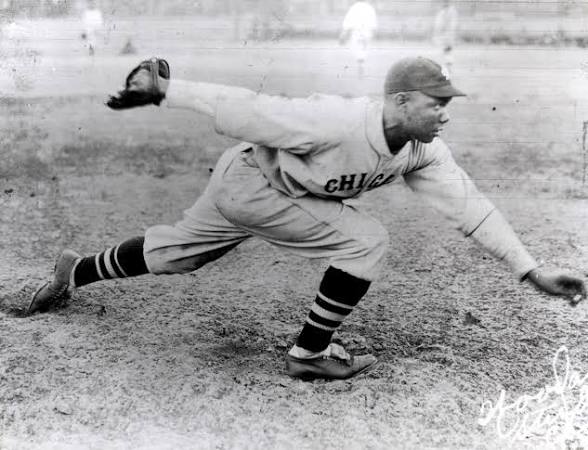
That’s when William “Bill” Foster came along. Well, not in person, he’d died 18 years earlier. But rather, a story on him dropped in my cub reporter lap when the legendary southpaw hurler was elected to the National Baseball Hall of Fame in Cooperstown.
As is well known, at least by regular readers of this blog and other Negro Leagues fans, Bill Foster pitched mainly for the Chicago American Giants as a pro before retiring to coach and serve as dean of men at his alma mater, Alcorn State College, in Lorman, Miss., where he passed away in 1978.
But what might be less known about Foster that between his stints as a big-time pro pitcher and his administrative tenure at Alcorn, he actually lived in Tarboro with his college sweetheart and wife, Thelma Quigless, a native of the medium-sized town in Edgecombe County, N.C.
Thus, quite naturally for an ambitious, energetic, young newshound, I jumped on the story and reported and wrote an article about Foster’s election to the Hall and his connection to Tarboro for the Daily Southerner. I was ably assisted and encouraged by my co-worker and lifelong friend, Calvin Adkins.
Why do I bring this up now? Well, first, the anniversary of his death was last Friday. But second, he was the subject of my presentation at the 2026 Jerry Malloy Conference a few months ago in Memphis.
So I figured to put out a little post about Foster as a precursor to the conference and in recognition of his birthday. Unfortunately, that 1996 Daily Southerner article isn’t online or in any database that I know of, and I don’t have a hard copy.
However, I did another article about Bill Foster and his connection to Edgecombe County, N.C. — this one from 2013 for the Raleigh News & Observer, involving how he pitched for teams in Princeville, the first town in the country founded by African Americans. (Princeville is located just across the Tar River from Tarboro.) Unfortunately again, the Princeville article is no longer online, either, although it can be found on newspapers.com.
Bill Foster’s World War II draft card, showing his address in Tarboro, N.C.
Even though his professional career was over by the time he lived in coastal plains North Carolina, he continued to pitch for various semipro clubs well into his 40s. As mentioned above, he hurled for teams representing historic Princeville, especially the Princeville Grays, in 1940. The Grays were piloted by Roy Matthewson, a member of the influential and popular Matthewson family in Princeville. Roy Matthewson later served as town mayor, as bid Glennie Matthewson and Glennie Matthewson II.
A photo of Foster’s future wife, Thelma Quigless, in the Alcornite yearbook from 1929. The couple met while they were both students there.
Foster also suited up for teams based in Rocky Mount, N.C., a large town/small city located about 30 minutes west of Tarboro. He pitched for the Rocky Mount Black Swans in 1940, then with the Rocky Mount All-Stars in 1947-50. (Rocky Mount native and NBHOF’er Buck Leonard managed another version of the Black Swans in the 1920s.)
Foster then, unbelievably, climbed the hill for the Tarboro Tars in 1950, when he was 46!
Bill and Thelma’s marriage certificate
Going through contemporaneous coverage of Foster’s exploits on the diamonds of North Carolina is intriguing because they occurred on such a smaller scale than the one he experienced with the Chicago American Giants. In addition, the wilds of the Tar Heel State were new to him, and he was a new face to the fans of semipro baseball in North Carolina.
On the whole, let’s just say that when he climbed the hill for local town and city teams in North Carolina, it was evident that Foster still had “it” — “it” being his knack for superb pitching and his ability to completely dominate opposing lineups. He might have been swimming in a much smaller pond, so to speak, but he definitely was a big fish in that small pond while in North Carolina.
In 1939, at the age of 35, Foster began hurling for the Rocky Mount Black Swans, who apparently had a little bit of a rivalry with the Kinston Grays. (Kinston is a big town/small city in southeast North Carolina about 60 miles south of Rocky Mount; it’s been home to several lower minor-league teams in organized baseball for decades.)
Foster quickly displayed his mastery on the mound for his new fans — in July 1940, he hurled a gem in the Swans’ 4-3, 15-inning win over the Kinston Grays.
“Lefty ‘Willie’ Foster, formerly of the Chicago American Giants, a new comer [sic] to the Rocky Mount teams, exhibited one of the finest pieces of hurling that has ever been seen in this section of the country,” stated a wire service article about the game that appeared in the Atlanta Daily World.
An article about the contest in the New Journal and Guide newspaper of Norfolk, Va., was similarly effusive in its praise of Bill’s performance. Oddly, the article dubbed him “Big Train” Foster, a nickname for him that I’d never heard before. Reported the Guide:
“… [T]he Swans sent Big Train Foster, former National league ace, to the mound in an effort to get revenge for [a] previous defeat. The giant southpaw sent 18 batters down on strikes in the fifteen innings he worked.”
(For several years, including at least some of Foster’s time with the team, the Black Swans were managed by Buck Leonard’s younger brother, Charlie “Specs” Leonard, who also played shortstop and third base for the team. According to Seamheads, Charlie Leonard appeared in a single game for the Brooklyn Royal Giants in 1933 and a single game for them in 1936. He died in 1952 at the age of just 39.)
While he was playing for the Swans, in 1940 Foster also pitched for the Princeville Grays; he gained the win in the their 3-2 victory over Winton in Tarboro. The Guide noted “the star hurling of Bill Foster, veteran of the big show.” He also dominated the Weldon Black Hawks in Princeville’s 3-2 triumph in which Foster limited the Hawks to three hits.
The Rocky Mount All-Stars’ home park as it exists today.
Later in the decade, when he was in his 40s, Foster anchored the pitching staff of the semipro Rocky Mount All-Stars, for whom he started games and also came on in relief. The All-Stars (sometimes called the Eastern Carolina All-Stars in coverage of in newspaper coverage) were frequently covered by the Rocky Mount Telegram, for which I worked a few months in late 1995 before jumping to the Daily Southerner.
The Telegram gave him several monikers of the seasons, including “Lefty,” “Screwball” and “We[e] Willie,” the last one a little puzzling given that Foster was relatively tall. The All-Stars played teams like the famed semi-pro Greensboro Red Wings, Norfolk Royals, Washington (D.C.) Tigers, Raleigh Tigers, Raleigh Grays, Durham Eagles and Tarboro Tars.
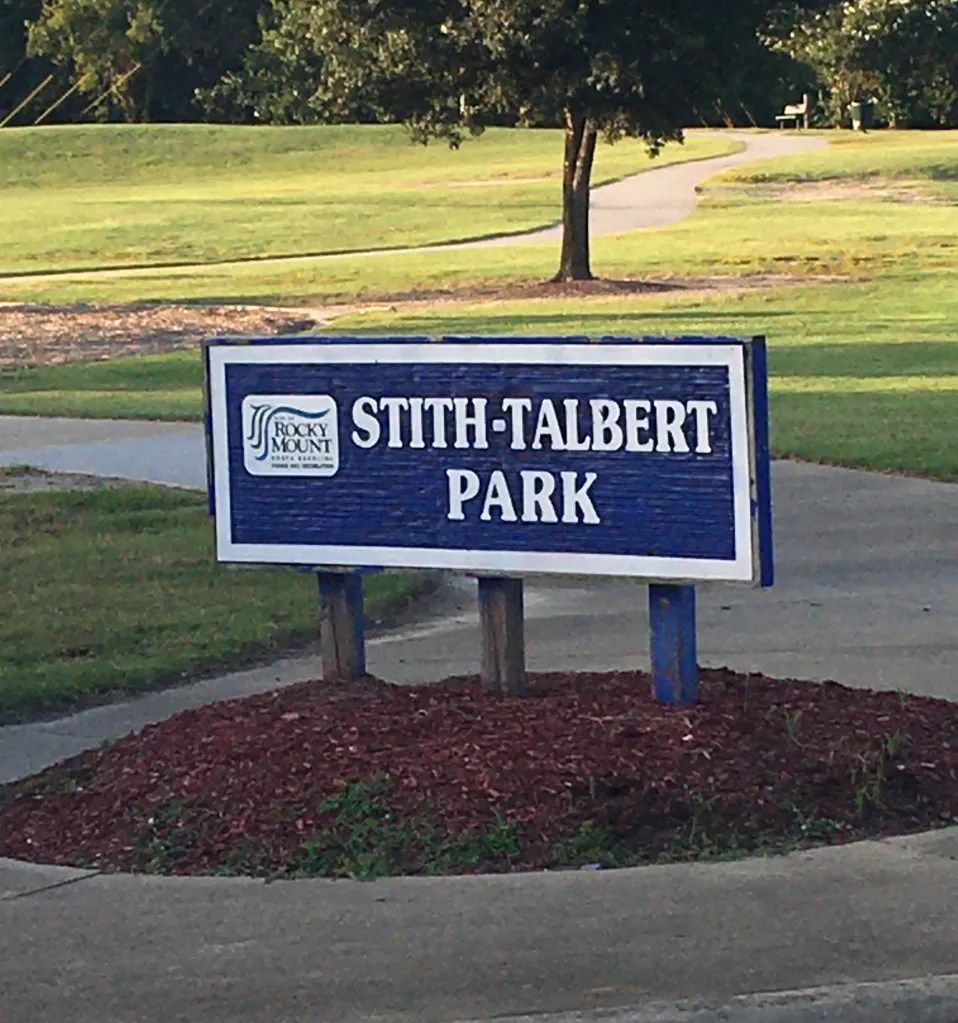
The Rocky Mount club played its home games at Talbert Park, located on the eastern side of the city along the Tar River, but the All-Stars also ventured to places like Tarboro and Goldsboro. Over several years, Foster remained steady on the mound for the All-Stars, frequently coming in from the bullpen to staunch the bleeding, so to speak, when the All-Stars were losing. In a September 1947 loss to the Raleigh Tigers, Foster gave up seven hits and fanned 11 Tigers in the 4-1 defeat; and in June 1950, he allowed only a lone single in relief in the Rocky Mounters 7-4 win over the Tars.
Meanwhile, as Foster was establishing a nice coda to his stories pitching career, he and Thelma became familiar faces around Tarboro. Foster played bridge with clubs attending dances, and in 1948 he spoke at a Tarboro High School ceremony bestowing the school’s football players they’re varsity letters. (He was joined by Buck Leonard as well.) He attended a surprise birthday party in Princeviile for a longtime resident of that town. (I was delighted to see that the party was also attended by Walter Plemmer, who was mayor of Princeville when I was working for the Southerner more than 40 years later.)
Foster also volunteered to be a Little League coach in Tarboro, an activity that was reported in the New Journal and Guide by Thelma, who appears to have occasionally served as a correspondent for the Norfolk newspaper.
“King baseball reigns — reigns in the hearts of all boys from nine to thirteen, as the Little Leaguers open their season with games between the city’s 15 teams,” Thelma wrote. “Manager Bill Foster says, ‘the pint size Jackies, Roys and Lukes are interesting to watch and a pleasure to work with.'”
Tarboro residents seem to have accepted Bill Foster as a resident of the town as well. In December 1941, he was the guest of honor at a reception given for him in Mrs. E.C. Burnett’s home.
Atlanta Daily World, July 18, 1940
On the personal side, Bill Foster married Thelma Quigless, his college sweetheart, on Oct. 16, 1941, in Tarboro. Thelma grew up in Claiborne County, Miss., which is also the home of Alcorn State. As such, it made attending the college a natural for her, and she also got the chance to get to know Bill, who attended at the same time after growing up in the next county over.
However, I’m not precisely sure why the couple ended up in Tarboro. But Thelma’s brother, Dr. Milton D. Quigless, did settle in Tarboro in 1936 to treat the African-American population in the underserved region. Milton would go on to become a revered figure in Edgecombe County. When I worked in Tarboro in the mid-1990s, there were many Quiglesses in the community.
Anyway, according to his World War II draft card, the couple lived at 514 E. St. James St. in Tarboro, right along the Tar River. However, the 1950 federal Census lists them and their son, 7-year-old William, at 906 E. Church St., a couple blocks from their previous home. According to the Census, Thelma was working in her chosen field of education as a grammar teacher at Tarboro High School.
While living in Tarboro, Bill Foster worked as an underwriter for the for the North Carolina Mutual Life Insurance Company, the largest and oldest Black-owned life insurance company in the country. Founded in 1898 and based in Durham, N.C., it was a vital part of that city’s vibrant “Black Wall Street” business district because it sold policies to African Americans who were refused by white-owned companies.
However, I’m not sure how Foster obtained the job at North Carolina Mutual, i.e. if he had any connections, friends or family at the company, or if he was maybe hired because of his athletic fame. Or maybe he just really wanted to sell life insurance.
That’s the rundown on Bill Foster’s time in North Carolina. Eventually he and Thelma divorced, and Bill moved back to Mississippi to begin a fruitful second career at Alcorn State. I know that’s kind of an abrupt ending to this blog post, but I’m honestly really tired and my brain is shutting down.
As some people might know, New Orleans University produced none other than Gentleman Dave Malarcher, my favorite pre-1947 player and a native of Convent, La., who manned third base for several local clubs, such as the New Orleans Eagles, before being signed by the Indianapolis ABCs, serving in World War I and gaining national renown as a third baseman and eventual manager of the Chicago American Giants.
But before his pro career, Dave attended NOU and captained its highly successful baseball team. However, I recently uncovered (quite by accident) this article in the States that lists a “Malarcher” as NOU’s right halfback. I didn’t previously know that he might have donned the pads for the school’s football team. While we seemingly can’t know for 100 percent sure that it’s Dave — he might have had relatives who also went to NOU — it’s a good bet that it is, in fact, him.
And just today, I found this article from the Nov. 15, 1915, New Orleans Item newspaper:
As you can see in both articles, NOU shut out Straight, 13-10. I haven’t been able to find any more information about the NOU football team of 1915 or if Dave Malarcher did indeed play for the team. I need to dig through my files on him, but there’s another complication: the Dillard University Archives and Special Collections are apparently closed to the public, and there’s no word on when they might re-open.
I made a couple calls to the DU library, and the decision to close the archives indefinitely came down from the university president herself after the university had trouble finding a permanent curator/director of the archives.
Hold on, though. It turns out that the Tulane University library, as well as the Amistad Research Center on the Tulane campus, have copies of “Seventy Years of Service: New Orleans University,” a little book assembled by the NOU faculty and published in 1935 that chronicles the history of the HBCU up until that point.
And here’s an excerpt from pages 60-61:
“The first football team of the University was organized in 1914 by Earl U. Harrison, then a student in the school. He was given encouragement and assistance by several interested friends of the city, notably Mr. O. C. W. Taylor, who gave some time to coaching the team. The men who composed this first team were: B. Lockley and T. Slaughter, guards; A. Jordan and U. Short, tackles: A. McNeal and R. Moses, ends; C. Williams, center; E. Harrison, J. Wilson, C. Wester, W. Chinn, D. Malarcher, P. Taylor, and D. Jordan, backs. The team played its first game on October 13, 1914 and defeated a veteran team of Straight College 13-0. John Wilson, quarterback, and Charles Wester, halfback were the stars of that season. Wilson later single-handed[ly] led teams of N. O. U. to victory by his phenominal [sic] kicking. In 1917 with a forty-yard drop kick from a difficult angle he changed a score that had stood until the last two minutes of a game 14-12 in favor of Straight College into a 15-14 victory for N. O. U.”
That’s right. It does indeed look like Dave Malarcher played football for his alma mater as well as baseball! Bo Jackson 70 years before Bo Jackson!
If I come across anything else about Malarcher playing football — and there might be an item or two in my files — I’ll post an update. …
*****************************
While I don’t plan to place Home Plate Don’t Move behind a pay way in the immediate future, I could always use contributions to assist in my research, complete my book project, and pay a bill here and there. If you’d want to chip in a few bucks, any help would be greatly appreciated. To contribute, head here. Thank you very much again for your support!
Editor’s note: I originally wrote this article for The Louisiana Weekly, which published it in the issue of July 13, 2026. I’ve added a few more things to the article for this post.
“Coach Roger Cador was far more than a baseball coach – he was a visionary, a mentor, a leader and a true pillar of the Jaguar Nation,” SU Athletics Director Roman Banks said in a press release. “His impact on Southern University and HBCU baseball is immeasurable. For more than three decades, he built a championship culture, developed generations of student-athletes, and inspired countless lives both on and off the field.
“Coach Cador’s legacy extends far beyond his wins, championships and accolades. He represented the very best of Southern University — excellence, pride, commitment and service. The foundation he built, the lives he touched, and the standard he established will continue to guide our baseball program and the Jaguar Nation for generations to come. We are forever grateful for his extraordinary contributions and the lasting mark he leaves on our university.”
In a statement after Cador’s passing, the American Baseball Coaches Association – into whose Hall of Fame Cador was inducted in 2022 – said the SU great was “one of the most accomplished coaches in college baseball history and a tireless advocate for HBCU baseball.”
“Cador’s impact extended far beyond Southern,” the ABCA statement added. “A passionate ambassador for HBCU baseball, he helped increase national exposure for Historically Black Colleges and Universities through initiatives such as the Urban Baseball Invitational, now the Andre Dawson Classic, while working alongside Major League Baseball to expand opportunities for student-athletes and grow the game in underserved communities.”
Cador coached the Jaguars for 33 years before retiring in 2017. In that time, he took a program with few resources and even less public recognition and guided Southern to two HBCU national championships, 14 Southwestern Athletic Conference titles and 11 NCAA Tournament Regionals appearances. In 1987, under his guidance the Jaguars became the first HBCU team to win an NCAA Regional game by beating No. 2 Cal State-Fullerton, 1-0. Cador compiled an overall record of 913-597-1 as the Jags’ head coach, making him one of the winningest college baseball coaches of all time. In addition, more than 60 of his players went on to be taken in the Major League Baseball Draft, and he coached 10 All-Americans during his career. He also received SWAC Coach of the Year honors 13 times.
“I didn’t know Roger during his coaching days, but of course I knew of him and his coaching achievements,” Sokol told The Louisiana Weekly. “I’m proud that I did get to know him after his retirement working on projects and loved his smile, laugh, positive attitude and the way he made you feel special.”
In an interview with this reporter several years ago, Cador said HBCU teams have been a crucial part of college baseball for a long time and deserve to be recognized for their contributions to the sport.
“It’s a story that’s extremely important for the making of the history of American baseball,” he said.
The coach added in the interview that HBCU baseball has produced a great number of players who have gone on to make an impact on professional baseball, beginning decades ago.
“There were several guys who played in the big leagues at some point,” Cador said. “That says a lot about how important [HBCU baseball] was. There were a lot of great people that played baseball and were important to baseball.”
Cador said back then that HBCU baseball was due for a resurgence, a prediction that has been proven current in recent years.
“We are in a good situation where we can try to get the good players back,” he said. “We have the right things we need to attract them.”
In June 2019, the USA Today Network wire produced an article that was subsequently published in the Alexandria, La., Town Talk newspaper and served as a retrospective of Cador’s career.
In the story, reporter Mike Gegenheimer quoted several of the Southern coach’s old friends and associates, including the great Dusty Baker, who knew Cador from their playing days and who assisted the latter in getting the resurrected Southern baseball program off the ground.
Baker discussed for the article why Cador was so beloved.
“It’s his genuineness,” Baker said. “The fact that he cares so much about the game, his players, the school of Southern University, and you want to help somebody that has that deep, genuine concern for what they’re doing. He’s touched many, many lives.”
Legendary Louisiana State University baseball coach Skip Bertman, a close friend of Cador’s, told Gegenheimer this about what Cador meant to Southern and his players.
“Roger has never complained one bit and has been a great representative of Southern University,” Bertman said. “He didn’t have everything that I had or the coach at LSU now has … Whenever he asked for something, it was always for the players. He never asked for himself.”
“He’s never let what he does for a living become who he is,” Robichaux said. “We have to be so careful in sports that sports can define us. … The thing I respect about Roger is, he’s never let the game define him. It’s the way he’s lived his life. It’s his personality.”
Teche News (St. Martinsville, La.), July 12, 2017
To commemorate Cador’s retirement at the time, the Louisiana State Legislature passed a resolution honoring his lifetime of service to the sport of baseball and the state of Louisiana. The document stated, in part, that “Coach Cador built the Southern University Jaguar baseball team into one of the most well-respected and successful baseball programs in the country” and that the coach “is an ambassador to the sport of baseball around the world …”
The resolution also noted that the achievement of which Cador was most proud was the program’s roughly 80-percent graduation rate, quoting Cador: “I receive a tremendous amount of satisfaction in helping a young man grow from adolescence to manhood and accomplish his goals. They revitalize me with the courage and effort they put forth. After four or five years the end product makes it all worthwhile.”
The resolution added that “it is appropriate to commend and celebrate this beloved coach who is widely respected and had one of the most influential careers in the sport of baseball.”
It concluded:
“THEREFORE, BE IT RESOLVED that the House of Representatives of the Legislature of Louisiana does hereby commend and salute Coach Roger Cador upon his retirement after leading Southern University’s baseball program for thirty-three years; does hereby commend his dedication to his student-athletes, Southern University baseball, and the sport of baseball; and does hereby recognize and record for posterity his outstanding accomplishments.”
John Graf, Paul Julion and Leslie Heaphy. (Photo by Sherman Jenkins)
To wrap up coverage of the recent SABR Jerry Malloy Negro Leagues Conference, I’ll highlight some of the other presentations and other events from the four-day smorgasbord of Black baseball history.
(For earlier coverage on this blog of the recent conference, check out this, this and this. The latter linked post is by guest writer Keith B. Wood, who gives an overall view of our Memphis experience, including the opening meet-and-greet at the Withers Collection Museum & Gallery, the Memphis Redbirds game Friday night, and the bus tour of local landmarks Thursday afternoon.)
On Thursday, conference committee member and local Memphis host Dr. Keith B. Wood welcomed those in attendance – the total number of people registering for at least one event of the conference topped 100 – by urging us to continue digging into and proclaiming the true story of African-American baseball.
“There are so many stories that need to be told,” Wood said. “That’s why we’re here. We need to find those stories, and tell those stories.”
Wood noted how in recent years and across the country, there’s been a concerted effort to once again shunt African-American history to the shadows and prevent Americans from learning about those sories.
As a result, he said, those in attendance at the conference must “push back [and] tell the truth.”
The film covered the entire history of the team, which existed from 1920-59, including its formation, its purchase by the Martin brothers, the championship season of 1938, the landmark status of Martin Stadium, the politics and bigotry that eventually drove team owner and community leader J.B. Martin out of the city, and the team’s bittersweet demise following the integration of baseball. The documentary featured interviews with many former players, community members and fans, musicians and family members, and it was narrated by actor Samuel L. Jackson. The acclaimed documentary was written and directed by University of Memphis professor Steven John Ross.
Conference attendees listen as Tom Thress gives his presentation. (Photo by Sherman Jenkins)
The following day we dived into the presentations – this earlier post discussed the ones about the Red Sox, and highlights of some of the other presentations included:
One by James Brunson titled, “Memphis Slow Grind Blues: Eureka-Eclipse Blackball Rivalry, 1884-1888,” in which he touched on some of cultural factors that impacted “colored” base ball (two words in the 1880s) in Gilded Age Memphis, especially the early emergence of blues culture and “blues people”; popular (and often derogatory) images of African Americans; the Robin Hood mentality; and, of course, the rise of Jim Crow. Brunson also discussed his own familial connections to the Bluff City, and he displayed paintings he created for the Memphis conference.
Gary Gillette highlighting the importance and success of Martin Stadium at Lewis Park, which Gillette called the greatest example of a Black-owned and operated facility that hosted top level Negro Leagues games. Gary noted that Martin Stadium, the longtime home of the Memphis Red Sox, stood out from the seven other such ballparks because of its relatively large capacity, its profitability and particularly its continuous ownbership by the Martin brothers, which ensured the stadium’s stability.
An attempt by Tom Thress to unravel a baseball mystery: Who pitched for the 1942 Cincinnati Clowns under the name Matchett? Thress explained that at the same time Jack Machett was pitching for the Kansas City Monarchs, a player named “Matchett” was appearing in box scores for the Clowns. Tom laid out all the details of the case, and while he was unable to come to a definitive answer to the question, he chronicled a fascinating, compelling tale.
Retired sports broadcaster and University of Memphis professor Curt Hart talking about interviews he had during his journalism career with several former Negro Leaguers, including Joe B. Scott, Ted “Double Duty” Radcliffe, country singer Charley Pride and none other than the great Satchel Paige.
Author Chris Jensen relating the triumphant and tragic tale of Octavius Catto, an early pioneer of both Black baseball and Civil Rights in the United States, who was murdered in Philadelphia on Election Day 1871 because of his efforts to expand African-American suffrage. Catto takes his mournful place in Jensen’s new book through McFarland, “Tragedy in Black Baseball: Early Deaths of 136 Negro Leaguers, 1871-1950.” During his presentation, Chris also touched on the stories of four other saddening entrants in his book. “It’s a book I wish didn’t have to be written,” he said.
A comprehensive, statistical breakdown of the post-integration careers in so-called “organized baseball” of Black baseball players by Clem Hamilton. His presentation featured detailed, quantitative analyses of the fates of dozens of African-American trailblazers in the national pastime at every level of professional organized baseball, from the majors down to the low minors. Hamilton’s breakdown of the men’s fates included those high-profile stars whose careers continued relatively unabated, to those who saw their careers disrupted, delayed or even ended.
Ted Knorr’s presentation of – who else? – Rap Dixon and the legend’s performance in 1927 as part of an all-star team of Negro Leaguers’ tour of Japan. The main theme of Ted’s analysis of Rap’s superlative showing in Japan was how Dixon displayed his mastery of each of the fabled “five tools” that make for a complete, all-around ballplayer – hitting proficiency, hitting for power, speed/baserunning, fielding and arm strength. As Ted’s written summary of his presentation said, “Dixon did not just play baseball in Japan – he expanded the game’s imagination of what was possible.”
A thought-provoking talk titled, “Home Field Heritage: Preservation of Place for Negro League Baseball,” by Julia Bucci, a graduate student studying historic preservation at Pratt Institute in Brooklyn, N.Y. For her presentation, Bucci zeroed on five former Negro Leagues ballparks – Rickwood Field in Birmingham, Ala.; Stars Park in St. Louis; McCormick Field in Asheville, N.C.; Hinchliffe Stadium in Paterson, N.J.; and Cooper Stadium in Columbus, Ohio – that each served as a home field for a Negro Leagues team at either the pro or semipro level and are still standing in some form. For each of the five case studies, Julia discussed the importance of each facility to local cultural heritage and historic preservation.
A talk by University of Memphis history professor Aram Goudsouzian underpinned by a basic theory – that for many, Aram said, “[Satchel] Paige is the vehicle [through which] white people understand the Black baseball past.” Goudsouzian related how Paige’s folksy, homespun demeanor post-retirement might have made him new legions of white fans, it occurred concurrently with the development of Black pride and Black Power, through which many African Americans resisted the type of “safe” depictions of Black culture such as Satchel.
The tale of the early interracial base ball games in Kingston, N.Y. – located in the Hudson Valley region north of New York City – between the Black Rondout Seniors and the white Excelsior Club in August 1867, as told and examined by Daniel Torres. Torres noted how the series of contests between the two teams came during the Reconstruction Era and just months before the earliest moves toward segregation in base ball took place. Significantly, Torres related, the Rondout Seniors-Excelsiors games showed that such athletic encounters weren’t so much bold social statements or protest, as they were routine, pastoral, community-based functions of that time and place.
The concluding presentation of the conference by Alan Cohen, who perhaps appropriately wrapped up the discussion slate with a summary and update of the enormous Negro League Homerun Project, a massive understaking that’s so far tallied well more than 7,000 Blackball dingers and could very feasibly be on its way to 8,000-plus.
John Wakelin and Sherman Jenkins. (Photo courtesy John Wakelin)
But I wanted to single out one presentation in particular, one that brought an unorthodox yet sublime approach to researching and interpreting Black baseball history – through first-person poetry as spoken by one of the greats of the game themselves.
Loren’s book covers almost the entirety of his life, including his career in the game and his life outside of it. With the poems, Newt Allen (through the pen of Broaddus) narrates his life with poems about meeting his wife, the travails of barnstorming baseball, enjoying jazz clubs on the road and costly fielding errors, among an array of other life events. The volume is bookended by poems inspired by a late-in-life interview Allen gave with writer Mary Still.
Broaddus told the conference attendees that much of his inspiration for “Wasn’t Any Maybe So” come from how Allen and his Negro Leagues compatriots adjusted to and overcame the systemic challenges that constantly hindered their lives and careers.
“I’m always amazed at how they navigated that, and even thrived in that,” he said. “Just the creating they did in a very difficult situation to do so.”
The main portion of last month’s Malloy conference concluded, as the gatherings always do, with the awards dinner on Saturday night, at which time the winners of each honor are announced.
But first came the Significa Contest finals, featuring the last three competitors standing, so to speak, and after the dust settled, Tom Thress had won his third title in four years, with Kevin Johnson coming in second for the second year in a row, and Wade Parker admirably taking third.
Thress’ third title ties Ted Knorr for most wins by living players (the late, great Dick Clark is the all-time leader with a whopping nine titles). Knorr says he’ll return to active competition in 2027, which could set up a possible showdown with Thress, who beat Knorr by four-sevenths of a point in 2024. Knorr will doubtlessly be out for revenge in ’27.
The banquet concluded with the annual awards, of which the 2026 recipients were:
Normal “Tweed” Webb Lifetime Achievement Award – Dr. James Brunson III
Robert Peterson Recognition Award – John Graf, Paul Debono
John Coates Next Generation Award – Karen Swanson, Chris Jensen, Scott Orris
Fay Vincent Most Valuable Partner Award – Dr. Keith Wood
I’ll wind down this post/summary of the Malloy Conference by quoting a letter to the conference attendees by City of MemphisMayor Paul A. Young, who wrote that the city was happy to share its Black baseball history with those at the conference:
“Memphis holds a deep and meaningful connection to this history, and it is especially fitting to welcome you to a city that proudly reflects the cultural significance and contributions of Negro League Baseball. As you engage in thoughtful discussion, learning and fellowship, we hope you also take time to experience the vibrant culture, history and hospitality that define Memphis.”
Editor’s note: The following is a lightly edited email interview with my friend and fellow Negro Leagues researcher/writer John Graf about his groundbreaking new book with McFarland, “Simulating Satchel,” in which he posits baseball’s biggest “what if.” I’ll let him explain it from there …
Ryan Whirty: How would you describe this book? What was the goal when you set out to put it together?
John Graf:Simulating Satchel is a fictional account of what might have happened if Satchel Paige and nearly 100 of his Negro Leagues contemporaries had been admitted, as young players in their primes, for the 1934 season into what were the exclusionary major leagues.
The effect I was going for was that of a reader imagining a combined preseason annual, account of the simulated season, and commentary from both fictionalized real life and invented members of the sporting news media. What would it have been like to hold in your hands a 1934 version of a yearbook like the old Street and Smith’s, with rosters, previews and predictions only titled Sweet & Fleet’s. Or like a daily newspaper with both “in-brief” and feature-length coverage. Or a fictional magazine-like publication modeled after The Sporting News, titled The Blackball Watcher. And I included simulated radio interviews with the fictional and real-life sports journalists describing the action and related stories, their context and significance.
The goals were simple: Create a book both fun and thought-provoking that not only reported on the games themselves but also in real life in the present invites consideration of how the stories relate to the larger world of which baseball and its integration history are a part.
RW: Where did the inspiration for this book come from? How did you come up with the idea for it?
JG: The inspiration for the book goes way back to my childhood, when my parents knew early on I was a baseball nut and gave me the tools of my trade, brown paper bags and pencils to copy data from baseball cards and draw pictures of players. I turned to half-sheets of typing paper for my stationery and produced My Sports Page, 93 pages worth of a 6-year-old’s chicken scratch penmanship and the best I could do at that age of illustrating.
The idea in part originated, also in childhood, as I played a solitaire, cards and dice version, of Strat-O-Matic Baseball. I played the games and compiled the stats. Eventually, Strat came out with a computer game during my adult years, and had Negro Leagues players like Satchel Paige in it, I was drawn to creating an integrated and expanded season that included the banned Negro Leaguers as well as the white players in the exclusionary majors.
John Graf
It started out as a simulated season “replay” for fun and when my buddies on the Strat Fan Forum liked the write-ups I was producing for their online discussions, I thought I’d “pitch” the idea to McFarland publishers. Bless their hearts, they made me a fiction guinea pig added to their own impressive catalog of sports history titles.
RW: How did you approach such a unique and innovative project? What did you do to undertake the project?
JG: Since I had a journalism background, it was natural for me to put the writing in a format that resembled newspaper and magazine coverage. Also, having watched and listened to my share of sports talk in broadcast media, I wanted to fictionalize a real-life broadcaster as well as the scribes who could provide the coverage. So Sherman “Jocko” Maxwell, the first Black sportscaster from the Newark and New York region, was my radio conduit.
To craft the project, I operated under the assumption that baseball could have re-integrated (remember Moses Fleetwood Walker and his brother Weldy were major leaguers back in 1884 before so-called organized baseball shut the door on Black players) in a big way, rather than simply modify its exclusionary status by adding small numbers of African-American players like it did when Jackie Robinson and his successors were added in the late 1940s and 1950s, just a handful of players at a time.
Whether that was plausible in real life in 1934 is certainly open to question. That’s why I call the book a “utopian baseball fantasy.” And that’s what the “what if?” is all about.
RW: What was the biggest challenge you faced writing the book?
JG: I would have to say that getting the “voices” of the players something close to right was the biggest challenge. I wanted to be able to close my eyes and ask the question, “Can I authentically imagine Satchel Paige saying this?” Or Dizzy Dean. Or Babe Ruth. Or Charlie Root. Or Oscar Charleston. Or, notably, Norman “Turkey” Stearnes.
John Graf with the statue of Satchel Paige at the Negro Leagues Baseball Museum. (Photo by Mary Easland)
I got a lot of help and encouragement on this from Vanessa Ivy Rose, who was instrumental in helping with the written content of the book as well as laying the groundwork for promoting it. Of course, Vanessa is Stearnes’ granddaughter, and she helpfully told me when I would do well to check myself on some particular phrasing. Or she would say something on the order of, “I don’t think Grandpa Turkey would have said it that way. Here’s what would sound more like him.” Invaluable guidance from someone who has become a dear friend and colleague. I have seen attempts by white writers attempting to mimic the vocabulary and cadences of Black characters done badly. It’s not a pretty sight and I wanted to avoid that.
RW: Are you pleased with the book and how it turned out?
JG: Oh, my! Pleased beyond bounds. I’m grateful for the responses I’ve received so far, including the critique that I came up with a unique concept. And a hat tip goes to Gary Mitchem who headed up McFarland’s involvement and to Mark Durr on the cover design. The discussion of the significance of my portrayal of a fictional 1934 is just beginning and I look forward to the give and take from the critics as well as other readers.
RW: Without giving away spoilers, what conclusions did you come to? What was the end result of the project?
JG: Even more than conclusions I’ll point out an assumption I started with. That’s that the “Negro Leagues Were Major Leagues.” That’s been borne out in the work of an impressive number of historians and captured in Todd Peterson’s book by that name. In over 600 games of head-to-head competition between Black teams and the white “majors” between 1900 and 1950, Todd reports the league, pre-league and all-star teams populated by African Americans won 315 games, lost 282 and tied 20. That, among a number of other convincing factors, led me to believe that in the simulation I didn’t prove that the Negro Leaguers were every bit as good. I assumed it all along, with evidence.
The end result is both a completion and a beginning. An end result is that, if I’ve proven anything, it’s that a reader can imagine what it might have been like in an integrated and expanded 1934. And that a lot of fun can be had in examining that story, which occupied the lion’s share of the book.
In addition, though, the book succeeds if it points out an awareness that the way I’ve portrayed it ain’t how it happened in real life.And I’ve got an extensive “For Further Reading” section that lists sources that provide those stories. I’ll be happy if readers can begin to imagine, if they haven’t started already, how integration could have happened more equitably, with less damage to Black baseball, whose demise occurred when what came to be known as the Major League Baseball brand absorbed the best of the Black players and attention shifted away from the Negro Leagues and the communities that thrived in part from their presence.
Finally, I’ll have succeeded if I have managed to introduce connecting baseball’s history to the larger world. That’s such a big subject that all I’ll say here is that will be an emphasis of my future writing. The short version is that our world needs to come to grips with how competition can too easily escalate, thinking globally, to levels that threaten our very existence. Just think of how human failure to effectively share power and resources has made for the dangerously-weaponized, war-saturated world we live in at present. I think that baseball, and sport in general, has the potential to be a venue in which we can build on the fact that, on the playing field, we can look at a world of competition in which we can determine fairly who “wins” without killing each other and destroying the planet that gives us life. There is so much more to be explored. The stories behind the stats. The larger meanings. Stay tuned. Critical PENNANT Race Theory beckons.
Harriet Kimbro Hamilton (center) speaks to the audience during the family members’ panel as co-panelists Carlis Wright Robinson and Julian Duncan listen. (All photos by Sherman Jenkins)
Possibly the most personal and powerful presentation of last week’s SABR Jerry Malloy Negro Leagues Conference in Memphis was the family member panel, during which the relatives of five Negro Leagues greats spoke about their famous family members, the players’ importance to Black baseball, and the influential place the Negro Leagues hold in American culture.
The four panelists were Carlis Wright Robinson, daughter of pitcher Johnny Wright; Dr. Harriet Kimbro Hamilton, daughter of outfielder Henry Kimbro; Julian Duncan, grandson of catcher Frank Duncan Jr. and son of pitcher Frank Duncan III; and Delores Brown, daughter in law of catcher Larry Brown.
Delores Brown said that for a long time, she wasn’t aware of who her father in law was while he and so many other veteran Negro Leaguers were still alive. However, she eventually learned more about Larry Brown and his baseball compatriots and got to know some of them.
“They were all really great guys,” she said. “They told so many stories.”
Some of those stories they told reflected how many challenges they faced, especially bigotry and playing and living conditions.
“They fought a lot,” she said. “Many people don’t realize that. They were really mistreated. But they had the love of the game.”
She said she and other Negro Leaguer family members “are trying to get them the recognition they deserve. We’re not asking for a handout. We’re asking for what they deserve.”
Brown added that her father in law’s career record speaks for itself – he should be in Cooperstown.
Panelist Delores Brown with conference chairwoman Leslie Heaphy.
“His statistics speak to the kind of player he was,” she said. “I’m never going to drop this ball, because I believe [the Hall] is where he belongs.”
Julian Duncan said that his grandfather, Frank Duncan Jr., rarely talked about his own baseball experiences; Julian said that he learned everything about baseball and his family’s role in the sport from his father, Frank III, who imparted a great deal of insight about the game to Julian.
The youngest Duncan said during the panel that although he researched and read about the Negro Leagues in his younger days, he’d now what to talk to his father about how the game has changed since the latter’s playing days, especially how much fewer Black Americans are playing baseball now.
Julian provided some levity when telling his favorite story about the man he knew as “Uncle Buck” – the great Hall of Famer Buck O’Neil. Julian said Buck would relate how, one time when the Kansas City Monarchs, including Larry Brown, were traveling through a town so small that the only lodging they had was at a Black funeral home. He said that one by one, the creeped out Monarchs would get up and leave the mortuary to sleep on the bus, where the entire team was found the next morning.
Wright Robinson said that growing up, she always knew that her father was a baseball player, but it wasn’t until her high school years that she found out that he pitched in the Negro Leagues. After that, she said, she realized that she needed to get the word out about her father when she visited the Smithsonian Institution, which displayed a picture of Negro Leaguers but identified her father as simply “an unknown Negro League player.”
“From there, I just continued to reach out [to the public],” she said.
She said when he signed with the Brooklyn Dodgers shortly after Jackie Robinson, Johnny wasn’t able to establish a career in so-called “Organized Baseball” after being demoted to the lower minor leagues and out of the system.
Carlis, Julian and Harriet being interviewed by a Memphis TV reporter.
“People often think that’s the end of his story,” and it is not. There’s much more to my dad’s story.”
Hamilton said that despite all the challenges and even threats Negro Leaguers like her father faced in their travels – “He saw a lot of ugly things,” she said, “especially in the South” – her father was grateful for the opportunity to play the sport he loved for a living.
“My father felt fortunate [to play], and he knew it was a privilege to play baseball, to be a professional baseball player,” she said.
And even though many white Americans still believed that Black Americans were inferior to white players, she said, “my father knew he was a professional baseball player. He knew the cream always rises to the top.”
Hamilton added that she’s trying to change her father’s reputation – “all the books say he was mean” – and that his demeanor was instead determined, devoted and hard-working. He also tried to have no regrets.
“He wasn’t someone who would ever turn and go back to a place he’d been,” she said.
Hamilton concluded the family panel by saying that even though their family members were shunted to the shadows of the national pastime, they’re still legends for their loved ones.
“They played,” she said, “and that made them heroes to us.”
Keith Wood, right, with Paul Julion and Delores Brown (photo by Sherman Jenkins)
Editor’s note: Today we have a guest column by Keith Wood, PhD, who was a board member for last week’s tremendous 2026 Jerry Malloy Conference in Memphis and is the author of The Memphis Red Sox: A Negro Leagues History. For more information about his books and his work in general, check out his Web site at www.keithbwoodauthor.com.
By Dr. Keith B. Wood
What an honor to host the 2026 Jerry Malloy Negro Leagues Conference in Memphis, Tenn. The 26th annual conference stood as an opportunity for the city to remind the Blackball community of its rich history and traditions associated with the Memphis Red Sox. A team and a city whose past is often overlooked in the annals of Negro Leagues baseball.
Last week, we were honored by the presence of J.B. Martin IV, whose great-grandfather, J.B. Martin Sr., stood as the owner of the Memphis Red Sox with his brothers W.S., A.T. and B.B. He shared his family’s story and then threw out the first pitch during the Memphis Redbirds celebration of the Red Sox.
Neil Sharma, a graduate student from the University of Memphis, opened our eyes to the realities of owning a Negro League team in the Jim Crow South. He reminded us how J.B. Martin Sr. was run out of Memphis for disagreeing with Memphis’ political boss, E.H. Crump. Even after being displaced and forced to move to Chicago, he reinvented himself as the owner of the American Giants and became president of the Negro American League.
Baseball continued to thrive in Memphis. historians Alex Painter and Thomas Van Hyning shared how our own Bob “Rope” Boyd made the Red Sox proud when he signed with the Chicago White Sox, becoming the most prominent Negro Leaguer from the Red Sox to play in Major League Baseball. We never forgot that Dan Bankhead was the first; his signing with the Brooklyn Dodgers in 1947 made him the first Black pitcher to pitch in MLB.
Delores Brown, daughter-in-law of the great Larry “Iron Man” Brown, joined us in Memphis and participated in a panel discussion on why we need to keep these stories alive. Joining Brown were Julian Duncan, son and grandson of the father-son battery of Frank Duncan Jr. and Frank Duncan III; Dr. Harriet Kimbro, daughter of Henry Kimbro; and Carlis Wright Robinson, daughter of Johnny Wright, the second Black baseball player to sign with the Brooklyn Dodgers.
Not only were we in awe of their presence, but the joy of hearing these family members share their stories inspired each of us to continue the work we do. We promised to strive as the old African proverb reminds us to keep saying their names, and as long as we do, they will still be us.
Memphis put its best foot forward throughout the week, with locally Black-owned businesses leading the way. The Malloy’s annual meet and greet took place at the historic Ernest Withers ’ Museum on Beale Street. Guests not only had a chance to catch up with each other, but to walk through the lens of history shared with us by the late Ernest Withers.
On Thursday, local tour guide Carolyn Michael-Banks led a tour of Memphis that shed light on Memphis’ rich history while also enlightening Malloy attendees about the challenges of life in Jim Crow Memphis during the Negro leagues era. A tour of the Lorraine Motel and the National Civil Rights Museum offered an opportunity to stand on sacred ground and reflect.
Last week in Memphis, Blackball historians and fans from across the country had a chance, like musician Marc Cohn reminds us, to go “walking in Memphis. Was walking with my feet, ten feet off of Beale. Walking in Memphis. But do I really feel the way I feel?” We touched down in the Land of the Delta Blues and experienced the greatness of Negro Leagues baseball and Memphis’ incredible role in that story.
James Brunson, Duke Goldman, Sherman Jenkins (photo courtesy Sherman Jenkins)
Another Jerry Malloy Negro Leagues Conference is in the books, and Memphis will never be the same! And we won’t, either – our time in Bluff City has been educational, exhilarating, exhausting, powerful and absolutely unforgettable. Keith Wood and the rest of the conference committee put together what was, IMHO, one of the best and most unique Malloy Conferences I’ve been to.
I have so much from the conference swimming in my head, and I’d like to do a whole bunch of blog stuff about my/our time here, but the week was packed with so many incredible activities, presentations and interactions that there’s no way I’ll be able to write about it all.
But I’ll start with one of the primary, overaching themes of the week – the great Memphis Red Sox franchise that was a steady, continuous fixture in the local African-American community in Memphis, the city as a whole and the history of the American pastime in general.
Active for almost three entire decades in the first half of the 20th century, the Red Sox were at several times members of the first Negro National League and the Negro American League, making them official Major League teams now. They were also key members of the Negro Southern League for several years, including in 1932, when the NSL was considered a Negro Major League.
The entire span of the Red Sox’ existence is jam-packed with rich history, colorful characters, top-notch players (including four National Baseball Hall of Famers), an enigmatic owner, economic power and even political intrigue.
There’s so much history running through the Memphis Red Sox story that I could never do all of it justice in a series of blog posts. If you want to learn everything about the Red Sox – and trust, it’d be worth it – check out Keith Wood’s book on the team published by McFarland.
I’m hoping to do more than one post on this year’s Malloy Conference, so for now, this post will focus largely on the second day of the gathering, during which the Red Sox were featured heavily, with multiple presenters discussing the team, its people and its city.
We’ll start right off with the conference’s biggest guest of honor – Dr. J. B. Martin IV, the great grandson of Dr. J.B. Martin Sr., the longtime owner of the Memphis Red Sox, who purchased the franchise with his brothers in 1929 and built it into a pennant winner on the field – they won the NAL championship in 1938 – and an economic success off the field.
The senior Martin had to sell the franchise in the early 1940s when the city’s political primary kingpin – the racist, spiteful E.H. Crump, otherwise known as Boss Crump – drove J.B. Sr. out of town because of the latter’s leadership of and activity in the local Republican Party, as well as his fierce advocacy for Civil Rights. (More on that in a bit.)
At the conference, J.B. Martin IV gave a presentation titled, “Making the Case for the Hall of Fame,” in which he ran down the reasons his great grandfather should be inducted into Cooperstown.
I’ll hopefully bring more from J.B. IV in the next week or two, but for now, all just reveal a few of his thoughts from his Malloy talk last Friday.
“J.B. Martin was a great pharmacist, he was a great businessman, and he was a great political leader,” J.B. IV told conference attendees.
He added that his great grandfather brought that same outstanding professionalism to his baseball team and his players.
“He allowed them to play in comfort,” he said. “They knew they were surrounded by a supportive community. If you had problems, someone would take care of it.”
J.B. IV added that the Red Sox “were an integral part of our community from the 1920s to the 1950s.”
J.B. Martin IV speaks at the conference (photo courtesy Keith Wood)
A big part of that was the central place that Martin Stadium, the team’s home, held in Black Memphis. Owned and operated by J.B. Sr. and his brothers, Martin Stadium “became a civil institution,” J.B. IV said. “It was a source of pride for the Black community.”
Multiple Malloy presenters focused on different Red Sox players, including some of the athletes’ careers outside of Memphis. Paul Spyhalski, for example, gave his presentation on pitcher Verdell Mathis, perhaps the preeminent southpaw in the NAL during the 1940s.
Specifically, Spyhalski examined how Mathis hones his skills and developed as a pitcher while playing for semipro and barnstorming teams on the prairies of Iowa, particularly in the unusual hotbed of African-American baseball, Algona.
Iowa is where Mathis crossed paths with manager Ruben Jones, who recommended the young hurler to J.B. Martin and the Red Sox, who promptly signed him. Mathis would go on to become a six-time all star and the anchor of the Memphis rotation for much of the ’40s.
Another Red Sox player placed under the proverbial microscope, this one by author and presenter Stephen Rice, at the conference last week was Carl “Lefty” Glass, a mainstay of the Red Sox pitching corps during the team’s earlier years, much of them before the Martin brothers bought the club.
A native of Lexington, Ky., Glass’ pitching career during his stint in the Army in World War I, during which he was also part of calvary units, and in addition to his long tenure with the Memphis Red Sox as a pitcher, he managed the club in 1928 and pitched in the vaunted, integrated California Winter League.
Glass was also one of the driving forces in the late-1940s and early-’50s semipro Lexington Hustlers, known as the first integrated team in the South. Rice said Glass “doesn’t get noticed [in history]. He’s very overlooked, and he was on some very good teams.”
Then on the conference slate came a panel on first baseman Bob Boyd, who began his career in the big leagues in the mid- to late-1940s with Memphis before enjoying a lengthy if modest stay in the integrated Major Leagues.
The Boyd panel was led by my buddy Alex Painter, who noted that Boyd “went through every part of Black baseball.” Despite his very admirable experience and resume, Boyd “always had to prove himself,” Painter said. “He was a star because of his personality. He always came [to work], he always showed up, and he played hard.”
Alex said such a workmanlike, steady, consistent effort helped Boyd embody the Black baseball spirit. “His was about as much of a Negro Leagues story as it could be,” he said.
Painter added that “that consistency, year after year, attracted people’s attention. He was always finding ways to contribute.
“By the end of the 1940s, he had established himself as one of the best first basemen in Black baseball.”
Such dedication to his craft helped Boyd then enter into a sustained tenure in integrated baseball. That’s where co-panelist Thomas Van Hyning picked up Boyd’s story by noting that throughout the 1950s and into the 1960s, Boyd became “Mr. Consistency.” Whether it was in the Puerto Rican League, the Cuban League, in the minors with the Houston Buffaloes, or in the Majors with the Orioles, the A’s or the Braves, Boyd came to play, and he played admirably.
Finally, we’ll bring things back to J.B. Martin, the driving force behind much of the Red Sox’ success, and how it took virulent institutional racism and insidious, embedded political corruption to force Martin to leave Memphis.
That tale was told by conference presenter Neil Sharma, who unspooled the narrative. Boss Crump, the corrupt kingmaker of the city of Memphis and Democratic ally of President Franklin Roosevelt who balked at the almost equally influential Martin’s support of Republican presidential candidate Wendell Willkie and his comprehensive Civil Rights platform.
Crump demanded Martin back off of his support for Willkie, and Martin refused, prompting Crump to launch what Sharma called the “reign of terror” – an oppressive, bigoted campaign of harassment and threats.
J.B. Martin Sr.
At first, Crump’s main tactic was having cops search everyone coming and going from Martin’s prominent pharmacist under the pretense of cleaning up supposed illegal drug-dealing in the city. Those sinister undertakings were eventually accompanied by death threats against Martin from Crump’s goons.
Sharma said that despite the attempts at intimidation and violence, bore as much as he could so he could stay in Memphis.
“He was increasingly becoming an ambassador for Black Memphis,” Sharma said, “and he felt a responsibility to oppose Crump”s racist regime.”
Sharma added that Martin “might have been part of the Black bourgeoise, but he never distanced himself from the Black working class “
Quite naturally the massive blow to Martin’s pharmacy business that resulted prevented Martin from putting a quality product on the diamond, something that greatly pained him.
“He felt a great responsibility to Black Memphis to give a strong team to the fans,” Sharma said.
In all, the reign of terror led to massive disruptions of and fear in the local Black community, and it gutted Martin’s business and tested his resolve, to the point that the J.B. Sr. eventually fled to Chicago out of fear for his and his family’s safety. They settled in Chicago, where J.B. continued his involvement in the Negro Leagues by buying the storied Chicago American Giants and eventually serving as president of the NAL.
That’s the scoop on the Memphis Red Sox as revealed by presenters at the Malloy conference last week. I’m hoping to post another thing or two from Memphis over the next week or so.
If you have any pictures from the conferences you’d be willing to send along to include in upcoming posts, definitely email them to me if you want at rwhirty218@gmail.com. I’ll of course credit you! Thank you in advance!
“In small cities and small towns across the country, there were other teams and other stars that may have been the greatest of the century, but whose deeds would live only in the memory of those who saw them play. Over the years, Black baseball stars played against White Major League stars at least 438 times in off-season exhibition games. The Whites won 129 of those postseason games. The Blacks won 309 (70.5 percent).”
– Baseball, 5th Inning, Shadow Ball, Ken Burns, 1994
Appendix II of “The Negro Leagues were Major Leagues,” edited by Todd Peterson, pp. 214-226, lists 503 games, dates and opponents, depicting games between Negro League teams and Major League teams. Negro League teams won 268 (54.6 percent), while losing 222, with 13 ties.
In addition to Burns and Peterson, I have seen compilations by historians William McNeil (69.8 percent in the California Winter League) and John Holway (57.1 percent), and researchers Scott Simkus (52.7 percent) and bench5 (54.5 percent). Every one of them finds the “so-called” Negro League teams holding their own (winning as often as losing) against “so-called” Major League teams.
Ted Knorr
Comparable results are reported from both my interpretation of Seamheads Negro League Database (where 67 Negro League pitchers won 54.1 percent of their decisions against teams made up of Major League players) and Retrosheet’s Database (58.0 percent), with both showing an edge to the Negro League teams.
I have never seen a compilation showing the Negro League teams losing more than they win. While each of these compilations have their own circumstances (such as the California Winter League usually featuring one Black team and three or four White teams, meaning the White talent was diluted; and the Ken Burns compilation is admittedly culled from oral history with few if any box scores.), my claim is unquestionably supported by these compilations and that is that the record shows “so called” Negro League teams held their own against “so called” Major League teams.
Further factual evidence supporting my claim is provided with the following data:
Major League and Negro League Regular Season slash lines 1920-1948
AVG OBP SLG OPS
Major League .275 .340 .388 .728
Negro League .270 .331 .372 .703
The 29-season slash lines on both sides of the color line are virtually identical. (Sources: “The Negro Leagues were Major Leagues,” p. 19, edited by Todd Peterson, McFarland & Company, 2020. Major League data is from baseball-reference.com. Negro League data is from Seamheads.com, NL/RAG, and the Center for Negro League Baseball Research.)
In concert with the compilations of games between Negro League and Major League and the regular season data over 29 years being identical, the argument – accepted by Major League Baseball on Dec 16, 2020 – that the Negro Leagues were (indeed) Major Leagues has now been accepted by those who matter and by a growing number of informed baseball writers, researchers and fans.
This editorial celebrates that December 2020 decision and advocates for a positive, logical and similar decision by the National Baseball Hall of Fame and Museum, a 501(c)(3) educational institution with the responsibility of educating the populace on the history of the National Pastime. In the next issue of Shadow Ball, I hope to be more specific in my “advice” for the National Baseball Hall of Fame and Museum. Here are some points for your pondering over the next couple of weeks …
The National Baseball Hall of Fame and Museum has done spectacular work in telling the history (and quality) of the Negro Leagues in a compelling fashion (as noticed, in my view, by most everyone but themselves).
For example, in 2021, they reinstalled a procedure, flawed but at least it is an improvement, once again providing the possibility by which Negro League players, executives, managers and umpires could be elected and, in 2022, for the first time since 2006, successfully inducted two “executives,” Buck O’Neil and Bud Fowler.
This litany of achievements tells us that the Hall’s heart is in the right place.
That is, its in the right place in every corner of the museum except for its “namesake” Hall of Fame plaque gallery, which had honored 29 Negro League players by 2006 but now includes only 28 (Frank Grant’s role having been inexplicably reassigned from player to executive). And, currently, no new Negro League candidates are even eligible until the December 2027 election.
Moreover, only 17 percent of all Hall of Fame players debuting under segregation in that gallery are Negro Leaguers. That contrasts starkly with the parallel fact that just more than 45 percent are players of color (i.e. Negro Leaguers) among players debuting since April 15, 1947. It is time for the Hall of Fame to match achievements with the rest of the museum.
The Hall of Fame.
My recommendation to the National Baseball Hall of Fame and Museum is to induct additional Negro League players to the Hall of Fame. I recommend that we once again be focused on the 20 remaining Negro League players, executives and managers on the 2006 ballot, plus Vic Harris.
There is no need to wait until December 2027 – an election should be held in December 2026 with a qualified, expert panel, as was done in 2006, with a segregated Negro Leaguers-only ballot and an up/down vote on all 21 personages and no limit on the number of affirmative votes case by each voter.
If that’s enacted, I can guarantee a great step will have been taken by the Hall, and its mission will have been furthered immensely in keeping with the Black Baseball Initiative begun in 2022.
Dear deaders, if you agree with my recommendation, please let the Hall of Fame know. It has been long demonstrated that they will not advance without a gentle nudge every now and then. Let them know 28 Negro League players is not enough. They can be reached at:
National Baseball Hall of Fame & Museum, 25 Main St. Cooperstown, NY 13326. They can also be emailed at info@baseballhall.org.