I’m done foolin’ around

“I am a public relations officer, and I can say without a doubt right now that nothing like that ever happened here.”
31965

Yes, I’m a researcher. I deal in databases and microfilm and files of old documents and pictures and stuff.

But in a previously life, I was an investigative journalist. A hard-as-nails-one. I asked people hard questions, backed them into a corner and got action because of it. In essence, I could be a bad ass, journalistically speaking.

But you see, that never really completely leaves you, that urge for doggedness and grit and pulling answers out of someone. And, quite especially and deliciously, proving someone wrong and rendering them, if only for a moment, speechless and dumbfounded. True, there’s a healthy dose of schadenfreude involved, but it comes with the territory of taking no, umm, poop.

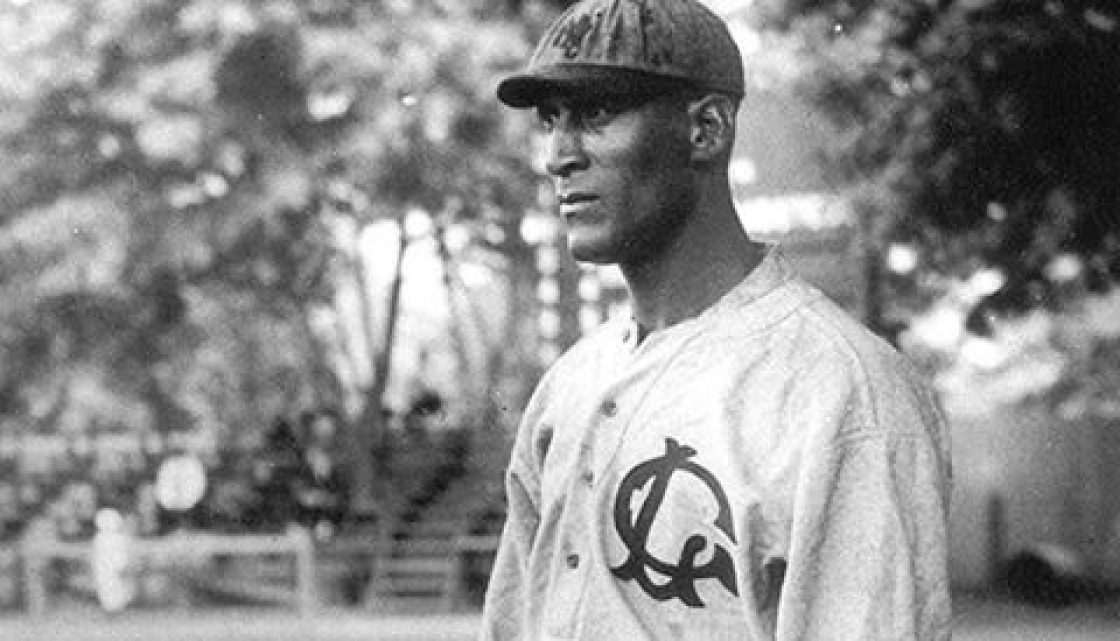
I reverted to that former self yesterday because I decided that, to a large extent, I’m done fooling around when it comes to finding out what happened to Cannonball Dick Redding in Pilgrim State  Hospital on Long Island in 1948.

Since my last few posts about this (here, here and here), I’ve been waiting to hear back from modern-day Pilgrim Psychiatric Facility about my request for the release of records from there — I’m not optimistic, given New York State’s strict patient privacy laws, even though that patient has no living relatives and has been dead for more than 65 years — and I sent a formal request for records from military services since Redding served in the Army in WWI.

But we journalists at heart are not a patient bunch. Not in the slightest. So I guess yesterday I took off the gloves and threw down the gauntlet.

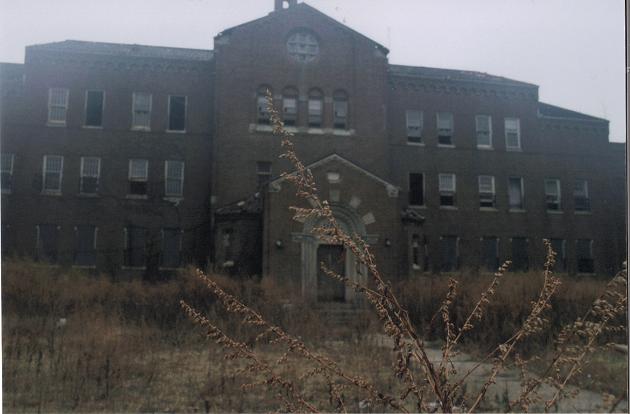
I  did so by calling up Pilgrim and asking form the public information officer at the center, Ms. Sara Kalvin. Let’s just say that during our roughly 20-minute conversation, I dropped the terms “murder,” “abuse” and “cover-up.”

Like the title of this post says, I’m done foolin’ around. And my, shall we say, aggressive questioning got Ms. Kalvin to pop out the quote with which I led off this post.

I had to explain who Dick Redding was, and I had to give some rudimentary background about what the Negro Leagues were pre-Jackie. She gave me the same basic line I’ve been hearing from various state officials regarding state privacy laws and the release of patient info. Yadda yadda yadda.

But when I said that events like murder, mysterious deaths and patient abuse were commonplace during the time of Dick Redding’s time as a patient/inmate (I used the term “inmate,” just to rattle the cage some more), that’s when she said that she could pretty much guarantee that such things never happened at Pilgrim.

“People like to think that this place is haunted, that there are specters all over the place,” she said. “But nothing could be further from the truth. We want to put an end to those  types of things, those rumors.”

At which point, of course, I pointed to documented, well reported cases of such occurrences happening at Pilgrim, as I detailed here and here.

That’s when she stammered a bit and searched for something to say. 

I then asked if, around the time of Cannonball’s death, if the autopsy and processing of the body would have taken place in-house, at the hospital,or if an investigation and autopsy would have been done by Suffolk County, N.Y., officials.

She said that “at one time in our history, we did have a morgue on site, but I’m not sure when that folded.”

She asked me why I was inquiring about this man, to which I responded that Redding was a Hall-of-Fame quality pitcher and that, indeed, many are building a case for him to be inducted into the shrine. That’s when I  said it. Impulsive? Perhaps? Tabloidy? Possible. Putting some accusational bait out there? Sure.

But this is journalism, folks. You want answers, you gotta stir the pot.

“I’m just concerned that if something bad did happen to Mr. Redding, there might have been a cover-up,” I said.

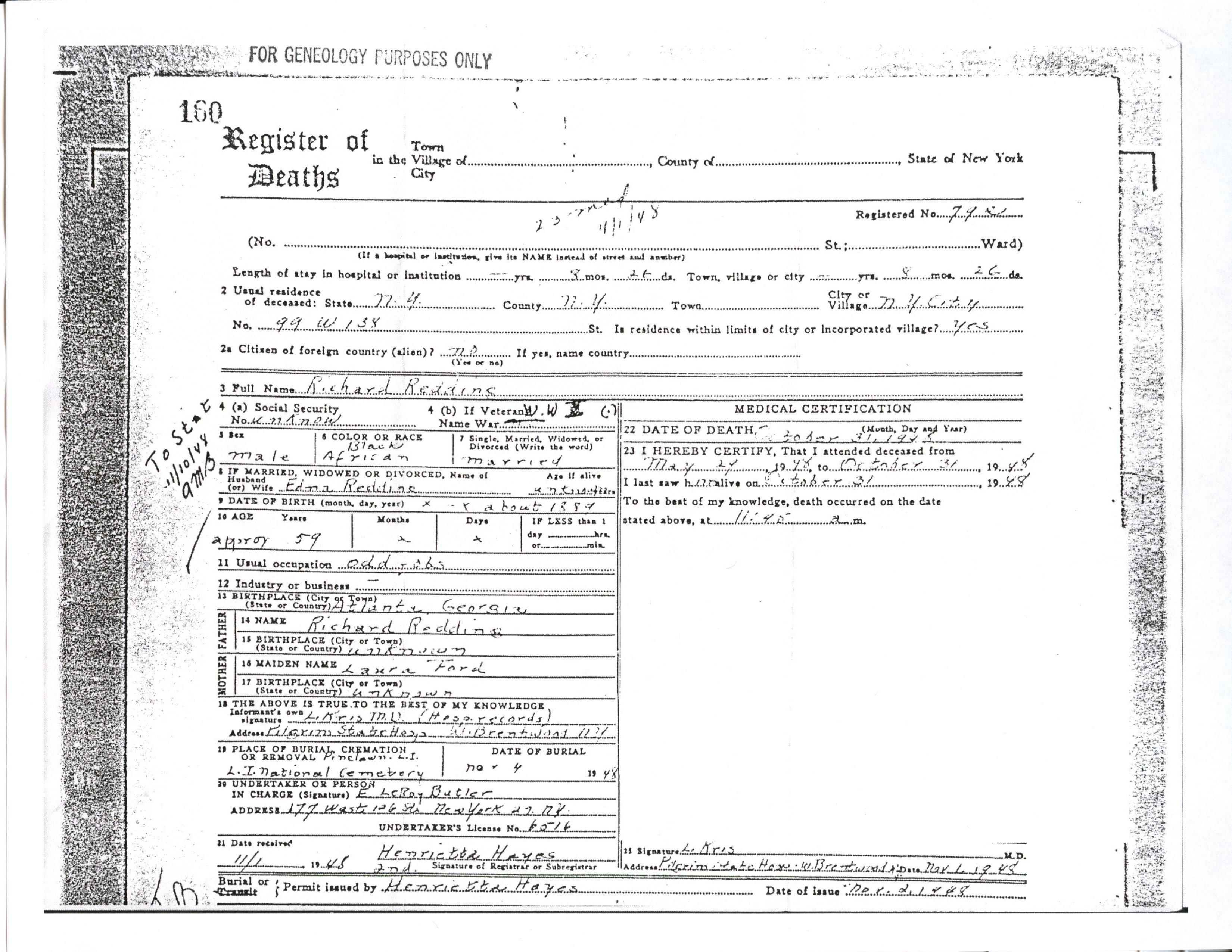
At that point, i also informed her that we, i.e. the research community, did have a copy of Redding’s death certificate, which does confirm that he was a patient at and died in Pilgrim on Halloween 1948 and that he was attended to by a doctor named “L. Kris” from May 24-Oct. 31. The cause of death, however, is whited out.
img001

We talked for a bit more, and she ended by promising to look into it and see what she could do for me, and she also promised she’d call me back.

So that was that. In a prologue to that neat little conversation, I called the Suffolk County Police Department to find out if there would have been a PD investigation of any questionable incident at Pilgrim in 1948. The officer who answered the phone looked up Redding’s name in their database and told me they had no record of an investigation by that name.

He also said that because Pilgrim was a state facility, any outside investigation would have been conducted by the NY State Police. I thus called the public information officer at the NYSP Troop L barracks and left a message. I have yet to hear back, and I’ll keep you posted.

Satch: A NOLA mystery

A query … Being first a New Orleans enthusiast and now a NOLA resident, I’ve always wondered: Did Satchel Paige, as is indicated in numerous biographies, really pitch for the New Orleans Pelicans at the end of the 1926 season, his first as a pro? I’m fixin’ to find out tomorrow …

Malloy schedule out

2014-Malloy-Conference-logo.preview

The schedule for the annual SABR Jerry Malloy Negro League Conference is out. Here’s a PDF of the presentations and other events:

program schedule

It looks like I’ll be making my presentation on Bill Binga and his rich family heritage at 9:30 a.m. on Saturday, Aug. 16, bright and early. Lots of Diet Pepsi consumption expected beforehand. 🙂

The other presentations look pretty intriguing, too. I’m looking forward to seeing Todd Peterson in action after corresponding with him via e-mail so much, and it’ll good to see Brother James Brunson again — missed him last year. Melissa Booker’s talk about Booker T. Washington and baseball looks especially alluring, as does, of course, hearing from Satchel Paige’s son, Robert, and the Stearnes family. But Vic Harris, greatest Negro League manager ever? I dunno … George Skornickel has a mighty task of convincing me …

I also hope I can make it on Thursday in time to go to Hamtramck!

Winfield S. Welch, an introduction

For a moment, let’s set aside the fact — and yes, it is a fact — that it’s ridiculous and insulting that the Baseball Hall of Fame has decreed that no more segregation-era African-American figures will be inducted into those “hallowed halls.” In essence, the grand Cooperstown institution has once again shut its doors to the Negro Leagues, even though they still remain woefully underrepresented in the Hall.

So aside the fact that a slew of induction-worthy African-American players will, apparently forever, continued to be denied their just due. What about the Negro Leagues managers, who are even more poorly represented in Cooperstown? Just look at this year’s induction roster: Three of  the half-dozen guys going in are managers.

I’m not saying that Bobby Cox, Tony LaRussa  and Joe Torre don’t deserve to go in. They do, at least certainly Torre and LaRussa (For all of his great Braves teams, Cox’s squads still only won a single World Series win, instead choking in the playoffs year after year.)

But what about the Negro League managers? What about, for example, Dave Malarcher, who some  believe is second only to his mentor, the great Rube Foster, in terms of segregation-era black skippers? That’s not to mention that “Gentleman Dave” was a true Renaissance man who more than lived up to his famous nickname.

Then there’s the case of one Winfield Scott Welch, who, like Malarcher, was a native of Louisiana. (Malarcher was from Whitehall, La., a couple stones’ throws north of NOLA, and, as I detailed in this article,  he was a graduate of New Orleans University, one of the precursors to modern-day  Dillard University.)

Welch, who hailed from tiney tiny Napoleonville, La., was so good as an on-field general that in September 1944, just about as Welch was guiding the Birmingham Black Barons to their second straight NAL title after they thoroughly dominated the league all year, the New York Amsterdam News tabbed him “baseball’s best pilot.” Welch, the story asserted, was what today would be called the ultimate “player’s coach.” Said the article:

“Many go so far as to say Welch is the greatest manager Negro baseball has ever produced, and they may not be far wrong. One look at the brilliant ball club he has fashioned, the way it hustles and plays heads-up ball at all times backs up an assertion of that kind. Sure, it’s a powerful club with every man a star, but more than that it’s a team that plays its head off for Welch. Every man on his squad idolizes him; they’d sooner lose an arm or leg than let him down.”

Birmingham_Black_Barons

By the time Welch finally retired from the gametwo decades later, he had garnered a resume not only as a stalwart coach, but a true hardball kingpin who helped keep blackball together after the integration of the majors. He became a confidante of sports magnates like Bill Veeck and Abe Saperstein — oh, for whom, by the way, Welch also coached a little basketball operation called the Harlem Globetrotters.

He had become an owner of arguably the most storied club in African-American baseball history, the Chicago American Giants. And he earned a rep as possessing one of the finest eyes for talent, and as one of the keenest developers of said talent, in the horsehide world.

And, to cap it off, he became, as many top former Negro League figures — such as, of course, Buck O’Neil — did, a major league scout, scouring the South for diamonds in the rough for the Phillies. It was in this capacity that Welch  arrived in Atlanta in the summer of 1961, at which time the Atlanta Daily World interviewed him and captured this quote from the man whose nicknames included “Lucky” and “Gus”:

“There is very little money in the minor leagues, and when I sign a ballplayer, I want to have every confidence that he can go all the way. You can ruin a kid’s life by signing him if his qualifications are doubtful. I do not sign just to show officials I am working. I may go all season without coming up with the right man, but meanwhile I am looking at every prospect with a critical eye.”

That reflective, judicious and compassionate attitude toward the game was developed over almost a half-century of immersing himself in America’s pastime, and it all began in sparsely populated Assumption Parish, Louisiana, just about at  the turn of the century. Welch earned his stripes, and his own shot at the big time, by playing for and managing some of the best local and regional teams in  New Orleans — and other Pelican State cities like Alexandria and Shreveport — for 20 years. He also organized and operated a state-wide “baseball academy” that tutored kids in the sport and nurtured their love of baseball.

The result  of that culturing — aside from an incredibly deep knowledge of and acumen for the game — was a fierce loyalty to his home state and to the Crescent City that remained throughout his fascinating baseball career. He helped cultivate, train and shepherd dozens of New Orleanians into the blackball big time, many  of whom remained with the skipper throughout their careers.

Consider this, then, the introduction of a series of posts about Winfield Scott Welch, a native Louisianian who is among the ranks of pre-integration African-American baseball figures who should be in the New Orleans Professional Baseball Hall of Fame but aren’t.

The next installment on “Gus” will come early next week, when I examine his roots in Louisiana and New Orleans and the time he spent in his home state accruing his well rounded baseball talent.

What’s coming up

Just wanted to post something really quick about what’s in the works. It might be a day or two before I can get this stuff completed and up, but hopefully I’ll get everything out by early next week.

Basically, I’ll have a couple more posts about Cannonball Dick Redding, one concerning the ongoing efforts to find out what happened to him in Pilgrim State Hospital on Long Island in 1948, the other about the history of the Redding side of his family and the search for a surviving descendant or relative.

I’ll also hopefully have a series of articles about Winfield S. Welch, a native of tiny Napoleonville, La., who developed into the most respected manager of his era in Negro League baseball.

In addition, there might be a post or two sprinkled in about the so-called New Orleans Professional Baseball Hall of Fame, as well as another post about Gretna, La., native and one-time Homestead Gray J.B. Spencer.

All that and more on “The Price Is Right.” Wait, no, I mean my blog. Yep. My blog.