I’ve hemmed and hawed about trying to monetize my blog for a long time. I’ve worried that doing so might cheapen it, because it truly has been a labor of love for, wow, a dozen years. I’m finally deciding to open it to voluntary donations. If you want to give a couple bucks, I’d be grateful, but if not, it’s no problem at all. I’ll keep doing this thing for the foreseeable future, whether it makes me money or not. I love it too much. What are your thoughts on opening this up to donations? Does it lessen what I’m doing?
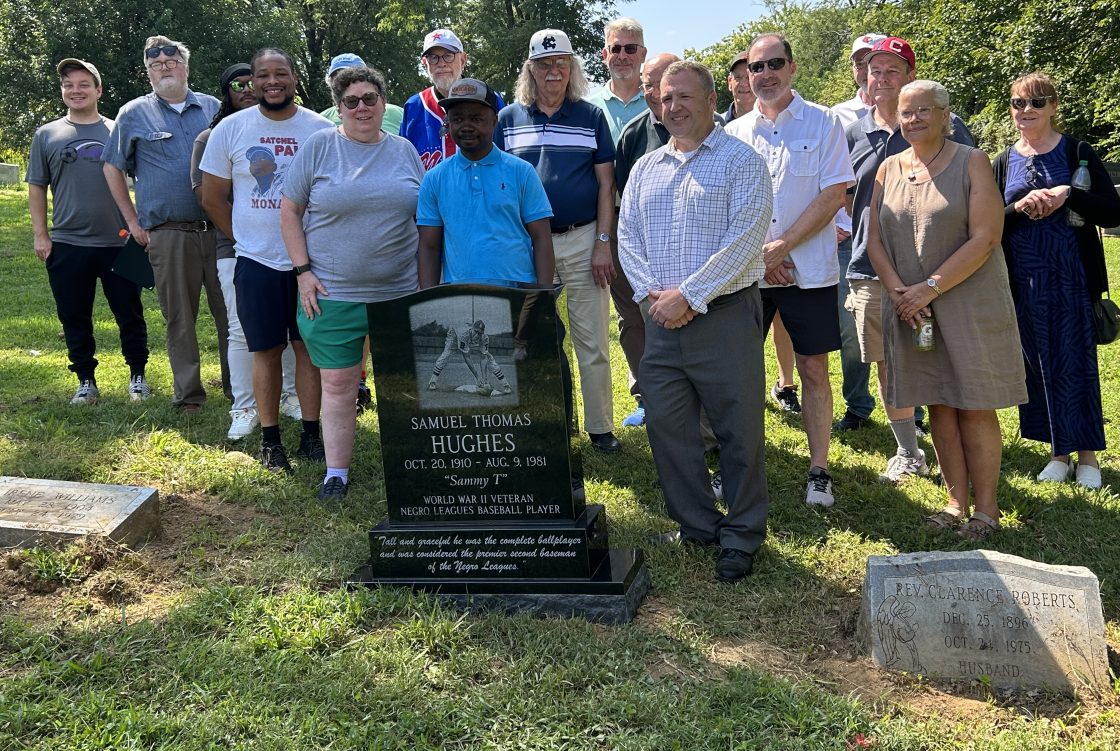
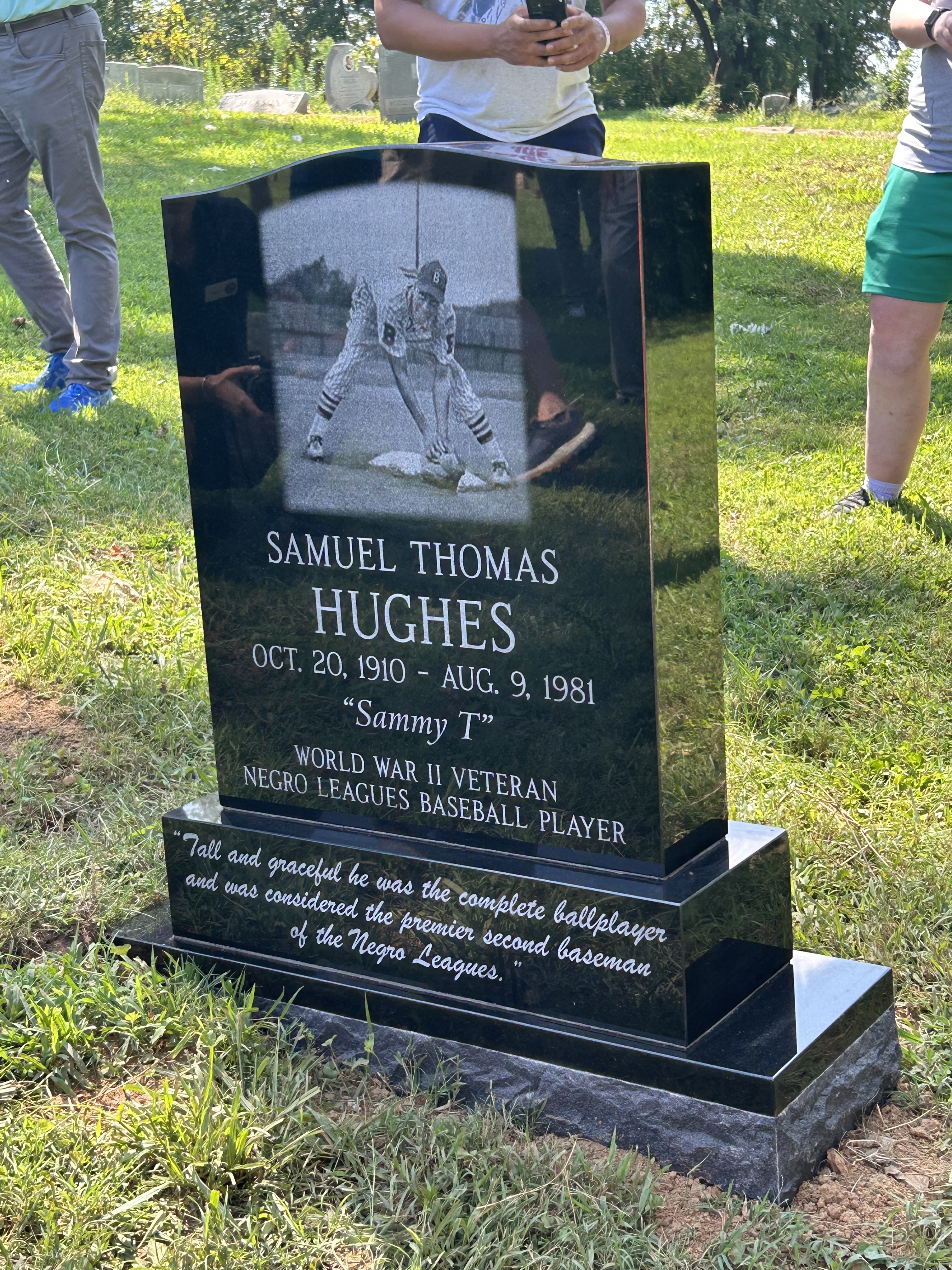
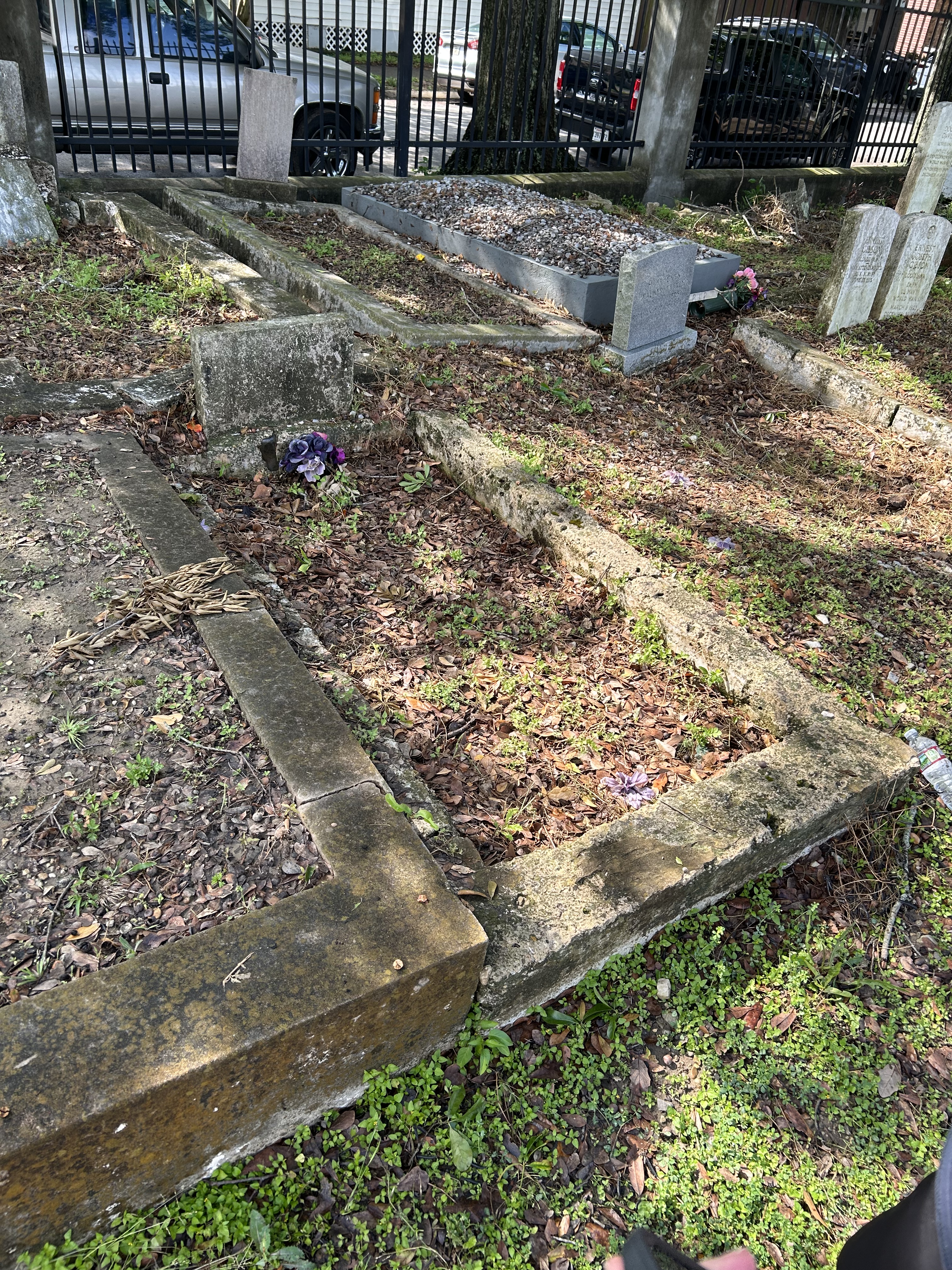
About 15 or so people gathered at Louisville Cemetery on Sunday, Aug. 10, to dedicate a new tombstone on the grave of Sammy T. Hughes, one of the best, most well rounded second basemen in Black baseball in the 1930s and ’40s.
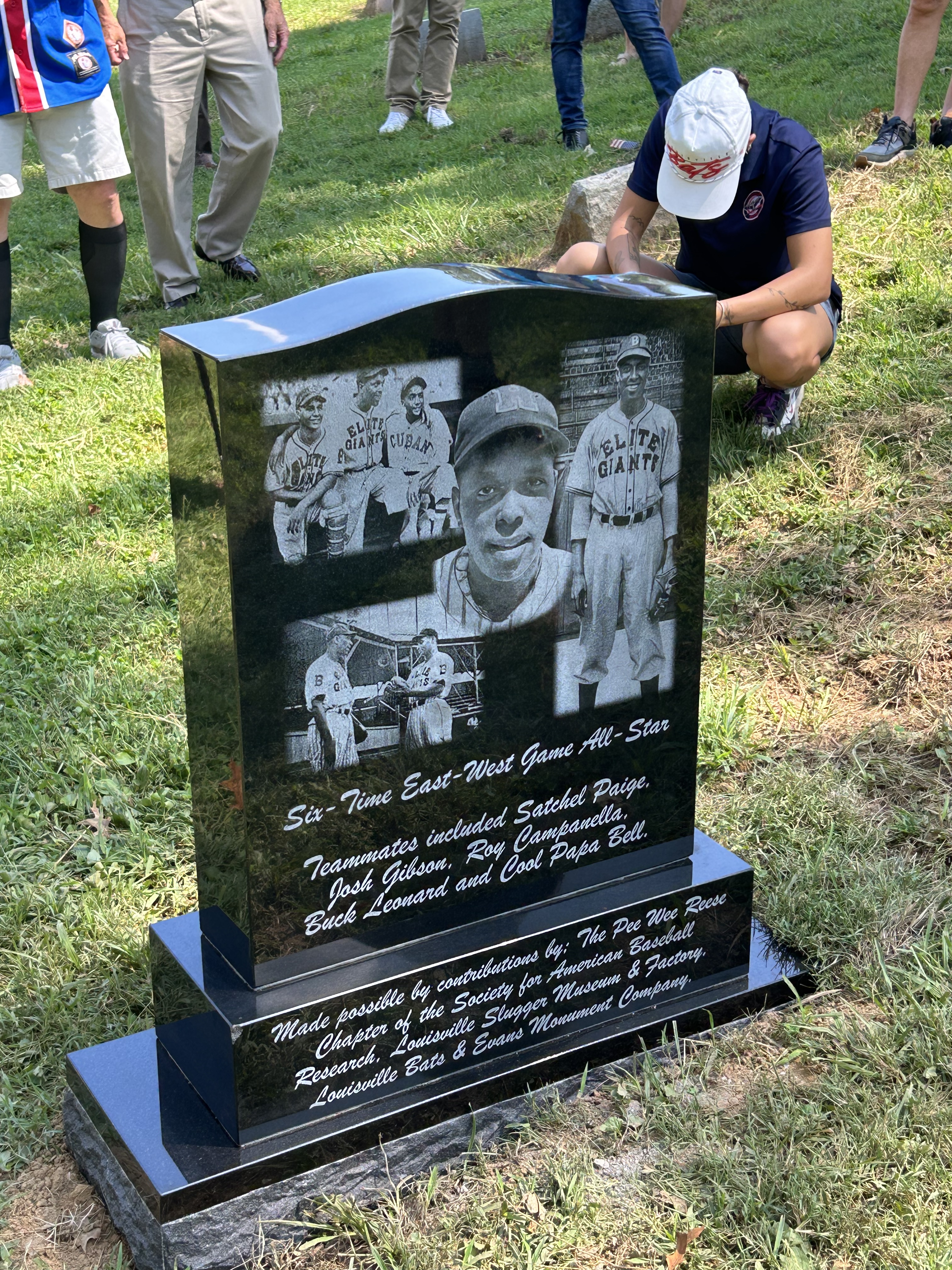
The two sides for Hughes’ new marker.
The headstone was the product of SABR’s Pee Wee Reese Louisville Chapter, said chapter president Chris Betsch. Discussion of such a project began a couple years ago, Betsch said, but the effort really picked up steam when the Louisville Chapter learned that it would host the 2025 Malloy conference.
The small gathering at Hughes’ grave began with SABR Negro Leagues Committee chair Leslie Heaphy reading a proclamation from the City of Louisville declaring Aug. 10 as Sammy T. Hughes Day in the city.
The proclamation honoring Hughes. (Photo courtesy Tad Myre.)
Betsch, during brief comments to those gathered at the cemetery that day, then said he first learned about Hughes a few years ago, when a similar effort resulted in a new headstone being placed at the grave of another Louisville Negro Leagues great, Felton Snow, in Eastern Cemetery.
Betsch said Hughes was one of the top three keystone sackers in Black baseball history, and, as such, deserves to be inducted in Cooperstown.
“Maybe someday we can rectify that,” he said.
He added that if Hughes had had such a beautiful new headstone years ago — as well as long deserved recognition from baseball and its fans — Hughes might have received the call from the Hall of Fame already.
“If he had this year’s back,” Betsch said, “maybe Louisville would be honoring Hall of Famer Sammy Hughes. You never know.”
Unfortunately, he added, “[h]e died at a time when a lot of Negro Leaguers were being forgotten.”
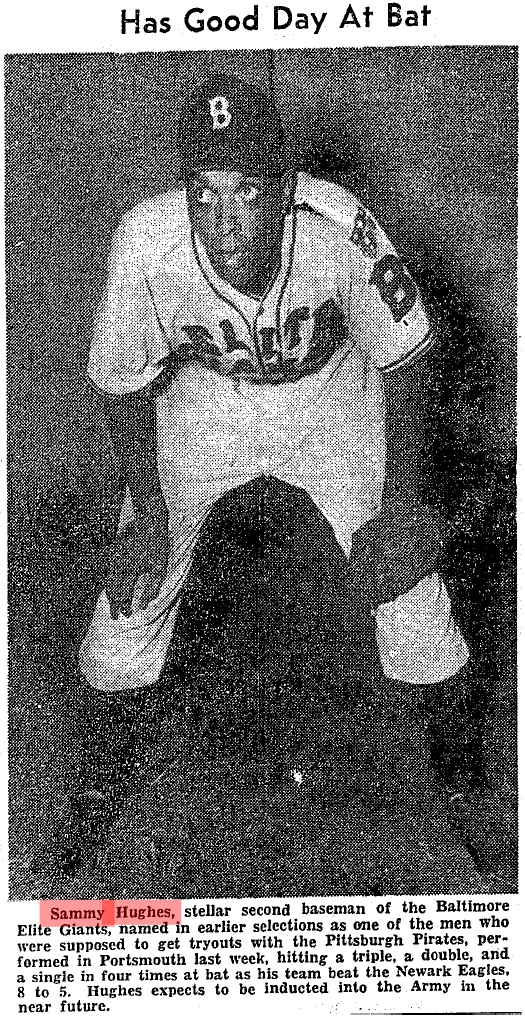
New Journal and Guide, Aug. 29, 1942
Hughes died on Aug. 9, 1981, in Los Angeles at the age of 70. He began his semipro baseball career in his teens on local Louisville teams in the late 1920s before becoming a major leaguer in 1930 when the Louisville Black Caps joined the Negro National League.
He eventually landed with the NNL’s Nashville Elite Giants and established himself as a star second baseman with the franchise for the next decade as the team moved to Columbus, then Washington, then, finally, Baltimore in 1938.
Hughes also starred for several all-star exhibition teams over his career, including an aggregation of the some of the best players in Black baseball that crushed the competition and won the title in the prestigious Denver Post Tournament in 1936.
Sammy also shined in other leagues across North America, including the trailblazing California Winter League and the upstart Mexican League. But perhaps Hughes reached the most recognition in his lifetime in 1942, when he was one of three Negro Leaguers — the others were pitcher Dave Barnhill and Baltimore teammate Campanella — invited to a tryout with the Pittsburgh Pirates.
At the time, Hughes was viewed as solid candidate to crack the color line. Norfolk New Journal and Guide sports columnist Lem Graves Jr. wrote that Hughes “is rated as one of the best in the business,” adding that the second baseman “gets our stamp of approval for this opening try.” The Cleveland Call & Post likewise stated that “Hughes is brilliant at his fielding position and is good with the stick as well.”
New Journal and Guide, Aug. 15, 1942
Unfortunately, and also perhaps unsurprisingly, the tryout never happened, meaning Hughes came agonizingly close to becoming the one who would integrate Organized Baseball, several years before Jackie Robinson did.
After a two-year stint in the Army during World War II, Hughes, despite trying to restart his baseball career, never played at his peak level again, retiring after the 1946 season and settling in Los Angeles for his later years.
Although never receiving adequate due for his baseball greatness during his lifetime, in the years since Hughes has gradually been recognized more and more as the Negro Leagues have gained their own long-overdue recognition and honors.
In his autobiography, “20 Years Too Soon,” longtime Negro Leagues catcher Quincy Trouppe named Hughes as one of the Blackball players who could have made the Majors if given the chance. Trouppe also listed Hughes as a utility infielder on Trouppe’s “Number One All-Time Team.” (George Scales was the assigned second baseman on Trouppe’s team.)
In a 1978 newspaper article, groundbreaking author John Holway listed Hughes as one of the 10 Negro Leaguers “most eligible” for induction into the NBHOF, writing that Hughes was “one of two top second basemen in blackball annals — Campanella says the best.” (Holway also interviewed Hughes for the former’s most influential books, “Black Giants.”)
The Baltimore Sun, in a retrospective of that city’s connections to and involvement in the Negro Leagues, stated this about Hughes: “The premier second baseman in the Negro Leagues was a solid contact hitter and magnificent fielder.”
I think a lot of people’s feelings about Hughes can be summed up by writer and artist Gary Cieradkowski, who wrote an excellent biography of Sammy T. at his Web site, in which Gary powerfully advocates for Hughes’ inclusion in the Hall.
“Every time the Hall of Fame convenes one of their Negro League committees,” Cieradkowski wrote in April 2024, “Sammy T. Hughes’ name makes the conversation, but he’s always pushed aside for players of seemingly lesser talent who played for better-known teams or had friends among the powers-that-be. Someday the Elites’ second baseman may get the recognition he deserves, but until then, Cooperstown is not complete because Sammy T. ain’t in there.”
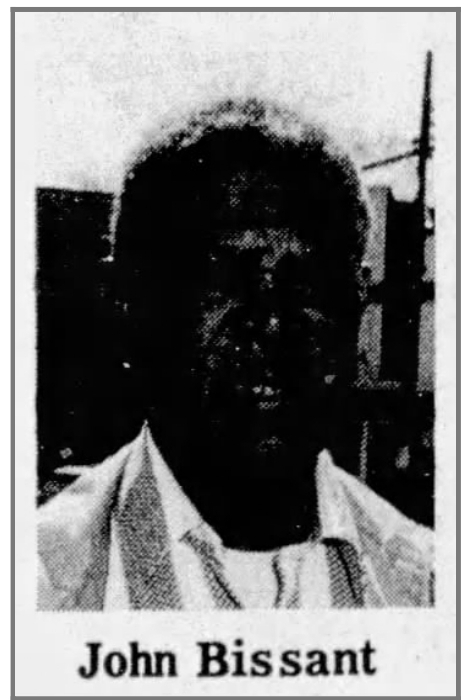
I’ve been delaying this post to account for all the most recent progress made on this project, but I think I can finally provide a substantive update on the effort to place a new marker at the grave of New Orleans athletic legend and Chicago American GiantJohn Bissant.
It’s going to happen.
We have all the key players in step with the project.
Jeremy Krock, founder and president of the famed Negro Leagues Baseball Grave Marker Project, says that once the group has funding open up – probably after the start of the New Year – the Bissant grave will be one of the markers slated by the NLBGMP for 2026.
Charisse DeLois Smith, John’s granddaughter, has given her support and help on the part of Bissant’s family.
And Jessica Strawn, Acting Cemeteries Superintendent at the City of New Orleans’ Cemetery Division, has connected with the team to provide information that will help move the project along and to offer moral support for the grave marker effort. She also said City staffers can assist in placing the new marker once it’s ready.
(For earlier posts about Bissant, his grave and Carrollton Cemetery, check out this, this and this.)
Several years ago I pitched the idea of a grave marker for Bissant to Jeremy, and, after some discussions, he decided to climb on board with the project. There’s never been an NLBGMP marker placed in or near New Orleans, I wanted to generate more recognition for New Orleans Black baseball, and Jeremy said he’d been thinking about getting an effort going in the South. It all dovetailed.
(Although there’s never been an NLBGMP marker placed in this region, there has been a similar project taking place here. In 2013, a group effort helped place one on the grave of Wesley Barrow in the City of Gretna, just across the Mississippi River from downtown New Orleans.)
John Bissant’s family sporting jerseys honoring him. (Photo courtesy Charisse Wheeleer.)
Meanwhile, I was able to connect with Charisse to learn more about John Bissant, and to raise the possibility of placing a new marker at her grandfather’s final resting place. As it turned out, she and her family had been working independently to honor John’s memory and get his name out into the public, including producing amazingly cool Bissant jerseys.
Getting the City of New Orleans on board was the most challenging venture. After months and months of trying to contact anyone at the Cemeteries Division to frustratingly no avail, I used my connections as a news reporter for The Louisiana Weekly, I emailed City Councilman Joe Giarrusso, whose Council district includes Carrollton Cemetery (it also includes my neighborhood, coincidentally), and whom I’d interviewed a few times for news stories for The Louisiana Weekly.
That unclogged the pipeline, and a City grounds employee called me within a couple days, which set in motion a process that led to Jessica emailing me and offering her and the City’s full help early this year.
Some more email correspondence, a phone call and Zoom session or so, and we scheduled and attended a group meeting in front of John’s grave in Carrollton Cemetery on April 2 of this year. We all introduced ourselves to each other, then touched base about what was left to be done to make a new marker a reality. (Jeremy, who lives in Peoria, Ill., obviously wasn’t able to attend, but I emailed him with details of what happened at the gathering.)
The biggest sticking point was the fact that the grave included two other people besides John, but a little hashing it out seems to have solved the issue – Jeremy and I will work on getting the marker for John Bissant produced (me doing a draft of the text, him securing funding), and Charisse said she and her family would investigate a smaller marker or something similar acknowledging her other two family members.
It must be noted that a tombstone does already stand at the grave, but it’s been so exposed to the elements and worn down by the weather that the text on it is completely obscured and illegible.
And that’s basically where things stand at this point. I’m working on the text, Charisse is looking into the other stone, Jeremy is waiting for funds to free up, and Jessica is coordinating on the City’s end and offering to assist whenever possible. I’m hoping that when we can get the marker installed, we might be able to do an unveiling or dedication event at the grave.
I actually spoke with Jeremy a couple weekends ago, when we both attended SABR’s Jerry Malloy Negro League Conference, which was held this year in Louisville. He and I were able to touch base in person and coordinate a bit on what the next steps are. Plus, it was just really good to see him.
Plus, last month I attended the regular meeting of the Schott-Pelican New Orleans chapter of SABR, where I updated attendees about the Bissant grave project, and I made a pitch for any assistance or support the chapter wanted to provide, including possible additional funding. (The chapter recently received a $500 grant from SABR headquarters, and for the last few local meetings, we’ve talked about how we can recognize and honor Black baseball in New Orleans, including getting a historical marker placed somewhere in the city. But hopefully more on that later.)
“My passion is to try to hold baseball accountable, and to particularly hold Major League Baseball accountable,” Gordon said Saturday at the 25th annual Jerry Malloy Negro League Conference in Louisville, “for why there aren’t more African-American kids in the sport.”
Gordon was attending his second Malloy conference after last year’s in Cooperstown, and on Saturday, he acted as emcee for the slate of presentations in the afternoon. However, he was soon called to do even more – because one scheduled presenter had to cancel at the last minute, Gordon was asked to pinch hit and fill in the vacant time slot.
He crushed it.
Using swift improvisation skills, he talked about his time as an educator and a youth baseball coach and how he’s seen a continuous dearth of diversity in the national pastime, beginning with youth teams and Little League and running right up through Major League Baseball.
He noted that on Opening Day 2025, only 6.2 percent of MLB rosters consisted of American-born Black players. He said that after Organized Baseball gradually increased in diversity post-1946, a process that peaked on Sept. 1, 1971, when the Pittsburgh Piratesfielded an all-players-of-color lineup in a game.
However, in recent decades, that progress has gradually reversed to the point that aspiring young, Black baseball players have fewer and fewer role models in the big leagues.
“That [gradual change] also happens when [diversity] is taken away,” he said. “You take a little, then you take a little more, you take a little more …”
The key to stopping that gradual decrease is access to the best learning, training and playing opportunities on the youth level – particularly the elite, regional travel teams that attract pro scouts and coaches.
And that access usually only comes with resources – particularly money. Money to be able to afford all the equipment, the travel expenses, the membership fees and the registration costs that come with those elite programs.
“If you don’t have any resources [to travel],” Gordon said, “you won’t be seen by a scout or by a college coach.
“The key word,” he added, “is access.”
Gordon cited the Cincinnati-area travel team he coached after the Covid pandemic. He said that because there were no other such teams within a 300-mile radius of Cincinnati, the squad turned out to become the best he’s ever coached and one of the best in the Cincy area in general.
He said the team was also one of the most diverse teams he’s ever piloted, with a roughly 50-50 split between white players and players of color, even though the costs of maintaining the team was unbelievably expensive – one road trip cost $10,000 just for lodging, reflecting the hurdles players, their families and their supporters must clear.
For a lot of aspiring Black players, such expenses are impossible to meet.
“The social and economic restrictions are extremely prevalent in baseball,” he said.
Gordon added: “Baseball has become a country club sport.”
The result is that many Black kids, especially those from urban areas, just can’t get the exposure and training to build any potential career in baseball.
“If you don’t put them in these opportunities and give them these experiences,” Gordon said, “they’re not going to get the access they need.”
He said that creates a reality that can’t be denied.
There’s still a racialization in baseball. We all know it’s true.
Clarence Gordon
“There’s still a racialization in baseball,” Gordon said. “We all know it’s true.”
In addition, many young players of color often have their enthusiasm for the sport crushed by coaches who still hold stereotypes about Black players. For example, a young kid might love playing a heady position like shortstop, but their coach tells them to switch positions, still believing that Black players are best in supposedly less brainy, more athletic-ability-based spots on the field.
“That joy gets killed,” he said. “You always get moved from shortstop to the outfield, and you’re not having fun anymore. You lose that joy.”
Part of the fix for these challenges in increasing diversity in baseball is finding ways to inspire youth of color to pursue baseball and infuse them with faith in themselves.
That’s where the Negro Leagues can come in, Gordon said. By learning about the Negro Leagues and all the talented, legendary players who filled their ranks, African-American kids can see that players who look like them can, in fact, succeed in baseball. That gives them the faith and ambition needed to succeed themselves.
“We need to get the information to them,” he said.
He added, “We should retain them by sharing our knowledge, telling our stories, allow them to see their heroes.”
Moreover, spreading knowledge of the Negro Leagues to adults – from parents to coaches to funding donors of all colors and ethnic backgrounds – those adults can see that enthusiasm for and talent in the Black community can exist and and, as a result, be encouraged to invest their own time and financial contributions.
“We need to have the people to make these changes happen,” he said.
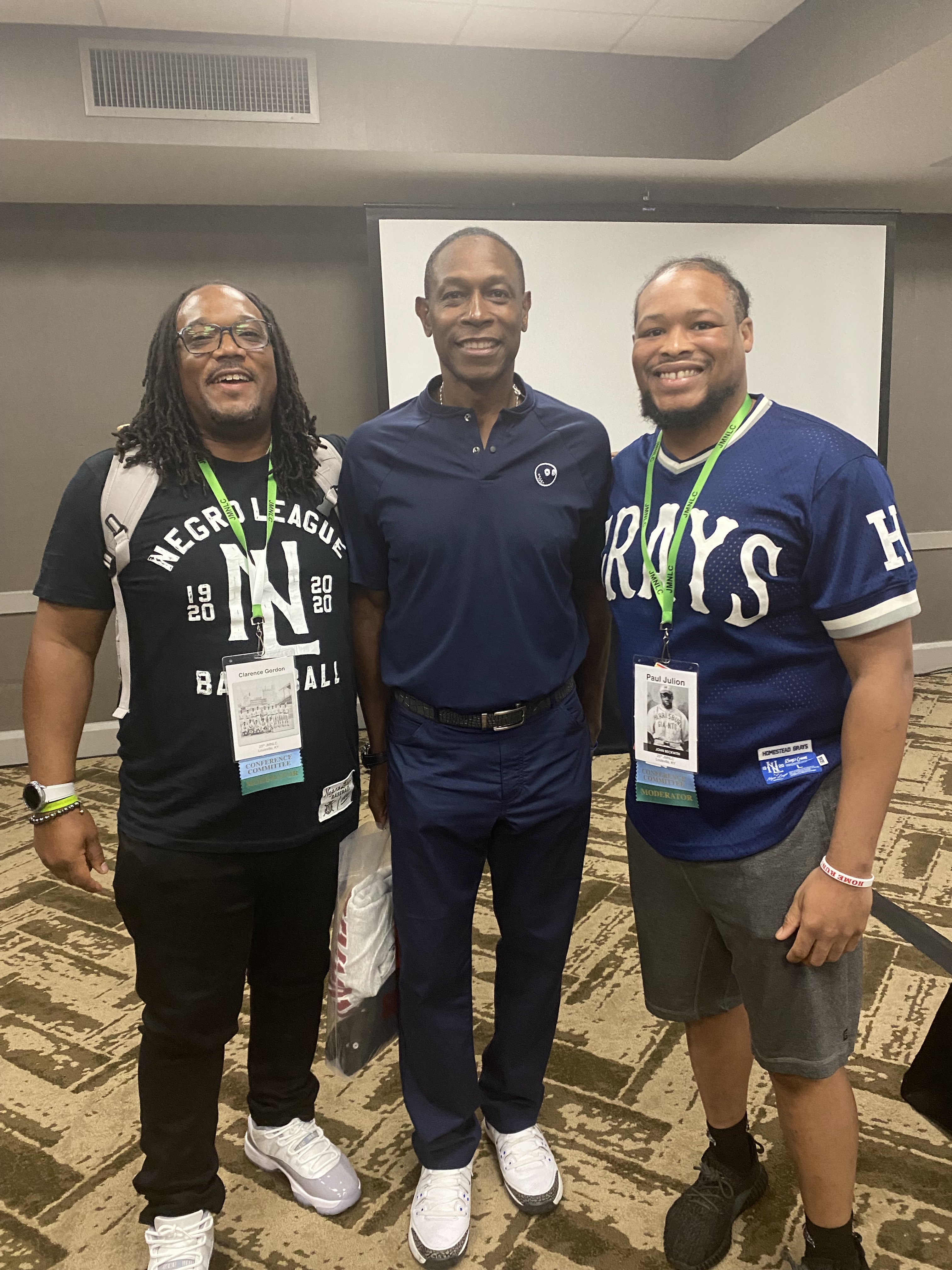
Kenny Lofton (center) with conference attendees Clarence Gordon (left) and Paul Julion (right). Photo courtesy of Paul Julion.
So far, the 2025 Jerry Malloy Negro League Conference being held in Louisville has knocked it out of the park, as it were, and I’m planning on writing/posting more over the next week or so, but I wanted to highlight one special happening in particular right now …
Yesterday (Saturday, Aug. 8), the slate of presentations and panels concluded with a visit from a surprise guest — former MLB star outfielder (and oughta-be Hall of Famer) Kenny Lofton, who helped put together and produce a fantastic documentary, “I Forgot to Tell You: The Story of the Cleveland Buckeyes,” which was screened for us attendees in the afternoon, followed by a four-person discussion panel.
The quartet of panelists included Lofton; Evelyn Pollard-Gregory, the director of the documentary; and Cleveland baseball historians Vince Guerrieri and Wayne Pearsall, whose lively and quite informative presentation on the history of the Buckeyes, who were members of the Negro American League during the 1940s and won the 1945 Negro World Series, preceded the screening and panel.
While all four panelists offered excellent thoughts and comments — and I hope to eventually post a detailed follow-up interview with Pollard-Gregory about the film — Lofton was the star of the session, not just because he was a former baseball All-Star, but also because his input and insights were captivating and quite colorful.
One of the main thrusts of his comments during the panel was his, Pollard-Gregory’s and other filmmakers’ primary goal with the documentary — at a time when the notions of diversity, equality and justice are being attacked by reactionary politicians, educators and governmental operatives across the country, it has become more important than ever to keep history, and African-American history specially, explored and alive.
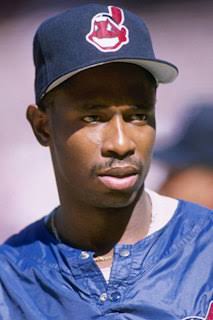
Lofton during his playing days.
“For me, knowing what’s going on in society right now, I didn’t want this history to be forgotten,” he said. “I didn’t want the younger generations to forget it.”
That’s why he wanted to help Pollard-Gregory and the rest of the filmmakers assemble “The Story of the Cleveland Buckeyes.” Once he learned of the documentary and saw the outstanding work of Pollard-Gregory and others, he jumped right in through his own film production company, FilmPool, Inc.
“I told them, ‘You really have something here, but it could be a lot better,’” Lofton said.
Lofton said the process of editing down all the phenomenal and selecting the best content for the film was a long, exhausting but ultimately rewarding experience.
“I sat there for hours trying to figure out what stuff I could use in this project,” he said. “I ended up putting together this great product.”
Lofton, who himself played for the Cleveland Indians (now the Guardians) for about 11 and a half years total, added that the documentary “has to flow. There was a little bit of extra stuff we had to do to get it to flow.”
Lofton said it’s especially important to do all we can to preserve and honor the fight for diversity, justice and equality that got us to this point. He said that must happen even with current threats – both governmental and corporate – to that process occurring now.
Passing the flame to youth, he said, is a top priority.
“We’re trying to find ways to get that process to the kids,” Lofton said.
He added: “Once we do something, it has to be successful. We can’t do it just to do it.”
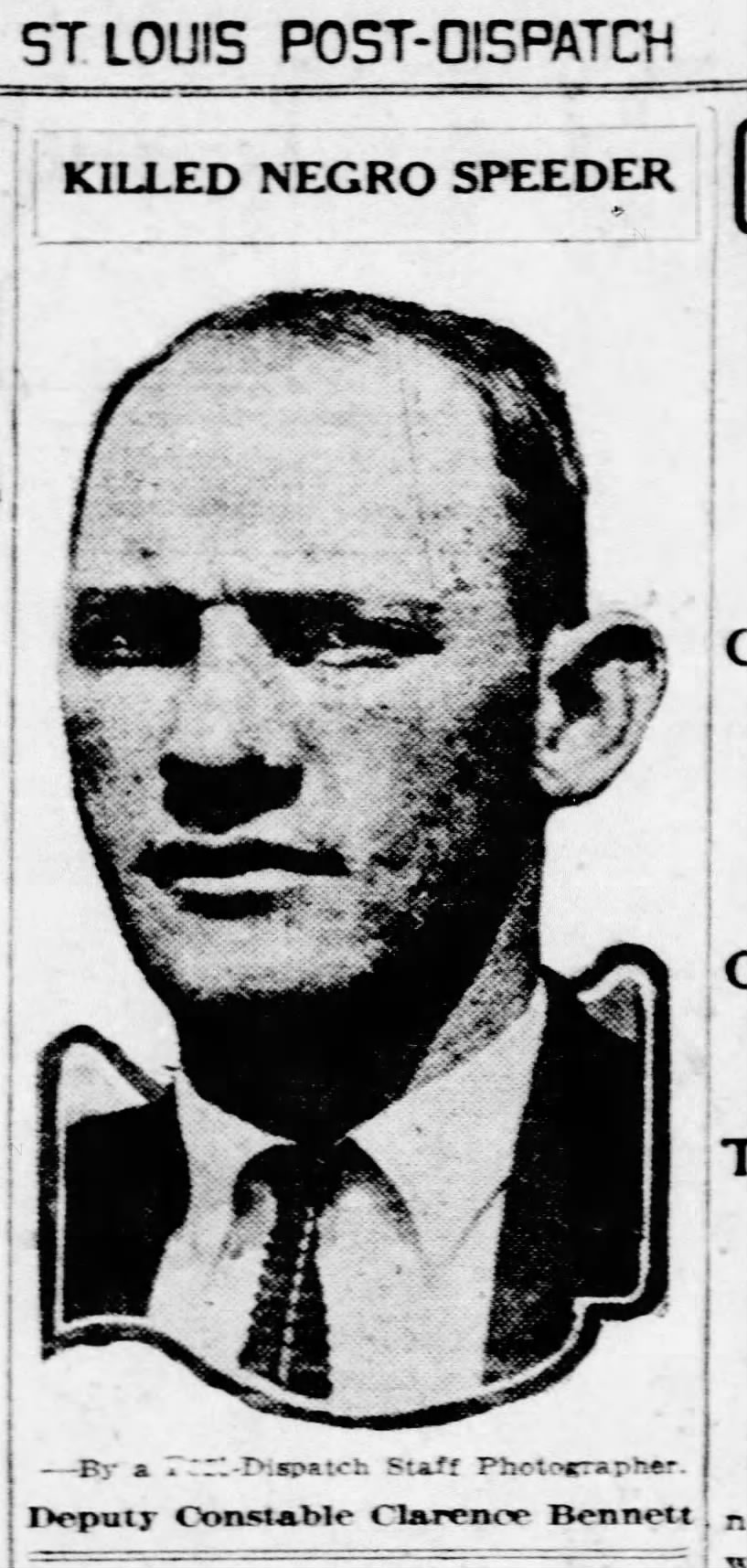
Exactly 100 years ago today – Aug. 1, 1925 – a baseball team owner was lynched by two deputy constables in St. Louis County, Mo., when a racism-fueled traffic stop ended with a beating and fatal shooting of a Black man on his way to one of his team’s games.
And make no mistake about the way Fred Goree died that night – it was cold-blooded murder at the hands of St. Louis County deputies Clarence E. Bennett and Charles J. Schuchman, both of whom escaped their crime without any legal or service consequence.
I previously blogged about Goree’s death here and here, but my reporting in those posts contained inaccuracies and left out some key pieces of the picture of Fred Goree’s life and death. I tried to be as accurate and factual as I could given the resources and information I had at that time, but the picture I painted was incomplete and not in focus.
I also wasn’t able to speak with or interview any of Fred Goree’s family members, which was absolutely detrimental to my blog posts.
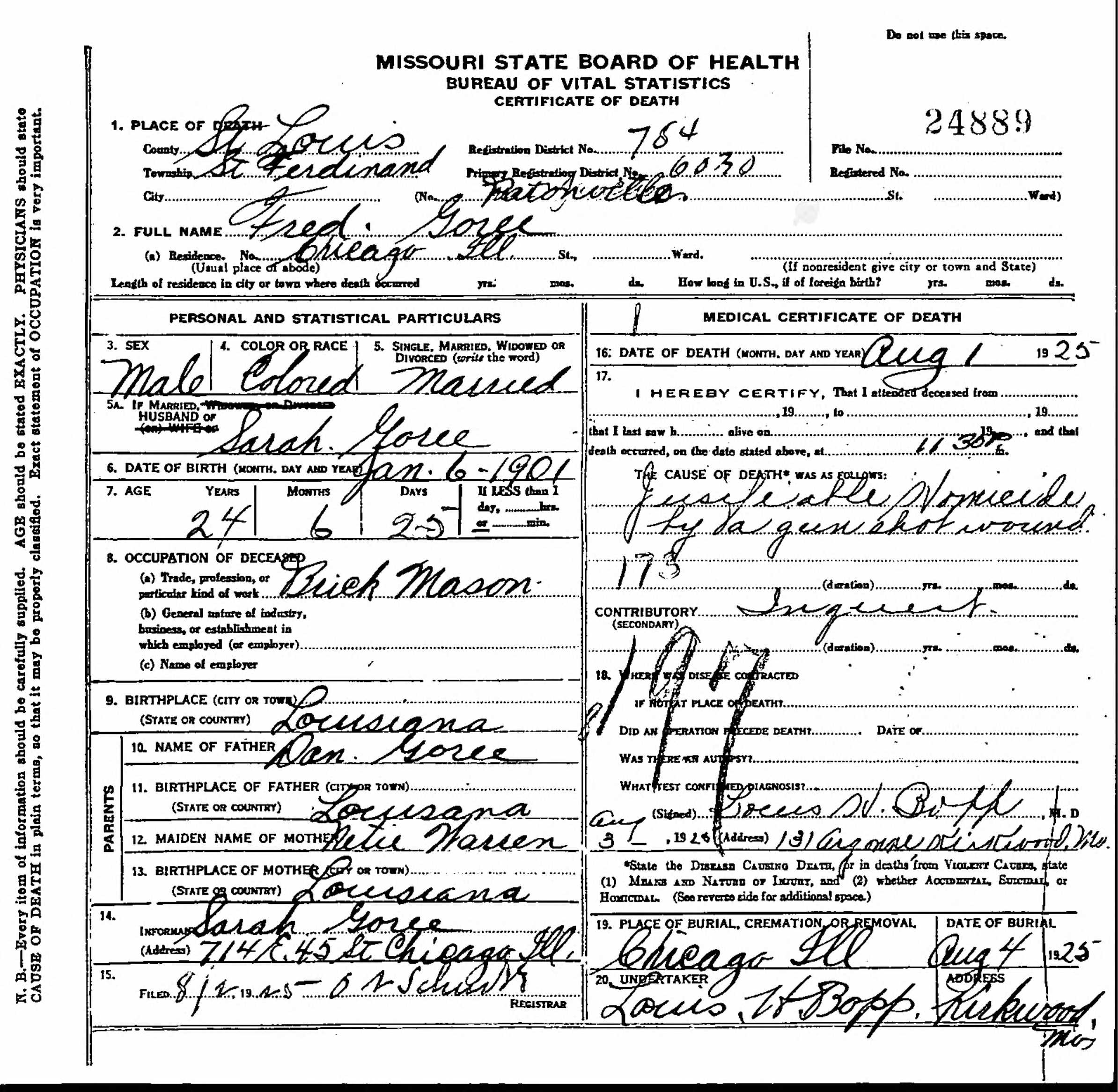
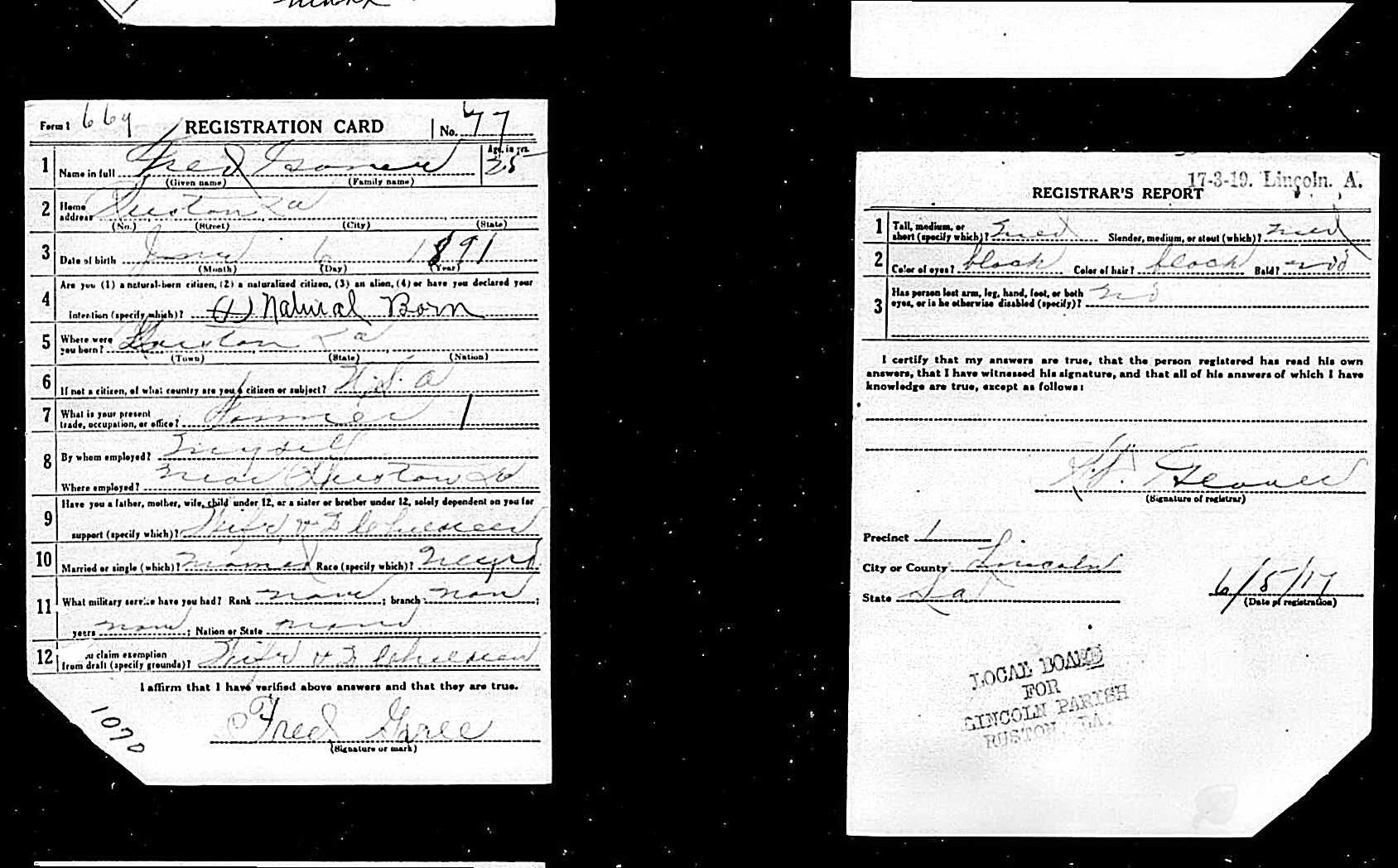
An example: I previously reported that Goree was about 24 and a half years old when he was killed, but that was inaccurate – he was actually 33. I based my first age estimate on his death certificate, which lists his date of birth as Jan. 6, 1901 when it was actually 1892. To make matters more confusing, his World War I draft card lists his DOB as Jan. 1, 1891.
Fred Goree’s World War I draft card.
A much fuller, more accurate and more comprehensive article about that tragic night a century ago can be found here. It includes interviews with two of Goree’s granddaughters, which obviously provides it with much richer details and more complete accuracy, tone and meaning.
It also places Goree’s death into a larger historical context, such as his family’s move north from small-town Louisiana to the metropolis of Chicago as part of the Great Migration; the constant, oppressive threat of violence and death facing African Americans at the time; and the biased, one-sided way the contemporaneous mainstream media of the day painted such events as Goree’s murder with a coat of whitewash and quite often portrayed Black residents in a pervasive, insidious way.
It’s an excellent article, but a good chunk of it is dedicated to describing and explaining many of the basics of Negro Leagues history – something that many readers of this blog already know pretty well.
The article also does leave a few questions and mysteries left unanswered and unsolved. For example, the identity of the deputy county constable who assisted Bennett in killing Goree is not revealed, and the fates of these two law enforcement officers following the murder remain unexplored. In addition, the article lacks any details about Goree’s baseball team, the Chicago Independent Giants, for which little has been discovered in the near-decade since the story’s publishing; and only St. Louis-area media outlets are cited by the writer.
In the next weeks and months, I’m going to try to provide a little more clarity to such questions in periodic posts about Fred Goree and the story of his brief life and brutal, tragic death. I’m also hoping to interview one or more of Fred Goree’s descendants this time around.
****************
While I’m hoping to go into more detail about these soon, there are a few things that I’ve found that I hope can add to the Fred Goree story.
The first is the identity of the second St. Louis deputy constable who joined the primary perpetrator, Clarence Bennett, whose role in the murder was well reported and known at the time, as was his galling exoneration by an all-white grand jury that took just three minutes to officially slander Fred Goree’s name and paint Bennett as a hero acting in self-defense.
Articles about the incident both at the time and in more recent years only referred to the second officer’s last name, if he was named or identified at all. But I was able to uncover his name – Charles J. Schuchman (or Schuchmann), who was apparently a mere 17 years and 11 months old at the time of the murder.
In addition to his youth, Schuchman himself died in a very sudden, violent way – according to his death certificate, he was just 21 when he died from a gunshot wound to the head on Oct. 3, 1928 in what the coroner ruled an “unavoidable accident.” Below that cause of death, the word “Inquest” is scribbled on the document.
I’ve been unable to find any information about Schuchman’s death in the newspapers of the time, aside from a small obituary in the “deaths” section that stated that he died “suddenly.”
But Schuchman wasn’t the only one of the homicidal pair to meet with bloody violence in the years after they killed Fred Goree – Bennett himself also ended up meeting the business end of a bullet.
Less than a year after Goree’s killing, in May 1926, was shot in the face, with two fragments of the bullet lodging in his jaw, after breaking up what was reported by the St. Louis Post-Dispatch as a robbery.
Unlike Schuchman, however, Bennett survived his encounter with violence and, in fact, went on to a lengthy, successful career in law enforcement and criminal justice before passing away in Ruskin, Fla., in 1971 at the age of 76.
St. Louis Post-Dispatch, Aug. 3, 1925.
I also found several references in contemporaneous media of what could of what could be Fred Goree’s baseball team, whose barnstorming slate led him to drive from his home in Chicago to St. Louis County that day and night.
In the spring of 1925, a small handful of newspapers referred to one or more semipro teams as the Chicago Independents or the Independent Giants. The May 3, 1925, issue of The Chicago Tribune lists an upcoming game in something called “Bob Figg’s League” between the Chicago Independents and a team named the Mason Parks in Evanston, Ill.
Then, on May 17, the Tribune, in its listing of slated semipro games, refers to a contest between the Independent Giants and the Cragens, while in mid-June The Daily Herald of Arlington Heights, Ill., reported on a clash between the hometown team and the Chicago Independents that was won by the townies, 8-2. The Herald article included this description:
“The Chicago club lived up to their name when practicing before game time, displaying some nifty and fast playing acting independent as five at the same time. It sure looked as if the Heights boys were in for a beating, but as the game started our boys were there with the smoke, which changed the opinion of some three hundred fans who turned out to witness the combat.”
The paragraph seems to describe the Independents performing some quick trickery with the ball before the contest started, perhaps shadow ball, something Black teams of the day often undertook at games in order to draw in and entertain fans.
Now, granted, none of that was major news; it was all just quick jottings, a line or three about semipro teams here and there. In addition, none of the newspapers explicitly stated that the Chicago Independents or Independent Giants were African-American teams. But the brief mentions at least provide a couple small leads in the quest for information.
The Chicago Defender, Aug. 8, 1925.
Finally, while the Aug. 7, 1925, edition of The St. Louis Argus, an African-American newspaper from that city, contained a more detailed and more graphic article on Goree’s murder, the nation’s leading Black publication, The Chicago Defender, published an article about the incident as well on Aug. 8.
The Defender story noted that Goree and his team had been motoring from their home base in the Windy City to the St. Louis area to play a local team from St. Charles, Mo., a St. Louis suburb. However, the paper stated, one of the team’s cars had broken down on the way in Effingham, Ill., forcing Goree to turn his new Buick around and return to Effingham to rendezvous with his stranded team members.
It was on that back-tracking venture that Goree and the other occupants of his vehicle were followed and pulled over for what Bennett said was “speeding,” a development that led to the lynching.
The Defender article also named the two passengers in Goree’s car at the time – 22-year-old Pullman car-washer Frenchy Henry of Chicago, and Harry Gaulden of St. Charles.
For now, I’ll leave things here, with hopefully more to come gradually in a while. With any luck, I’ll be able to do a more thorough and accurate job this time. Fred Goree and his memory deserve nothing less.




 The Negro Leagues Up Close