Exactly 100 years ago today – Aug. 1, 1925 – a baseball team owner was lynched by two deputy constables in St. Louis County, Mo., when a racism-fueled traffic stop ended with a beating and fatal shooting of a Black man on his way to one of his team’s games.
And make no mistake about the way Fred Goree died that night – it was cold-blooded murder at the hands of St. Louis County deputies Clarence E. Bennett and Charles J. Schuchman, both of whom escaped their crime without any legal or service consequence.
I previously blogged about Goree’s death here and here, but my reporting in those posts contained inaccuracies and left out some key pieces of the picture of Fred Goree’s life and death. I tried to be as accurate and factual as I could given the resources and information I had at that time, but the picture I painted was incomplete and not in focus.
I also wasn’t able to speak with or interview any of Fred Goree’s family members, which was absolutely detrimental to my blog posts.
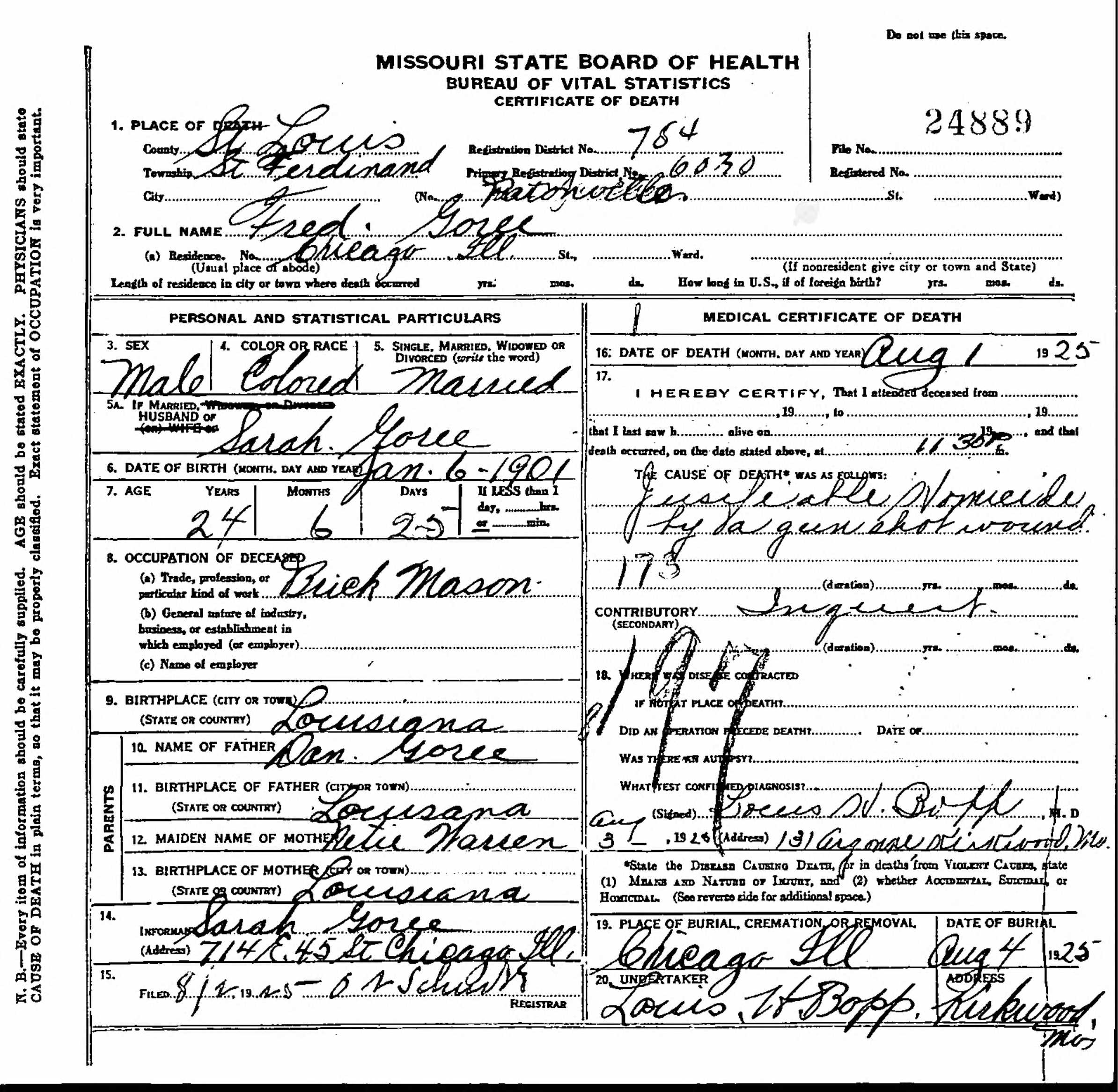
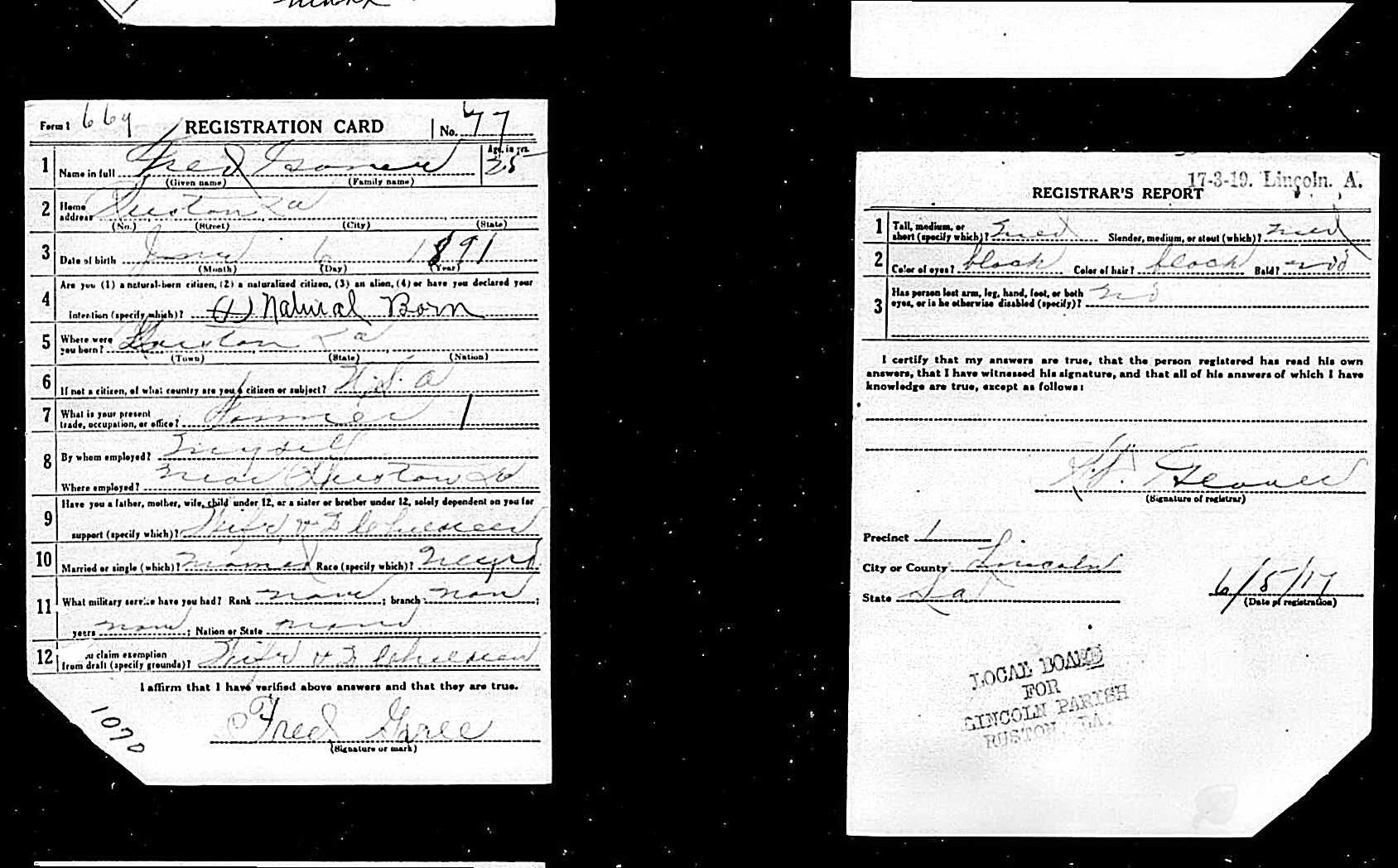
An example: I previously reported that Goree was about 24 and a half years old when he was killed, but that was inaccurate – he was actually 33. I based my first age estimate on his death certificate, which lists his date of birth as Jan. 6, 1901 when it was actually 1892. To make matters more confusing, his World War I draft card lists his DOB as Jan. 1, 1891.
A much fuller, more accurate and more comprehensive article about that tragic night a century ago can be found here. It includes interviews with two of Goree’s granddaughters, which obviously provides it with much richer details and more complete accuracy, tone and meaning.
It also places Goree’s death into a larger historical context, such as his family’s move north from small-town Louisiana to the metropolis of Chicago as part of the Great Migration; the constant, oppressive threat of violence and death facing African Americans at the time; and the biased, one-sided way the contemporaneous mainstream media of the day painted such events as Goree’s murder with a coat of whitewash and quite often portrayed Black residents in a pervasive, insidious way.
It’s an excellent article, but a good chunk of it is dedicated to describing and explaining many of the basics of Negro Leagues history – something that many readers of this blog already know pretty well.
The article also does leave a few questions and mysteries left unanswered and unsolved. For example, the identity of the deputy county constable who assisted Bennett in killing Goree is not revealed, and the fates of these two law enforcement officers following the murder remain unexplored. In addition, the article lacks any details about Goree’s baseball team, the Chicago Independent Giants, for which little has been discovered in the near-decade since the story’s publishing; and only St. Louis-area media outlets are cited by the writer.
In the next weeks and months, I’m going to try to provide a little more clarity to such questions in periodic posts about Fred Goree and the story of his brief life and brutal, tragic death. I’m also hoping to interview one or more of Fred Goree’s descendants this time around.
****************
While I’m hoping to go into more detail about these soon, there are a few things that I’ve found that I hope can add to the Fred Goree story.
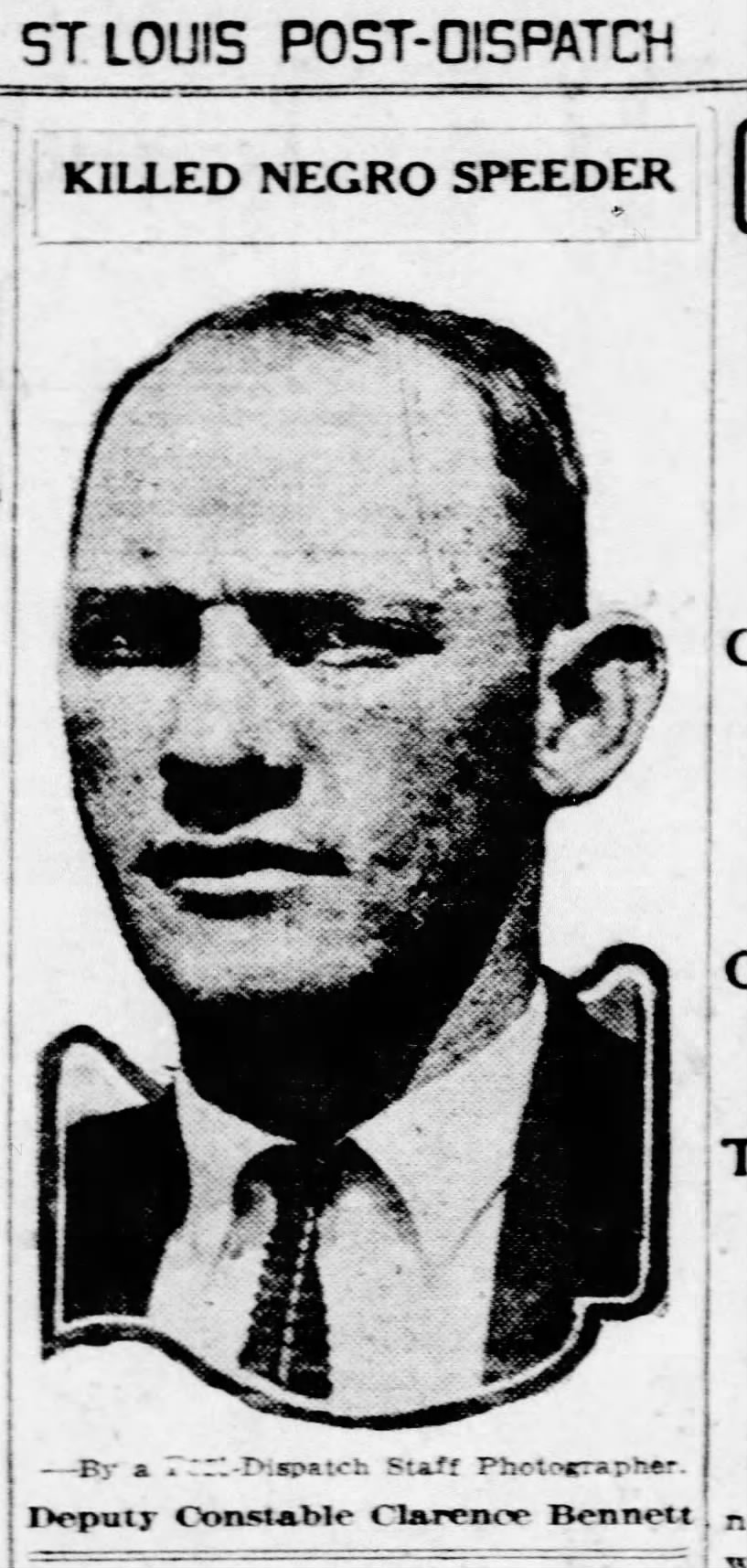
The first is the identity of the second St. Louis deputy constable who joined the primary perpetrator, Clarence Bennett, whose role in the murder was well reported and known at the time, as was his galling exoneration by an all-white grand jury that took just three minutes to officially slander Fred Goree’s name and paint Bennett as a hero acting in self-defense.
Articles about the incident both at the time and in more recent years only referred to the second officer’s last name, if he was named or identified at all. But I was able to uncover his name – Charles J. Schuchman (or Schuchmann), who was apparently a mere 17 years and 11 months old at the time of the murder.
In addition to his youth, Schuchman himself died in a very sudden, violent way – according to his death certificate, he was just 21 when he died from a gunshot wound to the head on Oct. 3, 1928 in what the coroner ruled an “unavoidable accident.” Below that cause of death, the word “Inquest” is scribbled on the document.
I’ve been unable to find any information about Schuchman’s death in the newspapers of the time, aside from a small obituary in the “deaths” section that stated that he died “suddenly.”
But Schuchman wasn’t the only one of the homicidal pair to meet with bloody violence in the years after they killed Fred Goree – Bennett himself also ended up meeting the business end of a bullet.
Less than a year after Goree’s killing, in May 1926, was shot in the face, with two fragments of the bullet lodging in his jaw, after breaking up what was reported by the St. Louis Post-Dispatch as a robbery.
Unlike Schuchman, however, Bennett survived his encounter with violence and, in fact, went on to a lengthy, successful career in law enforcement and criminal justice before passing away in Ruskin, Fla., in 1971 at the age of 76.
I also found several references in contemporaneous media of what could of what could be Fred Goree’s baseball team, whose barnstorming slate led him to drive from his home in Chicago to St. Louis County that day and night.
In the spring of 1925, a small handful of newspapers referred to one or more semipro teams as the Chicago Independents or the Independent Giants. The May 3, 1925, issue of The Chicago Tribune lists an upcoming game in something called “Bob Figg’s League” between the Chicago Independents and a team named the Mason Parks in Evanston, Ill.
Then, on May 17, the Tribune, in its listing of slated semipro games, refers to a contest between the Independent Giants and the Cragens, while in mid-June The Daily Herald of Arlington Heights, Ill., reported on a clash between the hometown team and the Chicago Independents that was won by the townies, 8-2. The Herald article included this description:
“The Chicago club lived up to their name when practicing before game time, displaying some nifty and fast playing acting independent as five at the same time. It sure looked as if the Heights boys were in for a beating, but as the game started our boys were there with the smoke, which changed the opinion of some three hundred fans who turned out to witness the combat.”
The paragraph seems to describe the Independents performing some quick trickery with the ball before the contest started, perhaps shadow ball, something Black teams of the day often undertook at games in order to draw in and entertain fans.
Also in mid-June 1925, The Bremen Enquirer of Bremen, Ind., reported that a team called the Chicago Independents will play a local team from South Bend, Ind.
Now, granted, none of that was major news; it was all just quick jottings, a line or three about semipro teams here and there. In addition, none of the newspapers explicitly stated that the Chicago Independents or Independent Giants were African-American teams. But the brief mentions at least provide a couple small leads in the quest for information.

Finally, while the Aug. 7, 1925, edition of The St. Louis Argus, an African-American newspaper from that city, contained a more detailed and more graphic article on Goree’s murder, the nation’s leading Black publication, The Chicago Defender, published an article about the incident as well on Aug. 8.
The Defender story noted that Goree and his team had been motoring from their home base in the Windy City to the St. Louis area to play a local team from St. Charles, Mo., a St. Louis suburb. However, the paper stated, one of the team’s cars had broken down on the way in Effingham, Ill., forcing Goree to turn his new Buick around and return to Effingham to rendezvous with his stranded team members.
It was on that back-tracking venture that Goree and the other occupants of his vehicle were followed and pulled over for what Bennett said was “speeding,” a development that led to the lynching.
The Defender article also named the two passengers in Goree’s car at the time – 22-year-old Pullman car-washer Frenchy Henry of Chicago, and Harry Gaulden of St. Charles.
For now, I’ll leave things here, with hopefully more to come gradually in a while. With any luck, I’ll be able to do a more thorough and accurate job this time. Fred Goree and his memory deserve nothing less.
 The Negro Leagues Up Close
Pingback: Another character in the Fred Goree story | The Negro Leagues Up Close