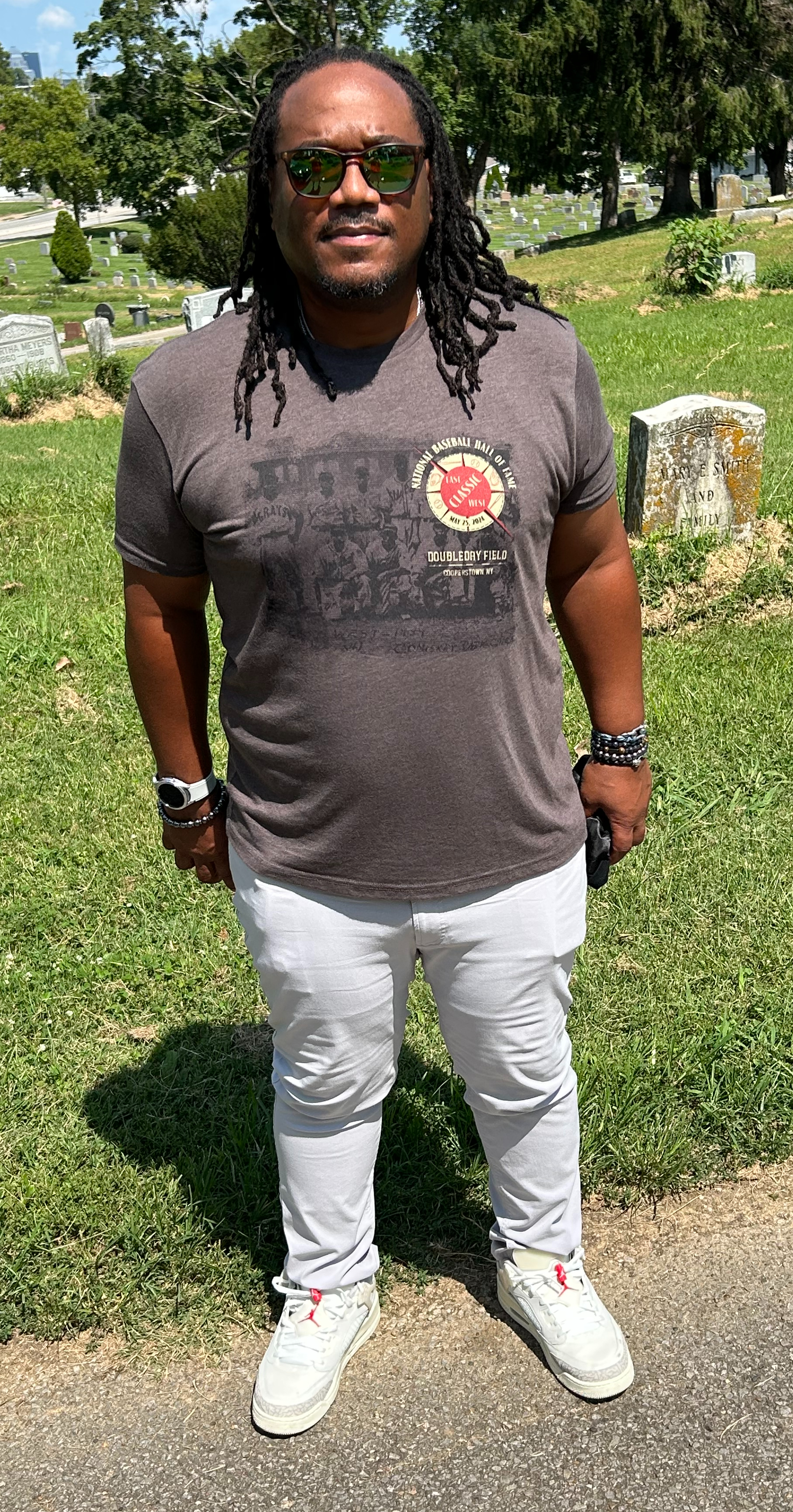
Clarence Gordon is dedicated to a singular goal.
“My passion is to try to hold baseball accountable, and to particularly hold Major League Baseball accountable,” Gordon said Saturday at the 25th annual Jerry Malloy Negro League Conference in Louisville, “for why there aren’t more African-American kids in the sport.”
Gordon was attending his second Malloy conference after last year’s in Cooperstown, and on Saturday, he acted as emcee for the slate of presentations in the afternoon. However, he was soon called to do even more – because one scheduled presenter had to cancel at the last minute, Gordon was asked to pinch hit and fill in the vacant time slot.
He crushed it.
Using swift improvisation skills, he talked about his time as an educator and a youth baseball coach and how he’s seen a continuous dearth of diversity in the national pastime, beginning with youth teams and Little League and running right up through Major League Baseball.
He noted that on Opening Day 2025, only 6.2 percent of MLB rosters consisted of American-born Black players. He said that after Organized Baseball gradually increased in diversity post-1946, a process that peaked on Sept. 1, 1971, when the Pittsburgh Pirates fielded an all-players-of-color lineup in a game.
However, in recent decades, that progress has gradually reversed to the point that aspiring young, Black baseball players have fewer and fewer role models in the big leagues.
“That [gradual change] also happens when [diversity] is taken away,” he said. “You take a little, then you take a little more, you take a little more …”
The key to stopping that gradual decrease is access to the best learning, training and playing opportunities on the youth level – particularly the elite, regional travel teams that attract pro scouts and coaches.
And that access usually only comes with resources – particularly money. Money to be able to afford all the equipment, the travel expenses, the membership fees and the registration costs that come with those elite programs.
“If you don’t have any resources [to travel],” Gordon said, “you won’t be seen by a scout or by a college coach.
“The key word,” he added, “is access.”
Gordon cited the Cincinnati-area travel team he coached after the Covid pandemic. He said that because there were no other such teams within a 300-mile radius of Cincinnati, the squad turned out to become the best he’s ever coached and one of the best in the Cincy area in general.
He said the team was also one of the most diverse teams he’s ever piloted, with a roughly 50-50 split between white players and players of color, even though the costs of maintaining the team was unbelievably expensive – one road trip cost $10,000 just for lodging, reflecting the hurdles players, their families and their supporters must clear.
For a lot of aspiring Black players, such expenses are impossible to meet.
“The social and economic restrictions are extremely prevalent in baseball,” he said.
Gordon added: “Baseball has become a country club sport.”
The result is that many Black kids, especially those from urban areas, just can’t get the exposure and training to build any potential career in baseball.
“If you don’t put them in these opportunities and give them these experiences,” Gordon said, “they’re not going to get the access they need.”
He said that creates a reality that can’t be denied.
There’s still a racialization in baseball. We all know it’s true.
Clarence Gordon
“There’s still a racialization in baseball,” Gordon said. “We all know it’s true.”
In addition, many young players of color often have their enthusiasm for the sport crushed by coaches who still hold stereotypes about Black players. For example, a young kid might love playing a heady position like shortstop, but their coach tells them to switch positions, still believing that Black players are best in supposedly less brainy, more athletic-ability-based spots on the field.
“That joy gets killed,” he said. “You always get moved from shortstop to the outfield, and you’re not having fun anymore. You lose that joy.”
Part of the fix for these challenges in increasing diversity in baseball is finding ways to inspire youth of color to pursue baseball and infuse them with faith in themselves.
That’s where the Negro Leagues can come in, Gordon said. By learning about the Negro Leagues and all the talented, legendary players who filled their ranks, African-American kids can see that players who look like them can, in fact, succeed in baseball. That gives them the faith and ambition needed to succeed themselves.
“We need to get the information to them,” he said.
He added, “We should retain them by sharing our knowledge, telling our stories, allow them to see their heroes.”
Moreover, spreading knowledge of the Negro Leagues to adults – from parents to coaches to funding donors of all colors and ethnic backgrounds – those adults can see that enthusiasm for and talent in the Black community can exist and and, as a result, be encouraged to invest their own time and financial contributions.
“We need to have the people to make these changes happen,” he said.
 The Negro Leagues Up Close