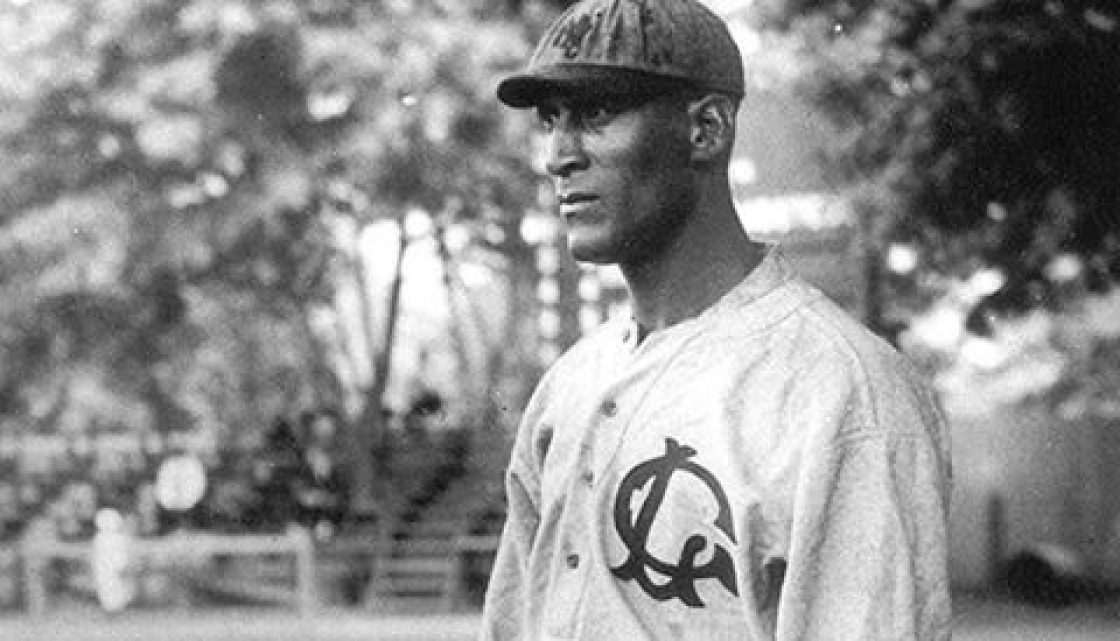
Before any more time passed since my previous post about the 100th anniversary of the lynching of African-American baseball team owner Fred Goree by two law-enforcement officers on Aug. 1, 1925, in St. Louis County, Missouri, I wanted to return to the subject, as promised.
One of the subjects surrounding the Goree tragedy on which I wanted to explore is the other people involved in the story. Revolving around the two main actors – Goree himself and the man who primarily committed the murder, St. Louis County deputy constable Clarence Bennett – was a small cast of side characters.
At the top of that cast list is Frenchie (or Frenchy) Henry, who was accompanying Goree in the latter’s new Buick when Goree was pulled over for very specious “official” reasons (but more likely for “DWB,” or Driving While Black), which led to his murder.
Because Goree was driving to a game scheduled near St. Louis for the baseball team he owned (likely the Chicago Independents), it’s been assumed that Frenchie Henry was a player on the Independents, but I haven’t been able to confirm that. (That inability to nail down Henry as a player is largely the result of the lack of clarity or dearth of information about the Chicago Independents team itself, a topic I explored in my previous post.)
So who was Frenchie Henry? His story begins in the Deep South town of Yazoo City, Miss., where he was born in June 1906 (some sources say 1904) to parents Anderson and Mollie (or Mary) (nee Grant) Henry. At different times, Anderson worked as a farm laborer or a carpenter.
Pre-Civil War Census slave schedules show several slaveholders with the last name of Henry in Yazoo County; the white Henrys might have belonged to the same family, with a man named Dixon (or Dickson) Henry as a patriarch. It’s likely that Anderson Henry, or at least his parents, were owned by one of the slaveholding white Henrys.
An Anderson Henry appears in the 1870 Mississippi state census in Hinds County, which is adjacent to Yazoo County, although if that was our Anderson Henry, he would have been around just 15 years old. Mary Grant is listed in Yazoo County in the 1880 U.S. Census.
While Anderson Henry and his family lived in Yazoo County for maybe a couple decades, they at some point moved, with young Frenchie in tow, to Montgomery County, Mississippi, eventually settling in the county seat of Winona, which at the time was about half the size of Yazoo City, population-wise. (In 1920, Yazoo City had about 5,200 people.) Frenchie was one of a whopping 17 siblings, 11 of them apparently older than him, and five younger.
Also living in Yazoo City at the time was the Moore family, which included Cora Lee, Frenchie Henry’s future wife, who was born around 1907 to Edward and Maggie (nee Tillman) Moore. Edward worked as a brick mason. Given that Yazoo City was a relatively small town/city at the time, it seems likely that Frenchie and Cora knew each other as kids.
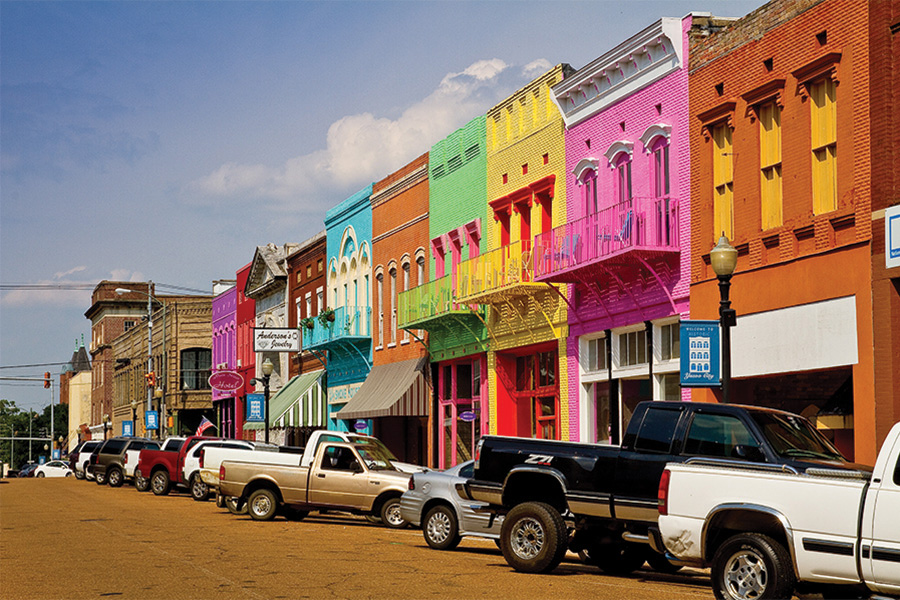
Like the Henrys, the Moores had left Yazoo City by the time of the 1920 Census, which has them listed in the Mississippi Delta city of Clarksdale in Coahoma County. Clarksdale was arguably the locus of early blues history, lore and tradition, including, just outside of town, the intersection of Highways 61 and 49, where Robert Johnson allegedly sold his soul to the devil in exchange for musical genius. (A few years ago I did an interview with author Michael Lortz about his book, “Curveball at the Crossroads,” which tells a variation of the Johnson crossroads legend.)
Sometime between 1920 and 1930 – likely before 1925, when the Goree tragedy took place – Frenchie (and, apparently, one or more of his siblings) joined the Great Migration and moved to Chicago, where he likely met Fred Goree and began playing on Goree’s baseball team(s). It was in this decade that Cora Moore headed north to the Windy City as well.
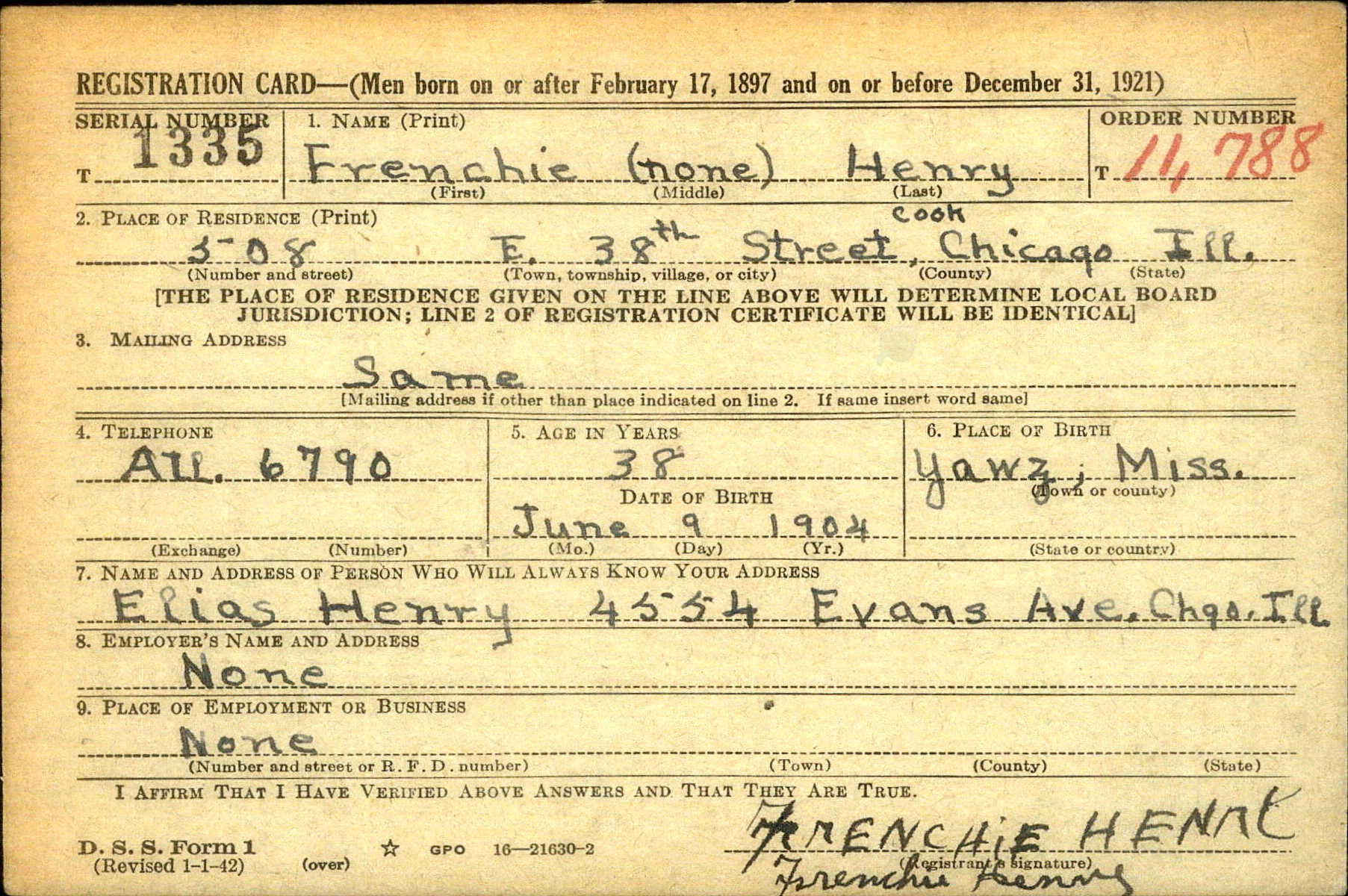
I wasn’t able to find Frenchie taking part in any more baseball activity beyond Goree’s Chicago Independents, unfortunately. As far as what he did for employment, I’m also not really sure. According to media coverage from the Goree murder, Henry worked at that time as a car washer for the Pullman train company. His World War II draft card, which was signed Feb. 16, 1942, states that he was unemployed at the time, while the 1940 Census, when he was still living in Chicago, lists him as a “cement worker.”
Now, what precisely happened to Frenchie and Cora Henry in the 1920s and ’30s is, well, unclear. Like I stated earlier, I wasn’t able to find any definitive, or even circumstantial, evidence that Frenchie was involved in baseball besides being with a team owner at the time that said owner died. (Also remember that I haven’t found any further concrete evidence – besides the coverage of his murder – of Goree’s involvement in the sport, and I’ve likewise found only scant mentions of any team called the Chicago Independents or some variation of that name. I detailed those media references in my previous post.)
However, regarding Frenchie’s personal and/or non-baseball activities during that nearly two-decade span, there does appear to be a fascinating, and maybe even unseemly, possibility.
The 1930 Federal Census seems to have no listing for Cora and Frenchie living together in Chicago. However, it does list a Cora L. Henry, born in Mississippi in roughly 1907, residing by herself in Chicago at a boarding house on Bowen Avenue. She’s listed as married and working as a houseworker for a private family.
So I think it’s safe to say that that is indeed Cora Lee Henry. But what about Frenchie? Where was he? In another example of a recurring theme here, I found no Frenchie (or Frenchy or French) Henry in Chicago in the 1930 Census.
But … I did turn up one Frank Henry listed as a 23-year-old (so born in about 1907) African American from Mississippi. Given that Frenchie is a somewhat common nickname for Frank (or, less regularly, vice versa), this could very well be our friend, Frenchie Henry.
But then why is he listed separately from Cora Lee?
Because Frank Henry was living in the Cook County House of Correction.
That’s right: Frenchie might have been incarcerated.
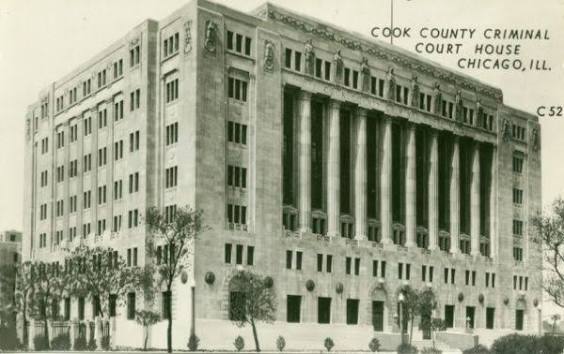
On the other hand, though, I’ve come across no articles or other documents that call him Frank, so maybe the jailbird Frank Henry isn’t, in fact, Frenchie. (But just as an aside, there was a Frank Henry in Chicago at the same time who, let’s just say, ran afoul of the law once and again. He worked as an undertaker with several funeral parlors and allegedly stole some money from the Elks Club. He then was accused of embezzlement from a funeral home, but the case was eventually thrown out. Whether or not this Frank Henry was the one in Cook County jail, I’m not sure conclusively. However, I’m reasonably sure that the undertaker Frank Henry was not, in fact, our ol’ Frenchie.)
Regardless of the status of their relationship in 1930 – or Frenchie’s legal situation – Frenchie and Cora had their first child, daughter Pauline, in 1932, followed by four more children, all daughters – Dorothy, Cora Lee, Yvonne and Betty.
By 1940, Frenchie and Cora were back together and living on St. Lawrence Avenue in the Windy City, and by the time Frenchie Henry registered for the World War II draft in February 1942, he was living at 508 E. 38th St. His older brother, Elias Henry – and not, notably, Cora, his wife – was listed as the person who would always know Frenchie’s address.
That curiosity might make the fact that the 1950 federal Census denotes only Cora with their five daughters, and Cora’s marital status is listed as separated and living on Chicago’s 38th Street – seemingly right next door to where Frenchie was living in 1942. I couldn’t find Frenchie in the 1950 U.S. Census, unfortunately.
But there’s something else strange, however. The 1940 Census seemingly lists Cora Lee and her daughters twice in different locations in Chicago. In addition to the one I already mentioned, Cora and the girls – and, notably, not Frenchie – are placed living on St. Lawrence Avenue, just a block down from where the 1940 Census also lists the whole family, including Frenchie.
All these different but strangely similar addresses seemingly cloud the picture of Frenchie Henry’s time in Chicago, and we can add that to the already substantial list of other mysteries, like how Frenchie connected with Fred Goree; what Frenchie did for a living; and if he played any further baseball besides Goree’s Independents.
The elder Cora Lee Henry died in September 1984, after serving many years as a community rights activist, according to an obituary article in the Oct. 2, 1984, Chicago Defender. Her community efforts included working with the Ida B. Wells tenant organization, the Parent-Teacher Association and the Maryland Avenue Baptist Church, the last of which she did missionary work for, according to the article. The story also noted that she was a graduate of Wendell Phillips High School, Chicago’s first major high school for African-American students.
(Interestingly, the Defender piece noted that Cora moved to Chicago when she was 8, which would have made it around 1915, but the 1920 Census lists Cora still living with her family in Clarksdale, Miss.)
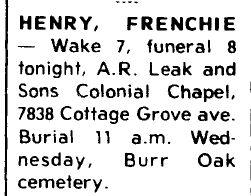
But what happened to Frenchie Henry himself? I couldn’t find much info at all about the latter years of his life, just that he died on Jan. 28, 1977, more than seven years before his wife. Unlike Cora Lee, Frenchie didn’t get much of a sendoff when he passed, just a standard, eight-line, block obituary in the Feb. 1, 1977, issue of the Defender.
He was buried in Alsip, Illinois‘ Burr Oak Cemetery, a somewhat famous burial ground that includes the graves of dozens of African-American athletes, musicians, artists, politicians and other famous figures, including a bunch of Negro Leaguers, some of whose graves received markers through the Negro League Baseball Grave Marker Project.
Several of Frenchie’s siblings joined him in Chicago at varying points. As stated, Elias Henry, who was a few years older than Frenchie, moved to the Windy City and apparently remained close with his little bro. Elias worked at Carnegie Illinois Steel, located in Joliet, Ill., at one point, and he also was employed as a laborer at what a Census taker called a “food manufacturer.” Elias lived in Chicago with his wife, Roberta, for most of his life, but he died in Detroit, Mich., in 1974 at age 72.
Another older brother, James, spent the majority of his life in Mississippi (including a stint in Bolivar County, Miss.) with his wife, Mattie, but he died in Chicago in 1964 at 60 years old. Frenchie’s oldest sibling – and the first of Anderson and Mary’s children – Elizabeth married the Georgia-born Frank Harris and lived, like James Henry, for a while in Bolivar County before the couple moved to Chicago before 1930. Elizabeth died in the Windy City in 1957 at the age of 71. In addition, Alberta Henry got married (I’m not sure to whom) and divorced and lived in Winona before moving to Chicago, where she died in 1979 at 81.
 The Negro Leagues Up Close
Pingback: Ironic twists of fate for Goree’s killers | The Negro Leagues Up Close