New book chronicles tragic deaths in Black baseball

Author Chris Jensen with a poster showing his new book.

Editors note: My friend and colleague, Chris Jensen, recently had published his comprehensive and moving new book, Tragedy in Black Baseball: Early Deaths of 136 Negro Leaguers, 1871-1950, through McFarland Publishing. I highly recommend checking it out; it’s extremely engrossing, empathetic and a little saddening, and it shines lights on dozens of noble, hard-working, talented people whose deaths, like many of their lives, have been overlooked, obscured or even erased from previous history books. The following is a lightly edited, email interview I recently conducted with Chris about his book and the process of researching and writing it.

RW: What was the genesis of this book? Why did you decide to write about this subject?

CJ: During the five years I spent researching and writing my first book, Baseball State by State (which came out in 2012), I kept coming across Negro Leaguers who died too young under tragic circumstances. I tend to get interested and then obsessed when I see patterns. Each time I encountered another tragic death I would copy the material into a Word document, building up a nice folder of intriguing information.

With basic details fleshed out for about 40 player deaths, I realized I had enough material to turn into a book project. Dave Wyatt’s “Death in the Game” article in the Feb. 24, 1917, edition of the Indianapolis Freeman listing 38 Black players who had died in the previous decade was a puzzle that begged to be tackled. I tried to identify who these 38 players were and what happened to them.

I was only able to flesh out the details for 20 of the players Wyatt mentioned – 15 of them made it to the final cut for the book. Then I set out to turn over every rock in my research to determine how many Negro League players died early, tragic deaths. In the end, my research uncovered nearly 200, although details were frustratingly elusive for some of the player deaths.

I decided to write about this subject because I wanted to put these Negro Leaguers’ life stories in the history books and give them greater recognition for their career achievements. Negro League players were deprived of the right to play in the major leagues for too many years, so that alone bothered me. To discover so many Negro Leaguers died young under suspicious circumstances, without any justice served, bothered me immensely. I wanted to make sure their stories got told and passed on to future generations of baseball fans, because these forgotten stars had already been deprived of so much. 

RW: For some, the subject of tragic, early deaths might seem a little dark, but why do you feel it’s important to highlight the fact that so many pre-integration African-American players died so young?

CJ: Many Negro League players, and especially pre-Negro League players, lived and died in anonymity. Some of their greatest feats on the baseball diamond are lost to posterity. African-American players were forced to play in a shadow league due to racial discrimination. They didn’t play for glory or recognition, but that doesn’t mean their stories are less deserving to be told. They are to be saluted, respected and appreciated for their talents, with some measure of dignity that was not provided to them during their lives.

I’m especially proud that my book calls attention to the outstanding work being done by Jeremy Krock with his Negro Leagues Baseball Grave Marker Project. What Jeremy and his group of volunteers have done over the past 20-plus years to bring lasting recognition and restore dignity to long-forgotten Negro League players is truly inspiring.

RW: Why do you think there are so many examples of such tragic passings in the world of Black baseball? Are there any economic, social or cultural factors that might cause such a situation?

CJ: For Negro Leaguers diagnosed with cancer, heart disease, influenza or tuberculosis – just to name a few examples – lack of access to quality health care limited their chances of getting successfully treated. Hospitals were segregated, and the medical profession determined that African Americans were an inferior race and therefore didn’t deserve top-notch care. In 1877, state governments began passing Jim Crow laws to deny equal rights to African Americans, which made all aspects of everyday life more difficult. The Great Migration to northern states created a housing strain and exposed Blacks to new stresses and an environment in which alcohol was more readily available and used to cope with these stresses. Alcoholism was a contributing factor in several of the tragic deaths featured in my book. Race riots in Chicago and other cities bred fear and uncertainty, while Negro Leaguers like Fred Goree learned the danger of traveling through sundown towns.

The Great Depression caused extra financial devastation to Black communities and placed ongoing hardships on Black teams, leagues and players. The only Negro League franchises that remained profitable were those run by men engaged in illegal gambling and bootlegging. Several of the player deaths were directly attributed to bootlegging. While whites also faced financial devastation, their 25-30 percent unemployment rate during the Depression was not as severe as the 50-plus percent unemployment rate for Blacks. With white workers forcing minorities out of lower-paying jobs, Black families no longer had disposable income to spend attending baseball games, and the lack of financial resources placed enormous strain on Negro Leaguers wondering where their next paycheck was coming from. Black teams were forced to travel long distances to play games, which had unintended negative consequences. Porter Moss, Smoky Owens and Buster Brown all died tragically as the result of a chain of events that started with their team bus breaking down.

There has been one Negro League player lynched (James Bowens), one threatened with lynching (Bud Scipio) and one executed (Jim Moss). More than 20 Negro Leaguers were murdered with little or no justice meted out to punish the perpetrator. The same cannot be said of white major leaguers during the segregation era.

RW: What were your biggest challenges writing this book?

CJ: Fleshing out the biographical information proved challenging for some of the players. Census records didn’t always jive with birth records, death certificates and military draft registration cards. Newspaper reporting on Black baseball teams was spotty, with names misspelled, game accounts lacking and details on player deaths wildly inaccurate. Also, it was upsetting to see so much overtly racist coverage in newspapers, especially in the pre-Negro Leagues era.

RW: Are you pleased with how the book turned out?

CJ: I love how the cover turned out, which features illustrations by Nick Wilson of Josh Gibson, Rap Dixon and John Merida. Overall, I am very pleased with the book’s content but wish I didn’t have to leave out so many players who died too young under tragic circumstances. I was given a word limit by my publisher, so featuring more players would’ve meant writing a lot less about each one.

The Negro Leagues were on a downward spiral once Jackie Robinson broke the color barrier in 1947, so it made sense to cut things off at 1949. That resulted in leaving out the stories of 20-plus Negro Leaguers who died tragically from the 1950s into the 1980s. It was disappointing to not be able to tell the stories of Phil Cockrell, Charlie Peete, Luke Easter, Hank Thompson, Sam Bankhead and others.

RW: Finally, which deaths that you touched on in this book were the most tragic or unexpected? Were there any particular cases that spoke to you?

CJ: I’d like to say all the player deaths spoke to me, but the reality is that some deaths were just unfortunate. Tuberculosis killed lots of people in the early 1900s and not just Black baseball players. I’ll mention just a few of the cases that made a big impact on me. 

Octavius Catto was the Martin Luther King Jr. of the 19th century, a true civil rights icon but also a legitimate baseball pioneer with the Pythian Base Ball Club of Philadelphia. He helped form the National Equal Rights League with Frederick Douglass and rallied support to pass the Thirteenth Amendment abolishing slavery. Catto was instrumental in getting Pennsylvania to ratify the Fifteenth Amendment granting Blacks the right to vote. So, it was deeply ironic and tragic that Catto was assassinated on Election Day in 1871, the first year Blacks could vote. It was surprising and disturbing to learn that when “A Quest for Parity: The Octavius V. Catto Memorial” was unveiled outside Philadelphia City Hall in 2017, it was the first of 1,700-plus statues in the city to honor an African-American individual.

James Bowens is one of 4,743 people to be lynched in America and the only professional baseball player. The mob that lynched Bowens in Frederick, Md., in 1895 was stirred up by sensational but untrue accounts in the local newspaper. Bowens, who professed his innocence to the end, was killed in an unbelievably cruel and inhumane way with no due process. He was dead before his alleged victim was alert and properly able to identify her attacker.  

What is most disturbing about Fred Goree’s 1925 death is that it took nearly a century for his descendants to learn the true details of his death. Goree, the manager and possible owner of the Chicago Independent Giants, was savagely beaten and then shot to death by a police officer who had pulled him over for alleged speeding, in a clear case of racial profiling. It was cold-blooded murder with multiple witnesses. White newspapers, none of whom spelled Goree’s name correctly, portrayed him as the instigator who left the cop no choice but to defend himself. The St. Louis Argus newspaper, representing the African-American community, told the real story of the shooting based on eyewitnesses who were in the car with Goree. The details of Goree’s death and the sham trial that exonerated his murderer got clouded over as the years went by, and family members didn’t see the Argus article until 2016. 

Jeremy Krock was moved to action by Goree’s story and ensured he had a proper grave marker. And you, Ryan, are among the journalists who have called attention to Goree’s tragic killing. It takes a village of researchers and historians to ensure stories of Black baseball are told accurately and with historical context. I’m pleased to be part of that process.

The tragic death of Porter Moss is another important one that has not been told accurately in print until my book came out. It was long believed that Moss died at age 34 in 1944 of a gunshot wound on a passenger train in Tennessee, a situation that culminated with a white doctor boarding the train and refusing to treat Moss because of the color of his skin. That version of the story was backed up by teammate Verdell Mathis in a 1993 interview with the Cincinnati Enquirer. That’s a pretty big accusation and numerous podcasts, articles and even doctoral dissertations have condemned the inhumane actions of the white doctor over the years. 

Except that’s not what happened. SABR researchers Russ Speiller and Gary Cieradkowski unearthed a July 21, 1944, article in the Atlanta Daily World (an African-American newspaper) that states the white doctor gave Moss an injection (perhaps morphine for pain) and told his friends to take him to the next station where an ambulance would be waiting to treat him. Moss needed more medical attention than a doctor with a black bag could provide in the baggage room of a train. It was not discrimination or malfeasance that sealed his fate, but being in the wrong place at the wrong time. 

Black baseball players like Catto, Bowens, Goree and Moss demonstrated a resilient spirit and love for the game that transcended the adversity they faced. I hope their stories get told and retold for many years to come with newfound respect for what they endured.

42 for 21 lays down the gauntlet

This is a follow-up from this post a week and a half ago, about a webinar concerning the National Baseball Hall of Fame’s inability and/or unwillingness to allow induction for more Black players from the segregated era.

As has been promoted on this blog and elsewhere, the 42 for 21 Committee has advocated for several years for justice and fairness in the Hall’s selection process, which continues to fail miserably at giving more-than-deserving Negro Leaguers a truly open and equal chance to pass through the hallowed halls of Cooperstown.

Last Wednesday, the committee issued another pointed proposal for the HOF selection process, challenging the Hall to revise its Eras committee system. Here’s the text of that press release:

FOR IMMEDIATE RELEASE

4 March 2026

The 42 for 21 Committee believes that the Hall of Fame needs to restructure its Era Committees to give Negro Leaguers and pre-league Black Baseball players a fair chance at election in the future. If not, their inaction will likely result in excluding additional Segregated Era Black players from being added to the Hall.

The Hall should restructure the Classic Era Committee into two committees, one for players and one for managers, umpires, and executives. There is no reason to lump these together in the Classic Era, especially when the Contemporary Era has separate committees for players and non-players.

The Hall should also limit the time span of the Classic Era to 1950 and earlier, which would be consistent with previous Era Committees. The span of the defunct Early Baseball Era Committee from 2016 to 2021 ended in 1949; prior to that, the 2010 to 2015 Pre-Integration Era Committee span ended in 1946.

Careful analysis of upcoming Classic Era Committee elections shows that Negro Leaguers and their predecessors are probably going to be shut out under current rules. The huge span of the Classic Era – 1871 to 1979 – and the large number of remaining attractive candidates from 1951 to 1979 mean that there will probably be few slots for Negro Leaguers on the ballots. 

That century-long time frame, plus the small number of ballot slots (10), plus rules that restrict committee members to casting only three votes, will create a logjam that will place future Negro League candidates at a severe disadvantage. That logjam will take many years to undo because the Classic Era Committee is scheduled to meet only once every three years.

Exacerbating the problem is that Negro League players and managers/executives/umpires will be competing with each other on the same ballot, and that previous Era Committees have included few members with expertise on the Negro Leagues. 

The combination of the above factors will result in a perfect storm that will sink the chances of deserving Black candidates for the Hall of Fame from the Segregated Era. The Hall of Fame has not been afraid to change the rules for the election of veterans in the past, and it should not be afraid to do so now.

************

The 42 For 21 Committee was founded in 2021 to advocate for “Justice for Negro Leaguers” – especially for more robust consideration of many meritorious but overlooked Black Baseball candidates for the Hall of Fame. The significance of the number 42 is self-evident.

More information at www.42for21.org, including the results of our poll of Negro Leagues experts who nominated 43 well-qualified candidates for renewed consideration by the Hall of Fame’s Classic Era Committee.

So far, there’s been little if any reaction from the Hall of Fame or anyone else with the power or influence to sway the Hall in a positive, just way. But that’s not really surprising. The Hall’s stubborn recalcitrance is nothing new. Neither is our dismay and frustration.

Anyone interested in offering support or assistance, or if they just have any questions, can call Sean Gibson at (412) 589-1906 or Gary Gillette at (313) 614-9006, or email 42for21@gmail.com.

I’ll just close with some comments from Dan D’Addona, the sports editor at the Holland (Mich.) Sentinel, and a devoted and talented Negro Leagues researcher, advocate and fan:

Dan D’Addona with the late Negro Leaguer Ron Teasley.

The Problem with the Era Committee

By Dan D’Addona

While the Era Committees have righted several wrongs and elected some deserving players, the move to having one era span from baseball’s origins to 1979 changed everything and is particularly detrimental to Negro Leagues candidates.

There are just eight finalists on every ballot with voters being allowed to vote for up to three. Numbers-wise it is tough for anyone to get in, but this ballot is spans so long it is worse for Negro Leagues players.

Popular deserving major leaguers like Luis Tiant, Ken Boyer, Thurman Munson and Tommy John have been finalists. If they are again, then you add the top pre-integration candidate Bill Dahlen and that leaves three spots at the most for Negro Leaguers. Cannonball Dick Redding, John Donaldson, Vic Harris and Grant “Home Run” Johnson have been finalists in this format.

So how are voters, who are Hall of Fame players as well as executives and a couple of media members and two Negro Leagues historians, supposed to come to a consensus on there?

Luis Tiant or Cannonball Dick Redding? Bill Dahlen or Home Run Johnson? Tommy John or John Donaldson?

It will be tough for any candidate to get 75 percent, but it will require the Negro Leagues historians to educate the committee and likely narrow in on one candidate at a time.That would lead to, say, the election of Luis Tiant and Cannonball Dick Redding.

But even that would take the right education, the right people and the right timing on the Era Committee.

Donate to Home Plate Don’t Move

I will never put Home Plate Don’t Move behind a pay wall, but I would certainly invite donations if you wanted to chip in. If not, it’s totally fine. I appreciate you checking out and reading my blog and any other support or contributions you’re willing to offer.

One-Time
Monthly
Yearly

Make a one-time donation

Make a monthly donation

Make a yearly donation

Choose an amount

$5.00
$15.00
$100.00
$5.00
$15.00
$100.00
$5.00
$15.00
$100.00

Or enter a custom amount

$

Your contribution is appreciated.

Your contribution is appreciated.

Your contribution is appreciated.

DonateDonate monthlyDonate yearly

Negro Leagues Night at Tulane!

Got some more news, this time from here in New Orleans …

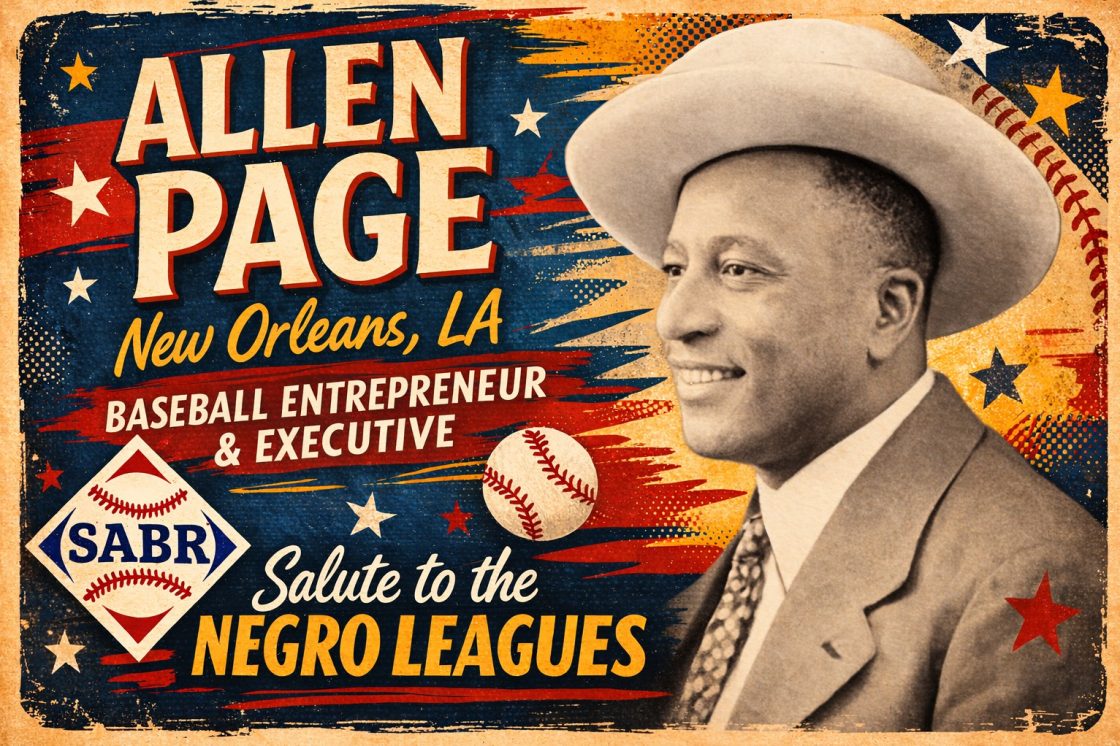
On Saturday, April 25 at 6:30, the SABR Schott-Pelican New Orleans chapter will co-host with Tulane University a “Salute to the Negro Leagues” Night at Tulane’s Turchin Stadium during the Green Wave baseball team’s conference game against UTSA.

We didn’t let the city’s sad lack of a professional baseball team deter our SABR chapter from finding an event at which we could celebrate the legacy of the Negro Leagues here in New Orleans. Representatives from the chapter approached Tulane officials late last year with the idea, and the Green Wave folks heartily agreed to do it.

The night will include the attendance of multiple family members of various New Orleans greats, and many of those Big Easy Negro Leagues legends – such as Johnny Wright, John Bissant, Allen Page, Lloyd Davenport, Herb Simpson and Oliver Marcell – will be recognized during the game.

There’ll be a poster giveaway for fans, and our SABR chapter will have a table set up where fans can purchase baseball books, read articles by local writers, and learn about SABR membership and benefits.

We’ll have more details the closer the game gets, but for now, if anyone has any questions, they email rcuicchi@aol.com or rwhirty218@gmail.com.

Hope to see y’all there!

Webinar cuts to the chase on the HOF

There’s been a lot of stuff happening lately in the world of Negro League scholarship and fandom. For example, the SABR Negro Leagues Committee is gearing up for its annual Jerry Malloy Conference, scheduled this year for June 18-21 in Memphis.

On my end, the John Bissant grave marker project continues to move forward; we’ve got the text for the marker written, and we’re in the process of finding a contractor to produce the stone. In addition, the Schott-Pelican Chapter of SABR here in New Orleans is working to put together a Negro Leagues Day at a Tulane University baseball game next month (more on that later).

And this past Saturday, Feb. 28, the Josh Gibson Foundation/Negro Leagues Family Alliance – which was co-founded and now headed by Sean Gibson, Josh Gibson’s great-grandson –  hosted its regular Negro Leagues webinar, this one on the topic of getting more Negro Leaguers inducted into the National Baseball Hall of Fame. The webinar featured presentations by Negro League advocates and aficionadoes Ted Knorr and Gary Gillette of our 42 for 21 committee.

Meanwhile, along those lines, on Wednesday, March 4, the 42 for 21 committee formally proposed a major revision to the Hall’s Era Committee system, which historically has been completely inadequate and unjust toward potential Black figures from the segregation era. I’ll discuss that in my next post, which hopefully will be posted this upcoming Monday morning. 

The National Baseball Hall of Fame

But right now, I’m going to give the lowdown about the webinar this past Saturday, and I’ll just dive right into it, because there were a bunch of sharp, pointed and passionate comments by several people, all along the lines of righting an ongoing wrong being stubbornly perpetrated the Hall of Fame.

Sean Gibson hosted the webinar, and he began by noting that the Family Alliance fully supports the efforts of 42 for 21 and the overall Hall of Fame push.

“We support this effort of getting more Negro League baseball players into the Hall of Fame,” he said. “The mission of the Negro Leagues Family Alliance is to always try to do our best ti use our name and brand to help other Negro Leagues players’ family members to advocate for them and causes like this. I just want to say on behalf of the Family Alliance, we do support this effort.”

The webinar really kicked into gear with longtime SABR Negro Leagues Committee member Ted Knorr giving a comprehensive rundown of the painfully convoluted, tortured history of the various panels and voting bodies, running back to the selection and induction of Satchel Paige in 1971, that were successively formed and disbanded that have elected, or failed to elect, segregated-era Black players, managers, executives, pioneers and umpires.

Satch and his Hall plaque

Ted also listed the various polls done by Negro Leagues experts over the decades aimed at selecting the all-time greatest Negro League figures, beginning with the famed 1952 Pittsburgh Courier poll of writers, players, managers and other experts at the time.

Ted’s listing of these polls included several that have recommended which segregation-era African-American baseball figures need to be inducted into the Hall as soon as possible, up through the “42 for 21” vote taken in 2021 by a group of Negro Leagues historians, writers, researchers and scholars.

Given how detailed Ted’s presentation on these committees and polls, I won’t summarize them in the post, but you should absolutely watch it with this link, which is also given above. However, I will include Ted’s rundown of the current 42 for 21 top 10 of segregated-era Black baseball figures who need to be inducted into the Hall. The current list is minus the three men who were listed in the original 42 for 21 list that have since been inducted by the Hall – Bud Fowler, Buck O’Neil and Minnie Minoso.

Here’s the countdown of the list of 10:

Rap Dixon

Overall, Ted noted:

“There’s going to be a wide range of opinion, and I think everyone in this room, and every open-minded person, realizes that a four-and-a-half to one ratio doesn’t do a good job of educating the public on the history of baseball. It’s my view, and this is just my opinion, that talent and achievement among Negro League players could fill 58 to 80 plaques in the gallery. There at 28 at present. That’s a shortfall.”

I also liked a comment that Ted made as an aside to his presentation – he noted that the induction of Fowler, O’Neil and Minoso in 2022 was celebrated by Negro Leagues advocates and gave us hope that more segregation-era Black figures would soon follow that trio into the Hall.

Unfortunately, Ted said, “It obviously misled us for the next four or five years.”

Gary was next up in the webinar, and I think I’ll conclude this post with his complete comments that he made Saturday, because his words some up the beliefs of many of us:

“Many thanks to y’all for joining us today. You’ve heard what my colleagues Sean Gibson and Ted Knorr have to say, and I hope that you have been impressed by the recitation of the historical evidence. It is undeniable that Black players from the National Pastime’s Segregated Era are substantially underrepresented in Cooperstown.

“I have some additional comments I’d like to offer for your consideration. Unfortunately, I don’t believe that — in the memorable words of the Captain in ‘Cool Hand Luke’: ‘What we’ve got here is … failure to communicate.’ Communication between the Hall of Fame and the baseball public is just fine; what is not fine is the Hall’s defense of its careful gerrymandering of its electorate.

“The carefully chosen words and the actions of the Hall of Fame speak clearly to their apparent goal of restricting future election of Black players, managers, executives and umpires from the Segregated Era to the Hall.

“Weirdly, while critics of proposals to elect more Negro Leaguers to the Hall often decry the supposed ‘quota systems’ of these initiatives, it’s actually the Hall itself that is intent on enforcing an informal, but strict, quota system of its own.

“If you think that’s unfair, I ask you: When has the Hall of Fame been proactive when related to including Negro Leaguers, as opposed to being reactive to public pressure?

Ted Williams giving his HOF induction speech.

“I’d like to see a show of hands for all those who think that, absent Ted Williams’s unexpected and brave plea at his 1966 induction, the Hall would not have taken another decade or more before setting up its first Negro Leagues Committee.

“No hands? As I expected, we all know that it was only the major public embarrassment that an icon like Williams could generate that forced the Hall to act. Yet unbelievably, the Hall initially proposed a new, Jim Crow Hall: a ‘separate but equal’ wing for the Negro Leaguers. The Hall was quickly forced to retreat from that indefensible position after a tidal wave of criticism.

“Even then, the attempt to constrict the number of Negro Leaguers continued, as the Hall pressured its initial Negro League Committee to disband after electing only nine players – not coincidentally, those nine neatly filled out a starting lineup with one player per position. (That lineup was enabled by the convenient assignment of versatile great Martin Dihigo to the keystone sack.)

“What will it take to get the grand panjandrums in Cooperstown to lower the de facto barriers they have set up to prevent more Black Hall of Famers from the Segregated Era from being added to the hallowed Plaque Gallery – the sanctum sanctorum of the National Pastime?

“No one knows for sure, but it certainly won’t happen without another sustained public outcry about the ridiculously unfair structure of the Era Committees. Let me read to you the exact text from the Hall of Fame’s Web site describing the history and function of the Era Committees:

“‘ERA COMMITTEES ELECTION’

“‘The Era Committee has been a part of the Hall of Fame voting process since the first class of electees in 1936, with the first Era Committee electees coming in 1937.

“‘The Era Committees, formerly known as the Veterans Committee, consider retired Major League players no longer eligible for election by the BBWAA, along with managers, umpires and executives.’

“Notice anything? One of the salient facts about the various incarnations of the Veterans/Era Committee system is its almost complete failure to elect any Negro League managers or umpires. Is anyone capable of keeping a straight face when they say that a half-century of segregated baseball could not produce one Hall-worthy manager or umpire? Really? Seriously? Pull the other one!

“As for Segregated Era executives, the Veterans/Era Committees have elected only one executive, Black baseball titan Rube Foster. What about the other four executives elected, you ask? Effa Manley, Alex Pompez, Cum Posey and J.L. Wilkinson were elected in the special 2006 process, not by any Veterans or Era Committee. What about Sol White, Frank Grant, Bud Fowler and Buck O’Neil, you point out – all of whom are shown as Executives on the Hall’s official Web site? They are more aptly described as Pioneers, one of five categories for induction, but that category has essentially been abandoned by the Hall for no good reason.

“The sad truth is that only Rube Foster – a no-brainer selection whose greatness even the brainless could recognize – is the only executive, manager or umpire from the Segregated Era that has been allowed through the bronze portals of the Hall in the half-century since 1971. 

“When Satchel Paige was finally inducted into the Hall of Fame in ‘71, he said in his speech that ‘there were many Satchels and many Joshes.’ We can forgive his rhetorical hyperbole there, and one can easily argue there was no pitcher as great as Paige and no player as great as Gibson.

“Paige’s point, however, is spot-on. There were many great Black players in the Segregated Era – far more than have since been immortalized in bronze in Cooperstown. It’s great that underappreciated outfielder Pete Hill has a plaque, yet the brilliant but almost unknown outfielder Rap Dixon does not. Shortstop Pop Lloyd was inducted in 1977, and Willie Wells in 2006, but King Richard, the great shortstop Dick Lundy, has been excluded along with Grant ‘Home Run’ Johnson – perhaps the best Black player of the 19th century. Intimidating, flamethrowing hurlers like Paige and Joe Williams have been honored, but Cannonball Dick Redding remains on the outside, virtually anonymous.

“In conclusion, I’d like to repurpose an oft-referenced phrase from American history that seems appropriate to describe the Hall of Fame’s history in this regard. In the Supreme Court’s precedent-shattering Brown v. Board of Education ruling in 1954, the Court ordered that segregation should be ended ‘with all deliberate speed.’ Unfortunately, that unclear language gave enough latitude for recalcitrant Southern states to disingenuously drag out the desegregation process.

“It has now been 55 years since the legendary Satchel Paige took his rightful place in Cooperstown, yet we are still struggling to end discrimination against the great Black players.”

Donate to Home Plate Don’t Move

I will never put Home Plate Don’t Move behind a pay wall, but I would certainly invite donations if you wanted to chip in. If not, it’s totally fine. I appreciate you checking out and reading my blog and any other support or contributions you’re willing to offer.

One-Time
Monthly
Yearly

Make a one-time donation

Make a monthly donation

Make a yearly donation

Choose an amount

$5.00
$15.00
$100.00
$5.00
$15.00
$100.00
$5.00
$15.00
$100.00

Or enter a custom amount

$

Your contribution is appreciated.

Your contribution is appreciated.

Your contribution is appreciated.

DonateDonate monthlyDonate yearly