Busy month in Central PA

eagles rap dixon

Harrisburg icon Rap Dixon

Here’s another great guest column for y’all, written by my SABR friend and Malloy conference roomie Ted Knorr, who’s been the leading light in remembering and honoring the memory of the great Negro Leagues players and teams from central and southern Pennsylvania. In this column, Ted details his busy slate of activities happening this month through June …

It is with great pride and appreciation that I discuss these three events — the Atlantic League‘s York Revolution’s 10th annual Negro League Night, the AL’s Lancaster Barnstormers’ 12th annual Negro League Night, and the Eastern League‘s Harrisburg Senators’ 20th annual Negro League Commemorative Night. I, with the immediate and continued cooperation of the three local minor league baseball clubs, founded all three tributes and have attended almost all of them — now 42 — annual events over the years.

York’s celebration on May 14 consisted of just me with a small exhibit, but it was fun and memorable for me and the dozens of fans who stopped by to talk and discuss segregated baseball from a long time ago.

369_Santander_Stadium_from_behind_home_plate

PeoplesBank Stadium in York

The night was made more special since the previous month at PeoplesBank Stadium, I had participated in a panel discussion on Jackie Robinson leading up to local PBS channel WITF’s showing of Ken Burns’ two-night, four-hour documentary about Robinson, so a lot of the York fans knew me, which made conversations more meaningful.

Harrisburg’s event came next, just this Tuesday at FNB Field, and it is always a very nice event. This year was no different, as we honored the great Harrisburg Giants outfield of 1924-27 — left fielder Fats Jenkins, center fielder Oscar Charleston and right fielder Rap Dixon.

I strongly believe that lineup is the greatest outfield of the Negro Leagues, as it is the only one of more than a one-year tenure that included three of the top dozen Negro League outfielders as designated by the National Baseball Hall of Fame.

jenkinsFats

Fats Jenkins

Further, with a four-year tenure, it is one of only about a dozen and a half professional outfields of any league or era that remained intact for four or more years. Among the others are the 1920s Murderer’s Row Yankees, the all-.400 outfield of the 1890s Phillies, and the two longest tenured — Speaker, Hooper and Lewis of the 1912-17 Red Sox and the 1957-62 Pirates slate of Clemente, Skinner and Virdon.

In addition to the honorees in Harrisburg this week, the surviving members of the 1954 Harrisburg Giants of the Eastern Negro League were introduced. This is a special and very unique team in that it was fully integrated with about a third of the team being white.

Lancaster’s Negro Leagues Night will complete the celebration trifecta on May 31 at 7 p.m. at  Clipper Magazine Stadium with the team’s annual Triple Play. This year’s festivities promise big fun, the least of which will be my Negro League exhibit.

The big event at Lancaster this year will be the Barney Ewell bobblehead giveaway. Ewell was a contemporary of — and just as fast as — Hall of Fame speedster Cool Papa Bell and the Negro League stars of the ’30s and ’40s. Ewell was a world-class sprinter who missed the 1940 and ’44 Olympics (as did Jackie Robinson) due to World War II. His bobblehead is going to be a great and valuable collector’s item, and it will be worth the trip if you are in the Mid-Atlantic area. Gates open at 6 p.m.

And speaking of the Mid-Atlantic region, if you want a nice Memorial Day Weekend event, consider historic Midland Cemetery on May 28 at 12:30 pm., when I will offer a few comments on African-American players who made the ultimate sacrifice in service to the country.

banner-1

Midland Cemetery near Steelton is a small, beautiful African-American cemetery and is the final resting place for USCT troops, Buffalo Soldiers, veterans of WWI and II, and one Negro League baseball player — Steelton native Herbert “Rap” Dixon. After the ceremony I will have a small exhibit at Rap’s gravesite. It truly is a great spot, and anyone who travels will be rewarded with a brief tour of Rap’s home, school and ballpark, all of which are located near his final resting place. (If you might make it out, let me know at papabell@aol.com.

The last event on the schedule is a humbling one. On Saturday, June 11, I will be accepting a plaque and making brief comments on behalf of the great Oscar Charleston on the occasion of his induction into the Capital Area Chapter of the Pennsylvania Sports Hall of Fame. Charlie lived in Harrisburg in the Twenties and early Thirties and played for the Harrisburg Giants for four spectacular prime years.

Andy Cooper Texas update

Head & shoulders posed portrait of newly inducted Hall of Famer, Andy Cooper.  Cooper is often ranked 2nd only to Bill Foster among the Negro Leagues left-handed pitchers.  Image is cropped from 1920 Detroit Stars 2442.89 PD

I’ve got a very encouraging update on the status of legendary pitcher Andy Cooper, a Waco native and National Baseball Hall of Famer. In this post, I reported how Cooper is inexplicably not a member of the Texas Sports Hall of Fame, and in this post I delved into Cooper’s roots in Waco and the Lone Star State.

I just learned that Cooper is, in fact, on the ballot for the TSHOF’s 2016 induction class! Here’s an email I received Friday from TSHOF Vice President Jay Black:

“Mr. Cooper’s bio will be in the nomination notebook at our annual selection committee meeting on June 7. While I am hoping that Mr. Cooper is voted into the TSHOF, I also realize that it is a difficult process because we have so many nominees and only 12 slots on the veterans ballot. I think that Andy Cooper is well qualified and deserving to be included in the TSHOF.”

Right now I’m working on an article about Cooper’s Texas roots and the 75th anniversary of his death, I really can’t proactively urge or encourage people to support Cooper’s possible TSHOF induction, but if you do want to do so, here is a link to the TSHOF’s selection committee Web page, with emails for many of the committee members.

I’ll try to stay current on the process — June 7 is just more than two weeks away, so we’ll see what happens …

Cannonball Jackman, Burlin White and Sanford, Maine

White,Burlin

Burlin White

I’ve been hip deep in article deadlines during the last couple weeks, and I have a couple more next week, so lengthy blog posts might be slim for a while. I do, however, have a few “newsy” items I’d like to post next week, so we’ll see.

In the meantime, here’s another article from my archives that I wrote for a magazine but never got published. (The magazine staff seems a bit harried and boggled, so it’s OK) This piece is about two famous Negro Leaguers and a mid-sized mill town in 1940s Sanford, Maine. I’ve always been interested in blackball in Maine because my grandparents live in Millinocket, which is a town in central Maine that’s surrounded by thick forests.

So here’s an entry along those lines. Keep in mind that this piece was originally written for publication in a general-interest magazine, so it’s a little different style-wise than my usual posts. Anyway, enjoy!

By the time pitcher Will Jackman and catcher Burlin White arrived in Sanford, Maine, in June 1949, they were each roughly 54 years old, although Jackman’s exact age was always notoriously hard to pin down.

When they pulled into the thriving York County industrial hamlet, Jackman and White were members of the Boston Colored Giants Negro Leagues baseball team, a barnstorming, African-American aggregation that had been existence 1923 and had, over the years, gone by different names as varied as the Quaker Giants, the Philadelphia Giants and the Boston Royal Giants. (The two Pennsylvania-themed appellations were the result of a common trend among segregation era black sports teams to name themselves based on marketing purposes.)

During its roughly quarter-year existence, the squad’s roster had seen dozens of players come and go, most of them journeymen who were hustling for a paycheck and who worked “straight” jobs on off-days and during the offseason.

Many of them had careers that amounted to, essentially, minor footnotes in the annals of baseball history, not only because they weren’t star players, but also because life in the Negro Leagues was often dealt in the shadows of the game and of society, thanks to the prejudice and lack of fairness inherent in a segregated country.

But Jackman and White … They were different. They weren’t just scribbles on a lineup card.
They were stars. Individually and as a duo, they were talented enough, persistent enough and self-marketed enough that their names were known all over New England. They were traveling attractions whose renown was cloaked in mythos and filled with tales — often tall ones — of the exploits and accomplishments achieved across more than three decades in the game.

“From the early 1920’s through 1950, Jackman and White formed the most popular battery in New England,” says Negro Leagues scholar and author Bijan C. Bayne, who has extensively studied blackball in both Boston and the rest of New England. He added:

“The friends faced industrial and factory teams, Boston Park League opponents, former and contemporary major league pitchers, college athletes, and town clubs from Maine to Massachusetts, and at least one summer in Nova Scotia. They were well regarded, celebrated by media, and long recalled by spectators.”

The Texas-born Jackman was an especially hot commodity, a fireball-flinging pitcher with prodigious talent who never quite made a big splash on the national Negro Leagues scene but who instead chose to be a big fish in a smaller pond, the toast of New England, a hardball nomad whose legend has, in historical perspective, made him one of the most fascinating but most elusive figures in the chronicles of the American pastime.

Wrote the late Dick Thompson, an award-winning historian and member of the Society for American Baseball Research:

“Today … Jackman has been relegated to the historical ‘who?’ pile. Despite being named in the famous 1952 Pittsburgh Courier player-voted poll of the all-time great Negro League players and years of touting by the mainstream white press of New England, where he barnstormed for nearly 30 years, Jackman’s name remains unrecognizable to all but the most astute black baseball historians.”

But, at the time and throughout his career, Jackman was in such rabid demand in his adopted stomping grounds of New England that he often played for otherwise all-white teams, and many contemporaries and historians consider him comparable to the legendary Satchel Paige, the first Negro Leaguer to be inducted into the National Baseball Hall of Fame in Cooperstown, N.Y.

Jackman’s influence has been so momentous that The Cannonball Foundation, a Millis, Mass.-based non-profit organization created in 2009 to create and enhance educational opportunities and character development for young athletes and citizens across New England.

The values of the Cannonball Foundation are based on Jackman’s own personality and dedication to his sport and his character and are codified in what the foundation calls “the Cannonball Way,” according to its Web site:

“A person modeling the Cannonball Way is a person who is: hungry to learn, sprinting through the finish line, completing every duty, task or job started. The Cannonball Way recognizes compassion as a sign of strength and courage, not weakness. As a community, those living according to the Cannonball Way will create a culture of collaboration. Together, we achieve more.”

Of course, Burlin White was no slouch, either. Born in Richmond, Ind., in 1895, White first donned the catcher’s mask professionally in the 1910s for the famed southern Indiana spa team, the West Baden Sprudels, before moving onto the big time with the Atlantic City Bacharach Giants.

By 1918, he was eliciting kudos from the national black press, garnering, for example, a large photo and caption in a May 4, 1918, issue of the Chicago Defender. After a stint in the Army during World War I, White returned to the diamond, where he quickly regained his popularity as a backstop and as a manager, helming the Steel City Giants of Buffalo, N.Y., and even the Boston Royal/Colored Giants by the 1930s.

will-cannonball-jackman

Cannonball Jackman

Thus, given the fame of both Jackman and White, it’s no surprise that towns across the Maine landscape queued up to solicit the duo’s fame and star power.

And in June 1949, one of those lucky burgs was Sanford, where residents were eager to assembled their best hardball talent to furnish the famous Boston Colored Giants — with the illustrious combo of Jackman and White — with solid opposition.

By the time their fame train pulled into Sanford, the Colored Giants’ 1949 season had been underway for about a month, beginning with contests in and around the Boston area and proceeding through Brooklyn for a clash with fellow Negro Leaguers the Bushwicks, then to Portsmouth, N.H., where they topped the Maher Club 5-4.

So the Colored Giants arrived in Sanford loose, trimmed and ready for the local boys. The encounter was slated for June 5 at Sanford’s Goodall Stadium, which had been built in 1915 by Goodall Industries, a local textile manufacturer. The stadium had become a popular fixture on the Sanford recreational scene, even, at various times, featuring the play of future Hall of Famer George Sisler and local lad Freddy Parent, an early shortstop of the Boston Red Sox.

2029_Historic_Park_Goodall_Park

Perhaps the most historically significant moment came in 1919, when none other than Babe Ruth himself clouted a three-run homer for the Red Sox in an exhibition game against the Sanford Professionals. The contest would prove the Babe’s very last in a Red Sox uniform.

The stadium was one of the highest-profile of the largess of the beloved Goodall family, which established roots in Sanford shortly after the Civil War, when Yorkshire, England-born Thomas Goodall made his home there.

The importance of the Goodall family and their extensive business, especially their textile mills, to Sanford was massive. Wrote author Edwin Emery in his book, “The History of Sanford, Maine, 1991-1900”:

“To give, in detail, the history of the Goodall enterprises, would require a volume of well filled pages, devoted to absolutely nothing else. … It is acknowledged that Goodall enterprise has been chiefly instrumental in transforming the Sanford of yesterday, into the thriving industrial centre of today.”

Emery added that Goodall was responsible for “[t]he conversion of this rustic, farming village, composed of thirty dwellings and a corner grocery, into the important commercial and manufacturing Sanford of the present …”

Today, Goodall Park has been rebuilt after a devastating arson fire in 1997 and currently plays host to the Sanford Mainers of the New England Collegiate Baseball League. And the Mainers are just the latest chapter in Sanford’s love affair with the national pastime.

“The people of Sanford have long demonstrated an affinity for baseball,” penned Pete Warner of the Bangor Daily News in June 2014. He added:

“Fans here enthusiastically embraced the game at Goodall Park (built in 1915) even before future Hall of Fame slugger Babe Ruth graced the grounds during a barnstorming visit in October 1919.”

Local reporter David Dutch of the Sanford News summed it up simply upon the stadium’s centennial celebration last spring: “Baseball, Goodall Park and Sanford are synonymous.”

The June 3, 1949, game between the Colored Giants and the Goodall-Sanford team was apparently big news, even attracting the attention of the Portland Press Herald newspaper, which hailed the arrival of the Negro Leagues barnstormers to the town of about 15,000.

“The famed battery of Will Jackman and Burleigh [sic] White will be the visitors,” stated the paper, “in this first appearance of the season at the local park.”

The Goodalls, meanwhile, had over the previous few years since the end of World War II mustered what Dutch tabbed “one of the best teams in New England” in what became known as “the golden age” of Maine semipro baseball.

Assembling the Sanford-Goodall aggregation for their showdown against the Colored Giants was business manager Johnny Burke, who quickly recruited sturdy-armed outfielder and pitcher Armand “Aime” Porrell to assume mound duties for the game. Porrell was fresh off a stint with in the Coastal Plain League, a minor-league circuit in the Carolinas.

Receiving Porrell’s tosses would be Henry L’Heureux, a Boston-area native and brother of the more well known Walt L’Heureux, who competed for the Canada-based Granby Red Sox of the Border League.

The Negro League wanderers wouldn’t just have Jackman and White, either; also studding their lineup was first baseman Fran “Lefty” Matthews, a native of Cambridge, Mass., who was arguably the Giants’ most well known athlete on the national Negro Leagues scene. The  34-year-old Matthews had spent portions of five seasons playing for the Negro National League’s Newark Eagles, one of the most storied franchises in blackball.

Alas, the oft-cruel fates of semipro baseball ended up playing a joke on the poor Sanford populace — a rain started to pelt Goodall Park, and the contest was called after seven innings, curtailing what could have been a barnburner.

SONY DSC

The Boston bunch won the precipitation-halted contest, 6-3, with Matthews driving in a run for the Giants and Porrell helping his own cause by thumping a double. The Giants tallied three runs in the top of the second, then added one each in the third, fifth and sixth frames.

The Goodalls pushed across two scores of their own in the thrd and one in the sixth, but it wasn’t enough.

Both teams carried on for the season, with the Colored Giants hitting the road yet again, heading to, among other locales, Portsmouth; Nashua, N.H.; and Newport, R.I. Baseball, and life, would inevitably churn forward.

In hindsight, though, what can be made of the Boston Colored Giants’ venture to Sanford, Maine, in summer 1949? As a specific event, perhaps not much. The game was cut short because of rain, the superstars didn’t play, and the local boys lost.

But on a larger scale, the African-American team’s appearance in the textile-mill town was a perfect example, almost a microcosm, of semipro baseball life at the time, for both squads, and for Sanford.

During the mid-20th century, following the conclusion of the Second World War, the American pastime thrived, not only in big cities like Boston, but in just about every town across New England.

It was in these settings, most of all, where ethnicities and cultures mixed, where segregation was torn down, at least for an hour or two. Black met white, barriers came down, and baseball players — and the towns in which they lived — learned how much they had in common.

A trip to India

pic2747

Bill Yancey

Every once in a while, I really miss my old graduate school bud, Arindam Mukherjee. He and I helped each other through some tough times at Indiana U., and we forged a bond for life during that stint.

Now is one of the times when I miss Ari dearly. But, alas, he’s in his native India — Delhi, to be precise, although he was born and raised in Ranchi — and I haven’t seen him since his academic green card expired a bunch of years ago.

However, I’m still in touch with him via the WhatsApp iPhone thingee, and we trade messages regularly. I try to keep up with what’s going on in his favorite sport, cricket, but it’s a challenge. There’s just not much coverage in the American press, despite numerous attempts by entrepreneurs and other visionaries — both in the U.S. and abroad — to create a foothold for cricket here Stateside. Check out this Web site and this one for the latest cricket dope.

(I should note India advanced to the semifinals of the most recent Cricket World Cup, held last year and hosted by the Aussies and New Zealand. However, Australia won the tourney, its fourth title in the last five Cups. Damn you, Paul Hogan!)

As all baseball historians know, cricket was one of the forerunners — along with rounders and a couple other English pastimes — of the American pastime. Ari and I tried to teach each other the basics of our respective passions, with mixed results. I will say that, to me, cricket bears a striking resemblance to the game of base ball — two words back then — in its nascence, i.e. 1840s to early 18880s, if my memory serves. Today that era in the national pastime is celebrated as “vintage base ball.”

I also have another connection to India: A few years ago I wrote a few articles about Dinesh Patel and Rinku Singh, two Indian javelin throwers who in 2008 won a novel reality show contest in India called “The Million Dollar Arm.” Patel and Singh possessed the fastest fireballs out of the many contestants and, as a result, earned them each minor-league contracts with the MLB’s Pirates. (They picked up a whopping $8,000 signing bonus and earned a visit to the White House.)

Their tale is best known through the 2014 Disney movie adaptation starring Jon Hamm. But I got in n the ground floor and was able, before the story became a global sensation, to interview not only the two neophyte pitchers but also the creator of The Million Dollar Arm, Los Angeles sports agent J.B. Bernstein.

Bernstein, along with a few visionary representatives from MLB, have been trying to plant some baseball seeds in the world’s second-largest country and largest democracy. One of the ultimate goals is to build on the success of TMDA and mine India’s vast population for hidden hardball talent.

Unfortunately, Patel was cut by the Bucs in 2010 and returned to India in 2011 to finish school, practice the javelin (his natural sport) and teach baseball to throngs of youngsters, many of whom took part in an ensuing edition of TMDA.

Singh, meanwhile, has struggled with major injuries, causing, for example, to miss the entire 2014 and 2015 campaigns, a painful stint that included Tommy John surgery. But he’s persevering, playing in numerous low-level pro circuits, including the Dominican Summer League and the Australian Baseball League. (Yep, baseball is actually pretty big among the Aussies.) Despite the travails, the Pirates still see promise in the India native — they resigned him late last year.

However, all of these recent exploratory efforts aren’t the first time American baseball figures have attempted to expose India and other parts of South Asia to our Grand Old Game. (Well, it’s old for us, but compared to cricket, baseball is maybe a teenager.)

And it was the Negro Leagues community that did it!

In spring 1945, in the waning days of World War II, ace New York Amsterdam News columnist and editor Dan Burley worked with the military’s USO program to assemble a sterling group of African-American athletes to tour India, Burma and other nations in the Asian theater of the war. (At that time, the modern nation of Myanmar was called Burma.)

(As another side note, in 1943, Burley reported that the National Baseball Congress — the amateur administrative body in American — had launched a 12-team in India. Burley stated that, “In far-off India, which had never been host to a game of baseball until the past few years, America’s national pastime has gone Asiatic.”)

Kenny-Washington-1

Kenny Washington

The troupe — dubbed the “Parade of Stars” — included former boxing champ Henry Armstrong, UCLA football star Kenny Washington, former pro football player Joe Lillard, and dual-sport luminary Bill Yancey, who starred in the Negro Leagues for the Black Yankees, Philadelphia Giants and other squads, and shined for the trailblazing African-American hoops squad Harlem Rens.

HT_RENS_TEAM_150218_DG

Harlem Rens

Yancey was particularly suited for the ambitious endeavor — a few years earlier he served as a Negro Leagues baseball scout in Panama and other Central American and Caribbean countries, a job that was lauded by his comrades back home.

The India ensemble made several stops at various U.S. military camps through South Asia and, according to media reports, performed for and entertained tens of thousands of appreciative, fervent G.I.s.

Their routine included demonstrations of their respective sports by each athlete, Q&A (or “bull”) sessions with the audience, and some boogie-woogie piano playing by Burley himself to close out the extravaganza. In addition, Armstrong flashed his old skills by winning an open boxing tournament in Calcutta.

In a dispatch from that city, an Amsterdam News correspondent (likely Burley himself) lauded the all-black USO crew for enlivening throngs of soldiers of all colors:

“Everywhere the unit has appeared it has received a rousing reception and wild acclaim from soldiers and sailors in the audiences. So popular has the unit become since its departure from the United States last April 6 that commanding officers of various installations in the China-India-Burma theatre are competing with one another for the services of the athletes. …

“Altogether the show is considered absolutely tops in the opinion of [the] Special Service Officer whose job it is to route such revues through the various military bases and and installations. In fact, it is being said that for morale value the sports show has done more in its short time in India than any other factor to give the hard working men a lift in spirits. The show has been playing to both white audiences and has stimulated the fighting men [to] no end with its color, drama and sports aspects.”

Several correspondents from the Stateside African-American media apparently tagged along with the entertainers as they visited bases along the Stilwell Road between India and Burma, and, one reporter dispatched, “traveled over 780 miles of the famous Ledo Road; played Calcutta, Karachi and other large cities and centers in India; and is due to return to the States sometime [in July].” (The Stilwell Road was forged as a key Allied supply line in Burma during WWII and was later redubbed the Ledo Road.)

African-americans-wwii-009

Ledo Road

In all, the troupe spent about three months traversing South and Southeast Asia, covering an estimated 50,000 miles and performing for 100,000 troops of all colors. One photo of the trip published in the May 19, 1945, Cleveland Call and Post pictures Armstrong shadow boxing with two Indian boys in Calcutta. The paper wrote: “Henry Armstrong, apparently convinced a left hook is the same in anybody’s language, tackles the job of teaching a pair of Indian youngsters the art of boxing.”

Also raving about the crew was National Newspaper Publishers Association correspondent Frank Bolden, who in June issued a report from somewhere “along the Stillwell [sic] Road, India-Burma”:

“It is a show that really gives the GIs entertainment and a terrific morale boost because it is right down the alley for any red-blooded American youth. …

“All in all it is a good show, and it has and is still being received widely by both colored and white military personnel alike. And the men are deeply appreciative for the efforts spent in their behalf by some of our top notch performers. …”

However, Bolden then lamented, “It’s too bad that more of our great and well-known stars are unable to make a trip this way to entertain some mighty swell ‘fifty-dollar-a-month-room-and-board guys,’ who here on the ‘Victory Road to Tokyo’ are making it possible for those back home to carry on for years to come. Over here the show goes on too, ya know.”

The impact of the USO show and its success was deeply felt by the athletes themselves, it seems. An article in the July 21, 1945, issue of the Afro-American — under a headline reading, “Bill Yancey, Back from Tour, Says CBI Yanks Dream of Home” — related Yancey’s impressions.

“… Billy found the morale fairly high,” the dispatch read, “but only one thing on the minds of the soldiers, including a great many officers, and that was ‘getting back home.’”

box_a_armstrong_195

Henry Armstrong

Of course, the troupe’s venture must be placed into historical context. On May 8, 1945, about a month into the USO tour, Germany surrendered to the Allies in Europe, marking what was to become V-E Day.

Meanwhile, thousands of U.S. soldiers, sailors and Marines were pushing through the South Pacific, advancing from island to island amidst brutal, bloody, costly fighting with the Japanese. As the American troops advanced, the U.S. launched the nuclear age when it dropped atomic bombs in the Japanese cities of Hiroshima (Aug. 6) and Nagasaki (Aug. 9).

The two bombings, combined with the victories of U.S. troops, convinced Japan to surrender to the Allies on Aug. 15, creating, forever onward, V-J Day.

My World War II history is a bit rusty, but the China theatre was crucial one in which the Chinese, especially in Manchuria, beat back the advancing, genocidal Japanese from the West.

Now, I don’t think the theatres in India and Burma were as important as the Allied military actions elsewhere. However, their placement in South Asia coincided with historic, history-defining events in Asia.

MTIwNjA4NjMzODE4MjIwMDQ0

The Mahatma

By 1945, the groundswell of the India independence movement — led, of course, by Mahatma Gandhi — had reached the tipping point as it used non-violent resistance to force colonial Britain to abandon its stranglehold on India, its people and its resources.

On July 18, 1947, that peaceful yet overwhelming effort achieved its goal, as the British conceded the country’s independence. Also, a day earlier, the new, majority-Muslim nation of Pakistan split off from the Hindu and Sikh-led India, setting in motion events that resonate to this day.

Undoubtedly the African-American U.S. troops watched the Indian independence movement closely, realizing what a nation of oppressed people could do to obtain freedom. As we know, the success and spirit of the Indians’ peaceful resistance greatly inspired Dr. Martin Luther King and the rest of the ensuing American civil-rights movement.

The African-American sports media definitely took a cue from the development of India’s method of peaceful resistance as a way to oust the colonial British. In 1953 — eight years after the black USO tour and six after Indian independence — Atlanta Daily World sports columnist Marion Jackson asserted those lessons could be applied to fight the insistence of certain Cotton States League teams’ on not taking the field against other squads with African Americans:

“Just how this will affect Cotton States League attendance is not known at the moment but a silent protest is in the offing which is similar to the non-violence campaign initiated by minorities in India, Kenya and other South African countries under the heel of sadistical [sic] rulers.”

Shifting back to 1945 and the push to win the war, the still-segregated black American troops joined thousands of other U.S. soldiers in sweeping east across Europe until they captured the German capitol of Berlin and toppled the Nazi regime. That victory coincided, of course, with the push in the Pacific.

Just like the black troops in India saw, first-hand, the effects of racial tyranny, the African-American soldiers looked at what the Allies were fighting — totalitarian government bolstered by ethnic cleansing and genocide toward Jews and other European minorities — and saw distinct parallels to their own second-class status back home in the U.S. The paradox of segregated black troops fighting for freedom overseas deeply affected the “Negro” soldiers and sailors after they returned home after the war.

Indeed, even before they shipped home, African-American soldiers in South Asia already felt the ongoing sting of segregation, even in uniform. In July 1945, Baltimore Afro-American war correspondent Max Johnson issued a missive from Cairo about what the USO troop witnessed during their travels:

“For example, Armstrong, who has been fighting fourteen years and once held three championships simultaneously, said he was impressed by the marked loneliness of those soldiers in the areas where his troupe [v]isited.

“‘After seeing how they must exist,’ Armstrong said, ‘I think that any man who spends six months out there should be brought back to the States and released immediately from the Army.’”

But Armstrong’s consternation was dwarfed by the indignation displayed by other members of the USO corps. Johnson continued writing:

“Lillard, who is on leave from his job as a New York policeman, shared the same views and was disgusted with the numerous indignities the colored troops faced there as a result of the racial discriminatory practices of white Americans commanding.

“Also outraged on this score was Burley, who contended that conditions were the worst — almost beyond belief.”

The American troops did, eventually, return home. Although they were greeted by a just-booming economy and the benefits of the landmark GI Bill, they also arrived Stateside just as the Iron Curtain fell, triggering a Cold War between East and West, USSR and US, democracy and communism.

However, the civil rights movement did ramp up, and once it started snowballing, there was no stopping the long overdue and much savored victories of equality and integration.

Occasionally the subject of mining the population of South Asia for baseball talent popped up; in October 1945, writer Fay Young in a column opined about the lack of fresh blood about the African-American community and pondered whether a ringer or two could be plucked from that region.

Such efforts continue to this day, but, alas, have met with only limited success, although American baseball execs remain optimistic. But just as importantly, that all-black USO tour of South Asia in 1945 might very well have played a role, albeit probably minor, in bringing true democracy to our country.

Final note: N’Awlins, my current abode is host of the incredible National World War II Museum. If you happen to be in the NOLA area, definitely check it out!

A singular honor for a Pittsburgh legend

Attachment-1

Cum Posey Jr.

Here’s another guest post, and it’s another great one! This was written by Facebook pal Eric Newland, who volunteered to write about the news concerning Cum Posey’s new honor. Many thanks to Eric for producing such a good article, and as usual, if anyone out there wants to write a guest blog post, just let me know at rwhirty218@yahoo.com.

By Eric Newland

On April 5, the Naismith Memorial Basketball Hall of Fame, located in Springfield, Mass., announced 10 new inductees to be enshrined Sept. 9.

Headlining this year’s class are Shaquille O’Neal, Allen Iverson, Yao Ming, Zelmo Beaty and Cumberland “Cum” Posey, who was selected by the new Early African-American Pioneers of the Game committee, which was formed in 2011 and which has the discretion to select inductees with a direct vote.

Claude Johnson, founder of the Black Five Foundation located in Pittsburgh, along with noted professor and historian Rob Ruck, have led the effort as advocates for basketball pioneers, whether black or white, on the hardwoods during the racially segregated “Black Five era” through 1950.

The term “Black Fives” includes those stellar, all-black basketball squads that thrived during the game’s era of de facto segregation. Johnson and Ruck led a 14-year campaign to build and recognize the unique body of work around Homestead’s own Cumberland Posey.

Posey was one of the original basketball pioneers as a player, coach, manager and owner, having won five National Basketball Championships. Ruck said, “Posey’s teams beat all comers, white and black. They did so with athletic skill, intelligence and dignity.”

Ruck said Posey’s basketball teams, as well as his Homestead Grays Negro Baseball League’s teams, “won more championships in the different sports than the Steelers and Pirates combined.”

Cumberland Willis “Cum” Posey Jr. was born June 20, 1890, in Homestead, Pa., into an elite, entrepreneurial family. Cumberland Posey Sr., born to slave parents in Virginia, was the first African-American licensed engineer of the United States, a riverboat builder and owner of Diamond Coke and Coal, the largest African-American business in Western Pennsylvania. The elder Posey was also president of the Pittsburgh Courier Publishing company, the nation’s largest circulated African-American newspaper.

Attachment-1-1

Cum Posey, bottom  right

Posey Jr’s bloodlines spurred the 5-foot-8, 145 pounder to join the worlds of baseball, football, basketball and golf, making him a barrier breaker preceding the likes of Jim Thorpe, Jesse Owens and Jackie Robinson. Wendell Smith, the prolific sportswriter for the Pittsburgh Courier and Chicago Defender, lauded Posey as, pound-for-pound, “the outstanding athlete of the Negro race in the 1920’s.”

Posey’s 35-year span from 1911-1946 as player, manager and owner of the iconic Homestead Grays baseball team of the Negro Leagues earned him enshrinement into the 2006 class of the National Baseball Hall of Fame in Cooperstown, N.Y.

Despite his size, Posey’s competitive spirit, tenacity and athletic DNA earned him high praise as one of the nation’s leading African-American basketball players during a career spanning from the early 1900s through to the mid-1920s. As an 18-year-old, Posey led his Homestead High School basketball team to the 1908 Pittsburgh city championship.

Upon graduating high school, Posey integrated the Penn State University basketball team, playing two years for the Nittany Lions. He also played briefly for the old gold and blue of the University of Pittsburgh. Posey’s collegiate basketball career extended for three more years at Holy Ghost College (now Duquesne University) under the pseudonym “Charles Cumbert.” Cumbert/Posey was the team leader in scoring between 1916-18. In 1988, Duquesne University inducted Posey into its sports Hall of Fame.

In 1912, Posey formed an all-black basketball team known as the Monticello Rifles, who went on to win the colored basketball world championships. In 1913, he organized the Loendi Big Five, named after an East African River. The exclusive “Black and Tan” club, located in the lower Hill District of Pittsburgh acted as the team’s sponsor. (Cum Posey Sr. served as the Black and Tan president.) The Loendi Big Five went on to win four consecutive black national titles on the hardwoods between 1918-21.

Ruck said Posey’s athletic accomplishments reflected a growing African-American consciousness and pride.

“Posey and his teams showed what the African-American community was capable of achieving during some pretty hateful times when segregation and theories of racial supremacy were the norm,” Ruck said,

With his election to the Basketball Hall, Cumberland Posey Jr. becomes the first individual to be enshrined in both the Baseball and Basketball Halls of Fame, an honor that in all likelihood will never be matched.

About the author: Eric Newland is a producer in development with a scripted episodic series. “The Parallel Game,” based upon historical events in the Hill District of Pittsburgh during the 1920’s and ’30s. Contact Eric at Eric@theparallelgame.com.

Herb Simpson in Spokane

Herb Simpson, Spokane Indians 1952(1)

Above is a photo I received from David Eskenazi, a popular photographer and ardent Negro Leagues advocate in the Pacific Northwest. It shows New Orleans’ own Herb Simpson in uniform for the 1952 Spokane Indians.

Eskenazi recently uncovered the previously unknown photo of Herb, whose professional baseball career included numerous successful stints in the national Negro League scene as well as the upper echelons of the post-integration upper levels of the minor leagues.

At a couple of those stops, Herb became the first African-American player on his team’s roster and/or to suit up in the league in question.

Herb, before his death in early 2015, was ubiquitous on the NOLA media and Negro Leagues advocacy scene. He was also a star in Seattle, where the Mariners hosted and honored him several times over the years.

I had the extreme honor to travel with Herb to Seattle for one of those ceremonies, the Mariners’ African-American heritage day. It was a very impressive and touching tribute to a baseball trailblazer, and I was humbled, and still am, to have been there to witness it.

And over recent years I wrote several articles about Herb and his impact on baseball, including this one about his time in Spokane, this one and this one about his visit to Seattle, and this one about his passing.

Many thanks to David Eskenazi for sending the pic! It’s a fantastic addition to Herb’s rich legacy and honored memory.

If you want to read about the superb outreach efforts of the Mariners RBI Club, check out its Web site here. It includes fantastic articles and testimonials by RBI Club beat writer Mikaela Cowles and Lorri Ericson! When I was in Seattle, I also met local freelance photographer Rick Takagi, who photographed Herb a few times.

New Orleans sports HOF: No Negro Leaguers … yet

malarcher

Last week the trustees of the Greater New Orleans Sports Hall of Fame gathered to vote on the nominees for the local HOF’s new class of inductees. I saw the New Orleans hall as another opportunity to push for greater local recognition of the Negro League greats who are from the NOLA area or have connections to this fantastic city and its environs.

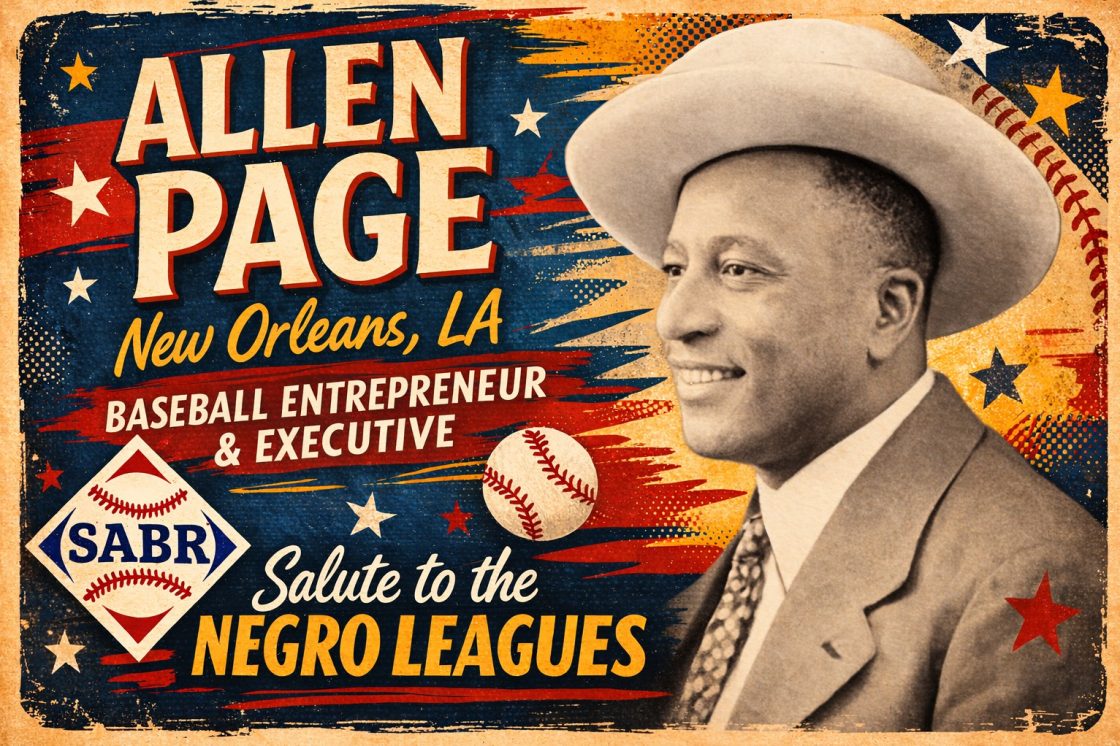
Unfortunately, I inquired about this year’s induction process at the very last minute — a situation that’s admittedly a common theme with me — so I had to scramble to throw together spur-of-the-moment nominations for three of the more overlooked blackball luminaries from NOLA: third baseman Oliver “Ghost” Marcell, player/manager/scholar “Gentleman” Dave Malarcher and owner/executive Allen Page.

My reasoning for putting forth those names are thus … Marcell, despite his cantankerous and volatile personality, is considered one of the greatest third basemen in Negro Leagues history, especially with the leather … Malarcher — in addition to being a college graduate, epic poet and a gentleman on and off the field — inherited the managerial reigns of the powerhouse 1920s Chicago American Giants from Rube Foster and guided them to multiple NNL and Negro World Series titles … Page is, quite simply, the most important behind-the-scenes mover-and-shaker this city ever witnessed in the blackball world; only Fred Caulfield comes close to him.

ghost4

Unfortunately, none of my nominees were selected by the GNOSHOF board when it handed down its vote April 27. I’m not sure which athletes and other local sports legends were chosen — it doesn’t look like it’s been made public yet. The news of my trio’s rejection was delivered to me by Allstate Sugar Bowl media relations head John Sudsbury.

Whether or not the figures who were selected for the new induction class are worthy or not is beyond the purview of this blog post; for one thing, to be honest I really don’t know much about any of them. Plus I admittedly submitted my three nominees perhaps way too late for them to receive adequate consideration from the local board.

And, perhaps, it’s hard for me to judge the induction worthiness of Negro Leagues players and executive because I’m probably biased in favor of their election because I write about, study and thoroughly enjoy blackball history.

But it was naturally still very disappointing to see that neither Marcell, Malarcher nor Page squeaked into this year’s group of honorees. It was another blow to the effort to garner long-overdue recognition for Louisiana’s great segregation-era hardball luminaries.

To get another side to this story, I inquired about receiving comments from a GNOSHOF representing about this year’s induction vote, why no Negro Leaguers were selected, and whether local Negro Leaguers might have a chance of being ushered into the prestigious local organization in the future.
In response to my inquiry, Greater New Orleans Sports Award Committee Chairman Will Peneguy offered these thoughts:

“Thank you for your continued interest in the Greater New Orleans Sports Hall of Fame. There is a surplus of outstanding candidates for the Hall of Fame, and every year it is very challenging for the committee to select the new class of inductees. The process takes weeks and discussions are thorough.

“There are three players from the Negro Leagues now honored in the Hall of Fame (Walter Wright, Herman Roth and Milfred Laurent). That said, it would not be surprising to see additional candidates with backgrounds in the Negro Leagues join the three former players that have already been inducted.”

The only quibble I’d have with that statement are the Negro Leaguers who are already in the GNOSHOF. While Wright is certainly deserving — although he wasn’t a star on the national level, for decades he was the omnipresent leading advocate for honoring and preserving the legacies of local Negro Leaguers — both Roth and Laurent didn’t have as much impact on the top levels of blackball as my three suggestions were.

But, though, on the other hand, both Roth and Laurent were huge figures on the NOLA-area sandlot and semipro scene for two decades or more, so I can see why they have been inducted into the Hall.

Overall, though, the statement was pretty encouraging; it intimated that Negro Leaguers definitely have a good chance at being ushered into the local Hall’s prestigious confines down the road.

So, although the GNOSHOF’s 2016 induction vote was disappointing — no Negro Leaguers were selected — the future looks bright.

So I’ll keep plugging away at getting more much deserved recognition for NOLA-area blackball players.

I do also want to note that Malarcher will be inducted into the Louisiana Sports Hall of Fame, which has also included Marcell for some time now.

The LSHOF induction ceremonies are next month.

Addendum: In earlier drafts of this post, I neglected to ask for suggestions from y’all about potential nominees for the future GNOSHOF inductions. I can think of J.B. Spencer, Johnny Wright, Black Diamond Pipkin (who was suggested by Evin Demirel, Fred Caulfield, Herb Simpson, John Bissant, Winfield Welch … Thoughts?

The Keystones: Steel City pioneers

Pittsburgh-skyline

Hi all, I’ve got a few things in the hopper at this point, but I’m still trying to dot some I’s and cross some T’s, as they say. Plus I have a few deadlines coming up, so — being the chronic procrastinator that I am — I’m scrambling to put that stuff together as well.

Therefore, in the meantime, I’m going to try to put up some articles I’ve written for various publications but that have ultimately been turned down because of lack of space, poor timing or other reasons. However, that (hopefully) doesn’t mean that the stories are of lesser quality than usual, so I hope you like them.

To start with, here’s something I put together for a couple publications based in Pittsburgh and Pennsylvania about the Pittsburgh Keystones, a team waaaaaaay back in the 19th century that helped pave the way for more better known Steel City teams like the Crawfords and the Homestead Gray. Enjoy!

Without a doubt, Pittsburgh and the Allegheny Valley make up one of the most important and influential spots in the country when it comes to segregation-era, African-American baseball.

In addition to being the stomping grounds of Hall of Fame catcher and famed pitch-crusher Josh Gibson, Pittsburgh played home to some of the best Negro Leagues teams in history before Jackie Robinson broke the Major League color line in 1947. In the 1940s, the Homestead Grays — featuring eventual Cooperstown immortals like Gibson, Buck Leonard and Jud Wilson — dominated black baseball, and the 1935 Pittsburgh Crawfords, with their five Hall members, are considered by some the best team in baseball history, regardless of race or era.

But decades before that, way back before the turn of the century, another Steel City squad was studded with future Hall of Famers and left an indelible imprint on the history of African-American baseball — the Pittsburgh Keystones, who competed against some of the top black hardball teams during the two decades before 1900, even finishing second in a national blackball tourney in 1888 and launching the careers of legends like Sol White and Pete Hill.

However, unlike 20th-century squads like the Grays and the Crawfords, the Keystones, like many other pre-20th century baseball teams, are in many ways largely overlooked, especially because of the praise and study that have been lavished on the Allegheny Valley teams that came later.

Recreation_Park_1894

A sketch of Recreation Park

“Nineteenth-century squads such as the Keystones are definitely overshadowed by their 20th-century successors,” says historian Todd Peterson, who specializes in early African-American baseball teams. “Part of their disappearance from the historical record is due to the fact, I think, that even the African American press had forgotten about most of these squads by the 1920s.”

What makes this lapse of historical memory all the more tragic is that 19th-century black baseball teams were frequently socially conscious and played vital roles in the development of the pre-1900 civil-rights movement and the rise of the black middle class in America.

“Let’s not sugarcoat this: they had to be,” says Northern Illinois professor emeritus James Brunson, one of the leading authorities on 19th-century black baseball. “Prior to 1870, black ballplayers figured among those who demanded citizenship; after 1870, black ballplayers fought for voting privileges, equal rights, jobs, access to housing, education, healthcare, and public accommodations in hotels, resorts, restaurants, theaters, ballparks and so on.”

Records and reports of all-black baseball aggregations date back to the Civil War or before in scattered spots around the country. In the Allegheny Valley, African Americans, despite de facto segregation, were taking part in what was rapidly becoming the national pastime.

Black teams played against each other — and, occasionally, even versus white squads — in places like Washington, Waynesburg and Canonsburg. The fact that such teams, like the rest of the African-American population at the time, faced both covert and overt racism was highlighted by when area newspapers sometimes referred to them as “dusky” and even “coons.”

Occasionally, though, local media did a decent job of covering, and therefore documenting for history. Take, for example, this article in the Aug. 11, 1875, issue of the Washington Reporter, which covered a game between two local black teams, the Alerts and the Independents, to determine the local champion and to honor the anniversary of the emancipation of slaves in West India:

“Early on the morning of the day the members of the Base Ball Club could be seen perambulating the streets dressed in their fancy new costumes, consisting of white pants, fancy white shirts decorated with the insignia and badges of the club to which they belonged. … The match game of ball which was played was witnessed by a large concourse of spectators, and was pronounced to be unexceptionally well done.”

The game was then followed by a grand ball and festival at Rush’s Hall, an event that embodies how important baseball was to black society at the time.

But by 1880, the Pittsburgh Keystones were the kings of the hill, figuratively and literally — in addition to being one of the best African-American squads in the country, the Keystone club was based in the city’s famed historic Hill District.

Drawing its membership, similarly to other black clubs around the nation, from the local African-American middle class of barbers, waiters, horse groomers, coachmen and other much-respected occupations, Brunson says, the Keystones served as a point of pride for the city’s black population.

Almost always packing a powerful punch at the plate that made up for an occasionally shaky pitching staff — which even then was usually studded with at least one top ringer — the Keystone club made and indelible mark on the local sporting scene, Peterson says.

The Pittsburgh newspapers often referred to the Keystones as “the colored champions” and occasionally heralded the club’s arrival each spring.

Reported the Jan. 20, 1889, Pittsburg Dispatch:

“The colored baseball team known last year as the Keystones have secured grounds at Twenty-eighth street and Penn avenue. … There is an abundance of players in the Keystones, so much so that a reserve nine is being talked of.”

The Keystones were also a brave, hardy bunch. In addition to taking a major financially risk by joining a nascent but ultimately doomed national African-American league in 1887, they even tried to play a game on Christmas Day one year, failing only because the groundskeeper failed to show up at Recreation Park to unlock the gates.

The club was also noted for being willing to face any challenger, as noted by the March 1, 1892, Pittsburg Post:

“The Keystone (colored) base ball club has reorganized for the season of 1892, and is open to all comers. … The Keystones will give a grand ball at Penn Incline March 15, for the benefit of the club. Any club wishing to make engagements with the Keystones will address No. 3 Wylie avenue, Pittsburgh.”

(Penn Incline was one of a series of elevated railways that crisscrossed the city and navigated the hilly terrain. Most of them were eventually taken down; the Penn Incline, which serviced the Hill District, was closed in 1953.)

However, as with other black hardball units, after the turn of the century the Keystones slowly disintegrated, giving way to newer, sprier aggregations as the decades passed.

But occasionally the club’s memory does live on, as it did in August of this year when the Society for American Baseball Research’s Negro Leagues Committee gathered in Pittsburgh for its annual Jerry Malloy Conference, where both Peterson and Brunson gave papers on the Keys and other regional, pre-20th century black teams.

As long as such popular and scholarly effort is given to preserving the Keystones’ history, their legacy as Allegheny Valley trailblazers will live on. Says Peterson:

“The Keystones were the first major black club in the area and established the barnstorming template that the Pittsburgh Colored Collegians, Grays the Crawfords would later follow.”

‘Everywhere I went, I had a baseball with me’

IMG_3063

This week I trekked westward across the Bonnet Carre Spillway along I-10 to the St. Charles Parish town of LaPlace, La. (population roughly 32,000), where I met with 88-year-old Paul Lewis, one of the few living ex-members of the New Orleans Black Pelicans, and it was a fantastic experience.

When I got to his modest, one-story home just off State Highway 3188, Paul was enjoying a late breakfast — I felt a bit guilty that I arrived a bit early and surprised him a bit.

But when he was finished, he used his walker to get to his comfy easy chair in the front room while I lounged back on a sofa across from him and we had a very nice — and, for me, quite revelatory — chat.

The biggest thing I took away from the experience was the full realization that so many Negro Leaguers of Paul’s era were members of the Greatest Generation whose experience serving in the military was an even bigger source of pride for them than their hardball career. Just like my old, departed friend Herb Simpson of New Orleans — whose most cherished life memento wasn’t anything from his baseball career but a piece of an exploded bomb instead — Paul’s best memories spring from his time wearing the uniform overseas.

The son of Paul Sr. and Dora Lewis, he was born in the town of New Iberia in Iberia Parish but later moved with his family to NOLA. He was living on S. Roman Street and working at the Flintkote Company when he decided to sign up to serve. Paul registered for the draft in ’45 but didn’t become a serviceman until enlisting as an Army private in early 1946 and was assigned to a medical unit in Germany.

Paul eagerly served his country and his fellow servicemen — “I liked so much of the experience of it,” he said — but his favorite aspect of his military service was playing baseball, and some football, for his company and corps while in Germany. His squads faced a slew of competition, including a few teams from the Air Force, with much of the competition coming with and against troops of other ethnicities at a time when the military was gradually being integrated.

“We had some good baseball and football teams,” he said, “and we played against some good teams. We’d be gone every weekend playing somewhere. I love sports and playing sports, and I’m grateful I got to play them. We played against white boys, black boys — anyone in the service, we played against them.”

IMG_3075

Baseball, truly, was ever the love of Paul’s life.

“It was everything,” he said with a laugh. “I used to eat baseball, used to sleep baseball. Everywhere I went, I had a baseball with me.”

Paul’s professional baseball career began in 1949, soon after his discharge from the Army, when none other than Wesley Barrow, the greatest manager the Crescent City has ever produced, signed Paul up for the Black Pelicans.

Paul continued with the Black Pels off and on until the early 1960s, when he finally hung up his spikes. In addition to hitting the basepaths for the Pelicans, he also suited up for various NOLA amateur and semi-pro teams, including the Collins Stars, who were also piloted by Barrow for a period.

Paul started his playing days as a catcher, an experience that intimidated him at first.

At first.

“I was scared of the ball,” he said. “I closed my eyes. But when that first pitch hit my glove, that was it.”

While Paul could man other positions, he was a second baseman extraordinaire, especially with the leather. Paul definitely was able to put wood on the ball, but it was on defense that he truly shined.

“That’s what I tell people, that I was known for my fielding,” he said. “Anything hit anywhere to the right of second base, I was there. Five feet, 10 feet away, I got that. My glove kept me in the game.”

Paul’s fielding acumen was so acute that he often got the call from various local semi-pro managers who needed a fill-in or sub at the last minute before games. He especially recalls contests in Napoleonville and Bogalusa when managers in a pinch for manpower for pick-up contests and gave him a ring.

Now, although Paul’s pro ball career started after Jackie integrated the Majors, integration was extremely slow in coming everywhere in the South, including New Orleans, so he and his compatriots still dealt with the indignities of Jim Crow. However, when reflecting on his experiences of playing during segregation, Paul kind of shrugs off the question.

“I was like anyone else,” he said. “I could play like anyone else.”

For a while Paul was involved in the Old Timers’ Baseball Club, an organization founded 50-odd years ago by New Orleans blackball mainstay Walter Wright, who for decades served as the spokesman and leading crusader for the city’s legions of proud former Negro Leaguers. Paul even took part in one or two of the club’s All Star games at the former Wesley Barrow Stadium in Pontchartrain Park.

Looking back, Paul recounts some of the best black NOLA players with whom he ever took to the diamond, names like Johnny Wright, Bob Bissant, Herb Simpson, Curtis JohnsonHerman Roth

When he wasn’t roaming the infield at the old (and now long-gone) Pelican Stadium at the corner of Tulane and Carrollton in New Orleans, Paul worked as a longshoreman on the river docks and at a roofing company.

These days, Paul is thoroughly enjoying the benefits of retirement; namely, just chilling with his wife of 35-odd years, Ora, in LaPlace. Still lean and lanky but now with graying hair and goatee, Paul has a simple answer when asked what he’s up to lately. “Nothin’,” he says with a grin and a chuckle.

Oh, sure, sometimes he hops on his riding mower to cut the grass, but mostly he settles into his easy chair and watches watching — you guessed it — baseball. Although he doesn’t have a favorite MLB team, it doesn’t stop him from feverishly following the game.

“I look at baseball all day and every night,” he said with a wide grin.
But taking in the game on TV just isn’t the same thing as flashing the leather or cracking the horsehide yourself.

“That’s what I loved,” Paul said, adding, “and I was good.”

A Day to Remember Jackie and Rube

Foster

The great Andrew “Rube” Foster

Hiddily ho neighborinos, I apologize greatly for being so delinquent in getting things moving again after a too-long break. However, Home Plate Don’t Move is hopefully back in high gear and ready get down to some serious business.

I also deeply apologize to Kevin Mitchell, who wrote the guest post below about Rube Foster’s connection to last Friday’s Jackie Robinson Day. Here it is, a bit late, but it’s really an excellent summation of the importance of last Friday, which, Kevin says, celebrated not only Robinson’s trailblazing efforts, but also the legacy of Rube Foster, the Father of the Negro Leagues.

Kevin’s column starts below. Please read, enjoy and comment if you are moved. And many, many thanks again to Kevin! …

On April 15, 1947, Jackie Robinson became the first African American since before the turn of the century to play Major League baseball. Wearing No. 42 for the Brooklyn Dodgers, Robinson played first base and batted second in the team’s home opener at Ebbets Field against the Boston Braves. In three at bats, he reached base on an error and scored a run in the Dodgers’ 5-3 win.

To celebrate the day of Robinson’s debut, this past Friday was designated “Jackie Robinson Day” by Major League Baseball. All Major League players that day wore No. 42 on their uniforms.

In the midst of all the events that took place at Major League ballparks to honor Robinson, let us not forget the name Andrew “Rube” Foster. That spring day in 1947 was also a great one for him!

“We are the ship, all else is the sea,” Foster famously said. Foster, a National Baseball Hall of Fame Negro League pitcher and manager and the founder of the first Negro National League (NNL) in 1920, saw Negro League baseball at that time as a ship sailing through the sea troubled by the stormy winds of racial segregation and discrimination that kept African Americans out of Major League baseball.

Foster’s NNL stands as the first successful official, long-lasting Negro baseball league, and it provided a structured environment for African-American and dark-skinned Latino players to apply and develop their God-given athletic talents in hopes that their efforts would lead someday to the integration of Organized Baseball.

Foster owned the Chicago American Giants, one of the league’s eight charter teams along with the Chicago Giants, St. Louis Giants, Detroit Stars, Dayton Marcos, Indianapolis ABCs, Kansas City Monarchs and Cuban All-Stars (Cincinnati). But Foster died in 1930 as “the ship” began a journey through the nation’s worst economic depression in history.

However, Negro League baseball did survive, and when Robinson took the field to begin the 1947 season in a Brooklyn Dodger uniform, Andrew Foster’s vision became a reality 17 years after his death. It was his hope that the NNL he formed would someday break down the racial barriers in professional baseball.

Although Foster’s original league folded in 1931 a year after he died, two other leagues were formed following his same structure later that decade.  In 1933, another Negro National League (NNL) was formed, and in 1937 the Negro American League (NAL) was birthed. It would be the players from these latter leagues that would fulfill Foster’s vision by finally breaking through the invisible color line beginning in 1947.

Jackie Robinson

The one and only Jackie Robinson

Jackie Robinson, the first of those Negro League players to crack Organized Baseball’s color line, was discovered by the Dodgers in 1945 while playing with the Kansas City Monarchs. Robinson had spent less than one season in blackball, but that still made him a product of the leagues foundation began by Foster.

Fifty-one other former Negro League players had careers in the Major Leagues, including Hall of Famers Larry Doby, Roy Campanella, Willie Mays, Henry Aaron, Ernie Banks and Satchel Paige. They not only changed forever how the game was played, but they also helped to initiate the period that many historically call baseball’s Golden Age.

Amongst all that was said last Friday about the significance of Jackie Robinson playing in the game that day in 1947, hopefully the name of Andrew “Rube” Foster was mentioned. That day was the fulfillment of his vision. For him, it was the day “the ship” reached its destination.