Exactly 100 years ago today – Aug. 1, 1925 – a baseball team owner was lynched by two deputy constables in St. Louis County, Mo., when a racism-fueled traffic stop ended with a beating and fatal shooting of a Black man on his way to one of his team’s games.
And make no mistake about the way Fred Goree died that night – it was cold-blooded murder at the hands of St. Louis County deputies Clarence E. Bennett and Charles J. Schuchman, both of whom escaped their crime without any legal or service consequence.
I previously blogged about Goree’s death here and here, but my reporting in those posts contained inaccuracies and left out some key pieces of the picture of Fred Goree’s life and death. I tried to be as accurate and factual as I could given the resources and information I had at that time, but the picture I painted was incomplete and not in focus.
I also wasn’t able to speak with or interview any of Fred Goree’s family members, which was absolutely detrimental to my blog posts.
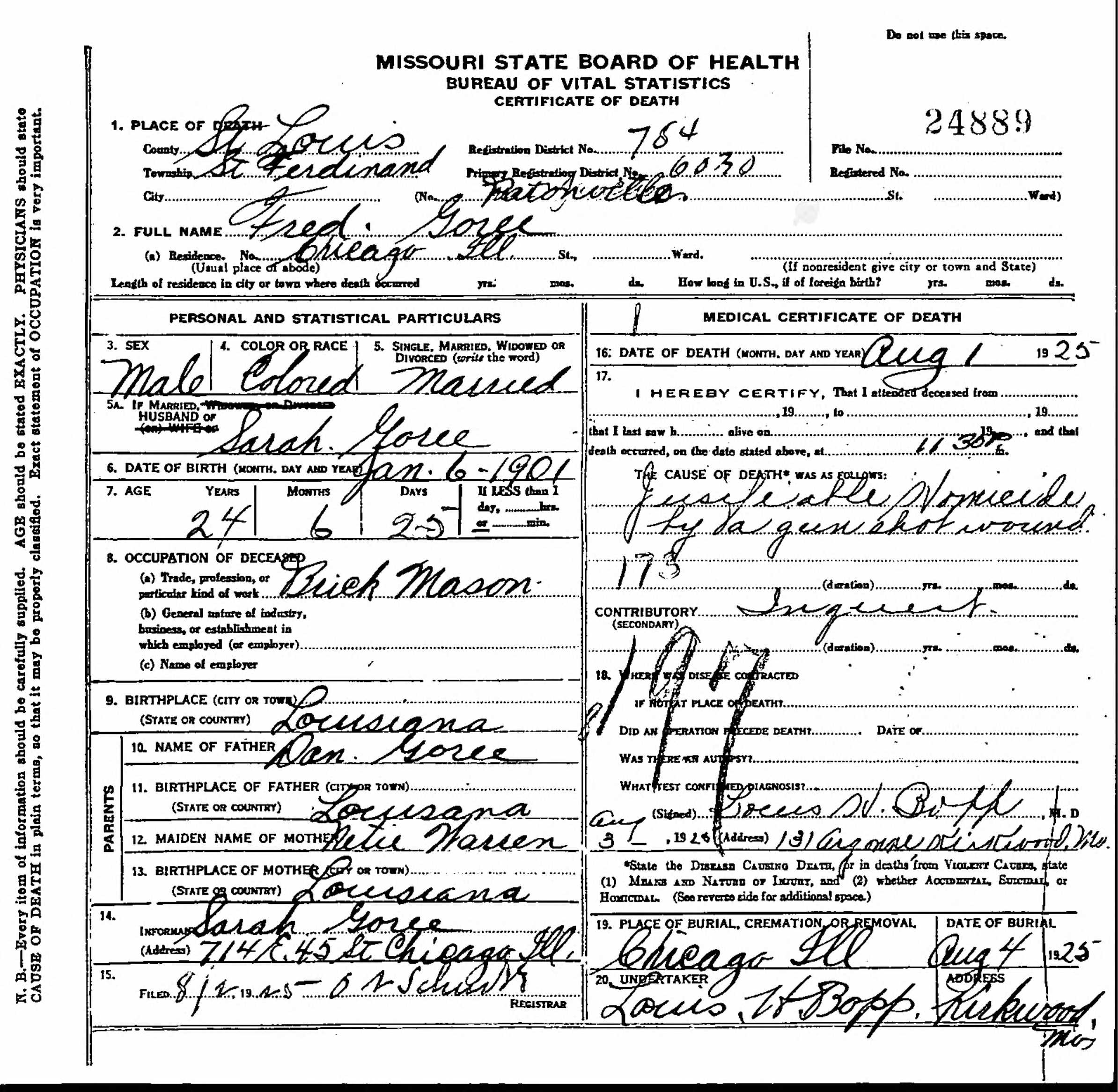
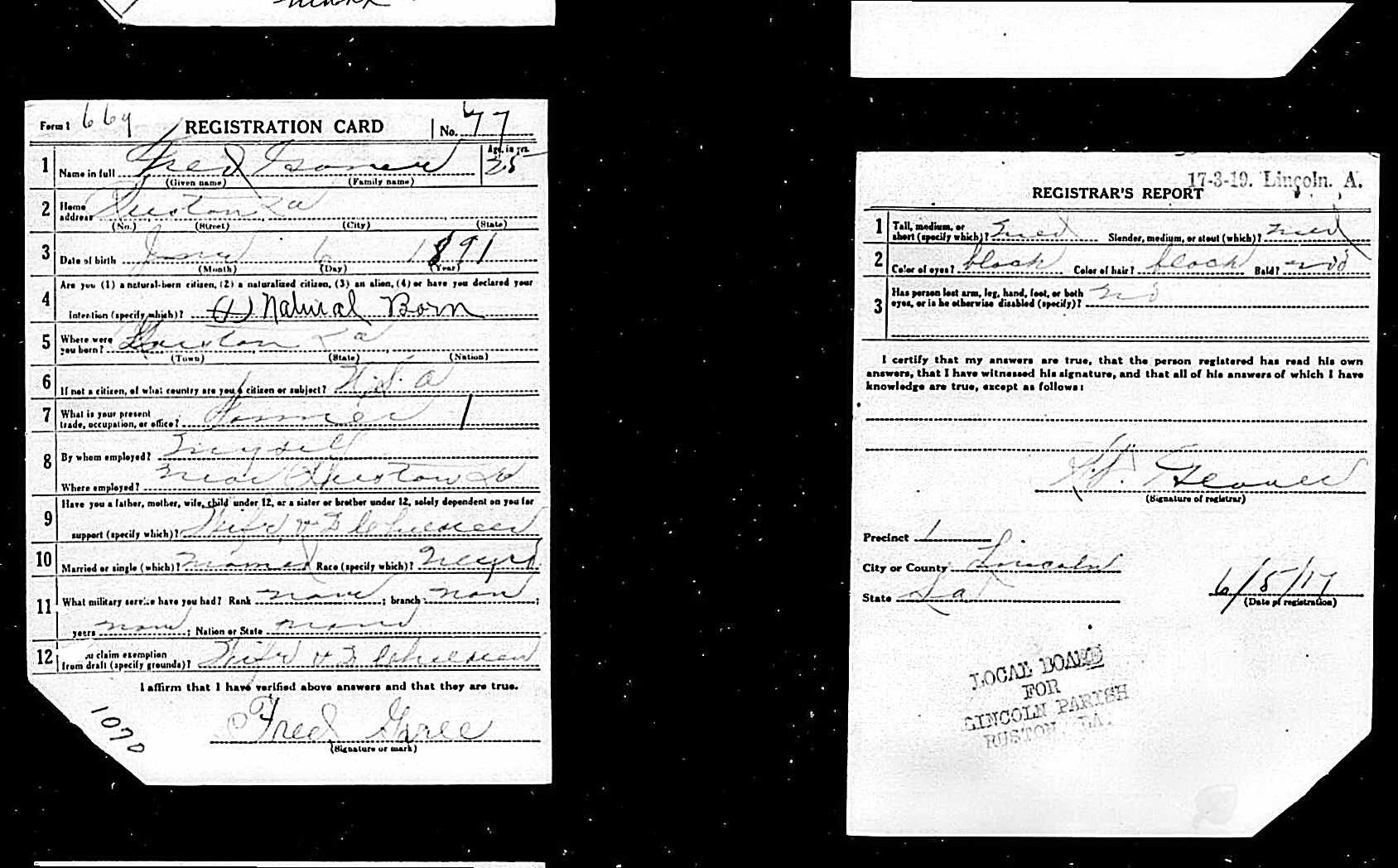
An example: I previously reported that Goree was about 24 and a half years old when he was killed, but that was inaccurate – he was actually 33. I based my first age estimate on his death certificate, which lists his date of birth as Jan. 6, 1901 when it was actually 1892. To make matters more confusing, his World War I draft card lists his DOB as Jan. 1, 1891.
Fred Goree’s World War I draft card.
A much fuller, more accurate and more comprehensive article about that tragic night a century ago can be found here. It includes interviews with two of Goree’s granddaughters, which obviously provides it with much richer details and more complete accuracy, tone and meaning.
It also places Goree’s death into a larger historical context, such as his family’s move north from small-town Louisiana to the metropolis of Chicago as part of the Great Migration; the constant, oppressive threat of violence and death facing African Americans at the time; and the biased, one-sided way the contemporaneous mainstream media of the day painted such events as Goree’s murder with a coat of whitewash and quite often portrayed Black residents in a pervasive, insidious way.
It’s an excellent article, but a good chunk of it is dedicated to describing and explaining many of the basics of Negro Leagues history – something that many readers of this blog already know pretty well.
The article also does leave a few questions and mysteries left unanswered and unsolved. For example, the identity of the deputy county constable who assisted Bennett in killing Goree is not revealed, and the fates of these two law enforcement officers following the murder remain unexplored. In addition, the article lacks any details about Goree’s baseball team, the Chicago Independent Giants, for which little has been discovered in the near-decade since the story’s publishing; and only St. Louis-area media outlets are cited by the writer.
In the next weeks and months, I’m going to try to provide a little more clarity to such questions in periodic posts about Fred Goree and the story of his brief life and brutal, tragic death. I’m also hoping to interview one or more of Fred Goree’s descendants this time around.
****************
While I’m hoping to go into more detail about these soon, there are a few things that I’ve found that I hope can add to the Fred Goree story.
The first is the identity of the second St. Louis deputy constable who joined the primary perpetrator, Clarence Bennett, whose role in the murder was well reported and known at the time, as was his galling exoneration by an all-white grand jury that took just three minutes to officially slander Fred Goree’s name and paint Bennett as a hero acting in self-defense.
Articles about the incident both at the time and in more recent years only referred to the second officer’s last name, if he was named or identified at all. But I was able to uncover his name – Charles J. Schuchman (or Schuchmann), who was apparently a mere 17 years and 11 months old at the time of the murder.
In addition to his youth, Schuchman himself died in a very sudden, violent way – according to his death certificate, he was just 21 when he died from a gunshot wound to the head on Oct. 3, 1928 in what the coroner ruled an “unavoidable accident.” Below that cause of death, the word “Inquest” is scribbled on the document.
I’ve been unable to find any information about Schuchman’s death in the newspapers of the time, aside from a small obituary in the “deaths” section that stated that he died “suddenly.”
But Schuchman wasn’t the only one of the homicidal pair to meet with bloody violence in the years after they killed Fred Goree – Bennett himself also ended up meeting the business end of a bullet.
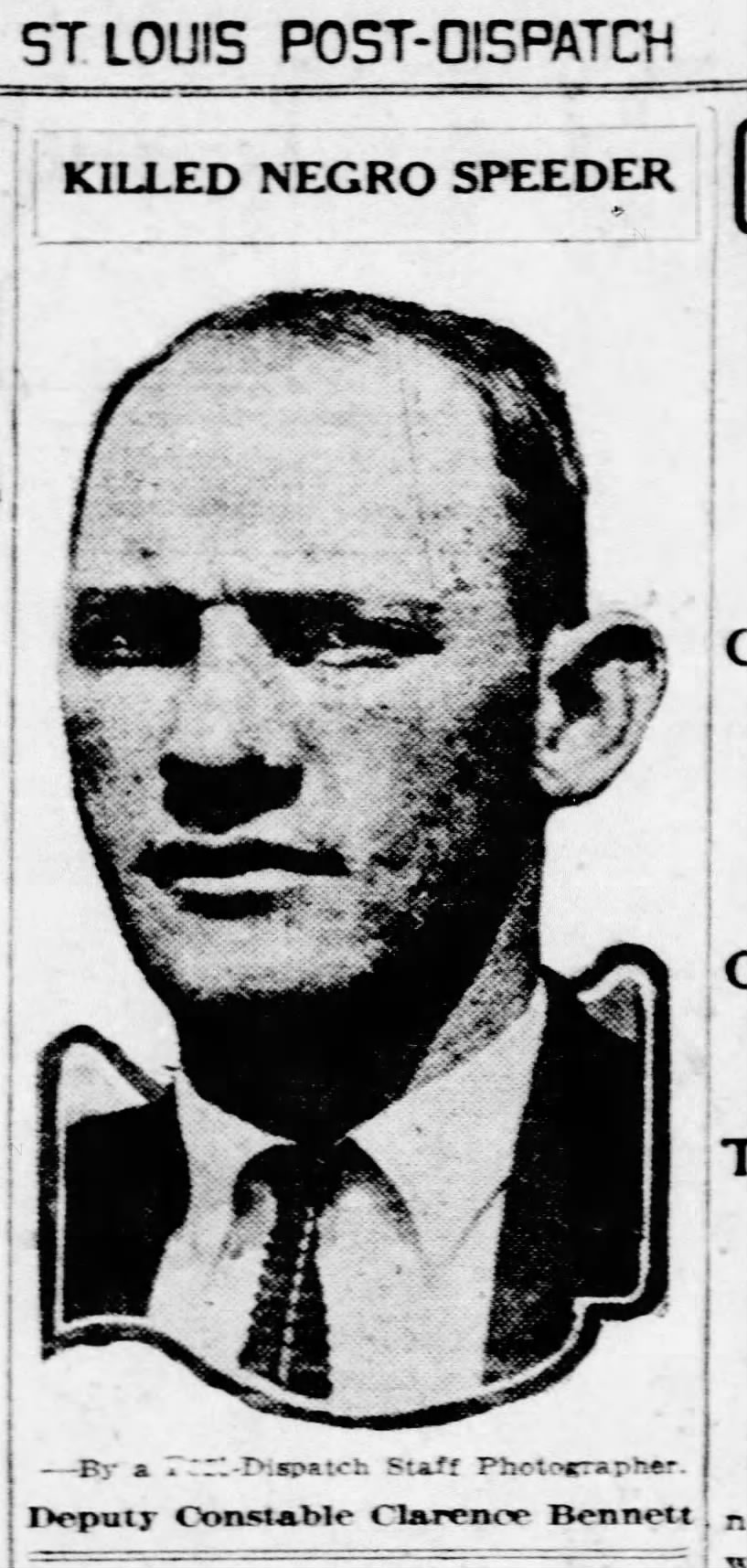
Less than a year after Goree’s killing, in May 1926, was shot in the face, with two fragments of the bullet lodging in his jaw, after breaking up what was reported by the St. Louis Post-Dispatch as a robbery.
Unlike Schuchman, however, Bennett survived his encounter with violence and, in fact, went on to a lengthy, successful career in law enforcement and criminal justice before passing away in Ruskin, Fla., in 1971 at the age of 76.
St. Louis Post-Dispatch, Aug. 3, 1925.
I also found several references in contemporaneous media of what could of what could be Fred Goree’s baseball team, whose barnstorming slate led him to drive from his home in Chicago to St. Louis County that day and night.
In the spring of 1925, a small handful of newspapers referred to one or more semipro teams as the Chicago Independents or the Independent Giants. The May 3, 1925, issue of The Chicago Tribune lists an upcoming game in something called “Bob Figg’s League” between the Chicago Independents and a team named the Mason Parks in Evanston, Ill.
Then, on May 17, the Tribune, in its listing of slated semipro games, refers to a contest between the Independent Giants and the Cragens, while in mid-June The Daily Herald of Arlington Heights, Ill., reported on a clash between the hometown team and the Chicago Independents that was won by the townies, 8-2. The Herald article included this description:
“The Chicago club lived up to their name when practicing before game time, displaying some nifty and fast playing acting independent as five at the same time. It sure looked as if the Heights boys were in for a beating, but as the game started our boys were there with the smoke, which changed the opinion of some three hundred fans who turned out to witness the combat.”
The paragraph seems to describe the Independents performing some quick trickery with the ball before the contest started, perhaps shadow ball, something Black teams of the day often undertook at games in order to draw in and entertain fans.
Now, granted, none of that was major news; it was all just quick jottings, a line or three about semipro teams here and there. In addition, none of the newspapers explicitly stated that the Chicago Independents or Independent Giants were African-American teams. But the brief mentions at least provide a couple small leads in the quest for information.
The Chicago Defender, Aug. 8, 1925.
Finally, while the Aug. 7, 1925, edition of The St. Louis Argus, an African-American newspaper from that city, contained a more detailed and more graphic article on Goree’s murder, the nation’s leading Black publication, The Chicago Defender, published an article about the incident as well on Aug. 8.
The Defender story noted that Goree and his team had been motoring from their home base in the Windy City to the St. Louis area to play a local team from St. Charles, Mo., a St. Louis suburb. However, the paper stated, one of the team’s cars had broken down on the way in Effingham, Ill., forcing Goree to turn his new Buick around and return to Effingham to rendezvous with his stranded team members.
It was on that back-tracking venture that Goree and the other occupants of his vehicle were followed and pulled over for what Bennett said was “speeding,” a development that led to the lynching.
The Defender article also named the two passengers in Goree’s car at the time – 22-year-old Pullman car-washer Frenchy Henry of Chicago, and Harry Gaulden of St. Charles.
For now, I’ll leave things here, with hopefully more to come gradually in a while. With any luck, I’ll be able to do a more thorough and accurate job this time. Fred Goree and his memory deserve nothing less.
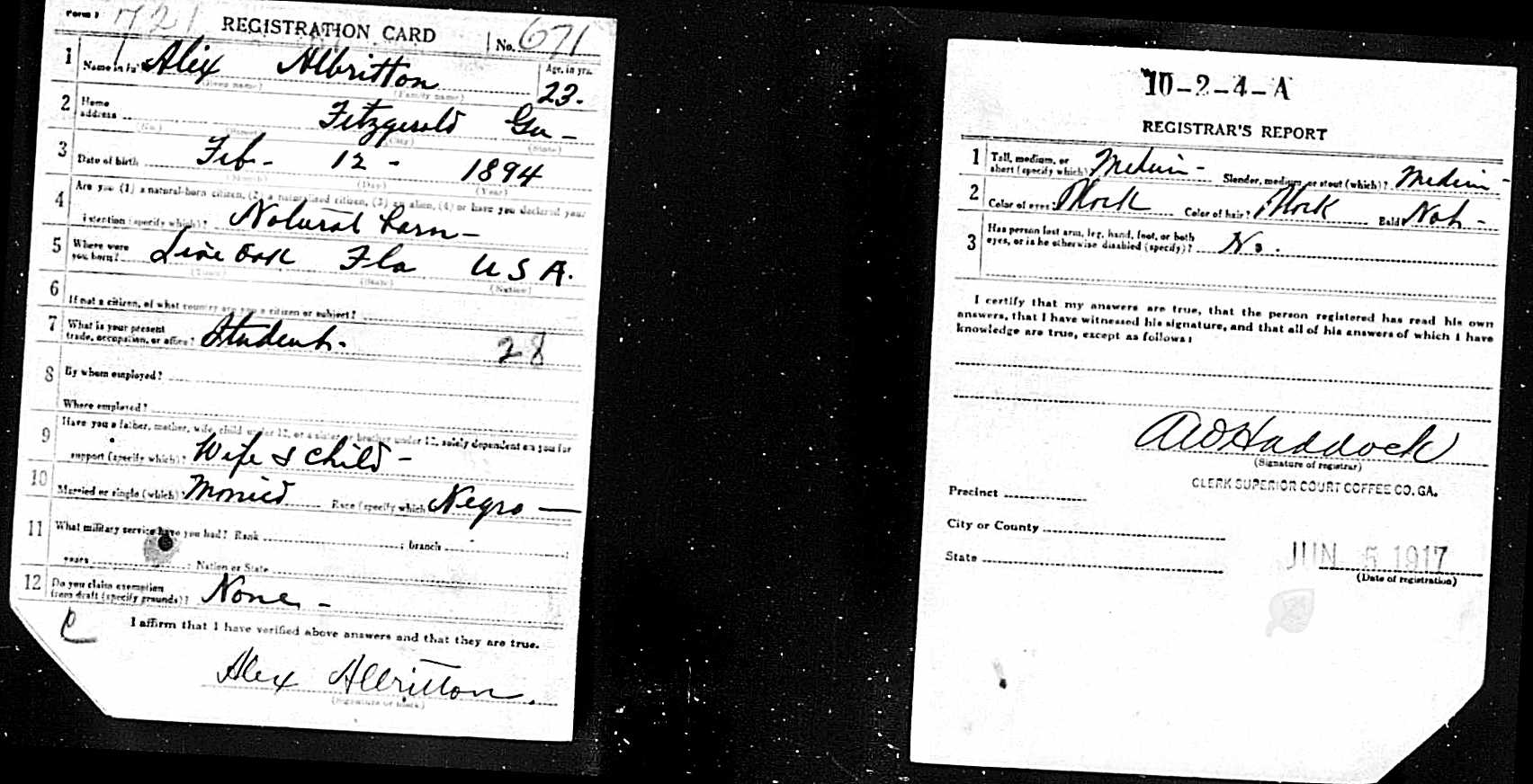
Update, July 18, 2025: Since first posting this a few days ago, I’ve gathered a lot more information — namely, game coverage and box scores — that fills in Alexander Albritton’s baseball career significantly. A more detailed explanation can be found later in this post, and I plan on eventually doing an additional, separate post that includes a bunch of newly gathered stuff about Albritton, the baseball player. For now, read on …
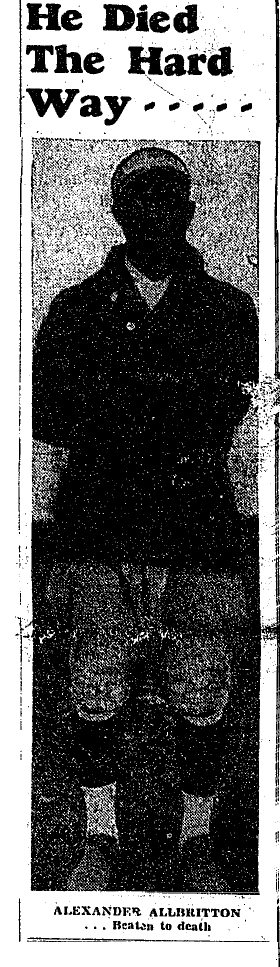
To follow up on my previous post updating the tale of Negro Leagues pitcher Alexander Albritton, who was beaten to death at a psychiatric hospital in Philadelphia in 1940, something I wrote about in these previous blog posts here and here, and in this article on philly.com, the Philadelphia Inquirer newspaper’s Web site. (Unfortunately the article is behind a paywall, though.)
This second installment gets back to basics a bit, shall we say, and away from depressing ghost stories by looking at Albritton’s actual baseball career and his performance on the field before he left the game.
Albritton was born in February of either 1894, 1896 or 1897 (depending on the source), making him in his early- to mid-20s in the first coverage of his playing career that I found.
That would be in May 1918, when Albritton took the mound for the Bacharach Giants of Atlantic City against the 349th field artillery team from nearby Camp Dix. The Giants nipped the Army team, 6-5, and Alexander whiffed four and walked six. At the time, the Bacharachs were a top-flight independent team based in Atlantic City, N.J.
But by August of that season, Albritton had skipped to the Black Sox of Camden, N.J., for whom he hurled a two-hit gem over a team from Chester, Pa., in a 7-2 victory. The Camden Courier-Post stated that the Chesters “were simply baffled at the bat by pitcher Albritton,” who produced some “clever twirling.”
However, a couple months later, Albritton was suiting up for another independent, largely barnstorming aggregation, the Pennsylvania Giants, who voyaged to Reading, Pa., where they played a local club, the Kaufmann Professionals, a team representing a furniture store, in a pair of games. Both contests actually went into extra innings, with the teams splitting them.
(The Pennsylvania Giants seem to be completely distinct from the earlier, juggernaut Philadelphia Giants, an independent professional team that was loaded with Hall of Famers and should-be HOFers.)
For the 1920 season, Albritton caught on with a team called the Pittsburgh Stars – likely the Pittsburgh Colored Stars of Buffalo, N.Y. – who were led by the great, ageless Grant Johnson, a turn-of-the-century star infielder who by then was pushing 50 (and who needs to be inducted in Cooperstown, like, yesterday). Albritton also apparently played left field for the Stars, but by the end of the season, Albritton was back with the Pennsylvania Giants, where he also suited up at first base on occasion.
It looks like Alexander started the ’21 campaign signed to the Buffalo club again, but he was lured away to the national capitol by the Washington Braves, who, according to contemporaneous reports, played in something called the Colored Professional Baseball League. I’ve never heard of a league in the 1920s with that precise name, and I doubt the media meant the first Negro National League, then in its second season.
Anyway, with the Braves, Albritton showed the talent that secured him a place in professional Black baseball. In late April, he hurled a three-hit, nine-strikeout, shutout gem to beat a team called the Brooklyn Slides, 4-0; a few weeks later, the Braves’ shoddy fielding let down Albritton, who held the Buffalo Stars (his previous team) to four hits in Washington’s 2-1 loss.
Fortune soon turned in Albritton’s favor. On May 18, 1921, he engaged in a pitchers’ duel with Hilldale’s Phil Cockrell before faltering in the later innings and suffering a 7-2 loss to the Darbyites.
At the time, the Philadelphia-based, then-independent Hilldale Club was one of the best teams in the country, and they apparently liked what they saw in Alexander Albritton, because 10 days after his hard-fought loss to the Darbys, he was on the mound, albeit for less than an inning, for Hilldale in its 10-9 triumph over the Norfolk Giants.
Two days after that, Albritton earned the starting nod on the hill for Hilldale in the front end of a doubleheader against Norfolk; Albritton claimed a 7-4 victory, which the Darbyites followed up with an 11-4 win in the second game.
He seems to have stayed with the Hilldales throughout the rest of the 1921 season, putting forth performances plagued by inconsistency. At times, he showed flashes of brilliance at times, such as his “airtight pitching” in a 2-0 blanking of a company team in Philly, according to the Philadelphia Inquirer.
But at other times, his pitching was certainly less-than-stellar, like when he got drubbed by a team called the Fleisher Yarners in Bristol, Pa. The Lancaster News-Journal summed it up nicely: “The ‘Yarners’ took a liking to Albritton’s offerings and knocked him out of the box in the first.” (Fleisher scored five times in the opening frame.)
In 1922, Albritton jumped to the Baltimore Black Sox, but I could only find one game in which he played – a late-August encounter with a local team, Public Service, in Camden, N.J., in which Albritton hurled a complete-game, seven-hit victory over the “Postscripts,” according to the Camden Courier-Post.
I could find no more mention of Albritton in the press until the following March, when the Courier Post reported that he had signed again with the Camden Black Sox. The newspaper asserted that Alexander would be the ace of the pitching staff.
However, the next time Albritton pops up is in May 1923, when he’s pitching for the Washington Potomacs, an independent team led by none other than future National Baseball Hall of Famer Ben Taylor.
Ben Taylor
With the Potomacs, Albritton pitched to a 4-4, darkness-ended tie with the Richmond Giants on May 18. Then, during a series of games with the great Harrisburg Giants, who at the time were also an independent club, one that included legendary outfielders and should-be Hall of Famers Rap Dixon and Fats Jenkins. (One year later, when the Giants entered the new Eastern Colored League, Dixon and Jenkins were joined in the outer garden by Oscar Charleston, many folks’ – yours truly included – choice for baseball GOAT of any era, league or color. That trio also ranks among the great outfields of all time – the greatest, according to some.)
One of the Washington-Harrisburg clashes came on Independence Day in D.C., with a doubleheader. Albritton pitched the first contest and got tagged with the 5-2 loss.
For the next five weeks or so – into late August – the Potomacs seemed to have played largely teams far from major-league level, such as company squads and town/city clubs. And in general, Alexander gave a good account of himself. Against a Philadelphia department store team on July 21, Albritton “was in wonderful form and did not yield a hit until … the seventh,” stated the Philadelphia Inquirer of his 3-0 victory; in Mount Holly, N.J., against a town team, Albritton “tightened up in the pinches” in posting another 3-0 W, according to the Pittsburgh Courier.
The Seamheads database paints a bit of a different picture, however. The Web site has the Potomacs going 14-20, with Albritton posting a record of 0-4, with a staggering 8.61 ERA, only five strikeouts and a horrendous WHIP of 1.783.
(If media reports are to be believed, though, the situation got a little better later on in the season, with the Aug. 25 Norfolk Journal and Guide, in describing the “rejuvenated” Potomacs, called Albritton “one of the leading pitchers in the East.” The Washington Evening-Star, one day later, asserted that “the local club has one of the best pitching corps in the colored league.”)
The 1924 baseball campaign seems to have started with a bit of equivocation for Alexander Albritton. Multiple media reports in April ’24 stated or hinted that he was uncertain with whom he’d sign – possibly with the Philadelphia Giants, possibly re-signing with the Potomacs, maybe with the Newark American Giants.
Pittsburgh Courier columnist Rollo Wilson, for example, wrote in early April that “Albritton … is undecided where he will twirl this summer. He is considering an offer to go up into New York state, he says.” But then, less than a week later, a newswire service reported that Albritton had committed to pitch for the Newark American Giants “but as yet has not sent in his signed contract.”
He landed with none of those. Instead, in 1924 Albritton initially suited up for the Brooklyn Cuban Giants, apparently a new, independent team that was distinct from the Brooklyn Royal Giants of the ECL. He pitched for them in a 2-0, 14-inning win over the Charleston Giants, as well as a 19-6 triumph over the Wilmington Professionals. Both games took place in May.
(Interestingly, on May 24, 1924, the Philadelphia Tribune asserted that Albritton “is the pitching ace of the Giants” and called him a “spit ball artist.” I’d never seen him reported as a spitball pitcher before I found the Philly Tribune article in question.)
However, he once again jumped ship and apparently left the Brooklyn club for a team called the Pittsburgh Giants; on June 22, he pitched for his new team in their 11-1 drubbing at the hands of the General Tire company team in Akron, Ohio.
And a month later, Albritton was back with the Washington Potomacs, who were again piloted by Ben Taylor. There was a key difference in the setting, though – in 1924, the Potomacs were no longer an independent team, but instead members of Ed Bolden’s Eastern Colored League, one of the seven Negro Leagues now officially recognized as major leagues. That would seemingly make Alexander Albritton an actual major league baseball player. But we shall see.
In practical terms, Albritton was back in action under a skipper he knew and hopefully was used to. The Courier’s Wilson wrote on July 19, quizzically, that Taylor plucked the battery of Albritton and catcher Willie Creek from the Homestead Grays, who at that point had yet to become the major-league powerhouse they were in the 1930s and ’40s. In 1924, the Grays were still growing and gestating toward their golden era. However, I’ve found no proof, i.e. game coverage or printed game box scores, of Albritton actually suiting up for Homestead. Anyhoo, Albritton appears to have finished the 1924 campaign with the Potomacs.
For the following season, 1925, Albritton reportedly began the season with the Potomacs. In early February, Rollo Wilson penned that in ’24, “Albritton proved one of the steadiest men of the [pitching] staff.”
Returning Washington manager Taylor, in an article in the Baltimore Afro-American attributed to himself, acknowledged that the Potomacs had been a mediocre venture on the diamond during the previous two seasons and would need significant adjustiments and additions for the ’25 season to be any better than the club’s previous couple summers. Taylor noted that he first inked Albritton to the Potomacs in 1923 and that the Philly lad would be back in 1925.
The ’25 season, though, didn’t work out as planned for the Washington Potomacs – by June, they’d abandoned the nation’s capital and moved to Wilmington, Del. But Albritton, along with the rest of the Potomacs, soldiered on, and on June 8 he earned a 7-6 victory over the Mahanoy City (Pa.) Blue Birds, despite inconsistency on the mound.
“‘Twas a game of good baseball, bad baseball, good pitching, bad pitching, and much heavy hitting …,” reported the Mahanoy City Record American.
“Neither Albritton nor (Blue Birds pitcher) Knetzer looked any too steady out on the hill,” the newspaper added, “each allowing five passes in addition to the heavy and sincere clubbing. Both were in to stay the limit, however, and both worked hard.”
Actually, Albritton was the article’s lead, starting with the first paragraph. Unfortunately, the report was dotted with some verbiage that is now woefully outdated and offensive. (That’s in addition to the bizarre word salad and questionable grammar.) Stated the initial paragraph:
“Alexander Albritton, looking like a coal yard at midnight in Pittsburgh, brought his rag time [sic] band of Wilmington Potomacs to the West End Park yesterday and pitched his dusky brethren to a 7-6 victory [over] the Mahanoy City Blue Birds in a battle featured by extra basehits [sic]. Alexander the Great emerged victorious over the Flock but not until a torrid session that lasted two hours and fifteen minutes and ended with the winning run on second base had been laid before the fans.”
(I’ll note here that in the June 13, 1925, edition of the Pittsburgh Courier, Rollo Wilson asserted that Taylor had actually signed Albritton to the Potomacs in the current year from the Philadelphia Giants.)
The rest of the 1925 campaign proceeded with further inconsistency from Albritton. On June 21, he pitched well in the Potomacs’ 9-3 triumph over a town team in West Lebanon, Pa., but five days later, he looked dreadful against a team in Hazelton, Pa., getting shelled for eight runs in seven innings of work in which he didn’t notch a single strikeout.
As the 1925 season wore on, there was more bad news for the Potomacs – they were forced to drop out of the ECL and revert to a barnstorming, independent team. (Wilson described the newly rebranded club thusly: “Several league discards are on a co-plan team which is laying around the Somnolent City as the Wilmington Potomacs. Larry Somer … has charge of the outfit and is getting them good booking.”) Albritton stuck with the rebranded franchise, however, with continued mixed, often mediocre, results.
Chappie Johnson
But Albritton still couldn’t sit still, and in September 1925, he took the mound for a traveling “all star” team under the managerial eye of grizzled veteran catcher Chappie Johnson, who was approaching the half-century mark age-wise. On Sept. 20, he hurled the the first game of a four-game series between Chappie’s All Stars and a barnstorming team in Binghamton, N.Y., and came away with a complete-game, 7-1 win in which Alexander scattered eight hits.
That’s the last mention on Albritton I could dig up until a few in spring 1927, which places him on another all-star aggregation or sorts, this one led by future Baseball Hall of Famer Louis Santop and apparently based in the small town of Ambler, Pa. Santop called the club the Bronchos, and, per his usual, Albritton was decent but nothing spectacular; in a doubleheader against the spring-training, Ben Taylor-piloted Baltimore Black Sox, Alex picked up the win after going seven innings in long relief against the strong-swatting Baltimore bunch. The Asbury Park, N.J., Press newspaper reported that “as a whole [Albritton] turned in a very credible performance.”
In 1928 Albritton reportedly returned to Santop’s crew, but I couldn’t find evidence of Albritton pitching in a game with the aggregation that year.
And that, as far as I could find, was that for Alexander Albritton’s career on the diamond. Looking back, one question we can maybe ask when summing up Alexander Albritton’s career on the diamond is somewhat basic: How good was he? And, more specifically, was he of major-league caliber?
We can probably trust the venerable writer/researcher James A. Riley, author of the landmark “The Biographical Encyclopedia of the Negro Baseball Leagues,” who included a brief entry on Albritton:
“During a five-year span in the early ’20s, he pitched with five different eastern teams, but despite being a hard worker and always ready to pitch, never really made it big. … He was a fair pitcher and could beat the white semipro teams but was not effective against the [B]lack major-league teams.”
From what I could glean, Riley’s assessment is pretty spot on and sums up Albritton’s on-field career perfectly, and that sentiment was generally echoed by Ben Taylor himself, who wrote in his aforementioned, first-person article in the Afro-American in early 1925:
“He is a fair pitcher, but is too light for the big leagues. However, he can beat most any white club and will earn his salary pitching against the semi-pros. He is a hard worker and is always ready to work.” (This might actually be from where Riley got his assessment of Albritton.)
Therein lies a second question we could pose about Albritton – did he ever actually achieve “major league” status?
From what I can tell, and from the record that I found, Albritton did play for a team that is now considered a major league team in the eyes of modern Major League Baseball – for the Washington Potomacs of the Eastern Colored League in 1924. By my tally, every other edition of a given team for which Albritton played was either an independent, barnstorming and/or sub-top level.
However, we should possibly go a bit further to sharpen up the focus even more by making sure that, during that tenure with the major-league Potomacs, did Albritton ever actually pitch against another team that was similarly of major-league level? Or did he personally only ever pitch against lesser opponents in games scheduled between official ECL contests?
The verdict: Albritton never took the mound pitching for an MLB-level team against an MLB-level team.
So, he was briefly a member of a team that is now considered major league, but he never pitched in any official fully major-league games.
Thus, the answer to the question of whether Alexander Albritton was a major league player is, as is quite often the case in the Negro Leagues, it’s complicated.
It also must be pointed out that I might have missed a game or two in my research, and that someone might, down the road, uncover proof of Albritton’s fully and unquestionably major-league status.
Update/Edit: Like I noted up top, I’ve learned a great deal more about Albritton’s life on the diamond, such as box scores and game covers, that detail many additional games in which he played over his career. The bottom significance of that is that we can definitively say that Alex Albritton, was, under newly modernized MLB standards, an officially major league baseball player.
Specifically, I now know that Albritton did pitch or otherwise play in several games in which his team was of major-league level, and so was the opponent. The records of these additional major-league games came courtesy of my friend and peer Kevin Deon Johnson, whose own database included these “new” games. Many thanks to Kevin for the input and research.
As stated at the beginning of this post, I plan on doing a separate, more thoroughly post fleshing out Albritton’s career, but for now, I’ll explain how I missed these additional games when I was doing my own research on Albritton.
Basically, I searched the newspaper databases to which I have access for the keywords “Albritton,” “Allbritton” and “Albritten.” The game articles and box scores Kevin possessed featured Alexander listed under an array of other spellings and names — “Britton,” “Britt,” “Al Britton” or some other abbreviation.
I subsequently did my own additional research using those new keywords, and I uncovered a slew of other games in which Albritton participated, many of them against semipro or company clubs.
So keep an eye out for my next post about Albritton’s baseball career. Now, back to this original post …
A final query we could ponder regarding Albritton’s time in baseball is whether he might have shown any flashes or hints of symptoms of the illnesses that would land him in a psychiatric hospital in just over a decade.
Alas, that’s a question that might have no discernable answer, at least at this moment. The coverage of him in his athletic pursuits mentioned no signs of psychological instability or distress that I could find. Moreover, we don’t immediately have access to any relatives, descendants or friends for any testimony, whether spoken or written, as to his health.
In general, though, many people afflicted by mental illness start showing severe, debilitating symptoms in the late teens or early 20s. Depending on the year of his birth, Albritton was in his early- to mid-20s years old at the time of the first game coverage of him, and late-20s-to-early 30s at the time of his last mentioned performance. Why did his career end? Was it his health? Was it by choice? Or was it because, well, he just wasn’t that great a player?
I’ll hopefully be able to more fully dive more deeply into his afflictions, hospitalization and death. But for now, we close the curtain on Albritton’s career pursuing the national pastime.
Editor’s note: This is the third and final installment of a series about the 1947 New Orleans Creoles. The previous parts are here and here.
I’ll launch this concluding chapter by concluding the story of the official 1947 Negro Southern League season. Like many a season in Black baseball, the ’47 NSL campaign was one filled with uncertainty, irregularity and seat-of-one’s-pants planning.
Schedules were always adjustable, including official league contests, and at the mercy of financial realities, travel complications and other variables that were always shifting throughout the season.
So by what was declared the end of the regular season, it was unclear about what to do in determining a league champion. From what I can glean, everyone involved agreed that the powerhouse Asheville Blues had won the first-half championship, but there was less consensus about who won the second half.
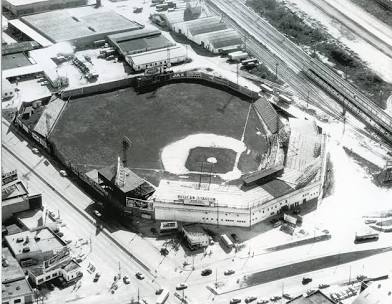
Pelican Stadium
At one glance it appeared the Blues had nabbed the second-half flag as well, which would have automatically made them league champs. However, the New Orleans media announced, somewhat unilaterally, that the Creoles had won the second half, thereby setting up a playoff between Asheville and New Orleans.
For whatever reason, all agreed just to hold a best-of-five championship series between the Blues and the Creoles, which began Sept. 12 in New Orleans.
“HEAR YE! HEAR YE! COME ONE, COME ALL,” wrote The Louisiana Weekly’s ace scribe, Jim Hall, in the paper’s Sept. 6 issue.
“Haven’t you heard the latest news? There is going to be a town meeting at the Pelican Stadium,” Hall added.
He continued later in his article: “Now, that you have the news, the old town-crier will stop singing the blues. But I must make this last call. Hear Ye! Hear Ye! COME ONE! COME ALL!”
The teams split the opening two games, both held at Pelican Stadium, then the New Orleans guys took game three, 4-1, at Baton Rouge.
However, the Blues rebounded with a 10-5 win at Shreveport to even the series at two games each, and they clinched the series and the NSL championship with a dominant 16-4 triumph in game five in Beaumont, Texas.
Thus ended the 1947 Negro Southern League season, with the New Orleans Creoles as runners up. The Creoles tied a bow on a relatively successful debut campaign by beating the visiting Indianapolis Clowns, 11-8, in an exhibition at Pelican Stadium on Oct. 2. Page somehow got Negro Leagues big-timer Chet Brewer (Cleveland Buckeyes) in pitch in the game against the Clowns, with Baton Rouge native Pepper Bassett, aka the Rocking Chair Catcher, backstopping.
William Plott, in his comprehensive book history of the Negro Southern League, described the life in the NSL for teams like the Creoles. In particular, he explained what the league meant for players.
“The Negro Southern League gave a home to professional baseball in Southern cities that could not field teams at the Negro National League level,” Plott wrote. “… In those cities were players whose renown would hardly leave their expanded neighborhoods. Thousands of them played the game in even greater obscurity than did their counterparts in the ‘major league’ Negro National League and later Negro American League. The Negro Southern League was minor league baseball … That means that the number of players who went on to become major leaguers … was relatively small.”
Plott added that the achievements, both routine and extraordinary, of the NSL’s players were quite often obscured, clouded, forgotten or ignored, the result of spotty media coverage, poor record keeping – Plott noted that “[n]o official statistics were ever issued by the league” – and irregular scheduling.
It was in this stark reality that the following three 1947 New Orleans Creoles toiled with a universal zeal for the national pastime.
Wenceslao Gonzales O’Reilly – In April 1947, Creoles owner Allen Page turned to a close friend to boost the Big Easy team’s roster, a move that brought five ringers from the storied Cuban Professional League. The personnel coup was arranged by Alex Pompez, the owner of the New York Cubans of the Negro National League and one of Page’s dearest friends. (Pompez was eventually ushered into Cooperstown in 2006.)
Among that group of five hired guns was pitcher Wenceslao Gonzales, a fresh-faced native of Quivican, Cuba, who was five months away from his 22nd birthday when he arrived in New Orleans.
Gonzales’ primary “claim to fame” was a single Major League Baseball appearance, with the Washington Senators on April 13, 1955, eight years after becoming one of the staff aces for the modest New Orleans Creoles.
“By stretching the imagination a trifle, we find that Wenceslao Gonzalez [sic] of Juarez … is a left-handed version of the famous Satchel Paige,” wrote the Citizen’s Ray McNally.
“Like Paige,” McNally added, “Gonzalez [sic] is “a pitcher with oodles of stuff, a variety of deliveries, [and] a sensational mound record. He’s a fellow whose age offers an interesting point of speculation and a guy who has plenty of color.”
The Citizen further analyzed Gonzales’ strengths as a pitcher, asserting that the Cuban southpaw “appears to have a rubber arm – one of those valuable pieces of a pitcher’s armor that seems to get better with age.”
But back in 1947, when he signed on with the New Orleans Creoles, he was barely in his 20s and fresh from a tour of duty in the Cuban Navy during World War II, ready to start his professional career. He’d spent eight years in amateur beisbol in Cuba, including an early stint on the Cuban national team in 1939 at the age of 14, when the club won the Amateur World Series, the country’s and the national team’s first international championship.
With the Creoles in 1947, Gonzales was generally viewed as the team’s pitching ace, something Pittsburgh Courier correspondent/columnist Lucius Jones asserted in a May 1947 column; Jones noted that Gonzales’ recent Creoles debut was a two-hit gem against the Memphis Red Sox.
Another article in the May 24 issue expounded on that notion: “Gonzales came to the states [sic] with high praise and in his only out[ing] he displayed a coolness and polish of a veteran and a rare assortment of every pitch in the book. He is destined to reach the highest rung in baseball.” In its June 8, 1947, edition, the Chattanooga Daily Times asserted that “[t]he Creole pitching staff is built around” Gonzales, who “is the strike-out wizard of the Creoles and is leading the league in that department.”
Wenceslao Gonzales retired from professional baseball at the age of 43 and passed away a dozen years later at the age of 55 in Cuidad del Carmen in Mexico.
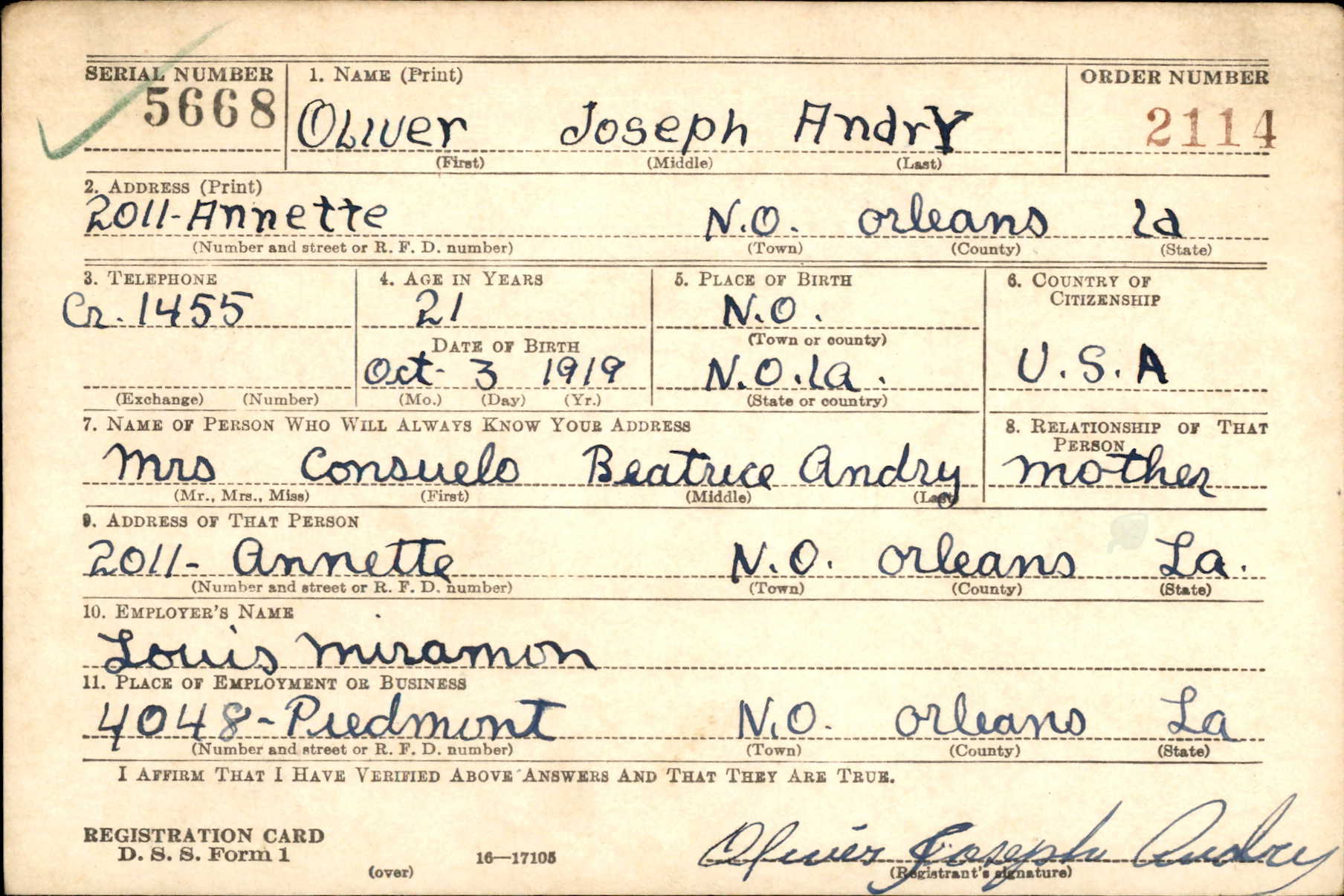
Oliver “Butsy” Andry – Oliver Andry was born on Oct. 3, 1919, in New Orleans; his parents were Willie Andry, a laborer for a steamship company, and Consuelo Andry, nee Jackson. When Oliver was a youth, the family lived on St. Anthony Street; later on, the Andrys moved to Annette Street in the same neighborhood.
Oliver was the third of (by my count) a dozen children and grew up in the historic Claiborne Avenue neighborhood, which, before it was chopped in half by the construction of I-10, was one of the liveliest, most tradition-rich Black sections of New Orleans.
By the time Oliver was in his early 20s, he was playing centerfield for the Dr. Nut Tigers, a New Orleans semipro team sponsored by the World Bottling Corp., a local company that produced Dr. Nut soda. In July 1941, Andry racked up two doubles and a homer in a Tigers game against a team from Houma. By trade he worked as a plasterer in building construction for Louis Miramon, a property developer from Slidell, La. But in May ’42, Andry enlisted in the Army as a private and served his country for three-plus years in World War II. After being discharged in October 1945, Oliver – nicknamed “Butsy” – continued a career in semi-pro baseball that included a stint with Allen Page’s New Orleans Creoles.
He returned to the diamond in 1946, once again playing for the Dr. Nut Tigers.
Andry was a potent little sparkplug on the field. At just 5-foot-1 and a mere 125 pounds, Butsy flitted around the outfielder catching fly balls, but at the plate he boasted a surprising amount of power and prowess.
When he climbed aboard to New Orleans Creoles’ train, by mid-season 1947, Andry had turned into a fan- and media-favorite standout, both at home and on the road. In late May of that year, the Macon (Ga.) News stated that “[a]nother star with the Creoles who are expected to take a bright spot will be Oliver Andrews [sic], amazing outfielder”; a Louisiana Weekly cover of a doubleheader bringing the Atlanta Black Crackers to the Big Easy reported that “center fielder Oliver Andry performed miracle catches in the field and continually brought the crowd to its feet.”
Oliver Andry’s World War II draft card
Later in the season, the Atlanta Daily World, in its preview of a Creoles-Black Crax series, dubbed Andry “the dapper youngster who made several spectacular catches in centerfield.” In June, Andry hit a three-run, inside-the-park homer in the second inning in the Creoles’ 14-3 cakewalk over a composite local all-star team in an exhibition clash, prompting the Delaware County Daily Times of Chester, Pa., to write that Andry was “the best flyhawk in the state, is hitting well over .300, and is a speed merchant on the bases.”
Andry continued with the Creoles the following season, and his local renown continued to grow, with some media reports referring to him as unusually little – in August 1948, as the Creoles were prepping for a game against the barnstorming Cincinnati Crescents in Selma, Ala., the Selma Times-Journal stressed Andry’s tiny stature in a preview article, referring to him as “Oliver Andry, New Orleans boy, sensational midget leftfielder.
“When fans see Andry they will see a real Creole boy making some sensational catches in the left field garden. He is the fastest man on the team.”
Unfortunately, I couldn’t find any mention of Oliver in The Weekly over the next two seasons (1949 and ’50), so I stopped looking at that point.
As Oliver approached middle age, he attended Beecher Congregational Church in New Orleans, serving as a deacon, and by the 1950s, multiple generations of pretty much the entire Andry family lived on Pauger Street, still in the historic Claiborne Avenue district.
But later in life, Oliver Andry and his wife, Mildred (nee Sayas) Andry, whom he married in 1959, moved to Slidell, maybe 35 miles away from New Orleans on the northeast shore of Lake Pontchartrain.
Andry also took part in the Old Timers’ Baseball Club, a local organization of dozens of former Negro League and Black baseball players and managers; he sometimes played in the club’s annual all-star reunion game.
Butsy Andry died on Aug. 31, 2004, roughly a month before his 85th birthday, and was buried in Resthaven Memorial Park in the New Orleans East part of the city.
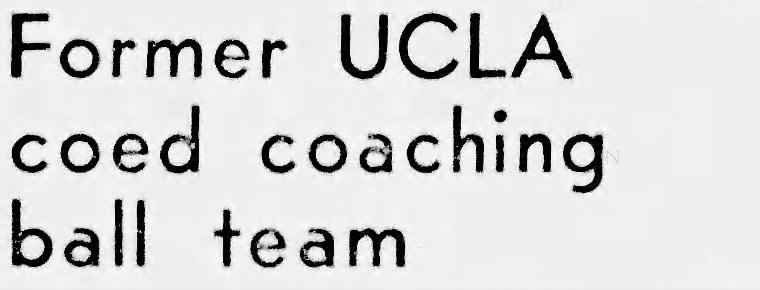
Lucille Herbert – “Miss Lucille Hebert [sic], former softball and [field] hockey star in California and one of the best feminine athletes in these parts, will be a regular figure in the frist[sic] base coaching box for the New Orleans ‘Creoles’ of the Negro Southern League this year. This wil make her probably the first woman in colored baseball history to be so intimately connected with the ‘playing’ end of a professional diamond aggregation.”
That’s how The Louisiana Weekly announced that Lucille Herbert, a New Orleans native and recent graduate of the University of California-Los Angeles, had been hired by Allen Page to blaze a trail in New Orleans baseball history.
While Page and the Creoles are well known as the folks who in 1949 famously hired the legendary Toni Stone, one of Negro League baseball’s earliest and most popular female trailblazers,
But Page plucked other women to join the Creoles’ roster and join his team, including Fabiola Wilson and Gloria Dymond. But Lucille Herbert (married name Lucille Bland) was the first, in 1947.
For her excellent book, “Curveball: The Remarkable Story of Toni Stone,”Martha Ackmann interviewed Lucille Bland, who told the author that Page ran an ad in The Louisiana Weekly for a woman to join the Creoles. The team owner thought having a female presence on the club might pique potential fans’ curiosities and entice them to games.
“He thought that would be the come-on,” Ackmann quotes Bland as saying.
As it turned out, Page ended up not having to look very far for a woman prospect – Bland was already working as a cashier at the Page Hotel.
“Lucille Bland loved sports, played basketball and baseball at Dillard [University, an HBCU in New Orleans], and read everything she could about her hero, Babe Didrikson Zaharias,” Ackmann wrote.
While Page insisted that Bland (at that time Herbert) stay attractive and “stylish” on the field, she knew how to entertain a crowd, and as a result she wasn’t afraid to “get right in an umpire’s face and let him have it,” Bland said.
She noted that at first the other players weren’t thrilled with her presence – “they resented it immensely” at first – but once she proved to them that she was a baseball junkie who knew the game front to back, they became more comfortable with her around and accepted her suggestions. “I was a sister to them,” Bland told Ackmann.
Los Angeles Tribune, Aug. 2, 1947
The first mention of Herbert I found in the media outside of New Orleans in 1947 came in mid-May, when the Morning World newspaper of Monroe, La., mentioned her in a preview article about the Creoles’ upcoming game against the Cinderella Sports of Monroe.
“A feature of the Creole outfit is its woman coach, Lucille Hebert [sic], who will operate from the first base coaching box when her team is at the bat,” stated the World.
The national press apparently caught wind of Lucille’s presence with the Creoles in mid- to late-July, when several papers from outside Louisiana, as well as multiple national Black wire services, reported on her position with the New Orleans club.
An Associated Negro Press dispatch from July 21 noted that “[n]ovelty has been added to baseball by the New Orleans Creoles, members of the Negro Southern League, in Miss Lucille Herbert, and attractive 24-year-old graduate of UCLA who travels with the club and acts as coach.”
It added that “[h]er hobby is sports and she played softball, basketball and a number of other sports. …
“[S]he hopes to land a post in a city playground or recreation center, but, until then, watch her on the first base line with the Creoles.”
The Los Angeles Tribune, another Black paper, published a sports brief about Herbert, noting that she was a student at local schools, Los Angeles City College and UCLA, and graduated in physical education from the latter institution. Being a coach, the paper stated, gave Herbert “one of the most unique jobs held by a woman.” The publication added that Lucille “plays baseball herself.”
Unfortunately, many of the media references to Herbert included commentary about her looks and attractiveness, including a column by my journalistic hero, the Baltimore Afro-American’s Sam Lacy.
“Southern League teams are whistling at the first base coach of the New Orleans Creoles,” Lacy wrote in the Afro’s July 26 issue. “He’s a she, 24-year-old Lucille Herbert, beauteous UCLA graduate.”
A short essay about Lucille can be found on the Web site for the Center for Negro League Baseball Research. The essay states that Bland “was an outstanding all-around athlete” who was selected by Page “as a third base coach/traveling secretary/player because of her athletic ability, her bubbly personality and her administrative skills.”
The CNLBR piece adds:
“As the Creoles’ third base coach Lucille was said to have put on quite a show when New Orleans was up to bat. Her confrontations with the umpires were said to have been quite a spectacle. Lucille’s fiery demonstrations always kept the fans entertained. She was very popular with the players, fans and media. A picture of Lucille in her Creoles’ uniform was even featured on the cover of the [team’s] program in 1947.”
The short article underscores that she was a well known figure in the New Orleans community by showing pictures of her in her Creoles uniform mentoring kids during a baseball camp at Pelican Stadium in June 1947.
After her tenure with the Creoles, Lucille stayed active in the local community; she attended Dillard, where she starred in basketball, and she later helped perform fundraising for the school. She also participated in a voting registration drive, sponsored by the Pontchartrain Park Homes Improvement Association in 1961, during the Civil Rights Movement.
Lucille achieved one of her goals when she earned a position as a recreation supervisor with the New Orleans Recreation Department in 1952. As part of the job, she coached the girls basketball team at the Rosenwald Recreation Center, for example. Unfortunately, though, she was dismissed from the job in 1957 for specious reasons put forth by the NORD supervisor, who was the son of the department’s executive assistant director.
Later on, Bland headed back to California, where she earned a master’s degree from Pepperdine University and spent her career in the education field. However, she maintained a home in New Orleans.
Before I complete the tale of the 1947 New Orleans Creoles (first two installments here and here), there’s a few other cool things I want to get to, including today’s post.
For this piece, I’m going to jump way back to something I discussed and wrote about in fall 2014 – that’s right, more than a decade ago. Here’s my article in the Philadelphia Inquirer, and this and this are the blog posts I wrote.
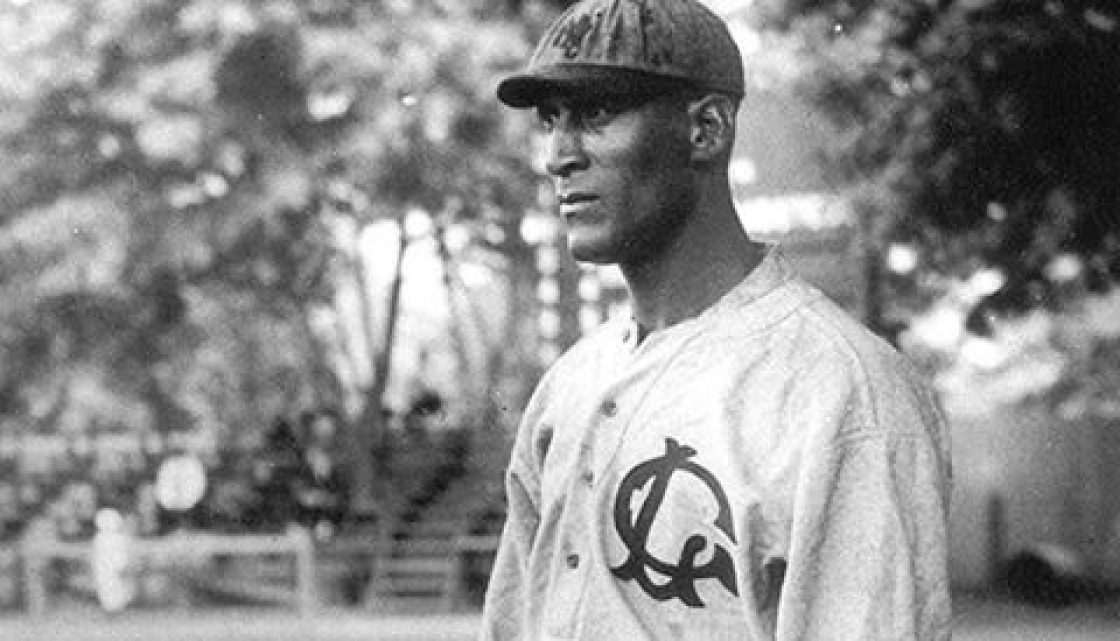
At that time, I somehow learned about (I can’t recall how, exactly) Alexander Albritton, a pitcher whose career in the upper echelons of Black baseball was mainly during the 1920s. I wouldn’t necessarily call his career brief, but it was generally unremarkable. He seems to have been a decent flinger of the horsehide, but he was far from a Hall of Famer. He could have brilliant outings, but he got just easily got shelled.
But his quality as a pitcher doesn’t really figure into the main thrust of his story.
What Albritton is most remembered for – the thing that makes his life truly remarkable – is his tragic death at the age of 45.
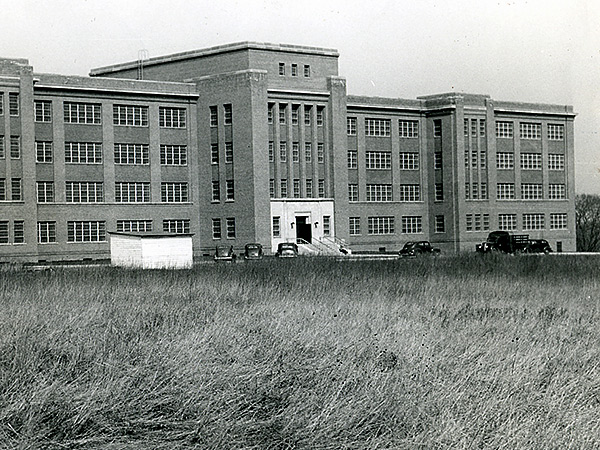
That death came in February 1940 while he was a patient at Philadelphia State Hospital, a notoriously decrepit, filthy and horrific public psychiatric facility commonly known as Byberry Hospital.
Albritton died at the hands of Frank Weinand, an orderly at the hospital who beat poor Alexander to death, allegedly to subdue Albritton during a psychological breakdown.
In addition to Byberry’s troubled, corrupt existence during its time – it finally closed in 1990 after numerous investigations into the deplorable conditions and questionable methods of its staff – several questions and mysteries remained, such as where exactly he was buried (I was unable to confirm his final resting place back in 2014).
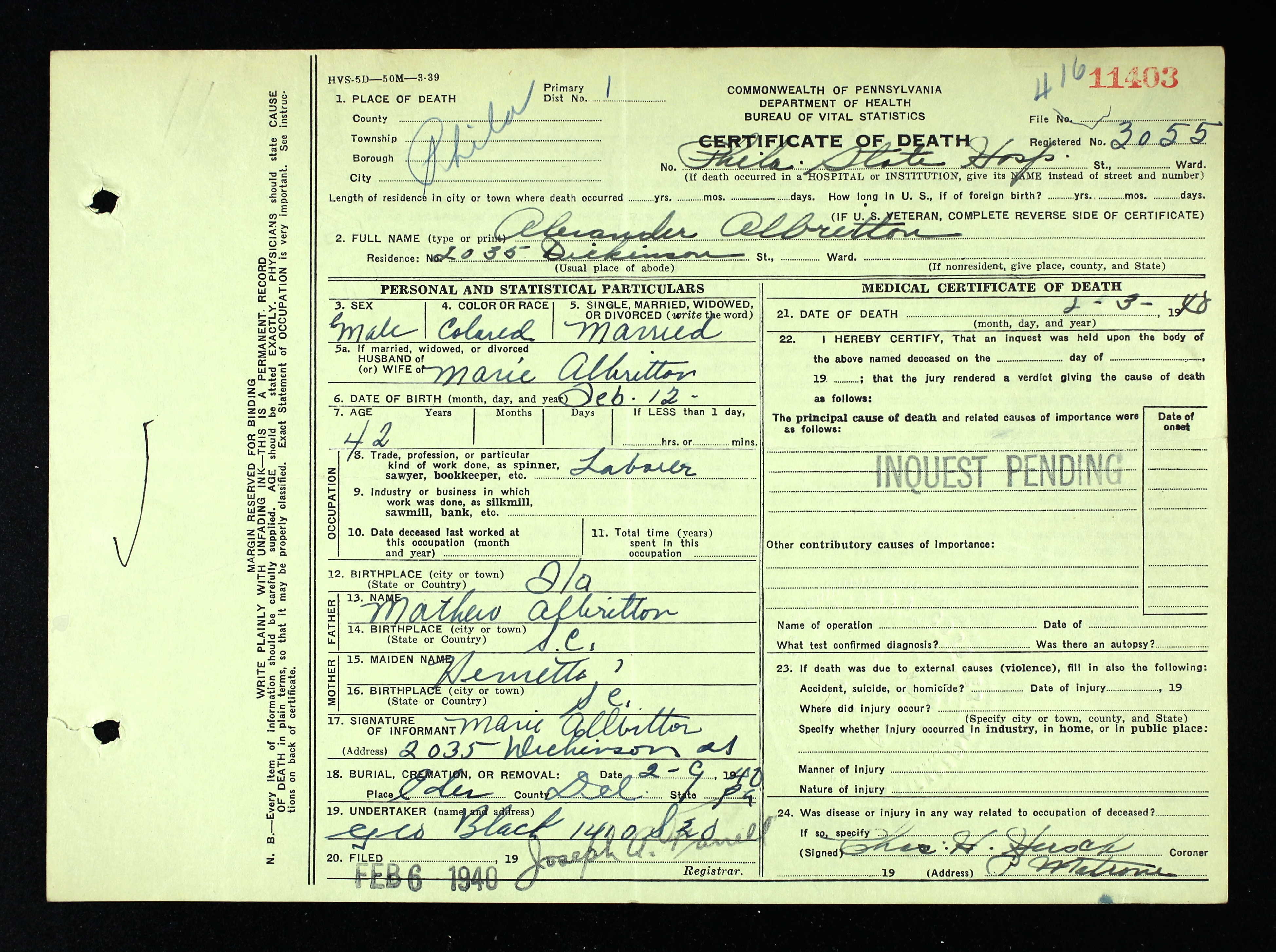
But the biggest blank space in Albritton’s saga was what precisely caused his death. News reports at the time weren’t able to offer any clarity, mainly because on Albritton’s death certificate, the lines for the principal cause of death just stated “inquest pending.”
So it was apparently unknown, or at least unverified, exactly what Weinand did in his physical altercation with Alexander that killed the latter on Feb. 3, 1942.
Since I wrote the article on Albritton for the Philadelphia Inquirerer and the corresponding posts I penned on the sad incident, I hadn’t really revisted the Alexander Albritton tale for many years.
But a couple weeks ago, something made me circle back to the tragedy just to see if anything new had developed or emerged since 2014. I’m not sure what prompted me to check it out; it just kind of struck me one day. I had a feeling.
Turns out it was a good thing, too, because I did indeed find something new.
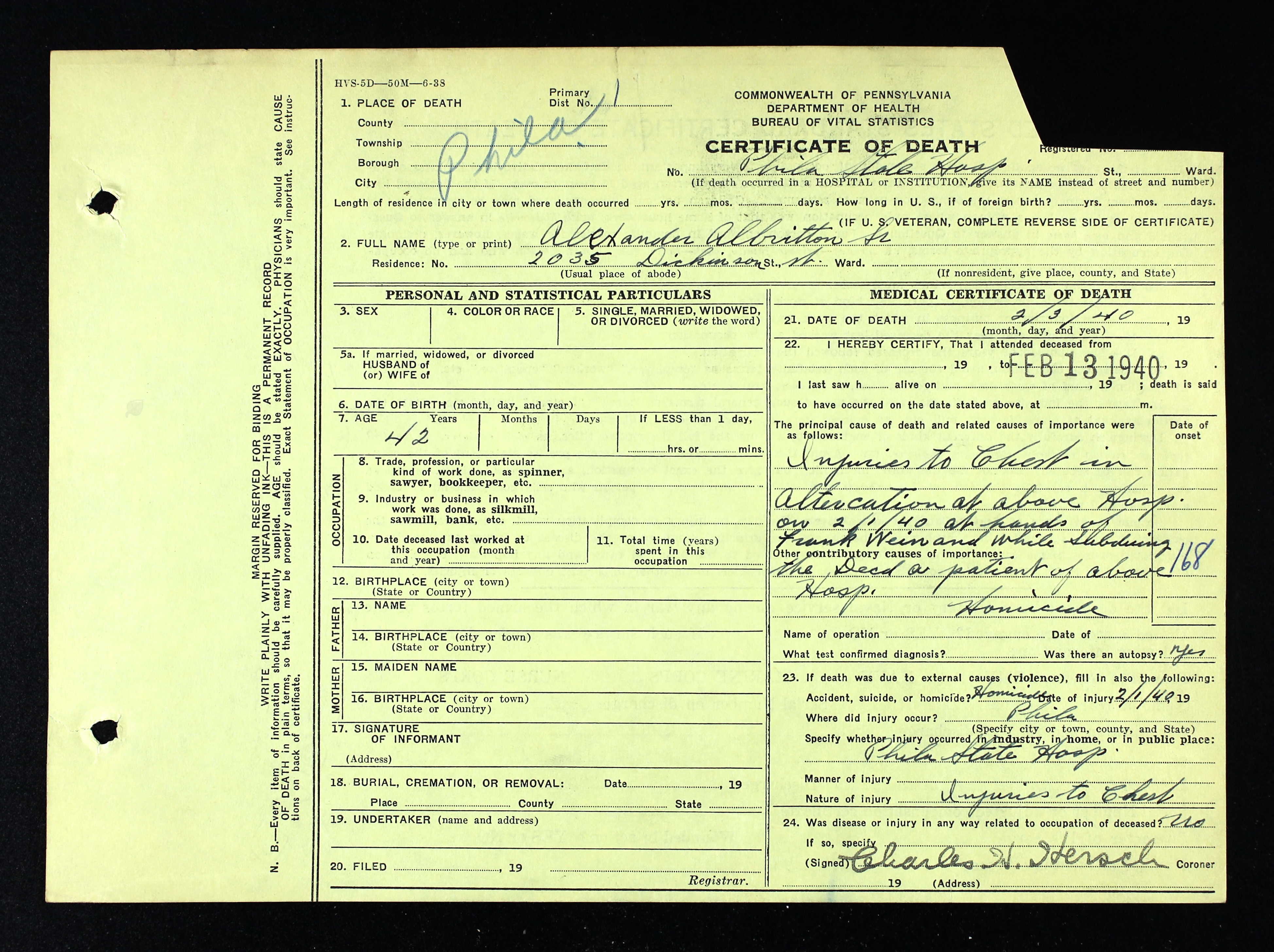
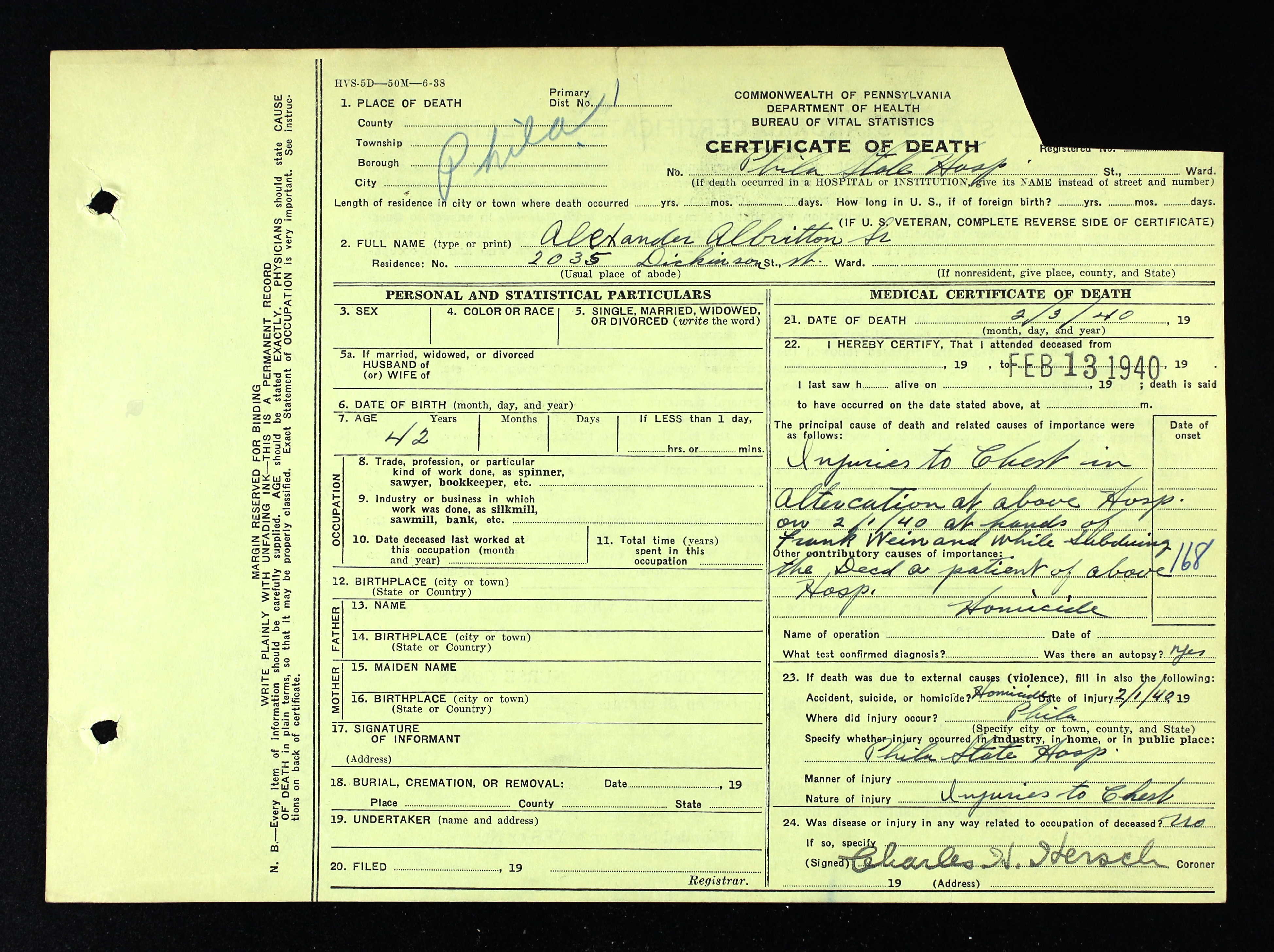
Namely, a second death certificate! One that included the actual results of the inquest/autopsy of Albritton’s body!
When I did take a return dive into the story a couple weeks ago, I hopped on Ancestry and did a search or two on Albritton’s life, including looking up the death certificate for the heck of it.
At first, what I found was the same document I came across in 2014 – with the same old “inquest pending” rubber stamp on it.
Curious as to whether there might be any addendums or anything attached to the primary certificate page, I clicked to see the next page of records that had been uploaded to Ancestry.
Lo and behold, there was now a second death certificate following the original, and it was one that had filled in the lines for the exact cause of death.
I don’t know precisely why I hadn’t uncovered the follow-up certificate 11 years ago, i.e. whether I was sloppy or careless in my reporting or if the additional document had been filed and uploaded since 2014.
Regardless of how it happened, it happened, and now, with a decade of additional lessons learned about journalistic investigation and historical research, I’d found something big.
So what caused Alexander Albritton’s death? States the newfound document: “Injuries to chest in altercation at above hosp. [sic] on 2/1/40 at hands of Frank Weinand while subduing the decd [deceased][,] a patient at above hosp. [sic].”
The ruling of the coroner, Charles H. Hersch: “Homicide.”
Murder was the case, indeed.
Now, as reported by the contemporaneous media of the time, Weinand was charged with murder on Feb. 5, 1940, but eventually he was largely cleared of wrongdoing by the investigation into Albritton’s death; the post-incident probe determined that Weinand had acted in self-defense when Albritton allegedly attacked the orderly with a broomstick. (The charges appear to have been downgraded at some point to manslaughter.)
However, even with the completed autopsy results, the second death certificate leaves a lot of curiosities and questions about what all happened. There’s also a lot of details about the case that, whether due to unavailability of information or lack of time on my part, I wasn’t able to fully explore and write about over a decade ago.
First, there’s other differences between the two death certificates. The most noticeable is that the spaces for background information about Albritton, or any deceased person – sex, race, relatives, spouses, addresses, birthday and place, etc. – are filled out on the initial document but left largely blank in the second one, probably because it would have been roughly the same information.
Philadelphia Tribune, Feb. 8, 1940
Another key difference between the two versions is the listed date of death; on the first one, it’s stated as Feb. 3, 1940, but on the ensuing one, it’s Feb. 1, 1940.
The variation can most likely be attributed to the gradual discovery and revelation of the complete and accurate account of what had taken place between Albritton and Weinand. In the particular case of date of death, it eventually came out that Albritton’s body – indeed, the fact that he was dead – wasn’t discovered for a couple days by hospital staff.
What seems to have happened is that Albritton’s body was likely found on Feb. 3, at which time staff and investigators probably just assumed that he had died that same day, but subsequent multiple investigations by the State Police, the Philly police and others found that the altercation between Albritton and Weinand actually occurred two days earlier.
It then took staff, doctors and others to not even realize for two days that Albritton was dead and hadn’t been treated at all for the injuries – which included, it seems, four broken ribs, a punctured lung, and constusions to the torso and arms – sustained by the altercation. It would seem that whatever Weinand did to Alexander, it was severe, even with the former’s exoneration.
Another aberration between the two death certificates is the date they were filled. The first one indicates that it was logged on Feb. 6, 1940, but, curiously, there is no filing date on the updated document version, only that Hersch had “attended the deceased” on Feb. 13.
Yet another discrepancy is Hersch’s signatures – they look substantially different.
Moreover is the uncertainty about where Albritton’s body ended up. The initial death certificate states that the dispensation of the body took place on Feb. 9, 1940, at Eden Memorial Park cemetery of Collingdale, Pa. However, back in 2014 I called Eden to confirm, and the staff there said they had no such record of Albritton. (I also called three other possible cemeteries, none of which had any record of him, either.) Then, in the second edition of the death certificate, all of that information is left blank.
The details of the fatal incident are intriguing, and hopefully I’ll be able to talk about those at some point. I also hope to follow up on where Alexander was buried, as well as examine his family background.
But next up will eventually be a look at Alexander’s career on the diamond.
Editor’s note: This is the second part of a three-part series on the New Orleans Creoles. The first installment is here.
We’ve covered the Creoles’ barnstorming, charity and other non-league contests. Now, we have to look at the team’s actual Negro Southern League games and the Creoles’ performance in the circuit.
But just like most years and most leagues in Black baseball, the NSL’s in-circuit season was irregular, unpredictable and nigh near willy nilly.
By the time the dust cleared and the 1947 Negro Southern League season wrapped up, there was, not completely unexpectedly, a lack of clarity as to who’d won the darn thing.
Thanks to the same challenges that plagued Black baseball and their leagues, teams and players for decades and at all levels of the game – erratic news coverage, incomplete or altered game schedules, small crowds, team-jumping players – the conclusion to the 1947 Negro Southern League campaign is a little cloudy, to say the least.
And the Creoles had for themselves a front seat on the roller coaster ride.
The Crescent City team opened its league schedule on May 11, with a doubleheader at Little Rock, where they split with the Memphis Blues, a club that existed for a single year in 1947 and played in the NSL for that season.
(As was usually the case in the Negro Leagues, NSL teams often played at neutral sites as a way to maximize revenue by bringing the gameday experience to different places, including those that currently didn’t have a team in the loop.)
After two more divided road series – a doubleheader against the Atlanta Black Crackers that the foes split, and a 2-2, four-game set with the Raleigh Tigers at different venues in North Carolina – the Creoles arrived in the Smoky Mountains of western North Carolina in the first week of June to face the Asheville Blues, the defending NSL champs.
Unfortunately, the Blues flexed those superpower muscles and swept the four-game set, and it didn’t get much better after that – a four-game series at Chattanooga against the Choo-Choos ended with the home team taking the set, three games to one.
Then came an example of a frequent practice that made the Negro Leagues wholly unique in professional baseball at the time – an extended, paired road trip, in which two teams accompanied each other on a jaunt to different locales, often across multiple states, as a traveling attraction, a road show of shorts.
In this case, the Creoles traveled with the Black Crackers, beginning with a doubleheader in Atlanta on June 15; the clubs ended up splitting that twin bill, then headed west.
Where, finally, at long last, the Creoles came home.
The Big Easy boys had their league home opener on June 17 at Pelican Stadium against Atlanta, and The Louisiana Weekly of June 14 stated that the event would hold tremendous significance for local baseball fans.
Pelican Stadium
“Two long months of endurance and waiting by New Orleans fans will end on Tuesday night when the Creoles clash with the strong Atlanta Black Crackers at Pelican Stadium,” the paper said. “This will mark the first time a stable, chartered league [in recent years] has had a representative from New Orleans.
“Twice on occasions in the past,” the article added, “New Orleans has had entrants in semi-organized circuits. … In days past it was such names and officials as Moss, Geddes and [Fred] Caufield [actually spelled Caulfield] that vanguard the movement to establish New Orleans as a baseball city.
“Tuesday and Wednesday nights, Allen Page will trot out one of the greatest young teams ever assembled and certainly one of the best that ever wore a New Orleans uniform.”
Thanks to, ahem, cracker jack pitching, the Creoles won both contests, held on consecutive nights. In the Tuesday game, the Creoles’ Cuban ace, Wenceslao Gonzales, hurled a four-hit, 1-0 shutout, and Billy Horne scored the lone marker on a Cracker fielding error in the sixth inning. An estimated 5,100 folks showed up to see the game.
Arizona Republic, May 28, 1954
The following night, New Orleans pitcher Wild Bill Chapman allowed six hits and only a lone tally in the first inning, followed by airtight, shutout ball the rest of the way in a 6-1 triumph. With the win, the Creoles (by my calculation) moved ahead of Atlanta and into sole possession of third place in the NSL, behind first-place Asheville and second-place Jacksonville.
The two clubs then embarked on their pair journey through the South and headed north and west to Shreveport, where the Creoles nipped the Crackers, 8-7, in a contest played on the home diamond of the white Shreveport Sports of the Texas League.
New Orleans then swept a doubleheader over the Black Crax in Houston and followed up by edging out the Atlanta aggregation, 3-2, in 11 innings at the American Legion ball field in Longview, Texas, on June 24.
Beginning in late July, the Creoles faced a grueling slate of league games that at some point paired them against (in order) Nashville, Chattanooga, Asheville, Raleigh, Jacksonville and Nashville again. The regular-season league schedule didn’t conclude until the last week of August.
And during those roughly six weeks, the Creoles enjoyed only eight home dates at Pelican Stadium in New Orleans. The rest of the time, the Big Easy lads were scheduled for contests at Longview, Texas; Alexandria, La.; Baton Rouge, La.; back to Longview; El Dorado, Ark.; again to Longview; another one in Longview after a quick trip home; El Dorado; Houma, La.; Shreveport, La.; back to Houma; to Nashville, Tenn.; and to Dayton, Ohio.
A couple notes on that schedule:
Only three of all those games were played at the home field of the Creoles’ given league opponent. That would be the ones for the last series, at the famed Sulphur Dell in Nashville against the Nashville Cubs.
Those contests at Nashville were billed in advertising in The Tennessean newspaper as “official championship playoff games,” but I’m not sure why. It could have been a series to determine the winner of the NSL second-half pennant and the right to play the first-half winner and defending champion Asheville. (More on that in the third and final installment of this blog series.)
While numerous games being played at neutral sites certainly isn’t surprising in the slightest for the Negro Leagues, I don’t know why these particular locales were chosen. However, since Shreveport is in northwest Louisiana, Longview is in northeast Texas, and El Dorado is in southwest Texas, all three of those places are relatively close to each other, which might have facilitated traveling between them. As to why Dayton was selected, your guess is as good as mine.
Houma is only about 60 miles and an hour’s drive to the southwest from New Orleans. The medium-sized town was at that time home to the Houma Indians, a team in the low-level, professional circuit Evangeline League, which, despite its rookie-level status, was an extremely colorful, beloved, scandal-plagued league contained entirely in the southern half of Louisiana.
Remember that this is a Black team traveling through the South at a time when segregration was still in full effect, which often meant rickety vehicles, sketchy hotels and meals grabbed on the fly wherever they could. It was a trying existence for the team, players and management.
As a way of concluding this installment, we’ll take a look at the off-field measures of success for a baseball team – gate receipts, attendance and public support? Did the Creoles draw good crowds, or did the local community not give the type of attention to the club that the Creoles for which the Creoles were hoping?
Basically, it was solid, but it certainly could have been better, something on which The Louisiana Weekly then-sports editor Jim Hall emphatically expounded in his regular column from July 26, 1947.
Coming shortly after the Creoles drew just 2,300 spectators to a doubleheader at Pelican Stadium against Chattanooga, Hall’s piece lamented the languid state of Black baseball in the Crescent City and the African-American citizenry’s apathy toward the situation.
We have one team (Creoles) that can play their games in Pelican Stadium and we don’t fully support it. Fans, colored baseball needs you and ‘Brother’ it needs you very badly.
Jim Hall, Louisiana Weekly columnist
“Judging from last Sunday’s twin bill affair at the Pelican Stadium,” Hall penned, perhaps, lots of the baseball fans or followers don’t know about the New Orleans Creoles … For years, local fans have been shouting the question, when are we going to have a home team, a team which will represent our city in one of the organized leagues in our country? …
“Now that the out-of-town teams games have been cut down and one of the baseball magnets [Page], who by the way, is a colored citizen, has invested nearly $10,000.00 in a baseball team called the New Orleans Creoles, which is a member of the Negro Southern League, the attendance is still fading. …
“At the present time,” Hall added, “there is [sic] some twenty baseball teams in New Orleans without a place to play their games, these teams must stay on the road and play their games. We have one team (Creoles) that can play their games in Pelican Stadium and we don’t fully support it. Fans, colored baseball needs you and ‘Brother’ it needs you very badly.
“In New Orleans, there is little incentive for colored players to give their best to baseball when the home town [sic] fans will not come out and see the team in action. Whether the [white] New Orleans Pelicans win or lose, the crowd is always giving full support. Why can’t the colored fans support a team of their own?”
That, unfortunately, is a common theme running through just about the entirety of African-American baseball history in New Orleans. In 1947 specifically, those citizens who declined to support their own Negro League team missed one helluva conclusion to the season. That, plus a focus on three of the 1947 Creoles themselves, will be in our next, final installment of this series.
New Orleans Creoles owner and Negro Southern League president Allen Page. (Photo from the Amistad Research Center.)
In January 1947, The Louisiana Weekly newspaper in New Orleans announced that Allen Page, a longtime sports promoter, baseball impresario, hotelier and businessman, was busy forming a new hardball team for African-Americans in the Big Easy. Dubbed the Creoles, the new organization was slated to start spring training in late March, and, reported The Weekly, “Page … is now signing up ball players” and “inviting all young baseball players … to contact him at the Page Hotel, 1038 Dryades St. …” The article also noted that the team’s home field would be at Pelican Stadium.
Two months later came the arrival of the Creoles’ first manager – 41-year-old Harry Williams, a respected, longtime Negro Leaguer who started his career in the top levels of Black baseball in the early 1930s and for 15 years or so hopped around to several clubs. He got into managing circa 1943, serving piloting tenures with, most recently, the Baltimore Elite Giants and New York Black Yankees.
The 1947 New Orleans Creoles’ season began, anchored by Allen Page, whose long-term impact on the National Pastime, both in NOLA and through the whole Black ball world, has been immense, as his son, Rodney Page, wrote a few years ago in a short article/tribute to Allen.
“The true story of Allen Page is his indomitable spirit, which speaks to the heart of self-reliance, self-definition, and self-determination,” Rodney wrote. “He transcended and excelled despite the shackles of the Jim Crow South and overt racism in America. A legacy of firsts was in his DNA.”
As alluded to the introduction to this post, one of Allen Page’s boldest, most daring moves as an owner and operator during his several decades in New Orleans previously owning and running several franchises earlier in his career, such as the Black Pelicans and Crescent Stars, was the launching of a fairly successful Negro minor league team just as integration had started the process of teams in Organized Baseball poaching the top talent from the Black circuits.
According to contemporaneous media coverage – particularly in The Louisiana Weekly – the New Orleans Creoles of the late 1940s were reliable members of the Negro Southern League who fared pretty well on the diamond, in the stands and out among the public.
The Creoles also reportedly maintained a working relationship with the Negro National and Negro American leagues, which makes sense, given the NSL’s ox thinking was the inclusion of women in the Creoles’ lineups, the highest-profile of which was doubtlessly Toni Stone, an infielder (usually second base, specifically) who starred for the Creoles in 1949 and later for the Negro American League’s Indianapolis Clowns.
Stone wasn’t the only woman to grace the rosters of the late-1940s New Orleans Creoles; in 1948, for example, Page brought aboard outfielders Fabiola Wilson, a former student-athlete at Xavier University of Louisiana in New Orleans, and Gloria Dymond, from Southern University in Baton Rouge. All of that was several years after Georgia Williams pitched for the Creoles in 1945.
There was one more female New Orleans Creole in the late 1940s, but we’ll save her for our next post about the club.
For simplification purposes, this post will largely focus on the New Orleans Creoles’ 1947 season, their first in existence under Allen, so we’ll now return to the narrative begun at the start of this post …
I’m going to try very hard not to get bogged down in too many specifics about the ’47 Creoles and just zero in on a few developments and trends that highlighted the season for the New Orleans crew.
In terms of significant developments or occurrences, there were two I want to point out. The first came in late April, when Page managed to wrangle in five players from the stellar Cuban professional league, including catcher Francisco “Frank” Casanova and pitcher Wenceslao Gonzales, the latter of whom I’ll examine in a little more depth in my next post about the 1947 Creoles.
“In an attempt to place a team in the Negro Southern League that is worth[y] of the great sport loving city that is New Orleans,” stated the April 26, 1947, issue of The Louisiana Weekly newspaper, “Allen Page, owner of the local league entry, has the services of five outstanding players” from Cuba.
The newspaper noted that the signing of the five Cuban ringers was facilitated by Alex Pompez, the owner of the Negro National League’s New York Cubans team. Pompez, a National Baseball Hall of Fame inductee, was close friends with Page and visited New Orleans frequently. The Weekly also stated that, essentially, the Creoles were a farm team for the NNL squad.
Alex Pompez
The inking of the five Cubans underscored the diverse locales from which Page plucked the members of the ’47 Creoles, reported the newspaper, which added, however, that the team’s roster was also stocked by much local talent, too.
“Although first preference for berths was given to local boys,” the paper said, “the lack of proper response and the refusal of candidates to report [to the team] consistently have forced … Williams to bring in many of the players who have written in from all over the country. However, despite the fact that players from Indiana, Illinois, Pennsylvania, Alabama and Ohio have been grabbed the spotlight [sic], at least six Louisiana youths, including four New Orleans lads, have showed [sic] enough to warrant at least four starting berths.”
The second major development in the Creoles’ season took place occurred on an executive level. Upon the death of then-NSL president Tom Wilson in late May 1947, Page was selected to succeed the revered Wilson, who had been a team owner and league executive in multiple Negro professional loops for nearly 30 years.
In covering the NSL’s season organizing meeting in Nashville (the home of the league-member Cubs) in late May, newswire reporter C.J. Kincaide noted the election of Page as league president.
“Mr. Page is no new figure to baseball,” Kincaide wrote. “In addition to being a successful businessman in New Orleans, he has been a promoter of baseball for a number of years and is well-known and highly respected by owners and managers of both the Negro American and National Leagues.”
In his article, Kincaide quoted Page himself, who told the reporter that “we have a big job to do, if for no other reason than for Tom Wilson who all baseball men loved and respected.”
While it was certainly an honor – and an assumption of significant responsibility – for Page to be elevated to the head of a far-reaching organization, he had assumed similar league executive positions before, and he would later, a fact that reflected how respected and capable he was for shepherding numerous teams into a functioning operation spread out of several states at a time in history when the long overdue integration of Organized Baseball was starting to gradually chip away at the viability of Black baseball.
Pundits from around the country chimed in with their thoughts of and hopes from Page’s ascension to league president, and what it might mean for the NSL. Referring to the building of a new edition of the NSL, seasoned journalist and columnist for the Pittsburgh CourierLucuis Jones wrote that Page was tasked with “[b]ringing the Southern League in its own [as] a two-year overhauling job.” He added that Page was an excellent choice to succeed Wilson, calling Page a “nationally-known team owner and sportsman,” and the scribe reported that Page thought that “a powerful … six-club circuit in which all the clubs are within a 500-mile radius of each other is a better financial proposition … and much more [stable] than an eight-club league” in which some teams must travel more than 500 miles and possibly barnstorm on the way in order to play every other league team.
Jones further outlined Page’s thoughts about the future of the NSL, noting that the new president said the league’s players must be aware of the importance of putting quality teams and exciting play when they take the field.
Every club cannot have a winning outfit. But every team can hustle and display sterling sportsmanship.
Allen Page, stated to columnist Lucius Jones
Jones penned that Page “stated firmly that effective at once, every club must require its players to hustle throughout every game and cease their ‘umpiring.’ Failure to adhere to these directives may bring fines or suspensions or both. ‘Every club cannot have a winning outfit,’ said Mr. Page … ‘But every team can hustle and display sterling sportsmanship.’ This will win the public anywhere, any time, [sic] it’s good box office and it’s a fool-proof way to get the cash customers …” to come to games.
Aside from these two events – the Creoles’ recruitment of Cuban players to beef up the team’s roster, and Allen Page becoming league president – the 1947 Creoles season marked a trend followed by Page and his teams over the course of several years.
Namely, that Page brought aboard women to his baseball operations, either as coaches or players, making him, and the women he signed for his teams, early trailblazers in women’s sports.
Although previous baseball history featured a bunch of women’s teams, both Black and white, that had played, often by barnstorming, America’s pastime – and, especially, the famed All-American Girls Professional Baseball League during World War II – Page was one of the very first baseball figures to sign individual women to his otherwise male teams.
That was especially true of his New Orleans Creoles teams of the late 1940s. The most famous woman recruit, of course, was Toni Stone, an infielder who suited up for the 1949 Creoles before moving on to the Black baseball big time with the Indianapolis Clowns.
Toni Stone
In addition to Stone, New Orleans native and former Xavier University of Louisiana student Fabiola Wilson and Gloria Dymond, who had attended Southern University, to take the field for the Creoles in ’48.
However, there was another women plucked from the ranks to play for the Creoles – former UCLA student-athlete Lucille Herbert – sometimes referenced by her married name, Lucille Bland – to act as one of the team’s on-field base coaches in 1947, a move that caught the attention of local fans and national journalists. I’ll discuss Herbert in more depth in an ensuing post.
On top of these factors, like countless other Black baseball teams at that time, the Creoles did their fair share of barnstorming across the country, and in 1947, the Crescent City club took several weeks in July to head north and east to take on various diverse aggregations on the way.
After a bus breakdown in Delaware and a few game cancellations and rescheduling, the Creoles played semipro teams in several Northeast states and locales, including Union City, N.J.; eastern Pennsylvania; Wilmington, Dela., where they played the similarly barnstorming Cincinnati Clowns; and in New York City, where they lost a pair of games to the famed Bushwicks of Brooklyn and crossed bats with their NSL rivals, the Asheville (N.C.) Blues as part of a doubleheader at the Polo Grounds. (Unfortunately, the Creoles did a figurative face-plant on the big stage, losing to the rival Blues, 15-2 in front of 9,000 spectators. The second game of the doubleheader was a showdown between the NNL’s New York Cubans and New York Black Yankees, with the Cubans winning the contest.)
The Creoles trekked back to the Crescent City in time for a home series with the NSL Nashville Cubs beginning July 13, but not before stopping in the City of Brotherly Love for a tilt with the Negro National League’s Philadelphia Stars. That clash ended in the 12th inning with the score knotted at 5-5; the teams ran up against the city’s midnight curfew, forcing the game to be called and left unsettled. The highlight of the affair was a grand slam by Creoles right fielder Fred McDaniels.
Other road trips made up a further significant amount of the Creoles’ schedule, including early-season warm-up exhibitions in McComb, Miss., against a squad from Hammond, La.; a conflagration against the Cinderella Sports in Monroe, La.; a trip to Grambling, La., to square off against the Grambling State University team; contests at various spots in the Pelican State against fellow Louisianian teams from Lake Charles and Shreveport; and showdown in Selma, Ala., against a team from that city.
Alabama Citizen, May 24, 1947
Even many official NSL league games were held on the road in neutral locations. When the Creoles ventured to North Carolina during the last week of May to face fellow NSLers the Raleigh Tigers, games weren’t just played in Raleigh proper. The teams also faced off in Clinton and Goldsboro. And the Creoles crossed bats with league powerhouse Asheville at different cities and towns in the Tar Heel State.
The Creoles also ventured into the Lone Star State a couple times to play both Texas squads and NSL rivals at neutral sites. In mid-June, for example, they made their way north and west, first to play another of their NSL foes, the Atlanta Black Crackers, in Shreveport, La. They beat the Black Crax 8-7 in front of more than 3,000 fans, then headed to Longview, Texas, where they were scheduled for another game with the Crackers.
As with other teams Negro League teams, the 1947 Creoles at times traveled with an NSL rival, the Atlanta Black Crackers and the always-league-leading Asheville Blues, a situation the Creoles employed when venturing to east Texas via games at Shreveport or Little Rock, Ark.
The Creoles returned to northeast Texas in late June-early July, to, among other tasks, take the field against league opponents the Chattenooga Choo Choos, as well as an East Texas all-star team comprised of players picked from various semipro clubs in Texas, particularly in the eastern side of the state. The Creoles beat the picked nine, 7-3.
It also must be noted that I couldn’t find the results of several Creoles games as previewed in newspapers across the South – such as apparently scheduled contests in Macon, Ga., in June; Hickory, N.C., also in June; Longview; and elsewhere. But again, such willy-nilly plans and scheduling often never worked out in the Negro Leagues, and teams picked up games – both in-league and barnstorming or exhibitions – whenever and wherever they could.
Hence, when accumulated into a whole baseball season, all of these highlights sort of reflect the colorfulness, unpredictability, resourcefulness and adaptability that were so common with pre-integration African-American baseball.
The Creoles and their owner, Allen Page, employed creativity when battling the uncertainty and roadblocks that constantly popped up for teams in at all levels of the Negro Leagues. In that way, they were very much a typical Black baseball enterprise, especially those that took place in the late 1940s and into the ’50s, when integration was gradually but steadily eroding the Negro Leagues’ cultural importance and fiscal bottom lines.
Sprinkled throughout the Creoles’ season were a handful of other events, including a charity game in late June against a collection of all stars from other local clubs at Pelican Stadium. Benefitting the New Orleans Mardi Gras Association, the contest pitted the Creoles against a squad composed of players from the New Orleans Black Pelicans, Dr. Nut Tigers, Algiers Giants, Regal Tigers, Kenner White Sox and other aggregations.
The all-star roster was led by catcher Lionel Decuir, who played several seasons in the Negro League big-time with the Kansas City Monarchs and others, and the one and only Robert “Black Diamond” Pipkins, a well traveled, highly sought after baseball mercenary of sorts who, like Decuir, broke into the Black majors, specically with the Birmingham Black Barons.
The benefit game ended with the Creoles’ 14-3 drubbing of the all stars, with the highlight being an inside-the-park home run by the Creoles’ Oliver Andry, a stubby but fiery team sparkplug whom I’ll examine, like Herbert and Gonzales, in an ensuing installment. The day featured other events, including a youth baseball clinic by Manager Williams for about 260 youngsters.
With all that said, how did the New Orleans Creoles do on the diamond and at the gate? How good were they in action and attendance?
Well, it’s a little hard to say. We’ll look at that in the next post on the Creoles.
“Unquestionably, Robinson and the sport which after a long and contemptible delay has employed him, stand as the key hopes in the discovery, some day, of the utopia of true democracy.
“Like no other individual, the Trumans and the Joe Louises notwithstanding, Jackie Robinson occupies the role of national benefactor, for who can dispute the assertion that the creation of tolerance and understanding will make for a stronger, united America.
“Alone, Robinson represents a weapon far more potent than the combined forces of all our liberal legislation, in the war on the tawdry facade of American hatreds.”
As is probably well known to readers of this blog, a week or so ago the U.S. Department of Defense, in its rabid pursuit of the elimination of the concept of Diversity, Equity and Inclusion – or, for short, DEI, which has became one of the latest buzzwords the right has glommed onto, weaponized and repeated ad infinitum like squawking parrots – stunningly took down the page on the DoD Web site that features an article about Jackie Robinson and his time in the military during World War II.
DoD Trump/Hegseth toadies removed other articles and pages featuring the feats and landmarks of various people of color, women and other trailblazers in their military services, including information about the Native-American code-talkers, without whose essential contributions the Allies very well might not have won World War II so decisively.
After a passionate and righteous outcry from the public, the DoD backtracked and posted all the deleted pages again, claiming that a couple worker bees had mistakenly taken them down. (It was certainly no surprise that Defense Secretary and Trump stooge Pete Hegseth shamelessly passed the buck and blamed lower members of the administration, gallingly failing to take responsibility for the “error,” but failing to take responsibility for anything bad is a solidly-minted Trump calling card.)
I won’t go into further details about the embarrassing incident, and I don’t need to elaborate on Jackie Robinson and his immense legacy with the American public. What is most immediately pertinent to this column is the overall devastating American crisis caused by the Trump administration’s pettiness, cruelty and hubris.
I’ll set aside for now the fact that Trump’s “friend” – I place the word in quotes because I’m guessing both Trump and Elon Musk have no actual friends – has indiscriminately, devastatingly, arbitrarily and sanctimoniously devastated the federal government, and the individuals who make it run as part of their living, by blindly firing government employees.
I’ll put on the back burner the way the Trump administration has spuriously, childishly and practically burned every bridge the U.S. had with its closest allies, damaging international relations in ways that will take decades to repair.
The issue most pressingly at hand with this article is the Trump administration’s ignorant, racist, sexist and homophobic attacks of DEI – again, a term of which many conservatives have no actual understanding, and one that has because only the latest catchphrase that many conservatives wield, often quite flippantly, in the public arena without even thinking about the true purpose and meaning of diversity, equity and inclusion.
No. 42
Any reference to the achievements and concerns of the nation’s women and people of color – as well as, more importantly, the devastating decimation of federal programs that for decades have targeted the unique, chronic, tragic challenges facing the powerless in this country – has been scrubbed from the administration.
That appalling, bigoted attitude and set of actions will inevitably filter down to the American public, especially in terms of what is taught in public education at all levels – something that states like Florida and Tennessee began with their laughable and cowardly implementation of laws meant to combat “wokeness” – another parroted term, of course, that conservative leaders and pundits bandy about and employ like Pavlov triggering his dogs.
And such a vicious attack on ideas, programs and actions aimed at truly providing disadvantaged, oppressed populations in this country opportunities that have for centuries been denied them, and that prevent all Americans from learning about the actual history of the United States, including its warts, of which there are quite a lot, will have tragic, far-reaching repercussions.
Which brings us back to Jackie Robinson; specifically, legendary journalist Sam Lacy’s 1946 commentary about the baseball trailblazer’s potential impact on American society, politics and culture.
Lacy – who, as I’ve explained before, is my journalistic hero – was incredibly prescient with his words in the May 11, 1946, issue of the Afro-American, for, in many ways, he described exactly what Jackie turned out to be – a key bellwether and impetus of the coming Civil Rights Movement.
Sam Lacy
Like Lacy wrote, No. 42 became not just a trailblazer, but a hero to millions and the embodiment of justice, fairness, equality and tolerance in a country that for so long had failed to provide such to all of its people – and, harsh truth be told, that America continues to sadly fail to do.
So when someone at the Department of Defense, whoever it may have been, removed the article about Robinson from the department Web site, they attacked not just Jackie, his life and his legacy, but also the very ideas and values of tolerance, justice and quality that this country must strive to achieve to at long last transform this country into a truly great one, a nation that actually lives up to the notions expressed in its sacred documents and repeated, often with a shameful amount of hypocrisy, by its leaders for multiple centuries.
I sometimes hesitate to post articles on this blog that discuss major sociopolitical issues and events beyond the scope of simply the Negro Leagues and the history of African-American baseball, because, although I frequently drop hints of my progressive beliefs, I want this space to offer not just a critique of such issues and events, but also a celebration of the way men and women of color bravely, persistently and optimistically forged their own way in the American pastime during a time of brutal, unjust segregation and discrimination.
I want this blog to be about the triumphs and achievements that comprised Black baseball history, the joys and celebrations, the camaraderie and the contributions to American history as a whole.
As such, I’ll conclude with not so much a lamentation of the dire situation in which the United States finds itself, but a call to action for all my readers to fight back against the ignorance, hatred and arrogance coming from the top, to rebel courageously against the negativity and triumph over it in a way that celebrates and trumpets the ideas of diversity, democracy, fairness and equality – in baseball, baseball history and society as a whole.
At this moment, we have an opportunity to show the world that we will not abide by bigotry and blindness, that we as a country can and will truly become that beacon on a hill, that we reject ignorance, discrimination and the foregoing of true justice.
We cannot and will not be cowed. We will not be denied. We will not buckle and run in the face of fear, hatred and oppression. We’ll fight, and we will win, in the name of justice, democracy and righteousness. We are brave, we are right, and we will win. We. Will. Win.
Black baseball history is, shall we say, fraught with complexity, nuance and the blurring of the lines between unique and ostentatious, creative and exploitative.
In a sport and a society that segregated ethnicities, relegated people of color to the sidelines and the shadows, and wielded hate and injustice as (often lethal) weapons, Black baseball players, managers, executives, journalists and fans often had to scrimp, save and scratch out a living. Teams and their owners were virtually forced to use creativity, flexibility and daring to find success and financial survival.
And sometimes, well, that led to some pretty ugly, embarrassing solutions and situations, ones that, out of fiscal desperation, exploited racial stereotypes and demeaning antics to maintaintain solvency and relevance.
That was certainly the case in New Orleans, where, perhaps more than any other community in America, blended, mixed and muddled the boundaries of race, class and ethnicity. This was, and is, a city known for its boisterous, bacchanalian celebration of Mardi Gras in a weeks-long, city-wide party that culminates with one club’s fabled parade of marching men wearing blackface and tossing coconuts to the hollering throngs that line the streets.
The annual Zulu club’s parade embodies both the joie de vivre of an entire city and the tangled, thorny, delicate historical and sociiocultural balance and backdrop in which New Orleans’ multihued, multicultural population lives and quite often thrives.
Now, enter one of New Orleans’ most peculiar baseball ventures ever – the Jax Zulo Hippopotamus.
Quite likely modeled on the Zulu Cannibal Giants – a largely barnstorming club that traveled the country and that had several different iterations in the 1930s and ’40s. The Giants exploited racial and cultural stereotypes of Africa and Africans to elicit laughs while playing decent baseball. Their schtick included wearing blackface and other face paint, putting on grass skirts, playing barefoot and adopting ridiculous “African tribal” names like Limpopo, Nyassess, Taklooie and Wahoo.
In an example of how tangled and scattered the Zulu Cannibal Giants’ story was, one version of the team was actually purchased by two New Orleans entrepreneurs, Ernest Delpit and Charles Henry, who moved the club’s base of operations from Schenectady, N.Y., to the Big Easy in 1936 and used the Lincoln Park ballfield as a home grounds for the Giants.
Now, whether there’s any tangible connection between the 1930s Zulu Cannibal Giants of New Orleans and the Zulo Hippopotamus is unclear, and I haven’t had the opportunity to explore the complete history of the former. (Also unknown is any possible connections between either team and the famed Zulu Social Aid and Pleasure Club and its hugely popular Mardi Graskrewe and parade.)
However, the two teams’ M.O.’s were very similar in terms of reducing themselves to outrageous racial caricatures that, looking back with 2025 eyes, were embarrassing and degrading but that, at the time in the 1940s, were quite profitable and popular.
Anyway, the first mention in local Crescent City media of the Zulo Hippopotamus that I found was the June 20, 1942, edition of the New Orleans States newspaper, which reported that the new aggregation would be sponsored by the locally based Jackson Brewing Company, makers of once-popular but now gone Jax beer.
“The team will be called the Zulo Jax Hippopotamus and will be dressed in Carnival (or Mardi Gras) style,” the paper noted, adding that the club was still seeking a few more players.
Louisiana Weekly, July 18, 1942
The Zulos apparently were scheduled to make their debut July 4 in a road doubleheader against a team in Bogalusa, a town in Washington Parish about 65 miles north of New Orleans across Lake Pontchartrain.
However, I couldn’t find any record of those contests actually taking place, so it looks like the Hippopotamus were introduced to the world when they stepped onto Hi-Way Park in New Orleans to face the Ryan Stevedores, a local club composed mainly of Mississippi River dockworkers, called stevedores.
In the lead up to the clash between the Zulos and the Ryans, the July 11 issue of the States called the Hippos “[s]omething new in Negro baseball” and that they “will be dressed in black uniforms and grass skirts [and] will wear wigs and comedianlike [sic] faces.”
The paper listed the team’s lineup, in which the players used goofy, supposedly “African” aliases like Zupotamus, Zipanter, Hippo and Zulk.
The unit’s second baseman, Joe Wiley, was a local star who ended up being dubbed Bozo for the Zulos. It also appears that another well traveled regional favorite, Kildee Bowers, played right field under the alias “Big Chief” Kobo.
The earliest reference of the Zulo Hippopotamus I came across in The Louisiana Weekly newspaper is the publication’s July 18, 1942, when it reported on the “newly organized baseball team” and its 6-4 win over the Ryan Stevedores in the Zulos’ debut contest July 11. (A doubleheader was originally scheduled, but the second game was called because of darkness.)
“The Zulos[,] wearing black uniforms and kinky wigs and comedian like faces[,] have some of the best players in their city in their club, each bearing a nick name [sic],” the paper stated, noting that the Hippopotamus’ “Denzo” earned the W on the mound.
The newspaper added that the Zulos were already looking forward to further action on the diamond.
“For the benefit of baseball fans who did not get a chance to see the Zulos in action at Hi-Way Park last Sunday will have a chance to see them in action on July 19 at Hi-Way Park,” reported The Weekly. “This is to be one of the interesting [sic] games of the season, because the Ryans want revenge and the Zulos will try to keep them from getting that revenge and not break their start of a winning streak.”
Jax beer sponsored many Louisiana baseball teams, including the Zulos.
The mastermind behind the creation and management of the Zulo Hippopotamus was Jacob White, a Mobile, Ala., native who worked as a longshoreman on the New Orleans docks. The team’s headquarters was 1200 S. Rampart St., which, according to various documents, was White’s residence, which placed them in the Central City neighborhood.
That’s the only reference I found to the Zulo Hippopotamus in The Weekly 1942, and in 1943, I couldn’t find any reference to the team until very late in the season – the end of October, to be precise. That’s when the Zulos squared off against the Jax Red Sox of Houma, La., a town about 60 miles to the southwest of New Orleans in Terrebonne Parish, for what The Weekly described as the “state championship” of Black baseball.
The Houma club was led by sawed-off half-pint pitcher Frank Thompson, nicknamed the Ground Hog because he was reportedly a squat 5-foot-2, with a cleft palate, a scar on his lip, and a broken, jagged bottom that protruded like an upside down tusk.
But Thompson’s unusual physical appearance belied his substantial talent on the mound; for the better part of the 1940s, the Hog was a frequently dominating pitcher in New Orleans and the entire region. He was so good that he spent four seasons in the big time, pitching for the Birmingham Black Barons of the Negro American League and the Homestead Grays of the Negro National League, compiling a cumulative record of 12-10 with a 3.51 ERA and an ERA+ of 113.
The Red Sox were for several years a formidable semi-pro team overall, too, and had posted a reported record of 23-2 in 1943 heading into the scheduled showdown with the Zulos.
But the Hippopotamus wasn’t just a collection of clownish stereotypes the Zulos boasted a virtual who’s who of New Orleans Negro League legends, beginning with the Skipper himself, Wesley Barrow, the greatest manager in New Orleans Black baseball history. In The Louisiana Weekly, Barrow was referred to as “Weslie Barral,” and his Zulo “name” was Big Chief Foozy. I am unfortunately not making that up.
The Zulo lineup was absolutely loaded. At shortstop was New Orleans native Billy Horne, who spent time in the top levels of Black hardball, primarily with the Chicago American Giants and the Cleveland Buckeyes. His Zulo character’s name was Zupater.
Patrolling left field was Gretna, La., native J.B. Spencer, who usually played in the infield, including with the dynastic Homestead Grays, the New York Black Yankees and the Birmingham Black Barons. Spencer received the Zulo moniker of Zulk.
John Wright (not with the Zulo Hippopotamus)
And, perhaps most significantly, the Hippos had pitcher John Wright, a New Orleanian who is most widely known as a staff ace for the 1940s Homestead Grays dynasty, and as the second African American signed to a Major League Baseball contract, following Jackie Robinson to the Brooklyn Dodgers organization. Zuba was Wright’s name with the Zulos.
According to The Weekly, the Zulos got a late start to the season but still managed to bring a record of 10-1 into the game with the Red Sox; the Hippopotamus, for example, had just beaten and tied the Gulfport, Miss., Black Tarpons.
(Interestingly, both teams in this “state championship” clash were sponsored by Jax Brewery, a less than surprising situation given that Jax sponsored many area baseball teams over the years, Black and white, pro and semi-pro.)
Between the star powered novelty of the Zulo Hippopotamus and the captivating character who was Frank “the Mighty Ground Hog” Thompson, the clash was a marketing goldmine for Allen Page, New Orleans promoter extraordinaire and successful entrepreneur, who booked the teams into Pelican Stadium for Oct. 24.
In the end, the Zulos proceeded to claim what was billed as the state championship for 1943 by beating the Houma club, 2-1, in the first of two scheduled games. Roughly 2,300 folks turned out the Pelican Stadium for the games and saw Wright go the distance on the mound for the Hippos and secure the win. Although the second game was called because of darkness, with Houma leading 9-3, The Weekly declared that Page and Zulos owner Jacob White “were convinced that the fans were satisfied at the way those boys performed.”
The Zulos then wrapped up their ’43 season with an 8-2 win over the Mobile, Ala., Black Shippers on Nov. 14 in another matchup arranged by Allen Page.
However, despite their success on the field and (apparently) at the gate, the deeply problematic nature of the Zulos’ clowning schtick and the way it pandered to ugly stereotypes of people of color didn’t win everyone over as fans. In the Nov. 20, 1943, edition of the Cleveland Call and Post, an unnamed sports columnist tore into the Hippos’ degrading conceit (warning about bizarre punctuation and text stylization):
“I notice that two of ‘our’ teams will play a baseball game in New Orleans Sunday afternoon. … They are the MOBILE BLACK SHIPPERS and the (hold your breath, please!) – JAX ZULU [sic] HIPPOPOTAMUS — (you may relax now.) Yep! Those are the names of the teams. And I thought ‘Ethiopian Clowns’ was bad enough.
“Do You ever stop to wonder why Negro teams have to adopt such unearthly names? Maybe it helps their playing ability???? It also ‘helps’ our reputation as a race of clowns.”
It’s a blistering critique of a team – and the idea of pandering to the lowest common denominator – that now, eight decades later, seems not just offensive, but actually culturally regressive.
(News of the Zulos’ existence and gimmick reached the mainstream media in other parts of the country as well, including the Associated Press, one of whose columnist, Romney Wheeler, found the novelty team somewhat amusing. “And a bright note for baseball: the Zulu Hippos, and newly formed negro [sic] team, left New Orleans for its first game dressed in mardi gras [sic] costume – the first time this season any club has felt the need of rejoicing clothes,” Wheeler penned in July 1942.)
The Town Talk (Alexandria, La.), Aug. 6, 1947
The 1944 season involved a handful of Zulo games, includingh a season-opening road loss to the Black Shippers in Mobile; a 0-0 tie with the Gulfport Black Tarpons in Pascagula, Miss.; several more games against the Houma Red Sox; a 7-0 whitewashing of the Regal Cubs in Lodbell, La., a contest that drew about 1,200 spectators; a one-run triumph over the Port Gibson (Miss.) Adds; a defeat in Slidell, La., at the hands of the Jax Red Sox of New Orleans (this Jax team appears to be a different one from the aforementioned, Ground Hog-guided Houma Jax Red Sox); and a 6-4 victory over the Houston Tigers.
The most significant development of the 1944 Zulos campaign came in May, when Robert “Big Catch” Carter, a popular, well regarded local outfielder and manager whose most respected tmanagerial stint (or at least the one I know the most about) was with the Metairie Pelicans, a top-quality semi-pro baseball club based in the small city just to the west of New Orleans.
According to the May 20, 1944, Louisiana Weekly, Carter more or less volunteered to take over the piloting reins of the Zulo after watching the Hippopotamus lose to the Houma Red Sox, 20-4, at Pelican Stadium in a rare mound loss for Ground Hog Thompson.
The newspaper opined that with Carter, the Hippos could look forward to a markedly brighter future.
“The Zulos played a good game of baseball, and the fans in Houma were well pleased with the airtight game,” the publication stated. “The Zulos are in much better shape than they were when they met the Red Sox at Pelican Stadium May 7 and lost the game, 20-4.”
The newspaper said that Carter “watched the game [and] … immediately offered his services to strrengthen the club. … [and] has already added some new players to the team, and from the way he feels about the matter he only needs a shortstop, then the fans of New Orleans will have a team to be proud of.”
The ensuing seasons for the Zulo Hippopotamus baseball team (I was able to look through The Louisiana Weekly archives up through 1947) unfolded in much the same manner as the first couple years of the club’s existence – mostly road games across Louisiana and into Mississippi, including games in Lake Charles, Alexandria, Rosedale, Shreveport and White Castle, La.; and Jackson and Hattiesburg, Miss.
Exactly how long the Zulo Hippopotamus lasted as a coherent group of athletres is unclear; like I previously noted, I only went through old newspaper archives up through 1947, and given that Negro Leagues records and statistics were always spotty at best, and that by the 1960s or 1970s, we might not be able to readily find out the length of life possessed by the Zulos.
What is known, though, is that a lot of players came through these two talent pipelines – and although many of the details are either a complete mystery or ride, the tale of the New Orleans Zulo Hippopotamus, a weird little baseball team that dreamed big and made its complicated, weird mark on a city that itself is just a little weird and an awful lot complicated.
Editor’s note: Earlier this month, the National Baseball Hall of Fame’s Classic Baseball Era Committee elected Dick Allen and Dave Parker to enter the Hall. While both Allen and Parker definitely deserve their induction into the hallowed confines of Cooperstown, the two Black candidates from the segregated era of the national pastime, pitcher John Donaldson and manager Vic Harris, weren’t selected for induction – and, in fact, received less than five votes each.
The failure to elect Donaldson and Harris means that it’s now been nearly 20 years – since the massive 2006 class of pre-integration African-American figures – that no such early African-American players have earned a place in the Hall of Fame.
The continued snubbing of such worthy segregation-era players prompted me to get the thoughts of good friend Ted Knorr, a Negro Leagues historian and longtime member of SABR’s Negro Leagues committee. Below are those thoughts, lightly edited for clarity.
Ted Knorr: It is an extraordinarily important topic and an area where the biggest beneficiary – even more than long dead players – will be the National Baseball Hall of Fame and Museum. I intend, hope and trust that nothing of what follows is seen as critical but rather suggestive. Thanks for the time.
Before addressing your specific questions, I must respond to the big picture.
There are 137 Hall of Fame players debuting prior to April 15, 1947, and playing in the traditional Major Leagues; according to the Hall of Fame’s yearbooks and Web site, there are only 28 players in the Hall of Fame based on Negro League play – an almost 5-to-1 ratio.
That’s despite the fact that, by virtually all accounts, Black stars [at the time] defeated the white Major League stars [in exhibition games] more often than not. Such a gap in Hall of Fame Black players cries out in 2025 for serious attention, if not total closure.
Now to your questions.
Ryan Whirty: Why do you think Donaldson and Harris not only weren’t elected to the HOF, but also received so few votes overall?
TK: I note that Donaldson/Harris got at least 75 percent against them versus the requisite 75 percent for them required for induction. Seventy-five percent for induction was going to be difficult for all the deceased players not named Richie or Dick. The members of the committee and the deserving names on the ballot doomed the Negro Leaguers.
RW: Do you think everyone on the committee knew enough about Donaldson and Harris to vote objectively and fairly regarding the two candidates?
TK: Clearly not. For candidates of that stature to receive at most eight votes (combined) informs all of us of [committee members’] knowledge about that pair. To be fair, however, with seven or eight deserving candidates on the ballot and a prohibition against voting for more than three, it would have been very difficult to get more inductees than what they did.
RW: Why or why not?
TK:Larry Lester, Leslie Heaphy [both respected Negro League scholars] and, I assume, Steve Hirdt certainly had the requisite knowledge [of Donaldson and Harris]. Of the other [voters], I’m not so sure.
RW: Many Negro Leagues researchers, writers, historians and fans have consistently and for many years for a more transparent, fair and inclusive Hall voting system, one that adequately realizes, acknowledges and sincerely wants to remedy the extreme, disproportionate dearth of segregation-era Black members of the HOF. But has the Hall been even bothering to listen?
TK: The BBWAA vote is more transparent than it ever has been, although that is likely more due to certain intrepid baseball historians, researchers and fans who have done preemptive questioning of voters, which removed most of the mystery in that set of voters.
Now, with a much smaller and higher profile set of voters [on the Classic Baseball Era Committee], it is more difficult to probe their opinions. By delaying the announcement of the ballot until early November and announcement of the voting panel membership until even later (almost last minute), the Hall does all it can to prohibit such [public scrutiny] with the era committee’s ballot.
By delaying the announcement of the ballot until early November and announcement of the voting panel membership until even later (almost last minute), the Hall does all it can to prohibit such [public scrutiny] with the era committee’s ballot.
Thus, I think the Hall remains consistent in the approach [to induction] that it’s had since 1936, with any openness [in the process] either beyond their control or due to outside pressure.
I do feel the Hall of Fame component of The National Baseball Hall of Fame and Museum needs to get past 2006 to the same degree that Major League Baseball has. After 2006, again according to the Hall’s Web site/yearbooks, the number of Negro League Hall of Famers has been stuck on just 28, while Major League Baseball has declared seven specific Negro Leagues and spans as Major and also included Negro League statistics into the Major League canon.
Action speaks louder than exhibits. The 2000-2006 work of the combined efforts of both MLB and the Hall of Fame that resulted in both 17 new Negro League Hall of Famers and paving the way for today’s continually improving Negro League statistical database needs a revival.
RW: What is the solution to this recurring, unjust method of Hall selection? How can we finally achieve racial parity in the Hall’s inductee membership? What will it take to finally, at long last, achieve full justice for the African-American men and women who pursued America’s pastime before 1947?
TK: The first thing to do is to determine what full justice or racial parity means. As I began to allude to above, the Museum component of the NBHoF & M has done spectacular work. Its exhibits for 40 years have been great, their new exhibit continues such, and the East-West Classic [exhibition game] in ’24 was a thing of beauty (not sure if they plan on continuing but not doing so would be an unforced error). In addition, inviting SABR’s Negro League Committee (i.e. the Jerry Malloy Negro League Conference] to hold their annual convention was another 2024 achievement.
However, let us be real … it is a great museum, one of the world’s best sports museums, but to the common baseball fan it is a HALL OF FAME first, and the five-to-one ratio of traditional Major League players debuting under segregation to 28 Negro Leaguers in the Hall sends a bad (and incorrect) message, one I trust can be rectified, in quick order, by (ideally with MLB’s financial involvement, perhaps by providing funds directly to Seamheads and Retro sheet [databases], as they did to the Negro League Researchers and Authors from from 2000 to 2006) revisiting the highly-successful-among-historian-types approach (if not the average fan; who after all is the most important target group then and now, the group that the NBHoF&M, as a 501 c 3 educational non-profit, is to educate, and one that’s becoming more and more diverse, i.e. non-white, annually).
But back to the question. Despite the resulting disparity, I feel that there should be at least 55 total Negro League players in the Hall of Fame – five per position plus 15 pitchers. To get there, beginning next December, I recommend a ballot of at least 21 candidates (ideally 39 in honor of the 2006 effort, which concluded with that many not elected by that year’s election process) should be considered, on an up/down vote, by a 12- or 16-person, diverse, knowledgeable voting panel.
These 21 candidates can be found in the 20 remaining on the ’06 ballot, plus Vic Harris. In the only change from 2006, I’d recommend that failure to garnish 75 percent should remove the candidate from the next ballot. I see no reason why such elections should not take place as early as next December and continued annually until justice is reached.
Again, at least 55 total segregation-era Black players – 28 of whom are already inducted – would be justice in my mind, but I’m one person and I’m sure opinions will vary on the number of Negro League players that should be in the Hall. (The 75-percent requirement will remain thus ensuring that no one is inducted who’s not deemed deserving.)
In closing, at 74, I’m very aware that I’m not the same judge on this topic that I was even a decade ago; accordingly, I’m not a candidate for that voting panel but … I’d love to assist the National Baseball Hall of Fame & Museum in developing both a diverse, knowledgeable voting panel and a 39-person candidate ballot.
It is great that Dick Allen and Dave Parker were elected, but I’m disappointed.
While Dave Parker isn’t my favorite candidate for the Hall of Fame, I’ve warmed up to his case and appreciate the Committee electing a living candidate. Fellow selection Dick Allen is a great example. Allen died in 2020, between consecutive cycles finishing one vote shy of election.
The fact that Tommy John finished third is a clear indication that the Committee focused on living candidates—which is admirable. But that is only a small part of the responsibility of this Committee. The Classic Baseball Era encompasses nearly 150 years of baseball — from the origins to 1980.
Furthermore, it is the only Era Committee that needs to consider players, managers, umpires, pioneers and executives all on one ballot (the Contemporary Baseball Era Committee is split into two ballots — one for players and one for non-players).
It’s too much baseball for one ballot.
As a Negro Leagues researcher, I was thrilled to see that the door was finally re-opened to Negro Leagues candidates in 2021 through the Early Baseball Era Committee. This committee covered candidates of all categories through 1950 (but unfortunately was only scheduled to meet once per decade).
Negro Leagues candidates were not eligible at all between 2006 and 2021 (15 years!) and then were only going to be reviewed every 10 years. The Classic Baseball Era Committee changed that cycle to every three years, but increased the scope of the Committee while shrinking the ballot to eight names.
There are two key issues I have with the state of Negro League candidates and the Hall of Fame. The first is that there is not a single Negro League candidate inducted as a manager. There are, of course, candidates from other categories (like Rube Foster, an Executive/Pioneer) who managed.
But nobody is in as a manager. That made Vic Harris such an obvious candidate this time around. He not only hit .300 over a 25-year career, he was also a seven-time pennant-winning manager for the Homestead Grays. Hall of Fame calls do not get easier than this. He came close in 2021, but lost all momentum this year.
This brings me to my second issue: there has not been a Negro League candidate inducted as a player since 2006. That is despite the incredible amount of statistical research happening that culminated with the Seamheads Negro Leagues database being included by Baseball Reference, MLB and others.
Fowler and O’Neil, both great choices, are in as Pioneers. Even the candidates that come close are not due to their major-league statistics. While Harris was a great player, his career as a manager is his first bullet point. While Donaldson has eye-popping numbers, they were outside of the “majors.”
Side note on Donaldson — he can be pretty polarizing due to the fact that his incredible stats happened against non-major teams. I happen to still think he is Hall-worthy based on his importance as a barnstorming pioneer and his wild success and fame there. He just isn’t my No. 1 priority as a candidate.
So what’s the solution? I’m not sure yet. Maybe the non-player ballot should be for all of history rather than 1980 to present. Maybe 1980 is too recent, and moving the dial back to 1970 would help. Maybe it is working as intended, with the focus being on recent and living candidates.
There are very few candidates from the white majors between 1900-1950. So I cluster the Classic Era into three types of candidates: 19th-century pioneers, Negro Leagues players and non-players, and post-integration stars that have been overlooked (your Ken Boyers and Luis Tiants).
Personally, my highest priority of the three is the Negro Leagues because they went so long without being eligible, have seen the most research that impacts cases, and are way behind their white contemporaries in terms of Hall population. I think you could induct 10 to 20 with no issue. Some say 40+.
Who do I like? I think the Hall has identified many. Vic Harris is the best manager candidate, but Candy Jim Taylor should also be inducted. Executive Gus Greenlee seems way too important to the Negro Leagues story to not be in Cooperstown.
But we are a long way from that. It’s not working.
Thanks for reading. If you’d like to talk to me about this topic for an article or a podcast, I would jump at the opportunity. This is very important to me (and to a lot of families).