The story of Creole Pete, part 1

Editor’s note: More than two years ago, I wrote this article for The Louisiana Weekly newspaper about how the Negro Leagues Baseball Grave Marker Project has provided a grave stone for “Creole” Pete Robertson, a New Orleans native who became a fixture on the Black baseball scene in two cities.

Using that article as a jumping-off point, I began work on a blog post that expanded upon the Robertson story, but I eventually got bogged down with the length of the burgeoning post and also became distracted by other projects.

As a result, I decided to publish the post in sections to make it more digestible and less interminably long. Here’s the first such entry; it includes much of the text from the original Weekly article, but also includes some new editions. So, without further ado, let’s get going …

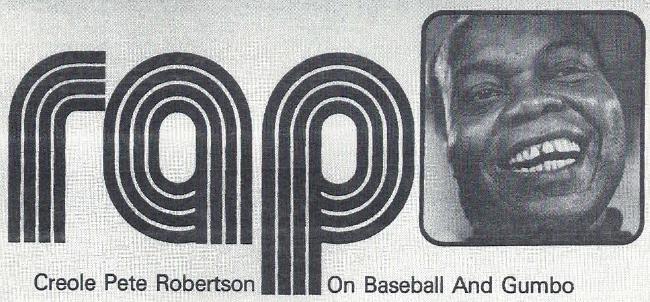
On Feb. 10, 1980, Peter “Creole” Robertson, a former restaurateur who became a major figure in the Harlem community for nearly 20 years, died at Nassau Medical Center in East Meadow, N.Y., on Long Island at the age of 75.

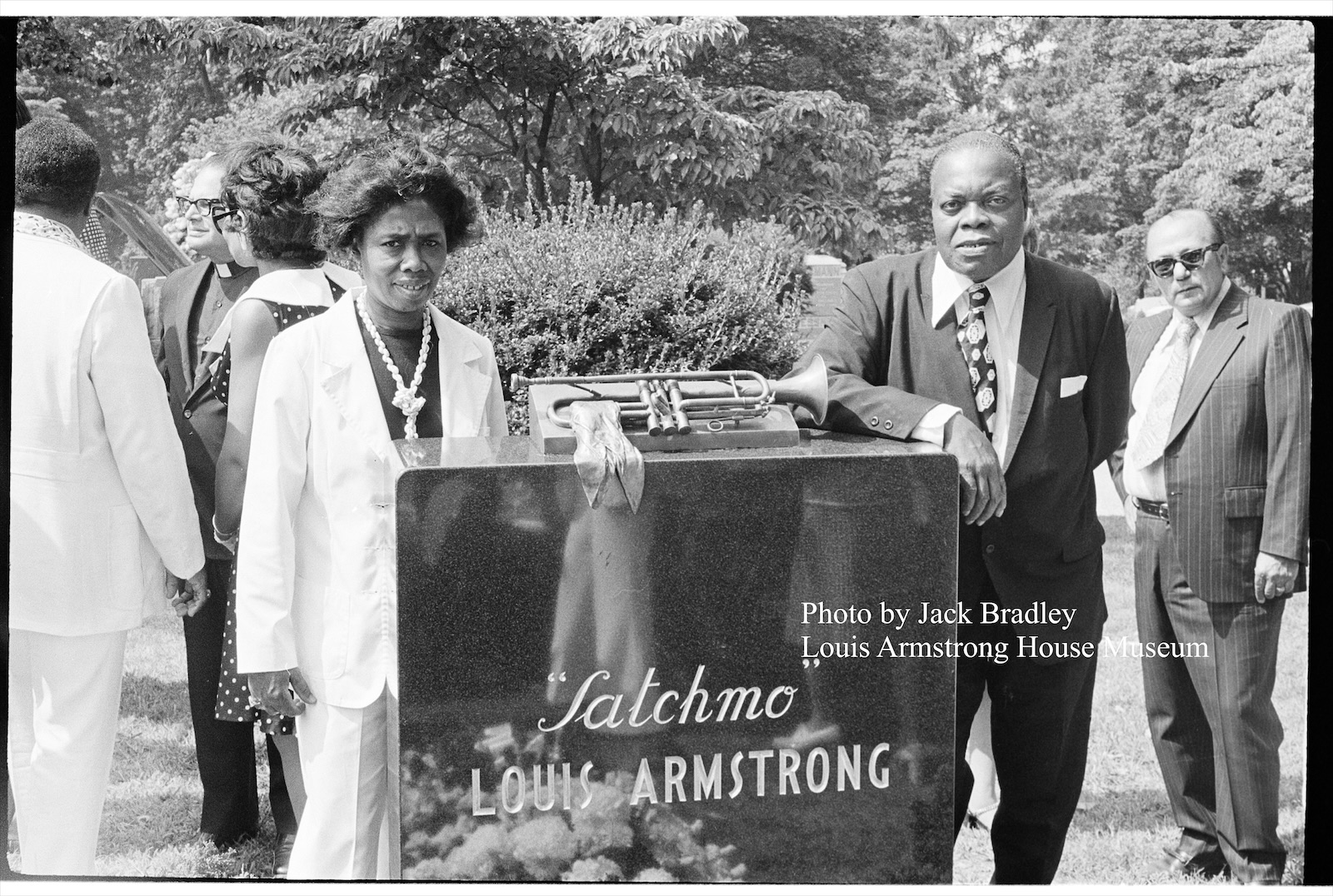
According to an obituary in Newsday, Robertson arrived in New York City in 1938 and five years later opened his wildly popular, 24-7 restaurant at 7th Avenue and 129th Street in Harlem. The noted that the food joint “attracted many celebrities, including Louis Armstrong, Nipsey Russell and Redd Foxx, with its creole [sic] gumbo and other creole [sic] specialties.”

An article in the Baltimore Afro-American added that Robertson also “promoted many dance and sporting events in the city.”

Robertson’s funeral was held at Bethel AME Church on Long Island, but, despite his fame and influence in New York City and Long Island, he was buried in an unmarked grave in Pinelawn Cemetery in Farmingdale, N.Y.

However, tracing back the years, rewinding the tale of Roberston’s life, his story, and his fame, first blossomed in New Orleans. Born in 1905 in Natchez, Miss., Robertson came to the Big Easy at the age of roughly 18 — at the behest of Tom Wilson, a Nashville-based baseball magnate, who pegged Robertson as an ambitious rising talent — and eventually built a small empire as a baseball impresario.

Starting as a slugging catcher for the New Orleans Black Pelicans of the Negro Southern League in the 1920s — he reportedly served as the backstop for none other than Satchel Paige, although there’s no concrete proof that Paige actually played for the Black Pels — Robertson grew in stature and influence in the bustling hive of Black baseball activity in New Orleans.

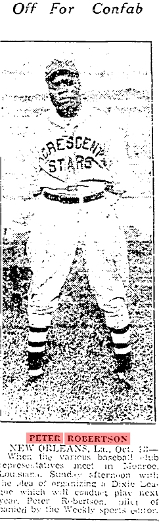
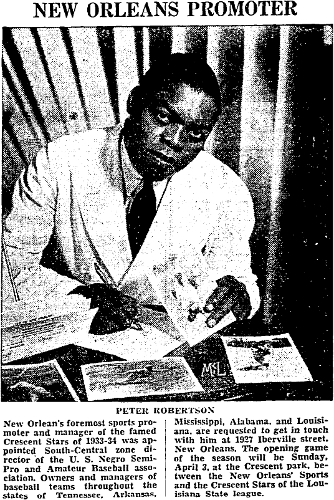
He eventually managed and owned multiple semi-pro and professional teams, including the powerful Crescent Stars in the early 1930s, and became a prime force in the construction of Crescent City Park, which became Black New Orleans’ premier baseball grounds for much of the 1930s and beyond. “Creole Pete” also helped draw top-level Negro League teams from the North and Midwest for exhibitions and other hardball events in New Orleans.

His goal, according to local media, was to replicate the success of the legendary Rube Foster of Chicago, the founder of the first Negro National League and eventual inductee into the National Baseball Hall of Fame in Cooperstown, N.Y.

“Peter Robertson lives baseball,” stated the July 15, 1933, issue of The Louisiana Weekly. “Has lived it for years. His chief ambition ever since the day he drew on a catcher’s mitt and decided to play the game was to become a second Rube Foster.”

It’s for those reasons, for his towering influence over 1920s and 1930s Negro League baseball in New Orleans — that his unmarked grave on Long Island, about 1,200 miles from his roots in the Big Easy, is in the process of receiving a stone marker, courtesy of the nationally recognized Negro League Baseball Grave Marker Project.

Created by Jeremy Krock, an anesthesiologist in Peoria, Ill., in 2004, the NLBGMP has raised money and worked to successfully purchase and place headstones or markers at the graves of dozens of Black baseball legends whose careers largely took place during the tragic era of segregation.

Starting with outfielder, Negro League All-Star and championship winner Jimmy Crutchfield, the NLBGMP has brought dignity to the final resting places of team owners, managers and players, including Hall of Famers Pete Hill and Sol White, as well as superstars and Hall of Fame candidates like John Donaldson, Grant “Home Run” Johnson, Bruce Petway, Dan McClellan, Sam Bankhead and “Candy” Jim Taylor. Most recently, the project dedicated a marker in St. Louis for Henry Bridgewater, who founded and created the St. Louis Black Stockings, an important early “colored” ball team in the 19th century.

The Grave Marker Project works with the Society of American Baseball Research to achieve its goal, and author Larry Lester, the co-founder and chairman of SABR’s Negro Leagues Committee, lauded Krock and the NLBGMP for their ongoing efforts.

“The Grave Marker project continues to build momentum and recognition as more unmarked graves are discovered and eventually honored with custom-made headstones, courtesy of Dr. Krock’s commitment in recognizing  these forgotten legends of the game,” Lester said. 

Lester added that Creole Pete is a perfect candidate for a marker.

“Because of his wide-range of skills, professions and his place in the communities, I think he truly deserves a headstone,” Lester said.

According to Krock, the Robertson effort began when another SABR member, Ralph Carhart of New York City, gave a lecture at the New York State Association of Cemeteries in 2017. Following the lecture, representatives from Pinelawn Cemetery reached out to Carhart about whether any ballplayers might be buried in unmarked graves in the cemetery, and, using the SABR Negro Leagues Committee’s databases, Krock and Carhart discovered Robertson’s grave.

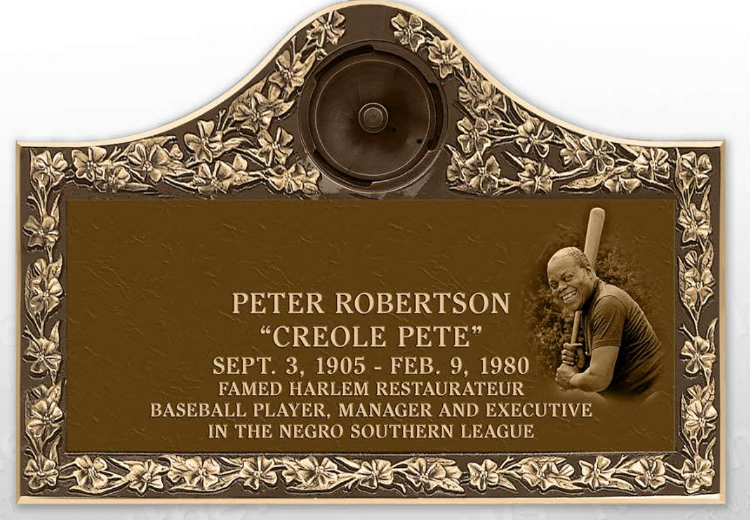
Krock said that Pinelawn continues to work with SABR and the NLBGMP to install a stone at Creole Pete’s burial site. The design of the marker has already been OK’ed, and it features a portrait of an older, smiling Robertson in a batting pose with a bat over his shoulder. The text on the stone reads:

Peter Robertson

“Creole Pete”

Sept. 3, 1905 – Feb. 9, 1980

Famed Harlem Restaurateur

Baseball Player, Manager and Executive

In the Negro Southern League

Krock credited Pinelawn Cemetery with taking the reins of the effort to find funds and move ahead with the stone, which is currently on order.

“The cemetery kind of took it upon themselves to do it and purchase the marker,” he said.

Krock said that SABR and the NLBGMP are working with the cemetery to possibly identify more unmarked graves of baseball figures at Pinelawn.

“[The Robertson effort] was just luck that the owner of the cemetery heard Ralph speak and reached out to us. It’s a wonderful opportunity.

“This is how a lot of our projects go,” he added. “If we hadn’t done this, no one would have.” 

Atlanta Daily World, Oct. 13, 1932

And beyond the Robertson project and any other individual NLBGMP efforts, Krock said all baseball figures, and all people, deserve dignity in death.

“As far as we’re concerned,” he said, “there’s no one who’s not worthy of a grave marker. It’s just a matter of identifying the graves and raising the money for a marker.”

Regarding Robertson in particular, Krock added that the process of delving into Robertson’s career made it obvious that Robertson was an ideal candidate for the NLBGMP.

“It was fascinating researching how his career went as a player, manager and owner,” he said. “He did all of those, and we’re proud to be a part of this project. He had a fascinating life.”

Creole Pete most certainly did.

After playing for the Black Pelicans for several years, Robertson tired of the seasonal nature of the baseball business — he reportedly washed dishes during the off-season to earn money at one point — and decided to take up cooking, a skill he inherited from his mother and grandmother. He found a year-round job working in the restaurant of a large New Orleans department store.

He saved money while working at the store and eventually raised enough capital to start his own baseball team, the Crescent Stars, circa 1930. He strengthened the team enough that top-level Black teams teams — like the Chicago American Giants, Homestead Grays, the Kansas City Monarchs and the New York Black Yankees — routinely stopped in the Big Easy for exhibition games with the Crescent Stars.

“I had this team — ‘30 and ‘31 — and at that time none of the major Northern teams came down,” Robertson said. “They didn’t come South because they never could make any money down there. There wasn’t any team good enough, but in two years time I had built up a team down there strong enough to play these teams from the North. And I invited them down with the guarantees that they’ll make money. …

“I was able to take all these teams down there and draw, and make money, because I had built me up the kind of team that could beat these people. And we used to beat them.”

He later bemoaned the fact that these same outside teams routinely poached the Crescent Stars’ best players, which became a factor in him folding up shop in New Orleans and heading North himself.

Chicago Defender, April 4, 1938

“After those teams from the North began to come down there and see [the Crescent Stars’ players] they started stealing them,” he said. “They started stealing all of my ballplayers, boys I’ve been training three and four years. The New York Black Yankees brought Zollie Wright and Red Parnell to New York. The Philadelphia Stars took a guy named [Ducky] Davenport. The Chicago American Giants took two or three players.”

“Well,” he added, “you couldn’t blame the boys. They had a chance to go North, get out of the South and get more money than we could pay them. And, after that I didn’t want to go to the trouble of building up another team, because they would just steal them. Then I decided I’m going North [italics in original].”

In addition, Robertson immersed himself in the annual doings of the Negro Southern League, and he periodically attempted to generate enough interest and funding for other regional, state and city-wide leagues.

In the lead-up to the 1932 campaign, for example, Robertson played a key role in a move to create something to be called the Tri-State Baseball League, which would potentially include teams from Louisiana, Arkansas and Mississippi and could, theoretically, challenge the NSL for dominance in the South’s Black baseball scene.

Robertson, as owner at the time of the New Orleans Black Pelicans, traveled up to Monroe, La. – home of the powerful Monroe Monarchs – in late January 1932 for the first official meeting for the fledgling league. While a dozen or so cities reportedly expressed interest in joining the circuit, the Louisiana Weekly stated that a “Big Four” franchises would lead the way – the Black Pelicans, the Monarchs and clubs in Little Rock, Ark., and Jackson, Miss.

However, by late February, the prospects of a successful launch of the lead dimmed, apparently despite all the enthusiasm from Pete, who, according to the Weekly, “has made plans to rebuild the Black Pelican Club and thrust it into the [league] hook-up, is rather dubious about some things these days.” The paper reported that Robertson hadn’t heard from the league headquarters in Monroe for weeks.

But regardless of whether or not the league would take off – it wouldn’t – Robertson was reportedly determined to give the Crescent City the best possible team.

“But reply or no reply [from Monroe],” reported the Weekly’s Earl Wright, “league or no confederacy the big former Black Pelican catcher says he is going to put a baseball team on the diamond.”

Within a couple weeks, the chances of a Tri-State Baseball League disintegrated when the Monroe Monarchs, who by then were arguable the best Negro Leagues team south of the Mason-Dixon Line, bailed on Robertson and the other team hopefuls to become the anchor of a revived NSL.

(The decision by the Monarchs to jump circuits was probably a smart one, and certainly understandable, especially because with the demise of the first Negro National League in 1931, the NSL was improbably emerging as the nation’s one and only Negro major league in 1932. Monroe emerged as the best team in the 1932 NSL and lost out on claiming the league title thanks to a questionable turn of events and bureaucratic smoke and mirrors that gave the crown to Cole’s American Giants. For more detail on the entirety of the 1932 Blackball season in the South, definitely check out Tom Aiello’s fantastic book, “The Kings of Casino Park: Black Baseball in the Lost Season of 1932,” an excellent history of the Monroe Monarchs.)

Thus began the baseball seasons of 1932 and ’33, which ended up representing both Robertson’s pinnacle as a baseball magnate, and a crucial turning point in his career, his life and the sport he loved in New Orleans.

More Creole Pete stuff to come …

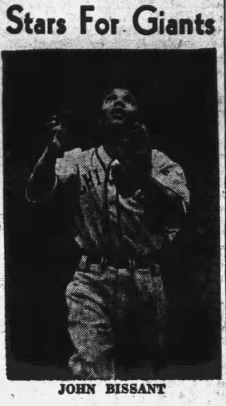
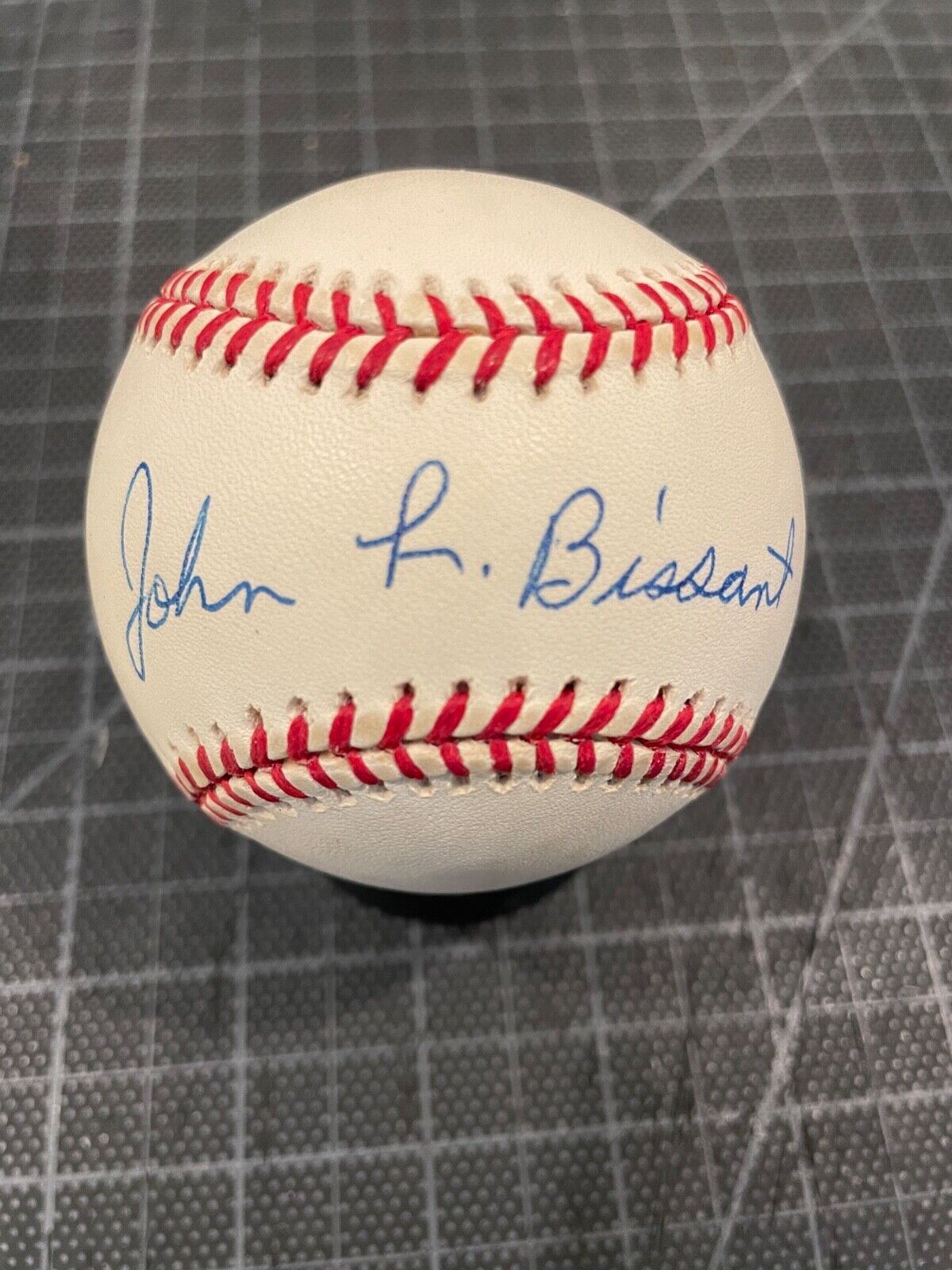
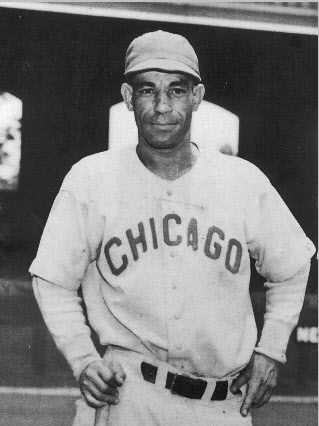
Wrapping up the John Bissant story

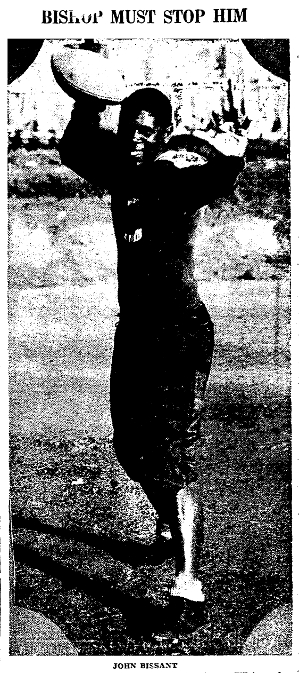
Herald-Press (Saint Joseph, Mich.), May 21, 1946

Another follow up on the life, career and legacy of John Bissant, Negro Leagues great and arguably the greatest all-around athlete New Orleans has ever produced. For some earlier posts, check out this, this and this.

In this post I want to kind of outline a little more about John’s athletic career, which, when reviewed from modern times, is pretty incredible. Aside from his baseball achievements and exploits, Bissant, who was born in 1914 in New Orleans, excelled on the gridiron, on the hardwood and on the cinders, first at historic McDonogh 35 High School in New Orleans, then the Texas HBCU Wiley College, and then on numerous professional and semipro football and baseball teams across the country and in this city.

John Bissant’s talent and achievements stemmed from his status as a well rounded, multi-tool athlete whose abilities were adaptable for just about any sport. Whatever you asked him to, he could do it, beginning with his fleetness afoot.

One facet of Bissant’s athletic prowess was his speed, for example, and he used it, perhaps most obviously on the cinders and on the gridiron, to his and his team’s advantage. Articles from his time with the Chicago American Giants, as well as other teams, often report that he occasionally took part in foot races on the field as a side attraction at games.

For instance, a May 1943 article in the Cincinnati Post that previews a Negro American League doubleheader between the American Giants and Cincinnati Clowns reported that Bissant was slated for a 100-yard sprint showdown with members of the Clowns:

“Johnny Bissant, Chicago outfielder, is generally regarded as the fastest man in Negro baseball, but the Clowns dispute this, claiming that their own Reece (Goose) Tatum, Freddy Wilson and Charley Harris can match strides with anyone.”

The Clowns swept the doubleheader, but it’s unclear who won the races, if they were run.

As a side note, the teams also held a “slowest player” race, with Baton Rouge fella Lloyd “Pepper” Bassett, aka the Rocking Chair Catcher, at the time with the Cincinnati Clowns, as a favorite in that one.

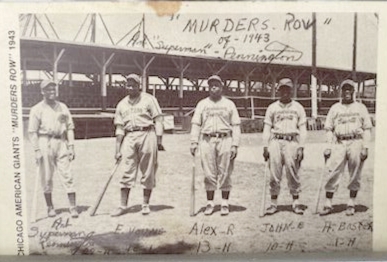
John Bissant, second from right, in 1943 with Chicago American Giants teammates Art Pennington, Ed Young, Alex Radcliffe and Herbert Buster. (Photo courtesy of Charisse Wheeler.)

Contemporaneous media reports frequently mentioned Bissant’s fleet feet in the outfield, where he chased down fly balls and flashed the leather frequently. In July 1941 a newspaper in Medford, Ore., called him “the club’s speed merchant” and that Bissant was paired in the Giants’ outfield with close friend Ducky Davenport, “another streak of lightning,” while In June 1942, a paper in Benton Harbor, Mich., noted that Bissant “holds several sprint championships and is one of the fastest negro [sic] players in the national pastime,” while a July 1944 article in the Belleville (Ill.) News-Democrat called Bissant “the team’s ace outfielder, and is a hard hitter as well as a great ground-coverer.”

As an outfielder, Bissant had the good fortune to team with other standouts – including NOLA lad Davenport – to form fearsome lineups in the outer garden for the American Giants. In June 1943, an Illinois paper noted that Bissant and Davenport were joined by Art Pennington in an “outfield [that] is considered the best in the [NAL].”

The South Bend, Ind., Tribune, in previewing a game between Bissant’s Chicago Brown Bombers and a northern Indiana semipro team, offered a concise but glowing estimation of the New Orleans legend. At the time Bissant was usually stationed in left field.

“Bissant is tagged as the fleetest of the Bombers’ outfield,” the newspaper stated. “Because of his fleetness he sometimes patrols center giving the Bombers added protection on the strength of Bissant’s ability to roam into right or left to haul down apparent hits. He is death on [the] bases and specializes in base thievery to the chagrin of rival catchers.”

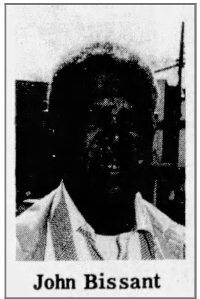
Louisiana Weekly, March 26, 1977

Actually, during and after Bissant’s playing career, newspapers often referred to Bissant together with Ducky Davenport as a duo of greatness; because both of them were from New Orleans – they competed against each other in high school here – and were both speedsters who prowled the outfield for the American Giants, it was natural to mention both in the same breath.

However, even then, Bissant garnered the highest praise, partially because he was so well rounded as an athlete.

“Bissant was a natural, as was Davenport,” stated the Louisiana Weekly in April 1970, “but [Bissant’s] wonderful physique, speed and power gave him the advantage, and his best sport was probably football, although he lettered in track [and] basketball, as well as baseball and football.”

As a result of his completeness as a player, his athletic glories were many. A few of Bissant’s accomplishments, honors and activities as a pro baseballer:

  • Played in the 1945 East-West All Star game in Comiskey Park in Chicago. (I should note that I couldn’t find any solid evidence that he actually appeared in the game.)
  • Starred at historic McDonogh 35 High School, from which he graduated in June 1935. McDonogh was the first four-year public high school for African Americans during the first half of the 20th century, and it boasts several pro athletes, as well as groundbreaking politicians and Civil Rights activists, including Ernest “Dutch” Morial, New Orleans’ first mayor of color; Joan Bernard Armstrong, a racial and gender trailblazers in the Louisiana state court system; and Rev. A.L. Davis, a founder of the Southern Christian Leadership Conference.
  • Broke into the Negro League majors in July 1937 with the Cincinnati Tigers of the Negro American League, managed by Double Duty Radcliffe. Bissant only played a handful of games for the Tigers after being lured away from the New Orleans Black Pelicans; during this brief stint in the Queen City, John was teammates with fellow Louisianans Ducky Davenport, Gene Bremer and Lionel Decuir. The Tigers themselves had folded by the end of the ’37 season.
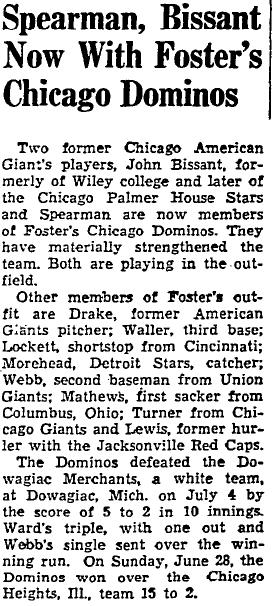
  • Apparently defected briefly from the American Giants to suit up for an extremely short-lived, largely barnstorming semipro team, the Chicago Dominos (or Dominoes), in summer 1942. According to media reports, the club was owned by one Jimmy Foster,  managed by Harlem Globetrotters impresario Abe Saperstein, and composed of guys who decided to work in factories in the wartime defense industry.
  • Apparently shared/alternated managerial duties of Chicago American Giants in 1944 with fellow New Orleanian Ducky Davenport and the great, severely underrated Bingo DeMoss. It should be noted that Bissant also served as team captain in 1947-48 under manager Candy Jim Taylor.
  • Selected for the South team seventh annual North-South All-Star Game at Pelican Stadium in New Orleans in October 1946.
  • Played in another contest billed as a “North-South all-star” game with two picked nines from the NAL ranks; New Orleanian Bissant was slated to play for the North team, ironically. The game was scheduled for Hudson Field in Dayton, Ohio.
  • Played in charity fundraising games in New Orleans, including at the Times-Picayune newspaper’s Christmas Gift Fund all-star game in 1947. Also taking the field were fellow local guys Herb Simpson and Wesley Barrow.
  • Honored by the Crescent City Old Timers Baseball Club in 1970. The Old Timers Club was a New Orleans institution that brought together former Negro League players and managers from New Orleans and Louisiana for 20-plus years. Bissant was a regular member of the organization.
  • Served as an instructor at the Old Timers Club at the group’s youth clinics in the 1970s..
  • Selected for the National Black Sports Foundation Hall of Fame, probably in 1975.
  • Invited by the Atlanta Braves to be honored at the team’s 1997 Negro Leagues reunion and recognition event for “Black Living Legends of Negro Baseball.” Also in attendance was Herb Simpson.

In a review of his career, here’s what I came up with, across several sources, in terms of some of the teams with whom Bissant played over the years:

Chicago Defender, July 11, 1942
  • Caulfield Ads (?) (1934) — The semipro Caulfield Ads were owned and managed by Fred Caulfield, a businessman in New Orleans who was extremely active in Black baseball in the city beginning in the late 1910s and running through the ’40s. What media coverage I’ve found about the 1934 Ads (which is very little) only lists the last name of “Bissant,” with no first name given. That leaves open the possibility that it could be John’s uncle, Champ Bissant, or his cousin, Bob Bissant. If the player listed is indeed John Bissant, it would mean that he was still attending McDonogh 35 High School at the time.
  • Cole’s American Giants (1934), a post-Rube Foster iteration of the club owned by Robert Cole and Horace Hall and piloted by holdover manager and Rube disciple Dave Malarcher. The team was part of the second Negro National League at the time, winning the first-half league title but losing the championship series to the second-half-winning Philadelphia Stars. However, although Riley states that Bissant was on this club, Seamheads doesn’t include any record of him for the season.
  • Shreveport Acme Giants (1935-36), a largely barnstorming team loosely based in the city of Shreveport in northwestern Louisiana. The history of the Acmes is quite fascinating and worthy of its own detailed chronicling. The team was managed by Louisianan Winfield Welch, whose career spanned several decades and included piloting several teams in the New Orleans area, the Alexandria Black Aces, multiple Shreveport teams, the Cincinnati Crescents and, most prominently, the big-league Birmingham Black Barons, whom he guided to two Negro American League pennants. Anyway, at this time in question, the Acme Giants included several guys from New Orleans and Louisiana, as well as the one and only Buck O’Neil, who was just beginning his career in pro baseball and used the Acmes as a launching pad for bigger and better things. The team toured up into the Midwest, the northern Plains and into central Canada; some of its members, including a few New Orleanians, ended up hopping to Canadian teams, while others ended up with the Cincinnati Tigers of the mid-to-late 1930s. (I should note that I wasn’t able to confirm that he definitely did play for the Acmes, but that by no means he absolutely didn’t.) And on that note …
  • The Cincinnati Tigers (1937) of the NAL (see aforementioned discussion of this team). Bissant jumped to the Tigers in July 1937 from the American Giants.
  • The New Orleans Black Pelicans (1938).
  • Caulfield Red Sox (1938) — Another one of Fred Caulfield’s clubs.
  • Shreveport Black Sports (1938). I found a bunch of articles referring to them, including, for example, one from the Longview (Texas) News-Journal newspaper from May 1938 that reported that Bissant swatted a three-run home run to help the Sports stake a 3-2 win over the Fort Worth Black Panthers. The Black Sports were also managed by Winfield Welch and were members of the Texas Negro League. It makes sense that Bissant would play for a team based in Shreveport because Wiley was only roughly 65 miles from the Louisiana city in Marshall, Texas, making it easy for Bissant to play for the Sports during summers out of school.
  • Chicago American Giants (1939).
  • Birmingham Black Barons (1940).
  • Chicago American Giants (1941-48). The CAGs frequently played exhibition or spring training games in New Orleans. In the 1940s the Giants were well past their prime years that included their founding and early ownership by Rube Foster in the 1910s and ’20s, and later owner Robert Cole in the 1930s. In the 1940s the club was owned by J.B. Martin, who also served as a league executive in the second Negro National League and the Negro Southern League and as president of the NAL while he owned the Chicago American Giants. As far as Bissant goes, it’s important to note that while his overall tenure with the American Giants spanned nearly a decade, his time with the CAGs wasn’t one continuous stretch; he frequently jumped to other teams here and there, as this piece will show.
  • Chicago Palmer House Stars (1940-43), a barnstorming team that won three straight Illinois state semipro championships, and they took part in the National Baseball Congress World Series in Wichita, Kan., and the Denver Post tournament, both annual events to determine national semipro champs. The Palmer House is a historic downtown Chicago luxury hotel that, in the 1930’s and ’40s, sponsored several baseball teams, including one African-American one. The hotel was owned by Potter Palmer III; the Stars baseball team itself was owned by L.M. Gamble, and, during its most successful stint, it was managed by Alex Radcliffe, the brother of the legendary Ted “Double Duty” Radcliffe and a player and pilot with a very distinguished record of his own. It appears Ducky Davenport was also on the roster at certain points. The team was referred to in different ways in the media; sometimes they were called the Chicago All Stars, or the Chicago Colored All Stars. (The lack of consistent naming definitely muddies the historical record and can be very confusing. For example, I wouldn’t rule out one or more of these various monikers actually representing different teams, or at least variations of the Palmer House club.) The Palmer House Hotel is still in operation today as a Hilton property. For more detailed info on the Palmer House Stars, check out this excellent article by Leslie Heaphy.
  • Chicago Brown Bombers (1942-43?) of the very short-lived, somewhat half-baked Negro Major Baseball League, the “brainchild” of white team owners/promoters Abe Saperstein and Syd Pollock. The league only lasted for a season, with few records and no standings left behind. The Bombers were managed in 1942 by Bingo DeMoss and owned by L.H. Gamble; they might actually have evolved from the previously listed Palmer House team. (Another version of the Brown Bombers played in the United States League in 1945; the USL was created by Gus Greenlee and Branch Rickey as a stealth way to evaluate Black baseball talent and bring players into Organized Baseball.) As far as Bissant is concerned, he appears to have started the 1942 season with the Bombers, defecting from the Palmer House club that he played for the previous year. However, in the middle of the 1942 campaign, he jumped to the next team listed below. Then found articles on the Brown Bombers from May 1943 that previewed the upcoming season, but it’s unclear how many games the Bombers played in ’43. The articles do list Bissant as an outfielder on the team still, but I couldn’t find an actual box score from early 1943 that proves that Bissant actually did take the field for the Bombers in 1943. What is certain is that by the early summer of ’43, Bissant was back in the fold with the Chicago American Giants.
  • Foster’s Chicago Dominoes (1942). A July 1943 article in the Chicago Defender states that Bissant, “formerly of Wiley college [sic] and later of the Chicago Palmer House Stars,” had recently signed on with the Dominos. The Dominoes seem to have offered a fair amount of clowning at games; one newspaper called them a “razzle-dazzle” club who “display a brand of baseball akin to the basketball gyrations of the colored Globe Trotters [sic], stablemates of the Dominoes and piloted by Abe Saperstein.” It appears that Bissant finished out the rest of the ’42 schedule with the Dominos. Overall, chronicling Bissant’s exact pathway through the early 1940s is extremely difficult, because he jumped around a lot, at least before ending up back with the American Giants in mid-1943.
  • Kohlman All Stars (1947), a New Orleans semipro team. By now Bissant was well past his prime and apparently picking up baseball action where he could, largely in the Big Easy. The Kohlmans were managed by legendary New Orleans player/manager Wesley Barrow, and the club also included fellow local lads Herb Simpson and Billy Horne, both one-time Chicago American Giants as well. In October 1947 the Kohlmans welcomed an all-star team from McComb, Miss., for an exhibition fundraiser to benefit the Times-Picayune Christmas gift fund.
  • New Orleans Creoles (June 1948) of the Negro Southern League.
  • New Orleans Black Pelicans (1955). Also on the roster were Bob Bissant, Robert “Black Diamond” Pipkins and Morris “Tar Rock” Arthur.

That listing is by no means complete, especially when it comes to Bissant’s presence on local New Orleans teams both before and after his time in the Negro Major Leagues. The best source for such info is the Louisiana Weekly, but a complete run of the paper’s archives isn’t available on any databases, and it’s been difficult getting to libraries that do have a complete run on microfilm.

Now, although best known on a national scale as an accomplished baseball player, it’s necessary to emphasize the fact that Bissant was a multi-sport star, also excelling in basketball, track and especially football.

Bissant’s greatest success on the gridiron came at Wiley College, a small, liberal-arts HBCU located in Marshall, Texas. Founded in 1873 – just eight years after the end of the Civil War – by the Freedman’s Aid Society of the Methodist Episcopal Church. Wiley, known today as Wiley University, has been known as one of the best and oldest HBCUs west of the Mississippi. Today, its enrollment tallies about 1,100.

Wiley students played a key role in the development of the Civil Rights Movement in Texas; together with students at the now-defunct Bishop College, another HBCU located in Marshall, Wiley students organized and participated in the first sit-ins protesting segregation in the Lone Star State. In addition, one of the national Civil Rights Movement’s most esteemed leaders, James Farmer, graduated from Wiley.

The Wiley varsity football team, meanwhile, used to be a regional HBCU powerhouse; Wiley helped co-found the Southwestern Athletic Conference and claimed 10 conference titles between 1923-57 under legendary head coach Pop Long.

Unfortunately, the Wildcats no longer have a football team, and in the years since their pigskin glory days, the school was dropped out of the SWAC in all other sports and is now a member of the Gulf Coast Athletic Conference, which includes smaller schools competing in the National Association of Intercollegiate Athletics (NAIA).

However, at a time when Wiley did have a pigskin program, John Bissant shined for the Wildcats on the field for several years. He arrived in Marshall for the fall 1935 semester and while he logged a fair amount of action during his freshman season, it was his second year in 1936 that really saw the Bissant legend start to grow at Wiley.

Chicago Defender, Oct. 1, 1938

Tipping the scales at a compact 167 pounds, give or take a couple, John became a fixture in the starting lineup at right halfback, piling up yards and touchdowns. In addition to carrying the rock, Bissant was also adept at both slinging and receiving the ball. (The sport looked somewhat different in the late 1930s, when the modern concept of a quarterback hadn’t yet developed and a dizzyingly diverse ground game remained the foundation for most college offenses.) Bissant could also placekick on extra points or field goals, as well as snare interceptions on defense at a time when most college teams featured numerous two-way players.

The 1937 season witnessed John staking out a permanent spot at or near the top of the SWAC statistical rundowns, leading the conference in scoring at various points. At the end of the ’37 campaign, nationally syndicated columnist James Parks listed Bissant at halfback on Parks’ postseason HBCU All-American team.

The 1938 season was Bissant’s senior year, and by the end of things he was one of the most lauded, most successful halfbacks in the HBCU football world. He was the SWAC’s leading scorer for ’38, and at the end of the campaign he was named to multiple first-team All-SWAC and All-America lists, including James Parks’ as well as that of Randy Dixon, another popular national Black media journalist who called Bissant the best all-around back in the game.

Quite interestingly, John Bissant garnered the nickname “Geech” or “Geechie” while playing at Wiley, although it’s not clear how he garnered that sobriquet. John’s granddaughter, Charisse Wheeler, told me that she’d known about his nickname, but she wasn’t sure where the moniker came from.

Word of John’s gridiron prowess traveled well, and his services were sought after as both a coach; he was an assistant coach for Florida A&M in the 1939 Orange Blossom Classic, an annual HBCU football bowl game, for example. Later on, in 1948, Bissant served as an assistant coach for the New Orleans Delta Midgets, who were likely another local semipro squad.

John also played semipro football himself at various times in his athletic career, including local NOLA clubs like the New Orleans Pirates in the late 1930s/early 1940s, and the Southsiders, one of the teams that made up the New Orleans Negro Independant Football League later in the 1940s.

Bissant also hit the gridiron for the Chicago Brown Bombers football team in fall 1940. Actually, it appears that he might have caught on, or at least connected, with the Bombers when the Windy City aggregation came to New Orleans to play the Pirates.

Given that he had a reputation as a speed demon, John also ran track in high school and for the Wiley Wildcats, often competing in the relays. At the 1939 Tuskegee Relays, for example, he ran legs of the 440-yard and 880-yard relays.

Strangely enough, I haven’t been able to see any definitive evidence that Bissant played for the Wiley baseball team. I’ve reached out to the special collections department at the Wiley library a few times but haven’t heard back.

Anyway, after retiring from baseball, John Bissant worked at several jobs in the New Orleans area, including at NASA’s Michoud Assembly Facility; Lykes Brothers Steamship Company, a shipping business; Glazer Steel and Aluminum; and a security guard firm.

John Bissant died on April 1, 2006, in Houston, Texas, at the age of 92; he had evacuated to Houston from New Orleans because of Hurricane Katrina. In its obituary of Bissant, the Times-Picayune called him “a Negro League Baseball Legend.” 

Hopefully someday we can persuade the Greater New Orleans Sports Hall of Fame and/or the Louisiana Sports Hall of Fame to induct John Bissant. Right now both halls of fame each have several inductees from the Negro Leagues, but so far Bissant isn’t among them.

The last Negro World Series: a son’s perspective

Rodney Page (photo courtesy Rodney Page).

Editor’s note: I recently wrote an article for The Louisiana Weekly newspaper here in New Orleans about the very last Negro League World Series, which was held in 1948. One game of the series was played in the Crescent City, with legendary businessman and sports promoter Allen Page organizing and hosting the event.

For my article, I got a few thoughts from Rodney Page, Allen’s son, and he generously agreed to do so. I used some of his comments for my article, but I wanted to show people the entirety of the amazing few paragraphs he put together about the 1948 NLWS, and his father’s role in baseball history. Here are those full comments. Many thanks to Rodney for his work.

Seventy-five years is a long time to honor and celebrate a significant event. Seventy-five years also coincides with a “diamond jubilee,” which resonates with the Negro League World Series of 1948. One of those World Series games was played on the Pelican Stadium baseball “diamond” in my hometown of NOLA.  

Photo courtesy of Amistad Research Center.

Another connection is that I was born 75 years ago (Sept. 4, 1948) in NOLA at Flint-Goodridge Hospital, located at the corner of Louisiana Avenue and Lasalle Street.

The host and promoter of this World Series game in 1948 was my father, Allen Page. This is a testament to his significant contributions to the entire Negro Leagues baseball experience. His contributions were not just local in NOLA, but included regional and national affiliations, promotions, and endeavors. The 1948 Negro World Series is an example of that. Consider the risks and the connections necessary in bringing this showcase to NOLA.

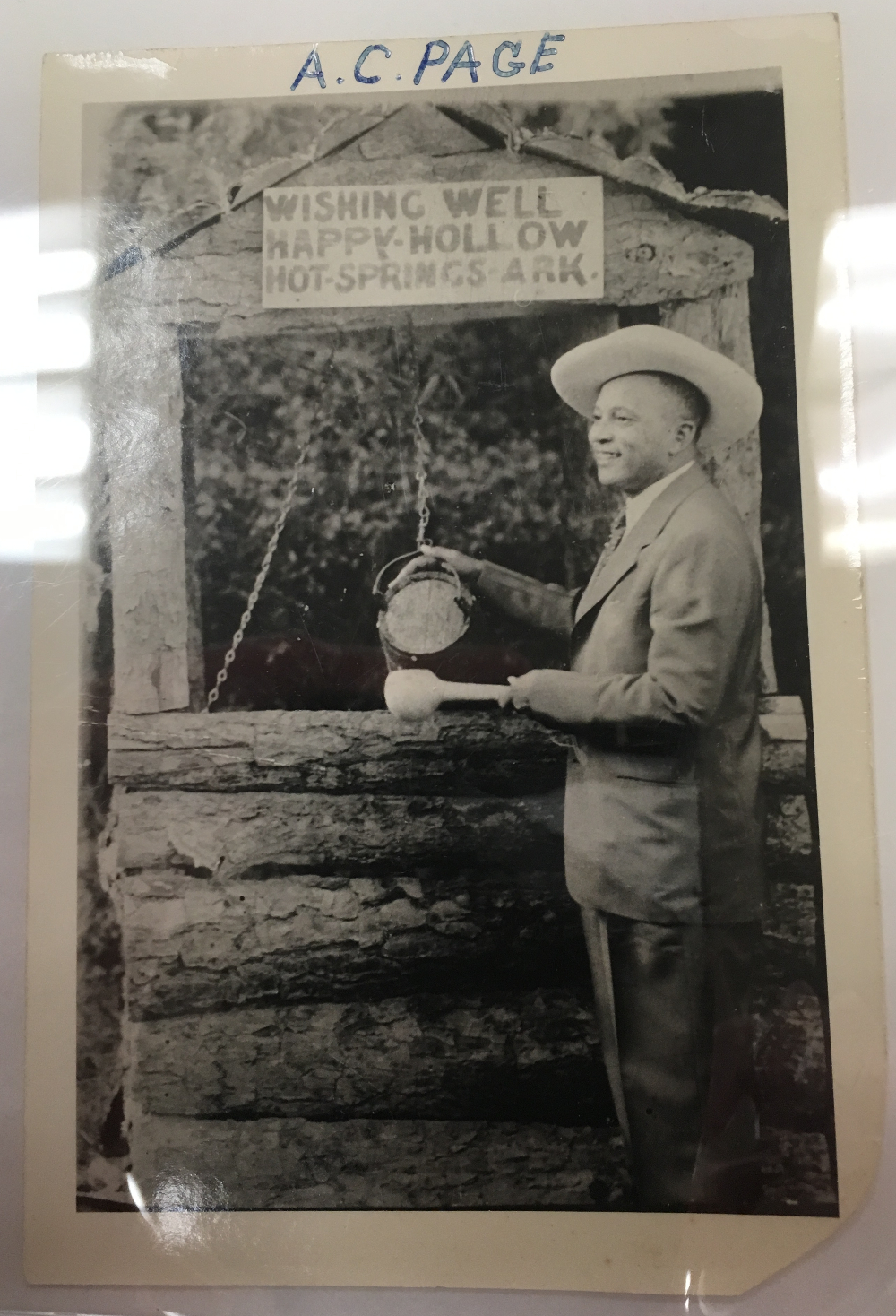
Allen Page (photo courtesy Rodney Page).

The hero’s journey does not always end in resounding victory. Sometimes the reward, the victory, is in the process. The process of overcoming and transcending enormous challenges and obstacles. The societal changes from segregation to integration and all of the gains, and losses, of this shift in the social landscape of America. From my perspective, this is part of the deeper story of the Negro Leagues, and Allen Page.

The true story of Allen Page is his indomitable spirit, which speaks to the heart of self-reliance, self-definition and self-determination.

Rodney Page

Some say this was the last Negro Leagues World Series, as Black baseball’s decline was rapidly approaching due to the integration of MLB. An interesting pattern is apparent in the journey of Allen Page. The final resting place for the once outstanding St. Louis Stars and the Newark Eagles was in NOLA.

In addition, one of the final NLWS games was played in NOLA. Allen Page was in the midst of all three significant events in the rich history of Negro Leagues baseball.

In my eyes, my father is a hero. Knowing where he came from and what he accomplished has given my life enormous inspiration and pride. He dared greatly and risked often and much. The true story of Allen Page is his indomitable spirit, which speaks to the heart of self-reliance, self-definition and self-determination. He transcended and excelled despite the shackles of the Jim Crow South and overt racism in America. A legacy of firsts was in his DNA.

Rodney Page, Sept. 14, 2023

Allen Page’s popular and successful hotel in NOLA (photo courtesy of Rodney Page),

The Hall of Fame goes silent

The National Baseball Hall of Fame.

I was hoping I wouldn’t have to write this, but I need to go ahead with it, quite unfortunately …

Many of us in the Negro Leagues research and fandom community have consistently expressed dissatisfaction with the haphazard, slapdash and dismissive way the National Baseball Hall of Fame in Cooperstown, N.Y., has handled the induction of segregation-era Black players, managers, executives, umpires and other representatives of a time when American society denied them the right to compete against and alongside white individuals and teams.

The rules of eligibility for such Negro Leagues greats and the methods of election and induction for them has been inconsistent, ever-changing and wholly inadequate, resulting in only a fraction of the qualified pre-integration figures of color actually being inducted so far, and to a stunningly disproportionate level of representation when compared to the number of white players from the same era who have achieved induction.

The Hall always seems to be well behind the curve on this issue, always reacting to scorn and criticism of the induction process in hastily, jumbled and inconsistent fashion. I’ve written about the Hall of Fame’s dereliction of duty and complete ignorance of and lack of respect for Negro Leaguers over the years. You can read my posts on this topic here, here, here and here. For articles in other media about the induction controversy, check out this, this and this.

A group of us Negro Leagues enthusiasts has been so dismayed and even angered at the Hall’s failures that we started the 42 for 21 Committee, dedicated to advocating for segregation-era baseball figures of color and their much needed, rightful election to the Hall. For info on 42 for 21, you can look here.

The current rules and guidelines for Hall of Fame induction can be found here; details of the “Era” committees process are here; and this link reviews the history of voting rules changes over the years. All three are links to the National Baseball Hall of Fame Web site. For other media articles about this topic, you can check out this, this and this. It’s all very confusing, honestly.

Members of the 42 for 21 Committee met this past July in Detroit at the annual SABR Jerry Malloy Negro Leagues Conference to start working out an advocacy strategy.

After that meeting, I figured that, as the respectable, quality journalist I am (more or less), I’d go right to the source of the controversy and interview a representative at the Hall of Fame to get the institution’s comments on the controversy and criticism.

As a result, I reached out to the Hall’s media relations office and asked about setting up such an interview; I suggested an email exchange for said interview, and the staff there said to go ahead and send questions and they’d try to line up answers from a HOF executive. I often prefer email interviews because it’s much more flexible time- and scheduling-wise, and since the questions and answers are written out, there can be fewer concerns about misquoting and lack of accuracy.

To put it bluntly, I’ve been extremely disappointed – even after a couple follow-up nudges, I’ve received no answers at this time.

After vetting the questions with a couple SABR peers, I emailed them to the Hall on Oct. 5, and the media rep said the next he’d get them to someone who could answer them. After two weeks I hadn’t heard anything back, so I followed up with media relations on Oct. 19, and the rep said he’d remind the leadership team about the interview questions.

A week later I hadn’t heard back and sent another email, this one saying that I would have to report that the Hall had been unresponsive and failed to answers my interview questions. That email got no response. That was on Oct.26.

And here we are.

A couple notes at this point … One, I wanted to detail my interactions with the Hall in this enterprise to offer full transparency with how the communications unfolded to give full context for the primary thrust of this post.

Second, I fully well understand that I’m not the New York Times or ESPN or The Athletic, and that my questions were very pointed and almost a little confrontational. However, I believe my queries are important and that the Hall needs to address them in some way, form or forum, even if they opt to not respond directly to me.

So, what did I ask them? Here are the questions I sent:

1) What are your thoughts on the criticism the Hall has received regarding the lack of segregation-era Black inductees? Do you think such criticism is fair?

2) Have you seen the work of the 42 for 21 Committee? How would you respond to its efforts and statements about nominating a more well rounded and informed panel of experts who are better equipped and more knowledgeable when it comes to selecting HOF inductees from the Negro Leagues?

3) The proportion of white major leaguers in the Hall compared to the Black players from the pre-integration era is still heavily skewed and in no way comparable. What are your thoughts about the possibility that such a lack of Black inductees can be rectified?

4) Is there the possibility of more changes in the induction process to make the results more equitable?

5) Even with what some observers view as constant tinkering with the induction process, some critics assert that process still does a woeful job of achieving equality, fairness and justice for the many segregation-era candidates of color who still deserve induction. What are your thoughts on that situation?

6) Is there anything else you’d want to say on the matter of segregation-era candidates of color and the processes that have been used to induct such candidates?

Like I said, I acknowledge that the questions are very blunt and somewhat combative. However, I think that’s a reflection of just how frustrated and disappointed many of us are in the Hall of Fame’s continued obstinacy and unwillingness to right ongoing wrongs and bring full equity and justice to a process and a mindset that has led to the institutionalization of racism and ignorance that’s plagued a our national pastime for well more than a century.

Clearing up a few John Bissant mysteries

Saint Joseph (Mich.) Herald Press, June 2, 1942.

This is a fairly short follow-up post to my previous ones (here and here) about John Bissant, his family and his grave in New Orleans’ Carrollton Cemetery. …

There’s been some confusion and lingering question marks about a few details in John’s life, and I wanted to maybe clear some of them up by connecting once again with Charisse Wheeler, Bissant’s granddaughter.

I chatted once more with Charisse, this time via text, a week or two ago and posed her a few questions, the first being about the specifics of John’s burial situation. Given that he, like just about all other people of color in New Orleans for centuries, was relegated to a segregated, “colored” section of burying ground in death, the current circumstances of his final resting place are somewhat frustrating and, honestly, depressing.

The little corner of Carrollton Cemetery carved out for African Americans is filled with ramshackle graves, fading and falling tombstones, and weeds and overgrown grass. When it rains, the plots are frequently muddy and difficult to access. Such is the result of the social and economic conditions rendered by the repressive, unjust system of Jim Crow.

To that end, Charisse told me that there are Bissants scattered all through the sectioned-off area of Carrollton Cemetery, and some of the family graves include more than one person. That includes athletic legend John Bissant, who died in Houston in 2006 and who’s interred with his wife (Charisse’s grandmother), Delores (died 1994), and his daughter (Charisse’s aunt), Barbara (died 2018).

The grave lacks a sufficient stone or marker, a situation Charisse and her relatives are working hard to remedy. (I’m hoping to see if the grave can be a future project of the famed Negro League Baseball Grave Marker Project as well.)

The second question I brought up with Charisse was the confusion I had when looking through old newspaper archives Ancestry because I discovered a bunch of John Bissants scattered through the various records, including multiple “Junior” and “Senior” monikers.

That perplexity led me to ask Charisse about the succession of John Bissants in New Orleans and which one was which. It turns out the John Lawrence Bissant of Negro Leagues lore is John L. Bissant Jr., son of John L. Bissant Sr. and father of (technically) John Bissant III. 

However, in the 2006 Times-Picayune obituary of baseball great John Bissant, he’s referred to as John Sr., and his son is listed as John Jr., even though technically John the Chicago American Giant is himself John Jr., and the man listed in the obit as John Jr. is actually John III.

This is not mine, unfortunately.

Charisse said that for some reason, when the actual John Sr. passed in 1957, the family began calling Charisse’s grandfather/baseball great John Sr. and began addressing John III as John Jr.

Confused? I sure was. And while such details might seem like relative minutiae, they’re actually quite important when doing historical research, which often on paper doesn’t reflect individual family traditions and quirks that can cloud the record.

The third topic on my mind is one that’s puzzled me, as well as other Negro Leagues aficionados (including my pal James Tate, who’s queried several times about it), is the relationship between John Bissant (the star athlete one) and Bob Bissant, who also played some pro and semipro baseball and was quite the athlete himself.

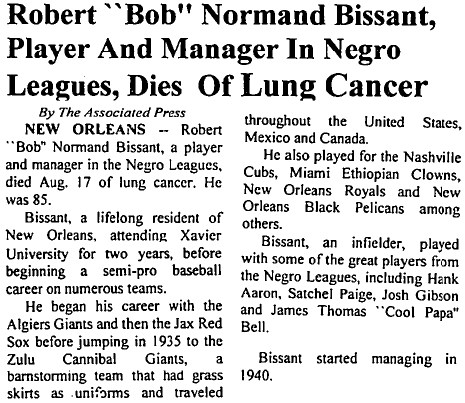
Bob, an infielder, played locally in New Orleans for a slew of teams, beginning in the 1930s with the Algiers Giants, a longtime team based across the river on the eastbank of the city;  the Jax Red Sox, operated by businessman and baseball magnate Fred Caulfield; the New Orleans Athletics; and that famed peculiarity of a club, the Zulu Cannibal Giants, they of facepaint and grass skirts. In the 1940s he also captained the Black Pelicans, and coached the Houma Red Sox (the town of Houma is located about an hour southwest of the Big Easy).

Bob graduated from the local sandlots and ballfields to, like John Bissant, spend some time on teams near the upper echelon of professional Blackball, including the Nashville Cubs; the Miami Ethiopian Clowns; and, in the ’40s, the Baltimore Elite Giants of the second Negro National League. At the time, the Elites were managed by New Orleans baseball guru Wesley Barrow. (To clarify, however, media reports from early 1947 stated that Barrow had signed Bob up to play for Elites that season, but Bissant isn’t included on the Seamheads database’s roster for the Elites from that year.)

Bob Bissant also played a year or two in 1930s on a team that barnstormed in Canada, and in 1946, ventured to the Pacific Northwest to join the Portland Rosebuds of the ambitious but short-lived West Coast Negro Baseball League. The Rosebuds were owned by Olympic legend Jesse Owens and managed by none other than Wesley Barrow, whose presence undoubtedly helped convince Bob to go to Oregon.

Like many of his Negro Leagues peers in his hometown, Bob Bissant was quite active with the Old Timers Baseball Club of New Orleans, as much or perhaps more than John was, attending the banquets and honor ceremonies. He played in several of the group’s annual reunion all star games at Wesley Barrow Stadium, and in 1980, the club honored him as veteran player of the year.

Atlanta Daily World, Aug. 26, 1999

Bob Bissant died in 1999 at the age of 85 and was interred at Providence Memorial Park and Mausoleum in the neighboring suburb of Metairie.

Because of Bob’s heavy involvement in the Black baseball, both as an active player and a retiree, I frequently came across references to Bob Bissant when going through the microfilmed archives of the Louisiana Weekly’s sports section. Since Bob and John were close in age and mentioned in newspaper coverage in the same time period, I’d assumed that Bob and John were brothers.

However, as I just learned from Charisse, that assumption was incorrect. Turns out they’re actually first cousins – their fathers (John Sr. for John and Champ Bissant Sr. for Bob) were brothers.

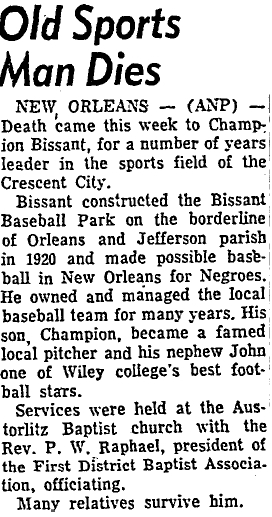
And there’s another facet to this familial tale – one of Bob’s brothers (and another first cousin for John Jr.), Champion Bissant Jr., also played a little ball here and there, mostly as a pitcher,meaning there were at least three Bissants who laced up cleats and took to the athletic fields. On top of that, too, Champ Jr.’s and Bob’s father, Champion Sr., was also a key player in the New Orleans Negro Leagues scene, owning and managing the  Bissant Giants, whose homefield was Bissant Baseball Park, which Champ Sr. built on the Orleans/Jefferson parish line.

Chicago Defender, Jan. 8, 1955

Finally, Charisse shed some light on the relationship of John Bissant and Lloyd “Ducky” Davenport, another native New Orleanian who made good in the Negro major leagues, especially, like John, with the Chicago American Giants.

Ducky (whose own anonymous grave is another sad tale on its own) was born in the Big Easy in 1911 and died in 1985. Like John Bissant, he played on local teams before landing gigs in the majors, beginning with Ed Bolden’s Philadelphia Stars of the second Negro National League.

He eventually enjoyed significant stints with the Cincinnati Tigers, Memphis Red Sox, Birmingham Black Barons, Cleveland Buckeyes (including the 1945 season, when the Bucks won the NAL pennant and the Negro World Series) and Chicago American Giants (including the 1943 campaign, when he led the club in batting at .313), all of the Negro American League.

(Davenport’s time with the Black Barons is perhaps the most interesting, at least to me. Ducky played for Birmingham during the 1941 and ’42 seasons; during the former year he came off the bench, but in 1942 he started in the outfield. The Black Barons at the time were managed by Louisiana legend Winfield Welch, a Napoleonville, La., native who managed several New Orleans and Louisiana clubs before hitching up with the Barons. While in Birmingham, Welch set up an informal but productive pipeline of talent from the New Orleans area up to the Black Barons; among those players, besides Ducky, was J.B. Spencer, from the NOLA suburb of Gretna, who later played for some of the dynastic Homestead Grays teams. Spencer was on the Black Barons roster at the same time Davenport played with Birmingham.)

Davenport was also selected to play in six East-West All-Star Games, and multiple North-South All-Star Games (which were held in NOLA and organized by legendary local entrepreneur and baseball magnate Allen Page). Ducky also spent a little time in the Mexican League.

Over parts or all of 10 seasons, largely as an outfielder, in the Negro majors, Ducky – who also earned the moniker of “Bearman” Davenport in Crescent City baseball circles – appeared in 242 games and batted a quite respectable .291, along with a .350 on-base percentage, .377 slugging and .726 OPS, all according to Seamheads. He has slashed 46 doubles, clubbed 11 triples, tallied 91 RBIs, swiped 30 bases and posted a WAR of 65.0. He batted and threw left.

Davenport was a relatively small guy, too; he was 5-foot-6 and 155 pounds, and he reportedly waddled when he walked, hence his nickname.

Most pertinent to this post, though, is the large amount of time Davenport and John Bissant spent with the same teams and on the same rosters; the pair was practically joined at the hip during their careers.

Ducky Davenport

In 1937, John and Ducky both played for the Double Duty Radcliffe-managed Cincinnati Tigers (along with pitcher Eugene Bremer and, briefly, Lionel Decuir, both also from New Orleans), and, most prominently, they reunited on the 1943-44 Chicago American Giants, with both New Orleans lads starting in the outfield.

Bissant and Davenport were extremely close their entire lives, Charisse told me. She noted that the two baseball stars became friends in New Orleans when they were 8 or 9.

“Ducky was [John’s] best friend,” Charisse said.

She said Ducky was a familiar face for the Bissant family, including Charisse.

“He’d always be at our house when I was growing up,” she said. “They were very close and stayed in touch until Ducky died [in 1985].”

The entire time, she added, baseball was never far from the friends’ minds.

“I loved to hear them argue and tell their stories about baseball,” Charisse said.

She added, “[Davenport] actually lived in my grandparents house, in a separate house, for a while.”

But what about Davenport’s famous nickname? Where did it come from, I asked Charisse.

She said she’s not sure how the moniker started, but she and her whole family just always knew him as Ducky.

“It just stuck with him over the years, even in baseball,” Charisse said.

She added: “My mom said that when she was a little girl, that’s all everyone ever called him.”

(It’s worth noting, though, that in his 1994 article about Davenport, Lewis asserted that Ducky walked with a sort of waddle, and, at a scrappy 5-foot-four and 150 pounds, Davenport indeed looked like a waterfowl when he patrolled the outfield during his career.)

I’ve blogged a little bit about Ducky Davenport, in particular about the sad situation with his grave – he was buried at Holt Cemetery, New Orleans’ primary potter’s field. And not only does Ducky not have a grave marker or headstone of any sort, no one is sure where his grave even is in Holt.

That’s about all for this time, but I’m going to try to have one more John Bissant post coming soon!
McNulty Park and the intersection of Black sports and trauma

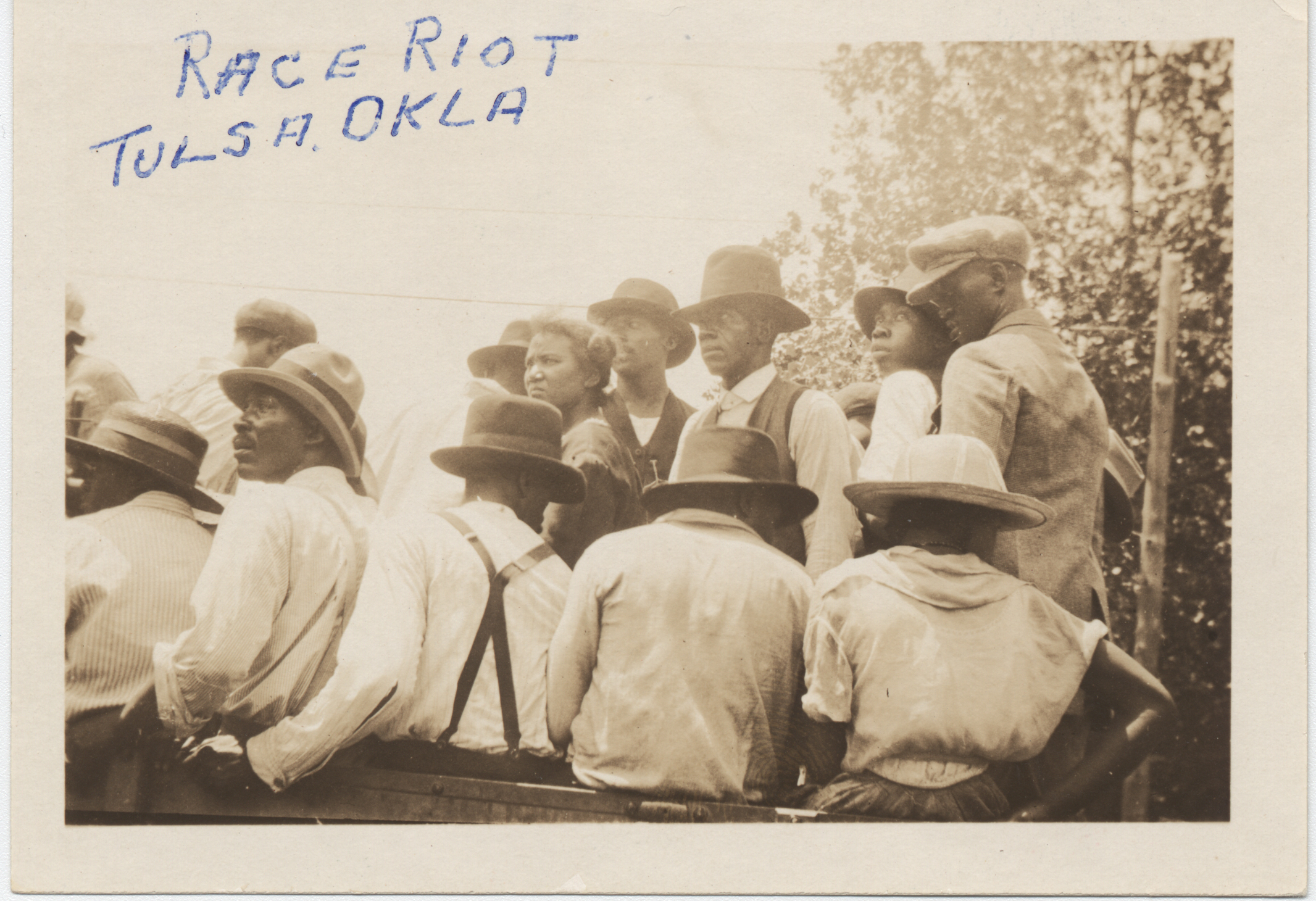
African-American residents of Tulsa being detained during the 1921 race massacre. (Photo from University of Tulsa Department of Special Collections.)

Editor’s note: The following essay was written and graciously submitted by my Facebook buddy and fellow baseball historian Johnny Haynes. It’s a pretty fascinating and saddening look at how baseball, race relations and tragedy collided in May 1921 in Tulsa. I’ve only lightly edited it.

Just like the Superdome in New Orleans during Hurricane Katrina, sports venues have long borne witness to non-related pain and trauma throughout history. As baseball is the original American pastime, so too have baseball diamonds. 

In 1919, McNulty Park opened for the new Tulsa Oilers of the Class A Western League and was soon a frequent destination for white major league teams and players, including Babe Ruth.

Negro League baseball had been played in Tulsa for well over a decade, and in 1920, an unnamed Tulsa team was listed as a member of the Texas Colored League. The north end of Tulsa was home to the Greenwood community, a prosperous area that housed most of the city’s Black residents.

On May 31, 1921, the white Oilers and the Oklahoma City Indians finished a doubleheader, unaware of what was happening beyond the ballpark’s walls.

One day earlier, a young man named Dick Rowland tripped walking into an elevator, accidentally landing on a white woman named Sarah Page. A bystander who heard her scream called police and he was arrested, with a sensationalized story printed in the newspaper the next day.

As the Oilers were boarding the train and the Indians were waiting for the next one, a group of armed Black residents from Tulsa who were concerned that Rowland would be lynched collided with a group of white residents at the courthouse. As the white group attempted to disarm the Black group, a shot rang out and a gun battle ensued that would envelop the entire city.

McNulty Park in its earlier days. (Photo from Tulsa Historical Society.)

Almost simultaneously, houses caught fire, stoked by arsonists on the ground and airplanes dropping crudely made incendiary bombs. Residents who came out with their hands up were either forced back inside, shot or whisked away by civilians. Bodies were also thrown back into the burning houses, a scene witnessed by Oklahoma City players who had their train out of town delayed. Trains themselves, for that matter, were attacked, and hospitals caring for the injured stormed. The National Guard arrived and was subsequently deputized alongside “all whites” and became officially sanctioned to join the mob.

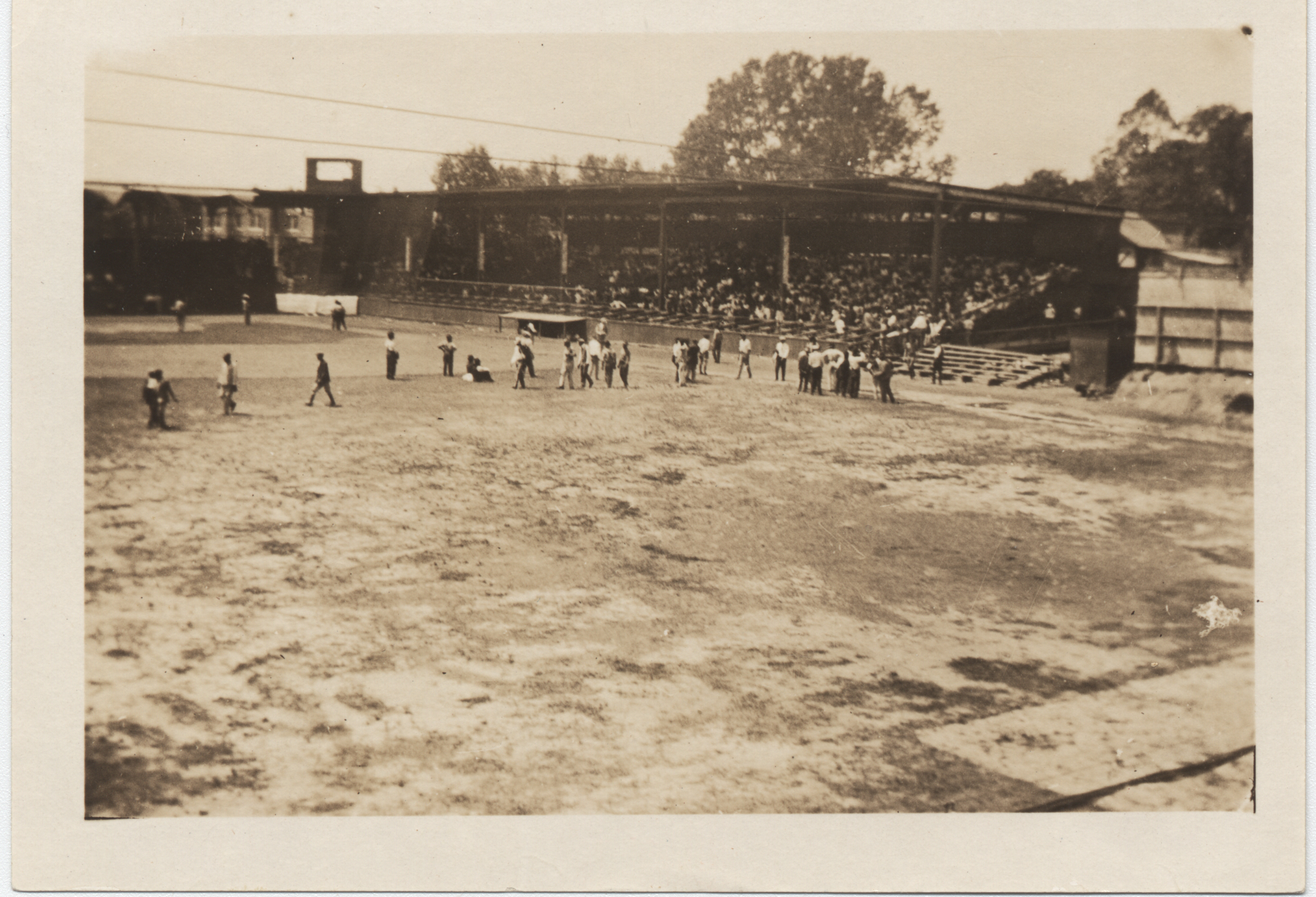
The Black residents who weren’t killed were rounded up, detained and marched by gunpoint into the city convention hall, then the baseball stadium as their homes burned. Women and children were allowed to take seats in the grandstands, while the men were held on the ballfield. None could leave until white employers came to vouch for them.

McNulty Park was photographed on that day, depicting what would look like a capacity crowd at a game were it not for the strange formation of men sitting on luggage and standing around hopelessly under armed guard. Other photographs show men being unloaded from trucks outside the stadium like cattle. The Coffeyville, Kan., Morning News described conditions in the park:

“Inside the park was color and heat – stifling, odorous heat – the crying of babies, the sound of many voices and the moaning of women; and negroes [sic] – thousands of negroes [sic] huddled together as far as the eyes could see from one end of the grandstand to the other. The majority of them accepted the inevitable in good part; crowded and hot and sticky as it was.”

Martial law was declared the following day, and perhaps because there was nothing left to burn, the riots ended. 

The toll will probably never be fully accounted for. Thirty-five city blocks of homes, businesses, churches and schools were razed, resulting in a reported $4 million in property loss. An estimated 10,000 residents were homeless overnight. The Oklahoma Bureau of Vital Statistics officially reported 36 deaths, though modern estimates range from 75-300. At least 800 people were hospitalized. Predictably, only the names of the white residents who died were printed in the newspapers.

Just 10 days later, McNulty Park was back to hosting ball games, like the massacre never happened. The Tulsa Tribune advertised a doubleheader between the Elks club teams of Tulsa and Oklahoma City on June 12. Returning too would be Blackball.

On June 4, with smoke still literally hanging in the air, the Black Texas newspaper The Dallas Express announced that “the Tulsa White Sox has organized a very fast team and will be heard from soon.” The very act of forming a baseball team seems out of place given the tragedy, but it was one of the only acts of defiance left for people who lost everything.

In 1922, the Black Oilers were incorporated and were members of the Texas Colored League in 1923 and 1929, spending most of their time in independent ball. One of the teams the Black Oilers would host in late September 1922 would be the Wichita Monrovians, who would take on and outplay the Ku Klux Klan’s team in Wichita.

In 1925, the Chicago American Giants and Kansas City Monarchs were juggernauts of the still young Negro National League when they linked up for a three-game set in Tulsa from Aug. 19-21. Despite receiving no compensation from insurance or otherwise, the Black residents who stayed did their best to rebuild, and seeing two big league teams was a welcome distraction.

Another scene from McNulty Park on June 1, 1921, show African-American men as detainees. (Photo from U. of Tulsa Special Collections.)

The games coincided with the 26th annual convention of the National Negro Business League, a meeting of Black entrepreneurs and businessmen from across the country. “The games played at Tulsa, Okla … between the American Giants and Kansas City, will not count in the official standing,” reported the Chicago Defender. The Tulsa Tribune stated the opposite in their advertisement of the game. 

Negro National League founder and American Giants owner and manager Rube Foster was not unaware of what happened in late spring 1921 at the ballpark. The “Red Summer” that saw violence occur in 26 cities across the country, including Chicago, precipitated the formation of the NNL in 1920. For Foster, a calculating man who had a reason for every single thing he did, the decision to visit Tulsa was likely formed by several things. For one, it was an opportunity to flex for Negro League baseball, which was quickly becoming the largest Black business in the United States, to other business owners.

The NNL teams’ appearance at McNulty also seemed cathartic and offered both healing and an act of defiance in a city where so much sadness and buried anger still lingered. For the Monarchs’ future Hall of Famer Bullet Rogan, the game was a homecoming of sorts – Rogan spent his childhood in Oklahoma City.

In the opening game of the series, the Monarchs routed the American Giants, 10-4, on long home runs by George Sweatt and Newt Allen. Game two went to the Monarchs again in a 13-9 slugfest, reported in the Enid Daily Eagle. No score has been found yet for the third game.

The American Giants would finish just behind the Monarchs in the NNL standings in 1925, who would go on to win the league pennant over the St. Louis Stars but lose the Negro World Series to Hilldale, five games to one. Several Black teams would subsequently call Tulsa home, including the Black Oilers, T-Town Clowns and Tulsa White Sox.

Rube Foster

Just a few years after the massacre, in 1929, McNulty Park was torn down and replaced by a grocery store. Today, a Home Depot parking lot sits on the site.

This story, however, underscores a few things. This history still must be taught, beginning to end. I’ve considered myself a longtime baseball fan and history nerd but never knew any of this story. The Greenwood Massacre is required teaching in Oklahoma schools as of 2020, but not anywhere else.

If the white players who were playing at the time were shaken by the terror they witnessed, then one can imagine that the Black players who just lost their homes, businesses and livelihoods faced even more unfathomable heartbreak. And yet, as generations of Black players would do in the face of oppression, they played ball anyway.

Editor’s note: If anyone else would like to submit something for publication on this blog, definitely feel free to emails me at rwhirty218@yahoo.com. Thanks, and special thanks to Johnny Haynes for today’s post!

Negro League family celebrates NOLA legend

John Bissant’s descendants show off the jersey made in his honor. (Photo courtesy Charisse Wheeler)

Since the beginning of this year, I’ve been in contact with Charisse Wheeler, a New Orleanian and the granddaughter of local Negro Leagues great John Bissant. I originally broached the subject of Bissant on this blog a few years ago with this post, about the ramshackle, anonymous nature of his grave in Carrollton Cemetery.

The cemetery, located in the Carrollton/Uptown neighborhood of New Orleans near the main campus of Tulane University, was historically divided into white and Black sections; the white area took up the vast majority of the graveyard, with people of color related to a small corner of the area.

Not surprisingly, the white section is today a much cleaner, nicer, and well maintained one than the Black section, much of which is untended, shambling, muddy and filled with many graves that include more than one family member.

The “colored” section of Carrollton Cemetery, Sept. 2, 2023. (Photo by Ryan Whirty)

While the white section includes numerous spacious, gleaning, well-kept crypts and mausoleums, the area for people of color contains many simple headstones, many of which are titled, toppled or askew. A lot of the stones are so eroded and obscured by nature that the names are practically illegible, rendering the graves’ occupants as essentially and sadly anonymous in death.

Such is the case with John Bissant’s grave, located on a family plot in the Black section. Resultantly, I’ve hoped that John’s grave could be the subject of another effort by the Negro League Baseball Grave Marker Project, but because his grave contains multiple people and cannot be specifically and conclusively located, it makes for a tough case for the NLBGMP.

I’ve also hoped that I could attract the attention of various local media in publicizing the location and ramshackle status of Bissant’s final resting and, by extension, the entire “colored” section of the cemetery. 

However, it’s proven a difficult road to getting any articles or pieces undertaken on the local Negro Leagues, aside from The Louisiana Weekly newspaper, which has been gracious enough to publish several Negro Leagues stories of mine, such as this one about Creole Pete Robertson, this one about John Wright and this one concerning Gerald Sazon.

(Most media types to whom I’ve reached out here have either ignored me or come up with excuses why they can’t be bothered, namely the supreme, unquestioned importance of the Saints and LSU football. Some have also been quite hesitant to do on-air pieces because I’d have to be interviewed on camera, and my stuttering has also served as a convenient excuse for not doing so.)

Soon after my original post, though, Charisse posted a comment on the post introducing herself and saying she’s liked my work. We’ve since traded emails and messages and hope to talk in person or over Zoom soon.

But in the meantime, Charisse has filled me in on some stuff she and her family have been doing to honor John Bissant and his contributions to baseball history and to the city of New Orleans.

In particular, the family gathered to celebrate John’s life on Resurrection Sunday (Easter) this past April. In addition to Charisse, one of John’s sons, Lawrence Bissant, also attended, as well as several other grandchildren, a great grandson and a great great granddaughter. They also had jerseys and shirts made up.

“We still very much keep him and his memory alive,” Charisse told me via email. 

She added: “We still very much talk about our grandfather and the many memories we had with him. I actually have a box of letters, where people would write [to] him from all over the world to get his signature.”

The Bissant family. (Photo courtesy Charisse Wheeler.)

Bissant’s most prominent stint in Negro Leagues baseball came with the legendary Chicago American Giants, from 1939-1947. At that point, the G-men were members of the Negro American League and a decade or so removed from their greatest era in the 1920s under Rube Foster and then Dave Malarcher.

Beginning in 1937, the American Giants were owned by Dr. J.B. Martin, a dentist from Memphis who owned the Memphis Red Sox before shifting to the Windy City. He also served as president of the NAL. Unfortunately, the American Giants were largely mediocre at best during Bissant’s tenure with the club, never winning the NAL pennant and finishing last a whopping five times. 

However, that American Giants club of the mid-1940s was, at times, fairly stacked. At various times Bissant’s teammates included standouts like Ted “Double Duty” Radcliffe and Duty’s brother, Alec/Alex Radcliffe; Art “Superman” Pennington; Gentry Jessup; Walter “Rev” Cannady; Lester Lockett; Willie Cornelius; Ted Trent; John “Mule” Miles; John Ritchey; Lyman Bostock Sr.; and fellow New Orleanians Billy Horne and Lloyd “Ducky” Davenport.

As it turned out, as an outfielder, Bissant had the good fortune to team with other standouts – including NOLA lad Davenport – to form fearsome lineups in the outer garden for the American Giants. In June 1943, an Illinois paper noted that Bissant and Davenport were joined by Art Pennington in an “outfield [that] is considered the best in the [NAL].”

Actually, during and after Bissant’s playing career, newspapers often referred to Bissant together with Ducky Davenport as a duo of greatness; because both of them were outfielders from New Orleans – they competed against each other in high school here – and were both speedsters who prowled the outfield for the American Giants, it was natural to mention both in the same breath.

However, even then, Bissant garnered the highest praise, partially because he was so well rounded as an athlete.

“Bissant was a natural, as was Davenport,” stated the Louisiana Weekly in April 1970, “but [Bissant’s] wonderful physique, speed and power gave him the advantage, and his best sport was probably football, although he lettered in track [and] basketball, as well as baseball and football.”

A vintage photo of the Chicago American Giants’ killer lineup, with John Bissant second from right. (Image courtesy Charisse Wheeler)

Anyway, those CAGs aggregations also included, at different times, numerous Black baseball legends who were in the latter stages of their careers, including Willie Wells, Pepper Bassett (a Baton Rouge native), Jimmie Crutchfield, Chet Brewer and Cool Papa Bell. In addition, several esteemed veterans served as American Giants managers during Bissant’s stints with the club, including Ted Radcliffe, Bingo DeMoss and Candy Jim Taylor.

In 1996, writer Ross Forman interviewed Bissant for an article in “Sports Collectors Digest” magazine, and the piece chronicled a great deal of Bissant’s memories and recollections about his career and some of the Black baseball stars with whom he played, with a focus on his time with the CAGs.

“We had a lot of traveling experiences, meeting other clubs,” Bissant told Forman. “They were very fond memories of the Negro Leagues. I guess the highlight of my career was the year [the Chicago American Giants] made me captain of the team. We had quite a few young ballplayers coming in then and, to be a leader on that ball club was quite an honor.”

The St. Joseph, Mich., Herald-Press, June 2, 1942.

Bissant said that in the Windy City, “In Chicago, I think I was quite a hit with the fans because I hit really well. At the time when they took me, I had been playing infield, they turned me into an outfielder.”

Bissant added that traveling the country remained a career highlight.

“I still remember playing in the major league ballparks, such as Yankee Stadium and Polo Grounds,” he said. “That was nice. We also played in some small parks, some very small parks, places that never would compare to a major league stadium. My favorite was Comiskey.”

John’s career, while not as stellar as other Black ball legends who are waiting for induction in Cooperstown like Dick Redding and Rap Dixon, was certainly successful enough to make him one of the best baseball products of New Orleans, white or Black — a fact that requires his induction to the Louisiana Sports Hall of Fame and the Greater New Orleans Sports Hall of Fame at the very least. While spending most of his career as an outfielder (playing in all three outer garden positions at different times), he could also man second base and even take the mound if needed.

According to James A. Riley’s exhaustive book, “The Biographical Encyclopedia of the Negro Baseball Leagues,” Bissant batted and threw right-handed, stood at 5-foot-8 and weighed 180 pounds. Riley wrote that John was “[A] good outfielder [who] could run and throw, but is probably better known for his hitting.”

Newspaper writers also described Bissant as a standout with all-around talent and adaptability. A July 1944 article in the Belleville (Ill.) News-Democrat, for example, called Bissant “the team’s ace outfielder, and is a hard hitter as well as a great ground-coverer.”

The South Bend, Ind., Tribune, in previewing a game between Bissant’s Chicago Brown Bombers and a northern Indiana semipro team, offered a concise but glowing estimation of the New Orleans legend. At the time Bissant was usually stationed in left field.

“Bissant is tagged as the fleetest of the Bombers’ outfield,” the newspaper stated. “Because of his fleetness he sometimes patrols center giving the Bombers added protection on the strength of Bissant’s ability to roam into right or left to haul down apparent hits. He is death on [the] bases and specializes in base thievery to the chagrin of rival catchers.”

According to Seamheads.com, across all or parts of eight seasons in the major Negro Leagues with the Cincinnati Tigers and Chicago American Giants between 1937-47, Bissant played in a total of 139 games, amassing 477 at bats, with 74 runs, 131 hits, 16 doubles, nine triples, two homers, 44 RBI and nine stolen bases, showing that he wasn’t really a power hitter and wasn’t quite speedy enough to swipe bases by a pile like Cool Papa Bell and Sam Jethroe, but he slapped out hits at a very solid  clip. His BA/OBP/SLG/OPS line was .275/.323/.358/.681. 

“I don’t brag on myself,” Bissant told Forman. “I leave that to other people to do that, and staying up there in the lineup for most [of] my career was an honor. …

“I was a decent hitter, very fast; I stole quite a few bases. I can’t remember yoo many catchers stopping me. Sure, I was thrown out (trying to steal), but not any rash of stolen base tries. Most of the catchers when I played, had very good arms, not like the catchers now.”

John Bissant’s World War II draft card.

He said he had a good relationship with fans, including those in Chicago.

“I think they appreciated my effort, and I enjoyed baseball,” Bissant said.

Unfortunately, Bissant was one of hundreds of Black players who never got a chance to compete in so-called Organized Baseball; he noted that “[W]hen they started taking Negro Leaguers into the major leagues, I was too old.”

But, even in his later years, the memories of his time in Negro League baseball remained sharp and sweet.

“Yep, it’s been over 50 years, yes indeed,” he told Forman, “even though I sometimes remember things like they happened yesterday.”

After retiring from baseball, John Bissant worked at several jobs in the New Orleans area, including at NASA’s Michoud Assembly Facility; Lykes Brothers Steamship Company, a shipping business; Glazer Steel and Aluminum; and a security guard firm.

John Bissant died on April 1, 2006, in Houston, Texas, at the age of 92; he had evacuated to Houston from New Orleans because of Hurricane Katrina. In its obituary of Bissant, the Times-Picayune called him “a Negro League Baseball Legend.” 

I’m working on additional John Bissant posts that gets more detailed about his career and accomplishments, so hopefully that’ll be done soon. Fingers crossed!

Scenes from Malloy 2023

Hamtramck Stadium, July 20, 2023

Here’s a bunch of pics from the 2023 SABR Jerry Malloy Negro Leagues Conference a couple weeks ago in Detroit. The first set are from the opening reception at historic Hamtramck Stadium. (For info and background about Hamtramck and its incredible preservation and revival, check out this, this and this.)

This second group is from the July 21 Detroit Tigers game, at which the team celebrated its annual Negro Leagues day.

Phil Dixon and I

I’m also including a couple pics of the team’s statue and memorial to Hank Greenberg, who also faced hate and bigotry in a city rife with anti-Semitism at the time he played. (Detroit was home to automobile and manufacturing magnate Henry Ford, as well as Father Charles Coughlin, who spouted bigotry on his radio show. They were both notorious anti-Semites.) Hank is one of my favorite all-time players.

Group honors Newt Allen at dedication ceremony

Attendees of New Allen’s grave marker dedication gather in Cincinnati’s Union Baptist Cemetery. (Photo by Paul Debono)

Editor’s note: I recently asked a couple SABR buds if they might be able to write a short essay detailing the dedication of a new grave marker on second baseman Newt Allen’s burial site earlier this year in Cincinnati. Below is such an article by Paul Debono, author of multiple fantastic books on the Negro Leagues, who was gracious and kind enough to unspool the story of providing a gravestone for the formerly unmarked grave of an overlooked Negro Leagues legend.

Jackie Robinson Day, April 15, 2023, a grave marker for Newt Allen was dedicated at Union Baptist Cemetery in Cincinnati, Ohio. Initially I felt a little awkward guiding the effort to place a marker on Newt Allen’s grave. I have always believed it is the historian’s duty to report history and not to change it.

I came across the fact that Newt Allen was buried in Cincinnati’s Union Baptist Cemetery years ago, which seemed odd as Newt was known almost exclusively for his storied career with the Kansas City Monarchs.

It was during the Covid-19 lockdown that I found some time to research the story behind how Newt Allen was laid to rest in an unmarked grave in Cincinnati.

He was born May 19, 1901, in Austin, Texas, the son of Newton and Rose (Baker) Allen. After the death of his father in 1910, Newt’s mother Rose picked up and moved to Cincinnati with four children.

While he was still just a young boy, Newt visited his aunt in Kansas City. His aunt had recently lost a young son, and the way things worked out Newt would stay in Kansas City. His auntie brought Newt into her home and adopted him.

He grew up in the historic Black neighborhood of 18th and Vine in Kansas City – very close to the current site of the Negro Leagues Baseball Museum. Newt discovered his true calling on the sandlots of Kansas City, working his way all the way up to the Monarchs in 1922. By 1924 he was the regular second baseman for the storied franchise.

Photo by Paul Debono

Not described as a “natural,” he was known for hard work and dedication. He mastered bunting and terrorized opposing infielders with aggressive tactics on the basepaths. Allen put in the work to become an excellent fielder on an excellent Monarchs team and helped the team to win the first-ever Negro League World Series against the Hilldale Club of the Eastern Colored League in 1924 – the first of many pennants for Allen and the Monarchs.

Newt ascended to captaincy and played alongside Hall of Famers Joseph “Bullet” Rogan, Andy Cooper and Buck O’Neil. Later in his career he also played with and managed Hall of Famers Satchel Paige, Willard Brown and Hilton Smith. Newt retired from baseball in 1944, but in 1945 briefly rejoined KC to evaluate a prospective shortstop named Jackie Robinson.

Newt Allen was one of the greatest second basemen in baseball. Buck O’Neil said he “never saw a second baseman with as good an arm as Newt Allen.” Legendary New York Giant manager John McGraw said, “Allen is one of the finest infielders, white or colored, in organized baseball.”

Along the way, Allen played baseball in Cuba and Mexico during the winter. He even toured China, Japan and the Philippines as a member of an “all-star team.” Newt Allen had a swan song as manager of the barnstorming Indianapolis Clowns in 1947 and then finally left the game he loved.

When he left baseball, he had a career as a repair foreman at the Kansas City courthouse. As an elderly gentleman in declining health, he moved in with his younger brother in Cincinnati and later into a nursing home. Newt was loved and respected. When Newt Allen died in 1988, the Kansas City Times printed a short article on the passing of the legend, but no obituary was published in the Cincinnati newspapers. And, probably due to a lack of money, no grave marker was placed.

Newt Allen (photo from the Negro League Baseball Museum)

I found a story online about a researcher who had previously been frustrated looking for Newt Allen’s burial place. Newt’s death certificate listed the place of burial as Union Baptist Cemetery, but the record of his precise burial place could not be found.

It seemed like that might be the end of the story. I was lucky though, and discovered a local historian, Chris Hanlin, who had taken on a project documenting Cincinnati’s historic black cemeteries.

The subject of most of Chris’ work was Cincinnati’s African-American pioneers in art, business, civil rights, education, law, medicine, religion and other fields going back to the early 19th century. Chris had never heard of Newt Allen, and he too initially thought that Newt Allen’s resting place might be unlocatable.

As a long-time student of Negro League baseball history, I appreciated just how important Newt Allen was to the game. Years ago, I made the acquaintance of Dr. Jeremy Krock, who founded the Negro Leagues Baseball Grave Marker Project in 2004. I knew that, given Newt Allen’s prominence, his resting place would be on the list of graves worthy of placing a marker for the NLBGMP.

I also found that SABR member Frederick Bush was in the process of writing a biographical sketch of Newt Allen, so we joined forces to research Newt. I enlisted the assistance of fellow Negro Leagues history buff/author Alex Painter; an old friend, Dr. Eric Jackson of Northern Kentucky University; podcaster Deqah Hussein-Wetzel; Union Baptist Church trustee Louise Stevenson; as well as many other supporters.

A breakthrough happened when Hanlin, who had over time built a relationship with the trustees of Cincinnati’s Union Baptist Church, was able to sift through the church records and find a record for the Allen family showing exactly where Newt Allen was buried.

While tracking down where Newt Allen was buried, we managed to learn a little bit more about his life story. We were also able to locate living relatives in Kansas City. While these pieces fell into place, it took time and work to create the grave marker.

Lest we forget, Covid-19 restrictions meant that in-person meetings were canceled, supply chains were slowed down, cemetery workers were laid off. We had Zoom meetings. We corralled support online. I did not meet my virtual colleague Chris Hanlin until we had both received our Covid vaccine six months after our online introduction.

Paul Debono, Alex Painter, Louise Stevenson and Dr. Orlando Yates at the dedication ceremony. (Photo from Paul Debono)

I told the story of how the Kansas City Monarch legend Newt Allen was buried on the west side of Cincinnati to anyone who would lend me an ear. I was asked several times, “Why are you doing this?”

That story always started with a short explanation of Negro League baseball, the significance of the Kansas City Monarchs, and then just who Newt Allen was and what he accomplished. I had some help telling that story – there were past voices inside my head guiding me.

Knowledge was passed on to me by big personalities like Buck O’ Neil and Ted “Double Duty” Radcliffe, whom I was privileged to meet many years ago. I came across Buck O’Neil’s “All- Time Negro League Team” posted online, in which he names Newt as his second baseman; everyone else on Buck’s team and now Buck himself is enshrined in Cooperstown.

Once it was determined where Newt Allen was buried, there was really no question that his grave would eventually be marked.

A grave marker is a simple slab of rock with an inscription that can last for hundreds of years – a small but important monument. The Negro League Baseball Grave Marker Project stepped up and coordinated the creation of the grave marker. It was delivered to Cincinnati’s historic Union Baptist Cemetery in the late summer of 2022. On December 1, 2022, the former sexton of the cemetery was lured out of retirement for a day to install the grave marker.

Jackie Robinson Day was chosen for the dedication because of Newt Allen’s special connection to Jackie. In his 1983 book, “Invisible Men,” writer/historian Donn Rogosin recounts a story passed on to him about how Newt Allen evaluated Jackie for the Kansas City Monarchs:

“Allen piled Jackie and the rest of the Monarchs onto a bus and headed to San Antonio to play [a team at the military base] Kelly Airfield. In the game, Robinson hit well and he proved that he was smart by handling some complicated baserunning chores and picking up the deliberately changing signs. But Allen recalled, ‘he couldn’t play shortstop.’ … Allen met with team owner J.L. Wilkinson … Wilkinson agreed, and Robinson was made a utility infielder, with the idea of grooming him as Newt Allen’s successor at second base.”

Since 2004 MLB has celebrated Jackie Robinson Day, in which all players wear No. 42 jerseys (a tradition started by Ken Griffey Jr.). Cincinnati is rich in baseball history and baseball history appreciators.

A group of about 50 people gathered at Union Baptist Cemetery at noon on April 15, 2023. Among the aficionados were a few baseball history buffs, including the director of the Cincinnati Reds Baseball Hall of Fame; church members; the son of a Negro Leagues player,; and friends and neighbors.

The day started off overcast with a few sprinkles, but by noon the splendor of a sunny Appalachian springtime came over the hallowed grounds. The dedication began with the Pledge of Allegiance – a tradition at the Union Baptist Cemetery, where the souls of over 100 Black Civil War veterans lie.

From the Negro Leagues Baseball Museum

We sang “Take Me Out to the Ball Game,” and the Union Baptist Church Pastor Dr. Orlando Yates gave a moving eulogy to Newt Allen – peppered with reminders of why history is important now! Newt’s accomplishments were recited and flowers placed on his tombstone.

While trying to gain support for the Newt Allen grave marker, I spoke with a few baseball historians. When you mention the name “Newt Allen” in certain circles, the conversation quickly turns to Cooperstown. The sheer number of games that Newt Allen played puts him in the National Baseball Hall of Fame discussion. The number of championship pennants he accumulated as a Monarch is more than any other player. The fact that there is not a true Negro League second baseman in Cooperstown also strengthens the case for his induction.

Regardless of whether Newt Allen winds up in Hall of Fame, he deserves to be remembered. We did our small part. We placed a simple marker on Newt Allen’s burial spot in hopes that he will never be forgotten. And the work of the Negro League Grave Marker Project goes on – since 2003, more than 50 markers have been placed, and there are more in progress.

Paul Debono (Cincinnati resident since 2000) is the author of two histories of Negro League baseball teams: The Chicago American Giants (2007) and The Indianapolis ABCs (1997) and currently working on a history of Negro Leagues baseball in Cincinnati.

As a final side note, Paul pointed at a little bit about Newt Allen’s connections to Cincinnati, where Paul has lived for many years. Here’s what Paul wrote on that:

Newt Allen was a Kansas City Monarch who was laid to rest in a different Queen City, however he did play a handful of games in Cincinnati. Newt played shortstop and was the leadoff hitter for the Monarchs May 25, 1934, at Crosley Field for a game against the Cincinnati Tigers. He went 2-for-5 and hit a double. It would be interesting to know if his Cincy family was able to attend the game.

The Negro Leagues and American education

Once again it’s been much too long since my last post. I’ve been working on posts but none of them seem to get done, unfortunately, but I really wanted to get something published about this particular subject.

That being the flood of state laws across the country that are banning the teaching of Critical Race Theory and outlawing in schools even the suggestion that systemic racism has always and continues to cripple our society by holding back a significant portion of the population – namely, non-white people.

(Here in Louisiana, Republicans in the State Legislature have tried to enact various anti-CRT measures but have fortunately been unsuccessful. Check out this and this.)

The basic truth of systemic racism remains that it has had and will continue to have a devastating impact it has on this country, and no amount of denying or ignorance can make it all disappear.

The notion that several well overdue laws like the Civil Rights Act and Voting Rights Act of the 1960s, court rulings like Brown v. Board of Education, and even three Constitutional amendments simply and magically erased all the horror, evil and consequences of hundreds of years of codified racial oppression of slavery and segregation in matters of instance is laughably, erroneous and deeply, deeply flawed, offensive and injurious.

Hiding our heads from reality in the sand doesn’t make systemic racism go away, and such pathological avoidance of the truth only reflects the fear and cowardice of those who ban the teaching of Critical Race Theory. Just like with segregation, such laws reveal the moral weakness and terrified existences of those leaders and their supporters. People like Ron DeSantis are, quite simply, cowardly little children and bullies.

Pictured: The derpy face of white American cowardice

But with that screed of mine out of the way, we need to get at one of the fundamental questions springing from such draconian, ignorant laws – what practical effects will such bans have on education in America? What can now be taught and acknowledged, and not taught and unacknowledged, in schools in Florida, Texas and other reactionary states?

Specifically in relation to this blog, we must conjecture whether the history and impact of the Negro Leagues can be taught to our children? Many people in the modern Negro Leagues community and fandom have worked hard, with a mix of determination and opportunity, to go into schools and clubs across the nation to teach folks about the bittersweet glory of the Negro Leagues.

For decades these baseball missionaries have exposed Americans, young and old, to the wonder and greatness that was segregation-era Black baseball. But would such efforts be allowed today? Could a teacher or guest in a school introduce “Only the Ball Was White” to students? Could the brilliant work of many subsequent Negro Leagues researchers and writers even be mentioned in classes?

Or would such instruction be barred or punished in states like Florida?

Because it’s absolutely impossible to teach about Satchel Paige and Josh Gibson and Pete Hill and Rube Foster and Pop Lloyd and Effa Manley without relating the very reason the Negro Leagues existed at all. The history of the Negro Leagues themselves is indisputably intertwined with why they were there – oppressive bigotry, segregation and, yes, institutional racism.

As a result, I suggest that any class lessons involving these legends – and legendary teams like the Cuban Giants, Kansas City Monarchs, Homestead Grays and Birmingham Black Barons, as well as numerous barnstorming all-star aggregations – that would be taught in school in Florida and elsewhere would be viewed by DeSantis and similar Palpatines as illegal and would be punished by the very legal system that should protect them. 

Pete Hill

In essence, the Negro Leagues now could not be taught in Florida. They simply couldn’t without vigorous, bigoted backlash.

But all this reveals another basic, unfortunate, tragic truth – that so much of what’s known as Black History in America is indeed the fight against institutional racism and oppression. The beliefs, writings and efforts of so many great African Americans were undertaken and put to paper as part of the centuries-long battle against bigotry, both codified and understood.

Frederick Douglass, Ida B. Wells, W.E.B. Du Bois, Malcolm X and Martin Luther King – they’re all legendary because they fought systemic racism. Think of some of the greatest works of Black literature – “The Souls of Black Folk,” “Up from Slavery,” “Native Son,” “The New Negro,” “Invisible Man” – and they all were created to, in some way, counter bigotry and correct the terrible political, economic and social impacts slavery and segregation had on our society.

Ida B. Wells

The people who are counted as important Black politicians and elected officials are, in part, remembered because they were racial pioneers in government. And from Shirley Chisholm, Barbara Jordan, John Lewis and John Conyers to Barack Obama and Kamala Harris, these trailblazers used their influence and power to affect achievements of tremendous social justice and political infrastructure.

Sports legends are no different. Isaac Murphy, Major Taylor, Jack Johnson, Fritz Pollard, Joe Louis, Jesse Owens, Wilma Rudolph, Althea Gibson, Arthur Ashe and Charlie Sifford were not only phenomenal, accomplished athletes, but at least some of their importance to American history is the fact that they were firsts for people of color in the athletic world.

Fritz Pollard

Even someone like Michael Jordan, who although wasn’t an athletic trailblazer like Bill Russell or the Harlem Rens were, became such a crucial figure in America, and indeed the world, because he was a Black man who was able to leverage his sporting achievements into an entrepreneurial juggernaut and massive economic success. Folks like Jordan, Tiger Woods and Serena Williams represent the mythic American Dream itself by becoming millionaires and billionaires, something that even early pioneers like Marion Motley, Joe Louis or Jesse Owens couldn’t achieve. 

Which brings us back to baseball, the national pastime, the oldest American sport, and the oldest American athletic business and, quite necessarily, to the Negro Leagues and their sad reason for being.

And, progressing from that, we come to the one and only Jackie Robinson. While Jack Roosevelt Robinson was undeniably an incredible, accomplished athlete regardless of color or era – he would have been a star and Hall of Famer in any league or in any decade – the driving reason he’s held up as an American hero is because he was the first player of color in the modern-era Major Leagues.

And moreover, his greatness and legend and importance also stem from the way he withstood withering hate and abuse when he suited up for the Brooklyn Dodgers in 1947 and beyond. He proved himself not just a good baseball player, but as a supremely strong, proud, resolute, honorable person and American. He was himself a Civil Rights pioneer who forever changed America for the better and bolder. That’s why he’s held up as a legend and an American hero today.

But, again, could his life, career and impact even be taught in the schools of Florida, Texas and other states today as a result? Would DeSantis-ites object to any mention in classes of a man who became a great American because of his battle and triumph over segregation and institutional, systemic racism, topics that are now feared taboo by weak, scared whites?

Frederick Douglass

Then extend the example of Jackie Robinson to other American Civil Rights legends. How could a teacher in Florida similarly instruct kids about why Frederick Douglass, Dr. King and Rosa Parks are important if those educators can’t even teach about someone – a “mere” baseball player – as fundamental to the last hundred years of American history and the lingering impact of that history?

When a nationwide movement calling, happily often successfully, for the removal of Confederate and Jim Crow statues, names and titles from the public sphere several years ago, reactionary whites leveled panicked cries of “how history was being erased.” They blustered and bloviated sanctimoniously about how Confederate history was, for better or for worse, American history, and thus shouldn’t be relegated to obscurity.

Overdue, to say the least

But now, these same reactionaries are now hypocritically doing the very thing they decried as an American catastrophe – effectively erasing history by banning its teaching. They’re deleting most of Black history from classrooms and textbooks across the country because teaching the reality of that history and the continuing, tragic impact of people of color would make them, and their precious white children, uncomfortable and sad. Snowflakes, indeed.

Black history – and therefore all of American history – is effectively being blotted out from lesson plans. We can’t teach about heroes like Jackie Robinson or MLK without accepting why they’re heroes – their heroism is defined and even exists because of systemic racism.

And without teaching the painful, ugly, centuries-long history of system and institutional racism in America, we cannot even begin to hope for the type of social and cultural reckoning that is absolutely necessary in order to affect nationwide healing that is so feared and almost pathologically avoided by people like DeSantis and his myopic, bigoted, cowardly supporters.

That reckoning with reality then necessarily envelopes the lives of, accomplishments made by and lessons imparted by American athletes like Jackie Robinson – and unavoidably, the Negro Leagues and Black baseball history.

It’s that Black baseball history that, sadly, stands as an emblematic microcosm of the entirety of American history and current American society. And if we can’t teach about Satchel Paige, Cum Posey, Sol White and Rube Foster – themselves relatively benign subjects compared to the shameful legacy of lynchings, mass murder and other violence – then how can we even teach the whole of Black history, as well as, then, the way that terrible, bittersweet history continues to cause the systemic, institutional racism that hasn’t simply disappeared in America, no matter how much some might want it to?