Kid Brown boxes his way into NOLA history

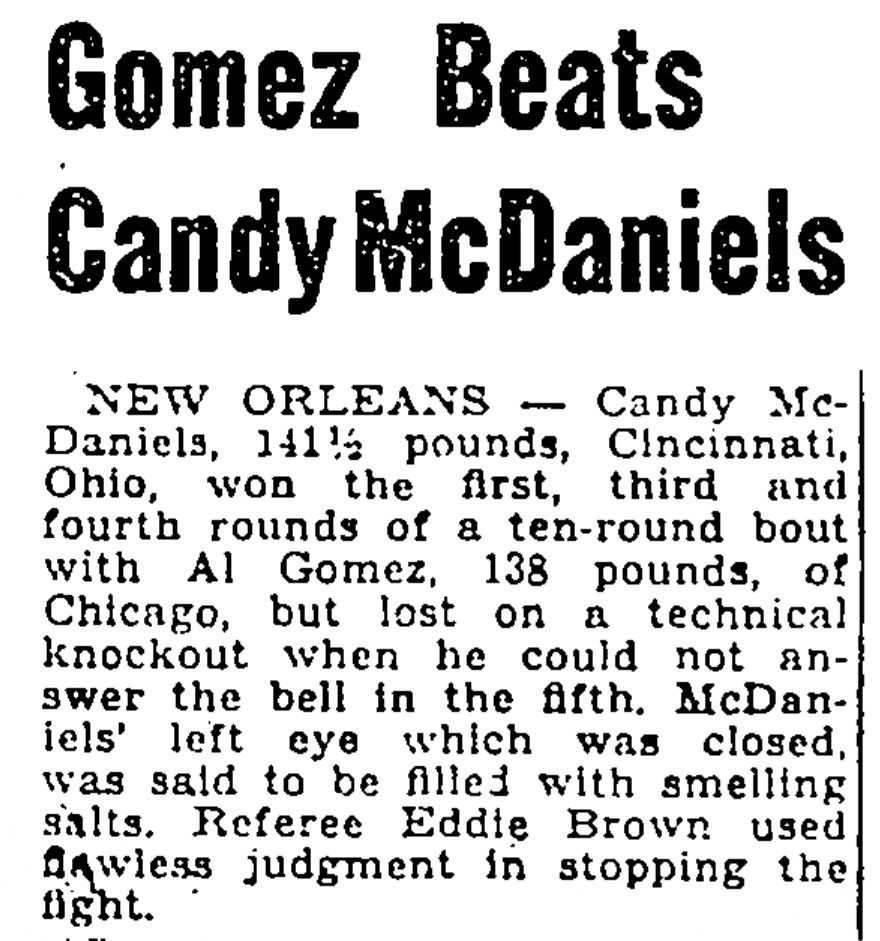
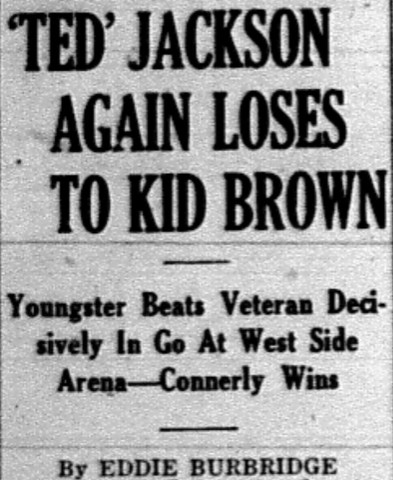
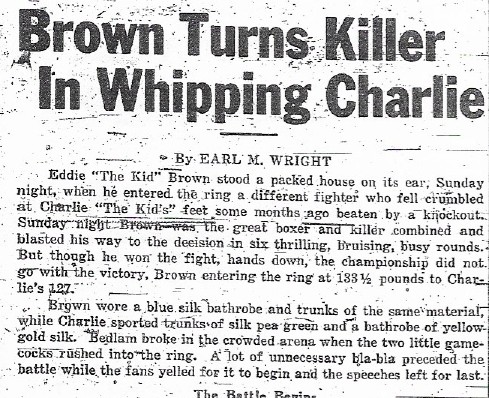
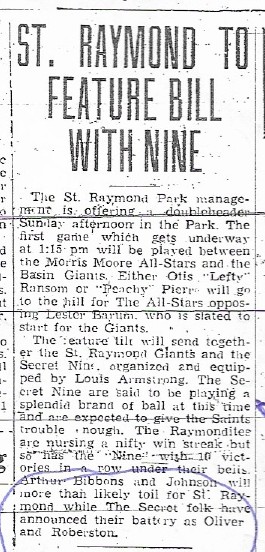
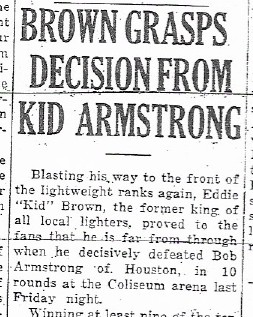
Louisiana Weekly, March 10, 1934.

This is the second part of a series of posts — actually sections of a much longer article in succession — about Eddie “Kid” Brown, a member of the Secret 9, Louis Armstrong’s semipro baseball team in New Orleans in the early 1930s. Check out the first part here.

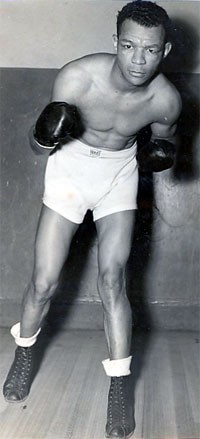
In this installment, begin to examine Brown’s other athletic pursuit — boxing …

Before I take a dive into some of the career of Eddie Brown Sr., I need to note that just about every pugilist who fought in New Orleans carried a nickname of some sort or another. Some of the monikers were pretty wacky, and some were a play on words about the boxer’s color — Torpedo Smith, Young Danno, Fast Black, Baby Bear, Battling Siki and any number of fighters coined “Chocolate [something].”

But one of the more confusing aspects of the period in question is several many boxers were nickname “the Kid” or “Kid,” and it can be a challenge at times to parse out who’s fighting whom in which fights. Probably my favorite moniker of the Kids I came across was Kid Stringbean, a New Orleans lightweight in the ’30s.

Some background on the nature of professional boxing in New Orleans in the 1930s could be needed, too. While I was doing research, which largely covered just a couple years (from 1933-35), I found that there often wasn’t too much structure or organization to the proceedings, at least not beyond just the weight categories. Boxers could face one particular opponent multiple times in a year, and Kid Brown had a bout every one or two months. There appeared to be no official state or regional titles or championship belts or rankings; the awarding of crowns seemed to be more of an informal process, almost based on based on popular sentiment or media commentary.

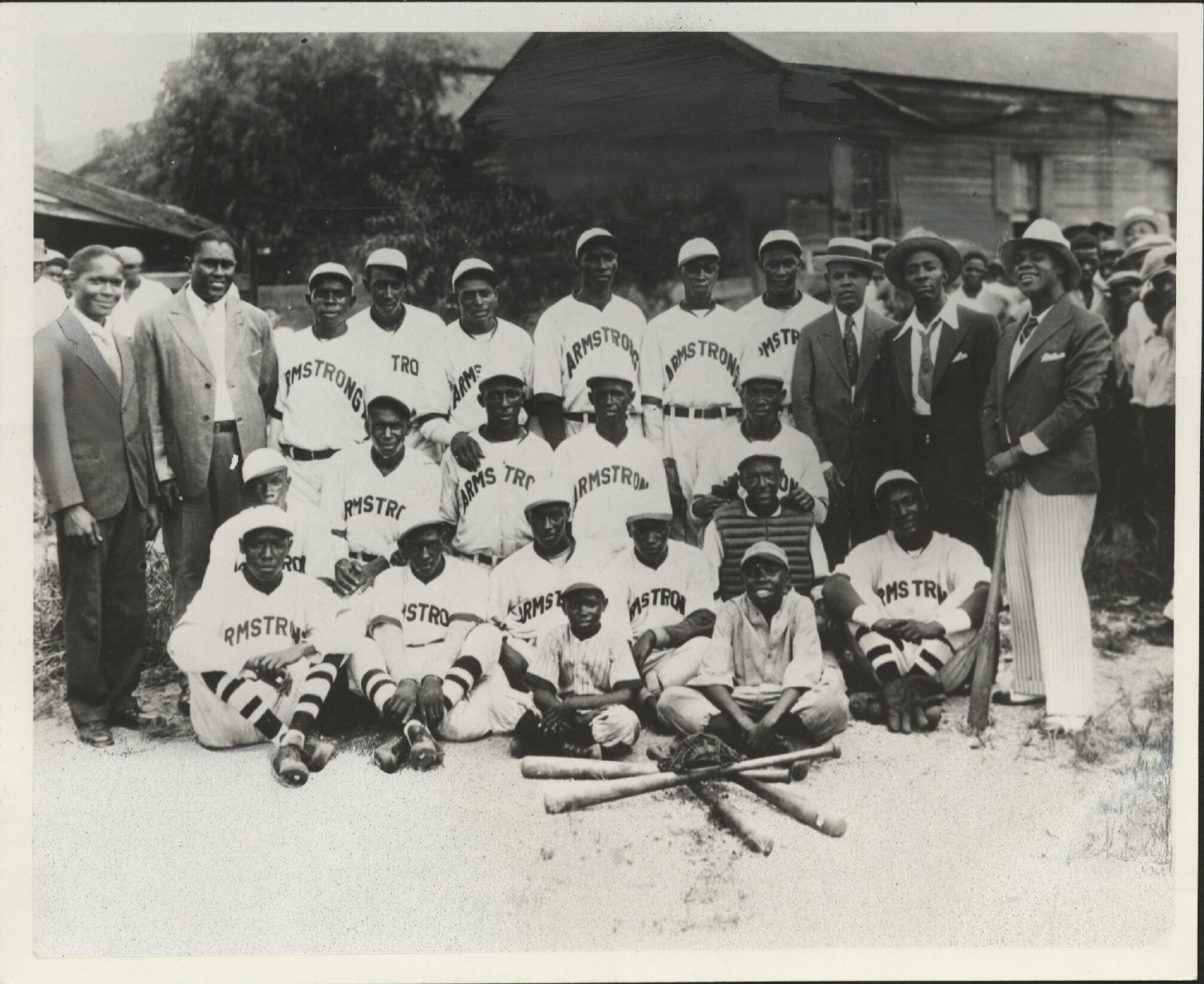
Louis Armstrong’s Secret 9. Eddie Brown is the third player from the left, back row. (Image courtesy of the Louisiana Research Collection.)

For boxers of color, add racism and lack of opportunities to this willy-nilly, chaotic scene that existed for most Louisiana boxers in the 1930s. My friend Derby Gisclair, a local boxing aficionado and historian, related to me in an email the conditions and social background in which black fighters found themselves at the time. It’s lengthy, but I feel his prose captures the scene beautifully, a scene dominated by lonely anonymity, economic desperation and a desire to make their mark somehow, some way:

The majority of the introductions made at ringside were greeted indifferently, as if smothered under the fog of cigar smoke drifting up to the plenum of dark and aging venues like the Coliseum Arena that [the boxers] found themselves in that night. [The public and the fans] had not and would not form any sort of attachment to the lesser known fighters, particularly black fighters, who all labored in general anonymity.

“Many fought under assumed names, a tradition made famous by the first Jack Dempsey, the Nonpareil, and reintroduced years later by the second Jack Dempsey, the Manassas Mauler. But for legions of boxers it was the first hopeful rung on the ladder that would take them out of the crushing poverty that had invaded the country during the Thirties. In most cases, these bouts were a monologue delivered without notice or critique, but which nevertheless fanned the fire of hope to an entire generation of fighters.

“Boxing was a way to escape the Depression, made even more important to black fighters as a means of also attaining some measure of social justice that was their due, and that they hoped would be different this time. The great black fighters who inspired their ambition ranged from Tom Molineaux to Joe Gans to Jack Johnson, fighters who ascended to the pinnacle of the sport and, in so doing, gained a small measure of acceptance that proved to be as elusive as their fleeting fame.

“Yet these intrepid souls persisted undeterred between the ropes, battling moment-to-moment in a test of courage and morality. It was a fight outside the ring as much as it was a fight within the ring. If they were lucky there was a payday and a short recovery, and a chance to grasp the next rung on the ladder.

“Progress would be slow, typical of the pace of most things in New Orleans, but it came with a glimmer of hope. The club fighters of the Thirties may have labored in anonymity, but they proved to themselves if to no one else that the harder they fought, the more successful they would become.”

The Coliseum Arena in New Orleans. (Photo courtesy of the Historic New Orleans Collection.)

Overall, according to BoxRec.com, an official boxing statistics holder, Eddie Brown Sr. had a career pro record of 18-7-1, with three knockout wins, in an active career stretching from 1929-36. His first recorded bout, according to the Web site, took place Dec. 11, 1929, against Kid Phillips at the New Orleans Coliseum Arena (where the majority of Brown’s pro fights took place) and ended, interestingly, in the only draw of Brown’s career. (More on this later, however, because murkiness exists in this area.) Brown wrapped up his fighting career with a knockout loss to Edgar Theard on July, 26, 1936, at Heinemann Park (later named Pelican Stadium).

Several other Brown fights heard the gong at Westside Arena in Gretna, La., which is across the river from the bulk of New Orleans itself; and a couple were enjoined at Lincoln Park in New Orleans. (It remains a mystery whether the national anthem at those clashes were performed by Linkin Park.) One took place at the Roseland Athletic Club in Baton Rouge.

From the first fight of Brown’s career — against the aforementioned Kid Phillips in 1929 — New Orleans’ black sporting community knew it had something special on its hands. However, the  start of Kid Brown’s fistic career appears to be shrouded in confusion.

Why? Because the media reportage of his first few months in the ring is, to say the least, jumbled. According to BoxRec, Eddie Brown’s debut came on Dec. 11, 1929, in a draw against Kid Phillips on Dec. 11, 1929, at the Coliseum Arena, a narrative that was reinforced by the daily New Orleans States newspaper in the publication’s Dec. 12, 1929 edition.

But the Louisiana Weekly offers a completely different timeline for Brown’s early days as a pro pugilist. The Weekly, New Orleans’ preeminent African-American journal, reported in its Dec. 14, 1929 edition that Brown defeated Kid Alfred on Dec. 8, 1929, at the San Jacinto Club arena as an undercard. (Check out the end of this post for more on the San Jacinto, one of the most influential men’s clubs in the Crescent City.) The paper stated:

“Eddie Brown came up from the canvas to carry away the laurels from Kid Alfred in the semi-final bout. Alfred massaged Brown’s face with a right jab he kept on tap for Eddie’s rushes, but after Brown got hip to Alfred’s southpaw style of milling the rest was easy and the judges handed him the verdict on a platter.”

(I’m not sure if “massaged” is the right word for pounding someone’s face with a fist, but it’s definitely descriptive.)

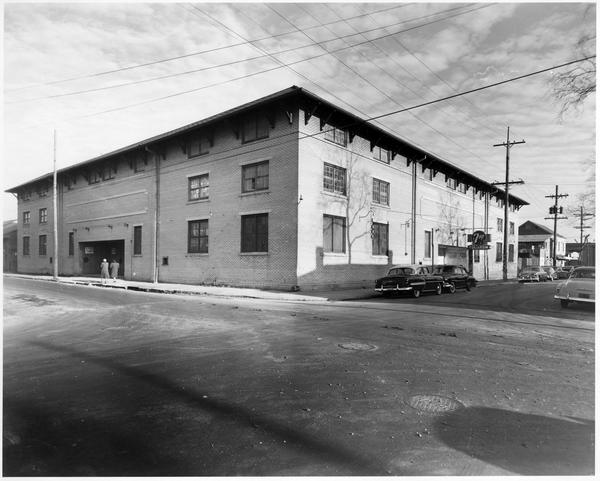
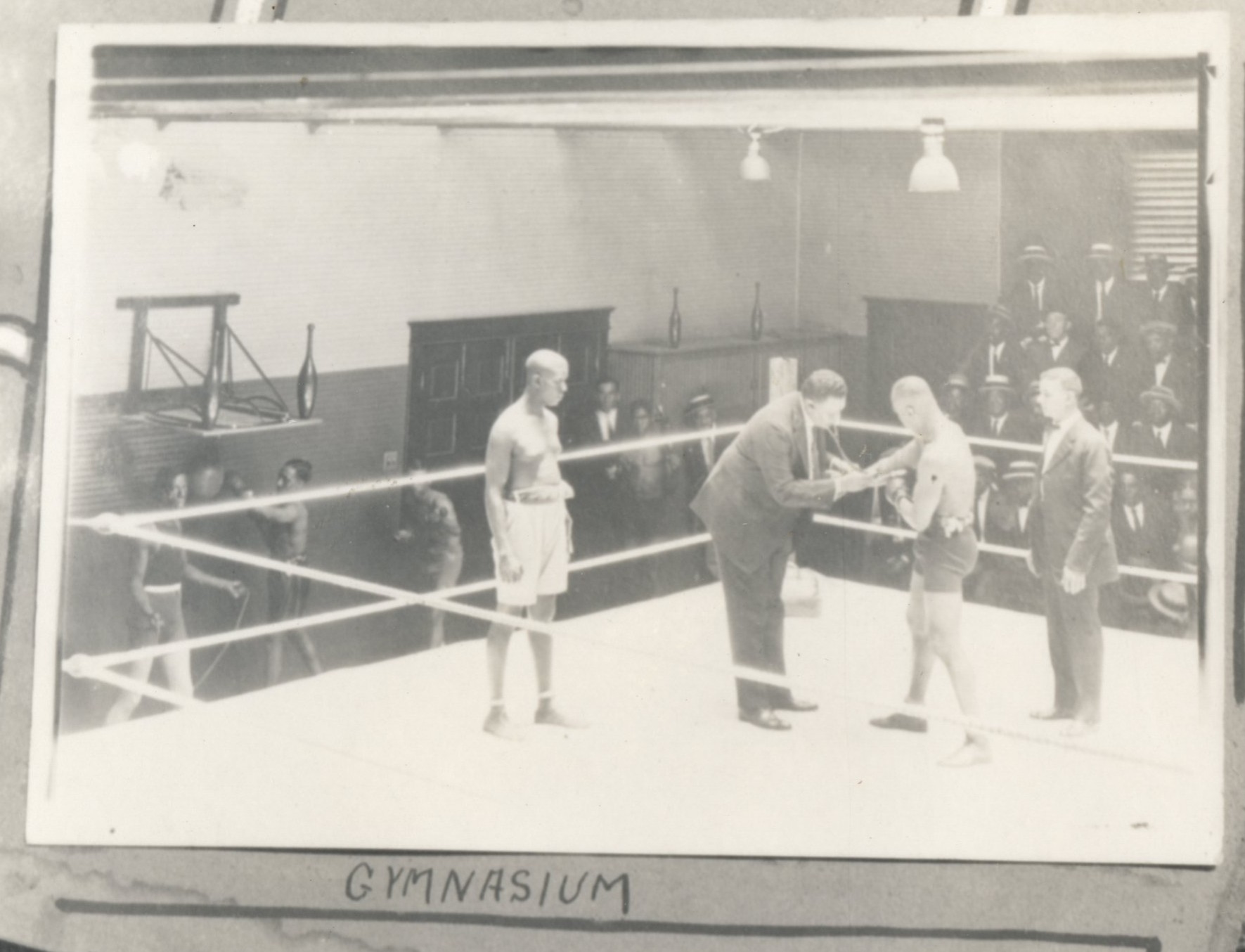
The boxing gym at the San Jacinto Club. (Photo courtesy the Hogan Jazz Archive at Tulane University.)

Brown quickly gained popularity, it seems, and by his Feb. 2, 1930, clash with John Boneris at the San Jacinto arena. The Weekly described as a pretty boy — it stated that Boneris was a “patent leather topped youngster” who “certainly draws the lady folk out to the San Jacinto Fight Arena” when he fought — who ended up having no chance against the up-and-comer Brown.

The fight led the card that night, signaling that the public already knew the young Kid Brown had dynamite in his fists and lightning in his feet. The bout garnered a large headline on the Weekly’s sports page, and 

Boneris, the Weekly stated, was out of shape, and his characteristic “ferocity and craftiness” was no match against “a tartar of the person of Eddi [sic] Kid Brown, 121 pounds …” By the fifth round, Kid Brown had taken control using a “two-fisted attack” that “pounded the ‘Patent Leather Kid’ about the face from long range and peppered his body in the clinches.”

The sixth round all but ended the proceedings in Eddie’s favor, stated the Weekly:

“Brown kept on Bonny all the way jabbing and sweeping him before him with a ceaseless barrage and won the round by a wide margin. And the fight too.”

Things got a little strange a couple weeks later, however, almost inexplicably so. It seems Kid Brown was a card headliner for a slate of fights at the San Jacinto Club on Feb. 16, but, according to the Weekly, he had to back out of his scheduled six-rounder against Kid Bagneris after “suffering a nervous breakdown.”

The newspaper’s article didn’t elaborate on the situation at that time, but in its March 8, 1930, issue, the journal reported Kid Brown back in action for an intense go with Jackie Moore, whom the paper’s sports editor, Earl Wright, colorfully derided as “that little Jamaican that fights at the San Jacinto Arena between boat trips [who] has no more business scrapping around New Orleans for the price of a meal ticket than Phil Scott had for climbing into the same ring with Jack Sharkey over in Miami the other night.” (That was a reference to the heavyweight fight a couple weeks earlier in Miami between reigning American champ Sharkey and challenger Phil Scott of Britain in which Sharkey dominated the Brit in a third-round TKO.)

The Brown-Moore six-rounder on March 2, 1930, turned out to be heated, and not just inside the ring. By the time the clash concluded, those in the crowd weren’t too happy. Reported Wright:

“Moore has everything. A fighting heart, a sock in both mitts terrific enough to drop almost any man in the flyweight and bantamweight divisions and a shift that is beautiful to see in execution as well as in snatching him out of dangerous holes. Jackie brought all of his wares into play Sunday night against Eddie ‘Kid’ Brown … and after the thrills and shouting had died away Moore received the verdict. But he didn’t earn it. Half the fans who saw the mill voiced the opinion along with us.”

Enter even more weirdness, in the form of medical conditions. Wrote Wright:

“But, man and boy, what a scrap that was! Brown, discharged by a doctor five days before the bout, substituted for Bobby Peyton, and the way he left jabbed and hooked his right after the first canto was impressive and disastrous enough to earn him a draw in the least.”

And the climax, per Wright:

“The fighters continued their killing pace throughout the six round and both were bleeding at the end. Moore’s aggressiveness won a large portion of the crowd, but according to our tally a draw decision would have done justice to both fighters.”

Wright didn’t elaborate as to Kid Brown’s exact medical condition, further enhancing the mystery of what exactly transpired in Eddie’s early career. However, these breathless several months — and the media coverage of them — fleshes out the atmosphere in which black pro boxing took place in the first half of the 20th century in the Big Easy. Spirited prose, passionate audiences, scheduling, seat-of-the-pants action … it was all there, in vivid scenes and on sweaty, bloody canvases. It was magnificent.

(The San Jacinto Club deserves its own blog post because of its importance to the New Orleans African-American community in the first half of the 20th century, so I’m going to try to produce such a story within the next few months. For now, check out the end of this post for a “short” — well, short by my standards — description of the San Jacinto for now.)

To kind of cap off the narrative of the first half-year or so of Eddie “Kid” Brown’s fistic career, in early June, I’ll note that even at that young age, “Kid” was already-community minded — in early June 1930, he was on the card for a fundraiser for the “Colored Hospital Fund.” The Weekly described the packed slate of benefit matches at a local community center gym as “a crop of exciting scraps … “ Also on the bill were local pugilists Joe Oliver and Young Harry Wills. (More than likely, the term “colored hospital” referred to the Flint-Goodridge Hospital, which for decades was operated by Dillard University as the primary medical-care center for segregated New Orleans’ African-American community.)

At this point, the online record (such as at BoxRec) of Eddie Brown’s career goes dormant for a spell, and I wasn’t able to fully dive into the period between mid-1930 to early 1932. However, it looks like many of Brown’s bouts between 1930-31 were held at the San Jacinto Club.

Downtown Gretna, 1943. The Westside Arena, where Kid Brown engaged in a few bouts in 1932, is located in the westbank city. (Photo from the Louisiana Sea Grant Digital Images Collection.)

Now, January ’32 is when online lists of Brown’s fights pick back up. It’s also when the New Orleans daily newspaper once again generated coverage of Brown’s fights — of course, their reportage on Brown’s bouts, as well as of black boxing in general, was seriously lacking in detail and comprehensiveness — beginning with a long series of pugilistic encounters at Westside Arena.

The Westside Arena, briefly, was the premier venue for boxing and wrestling clashes on the westbank, which is the portion of greater New Orleans across the Mississippi River that today includes the Algiers section of the city of New Orleans, as well as a good chunk Jefferson Parish. Cities/towns like Gretna, Marrero and Westwego make up the westbank half of Jefferson Parish; the other section is back over the river, mainly in the city of Metairie, to the west of the city of New Orleans. (Numerous semi-pro and even pro teams African-American baseball clubs sprang up very early in the 20th century, and perhaps earlier, on the Westbank, most notably the Algiers Giants, one of highest-profile and successful Negro aggregations.)

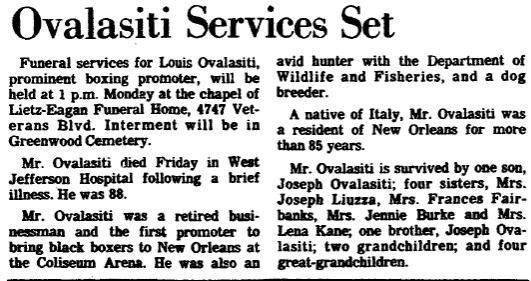
At various points during the facility’s existence, promoters (usually either Lou Ovalasiti or Tony Tripani, more on those guys in the post-notes below) strove to assemble weekly, multi-bout cards of black fighters, including Eddie Brown, events that attracted enthusiastic, fairly decent-sized crowds at times. In all, BoxRec lists three of Eddie Brown’s fights taking place at the Westside Arena in early 1932, all of them ending in winning decisions for Brown.

That wraps up Part 2! Look for Part 3 after New Year’s! As always, many thanks for reading!

Satchmo’s Secret 9: a name behind a face

Louis Armstrong’s Secret 9. (Photo courtesy the Louisiana Research Collection at Tulane University.)

Editor’s note: For the last year-plus, I’ve been gradually working, with much-appreciated assistance from several folks, to identify and discover more about the famous photo of the Secret 9 semipro baseball team owned by Satchmo himself, Louis Armstrong, in the early 1930s in New Orleans.

That photo, shown above, has been a source of both great pride and great mystery here in NOLA, because so far, none of the players had been identified, the source of the photo remains an enigma, and the nature of the team’s possible connection to the famed Zulu Social Aid and Pleasure Club has been been nearly impossible to define.

I’ve written about the Secret 9 in several publications, including here and here.

But over the past year, there’s been several breakthroughs in the slog to unearth facts and put to rest fiction surrounding the Secret 9! One of those epiphanies has been the identification of one of the players in the photo, and here’s a multi-part tale of that discovery and the talented, influential athlete at the center of the find.

Also, I know that in the process I’ve started multi-part stories on this blog and not finished them, for which I greatly apologize. However, that absolutely will not be the case here. I promise I’ll tell the whole tale. Now, without further ado, the story of Eddie “Kid” Brown, Part 1 …

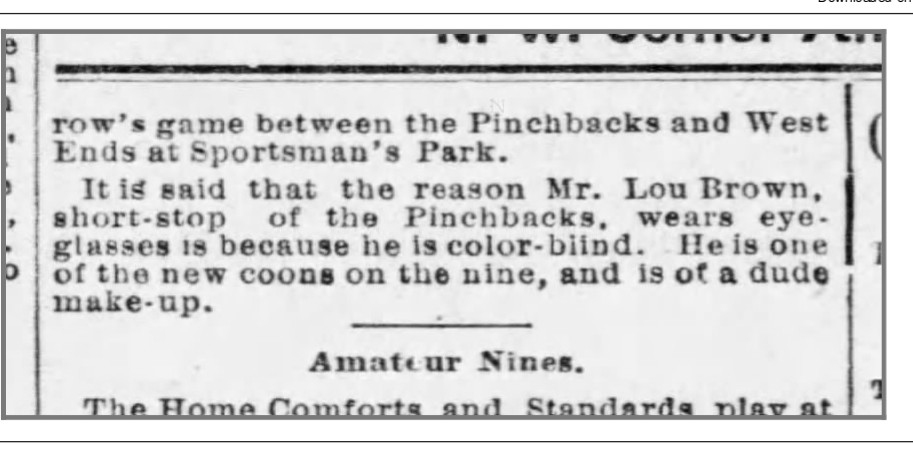
In late August 1889, the St. Louis Post-Dispatch newspaper reported on the upcoming game between the hometown West Ends and the visiting Pinchbacks from New Orleans. The two teams claimed to be the champions of “colored” baseball from their respective geographic regions; in this case, respectively, the West and the South. (At the time, St. Louis was still considered a city on the Western frontier of the growing nation.)

The paper — which unfortunately reflected the level of racism prevalent in society by calling the Pinchbacks the “new coons in town” and referring to the game as the exposure of “a dark secret” — specifically addressed the presence of one New Orleans player in particular.

“It is said that the reason Mr. Lou Brown, short-stop of the Pinchbacks,” stated the P-D, “wears eye-glasses is because he is color-blind. He is one of the new coons on the nine, and is of a dude make-up.”

St. Louis Post-Aug. 30, 1889. 

In addition to the reporter’s fascination with the mystifying phenomenon of eyewear and the casual racism, the term “dude” is quite a unique one particular to the era. In this case, it doesn’t mean a White-Russian-chugging, strike-rolling, Creedence-loving, be-robed stoner, but, in the parlance of the time, a man who’s always dressed to the nines, free-spending and socially active. Depending on the precise context, “dude” could be used as either a term of affection, or a derogatory pejorative for black men.

In another article in the same Post-Dispatch issue, Lou Brown is listed on the roster of the Pinchbacks, a team that coalesced in the Big Easy as the wall of segregation was being constructed and that was managed by Walter L. Cohen, one of the most prominent African-American politicians and businessmen in the Crescent City and much of the rest of the country for decades.

The team coined its name to honor P.B.S. Pinchback, who for a few months in 1872-73 became the first African-American governor of a U.S. state. The squad only existed for a handful of years but nonetheless stamped a significant impact on baseball in New Orleans and black ball overall.

The New Orleans squad stopped in St. Louis for a few games while on their roughly three-week tour of the Midwest that also brought them to Chicago for more contests. The West Ends clobbered the travelers, 17-5, on Aug. 31, but the ‘Backs annihilated the local guys, 12-2, the next day. However, the West Ends took the rubber match, 20-13, allowing the locals to “maintain the colored championships of the South and West.”

The Pinchbacks pulled into New Orleans on Sept. 14 after posting a 5-3-1 mark on their road trip, and they continued their 1889 season well into autumn. Exactly how much playing time Lou Brown got for the Pinchbacks might, thanks to poor record-keeping, never be known.

But he did play for one of the first great black ball teams in history, making him a sportive trailblazer.

(Off the field, Louis Brown, who was born in April 1869, worked as a fish cleaner at the French Market in the first few decades of the 20th century. He died in January 1939 at the age of 69.)

Louis Brown’s place in baseball history and New Orleans heritage overall doesn’t end with the Pinchbacks.

That’s because his son — Edward “Eddie” “Kid” Brown Sr. — also earned a place on a legendary baseball aggregation in the Crescent City.

Eddie Brown, you see, was a member of none other than the Secret 9, jazz legend and hometown icon Louis Armstrong’s semipro baseball team.

The copy of the famed photo used by the Brown family to identify Eddie Brown, who is in the back row, third player from left, with a circle around him.

The Secret 9 only existed for a season or two circa 1931, and by all accounts they were mediocre at best, but Satchmo, an avid fan of the national pastime, was ebullient to have his own club, and he was extremely proud of his boys back home.

So proud, in fact, that on one trip to his old stomping grounds in the Big Easy, Louis gathered up his club, as well as his sidemen and assistants, for a team photo that has since attained near-iconic status.

The photo, however, has also become an enigma of sorts, because so far, no one has been able to identify the players in the shot; while a few names have popped up as being associated with the team — such as Julius “Kildee” Bowers, who is listed as the Secret 9’s pitcher in a game or two — none of the players in the picture have been identified by connecting a name with a face.

Louisiana Weekly, Sept. 24, 1932

Through numerous articles about the team, no one had been able to do that, even with a recent story I did for the Times-Picayune newspaper. However, since then, the quest for names has been joined by the folks at the International House Hotel in New Orleans, who made it a mission to promote the culture and heritage of New Orleans by honoring Armstrong and his countless contributions to the city.

Last year the IHH offered a re-creation of Armstrong’s favorite alcohol concoction, the Laughin’ Looie, and offered replica jerseys of the Secret 9’s uniforms — the ones worn by the long-ago players in that long-ago photograph.

The hotel’s efforts also included trying to do something where others have failed — identifying the athletes in the pic. A few months ago, they found success when they connected with Eddie Brown Jr., son of the Secret 9 player who positively ID’ed his father in the photo — back row, third player from left.

Earlier this year, Eddie Jr., his son (and Kid’s grandson) Marcus and I met with Sean Cummings and Stephanie Wellman at the IHH to meet and chat, and since then I’ve been digging into the history books and newspapers, and texting back and forth with Eddie Jr. about his athletic family’s history.

It’s taking me a lot longer than I expected to post this blog entry detailing the Brown family, but I really wanted to fill out their story. And the way this connection was made was quite serendipitous.

Louisiana Weekly, March 10, 1934 (apologies for the poor quality, the original on the microfilm is dark.)

Eddie Jr. told me that despite his father’s local sportive fame, his family has few photos of him from his life and career, with much of the family’s mementos lost during Hurricane Betsy in 1965, including a scrapbook, newspaper clippings and photo collection of his dad’s career.

“The only photos of my grandfather that I’ve ever seen was in his baseball uniform with the old fashioned flat top baseball cap on,” Eddie said.

One of the photos lost during Betsy more than a half-century ago was a copy of the iconic Secret 9 snapshot. Several years ago, Eddie looked up the Secret 9 during some exploring of history, and when he came across the team photo, he said, “I realized that this was the same picture that we had before Betsy destroyed it in 1965.”

Then, a bit later, one of Eddie’s son’s friends saw my article about the Secret 9 in the T-P, and the friend remembered that he (the friend) knew from Marcus that Marcus’ grandfather played on the team.

From there, the Browns contacted the folks at the International House Hotel, and the ball started  rolling from there.

(I should note that I haven’t found any references to Eddie Sr. in the contemporary coverage of the Secret 9 from 1930-32, but those articles don’t mention any members of Armstrong’s club besides beyond a handful, led by Kildee Bowers.)

As a side note, the fact that Eddie Brown Sr. was a member of the Zulu Social Aid and Pleasure Club gives credence to the belief that the roster of the Secret 9 was largely plucked from the ranks of Zulu. Eddie Brown Sr.’s younger brother, Roland, served as King of Zulu for Mardi Gras 1951 — two years, coincidentally, after the reign of none other than Louis Armstrong, who relished the honor in 1949.

Louisiana Weekly, July 28, 1934

(However, for years, Zulu and its club historian haven’t even responded to inquiries about the Secret 9 from numerous people, including me and Stephanie at the IHH. Their stonewalling has actually been quite frustrating. In addition to making the process of filling out the history of the Secret 9 and identifying the players, you’d think the club would want to play up its connection to such a historical gem.)

As for Louis Brown’s role with the Pinchbacks, Eddie Jr. says he doesn’t know a whole lot about the 19th-century club, but he did remember that his grandfather (Louis) had in fact played on the squad. I then reached out to my esteemed friend, colleague and 19th-century black ball guru James Brunson, who turned up the 1889 article in the Post-Dispatch, and we had confirmation!

However, Eddie Jr. told me that his father was much more than a diamond demon. In addition to being a prolific, multi-sport talent, Eddie Sr. served as a coach and mentor for younger generations of black and white youth.

“I don’t know much about the Pinchbacks but I do know that my dad was a Zulu member, and he played baseball as well as football at Milne Boys home, which used to be called the Colored Waif’s Home,” Eddie told me.

Incidentally, the Colored Waif’s Home most famous resident and successful product was none other than Louis Armstrong. Eddie Brown Jr. said that while his father played on the Colored Waif Home’s sports teams, the elder Brown, as far as Junior knows, didn’t actually live at the home.

But did the Brown family know Satchmo himself, the man who formed, funded and found much pride in the Secret 9 baseball team? Eddie Brown Jr. said his grandmother, Georgianna, as well as Eddie Brown Sr., knew Armstrong; in fact, he added, his grandmother was friends with Armstrong. However, Junior said, neither his grandmother nor his father talked too much about Satchmo and their relationships with the great trumpeter.

Eddie Brown Sr., in his later years, passed on what he had learned — as a boxer, as a baseball player and as a black man — to younger generations, Eddie Jr. said.

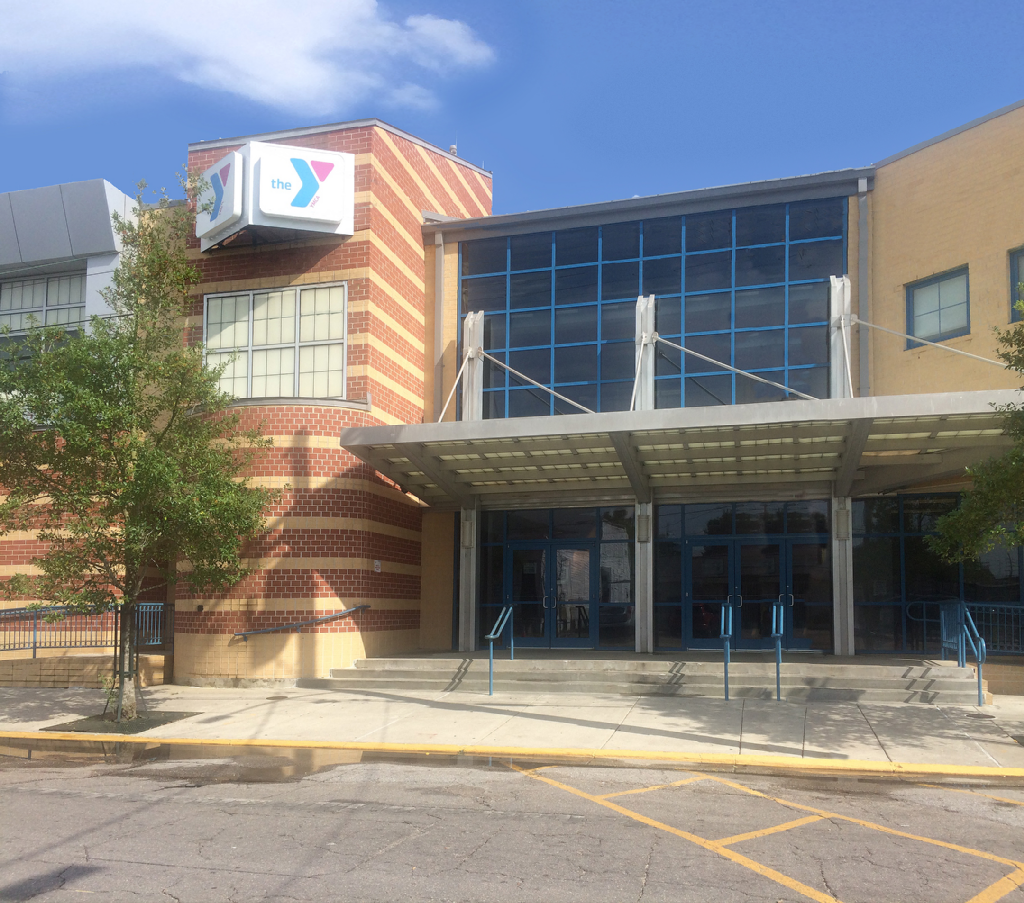
“My dad taught boxing as well as fencing at the Dryades Street YMCA,” he continued. “He also taught boxing at the [New Orleans Police Department] Academy on Navarre Avenue, and at Loyola with a fraternity. The club was called the Badgers. He coached boxing teams around the New Orleans area. He would pick up many of the neighborhood kids and bring all of us to the YMCA with him every day after school.”

While Eddie Brown Sr. was also adept with a Louisville Slugger and a foil, it was as a boxer that he really made his mark on New Orleans sports history as a boxer, fighting against an array of regional and national standouts, fighters with flamboyant names, fervent followings and impressive cache.

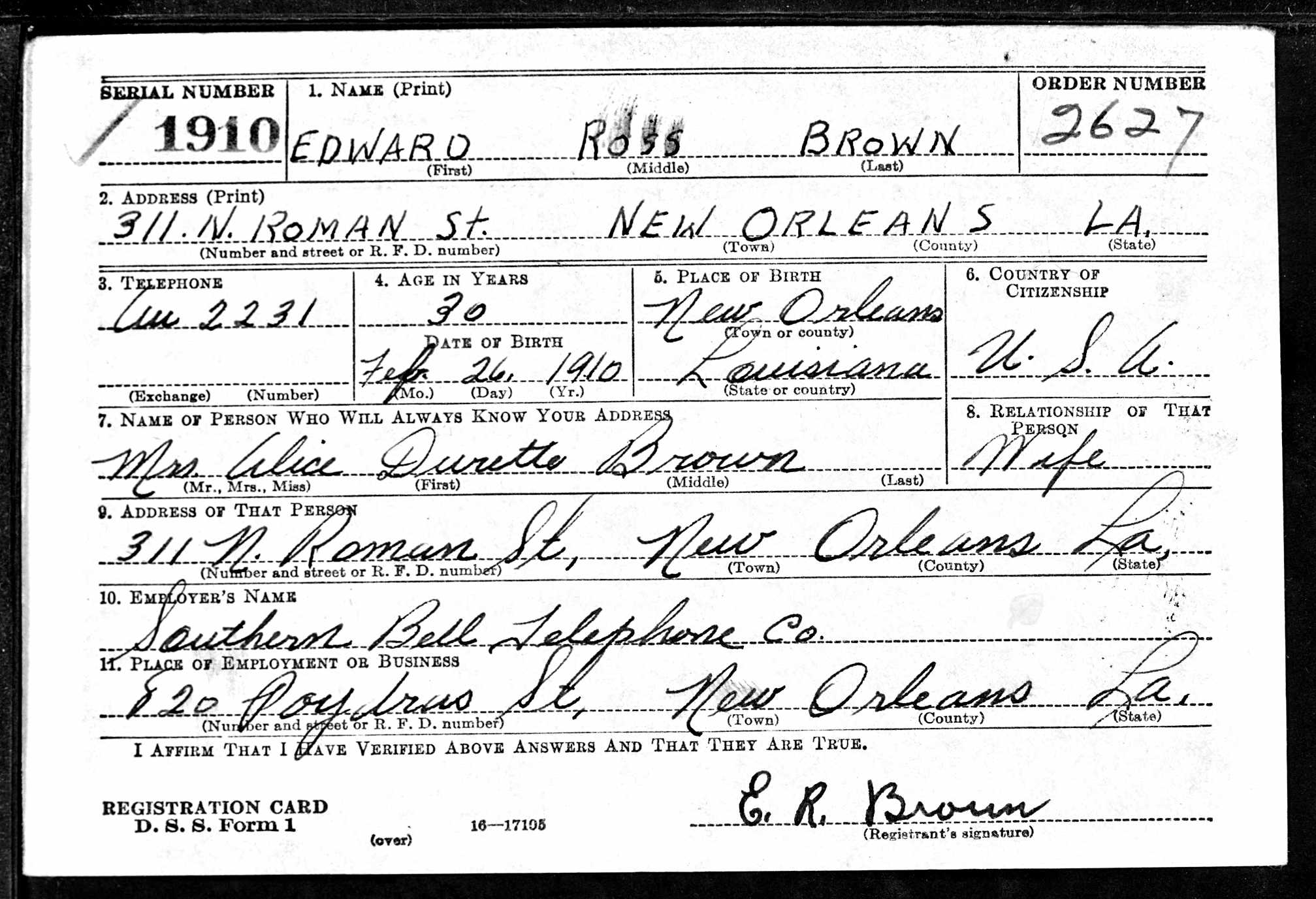
Eddie “Kid” Brown’s WWII draft card.

However, unfortunately, and perhaps not surprisingly, Kid’s celebrity remained limited to the African-American community. Much like the Nego Leagues and other black baseball players and clubs, info on black boxers’ exploits can be quite difficult to find, something Eddie Brown Jr. learned right away. Longtime, respected boxing publications like The Ring frequently short-changed or altogether omitted coverage of African-American pugilists, especially during segregation in the South.

Still, the proud son did manage to glean some information about his dad.

“I was trying to get his boxing records from the list at Ring Magazine and was getting nowhere because they didn’t keep accurate boxing records of African Americans back then,” Eddie Jr. told me. “I know for a fact that he fought for many years based on the amount of newspaper articles I had read as a child. Ring had only a few fights listed, I know that he beat Chocolate Bon Bon in NYC and was bold enough to sit on the corner post because it was a headline in the New York paper that I read.”

While Eddie Brown Sr.’s fighting career, much of it as a lightweight or a welterweight, spanned nearly a decade from the late 1920s to the mid- to late ’30s, arguably the heady height of his fame occurred during a two-year span from 1933-35, a stretch that found his name and photo splashed across the sports pages of the Louisiana Weekly and in wire reports across the country.

The second installment of this tale will (hopefully) be published next week. As usual, thank you for reading, and happy holidays!

Biography of Ted Strong Jr. brings light to two-sport star

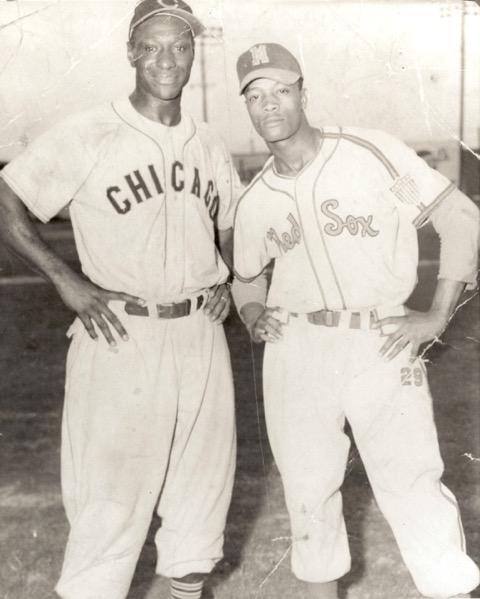
Ted Strong Jr. (left) with Memphis Red Sox player Joe Henry. (Photo Courtesy of NoirTech Research, Inc.)

Ted Strong Jr. holds a unique place in African-American sports history. Much like Bo Jackson and Deion Sanders, Strong excelled in two sports for years; Strong starred in the Negro Baseball Leagues and for the legendary Harlem Globetrotters basketball team.

As such, Strong could be compared to fellow Negro League standouts like Cum Posey, the Homestead Grays magnate and early black basketball star who is the only person inducted into both the National Baseball Hall of Fame and the Naismith Memorial Basketball Hall of Fame; or to Fats Jenkins, who prowled Negro League outfields and helped revolutionize hoops with the Harlem Rens and whom I’ve previously profiled on this blog.

Fortunately, a 2016 book by my friend and colleague Sherman Jenkins entitled, “Ted Strong Jr.: The Untold Story of an Original Harlem Globetrotter and Negro Leagues All-Star,” has illuminated the life and career of Ted Strong Jr., a forgotten legend who excelled in two sports at a time of strict, tragic segregation in American sports. What’s more, Sherman built the book upon a solid foundation of friendship and familiarity with Strong’s family, giving the volume a warm, intimate feel.

Below is a lightly-edited, email interview I recently conducted with Sherman about his book …

RW: What prompted you to research and write about Ted Strong? Do you have a personal connection to him?

SJ: I knew Ted Strong Jr.’s father, Ted Strong Sr. I grew up with Ted Sr.’s children from his second marriage. We grew up on the South Side of Chicago in Woodlawn. I wrote an article about the senior Strong (see attached). Strong Sr. liked the article and told me that I needed to meet Ted Jr., who was the oldest child from Ted Sr.’s first marriage. I was scheduled to meet Ted Jr. but two weeks before our meeting, he suffered an asthma attack and died at the age of 61. Ted Sr. and Jr. had the same first, middle and last name. The only designation was Senior and Junior.

Ted Strong Jr. (Photo courtesy of the National Baseball Hall of Fame Library, Cooperstown, N.Y.).

RW: What were the biggest challenges you faced when undertaking this project? Did you have a hard time finding human sources for the project? What about other sources? How much is out there about Ted?

SJ: The biggest challenges were finding people who were still alive and who played with or against Ted Jr. Moreover, I wrote the article about Ted Sr. in 1977. Life happened, and it wasn’t until 2013 that I worked to complete my research and write the book.

RW: How would you describe Ted Strong as an athlete, and as a person?

SJ: From what I could glean from various news articles in the black press, he was competitive, a gentle giant and, as his friend Buck O’Neil told me, “Ted moved as the wind blew.” He was an easy-going guy. O’Neil also said that Ted Jr. was the best athlete he had ever seen. Several family members told me that he was a fun-loving man who made family get-togethers fun.

RW: Do you feel Ted has received the amount of recognition and respect he’s due? How do we tell people what an incredible athlete and human being he was?

SJ: No. Researchers and the general public seem to focus on the staple [Negro League] names: Josh Gibson, Cool Papa Bell, Satchel Paige. I try to focus on [Ted’s] stats: seven-time Negro Leagues All-Star, 1946 home run champion, member of the 1940 World Basketball Champions Harlem Globetrotters, member of the Globetrotter team that defeated the all-white Minneapolis Lakers featuring George Mikan in 1948.

RW: What has been the reaction to your book from the public? Has it been positive?

SJ: Reaction has been positive. People ask why they haven’t heard about him until now. Take a look at comments about the book on Amazon.

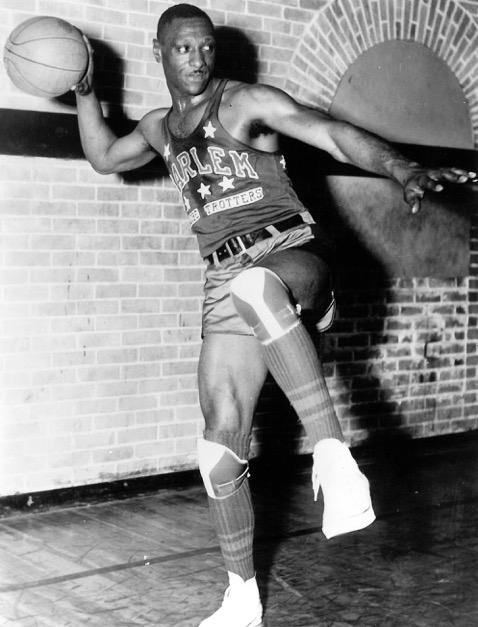
Ted Strong Jr. striking his baseball pose in his Globetrotters uniform. Ted, Jr. was among the many players the Globetrotters publicized to marketed the team to fans. In news releases promoting an upcoming Globetrotter game, the publicist would state that Ted Jr. had the largest hands in basketball. (Photo credit: Harlem Globetrotters).

RW: What were some of the more interesting nuggets of information about Strong that you discovered during this process?

SJ: Per Strong Sr., Ted Jr. had asthma, but it didn’t seem to affect him, although, an asthma attack took his life. He was very respectful of his elders. Moreover, he played himself in two movies about the Globetrotters: “The Harlem Globetrotters Story” and “Go Man Go!”

RW: Now the tough question: was Ted Strong a better baseball player, or a better basketball player?

SJ: I would say baseball. Seven-time Negro League All-Star, [for] which … the players were selected by readers of black newspapers across the country. Although, in basketball he was a rock in the post and marketed by the Globetrotters as having the largest hands in basketball.

Sherman Jenkins’ biography of Ted Strong Jr. can be purchased on Amazon here.

Sherman Jenkins

Sherman L. Jenkins has been a researcher of the Negro Leagues, and specifically Ted Strong Jr., and working with Ted Strong Sr. over the last 30 years. Jenkins is a member of SABR Negro League Committee, and the book “Ted Strong, Jr.: The Untold Story of an Original Harlem Globetrotter and Negro League All-Star” was published by Rowman & Littlefield Publishers of Maryland in October 2016.

New Oscar Charleston book chronicles legend’s story

Oscar Charleston in 1922 (Photo courtesy of Elizabeth P. Overton estate.)

Whenever I’m prompted to discuss the greatest baseball players of all time, my answer is usually quite succinct: Oscar Charleston is the GOAT, and he most likely always will be. He was a five-tool player times 10, someone who casts a shadow over person I believe is the best MLB figure of all time, Willie Mays. Add in his supreme intelligence, cagey savvy and unquenchable fire, and there’s no one — not even Ruth, Mays, Cobb, Gibson — who can touch Oscar Charleston.

I’ll admit that I’m a little biased because of the seven and a half years I lived in Indiana, Oscar’s home state (he’s an Indianapolis native), and because I wrote an article about him years ago myself. I’ve been to his grave in Floral Park Cemetery, and I’ve strode through Oscar Charleston Park in North Center Indianapolis).

But regardless, there’s never been a comprehensive biography of Charleston that’s done justice to his talent, his influence, his success and his legacy. But Jeremy Beer has changed that with “Oscar Charleston: The Life and Legend of Baseball’s Greatest Forgotten Player,” an exhaustive tome chronicling the Oscar Charleston story, and it’s destined to become a classic, just like Oscar himself.

Below is my recent, lightly-edited email interview with Jeremy Beer …)

RW: Given that Oscar Charleston is one of the greatest players and figures in baseball history, why do you think it took so long for someone to set about writing a book about him? What prompted you to take on the challenge and work through it?

JB: Well, oddly enough, we have full biographies of only two or three players who spent their entire careers in the Negro Leagues to begin with (Rube Foster, Josh Gibson and I think one other), so Oscar isn’t the only player who has been neglected. You would think that the burgeoning of African-American Studies departments would have led to a plethora of biographies and in-depth studies, but that hasn’t happened, for some reason. Also, until recently most old newspapers weren’t digitized. That the vast, vast majority of them are now online and easily searchable with one or two subscriptions was a huge help to my work — I probably couldn’t have reasonably undertaken it otherwise. So maybe that’s another reason: that only recently has everyday documentation of the past been so readily available to us.

I took on the challenge for two reasons: (1) I couldn’t believe that I had never heard of Oscar when I encountered Bill James’s ranking of him as the fourth greatest player of all time — if others also didn’t know him, that seemed like an obvious and regrettable injustice; and (2) Oscar, like me, was from Indiana, which meant it would be even more fun and satisfying to tell his story.

RW: What were the biggest challenges you encountered when conducting research and writing the book? How did you overcome them and get to the nitty gritty of Oscar’s life?

JB: The biggest challenge is that the trail is cold. Oscar has been dead for 65 years. I got started too late to talk to too many ex-players; as you know, their number has dwindled dramatically in the last 10 years or so. Oscar didn’t leave any descendants. Maddeningly, the nine brothers and sisters who lived to adulthood didn’t seem to leave much of a descendant trail either — my Ancestry.com family tree for Oscar was exceedingly difficult to fill out after his generation. In short, there just weren’t that many people to talk to, at least not that I could find (someone else might do better than me on this).

But I talked to everyone I could, and three other things really helped. First, I made contact with Oscar’s wife Jane’s niece and her daughter. They were tremendously cooperative and helpful and helped me fill out some details of Oscar’s personal life. They also had some great photos and other personal effects to share with me. Second, I had access to Oscar’s personal scrapbook and photo album, which are held at the Negro Leagues Museum in Kansas City. 

Jeremy Beer

Those items offered precious windows into Oscar’s personality, interests, and character. I relied on them heavily. And third, sportswriter John Schulian graciously shared with me all of the notes he had taken when writing a profile on Oscar for Sports Illustrated in the early 2000s. Those notes included interview transcriptions with a number of players who had played with and for Oscar. All praise to John (who created Xena, Warrior Princess, by the way) for being such a mensch.

Then, of course, all the census data, ship manifests, birth and death certificates, draft cards—all of that stuff helped tremendously, and fortunately most of it is available on ancestry.com these days. These are good times for a biographer!

RW: How would you describe Charleston as a player, as a manager and as a human being? What were some of his biggest traits, strengths and weaknesses?

JB: As a player: intensely competitive with a nearly maniacal drive to win. Dynamic. Energy pouring out of him. Twitchy at the plate, always pumping the bat up and down. Talkative, including trash-talkative. Aggressive, taking the extra base whenever he could and sometimes when he couldn’t. Rather unconcerned with your personal safety. And needless to say, truly excellent at almost everything (he may have had only an average or just above-average throwing arm). As of right now, he has three of top seven best offensive seasons, by OPS+, in the Seamheads.com database (and five of the top 16, minimum 300 plate appearances) and has more of lots of counting stat than any other Negro Leagues player: hits, doubles, triples, runs, walks, stolen bases. (He is second to Gibson in home runs and RBIs.) He played a very shallow defensive center field and was lauded for more than a decade for his ranginess out there.

Oscar Charleston’s death certificate

As a manager: Oscar was a natural leader, first and foremost. His managerial style was not democratic, nor was there anything new-school about it. He demanded effort, punctuality and attentiveness. He also believed in the principles of “scientific baseball” as taught by his mentor C. I. Taylor, who signed Charleston to play with the Indianapolis ABCs in 1915. You didn’t screw around with Oscar as a player, but at the same time he had your back and was lauded by Crawfords players of the 1930s for the way he bonded them together as a team. He was voted the greatest manager in Negro Leagues history in one poll conducted 20 or 30 years ago.

As a human being: charming, charismatic, friendly, self-disciplined (he neither drank nor smoked). Said to have been an accomplished pool player and a good singer. He dressed well and was not unattractive to women, to the detriment of his marriage with Jane. Perhaps most importantly, he was really intelligent. He only went to school through the eighth grade in Indianapolis, but he nevertheless seems to have taught himself how to read, write and speak Spanish remarkably quickly while he played winter ball in Cuba. The intelligence is further confirmed by the sorts of friends and associates he preferred — almost always college-educated, socially accomplished types. He seems to have taken a lively interest in the issues of his day, including civil rights.

I’ve mentioned a lot of strengths already, so among the weaknesses would be hot-headedness during competition. He got into more fights than he should have on the field. He could be overly stern as a manager, and he wasn’t regarded as an innovator in that regard. And he was a proud man — not arrogant, but proud, and that probably hurt him at times.

RW: Many legends describe Oscar Charleston as “the black Ty Cobb,” not just for his incredible accomplishments as a player, but also for his irascibility, temper and boldness. Would you agree with that assessment? Or was Charleston more complex and misunderstood than that?

JB: So Charleston was like Cobb on the field in several ways, yes. He might spike you coming into a base and figure that was part of the game. When you were playing against him, you probably didn’t much care for his style; Buck Leonard certainly didn’t. But that’s about as far as I would go. Cobb, although he has been partially rehabilitated by Charles Leehrsen, was not very popular with some teammates and many others. He was moody and brooding, at least at times. And he definitely got into some scrapes and scandals off the field. Charleston was a more popular and likeable character, by contrast. I wouldn’t say he was irascible. He doesn’t seem to have been touched by the melancholic aura that surrounded Cobb, nor was he as concerned about preserving his own reputation. When sportswriters called him the “Black Ty Cobb” early in his career, it was mostly just a way of saying, “This guy is the best we have.”

RW: Some, including the great Buck O’Neil, felt and still feel that Oscar was simply the greatest of all time, regardless of race, league or era. Would you agree? Why or why not?

JB: I think it would really be stretching it to rank him ahead of Ruth, in terms of how much he towered over his contemporaries. But I think you could make a reasonable case against literally everyone else (besides Mays and maybe Honus Wagner, the best competition comes from Josh Gibson). I’ve imagined an alternative Oscar who played in the white majors and concluded that, look, we know he was incredibly durable, we know that his speed and defense would have translated easily to that game. Maybe he would have faced more consistently good pitching.

Headstone application for Oscar Charleston

Fine: let’s give him a career OPS+ of 140 (it was 174 in the Negro Leagues), 250 career home runs (he had 209 against major black competition, in a little more than half the career plate appearances of Willie Mays), 400 career stolen bases (he had 354), and make him an above replacement defender (so, a defensive Wins Above Replacement above 0). Who else has done that in the majors? Only Barry Bonds, who presumably had a little chemical help. And we are being *very* conservative with our alternative Oscar’s numbers here. So that’s one way of answering your question.

I will say, too, that you can make a solid argument that Charleston has the best overall resume of anyone who ever played the game, when you take into account not only his stellar playing performance but also his managerial record and his record as a scout. It’s worth mentioning that not only did he lead Negro Leagues teams to championships as a manager, but he also seems to have managed a semi-pro team in Philadelphia’s Industrial League during World War II. Why does that matter? Because it was an *integrated* team, five years before Jackie Robinson debuted for the Dodgers. That was pioneering. So was the scouting work he did for Branch Rickey in 1945, which I think probably makes Oscar the first African American to have paid to scout for a National League or American League team.

You put it all together and the resume is incredibly impressive.

World War II draft card

RW: Was there any person, source or organization that was particularly helpful as you pursued this project?

Tons! I’ve already mentioned John Schulian. Larry Lester was always generous and encouraging and shared photos, statistics — anything he had. Ray Doswell at the Negro Leagues Museum provided crucial assistance. Gary Ashwill gave me the day-by-day box scores for Oscar that underlie the stats on Seamheads. Ted Knorr in Harrisburg made key connections for me. Various librarians and archivists helped out. Ex-players gave me their time. Lots of others are mentioned by name in my Acknowledgments. And then I benefited so, so much from all the work done over the previous decades by Negro Leagues researchers like Robert Peterson, Donn Rogosin, John Holway, Neil Lanctot, Brent Kelley, Jim Bankes, and the list goes on. I am standing on the shoulders of giants in writing this book, to be sure.

RW: What has been the reaction and public response to the book?

JB: It’s been uniformly positive, fortunately. I do sometimes encounter skepticism that anyone as good as I claim Oscar was — or as James claimed he was—could actually have been so forgotten. Some people have a hard time believing historical memory can be so unjust. But it is! It’s not just Oscar and it’s not just Negro Leagues players who fall prey to the erasures of time. Other athletes, writers, inventors — there are plenty of stories out there to be recovered and re-told, especially the stories of those whose lives didn’t or still don’t fit convenient culturally dominant narratives. One of my jobs, as I see it, is to convince people that that’s the case.

Author bio

Jeremy Beer’s Oscar Charleston: The Life and Legend of Baseball’s Greatest Forgotten Player was published by the University of Nebraska Press on November 1. Beer has published on sports, philanthropy, politics, and culture in outlets such as the Washington Post, National Review, the Washington Examiner, First Things, Modern Age, the Utne Reader and the Baseball Research Journal, among other venues. He is the author of The Philanthropic Revolution: An Alternative History of American Charity (University of Pennsylvania Press, 2015) and the editor of America Moved: Booth Tarkington’s Memoirs of Time and Place, 1869–1928 (Wipf and Stock, 2015). He lives in Phoenix, Arizona, with his wife, Kara.

To purchase Oscar Charleston: The Life and Legend of Baseball’s Greatest Forgotten Player, go to Amazon here or to the University of Nebraska Press Web site.

The Cuban Giants meet Louis Sockalexis

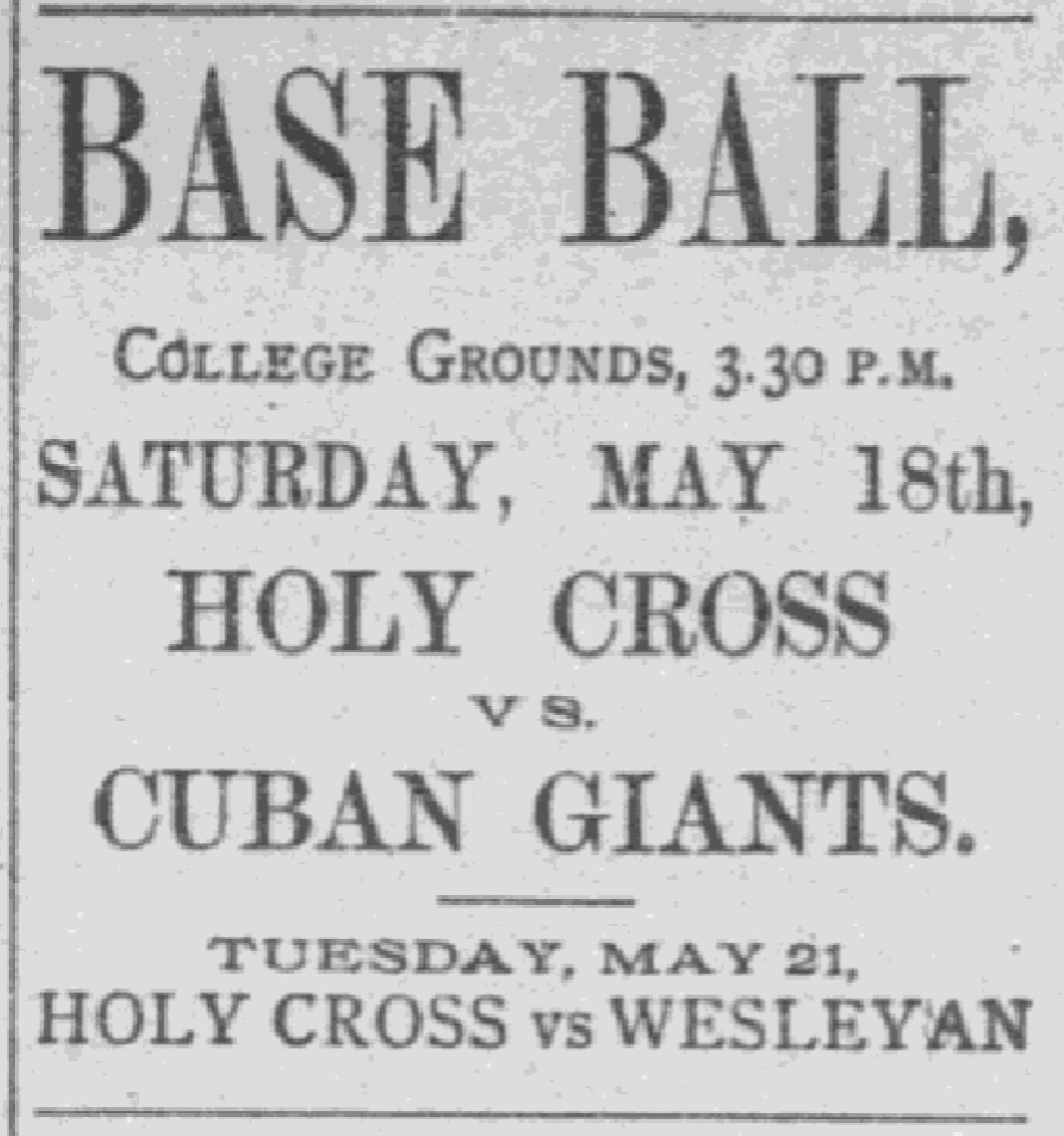
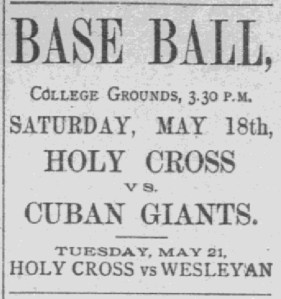
Worcester Spy, May 18, 1895

I’ve talked before about how I have family roots in central Maine, way up in the woods, and I’ve written a few Maine-centric posts on Home Plate Don’t Move, such as here.

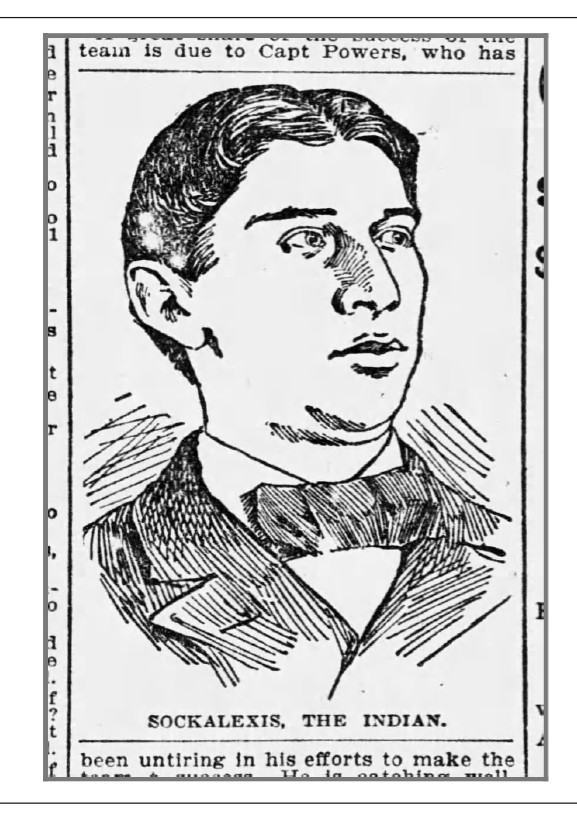
However, in addition to a natural affinity for all things Pine Tree State, I also enjoy dipping into Native-American history when I can (including when that history intersects with the Negro Leagues, such as here and here), and the combination of those two interests led me to recently purchase and read Brian McDonald’s book, “Indian Summer,” a biography of Maine native Louis Sockalexis, the first acknowledged Native-American to play in major league baseball.

(Research has recently found evidence that the honor of first American Indian to play in the majors was Jim Toy, a Pennsylvania native who competed for a couple major league teams between 1887 and 1890, but who apparently “passed” as white and as such wasn’t recognized as a Native-American during his career).

Sockalexis was a member of the Penobscot tribe, a relatively small group located in Old Town, Maine, a small island community nestled between two rivers and located just north of Orono, which is the home of the University of Maine.

Sock’s astonishingly quick ascent to baseball stardom was followed by an equally precipitous — and quite tragic — fall. His raw athletic talent was prodigious, especially when he poured it into America’s still-growing national pastime of baseball. He roamed the outfield with a quickness and natural instinct that seemed to preternaturally guide him to almost any ball lofted his way. He also possessed a cannon of an arm and a savvy, heady, daring fleet-footedness on the basepaths.

He was also a dangerous hitter, capable of tremendous, slashing power, especially once he mastered hitting a curveball.
Boston Globe, May 5, 1895

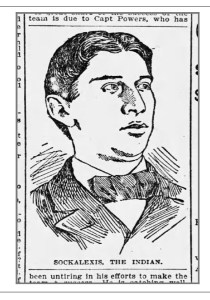
In 1897, at just 25 years old, Sockalexis earned a spot on the roster of Cleveland’s National League club, nominally dubbed the Spiders. He had a blistering first half of the season — at bat, on the bases and in the field — that both tabbed him for eventual superstardom and caused the Spiders’ attendance to rocket.

However, by the end of July 1897, Sock’s quickly worsening alcoholism — along with an untreated broken ankle — hastened a swift decline first into mediocrity, then into oblivion. He received less and less playing time as the summer came to a conclusion.

The following season continued the swift decrease Sockalexis’ playing time, and while he was able to maintain sobriety for some stretches, his frequent alcohol benders and his bum ankle ensured his place on the bench.

The 1899 season saw the end of both the Spiders and of Louis Sockalexis’ major-league career. He subsequently hoboed around the minor leagues of New England, signing contracts when he could but invariably blowing each chance he had at a comeback because of his physical deterioration. By the end of 1903 he was out of organized baseball for good, just six years after rocketing onto the national hardball scene as a can’t-miss prodigy.

On Christmas Eve 1913, Louis Sockalexis died of a heart attack while working on logging crew at just 42 years old. He thus joined the seemingly endless parade of “what might have been” tales throughout baseball history — which, in many ways, mirrored the fates of hundreds of Negro League and blackball players who never got the chance to become the stars they could have been in organized baseball.

And just like those black ball stars, Louis faced the same kind of racism and hostility that African-American players have faced for a century and a half of baseball. While the bigotry Sockalexis encountered might not have reached the same oppressive level of spite and intensity experienced by black players, the prejudice certainly contributed to the withering, alcohol-fueled despair that destroyed his promising career.

Sock’s tale has been told multiple times in book form, and McDonald’s biography is quite good, if a little skimpy on details of his youth with the Penobscots and his later years after his baseball career ended.

Why do I bring this up in a blog about the Negro Leagues? Because MacDonald’s book also talks about Sockalexis’ pre-professional college career, first at Holy Cross in Worcester, Mass., then briefly at Notre Dame in Indiana.
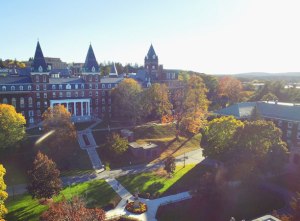
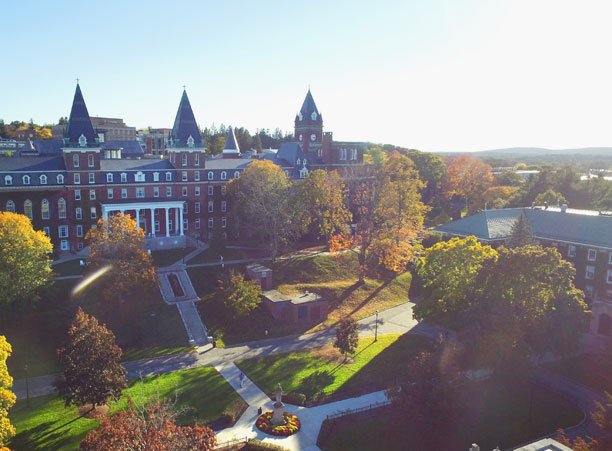
The campus of Holy Cross

The time Sockalexis spent studying at and playing baseball for Holy Cross in 1895 and ’96 (he also was a running back on the school’s football team and ran track) was extremely productive, joyful and hopeful, an experience he used as a launchpad to organized baseball and the major leagues.

At the time there probably weren’t enough institutions of higher learning that offered varsity baseball, if they did any sports, so collegiate clubs had to fill out their spring and early summer schedules by playing semi-pro, town and barnstorming teams.

For Holy Cross, those semi-pro foes came from all across the Northeast and, in 1895, they included none other than the Cuban Giants, the first all-black professional baseball team (with an ensuing lack of clarity, as you’ll see in a few paragraphs down).

The Cuban Giants were formed in 1885 with wait staff at the Babylon Argyle Hotel on Long Island, and they instantly became the class of “colored” baseball by touring constantly. There were no stable colored leagues at the time, so the Cubans — there were no actual Cuban men on the team, with the name being basically a marketing technique to appeal to a broader (read: white) fan base.

Adding to the attraction was the Giants’ playful yet tomfoolery that engaged stadium crowds with colorful gabbing, very enthusiastic coaching and the type of ball hawking and catching skills that many white baseball fans had never seen.

Early on the Cuban Giants’ roster was studded with black baseball stars, including future Hall of Famers Sol White and Frank Grant, as well as other legends like Clarence “Waxey” Williams, George Williams and John “Pat” Patterson.
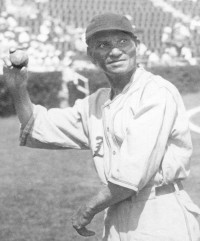
Sol White

The Giants enjoyed their first full season in 1885, and by the time they played the Holy Cross squad nearly a decade later, the African-American aggregation were well known and highly sought after as opponents for towns, city’s and other teams throughout the country and especially in the Northeast.

The clashes between the two teams made for a fascinating anecdote in McDonald’s book on Sockalexis — the first black professional baseball team squaring off against the man who would become the first acknowledged Native-American player in the major leagues.

Holy Cross and the Cuban Giants first encountered each other during the 1895 season on May 18 at Worcester, with the African Americans clubbing the Crusaders, 9-1, with Sockalexis going 1-for-3 and scoring his team’s only run. He also swiped a base. Grant went 3-for-5, stole a base and scored three runs for the Cubans, while Robinson (I’m not sure of his first name) got the win in the mound.

Here’s how the Boston Globe described the G-men’s win:

“The Cuban Giants created quite a lot of fun for the spectators by their lively coaching. They played fast ball all the time, taking every advantage of their opponents’ misplays.”

Waxey Williams, added the Globe, “supported [Robinson] in good shape besides amusing the crowd in the grand stand by his catchy remarks.”

The Cubans came back to Worcester for a return engagement on May 28, when the result was the complete opposite of the first kerfuffle — the Crusaders this time clobbered the Cubans, 12-5.

On the mound, Holy Cross pitcher John Pappalau stymied the Giants hitters, scattering nine (or 10, depending on the source) hits for two earned runs and 11 K’s.

The Giants also played a sloppy game, making a whopping seven errors and allowing eight unearned runs. Bill Selden started the contest on the mound for the G-men, but he was quickly yanked for Robinson, who didn’t fare much better.

Sockalexis went 2-for-4 with a double, while Grant again led the Cubans by going 3-for-4 and a run scored. Waxey Williams smashed a home run as well.
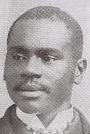
Clarence “Waxey” Williams

(Pappalau ended up joining Sockalexis on the Spiders’ 1897 roster, bagging a single season in the majors.)

But here’s the weird part — McDonald, while correctly stating that Holy Cross played the Giants in 1895, In his book, he refers to an undated game with a score I couldn’t confirm. He wrote:

“The school also took advantage of baseball’s popularity by scheduling games outside the college ranks. In 1895, Holy Cross played the vaunted Cuban Giants. Originally a team made up of black porters to entertain guests at a posh Long Island hotel, the Giants had become a traveling sensation. There were no Cubans on the team, but the name was affixed to the club as a way to side-step the stigma then surrounding black ballplayers. The Cuban Giants were led by Ulysses F. ‘Frank’ Grant, one of the premier black players of the nineteenth century. Though the contest was game, the Holy Cross nine lost to the Giants, 6-5.”

Moving past that idiosyncrasy and jumping along further, it’s interesting to note that the regional New England press covered the exploits of both Holy Cross and the Cuban Giants throughout that season, so much so that, in addition to the two teams’ games against each other, they sometimes appeared on the same page of newspaper coverage.

The May 3 edition of the Boston Globe reported Holy Cross’ loss to Brown University, the Crusaders’ first defeat of the spring. Just six columns inches below that, the Globe included a brief about a Giants’ triumph over the University of Vermont (more on the UVM Catamounts later).

A little under two weeks after that, the Globe reported on one of the Cuban Giants’ triumphs over Wesleyan, and two short box scores below that, the paper announced an impending Holy Cross contest against Hahvahd. Then, on June 2, the Globe noted the Crusaders’ loss to Yale, exactly adjacent to a short report on another Cubans victory over UVM.

Beyond their games against the Crusaders, the Cuban Giants’ spring through fall 1895 schedule trekked all across the Northeast, especially New England, taking on all comers. While Sockalexis was burning up the basepaths for Holy Cross, the Giants sauntered from Connecticut to Rhode Island to Massachusetts to Vermont that season. The Cubans also ventured as far south as Maryland and west into Pennsylvania and New York.

Stated the Philadelphia Times in April 1895 about the Cubans’ tireless travels:

“The Cuban Giants, the colored club, which is now touring the eastern part of this State, is a well managed organization, and it still includes almost the same players that it had ten years ago. The manager is a white man [most likely owner John M. Bright] who knows a thing or two about arranging dates. Although his club is not in any organization [league] he has 125 games booked for the season. His players are reasonable in their demands for salary, and do not want the earth while they are having a good time on the road.”

Such commentary reflects a public image of the team in which the traveling African-American players hard-working and dedicated but also are not to “uppity” or brash (as well as “controlled” by a white man), a combination that made the Giants an appealing opponent for mostly white communities.

Other media representatives approached the Cuban Giants with bemusement and curiosity. Take, for example, the July 22, 1895, Boston Journal, which employed either ignorance or snark (or both, it’s hard to tell) when discussing the team with a reference to global affairs:

“Of what stuff are these ‘Cuban Giants’ made, that they spend their time on the ball field when their country needs their help so sorely?”

Most likely this referred to the Cuban War of Independence from Spain, a conflict that began in 1895 and wasn’t completely resolved until after the Spanish-American War in 1898. Of course, the Cuban Giants weren’t actually Cuban; the team was given the name as essentially a marketing tool that portrayed the players as foreigners, which provided them an air of exoticism and a false image that they were non-threatening foreigners, a mirage that placed the white community more at ease.

So the Journal was either being ignorant, or the writer tried to employ satire to riff on the team’s exploits.

Other communities, though, eschewed such subtlety when hailing the impending arrival of the Giants to their midst, instead employing flippancy at best and bigoted derision at worst. The Mount Carmel (Pa.) Item announced the club’s approach to town in May 1895:

“The Cuban Giants will be here next Thursday to do battle with the Reliance. The ‘n*****s [my edit] are a set of hustlers and will put up a good game under all circumstances as they have done heretofore. Everybody should turn out and hear those Cubans coach.”

About a week later the Item doubled down on its tone:

“The Reliance and Cuban Giants are playing ball at the National park this afternoon, and quite a large crowd from the Gap are listening to the ‘n**s’ coaching.”

I gotta admit it’s a strange day when a town newspaper is so casually racist that it abbreviates the n-word as a method of advertisement.

Now, perhaps a valid question to ask before we proceed concerns the quality of the 1895 Cuban Giants. Were they as good as they were a decade earlier when they formed? Had the club sustained excellence and continued to be one of the most important baseball teams in the scene in the years leading up to the turn of the century?

My friend and colleague James Brunson, who recently published a magnum opus on 19th-century African-American baseball, offered a few thoughts.

“The 1895 Cuban Giants team was good enough,” James offered. “Good enough to split into two clubs in 1896; one being the Cuban-X Giants. I think the Cuban Giants traveled to Chicago that year as well, and played white and black clubs.”

Had the Cubans quality of play dropped off?

“No sir,” James said. “They were still pretty good.”

Having said that, and using the G-men’s clashes with Louis Sockalexis-led Holy Cross as a jumping off point, it’s fascinating to delve into the Cuban Giants other exploits in 1895 as a way of giving context to those encounters with the Crusaders. It also provides a peak into the life of a pre-1900 professional barnstorming “colored” team, an existence that was both thrillingly eclectic and exhaustingly workaday.
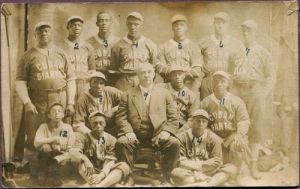
Cuban Giants, circa 1895

For many of the Cubans’ opponents, their encounters with the legendary African-American aggregation provided one of the highlights of the baseball season — and it big day at the gate. Games with the Giants were highly sought-after and, frequently, quite financially lucrative.

Often, smaller cities and towns frequently sought out the Cubans as visitors for games against local aggregations, especially when the town was celebrating a big event or having a fair of some sort. The highly touted Giants guaranteed a big attendance at these shindigs, which meant a bigger gate and more jubilant festival.

In June 1895, for example, the town of Brandon, Vt., solicited the attendance of the Cuban Giants at the town fair, scheduled for late September. The Brandon Union newspaper explained why the town pined for a stop from the blackball stars:

“It is expected that the fair as a whole will eclipse the effort of last year and plans are already being formulated and attractions secured for the edification of the public. The athletic committee were [sic] instructed to correspond with the ‘Cuban Giants’ base ball team for the purpose of ascertaining their terms, with a view, if reasonable, to secure their appearance with some other crack ball team as opponents, during one day of the fair.”

But in addition to quirky one-offs in tiny towns across the Northeast, the Cuban Giants also developed regular and heated rivalries with several opponents, including a foe or foes in Hartford (perhaps the Hartford Bluebirds of the Connecticut State League); clubs in Hagerstown, Md.; Newport, R.I. (these guys pop up a little later in this blog post); and Orange, N.J.

Instead of recounting the rest of Cuban Giants’ 1895 schedule in agonizing (for the reader) detail, I’ll touch on a few highlights I found intriguing:

— In June that summer, the club nipped the town team in Woonsocket, R.I., 8-7. No special anecdote here. I just like saying “Woonsocket.” Woonsocket. Goonrocket. Toondocket. Toadthewetsprocket. Now is the time on Sprockets when we dance.

— In late March, the G-men defeated a team from Lakewood High School of N.J., 8-5, showing that the Cubans were truly willing to take on all comers, even high school kids.

— The Giants routinely squared off against collegiate squads; aside from Holy Cross, the team of African American combatants played the University of Vermont (whom I’ll discuss in detail later), Wesleyan University and the blue bloods of Dartmouth, whom the Cubans clobbered, 17-8.
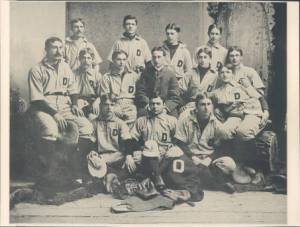
Dartmouth University baseball team, 1895 (photo from Dartmouth Library digital archives)

A resulting brief in the Boston Post reporting on the Cuban Giants’ triumph over the Ivy Leaguers of Hanover, N.H., in many ways encapsulates the team’s impact on any given community they visited — for many whites, watching the Giants display their talents was an experience both astonishing and peculiar. Stated the Post.

“The Cuban Giants won very easily from Dartmouth this afternoon, scoring 17 to 8. Each side wielded the stick vigorously, but the team work of the dusky ball tossers was so much better than that of the collegians that the result was never in doubt, and the exhibition was interesting chiefly on account of its novelty.”

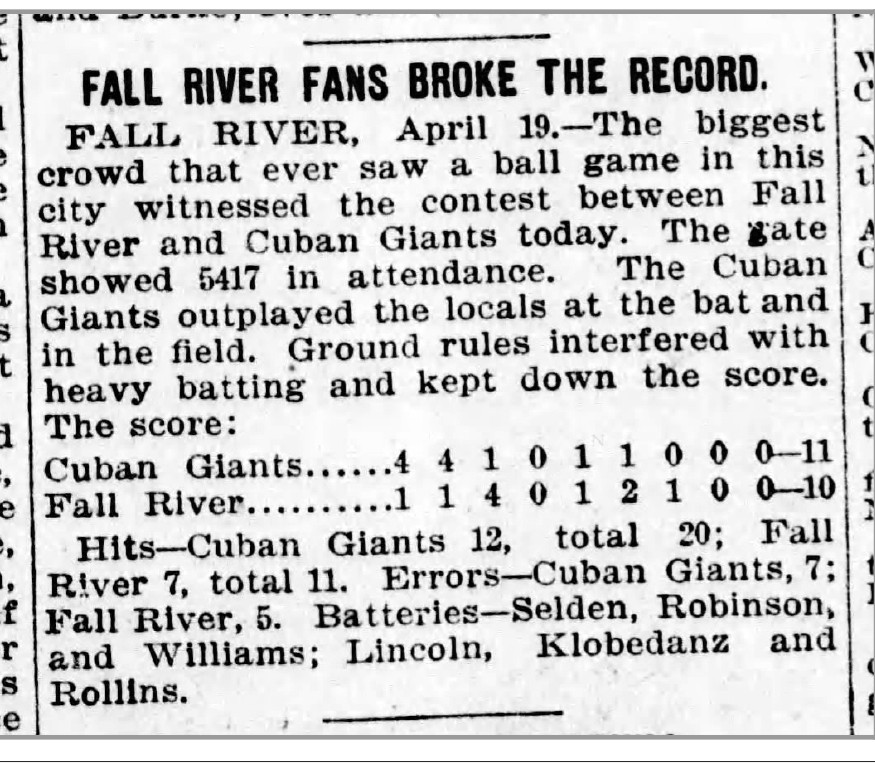
One of the few repeat opponents that seemed to turn the tables on the Giants was the Fall River Indians of Massachusetts. In April 1895, the squads split a two-game series, then in September the Indians swept a pair of contests by a combined tally of 34-9.

Upon discovering these reports, my first thought wasn’t the athleticism, it was the macabre. Just three years earlier, Fall River was rocked by the grisly murder of Andrew and Abby Borden in their own home by an ax-wielding assailant. A year after that, Lizzie Borden, Andrew’s daughter and Abby’s step daughter, was infamously acquitted of the murders, which as a result remain officially unsolved to this day. The surrounding media scrutiny and public sensationalism trained the eyes of the whole world on Fall River, and even today the murders and ensuing trial remain in the public consciousness.

So, being a major fan of horror movies and Edgar Allan Poe (but not an enthusiast for H.P. Lovercraft, who, despite his brilliance, was still a racist, anti-semitic jerk), the mention of Fall River automatically piques my interest. However, the Fall River baseball team will also come up again a little later in this post.
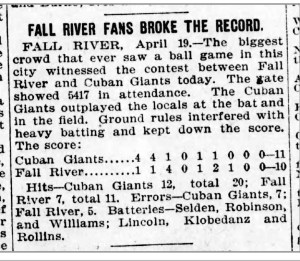
Boston Post, April 20, 1895

While we’re on the subject of Massamachusetts … the 1895 Cuban Giants became a familiar face in Western Mass as well; in July in Orange, Mass., for example, the Giants topped the Central Parks, 10-6.

Why do I have a particular interest in 1895 baseball games in Western Massachusetts? Because, you see, for two years in the late 1990s, I lived in the region, working for the weekly Holyoke Sun newspaper in Holyoke, a small city adjacent to Springfield, the largest city in the region.

Holyoke and Springfield help form the Pioneer Valley area, a region that runs along the north-south Connecticut River from the Connecticut state line up to Vermont.

Anchored by Springfield (the home of the Basketball Hall of Fame) on the Mass-Connecticut line, the Pioneer Valley also includes what’s colloquially known as the “Five College Consortium” — the University of Massachusetts-Amherst, Hampshire College, Mount Holyoke College, Amherst College and Smith College. The last four are private, liberal-arts institutions, and Smith and Mount Holyoke are women’s colleges. UMass-Amherst is the state’s flagship public university. (My brother earned his bachelor’s from there.) Also, confusingly, Mount Holyoke is not located in the city of Holyoke; it’s across the river in South Hadley.

(Also, let’s get one thing straight — contrary to popular theorizing, the Five College Consortium are not the basis for the characters on “Scooby-Doo.” According to the legend, Daphne is Mount Holyoke, Velma is Smith, Fred is Amherst, Shaggy is Hampshire and Scooby is UMass. But numerous people involved with the classic cartoon have asserted that the rumor isn’t true.)

Anyway, so I lived in Western Mass for a couple years, and it was a remarkable, emotional and bizarre time in my life. West of the Pioneer Valley run the Berkshire Mountains, a range in which is nestled a bunch of small, quaint, historic towns, such as Great Barrington, North Adams and Stockbridge.

The Berkshires could be viewed as the confluence of the Appalachian Mountains from the south and the Green Mountains from the north, and the region has become known as a resort area that attracts tourists visiting the forested highlands and enjoying the region’s rich arts, music and culture scene.

Baseball, especially in the sport’s beginnings, thrived in the Berkshires, as Major League Baseball historian John Thorn details in his revelatory book, “Baseball in the Garden of Eden.” The earliest known written reference to “base ball” occurred in Pittsfield, Mass., the large town at the northern end of the Berkshires, in a 1791 bylaw aimed at stopping those blasted kids from busting windows while playing this newfangled pastime.

Baseball teams of varying size, level and organizational status dotted the Berkshires and Western Mass throughout the 19th century, including the 1890s, when the Cuban Giants were thriving by traversing the country and taking on town teams in geographic nooks and crannies.

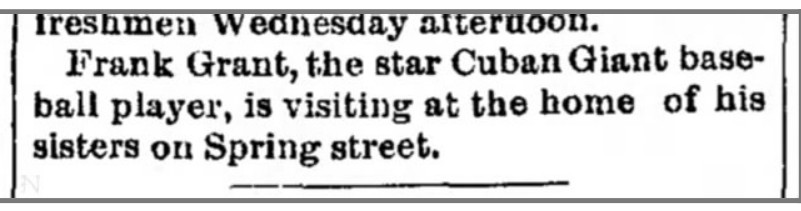
In 1895, the Cubans travels brought them frequently to Western Mass and the Berkshires for a few reasons, not the least of which was that Giants star and eventual Baseball Hall of Famer Frank Grant was from Pittsfield, where he began his baseball career. Grant also frequently returned home to visit family in Pittsfield.

North Adams Transcript, Nov. 6, 1895

Another reason for the G-Men’s frequent presence in Western Mass in 1895 was the formation of, in August of that year, the Stanleys, a semipro club based in Pittsfield that took on the Cubans several times in late summer. 

(With a dive into the research only a bit deeper than the tertiary level, it’s hard to pin down completely where the Stanleys were based because there were other towns with other teams, likely most semipro or club, in the Berkshires area, including Great Barrington and North Adams. Some of these other aggregations played the Giants as well, all of which at the very least that the region remained a hot spot for the burgeoning national pastime.)

The Cuban Giants’ meetings with the Stanleys were fairly well covered by the local press, such as The Berkshire County Eagle of Pittsfield, The Pittsfield Sun and The North Adams Transcript. The clashes even got a paragraph in the Springfield Republican now and again.

The day before what was apparently the teams’ first engagement, the Eagle noted, “Tomorrow’s game with the Cuban Giants will be one of the most interesting of the season as the visitors are a very strong team. Their coaching is one of the features.”

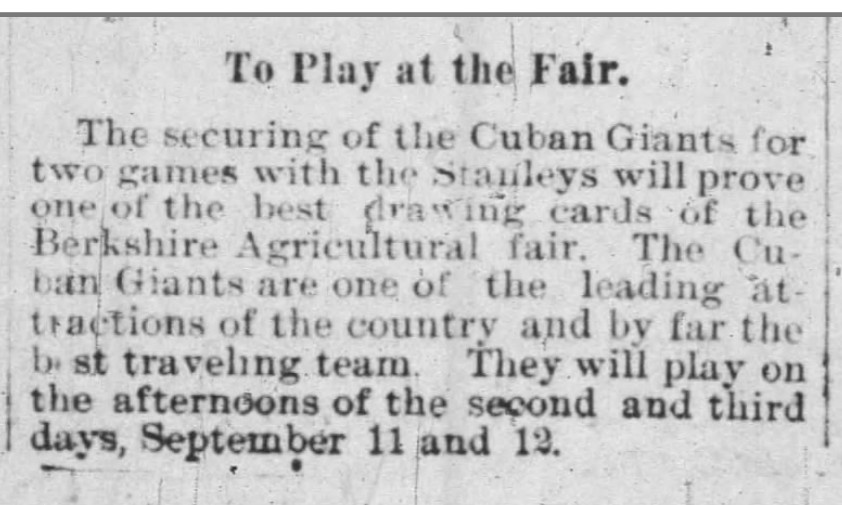
And a later issue of the paper that “[T]he Cuban Giants are one of the leading attractions of the country and by far the best traveling team.” Both assertions reflect how highly prized a date with the Giants was, and how much the “colored” team got people a-talkin’ about the Cubans’ arrival.

Let’s highlight what was by all accounts the finest Cubans-Stanleys game — the one on Aug. 13 of the year in question that boiled down to a nailbiter of a pitching duel that ended in a hard-fought, 1-0 triumph by the visitors after the G-men’s John Nelson got the W over the Stanleys’ John Pappalau.
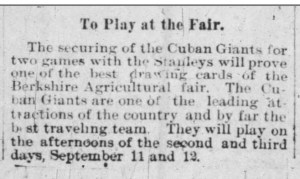
Berkshire County Eagle, Sept. 4, 1895

(Pause for another entry in the “well ain’t that a coincidence” file. Pappalau came to the Stanleys after attending and pitching for Holy Cross on the same collegiate roster as … Louis Sockalexis! Moreover, Pappalau even briefly joined his college mate with the Spiders in 1897, when Pappalau pitched in two games for the Cleveland MLB club.)

The Aug. 13 game between the blackball legends and the Stanleys not only reflected how the Giants frequently brought with them some stellar, thrilling baseball, but the coverage of the clash — especially in the Berkshire Eagle — reflected the tremendous popularity of the Cubans each summer.

Unlike the few previously mentioned newspaper articles that used derogatory words and exhibited a flippancy and ignorance about the Giants, the Eagle’s Aug. 14 issue was extremely flattering:

“The kind of baseball played at Waconah park cannot but help in promoting interest in the game in this county and although the home team was beaten, hardly a person left the grounds but what were satisfied they had more than received their money’s worth in seeing one of the sharpest games of the season. The Stanleys had as their opponents the celebrated Cuban Giants and although outplayed in the field, the home team made a credible showing.

“A team that is able to hold the Cubans down to one run is able to hold its own with any semi-professional team in the country. …

“The visitors, who by the way are among the most gentlemanly set of players seen here this season, put up a game in the field that could not be beaten. They covered a large amount of territory and upheld the great reputation they have throughout the country. There is no let up in their game which keeps up the interest from the beginning to the end.”

The article then added:

“The game put up by the visitors would make any team a big drawing card. Their coaching is a feature and they are in the game all the time.”

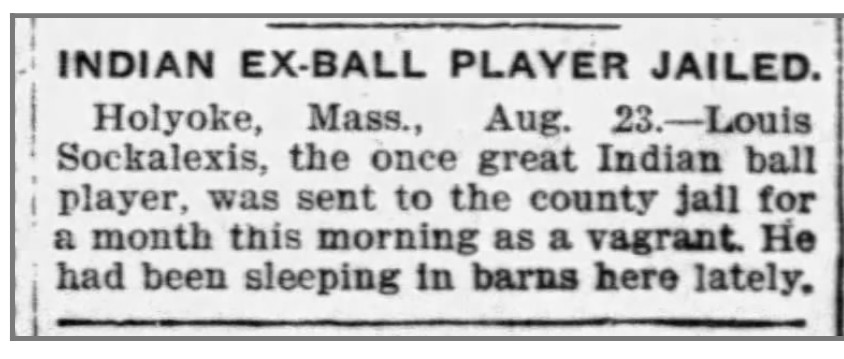
As an aside that tenuously connects Louis Sockalexis with my personal history, Sock — who spent several of his post-MLB career as a baseball vagabond, bouncing and careening and hoboing through the Northeast, playing for teams of all levels and invariably getting kicked off each one, usually because of his alcoholism — himself made a stop or two in Holyoke, where I lived and worked for two years. Unfortunately, at least one of those visits did not exactly go well — in August 1900, he was arrested for vagrancy at spent 30 days in the Holyoke clink. In the ensuing years there were reports that Sockalexis was seeking a spot on a team in Holyoke, but by then he was physically wrecked and psychologically crushed.
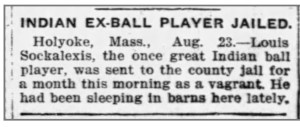
Dayton (Ohio) Herald, Aug. 23, 1900

Now to bring back two of the previously mentioned Giants opponents, Fall River and Newport, as well as contemplate a common phenomenon around this time — the emergence, operation and often quick disintegration of leagues of all sizes and levels    

It honestly can get very confusing. So there was there was minor-league New England League for decades between the 1880s and 1940s. Apparently teams and franchises came and went, then came and went again. Different cities would rotate in for a few years, then bag their team and league membership.

Over these decades the league changed size, covered an always-amorphous geographic reach, and shifted between minor-league levels. There were a handful of times when it didn’t play, and during World War II it was even a semipro loop. It seems the New England League’s importance soon waned by the time the American League joined the National League as the country’s two major league circuits and as an organizational, hierarchical network of the hundreds of pro baseball teams scattered all over the country — the formation of “Organized Baseball.”

It looks like that in 1895, according to Baseball Reference, the New England League included eight franchises — Augusta, Bangor, Brockton, Fall River, Lewiston, New Bedford, Pawtucket and Portland — but BR doesn’t list any stats, records, standings or championships for the 1895 NEL.

And as far as this blog post goes, I’m not really concerned about that. What’s important to note is three-fold:

One is just the entire baseball landscape that existed in New England in 1895. With the formation of Organized Baseball still a little ways away, teams of all sorts — pro, semipro, college, amateur, touring, barnstorming, from all six states in New England — were all mixed up together is a mild free-for-all.

While a minor-league New England League existed, the professional “farm” system hadn’t really emerged yet in the sport (that would happen in 1901),  meaning that every franchise, every club, every town, it seems, could do whatever it wanted — join a league, drop out of a league, not join a league at all, barnstorm — and could play wherever it wanted, outside of any league structure. Teams that were in leagues had their league schedules, but they also played exhibition games, one-off contests against traveling clubs, pre-season contests with college teams, games at county fairs — anything that could bring a decent payday.

This loose system also allowed players — and coaches and managers, for that matter — to hop from region to region, state to state, team to team with chaotic fluidity. The infamous reserve clause, which bound players to their respective teams even after the players’ contracts had expired, was in the process of forming in the 1890s on the major league level, but with the formal minor-league system still a half-dozen years off, baseball teams below the major-league level had free reign, I think.

Which allowed minor-league clubs (as well as collegiate ones) to play the Cuban Giants, including in 1895. But one particular little scheduling quirk that took place that year was something I’ve never really stumbled across before in my research — a spontaneous, late-season “league.” This newfangled circuit kind of filled in for the New England League, which apparently fell apart sometime earlier in the baseball season.
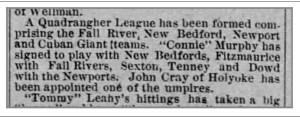
Windham County (Vermont) Reformer, Sep. 13, 1895

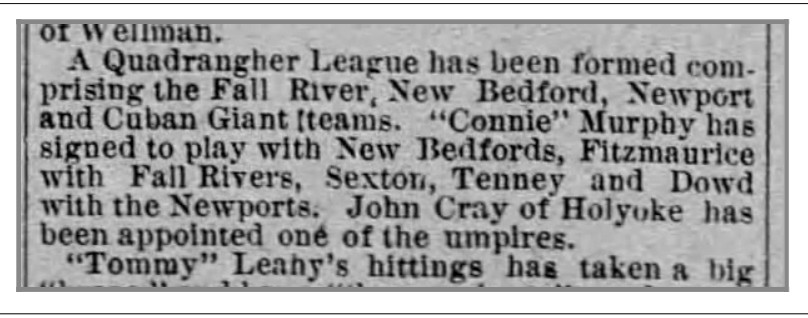
And not only did this “quadrangle” circuit sprout up, but one of the four teams in the league was the Cuban Giants. So along with the pro teams from Fall River; New Bedford, Mass.; and Newport, the four-team loop had a trailblazing, barnstorming, African-American aggregation. (As noted earlier, Fall River and New Bedford had been members of the New England League.)

I wasn’t able to delve too deeply into this league — I’m not sure what, exactly, the format and scheduling were, and I don’t know who won the “championship,” if there was any — but the fact that it existed, and that it included the Giants, is pretty fascinating in and of itself.

Unfortunately, from the coverage of this four-team league that I’ve uncovered, it appears the Giants didn’t do all that well in circuit play. They seem to have lost a lot more than they won, including a handful of blowouts. On Sept. 12, 1895, New Bedford bashed the Cubans, 15-3; the Boston Globe reported that “New Bedford knocked the Cuban giants [sic] all over the lot today in the presence of 1200 people.” Then, on Sept. 20, Fall River clobbered — the Globe used the term “annihilated” — the Giants, 20-3.

The Cubans managed to win one or two of these league games, though, including their first victory, on Sept. 16, when they toppled Newport, 10-4. 

One final note here … even though I do have strong personal and familial connections to Maine, and even though I started this epic post by pointing out that fact, I couldn’t find any coverage of the Cuban Giants playing in Maine in 1895. That doesn’t mean they didn’t; I just didn’t uncover any such Pine Tree State excursions. 

If anyone has any comments, questions or corrections about or for this post, definitely let me know, either by leaving a comment here or emailing me at rwhirty218@yahoo.com.

Aaaaaaaand that tops off my post about the exploits of Holy Cross, Louis Sockalexis and the Cuban Giants in 1895. Well, that’s not true. I hope to do an addendum piece (I promise it won’t be as long as this one!) about two particular aspects of the Cubans’ 1895 outing — a series of games against the University of Vermont, and the Giants’ ventures through Pennsylvania, especially how the black ball club was received in the Keystone State.
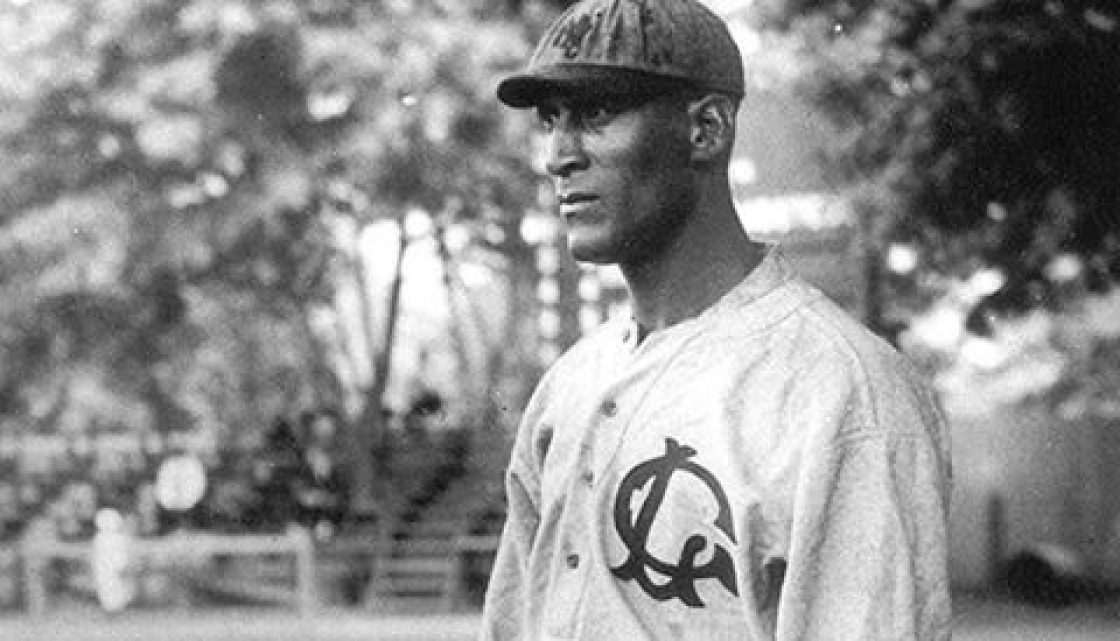
The Detroit Stars conference in pictures

The usual suspects. Left to right: Donald Conway, Phil Ross, James Brunson, Larry Lester and Jay Hurd. Photo courtesy Larry Lester.

Here’s my second post about the Detroit Stars Centennial Conference held Aug. 8-10 and hosted by the Friends of Hamtramck Stadium and other capable individuals. This one will be all photos, mostly from some of the folks who attended the shindig. Thank you to all the contributors to this post!

This is a follow-up to the previous post, which was an essay by conference stalwart John Graf. That post includes a bunch of links about the various attendees, presenters and discussions from the conference, so definitely check it out here.

OK, we’re off … The first photos are courtesy of presenter and newly minted author Mitch Lutzke, whose recent tome about the legendary Page Fence Giants has snagged a whole bunch of awards and media coverage:

The conference featured a presentation by Vanessa Ivy Rose (center), granddaughter of Hall of Fame slugger and Detroit Stars outfielding stalwart Turkey Stearnes, entitled “Combining Forces: Restorative Options for Baseball Integration and the Inclusion of the Negro Leagues.” Here Vanessa is pictured flanked by two of Stearnes’ daughters, Rosalyn Stearnes Brown (left) and Joyce Stearnes Thompson (right).

Quizmaster Ted Knorr, far left, and the three finalists of Ted’s Significa contest — left to right Geri Stricker, Larry Lester and John Graf. Larry would end up the overall winner.

Conference co-organizer Gary Gillette presents his all-time Detroit Stars team.

Larry Lester (standing) moderates the Player’s Panel before the Tigers-Royals game Saturday, Aug. 10. Seated to the right is Johnny Walker of the Kansas City Monarchs and Detroit Stars, the two squads honored with replica unis at the game.

Hamtramck Stadium

The one and only Motown Museum, which started off our day-long tour of the sights in Detroit on Saturday.

Multimedia artist Phil Dewey at the Detroit Historical Museum discusses his career creating Negro Leagues-themed art.

Left to right: Donald Conway, Phil Ross and some goof at the Hamtramck Stadium historical marker.

Mitch and Larry Lester with Mitch’s award-winning book.

The next selection of pics is from Jay Hurd:

A triumverate of conference-goers at the Tigers-Royals Negro Leagues game. Left to right: Negro League Baseball Grave Marker Project founderJeremy Krock, Jeremy’s wife Jeanette and Phil Ross, who was easily the most photogenic person at the event.

Unofficial conference photographer Lizz Wilkinson at the Tigers game.

Jay, left, and James Brunson show their high-wattage smiles at the Tigers-Royals game.

Jay and John Graf at the Motown Museum.

Next up is a slew of shots from Larry Lester, beginning with a bunch snapshots of beautiful Comerica Park:

Some images from the Motown Museum:

That would be Little League World Series aficionado Lou Hunsinger in in contemplation at front.

Charles Young, left, and John Graf.

Larry also took a bunch at Hamtramck Stadium, including this pair of an expansive mural at the old park:

Some of Larry’s photos of folks at the Tigers-Royals Negro Leagues game:

Left to right: Joyce Stearnes Thompson, Turkey Stearnes’ daughter; Minnie Forbes, the last living owner of a Negro Leagues team; and Rosalyn Stearnes Brown, also one of Turkey Stearnes’ daughters.

Former Negro League players being honored on-field during a pre-game ceremony.

Walt Owens (left) and Pedro Sierra (right).

Walt Owens

Minnie Forbes (left) and Johnny Walker.

Here’s a few from me. I humbly but slightly egotistically present them:

We visited historic sports bar Nemo’s for lunch on Saturday. According to Gary Gillette, Nemo’s is one of the oldest sports bars in the country and one that’s received national attention and commendation. It’s located just a block from the site of the old Tiger Stadium.

Some from Hamtramck Stadium …

That’s Phil Ross there. He seems to find his way into a lot of people’s photos. Quite adorably ubiquitous.

I believe that’s Jay Hurd.

Some from the Tigers game:

The pre-game Players (and Owners) Panel, moderated by Larry Lester and featuring (front row, left to right) Johnny Walker, Ron Teasley, Pedro Sierra, Walt Owens, (back row, left to right) Bill Hill, Minnie Forbes, Jake Sanders and Eugene Scruggs.

Another baseball trailblazer and a favorite of mine, the Hammerin’ Hebrew.

Last but not least, here’s a series from Kevin Johnson:

A pair of shots from Old Tiger/Navin Stadium, one of the stops on the Saturday bus tour.

Kevin Johnson during his presentation, “Mack Park – Friend or Foe?”

A couple of pics from Comerica Park.

Larry Lester (left) and former players Johnny Walker, Ron Teasley and Pedro Sierra before the Tigers-Royals game.

The pre-game ceremony honoring the ex-Negro Leaguers.

Fox Sports Detroit’s John Keating interviewing Rosalyn Stearnes Brown at Comerica Park.

And there you have it! We had a stupendous time in Detroit — seeing old faces, restarting dormant discussions about baseball, and just being together with our Negro Leagues family again. We now await next year’s return of SABR’s Jerry Malloy conference, which will recognize another monumental centennial — the 100th anniversary of the founding of the Negro National League.

Thank you again to all those who contributing to the last two posts on this blog!

Summing up the magical Detroit Stars conference

Guest blogger John Graf (right) joins Charles Young at the historical placard at the Motown Museum. Photo courtesy of Larry Lester.

Editor’s note: Apologies for taking so long to get stuff from the Detroit Stars conference up on the blog. To start, here’s a guest commentary by researcher and frequent Negro Leagues-conference goer. John does a nice job at summing up what was indeed a magical few days in the Motor City.

By John Graf

The 100-year anniversary celebration of the formation of the Detroit Stars in 1919, one year before the launching of the Negro National League, was nothing short of magical. I could feel the magic that is in the air whenever and wherever our Negro Leagues history family gets together.

Two days’ worth of presentations provided a groove that was musically amplified Saturday morning with a tour of the Motown Museum. The gathering ended with an intimate look at the suffering of Tiger partisans this season as the home team, clad in Detroit Stars uniforms, went down to another defeat.

Those presentations were simply loaded with something for all tastes. There was Detroit general sports history (Mike “Tiger” Price), the 19th-century Page Fence Giants (Mitch Lutzke), Mack Park by the numbers (Kevin Johnson), the case for ranking the Negro Leagues as major leagues (Ted Knorr), a tour of the Negro League baseball card world (Gary Gillette), historic preservation and Hamtramck Stadium (Melanie Markowicz and Brian Powers), and a creative discussion of baseball and restorative justice (Vanessa Ivy Rose). Thursday was capped with a delightful reception that recognized Negro Leagues players and their families.

That’s not all. Nineteenth-century Black baseball was front and center once again Friday morning (James Brunson). The significance of Negro Leagues’ home fields (Geri Strecker) continued the theme of a sense of place that can capture the magic that was Negro Leagues baseball. The All-Time Detroit Stars Centennial Team was unveiled (Gary Gillette).

We were treated to an autobiographical journey through the career of Leslie Heaphy, one of a number of estimable “doctors in the house.” We had a discussion of the “Bingo Long Traveling All-Stars and Motor Kings” film (Lisa Alexander) and a screening of “There Was Always Sun Shining Someplace” (Donn Rogosin). A presentation on Negro League photography challenged us to utilize our observational skills (Lizz Wilkinson). We were also filled in with more detail on who played where throughout the Negro Leagues (Paul Healey).

 And oh, that Saturday! There was dancing in our seats as we watched an introductory film on the history of Motown Records and then strolled and sang our way through the spaces that made up “Hitsville, U.S.A.”  A stop at the Detroit Historical Museum included a slide presentation of Negro Leagues art (Phil Dewey) and additional displays.

Our highly-informative bus tour guide Gary Gillette (a special hat tip to Gary for a job well done in all respects) regaled us with one story after another about places of note as we rode through Detroit and Hamtramck. The now-redeveloped Tiger Stadium site, the hopefully to-be-restored Hamtramck Stadium and the former Mack Park site gave us a chance to wander both among what still is and reflect on what once was.

The Negro Leagues Players Panel, moderated by eminent historian and “Don’t Call it Trivia” contest champion Larry Lester, included Ron Teasley, Pedro Sierra, Bill Hill, Jake Sanders, Johnny Walker, Walt Owens, Ms. Minnie Forbes and Eugene Scruggs.

All that and Joyce and Rosilyn (the golden-voiced Stearnes sisters), Phil Ross and Donald Conway (among the most entertaining attendees who weren’t presenters)! Who could ask for anything more?

Editor’s post note: Many thanks to John Graf for being willing to have me publish his excellent wrap-up of the conference. My next post (hopefully later this week) will be full of photos from various attendees at the conference. I’ll also includes links to some media coverage of the conference.

Life lessons from Sammy the Jet

Sammy “the Jet” Jethroe (photo courtesy Negro Leagues Baseball Museum)

A few weeks ago, while I was in Rochester for my mom’s funeral, a few of us were hoping to sneak away to a Red Wings game on July 27 to kind of have some fun and blow off emotional steam. I learned via Nate Rowan’s media listserv that before the game, the Wings were going to host the induction of Sam Jethroe into the International League Hall of Fame.

Armed with this new knowledge, I thought about attending the game and interviewing some of Jethroe’s descendants and International League president Randy Humber for a prospective article on Sam’s ushering into the ILHOF. However, we weren’t able to squeeze the game into our slate of events, which was disappointing, but we knew there was too much else going down in terms of the funeral trip.

But, fortunately, since then I’ve been able to land a few assignments about Jethroe and his induction, and I’ve been able to do a few phone and email interviews as follow-ups. One of the folks I talked to was Rachel Jethroe, Sam’s granddaughter, who lives in Rochester.

Other members of the Jethroe family attended the ceremony as well, including some from Erie, Pa., where Sam Jethroe retired to and spent his last several decades as a resident and businessman. (The IL does its Hall of Fame inductions separately at various places; Sam’s induction was held in Rochester because of Rachel’s residence there.)

“It’s a wonderful lifetime achievement,” Rachel later told me. “I wish he could have been there to enjoy the recognition for his achievements.”

Rachel added that the induction ceremony was extremely touching and meaningful.

“We enjoyed the game, the whole family came up from Erie,” she said. “It was a beautiful moment.”

Carla Jethroe, another of Sam’s granddaughters, told me that they’re “beyond proud” of their grandfather, adding that the honor helps to keep Sam’s legacy alive.

“It was a great [legacy] because it still lives on,” she said.

Red Wings officials, IL representatives and members of Sam Jethroe’s family gather for Jethroe’s induction into the IL Hall of Fame July 27 at Frontier Field (photo by Joe Territo/Rochester Red Wings).

I just contributed an article to the Erie Times-News about the induction; it was published Sunday, and you can check it out here.

But wait, wait, wait … Who’s Sam Jethroe anyway, you might be asking, and why is he important enough to warrant election to a hall of fame?

Well, here’s the rundown …

Sam Jethroe, who was raised and started his baseball career in East St. Louis, played for the Cleveland Buckeyes of the Negro American League in the 1940s. He was known first and foremost as a near-supersonic speedster and demon on the basepaths, but he also led the NAL in batting multiple seasons using a deceptively powerful swing to crush doubles and triples by the boatful. The Bucks won the 1945 Negro World Series over the vaunted Homestead Grays with Jethroe leading the way.

Here’s how SABR colleague, historian and author Stephanie Liscio summed up Jethroe’s Negro Leagues career:

“He was one of the Buckeyes’ most consistent and talented hitters during the 1940s. He hit for average, had tremendous speed, and was a skilled defender. The Buckeyes likely don’t win the 1945 World Series without him (and may not have been in a position to even be in the World Series).”

However — and here’s where he enters the baseball lexicon for many people — he went on to integrate the Boston Braves in 1950 as a starting centerfielder. Jethroe’s jump made the Braves the fifth major-league team to integrate, and, after a scorching first season in the majors, he earned the National League Rookie of the Year award at age 32.

The accolade made him the oldest rookie so far in MLB history to pick up ROY honors, and his second season in the majors, 1951, saw just about an equal amount of excellence as his first one; he led the NL in stolen bases each year, and he ranked high in several other categories.

In March 1951, Jethroe gave an interview to Baltimore Afro-American sportswriting legend Sam Lacy, who transcribed Sam’s comments and published them in a column. Jethroe’s words reflect how he realized that, despite some flashiness at the bat, it was his quickness and daring on the basepaths that earned his paychecks. Jethroe told Lacy:

“Anyone should know my legs are most important to me ’cause I make a business of running.

“I can run fast and I know it. May the Lord help me when I can’t run anymore. …

“[W]hen it comes to a real showdown, it’s the pair of good legs I was lucky enough to draw that makes my major league baseball life a success. …

“Taking a chance is something I believe in. If the other guy bobbles the ball, I’m gone, and he’s got to throw me out. In a close game, if an outfielder holds his head down on a ground ball just a second longer than I think he should, I’m going to make him throw me out ’cause I ain’t stopping! …

“I find that taking a chance pays off ’cause it has a tendency to make the other side jittery. The fielder knows he’s got to make the perfect throw and the man covering base realizes he has to catch the ball and outguess me on the slide.”

But things took a disappointing turn in 1952, when intestinal surgery and uncorrected bad eyesight led to a steep dropoff at the plate and in centerfield, where his poor eyesight led him to misjudge and just plain lose fly balls in the sky as they arched his way.

So for the 1953 campaign, the Braves demoted Jethroe to their Triple-A farm club, the Toledo Sox. The Pittsburgh Pirates took a chance on him and picked him up for the for the ’54 season. However, his foibles in the field and at the plate — coupled with the slowing of his fleet feet — earned him just two game appearances for the Bucs, who promptly sent him down go Triple-A again. He was retired from professional baseball and living in Erie by the early 1960s.

Thus, Jethroe’s major-league career — just over three seasons total in the bigs — now seems like a historical footnote and a prime example of advancing age catching up with a once-talented and supremely gifted athlete. (Actually, his career probably, for many people, carries a second footnote, but more on that a little further down.)

However, we have to remember the main reason why he didn’t break into the bigs until age 32 — the 60-year enforcement of a tacit “gentleman’s agreement” that barred African-American players, coaches and managers from the majors that wasn’t broken until a fellow named Jack Roosevelt Robinson came along.

In addition, Jethroe’s career wasn’t just about his relatively fleeting time in major league baseball. His stellar tenure in the Negro Leagues — particularly with the Cleveland Buckeyes — not only convinced MLB teams to sign him up, but also stands by itself as a formidable achievement. He was one quite simply one of the best players in the Negro American League in the 1940s.

(This is where the second footnote comes into play. In 1945, Jethroe was one of three Negro Leaguers — the others were Robinson and Marvin Williams — invited by the Boston Red Sox for a workout in front of Sox management. As could be predicted, the event turned out to be a complete sham; the Sox were never going to sign any of the trio anyway. The BoSox, of course, were the very last MLB team to integrate, which didn’t happen until 1959 with Pumpsie Green, who died just this past month).

However, there was a third section of Jethroe’s blazing career — his tenure in the minor leagues, during which he emerged as one of the greatest players the Triple-A International League has ever seen.

Jethroe’s saga in the minors begins not within the Braves organization, but in none other than Branch Rickey’s Brooklyn Dodgers farm system.

Because, you see, Rickey ended up signing and grooming a large handful of Negro Leaguers during the late 1940s, in addition to Robinson. Naturally there were Roy Campanella and Don Newcombe, but Dan Bankhead, Joe Black and Jim Gilliam all eventually made it to the Dodgers roster. 

Like that half-dozen, Jethroe was inked by Rickey, and in 1948 he was assigned to the Montreal Royals of the International League, the team that Jackie Robinson shined for in 1946 on his way from the Negro Leagues to the majors.

And Jethroe made the most of his first true crack at “organized” baseball, eventually establishing himself as a phenom in the International League for two full seasons in which he ranked highly in a whole bunch of categories, including stolen bases, homers, doubles, hits and other rankings.

(Jethroe enjoyed his experience in Montreal, too.the province of Quebec as well. In a 1948 American Baseball Bureau survey, he answered the question about his most interesting experience in the sport, he answered, “when I had a chance to play with the Montreal Royals.”)

However, while such a track record that normally would most likely lead to a call up to Brooklyn, Rickey instead sold Jethroe to the Boston Braves for a then-whopping $125,000. (To this day there’s much speculation about exactly how high the price tag was, but it was easily at least six figures.)

1957 Toronto Maple Leafs

Reasons for Rickey’s decision to let such a bright prospect, from what I can tell, have never been completely pinned down — it’s tough to tease out the mental machinations of the baseballs Mahatma — theories included the fact that future National Baseball Hall of Famer Duke Snider was already ensconced in centerfield in Brooklyn, making another CF like Jethroe, no matter how good, expendable.

Another theory is that Rickey was hesitant to bring up a fourth black player (in addition to Robbie, Campy and Newcombe) to his major-league roster because, the notion goes, having four players of color on the Dodger roster was simply too much to be acceptable at that point in the integration process, i.e. the other teams and powers-that-be, while they might grumble, were willing to accept three black guys on one team, but four was beyond the pale for the conservative times.

Plus, of course, the sale of a hot commodity like Jethroe would net a whole lotta green for Rickey and the Dodgers. Money, it seems, has always talked.

So the Braves were given the first crack at establishing Jethroe with a major-league career. But, as noted previously, the Jet became a shooting star for the Braves, who sent Jethroe to Toledo. 

At that time, the Toledo Sox were members of the American Association, but the International League eventually emerged on Jethroe’s horizon again. Because when the Pirates dropped Sammy to their minor-league system, he ended up with the Toronto Maple Leafs of — you guessed it — the International League!

For five seasons, Jethroe served as a steady member of the Maple Leafs, batting .280 over the stretch and once again frequently showing up in the IL’s leaders in various categories.

Encompassing his entire cumulative tenure in the International League with Montreal and Toronto, Jethroe batted .293 over 875 games, racking up 940 hits, 157 doubles, 52 triples, 91 home runs, 383 RBIs and 205 stolen bases. That includes the single-season marks for steals, hits and runs, the last two of which still stand.

He retired after his stint in Toronto, settling in Erie for the rest of his life. He owned and worked at a bar for many years and became a fixture in the northwest Pennsylvania community.

In the 1990s Jethroe sued Major League Baseball and the players’ union for a pension plan, arguing that he and many other former Negro Leagues players hadn’t reached the required threshold of MLB service because racial discrimination prevented them from breaking into the majors sooner. Although the lawsuit was eventually tossed, MLB agreed to provide a modest pension to Jethroe and other players.

Sam “the Jet” Jethroe died in 2001 at the age of 84.

For my article in the Times-News, I chatted with International League president Randy Mobley about Sam Jethroe’s election to the IL Hall of Fame, and he said Jethroe’s outsized achievements, especially with the Royals, more than earned the Jet a spot in the hall.

Another scene from the July 27 induction ceremony (photo by Joe Territo/Rochester Red Wings).

“To put in perspective how well he played, in my research I’ve come across where some people thought he made Montreal forget about Jackie Robinson,” Mobley said. “That’s a pretty good statement about him.”

Also thanks to Red Wings media relations guru for his help with my articles and blog. I also want to give credit to longtime Wings GM Dan Mason for his contributions, including commenting for my articles.

“It was an honor to host the family of Sam Jethroe on Saturday, July 27 as Randy Mobley inducted Sam into the International League Hall of Fame,” Dan told me. “It was great to see our fans so interested when Randy described the details of Sam’s groundbreaking career. With such a rich history of professional baseball in our community it was great to host this event for the League and Sam’s family, some of whom reside in our town. He is certainly a VERY worthy inductee for the International League Hall of Fame.”

When assessing Jethroe’s overall legacy on the national pastime — as well as the game’s history of racial turmoil, struggle and ultimate success — it’s perhaps instrumental to note that he was never a superstar in the majors, but he still made it to that top level of play. Just like all white players couldn’t be Joe DiMaggio, not all former Negro Leaguers could be Jackie Robinson. As Martin F. Nolan wrote in the Boston Globe upon Jethroe’s death:

“The lesson in equality Jethroe taught is the civil right to be less than the best.”

Sometimes “success” isn’t about becoming an all-time legend; it’s measured in more modest terms. And that’s a lesson I myself can learn from Sam Jethroe.

Am I a Pultizer Prize-winning writer? Honestly, probably not. But I know I’m still pretty darn good at what I do, and I’ve earned a pretty decent spot in the worlds of journalism and historical research. For years, I’ve beaten myself up for not writing books or becoming a university professor or breaking through to the prominent national-level media.

But I’m learning to be proud of what I have accomplished — I’ve developed an award-winning blog, and I’ve had hundreds of articles published in dozens of publications and on dozens of Web sites. Are the New York Times and Smithsonian Magazine among them? Not as of yet. But I know that most of the media outlets I have worked for really liked and appreciated my work and efforts, and I’m proud and glad to be able to contribute to every one of them in any way I can.

And I know my colleagues respect and like me (I hope!), and I respect and like them, and I’m extremely grateful to everyone who has supported and encouraged me over the years. That includes family, friends and loved ones, too. Despite all of my health challenges, I’ve found a place for myself in the world, however modest, and I’m starting to learn to be proud of that as an important achievement on its very own — just like Sam Jethroe did.

And just like, I sincerely hope, have all of you, my readers. Find your place in the world — a place of respect and pride and accomplishment and acceptance and happiness — and enjoy life for all it brings you. Do your best and make an impact all your own, and know that you’ve made a difference for countless people and enriched their lives.

That is what Sam Jethroe did, and he deserves and hard-fought, honored place in many people’s lives. We should all be so lucky.

Negro Leagues Baseball Museum curator Dr. Ray Doswell offered a pretty good summation of Sam Jethroe’s impact on baseball history:

“Jethroe to me represents the great talent, yet unfulfilled opportunities of many Negro Leagues stars had to endure. If, perhaps, he had opportunities a few years sooner, could we be speaking of Jethroe among his Hall of Fame contemporaries? Might his ROY season been sooner? He was as good an athlete as any available at the time and could have helped any team. This honor from the International League recognizes that and the importance of his minor leagues contributions.”

Upcoming conference focuses on Detroit Stars, Hamtramck Stadium

The 1920 Detroit Stars (photo by the Detroit News)

With SABR’s Jerry Malloy Negro Leagues Conference on hiatus until 2020, when it will celebrate the 100th anniversary of the founding of the original Negro National League, another group of dedicated baseball historians, researchers and preservationists have stepped up to fill the void with a conference that will recognize and shine a light on another crucial black baseball milestone — the centennial anniversary of the founding of the Detroit Stars.

From Aug. 8-10 at the Marriott Detroit Metro Detroit, the Friends of Historic Hamtramck Stadium — a group that works to preserve and promote Hamtramck Stadium, one of only five Negro League home ballparks still in existence — as well as other folks in the Detroit area will host the gathering celebrating the establishment in 1919 of the Stars, a club that played in the NNL for the latter’s entire lifespan (1920-31) and featured lengthy stints by Hall of Famers Andy Cooper, Pete Hill and Turkey Stearnes, as well as other black ball greats like Bruce Petway, John Donaldson, Jimmie Lyons, Bill Holland and Frank Wickware.

Below is a lightly-edited email interview I conducted recently with Gary Gillette, one of the Detroit conference’s organizers, who encourages all Negro Leagues enthusiasts and fans of baseball history in the Motor City to attend.

Ryan Whirty: What was the genesis of the Detroit Stars conference? How did it start and get off the ground?

Gary Gillette: Because 2019 is the 100th anniversary of the founding of the Detroit Stars, the Friends of Historic Hamtramck Stadium were planning several special events. At the same time, the SABR Detroit Chapter was considering making a bid to host an upcoming Jerry Malloy Conference, most likely in 2021. When the surprising announcement was made on March 2 that the 2019 Malloy Conference would not be held, we started to think about whether we could host our own conference to focus on the Detroit Stars’ centennial.

RW: Why did you (the conference committee) feel the need to organize and present an event like this? What about the history of black baseball in Detroit makes this subject intriguing?

GG: The primary organizing reason was the Stars’ centennial, which no one else in Detroit seemed to be thinking about. A second reason was the general lack of knowledge about the history of the Negro Leagues in Detroit. This seemed like a good way to publicize the history of Black Baseball in Michigan as well as seed the ground for more events next year during the national celebration of the centennial of the Negro National League.

The back of the historic marker at Hamtramck Stadium (photo by Karolina Gillette)

RW: Detroit in general, and especially the Stars, sometimes gets overshadowed by more well known “western” Negro League teams like the Chicago American Giants and Kansas City Monarchs. Why do you think that is, and why is it important to remember and celebrate Detroit’s blackball legacy?

GG: The American Giants and the Monarchs were two of the most successful Negro League clubs ever, so it makes sense that they would overshadow the Detroit Stars. Plus, the American Giants had the connection to [original NNL founder and National Baseball Hall of Famer] Rube Foster, and the Monarchs a strong connection with Satchel Paige.

Another key factor is that the original Detroit Stars lasted only until 1931. After 1931, the three major Negro League teams in Detroit weren’t very successful, and each lasted only one season. Detroit should have gotten another franchise in the Negro American League in the 1940s, but never did. Several NAL owners apparently conspired to block that logical move so as to preserve lucrative dates for neutral-site games in Motown, which was prospering due to the wartime economy.

The 1935 Detroit Cubs, another team that played at Hamtramck Stadium (photo property of the Burton Collection/Detroit Public Library)

RW: Preserving and rehabbing Hamtramck Stadium has been a massive, lengthy and ongoing undertaking. How do you think the stadium is holding up today, and do you think the general public, especially in Detroit, realizes its importance and understands why it should be preserved?

GG: In terms of its physical condition, the stadium is about the same as when I first learned about it 11 years ago. After all, these buildings were designed to withstand the weather. Of course, there’s some new graffiti, a few more holes in the bleacher treads, and some general age-related deterioration — but it is still restorable and well worth saving.

The major improvement in the past decade is the awareness of the stadium’s history and its importance to both [the city of] Hamtramck and Detroit. The number of people who know at least a little about the history is many times what it was a decade ago, and the number of people who care about its preservation is hundreds of times what it was 10 years ago.

Former players Ron Teasley and Pedro Sierra at Hamtramck Stadium (photo by Karolina Gillette)

RW: Who is your favorite Detroit Star, and why?

GG: [National Baseball Hall of Famer and centerfielder] Norman “Turkey” Stearnes, one of the most underrated players in baseball history. His life story is fascinating. Note that I can’t claim objectivity here, as the Stearnes’ family in Detroit has been incredibly warm and welcoming to me. Other favorites are [catcher and outfielder] Andy Love and [third baseman and NBHOFer] Ray Dandridge. Love was a star prep athlete at Hamtramck High School who was a utility player for the Stars’ in 1930–31, their first two years in Hamtramck. Hall of Famer Dandridge made his pro debut in Hamtramck with the 1933 Stars.

Turkey Stearnes later in life (photo by John Collier)

RW: What do you think was the Stars’ greatest team?

GG: There’s no question that the best Stars’ team was the 1930 club, which played at a .750-plus clip in the second half to end up in the Negro National League Championship Series against the powerful St. Louis Stars. Detroit lost that hard-fought Championship Series in seven games.

RW: Who would you say was the greatest Negro Leagues player born and raised in Detroit and surrounding areas, and why?

GG: There weren’t many Negro League players born in Detroit, probably because the black population of Detroit was pretty small before 1920. The best of the native Detroiters was Mike Moore, an outfielder in the pre-league era. However, he only lived in Detroit until age 13 or 14, when his parents moved to Chicago. Because Turkey Stearnes came to Detroit very young (22) and stayed for the rest of his life, I consider him to be a native Detroiter. If one agrees with me, then there’s no competition for the greatest native …

Major League Baseball legend Ty Cobb throwing out a first pitch at a game in Hamtramck Stadium (photo property of Avanti Press)

RW: Of course, there’s much more to the Negro Leagues in Detroit and the state of Michigan than just the Stars, from the Page Fence Giants forward. What other subjects will be presented and discussed at the conference? How would you describe the black baseball legacy of the state of Michigan overall?

GG: Certainly significant, but after 1931, essentially a lost opportunity for the reasons outlined above. The Page Fence Giants were pioneers, but the club lasted only four years. If baseball had integrated in the 1930s, Detroit would have been remembered as one of the most prominent Negro League venues, but by the time Jack Roosevelt Robinson took the field for Brooklyn in 1947, Detroit’s Black Baseball history had faded.

For more information on the Detroit Stars Centennial Conference or to register for the event, check it out here. For more info on the Friends of Historic Hamtramck Stadium, head here.

All photos provided courtesy of Gary Gillette and the Friends of Historic Hamtramck Stadium.

New 19th century chronicle a labor of love

Sylvester “Syl” Anderson was a member of a large baseball family. Anderson’s career (1890s-1900s) was primarily played in Wichita, Kan. He became a police officer and continued to play ball.
(All images courtesy of James Brunson.)
Friend, researcher and scholar James Brunson recently published a massive, comprehensive, revelatory study of 19th-century African-American, or “colored,” baseball through McFarland Publishing, “Black Baseball, 1858-1900: A Comprehensive Record of the Teams, Players, Managers, Owners and Umpires.”

It was a momentous undertaking, and it’s uncovered details and intricacies hitherto unknown, and it’s drawn the curtain back on some of systemic and individual racism — both overt and implied — that both hindered black baseballers and inspired them to great heights.

John Thorn supplied the foreward to Brunson’s book; here’s a link to Thorn’s Our Game official MLB blog featuring the text of that intro.

Here is a lightly edited, email-interview I recently conducted with James about his new work …

Ryan Whirty: This obviously was a massive undertaking. How long did it take you, and where do you even start with a project this big?

James Brunson: I am academically trained as an art historian and visual culture specialist who integrates high art and popular art into the history of 19th century black baseball.

My project began in 1985 or 1986, depending on how one views it. In 1985, I was researching subject matter for a series of paintings. Reading microfilm, I came across a story on Isaac Carter, a ballplayer for the St. Louis Black Stockings in 1883. Carter was shot and killed in 1884, by a man who claimed he was a burglar (the story is much more complicated). This story piqued my interest. I photocopied the page and filed it away.

In 1986, my family made its annual Memorial Day pilgrimage to St. Louis. Time was set aside to do research at the Olive Street downtown library. Eerily, the home connected to Carter’s death was on Olive Street. I photocopied everything I could about the St. Louis Black Stockings. Currently, I have two notebooks on them, at least three inches in thickness. I came across more St. Louis teams, and photocopied their stories.

I discovered that black clubs of Chicago and St. Louis had been rivals since the 1870s. I discovered that few baseball books detailed the history of the Black Stockings, let alone black baseball, to my satisfaction. Why? Such books posed more issues, which raised questions that I thought others — like me — wanted to know. With pluck and perseverance, I decided to research the entire history of 19th century black baseball. That was the beginning …

RW: What types of sources did you use? Were there any sources of information that proved especially challenging to locate, track down and use?

JB: When I began my project, neither Internet nor digital newspapers existed. I primarily used microfilm. My university [Northern Illinois] has a great microfilm library. St. Louis has a great microfilm library. The University of Illinois Champaign-Urbana has a great microfilm room, including many Missouri and Colorado newspapers, that historical communications corridor along the Missouri River. I expanded my search by going to libraries around the country (California, Nevada, Texas, Tennessee, Georgia, Ohio, Delaware, New Jersey, Michigan, Indiana, Missouri, Wisconsin, Pennsylvania).

Whenever I had a university conference or family vacation, I carved out time in my schedule to visit microfilm rooms. Sometimes, I took weekends and traveled to libraries. To keep my new piece of information, despite the financial travel and hotel costs, was worth it (I am reminded of a Cincinnati trip where I only found the rosters of the 1869 Western Union B.B.C., and its precursor, the 1868 Creole B.B.C.).

The Wilson boys, Hiram (left) and Fred, of Kalamazoo, Mich., played in the 1880s and 1890s.

The Pythian archives at Harrisburg, Pa.,’s library is a gem. Unknown teams and players (at least to me) are listed. Moreover, this archive helps to flesh out mysteries that I had. For example, the Ashmun Club of Lincoln University had organized around the time of the [Philadelphia] Pythians team. Cross-referencing the club in the school’s 19th century yearbooks, I discovered more biographical info on players and team rosters.

Nothing was especially challenging in locating or using microfilm. If I wanted a newspaper unavailable at my institution, I ordered it through interlibrary loan. Usually received the microfilm in a few days. My organizational approach included photocopying, and jotting down information on my many legal pads (gray, pink, white, yellow). I also used composition notebooks. They are filled from front to back. I used multi-colored ink pens to differentiate either dates that I collected information, or to define a specific team or state. I was obsessed!

My ambitious plan included collecting and archiving everything! No parts of the newspaper, black- or white-owned, are left untouched. I have found advertisements with names of teams and players, as an example, which initially astonished me. They were similar in format to business cards. My archive grew. The main challenge was making sense of it all. I began to identify themes. Hotel-waiters, tonsorial artists-barbers, team rosters, black umpires, men and women’s teams, military teams, minstrel-theatrical teams, families composed of ballplayers, individual biographies, and black aesthetic style were themes I explored in my first book, “Early Image of Black Baseball.”
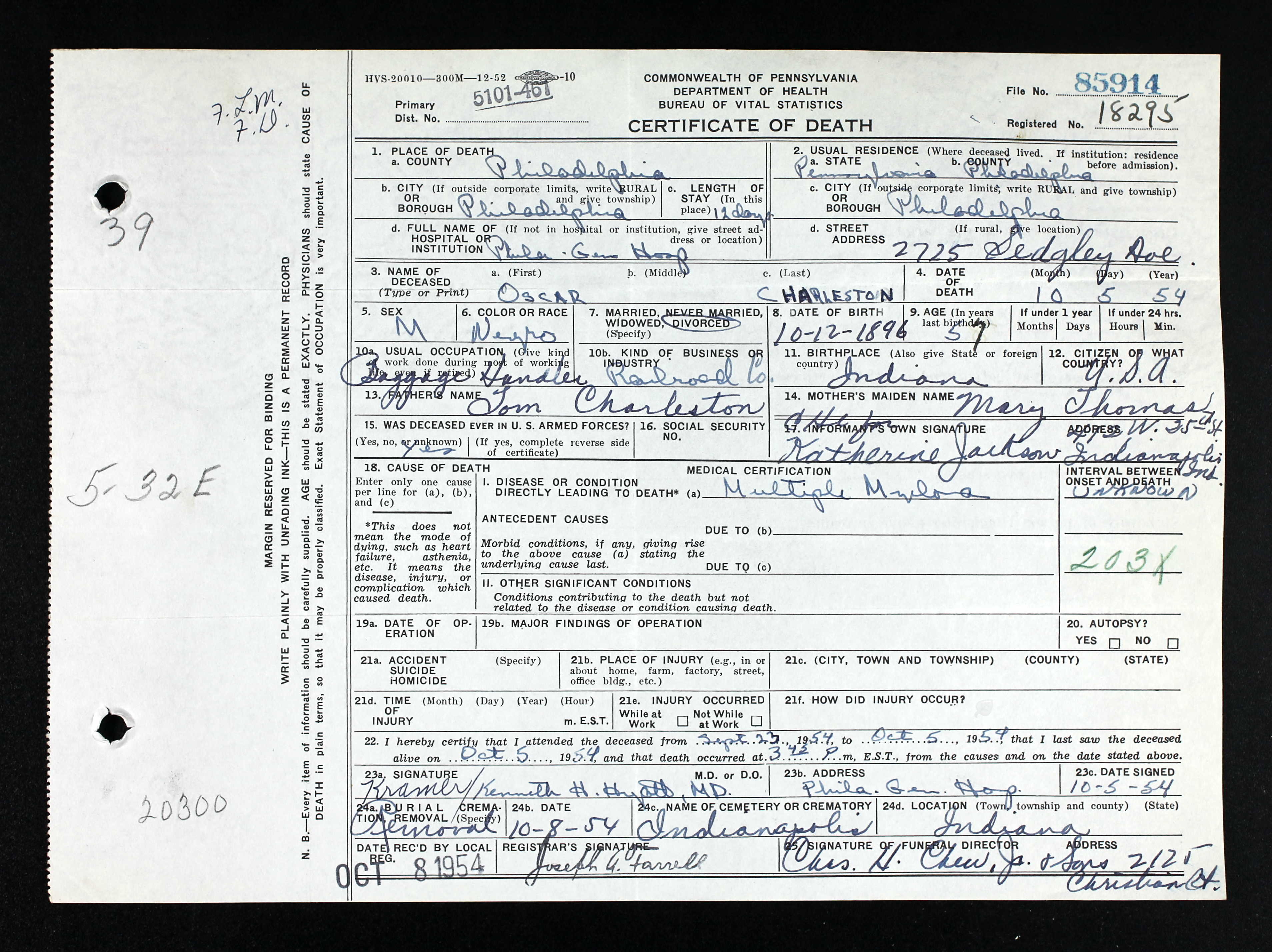
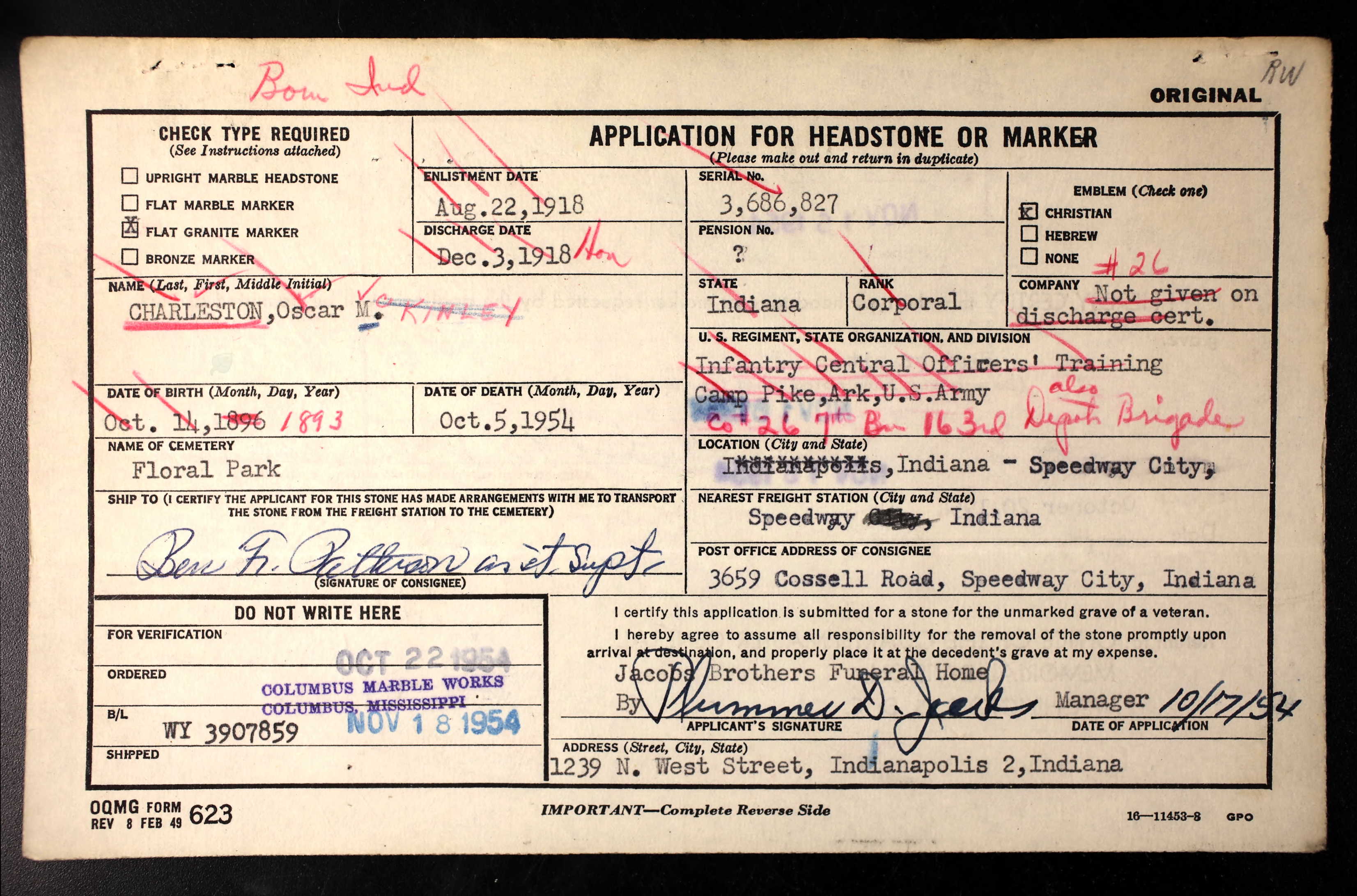
RW: Perhaps the biggest finding discussed in this work is that African Americans were playing what today would be called baseball a lot earlier than previously thought. What were some of the first instances of “colored” or “Negro” baseball that you uncovered?

JB: Historians not primarily focused on 19th-century black baseball (there are some who are, as you know), sometimes find additional gems that solidify organized black baseball’s roots in the 1850s. The first black baseball towns I uncovered were St. Louis, Chicago, Rockford, Ill., and Springfield, Ill. I discovered that some teams traveled to other cities, states and countries in the 1870s, and I began searching newspapers in those countries, states and cities. I was blown away, as an example, when I discovered that Chicago’s Uniques, in 1871, traveled to Kentucky, Kansas, Michigan, Pennsylvania, Maryland, New York and Upper Canada. I came across more teams and new locales to search. The discovery of the St. Louis Browns, a club that claimed professional status in 1870, was a revelation. It also became clear, at least to me, that the Uniques had claimed professional status as well.

The digital age: In the mid-1990s and early 2000s, my ongoing research uncovered that black clubs had formed baseball circuits in the 1850s, 1860s and 1870s. I became particularly interested in finding players that moved from one team to another. Between the 1850s and 1870s, the following organized teams captured my attention: Flushing’s Hunter B.B.C.; Binghamton’s Parlor B.BC.; Brooklyn’s Van Delken/Weldenken B.B.C.; Chicago’s Twilight Blue Stocking B.B.C.; Rockford’s Blue Stocking B.B.C.; New Orleans Pickwick B.B.C.; New Orleans Union B.B.C.; New Orleans Excelsior B.B.C.; Cleveland’s Twilight B.B.C.; Cincinnati’s Vigilant BBC; Louisville’s Fair Play BBC; and Indianapolis’s Western Fairplay B.B.C. These nines immediately come to mind. Many others appear in the book.

RW: How early were white players, teams and executives already pushing back against the idea of integration in the sport? When did racism and segregation first start seeping into the history of our national pastime?

JB: Many books have been written on the subject, and I have little to say about it. What I will say is that black men played with white clubs in the 1860s, which I discuss in my book. White teams played black teams in the 19th century, also covered in the book. One target that I devote considerable attention to relates to the racist impact of blackface minstrelsy on black baseball. It was devastating! Its effects on black baseball have been little examined. My book examines what I call black aesthetic style — intentionally misrepresented in 19th-century newspaper accounts. Baseball narratives constructed by newspaper reporters (if carefully analyzed) and visual culture, support this thesis.

Representations minstrelizing black players trace back to the 1850s, the enslaved black body metaphorically transformed in a modern black Frankenstein. Just as Frankenstein’s body was constructed of mismatched pieces, so were literary and visual representations of the black ballplayer. The eyes, nose and mouth too big; the hands and feet too big; the body too fat, too gangly or too muscular; and shine bones, incompatible with hot grounders. In the book, I examine this racist ideology.

Some baseball literature remains mired in representations of black baseball or Negro Leagues as novelty, that is, “Negro Comedy,” a self-reflexive mode that serves little purpose in the 21st century. Unfortunately, such views are complicit in reifying the notion of black players engaging in baseball farce or baseball minstrelsy. Until now, no one has analyzed how this racist narrative gained traction and its misrepresentations incorporated into baseball literature. Initially, I found this all astonishing. Getting over my disgust, I began to critically examine how it happened. It’s not easy getting 19th-century black baseball right, because it’s easier to get it wrong.
Black Frankenstein, by Frank Bellew, 1853. Theatrical performers, newspaper reporters and visual artists imagined the black ballplayer as a Frankenstein monster. 

Black aesthetic style in organized baseball easily traces back to 1870, and it had nothing to do with baseball farce. It was cultural, part of the lived experiences of black folk in organized baseball; in certain cases, traceable to black enslavement. Organized baseball, newspapers and visual culture intentionally portrayed black clubs/players as minstrel shows/minstrels, not only to limit their search for equality, but also to mock their athleticism and baseball skills as novelty.

Another strategy had to do with leisure class culture and class competition — to hire black players meant fewer jobs for white players; in the professional leagues, relatively well-paid jobs for doing what one loved, baseball, mattered. To disparage black players and push them to the margins was a massive effort that sadly goes back to the beginnings of organized baseball. Let’s remember, however, that Ulysses Franklin Grant and King Solomon White, both playing for white and black clubs, engaged in so-called “Negro antics.” Both players are in Baseball’s Hall of Fame. Let’s not get it twisted.

John H. Devereaux, publisher for the Savannah Colored Tribune (1875), and co-publishers George Davison and Thomas T. Harden, supported black baseball. Davison would manage the Savannah Chathams. The three men also played a role in the formation of the League of Southern Colored Base Ballists (1886).

RW: As someone who’s based in New Orleans and who’s focused a great deal on black baseball here, I’m curious to know how much your new work discusses early African-American baseball here in NOLA. How early did “colored” baseball spring up here in New Orleans, and how rich was the baseball tradition here in New Orleans in the 19th century?

JB: Louisiana in general, and New Orleans in particular, are covered extensively. I first discovered New Orleans while researching the St. Louis Black Stockings who traveled there in the 1880s. My research notebook of photocopies on black baseball in New Orleans is four inches thick. For detailed information, I recommend my book’s team and player biographies, and team rosters.

While New Orleans has a rich black baseball history, traceable to the 1860s, it takes firm ground with the organization of a baseball tournament in 1875. By 1876, the Pickwicks, composed of black servants for the Pickwick Club, was a very strong organization. The black Pickwicks named their club after their employers (a dangerous, white supremacist organization that funded Mardi Gras and engaged in racial violence against black people). The Pickwicks team was led by the Cohen brothers, Walter Louis, Edward and James; and Edward Williams and James Duncan Kennedy; all excellent ballplayers. Interestingly, William Albert “Al” Robinson, from Chicago, joined the team around 1879. He played in Louisiana off and on between 1879 and 1886.

RW: Summing up, what would you say is the overarching theme in this work, and what message would you hope readers get out of the books?

JB: Family, Teamwork, Love, Hope and Devotion – My deceased wife, Kathleen (whom I love and miss dearly), traveled with me. Three times we visited [Major League Baseball official historian] John Thorn at his home in the Catskills. John enjoyed talking with her as much as he did with me; probably more. She shared my enthusiasm to the end. In the middle of the night, it was not unusual for Kathleen to yell from upstairs for me to get off the computer and come to bed. While she didn’t live to see the book’s publication, I had — from the beginning — dedicated this book to her.

I also dedicated the book to my daughters, Takkara and Tamerit, and my mom, Lucille Brunson. A special token of gratitude was given to my lifelong friend, Willard Draper, who read my drafts and posed questions that I hadn’t considered. Sadly, “Draper” wouldn’t live to see the book’s publication either, his death coming this year (2019), almost one year after Kathleen’s (2018). My book’s completion embodies family, teamwork, love, hope and devotion.

I end with this quote from my book: “Researching this book has been a humbling experience. Documenting the lived experiences of men and women who played the game has evoked a range of emotions: shock, sadness, disgust, humor, and jubilation … They played in the heat, rain, mud, and cold. They elicited hecklers, peals of laughter, and enthusiastic rounds of applause. Many of them went on to have successful careers outside of the game. As young men and women, however, all they ever wanted to do was play baseball — if they could — alongside their white brethren. This book is for them.”

I especially thank my editor, Gary Mitchem, at McFarland Publishing, who, back in 2011, believed in this baseball project.