Who holds Cristobal’s fate?

torriente

Over the past week, I’ve been trying to keep several pots simmering on burners in an effort to churn out a bunch of posts about two primary subjects — opening the doors of the Hall of Fame once again to Negro Leaguers, and addressing the likelihood that Hall of Famer Cristobal Torriente is buried in a mass, unmarked grave in Queens.

Those multi-pronged efforts are starting to bear fruit, so hopefully I’ll have at least a post every other day through the end of next week. That’s a hefty goal, but I’m trying to keep at it.

Today, though, the focus returns back to Torriente, whose situation I addressed, with valuable help from a few others, in these posts here and here, with the latter being very heavily researched-base.

But beginning last week, I went on an all-out, investigative-journalist blitz to pin down as many officials and media relations folks as I could to see if anyone in New York City might be interested in trying to bring a greater focus to Torriente’s sad situation in Calvary Cemetery in Queens.

Hence, a week ago, I sent out a flurry of emails to various NYC offices and agencies — including the City Council — as well as the Archdiocese of New York. And, after a week of waiting and follow ups, the news ain’t good. It ain’t good at all.

I’d ideally like to start off with the response I got from the City Council, but, unfortunately, I haven’t received any such answer. I sent emails to three officers of the Council’s Black, Latino and Asian Caucus — Co-Chairs Rosie Mendez and Andy King, and Council Speaker Melissa Mark-Viverito — and heard precisely bupkis back.

I also dashed off an email to the Council’s press office, but after several days of waiting, my overture bounced back as undeliverable. So I called the Council press office today, when a staffer there asked me to send an email to her personal address, something I will do later today.

I had a little more luck with the City’s Health Department and with the New York City Health and Hospitals Corp., a non-profit agency formed roughly 45 years ago to administer the city’s 11 public hospitals and other health-care services open to the public.
ramiro_ram%EDrez

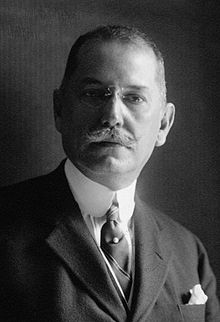
Ramiro Ramirez, who reportedly claimed Torriente’s body (from Seamheads)

But before we get into the input from those two agencies, let’s go back a bit and recap what we do know about Cristobal Torriente’s last years, his death and his burial, much of which was uncovered by the Herculean research efforts of friend and fellow SABR member Ralph Carhart of the Hall Ball Project, as well as researcher extraordinaire Gary Ashwill

Somewhere in the mid- to- late-1930s, Torriente, who had settled in NYC after spending much of his playing career there with various teams and (apparently) retiring around 1933, checked into what was Riverside Hospital on the city’s North Brother Island on the East River in July 1937.

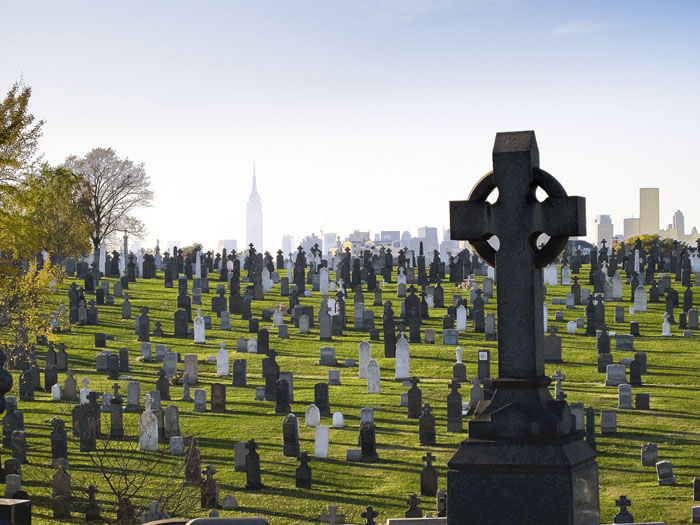
Torriente passed away at the hospital on April 11, 1938, with the coroner listing the primary cause as pulmonary tuberculosis. It was thought at the time and for many decades after that Torriente was originally interred at Calvary Cemetery — a massive, sprawling but densely packed (365 acres) Catholic facility owned by the Archdiocese of New York and that today contains the remains of an astounding 3 million people, the most interments of any cemetery in the U.S. — but was disinterred by the Cuban government a short time later and reburied with pomp, circumstance and high honors at the baseball shrine in Havana’s Cristobal Colon Cemetery.

That, though, now appears to be a huge fallacy, one likely originated and fabricated by a dictatorial Cuban government as a PR move to help retain power. Thanks to Ralph Carhart’s efforts, we are know almost positively certain that Torriente’s body was never disinterred from Calvary at all.

The truth is that Torriente, who by his death was, heartbreakingly, indigent and penniless, and was a ward of the state while at Riverside, which seems to have been basically a sanitarium designed to house massive of poor New Yorkers who were suffering from grave diseases and were most likely going to die pretty soon.

(In fact, one of Torriente’s co-residents was Mary Mallon, a.k.a. the infamous Typhoid Mary, patient zero in the typhoid fever epidemic that swept through the city in the first decade of the 20th century. In effect, Riverside was a gigantic hospice/warehouse for sick, poverty stricken people the city deemed unfit to be anywhere near the rest of society. In other words, a very dismal, terrifying place.)

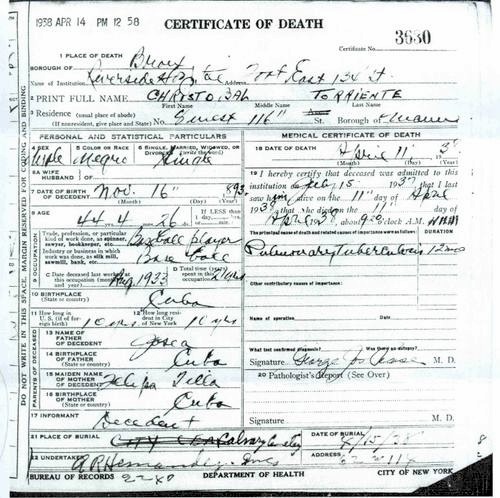
To discern what happened from there, it’s partly a matter of studying Torriente’s death certificate, a copy of which was secured by Gary Ashwill. The record states that the informant of death was, somehow, Torriente himself (not sure how that’s possible, at least in a legal sense), and that the body was claimed by Ramiro Ramirez, a fellow Cuban who, like Torriente, also starred and managed in the Negro Leagues for many years.
6a00d8341ccce053ef01b8d0d0f482970c-500wi

Cristobal Torriente’s death certificate (courtesy Gary Ashwill)

The certificate states that Ramirez, who took charge of the body with his signature, was Cristobal’s “cousin” and nearest next of kin. However, no proof has yet to be uncovered of any familial connection between Torriente and Ramirez, although they were teammates on occasion, I think. (Maybe Gary can confirm this.) That mystery — why Ramirez claimed the body, why he apparently lied about his connection to Torriente, and what Ramirez might have known about this whole situation — is something I’ll explore in an ensuing post.

Anyway, the funeral home in charge is listed on the death certificate as A.R. Hernandez, Inc., a long-time mortuary in Brooklyn that seems to have catered to local Latinos and African-Americans. (I’ve tried to look into why Hernandez was chosen, whether the proprietors have any link to Torriente, and whether the company’s history could uncover any keys to finding descendants or relatives of Torriente. More on that in a while, too, hopepfully.)

Then, crucially, we look at the line on the death cert indicating place of burial — the word “CITY” is crossed out and “Calvary Cemetery” is scribbled in its place. Ralph believes this means that Torriente’s body was originally intended for a city-owned cemetery but that Calvary stepped up and offered to house the remains at their facility. Again, what exactly went down between Torriente’s stated death at 9:20 a.m. on April 11, 1963, at Riverside Hospital and his listed interment date on April 15 is unclear, and it could stay that way.

But here’s the twist — despite what the Batista regime ballyhooed about bringing the Cuba legend back to his own country, Calvary staffers confirmed to me and Ralph that they have no record of Torriente’s remains ever being disinterred, which means he’s still there. Hence yet another question, and perhaps the biggest of all — why was such a legendary, admired baseball hero apparently spurned by his own country and left to tragic anonymity thousands of miles from his beloved hometown of Cienfuegos, Cuba? I’m trying to investigate that as well.
Fulgencio_Batista,_president_of_Cuba,_1952

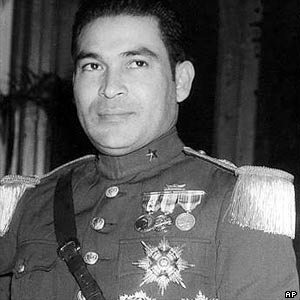
Cuban dictator Fulgencio Batista

Those Calvary staffers have also said that there’s nothing anything can be done to disinter any of the remains in that grave, an effort that would be necessary to do the required DNA testing on all 18 bodies in it to see which one is Torriente. The cemetery told me — and this could be a very key point — that mass graves like this one are “owned by the city” and, therefore, it’s the city and not Calvary (and, by extension, the Archdiocese) that would have any say on what happens to it and the remains located there.

So … I was hoping that a few inquiries to various NYC agencies and offices might help uncover any details about Torriente’s last days and his fate — as well as work toward hopefully bestowing recognition to the final resting place of a baseball legend.

My inquiries and conversations (both via email and over the phone) with these staffers answered some questions, but they also heaped on a bit more confusion, with the resulting conundrum being this — who controls the fate of that mass, unmarked grave and the body of a Negro Leagues star contained in it?

I managed to communicate with staffers from both the NYC Department of Health and the NYC Health and Hospitals Corp., and from both of those conversations, this is what I gleaned …

That, one, there’s a gargantuan problem right off the bat — that all of this is ancient history, and therefore, will always remain a mystery. Why? Because no one knows of the existence, let alone location, of any records pertaining to Riverside Hospital.

In fact, neither of the people to whom I talked had even really heard about Riverside before my queries, with the NYCHHC rep saying he wasn’t sure who or what owned Riverside at the time and added that he couldn’t venture a guess as to “who made the decision to shut it down or know where to tell anyone to go from here.” That, he said, definitely precludes any possibility of locating hospital records from 1938.

Because no one I’ve spoken with or any online information I’ve researched has been vague, I haven’t been able to discover conclusively who owned and operated Riverside Hospital. North Brother Island is located in the East River between the Bronx and Riker’s Island, where the city’s famous jail is.

Over its century-plus existence, Riverside Hospital/North Brother Island have housed a smallpox facility, an infectious/quarantibable diseases holding bin, and, in the mid-20th century, a treatment facility for teenagers with chemical dependencies, especially heroin addicts. So, again, definitely not a fun place to be.
Riverside_Hospital_North_Brother_Island_crop

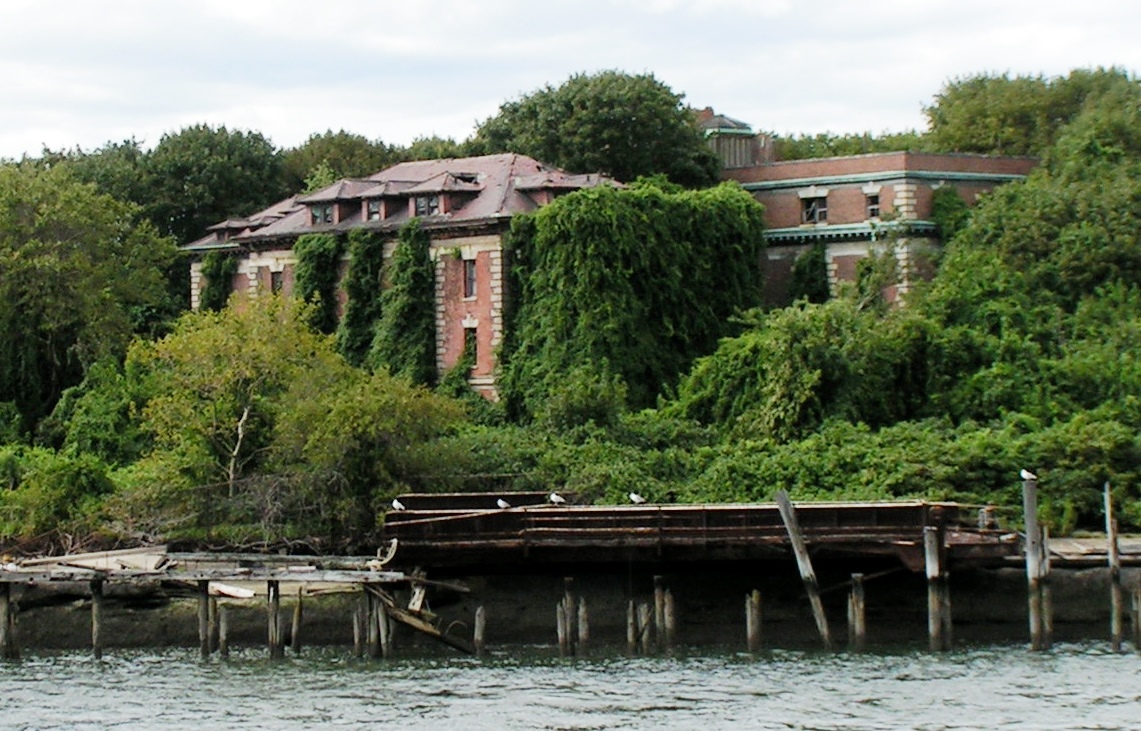
The remains of Riverside Hospital

Riverside was shuttered for good in the ’60s, thanks to alleged corruption and a general  inability to rehabilitate its young patients. Today, the 20-acre North Brother Island is a bird sanctuary and is completely off-limits and inaccessible to the public, or pretty much anyone. The remains of the hospital are crumbling, heavily deteriorated and completely obscured by dense forest growth.

One has to wonder … might there actually be hospital records contained in the rubble? Could documents, or any evidence, exist among the crumbling brick and mortar that shed light on a Hall of Famer’s final weeks? Due to likely exposure to the elements over at least a half-century, the likelihood of that is quite slim, but it’s still a tantalizing possibility …

But I digress, and back to the health officials … Here’s the email response I received from a source at the City Department of Health about Riverside’s records and the state of Cristobal Torriente:

“The Health Department does not maintain these records. The death record from 1938 is old enough to have been transferred to the New York City Municipal Archives; it is now a public record available through the Archives … You may check with Calvary Cemetery – it is an active cemetery and should maintain records.  We do not have information on Riverside Hospital [my emphasis].

As to your question about mass unmarked graves in New York City, the City has used many burial sites throughout its history. It currently uses Hart Island as its potters’ field, which is maintained by the New York City Department of Correction.  … there is a searchable database available.”

As to the first paragraph, we already have the Torriente’s death record, and we’ve already talked with the cemetery. The last paragraph, though, is quite intriguing … Was Hart Island — where penniless, indigent and/or unclaimed remains in NYC now go — where Torriente’s body was originally supposed to go, and would that online database — which, believe me, I’ll search soon — hold any clues about this mystery?

As a final note, I add that I’ve tried to reach out to the Archdiocese but haven’t had any success yet.

So what is the upshot of aaaaaaalllll this? Here’s a few concluding thoughts, based on my interviews, inquiries and research discussed herein:

• The New York City Council hasn’t gotten back to me about whether it might care about the sad state of a baseball Hall of Fame player.

• There’s in all likelihood no records or other physical documents, aside from the official death certificate that we already have, that could provide any clues about the fate of Cristobal Torriente’s death.

• That includes any conclusive evidence revealing the mechanism and chain of events — commitment to a sanitarium, the claiming of the body by a fellow ballplayer who lied on the record, original designation of the body to a city-owned potters’ field, the change of designated burial spot to a Catholic institution that stands as one of the largest cemeteries in the world, and the reason why Torriente wasn’t brought back to Cuba as previously thought — that landed him in a communal, anonymous grave with 17 other individuals.

We aren’t sure who, exactly, has charge of that grave today — does the grave belong to the city, or to the cemetery and archdiocese — and, subsequently, who would have the theoretical power to do something about it.

Now, any or all of those bullet points could change pending future inquiry and research. One key here is whether we can find any living relative, descendant or other human source who could shed any light on Cristobal Torriente’s death — and who might have the legal and emotional authority to demand something be done. That’s something else I’m working on, and something else I’ll yet again try to detail in later posts.

So, here we are. If anyone has any information, additions, corrections suggestions and/or leads that could help clear this up, please let us know!
Torriente: Slavery, politics, the sugar trade and the search for answers

torriente

In early March 1938, a small cadre of dissidents were caught in an alleged plot to kill Cuban dictator Fulgencio Batista. Among the group of conspirators was Cosme de la Torriente, a diplomat and statesman who had previously held several roles in post-independence Cuban government, including secretary of state and president of the ill-fated League of Nations.

It doesn’t look like de la Torriente suffered too much for his part in the alleged assassination; he went on to live a lengthy, comfortable life before passing away in Havana in December 1956.

Parallel to the machinations of the unsuccessful 1938 coup of Batista, though, was the death, in April of that year, of Cristobal Torriente, a native of Cuba and legendary star of the Negro Leagues and pre-Negro Leagues. By that time, Torriente — who in 2006 would be posthumously and very belatedly inducted into the Baseball Hall of Fame — had faded into penniless obscurity in New York City and withered away from tuberculosis in NYC’s long-since-demolished and rather infamous Riverside Hospital on North Brother Island.

By all appearances, because of Torriente’s status as a pauper and ward of the state, he was unceremoniously dumped in a mass, unmarked, city-administered grave in Calvary Cemetery in Queens.

The fable, as it’s been told for decades, then tells that the Batista government in Cuba had Torriente’s remains disinterred, shipped to Havana and placed in a shrine to Cuban beisbol greats in Cristobal Colon Cemetery.

But, according to recent research I attempted to summarize in this blog post, it looks like that last part never happened — there’s no record of Torriente ever being disinterred from Calvary Cemetery, as cemetery staffers have told both me and fellow researcher Ralph Carhart.

So it looks like the tale told by the Batista government — that Torriente’s body was feted like a national hero when it was brought back to Cuba — was a tall one, fabricated by a brutal dictatorship, possibly as a propaganda effort to secure popular support and bureaucratic stability in the wake of the attempted coup a month prior.

The question in my mind — or rather, one of the many rolling around in my noggin — is whether the political maneuvering of Cosme de la Torriente had anything to do with the unfortunate fate given to Cristobal Torriente? Was the baseball great punished in death by the Batista regime for a relative’s “crime” against the government?

On the one hand, that likelihood appears slim; as fellow baseball researcher and Cuban Leagues specialist Gary Ashwill noted to me, in the Spanish language, “Torriente” is a distinctly different surname from “de la Torriente.” Plus, Cristobal Torriente was from Cienfuegos, Cuba, while Cosme de la Torriente was from Matanzas.

And, finally, Cosme was white. Cristobal was black.

Why, though, does any of this matter? Why is it so important that we try to unlock the historical conundrum of how such a legendary, pivotal Cuban baseball player ended up in an unmarked grave?

bsQ_calvary_alsmith_001

Calvary Cemetery, Queens

For one, I just like a mystery. Research is fun, investigation is fun, and historical quandaries are fun. And just discovering why history unfolded as it did might help fill in a small, missing piece of the greater baseball — and cultural — puzzle of the Americas.
But two, even beyond that, I feel that we might need to recognize and rectify the apparent fact that such a formidable hardball luminary and cultural ambassador as Cristobal Torriente is entombed in a mass, unmarked, undignified grave thousands of miles from his homeland.

And in my mind, arguably the best way to achieve that recognition is to somehow find a living relative or descendant of Torriente, someone who could personally and powerfully lobby on his behalf, who could draw intimate attention to the sad fate of their legendary ancestor.

To find a living descendant, I’m thinking that if we perchance delve back into history to unearth Torriente’s roots and genealogy, we could then move forward into the present along a divergent but still attached thread of his family.

So far, however, that’s been quite difficult, and I’m resorting to some halfway desperate measures to achieve that goal. In a future post (hopefully next week), I’ll discuss those attempts to find a family member.

And in yet another article, I’ll attempt to review the steps that have been taken to draw attention and recognition to Cristobal Torriente’s tragic postmortem plight.

But for the rest of this post, I’ll embark on an analysis of one chunk of Cuban history that could fill in some of the gaps in Torriente’s background.

220px-De_la_Torriente,_Cosme

Cosme de la Torriente

One of those chunks is any possible connection between Cristobal and Cosme de la Torriente, and whether the political wrangling of the latter might have affected the post-death destiny of the former. However, that’s not what I’ll be fleshing out today, and I apologize for the bait-and-switch. I just liked the Cristobal/Cosme dichotomy as a method of introduction to the complexities of Cuban history as they relate to the Hall of Famer’s life and death.

Also, that’s not to say that Cosme de la Torriente doesn’t figure into Cristobal’s story somehow; in fact, the two plot lines could very well intersect, because, as I’ve found, there seems to be a lot of plot lines, or at least possible ones, and a bunch of them likely do criss-cross at some point. As a matter of fact, they just might later on in this post.

But, for now, here’s this narrative …

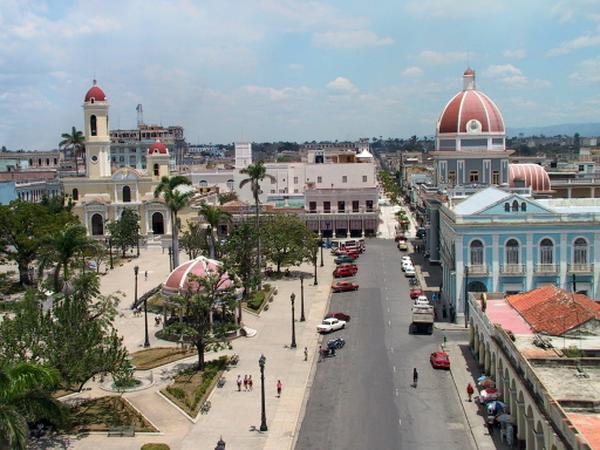
Cristobal Torriente — dubbed, later in life, the Black Bambino and the Cuban Strongman — was born on Nov. 19, 1893, in Cienfuegos, Cuba, a picturesque city on the island’s southern shore that has accumulated so much historical value, especially architecturally, that it’s now a UNESCO World Heritage Site.

The name Torriente, while a popular one (along with de la Torriente) in Cuba, seems to be and have been especially prevalent in Cienfuegos. Also quite prevalent in the historic city was the sugar trade, including sugar plantations, sugar refineries and American businessmen exploiting the region for its resources and labor. Here’s a description of Cienfuegos from the UNESCO Web site:

“The colonial town of Cienfuegos was founded in 1819 in the Spanish territory but was initially settled by immigrants of French origin. It became a trading place for sugar cane, tobacco and coffee. Situated on the Caribbean coast of southern-central Cuba at the heart of the country’s sugar cane, mango, tobacco and coffee production area, the town first developed in the neoclassical style.

“It later became more eclectic but retained a harmonious overall townscape. Among buildings of particular interest are the Government Palace (City Hall), San Lorenzo School, the Bishopric, the Ferrer Palace, the former lyceum, and some residential houses. Cienfuegos is the first, and an outstanding example of an architectural ensemble representing the new ideas of modernity, hygiene and order in urban planning as developed in Latin America from the 19th century.”

One of those sugar kingpins in the area was a Spaniard named Esteban Cacicedo Torriente, who emigrated to Cuba in 1865 — when slavery was still in full force on the island — and formed a business partnership named Ruesga and Cacicedo in Cienfuegos in the 1870s. Esteban also opened a grocery store in the city a partner named Jose Garcia; the company was also involved in banking, and in 1922 the business was consolidated as Cacicedo & Co.

Esteban Cacicedo Torriente seems to have been a very influential man in Cienfuegos. Here’s a rough translation from an entry on ecured.cu, the Cuban version of Wikipedia. I’ll acknowledge right now that I don’t know a lick of Spanish, so I lamely translated the Ecured entry using a Spanish-to-English Web site:

“He was estimated as one of the richest men in the city. In addition to his large trade house, established in on Argüelles street at the corner D ‘Clouet, up the great central [road] to Santa Maria, since 1909 and under the direction of his son Stephen, he encouraged in the central Carolina the establishment of a pasture whose administration was in charge of his son Isidore, where the big shots and young horse stallion products imported from Europe and United States gave rise to domestic livestock.

“He was a City Councilman in the years 1878 and 1880; Treasurer of the Steering Committee of the Fire Department of Commerce several times; and President of Casino Spanish since 1918. In 1887, he was the deputy of a battalion of volunteers from Cienfuegos and was several times president of the Spanish Casino. …

“[The family] distinguished themselves in Catholic activities and charitable and pious works, contributing to the foundation of Nursing homeless, the institution of the Servants of Mary, the establishment of the Jesuits and others.”

(Yeah, like I said, that translation is quite mangled, for which I apologize, especially if some of it doesn’t make sense. If any of my Spanish-speaking friends reading this could correct me, I’d gladly accept it. 🙂

Anyway, by all accounts, including a bunch of documents I’ve found online, Esteban Torriente Sr., and his son Esteban/Stephen Jr. and Isidore — and therefore likely the whole family — were white. That’s also probably the case because they were direct immigrants from Spain, and because there’s likely no way a person of color would own that much property, and be that rich and powerful, in antebellum Cuba. (Slavery wasn’t abolished there until 1886.)

And here’s another very intriguing note — Esteban Sr. married his cousin, Ramona de la Torriente, the daughter of other wealthy landowners and merchants in Cienfuegos. With that, we have a possible linking between a family grouping with the “de la Torriente” and “Torriente” surnames.

Mushrooming out of that is the fact that the de la Torriente clan, including Cosme, seem to have been major sugar big wigs in Matanzas. So we could, here, have the mixture of several variables that could — and I emphasize could — start to bring some pieces of the Cristobal Torriente puzzle together.

But a little more on Esteban Torriente and the 19th-century Torriente family in Cienfuegos …

cienfuegos-city-center

Cienfuegos, Cuba

I uncovered a 1998 essay by Christopher Harris called, “Edwin F. Atkins and the Evolution of American Cuba Policy: 1894-1902,” in which Harris theorizes that Boston-based entrepreneur Edwin Atkins as well as Edwin’s father, Elisha, established a lucrative trading business — largely sugar-related — in Cienfuegos.

From there, Harris argues, Atkins, thanks to his big bucks and fortuitous political connections, Edwin Atkins greatly influenced the U.S.’s relationship with and approach to Cuba, especially during the crucial period encompassing the island’s war of independence from Spain and the ensuing Spanish-American War, when the States began to seriously flex its imperialist muscles.

In his essay, Harris doesn’t really state whether Atkins’ influence on turn-of-the-century Cuba was a good thing or not; at times the writer seems to hint that the American entrepreneur was a bit weasely (my words) in his dealings and therefore had a somewhat undue influence on the island’s development after independence.

But that’s a side note. For the purposes of this blog, this is the part of Harris’ work that’s important:

“… [Atkins’] company pursued a triangular trade: sending finished New England manufactured goods to Central America, picking up coffee, cochineal and granadilla, usually from Guatemala, and carrying these goods to Cienfuegos or Trinidad to trade for sugar. … The Torriente Brothers of Cienfuegos acted as agents for Atkins and Company [my emphasis], and the families developed strong personal relationships. By the 1860s, Atkins was becoming wealthy, owning a half dozen ships and running over 400 charters a year to Cuba in his own and others’ ships.

“By the mid-1860’s … Atkins’ business began to evolve. From simply trading, shipping and merchandising, the company began to extend credit and financing to planters, both directly and through the agency of the Torriente Brothers, their agents in Cienfuegos [my emphasis]. While under the Refaction Law (until 1880), credit to planters was secured only by a lien on crops, interest rates were high enough to make financing a profitable addition to merchant’s offerings.”

I have yet to conduct a lengthy investigation of the Torriente Brothers company, and when I do, I’ll try to write updates in ensuing posts.

But further on in Harris’ essay, the writer again brings up a variation of the Torriente name:

“With the outbreak of the Ten Year’s War in Cuba (1868-1878), the old Cuban plantation families began to be economically squeezed on all sides. Overseas beet sugar led to increased price competition. To be competitive, the Cuban producers needed new equipment and sugar processing machinery, which required capital. In was in this period that large sugar processing plants, called centrales, began to replace theingenios that formerly processed sugar on each plantation. Those who couldn’t afford to modernize and become centrales, were reduced to being colonos, plantations that only grew sugar cane, without processing it. But as a class, the Cuban planters carried a high level of debt even before the War, owing money, mostly to Spanish financiers and merchants who controlled the trade. To make matters worse, the Revolution itself caused considerable economic dislocation. …

“… Presumably, it was for this reason that Elisha Atkins sent his son Edwin to Cienfuegos in 1869 to learn the business from Ramon de la Torriente [my emphasis] rather than sending him to college. While profits may have been high, the risk from this business was large as well. The son was sent to protect the family’s interests.”

So here’s another cropping up of the Torriente moniker in Cienfuegos. But there’s one more, again from Harris:

“… At the end of the Ten Year’s War, only a few plantations around Cienfuegos continued to operate. … Atkins and Company was, in effect, forced into becoming sugar producers themselves. In 1882, the Atkins began collecting properties by foreclosure. …

“They foreclosed the Soledad and Rosario plantations of the Rosario family, Carlota from the Torriente family [again my emphasis], Caledonia from the estate of Diego Julien Sanchez, Guabairo from Manuel Blanco, and Limones from the Vila family. Vega Vieja and Manaca were purchased from the Yznaga family and Algoba was leased.Santa Teresa was acquired from Juan Perez Galdos, Veguitas from Jose Porroa, Vaqueria from the Barrallaca family and San Augustine from the Tomas Terry family. Leased properties included San Jose, Viamones, San Esteban and Algoba. …”

The whole scheme is summarized on the Web site of the Massachusetts Historical Society, which possesses a large collection of Atkins family documents and papers. States the MHS:

“E. Atkins & Co.’s most frequent business correspondents in Cienfuegos were the Torriente Brothers. After the Ten Years’ war in Cuba (1869-1878), Torriente Bros. had many sugar estates indebted to them, and the firm in turn was indebted to E. Atkins & Co. Torriente Bros. foreclosed on several estates, including the Soledad plantation in Cienfuegos …”

With those generalities established, let’s now take a closer look at a few seemingly loose ends and random strands of personal documents and records that might help to continue connecting the dots.

For example, there’s the fact that Esteban Sr. is referred to as Esteban Cacicedo Torriente, which could be very significant, because — while I again stress that I’m a bit deficient in the Spanish language and its naming traditions/procedures — it looks like that a theme running through many historical documents and records relating to his family members is the interchangeability and malleability of the Torriente and Cacicedo surnames.

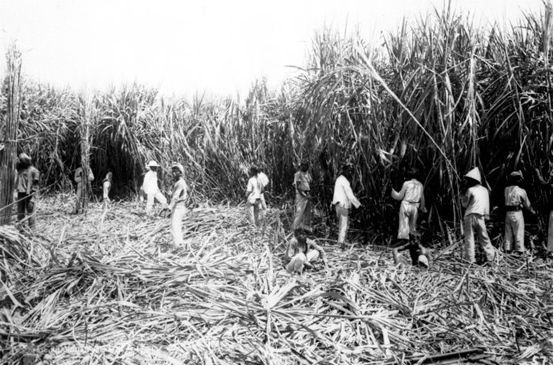
sugar_java_cuba_fig7

A Cuban sugar plantation

While Esteban Sr. died in 1932, it looks like several of his children — including Ramon, Esteban Jr. and Luis — filtered into the U.S. throughout the 20th century, some of them landing in Florida (more on that in an ensuing post), and some in New York City.

I think Luis, for example, studied at MIT, returned to Cienfuegos and became an engineer at one of his father’s plantations. Esteban Jr. was also an engineer, it seems, probably on one of his dad’s estates as well, and all of the documents pertaining to the latter son I could find refer to him as white.

The same goes for Luis. But Luis might be an even more fruitful figure to study, for two reasons: One, he traveled to and from New York City a lot, placing him in the same locale as Cristobal Torriente; and two, various documents list his name, somewhat interchangeably, as Luis Torriente, Luis Cacicedo and Luis Cacicedo Torriente.

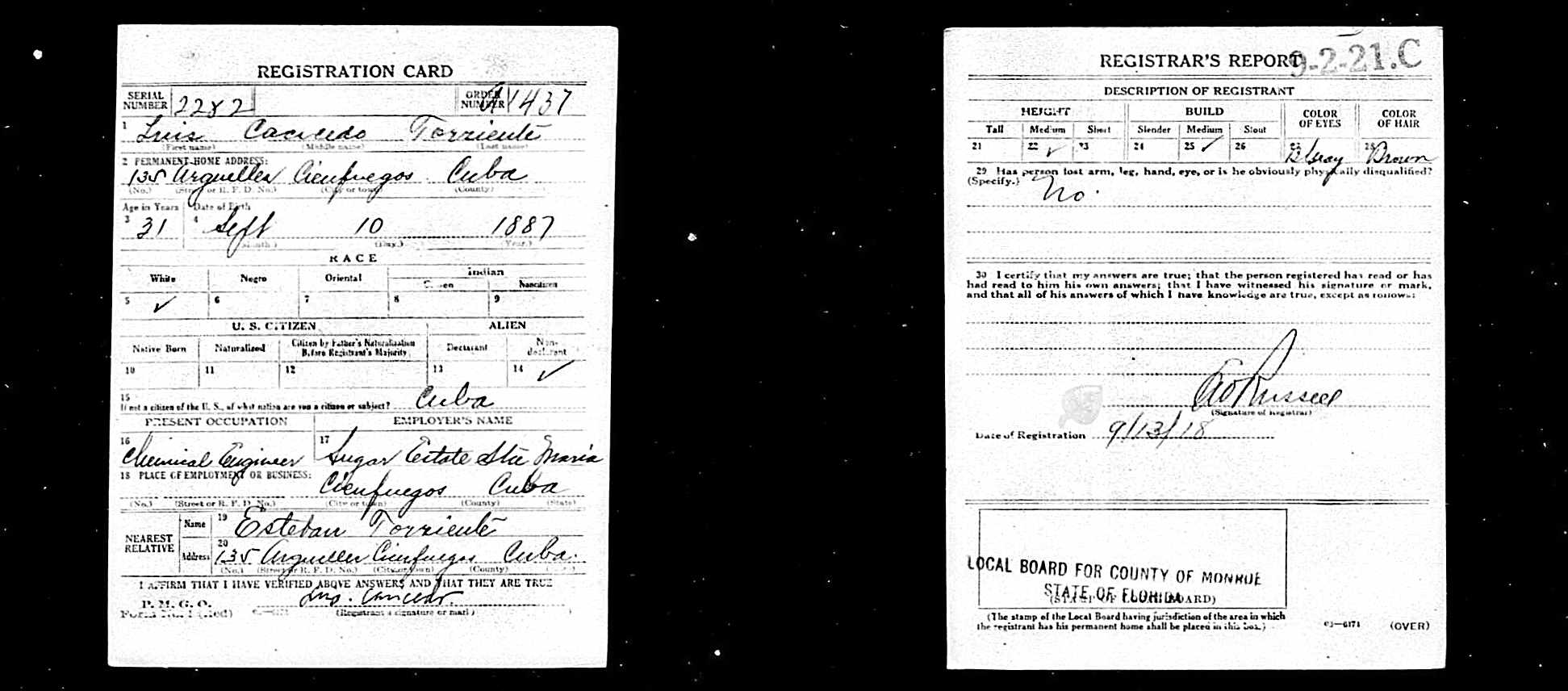
Take, for example, his U.S. World War I draft card. He’s listed as Luis Cacicedo Torriente, with a permanent residence on Arguelles Street in Cienfuegos (the same street on which his father’s business was located) and a birthdate of 1887. The card lists Luis as white, and his profession is “chemical engineer” on a “sugar estate” in Cienfuegos. His nearest relative is pegged as Esteban Torriente at the same permanent address. (It’s not clear if that’s Esteban Sr. or Jr.)

What’s more, Luis’ listed surname varies from Torriente to Cacicedo on different ship manifests during the first two decades of the 20th century. He also shows up as Luis Cacicedo, a 22-year-old white male, in the 1910 Federal Census of Manhattan, where he’s a lodger on W. 115th Street. Finally, on his 1922 New York marriage certificate to one Rafaela Tess, he’s called Luis Cacicedo.

005150525_03493

But there’s one final component … Both Cristobal Torriente and Luis Cacicedo Torriente had multiple WWI draft cards — I’m not sure why, exactly, except the various ones have different permanent residences for each of them — and these documents could reveal something telling.

On one of Cristobal’s three (!) cards lists his birthdate of Nov. 16, 1893, his birthplace as Cienfuegos, and his current residence as Monroe County, Fla. (which is basically the Florida Keys). His race is stated as black.

Meanwhile, a second card for Luis states his name as Luis Cacicedo Torriente, his birthdate as Sept. 10, 1887, his birthplace/location of relative as Cienfuegos and his residence as … Monroe County, Fla.! The card, further, states that he’s white.

On top of that, the historical record is littered with documents involving various Torrientes or de la Torrientes of both colors living, going to or coming from Monroe County and/or Key West.

Finally (I know I’ve said finally a few times, apologies for the absurd length of this post), I might have come across documented proof that Luis Cacicedo Torriente — son of wealthy, white, 19th-century sugar planter from Cienfuegos — and Cristobal Torriente — black baseball legend and Hall of Famer now resting in a mass, unmarked grave — are indeed on different branches of the same family tree.

Umm, but unfortunately at this point, I can’t, uhh, confirm that last assertion because I haven’t quite figured out the details yet. I know, that’s a bit confusing and likewise a bit tenuous, but rest assured that I’m working to nail it down for certain.

But here’s my hypothesis: That the Negro League great was possibly descended from former black slaves belonging to white Esteban Torriente and his lineage in the city of Cienfuegos, Cuba, where, like much of the country, race and ethnic identity are slippery, elusive and firmly entwined in the complex social, political and economic history of the island nation.

Phew.

Having said that, I invite any other friends, peers or fellow researchers to step in and correct and/or add to my probably spotty interpretation of Spanish-Cuban language, genealogy and other traditions! My email is rwhirty218@yahoo.com, or feel free to leave a comment on this post.

I also stress that, because I’m a relative neophyte in Cuban culture and history, this post was written from a probably narrow, Americanized point of view and, as such, it could omit, gloss over, obscure or obfuscate many points mentioned in the article that could look differently from a Cuba-centric approach. Again, if that is the case, and if anyone reading this can clarify or fill in the narrative, please feel free to contact me.

Over the next week or so, I hope to write two more posts concerning Cristobal Torriente, one that deals with my effort to find a living relative or descendant, and the other detailing the effort to call attention to the deplorable state of his remains in Queens.
Hopefully, somewhere down the road, I’ll be able to somehow pull aaaaaaaall these strands together, but not without help from all of you!

HOF: No more Negro Leaguers, and no changes to policy

… At least for now, anyway.

According to National Baseball Hall of Fame Vice President of Communications and Education Brad Horn, for the foreseeable future, the Hall’s board of directors has no plans to change or even revisit its current policy of keeping additional segregation-era African-American candidates out of Cooperstown.

I spoke with Mr. Horn this morning, and he confirmed what many Negro Leagues enthusiasts have both feared and protested ever since a special committee elected 17 Negro League figures in 2006.

“The board is comfortable with its [election] process at this time,” he said. “It does not have a perpetual process to consider Negro Leaguers. The board said that at the time in 2006, and it hasn’t deviated from that at this point.”

I suggested to him that a few Negro Leagues fans and researchers such as my Malloy roommate Ted Knorr have crunched the numbers and found what they believe to be a woeful under-representation of segregation-era African-American players, managers and executives. Compared to the number of white, pre-1947 Major Leaguers, the number of black candidates in the hall is miniscule.

Mr. Horn said that he and the HOF’s board certainly understand that argument, but he added that despite any such ratios, right now the Hall is sticking to its guns.

“In 2006, the Hall of Fame said [the special committee] served as the final consideration for the Negro Leaguers,” he said.

“But,” he quickly added, “we kept the door open for new research to be considered. [The current policy] doesn’t mean that it won’t happen at some point.”

Still, he said, “At this time, the board is comfortable with the fact that it has given [Negro League and pre-Negro League figures] comprehensive consideration. It does not want to rewrite the policies and procedures.”

I noted to him that because the Hall has a Pre-Integration Committee that continues to elect white Major Leaguers from that era but still has closed the door to Negro Leaguers, many in the blackball community simply feel that such policies and mechanisms are unfair and unjust.

I also asked him whether the Hall feels that there are, in fact, segregation-era African-American candidates out there, but Horn declined to address that directly. He also hedged a bit when asked what it would take to have the policy changed eventually.

“The Baseball Hall of Fame remains committed to an election process that continues to meet the needs of preserving baseball history,” he said. “Certainly the argument that baseball has many individuals who are always going to be good candidates for induction is an argument that is recognized by the Hall of Fame.”

But, he added, “Our job is to allow for the best system possible, and at this point, the board remains dedicated to evaluating how the induction process affects all candidates.

“The board is always willing to consider candidates in its regular course of business, and it has the ability to change the process [at any time]. We continue to encourage baseball fans to send us letters stating their viewpoints and the board will consider them, but there are many fans who each have their opinions of the induction process.”

“At this point,” he concluded, “the board feels there is not the need for an election process that considers new [Negro League] candidates.”

What do you think about the Hall’s policy? Feel free to leave comments on this blog or on the various Facebook pages or to email me at rwhirty218@yahoo.com. I want to hear from you!

A mass grave for a beisbol legend?

torriente

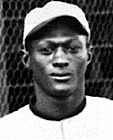
The gentleman above is Cristobal Torriente, a Cuba native and African-American baseball — or beisbol — legend who was elected to the National Baseball Hall of Fame in Cooperstown in 2006, the after which the Hall once again officially and unjustly its doors to segregation-era African-American players.

As I discussed in this previous blog post, in 2016 I’m going to try to sharpen Home Plate Don’t Move’s focus to advocating for two goals: one, to, with your help, get the BHOF to acknowledge its ignorance bigotry and once again allow Negro Leaguers into its hallowed halls; and two, try, again with help, to bring attention to the possibility that Cristobal Torriente, the “Cuban Babe Ruth,” is now the only Hall of Famer buried in an unmarked grave.

What’s worse, said burial location could be a mass grave in which Torriente — who, by the time of his death in 1938, was in all likelihood a penniless pauper (which was tragically the fate of many former Negro League stars — was unceremoniously laid to rest (if you could call it rest) with 16 other anonymous souls at the prestigious Calvary Cemetery in the New York City borough of Queens.

And that discovery right there — that Torriente’s remains are in Queens, not Cuba — represents a stunning and monumental development that completely rewrites what we know about the fate of this outsized beisbol legend. (For example, the esteemed Find A Grave Web site still lists, mistakenly, that Torriente is interred in Cuba.)

Right off the bat, I’m to to credit three baseball researchers/historical enthusiasts with each doing a yeoman’s job in getting the ball rolling on identifying the exact location and status of Torriente’s remains.

The first is John Thorn, Major League Baseball’s official historian, who is arguably the leading light in the area of baseball research. The second is Gary Ashwill, whose incredible — and incredibly researched — blog, Agate Type, is located here. Gary specializes in Negro Leagues and, perhaps more importantly, Cuban beisbol.

The third person is Ralph Carhart, a SABR member and driving force behind the massive Hall Ball project, which is dedicated to criss-crossing the landscape with a baseball to as many Hall of Famers — both living Hallers and the graves of deceased ones — and take pictures with each man or burial location.

It’s a massive, remarkable, and incredibly admirable effort, one that has been underway for several years and one that continues in energetically full force. (Ralph has launched a Go Fund Me effort to help finance his work in this project. If you’re interested in helping out, go here.)

Now that relations between Cuba and the U.S. have thawed a bit, Ralph has zeroed in on bringing the Hall Ball to that once-prohibited island and visit the graves of multiple Hall of Famers from the Caribbean country, such as player, manager and owner of the famed New York Cubans Jose Mendez, and multi-tooled player Martin Dihigo.

Ralph sailed to Cuba last year, one of numerous baseball historians who have been itching for the chance to study the storied Cuban League, which has spawned countless beisbol stars over the years, a voyage I discussed in this blog post.

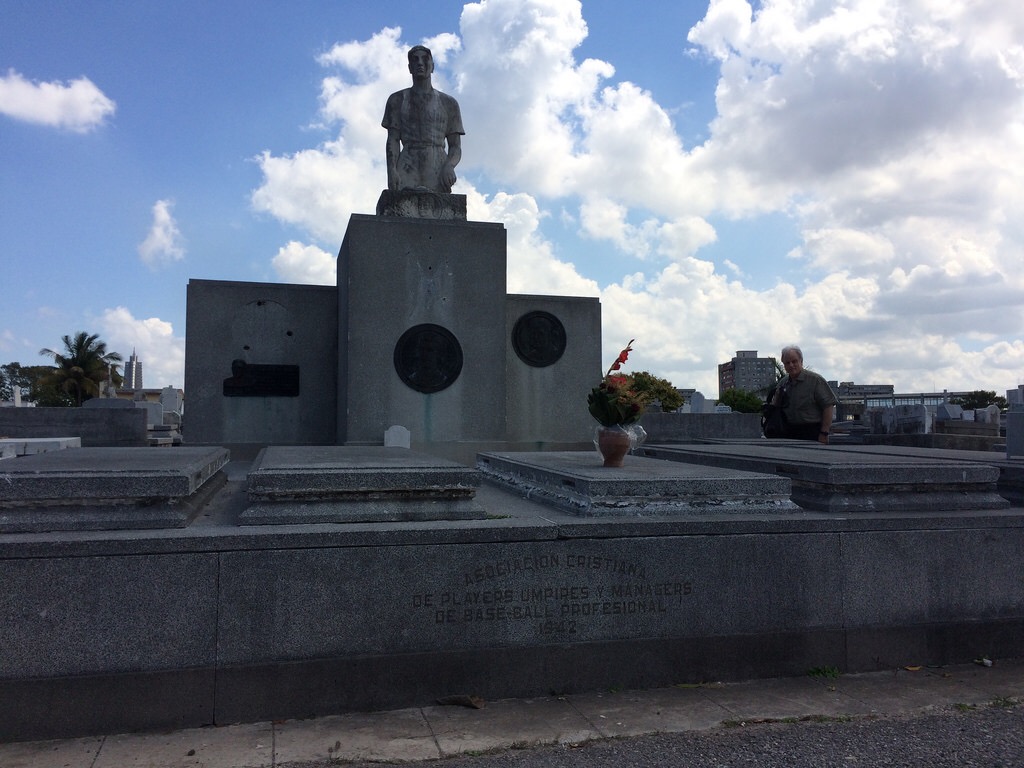
In his journey to Cuba, Ralph was able to visit Cristobal Colon Cemetery, which includes a towering monument honoring dozens of Cuba’s past baseball legends, including the nation’s Hall of Famers in Cooperstown.

download

The majestic baseball memorial in Cristobal Colon Cemetery (photo courtesy of Ralph Carhart)

Correspondingly, Cristobal Colon Cemetery is the burial location of such beisbol luminaries, including Hall of Fame members Dihigo, Mendez and Cristobal Torriente.

Or so almost all of the baseball history community of researchers and fans thought. But, in a blockbuster revelation, Ralph firmly believes that Torriente is not, in fact, buried there, in his native Cuba, as previously believed.

After a gargantuan amount of research — largely on-site in Cuba and Ralph’s current domain in New York City — Ralph has determined, almost conclusively, that Cristobal Torriente is actually interred at Calvary Cemetery in Queens, one of 17 unknown former NYC residents who died in anonymity.

And, crucially, several historians believe that Torriente is sadly now the only Baseball Hall of Fame inductee buried in an unmarked grave. (Organizations such as SABR’s 19th-Century Baseball Grave Marker Project and Jeremy Krock’s Negro League Baseball Grave Marker Project, have diligently and tireless worked to place markers of dozens of late players’, managers’ and owners’ graves including several HOFers.)

Ralph chronicled this titanic endeavor on his Hall Ball Web site. (If you scroll down a ways to the February 2015 blog entries you’ll find it.)

As that post chronicles, Ralph attempted to jump through numerous bureaucratic hoops — including speaking with staffers at Calvary Cemetery — to determine two things: one, if Torriente was, in fact, buried there; and two, if he is, if it would be possible to place a grave marker on the burial site honoring Torriente.

I spoke with Ralph earlier today to ascertain the status of the answers to both of those questions. As to the first query, Ralph said he is as sure as he can possibly be, given the strict rules employed by Calvary Cemetery and the steep financial necessities of the situation, that Torriente is indeed buried there in Queens, a finding that, at least in the Negro Leagues community, is simply gargantuan.

“I think it would be impossible to determine with the research resources we have at our fingertips now,” he said.

What would it require to definitely determine that Torriente is there? Ralph said, quite simply, that the mass grave must be unearthed and all the remains buried there to be DNA tested to identify which one, if any, is Cristobal Torriente.

Understandably, such an undertaking — especially without the official blessing of the cemetery itself — would require a massive amount of financial and logistical resources, as well as the backing of a hugely influential political, governmental or political figure who could throw his or her weight behind the effort.

And right now, Ralph says, that’s simply not the case, unfortunately.

“I certainly don’t have the resources for that, and I don’t know anyone who does,” he says.

Ralph has contacted and conferred with Jeremy Krock, the founder and driving force behind the nationally-known Negro League Baseball Grave Marker Project, to see if Krock and the NLBGMP could help out at this point.

Ralph says Jeremy is definitely willing and eager to do anything the NLBGMP can. But, given all the aforementioned limitations, what can be done to properly honor this towering baseball luminary?

“We likely can never but a stone at the grave,” he says, “so our best option would be a marker or memorial in the general area of the grave site.

“I’m going to give it a shot.”

At the moment, Ralph encourages anyone who might be interested to pitch in do so, with the best way to help being simply spreading the word about this deplorable situation.

“Advocacy,” he says. “Advocacy will help with that, just making people aware of this.”

If you’re interested in helping out, email me at rwhirty218@yahoo.com, Ralph at thehallballproject@gmail.com, or Jeremy Krock at jlkrock@comcast.net.

But another question remains, one that may never be solved conclusively — why and how did Cristobal Torriente end up buried in an unmarked mass grave in Queens instead of, like other Cuban baseball legends, in a prestigious memorial in an historic cemetery in his homeland?

That, my friends, is a query I’ll attempt to address, however humbly, over the next few weeks and months. It seems to be an intricately woven and at times disheartening tale of governmental inertia, political intrigue, historic economic realities, and racial and ethnic mystery and fluidity.

It involves a brutal dictatorship, the rise and fall of the island’s massive sugar industry, the perhaps undo influence of a handful of American business and political kingpins, and the interweaving of racial and cultural definitions that combine to muddy the picture and prevent us from discovering both Torriente’s familial, geographic and ethnic background, as well as the intricate machinations that took place in the days, months and years after the beisbol great’s all-too-soon passing in 1938.

A new year, a new focus

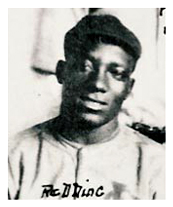
redding

Cannonball Dick Redding, more than qualified for the Hall.

Greetings all … Many, apologies for not posting for almost two weeks. The holidays, as I feared, knocked me out a bit in terms of time and discipline to put toward this here humble operation.

I was also contemplating and planning new directions and goals for this blog for the New Year. Instead of dedicating it to research, I’d like to zero in on advocacy, to have a purpose being my own little, often sequestered historical studies, whims and article development.

I want to try — again, in my own modest way — to make a difference. I want to start and pursue — with any help y’all are winning to provide — a heightening of Negro Leagues preservation and recognition of the men and women of segregation-era African-American baseball. Much still needs to be done, I feel, to sufficiently honor these legends and their legacies and influence on both modern baseball and society as a whole.

To that end, I’d like to, with this blog, concentrate of two main goals.

The first one is pushing to rectify the fact that multi-talented Hall of Famer Cristobal Torriente — a native of Cuba who was one of the greatest and most admired segregation-era players during the first two decades of the 20th century — might very well lay in a mass, unmarked grave in a New York City cemetery and could be the only Hall of Famer whose burial location is anonymous and unidentified.

torriente

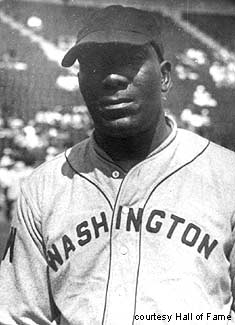
Cristobal Torriente

A few of us in the baseball research community have been batting around the exact location of Torriente’s grave and how, once that’s determined, to help make right this deplorable situation. Actually, the vast majority of the recent efforts toward this goal have been undertaken by Ralph Carhart, Gary Ashwill and John Thorn, with Ralph doing a yeoman’s job in the project. In fact, Ralph wrote a fantastic blog post here on his Hall Ball page about his mammoth task and adventure if the search for Cristobal Torriente.

The second goal is to, quite simply, work to open the Baseball Hall of Fame‘s doors to segregation-era, African-American players, managers, owners and executives, an injustice that has been sustained by the Hall since 2006. That insult is especially heightened by the fact that the HOF retains a “Pre-Integration Era Committee” that continue to elect white historical figures and not black ones, thereby further skewing the ration of Major League personalities to those of Negro Leaguers.

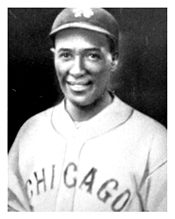
malarcher

Does Gentleman Dave Malarcher belong in the Hall?

Several blackball enthusiasts, such as my Malloy conference roomie Ted Knorr, have pretty successfully quantified this inexcusable inequity, a situation he detailed in this post on Home Plate Don’t Move. Others have striven to do much the same, and as their efforts bear out, the legendary figures of the Negro Leagues and Negro Negro Leagues are overwhelming underrepresented in an institution that purports to enshrine the best, most accomplished and most influential baseball figures ever.

We all know that such a claim is, at best, ignorance personified and, at worst, a flat out lie, a denial of justice, the galling equivalent of Hall officials covering their ears and shouting, “Nah nah nah nah nah I can’t hear you!”

This absolutely must change, and all of us in the blackball community must band together to make this change, to strive for fairness, to rectify a stubbornness that perpetuates prejudice and exclusion.

I want to do my own small part in this, and I know that one person can’t do it alone, and I hope a few of you will climb on board as well. If you’d like to help the effort, feel free to post a response to any of my blog posts and/or two email me at rwhirty218@yahoo.com.

We can do this, and we must do this if justice — true justice — will ever be served.

Many thanks in advance for anything you can do to this end.

Honoring a Baltimore hero and baseball legend

download-3

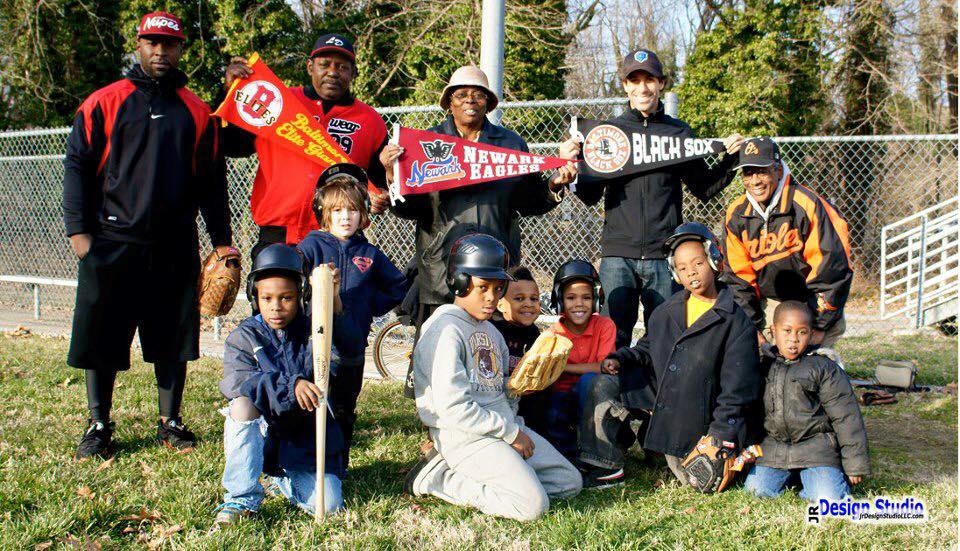
Little Leaguers at Leon Day Park in Baltimore. (All photos courtesy Michelle Freeman.)

As Christmas approaches and the happy holiday season continues, I wanted to put up a post about something good, something positive, something inspiring, and fortunately, my friend, fellow SABR member and Malloy Conference-goer Michelle Freeman was glad and eager to help out. 🙂

Michelle is the head of the Baltimore-based Leon Day Foundation, which honors the legendary Hall of Fame pitcher and his legacy by doing a whole bunch of good in the local community. And, seeing as how we’re less than a year away from what would have been Mr. Day’s 100th birthday, Michelle was gracious enough to submit the following article about the organization …

By Michelle R. Freeman, President
The Leon Day Foundation, Inc.

The Leon Day Foundation, Inc., was founded in 2001 by Mrs. Geraldine Day, widow of the late Leon Day, Negro Leagues pitcher and member of the Baseball Hall of Fame. The Leon Day Foundation is a 501(c) (3) non-profit organization dedicated to the education and preservation of the legacies of Leon Day and the Negro Leagues. The Foundation’s purpose is to give recognition and exposure to a group of talented baseball players who were never acknowledged. The Foundation is about kids and baseball, and the fierce urgency of connecting the two. We do this by making baseball history “relevant and exciting” and by playing baseball.

Prior to the founding of the organization, Leon Day’s memory and legacy were firmly cemented in Baltimore. In 1995, then-Mayor Kurt L. Schmoke renamed the Eutaw Street Plaza entrance to Oriole Park at Camden Yards the “Leon Day Way.” On Aug. 23, 1997, Mayor Schmoke renamed the former “Bloomsbury Oval,” a meadows/playground along the Gwynn Falls Trail, to “Leon Day Oval.” It is most commonly referred to as Leon Day Park.

Leon Day became the first Negro League player in Baltimore to have a city park named in his honor. This park has been a source of pride for families in the Rosemont/Franklintown community. The park received funding from Peter Angelos, majority owner of the Baltimore Orioles. Mr. Angelos provided funding for the baseball diamonds, basketball courts, playground, lighting system, dugouts and the viewing stands.

The park is also the host of the annual Leon Day Festival. This festival is usually held the second Saturday of June and provides an opportunity for families in the neighborhood to come together for a day of celebration, food, baseball games and fellowship. In 2013, the community center at Leon Day Park was dedicated in the memory of the late Mrs. Betty Hawkins. Mrs. Hawkins was a charter member of the Leon Day Foundation, Inc. and a community organizer in the Rosemont/Franklintown neighborhood. In 2013, a new mound was built at Leon Day Park. It was dedicated by the late Al Burrows, another Negro Leagues player.

Leon Day was inducted into the National Baseball Hall of Fame in 1995. He was the 12th Negro League player selected. Many of the records he established during his career still stand today: a record-setting seven appearances by a pitcher in the East-West All-Star Game; strikeout record in a game (18); strikeout record in the East-West All-Star Game (14); and the strikeout record in Puerto Rico (19).

download-4

Leon Day’s winning percentage as a pitcher was .708 and he consistently hit over .300. He was widely regarded as the best fielding pitcher in the Negro Leagues. In his career, he played every position except catcher. In 1937, as a member of the Newark Eagles, he was 13-0 on the mound and hit .320 with eight home runs. In 1942-43, he was named the best pitcher in the Negro Leagues. In 1946, after serving two years in the military, he pitched an opening-day no hitter against the Philadelphia Stars.

Why is Baltimore a center of Leon Day remembrance? Leon Day was born on Oct. 30, 1916 in Alexandria, Va. His family moved to Baltimore when we was six months old and settled in the Mt. Winans community. He was discovered playing baseball in the sandlots of Baltimore. He began his professional baseball career in 1934 with the Baltimore Black Sox. He is considered a son of Baltimore, and the foundation seeks to do its part to preserve his legacy.

Through the years, the foundation has sponsored various little league teams and a football team, as well as supported the baseball team at Carver Vo-Tech High School. Currently, the foundation sponsors the Yankees of the James Mosher Little League. This is a team for 9 to 12 year olds.

In 2014, the foundation established the Leon Day 10th Man Award. This award is given annually to a senior baseball player at Carver Vo-Tech High School. This award recognizes the player who best embodies the spirit and legacy of Leon Day. This player exemplifies the best in sportsmanship in conduct both on and off the baseball field. This player captures the “warrior” spirit that was the essence of Leon Day. The winner receives a trophy as well as a small monetary scholarship.

download-1

The foundation is currently developing curriculum for a teen-mentoring program. This idea developed due to the unrest in Baltimore after the death of Freddie Gray. This program will teach high school aged kids to serve as mentors in their schools.

The foundation is also committed to a better Baltimore. Our community partners include Docs in the Park, the KJM Youth Foundation, the James Mosher Little League, the Friends of Gwynn Falls Trail, the SABR Baltimore Babe Ruth Chapter, Bundy Films LLC, the Baseball Factory Foundation, the Epsilon Omega Chapter of Alpha Kappa Alpha sorority, Omega Baltimore, and the Hubert V. Simmons Negro Leagues Museum of Maryland.

The Foundation underwrites the Carver-Vo Tech High School Bears signature program’s Baseball Tuesdays and is active in their capital campaign to raise funds for a new baseball field in West Baltimore that would serve the Carver Bears and the baseball team of Coppin State University. Past projects include Sandlot Saturdays, a six-week program teaching baseball fundamentals to kids in the Rosemont/Franklintown community at Leon Day Park.

Throughout his career, Leon Day played for teams such as the Baltimore Black Sox, the Brooklyn Eagles, the Newark Eagles and the Baltimore Elite Giants. He played baseball in Puerto Rico, Mexico and Canada. He played briefly in the minor leagues during 1951-52. He would retire from baseball in 1955 and settle in Baltimore. Drs. Robert and Zohara Hieronimus successfully led a campaign to have Leon Day inducted into the Baseball Hall of Fame. On March 7, 1995, he received the call that he had been elected into the Baseball Hall of Fame. Sadly, he would pass away six days later on March 13, 1995.

Leon Day has been enshrined in the Puerto Rico Baseball Hall of Fame (1994), the Newark, N.J., Jersey Sports Hall of Fame (1993) and the Virginia Sports Hall of Fame (2002). A nomination was recently submitted to the Maryland State Athletic Hall of Fame. In 2016, the foundation will celebrate the 100th anniversary of Leon Day’s birth with a series of events during the year.

The Leon Day Foundation, Inc. is committed to preserving the legacy of Leon Day and all of the unsung heroes of Negro Leagues baseball. We are committed to creating opportunities to engage kids with baseball in West Baltimore. To learn more about the foundation, follow them on Twitter @leonday park and on Facebook here. Emails can be sent to the foundation at leondaypark@gmail.com.

Many, many thanks to Michelle for being willing to write such a wonderful piece for this blog, and for everything the Leon Day Foundation does to better the Baltimore community. Happy Holidays to all!

The Salt Lake Occidentals, the conclusion

Forthwith comes the second part of our intricate Salt Lake City tale, circa 1908, about the intersection of baseball, bigotry and breaking the law. (I like alliteration on occasion.)

In Part 1 from Thursday, I largely discussed the life, baseball run-ins and other travails of Frank Black, player manager of the city’s powerful African-American semipro barnstorming team, the Occidentals.

Part of Black’s story contains links to Salt Lake City’s red-light district of the 19-oughts, centered on Commercial Street. The hub of that seedy neighborhood was one “Candy Bill” McKenzie, an African-American businessman who owned a hotel and saloon at 43 Commercial Street — a business that allegedly was a “den of sin,” one that was constantly drawing the ire and legal attacks of the city’s white establishment.

As for McKenzie’s personal background and data, it’s been a tough slog finding much at all for the kingpin known as “Candy Bill.” About the only thing I’ve been able to glean I that during the 19-oughts, he owned and lived what are described as “hotels” on Commercial Street, according to a few city directories; his occupation is variously given as “bartender,” “porter” and “laborer.”

McKenzie appears to have arrived in Salt Lake City, from whereabouts unknown, in early 1905 but didn’t about the saloon/hotel until a couple years later. However, it quickly became a frequently site of violence and physical quarrels, it seems:

• On March 12, 1908, a popular African-American jockey, Jerry Chorn (or Shon or Shorn, in some reports), was charged with attempted murder after he allegedly pumped another patron of McKenzie’s establishment, Henry Staten, over a squabble over a craps game in the basement. Staten was hospitalized with serious wounds, but he eventually made a full recovery. McKenzie, as well as numerous customers, stated that the fight occurred in the saloon proper, not illicitly in the basement. Their assertions seem to have worked, much to the dismay of the Herald, which stated “the police were so completely hoodwinked by the story that neither the saloon nor the gambling house downstairs were closed because of the tragedy.”
• Roughly three months later, in June 1908, one “negro,” William Marshall, was cracked on the back of the head with a pool cue by an unknown assailant, resulting in a grave gash that required four stitches and place Marshall in a near-coma.

• Then, in September 1908, according to the Salt Lake Herald, “[O]ne more bloody crime was added to the long record of ‘Candy’ Bill McKenzie’s saloon at 33 Commercial Street … when Dick Hawkins, a hanger-on of the street, was shot and killed by David Logan, another Negro.” According to the paper, the fight’s origins began a week before in the Colored Elks Lodge and continued at the Americus club after Hawkins’ application for Elks membership was turned down, eventually spurring Logan to shoot Hawkins at McKenzie’s establishment.

• But the incident that takes the cake in terms of the overtly racist white media in Salt Lake came in September 1908 — that was apparently a very rough year at Candy Bill’s tavern — when Silas Wilson, “a negro,” was rushed to the ER after suffering a half-dozen knife wounds by Henry Taylor, “another negro.” The fracas erupted, allegedly, over a craps game and the winning by Wilson of a dime, an outcome that teed off Taylor, who then reportedly knifed the other man repeatedly. And how did the Salt Lake Herald describe the melée? Under the headline: “Negro Carves Dark Meat.” Oy vey.

The whole chronicle — which also allegedly included a billiard cue battle between two infantry soldiers and two incidents of gun discharges — was perhaps summed up in a Herald article on Sept. 11, 1908, covering the alleged murder of Dick Hawkins by David Logan:

“The murder Thursday morning is the sixth serious criminal act which has been committed in ‘Candy Bill’ McKenzie’s resort … since January. Of the six, only one conviction was secured, and in most cases no complaint was issued.”

However, it’s perhaps important to note that while McKenzie was the locus of alleged crime, other locales on Commercial Street did attract heated incidents as well. One such establishment was another saloon, this one owned by a Gus Williams.

A few days after the July 4, 1910, “Fight of the Century” in Reno between controversial heavyweight boxing champ Jack Johnson and former titlist and “Great White Hope” Jim Jeffries — which ended up with Johnson kicking Jeffries’ ass — the Salt Lake Tribune described a “Humble Edition of Championship Fight” at Williams’ tavern between “George Carter and Fred Clay, negroes, and a number of newsboys [who] got into an argument regarding the outcome of the Johnson-Jeffries fight … which resulted in the arrest of three newsboys and the two negroes …” Although the two sides lobbed empty bottles at each other, no one was hurt.

Then there was this scene described in the Oct. 20, 1903, Deseret Evening News:

“There was a rather torrid time in a Commercial street resort at an early hour this morning when two women, Fannie Lambert and Lillie Mueller, engaged in a hair pulling match. Just what provoked the fight could not be learned but jealousy is said to have been the cause. Officer Brown heard the women yelling and cursing each other and when he arrived on the scene of combat an interesting sight met his gaze. Fanny was doing her best to chew one and Lillie’s fingers off, and Lillie was industriously pounding Fanny over the head with a small alarm clock — just to pass the time away.”

Har har har.

Finally, way back in 1897, the Salt Lake Herald reported on a kerfuffle at a Commercial Street saloon operated by a businessman named Bruce Johnson. Allegedly, one Charles Barnett, “colored,” had been imbibing a decent amount when he got into heated words with a Fred Collins. Barnett came back to the bar in the evening and, upon spying Collins, whipped a large rock at Collins, ripping up a billiard table. Then, stated the July 22, 1897, Herald:

“Collins and Barnett then got together and as the former threw up his left arm to ward off a blow Barnett struck him in the side with a pocket knife. Barnett was immediately thrown out of the house and Collins went to have the cut, which bled considerably but was not serious, fixed up.

“Soon after the occurrence, Bruce Johnson, the proprietor, came in an heard of it. He immediately went out on a hunt for Barnett and soon found him. Johnson then marched Barnett to the police station and had him locked up.”

But it was doubtlessly McKenzie, his business and their clientele — most of them African-American — that irked the city’s establishment the most, partially because it seemingly was the crucible of all the “criminal activity” that was going down on and around Commercial Street.

And, as a result, city officials targeted McKenzie and his surroundings with a vengeance, beginning at least as early as September 1907, when the police chief launched a massive, early-morning dragnet of the Victoria alley area, a sweep that included the arrest of Bill McKenzie. We’ll let the Sept. 4, 1907, Deseret Evening News take it from there, with some barefaced racist reporting under the headline, “Dragnet Gets Scum of Society”:

“The raid was made by Officers Taylor and Seager … and as a result, 21 vags, thieves and resorters to houses of ill fame were rounded up and landed in the city jail.

“The haul was a big one and will do much toward cleaning out the undesirable element, for among the captured ones are a number of notorious violators of the law …
“In police parlance, the raid is called a ‘crib raid.’ The joints rounded up by the police are frequented by negro female pick-pockets, thieves and their male companions — parasites of the under-world. …

“When the officers swooped down upon the notorious alley, they found a most shocking state of affairs. White and black men and women, drunkards, ‘dope’ fiends, thieves, robbers and parasites were there in one heterogeneous mass. White men and black women, black men and white women, with a Jap or two to complete the ugly picture, is what confronted the minions of the law.

“Some were in a beastly state of intoxication. Others were under the influence of cocaine of morphine. Some of the women had blood-shot and blackened eyes. All were in a most depraved condition. Drinking, fighting and screaming was their pastime.

“Among the notorious ones arrested were Josie Russell and W.J. McKenzie, better known as ‘Candy Bill.’ Why he is called ‘candy’ no one knows, unless it is because of the fact that he is of the chocolate variety of negro.

“After they were landed in jail, Josie sang out to Bill: ‘Say, Candy, mah honey, what did dey all do t’you-all?’ ‘Candy’ did not deign to answer. Another one screamed out: ‘What fo’ did dey go an’ grab us an’ let a lot ob othah niggahs go fo?’”

So, yeah, there you have, laid bare for all to see, both then and now — a virulent racism  on behalf of a white population outraged at the fact that so many different races and genders were allegedly involved in such notorious and even obscene together.

Whether or not such crime was indeed going on around Candy Bill McKenzie and his saloon is probably irrefutable; just about every city, at one time or another, has had an infamous red-light district.

But what’s sinister about the true motivations behind such legal sweeps — as well as the press coverage of them, which obviously employed racist, stereotypical language, slurs, pigeon English, and “coded” terms like “parasites” and “undesirable elements” — is the fervorous nature with which they were undertaken and the fact that much of the white establishment’s anger was spurred by the cross-racial interaction that permeated the neighborhood.

But what’s also important to remember, though, is that one of the reasons for such zones was the segregation — whether enforced by law or by de facto economic and social separation — that disallowed and prevented African Americans in cities across the country from patronizing and enjoying above-board, legal (read: white) businesses, clubs and neighborhoods.

That forced minorities, as well as white citizens who wanted to interact with them, into such black-market, underworld establishments and hangouts. Often, they practically had no choice to do so.

Also inducing such “vice” and seedy behavior was often the lack of employment and other socioeconomic opportunities for African Americans that created poverty and despair and drove people to support themselves and their families any way they could, including saloons, gambling, drugs and prostitution.

Intertwined in this, quite unfortunately, was the existence of black baseball teams, which —again, because of segregation and lack of opportunity — were sometimes forced to the fringes of society and the economy, driven to legally iffy clubs and establishments that served as a base of operations for these teams and athletes.

McKenzie’s story doesn’t end there, though. In fact, the September 1907 police shakedown of the district marked a beginning, of sorts, of an all-out legal blitz by city officials against McKenzie and his neighborhood.

One day after the Deseret Evening News’ story on the September 1907 sweep, the Salt Lake Herald published a story that labeled the massive police action part of “a movement … to clean out dens of vice” that netted 21 “dissolute and vicious inmates of resorts.” While not directly using the word prostitution, the article made it clear that that was the main problem, especially because it involved the mingling of “black, white and yellow.” It added:

“Morphine, cocaine and opium fiends, as well as inveterate drunkards, were included in the haul. After the midnight crowds have deserted the street, the denizens of the resorts gather and complete the night with wild orgies, often continuing until after daybreak.”

The article points to Bill McKenzie as one of the primary kingpins of the neighborhood, largely because, it seems, McKenzie had by then, despite his relatively short time in town, amassed a large amount of political pull, which was derived from the city’s black population. The paper claims, in a tone dripping with racial animus, that McKenzie is “known to the criminal element as the colored chief of police” and someone who:
“… makes a business of supplying bail for unfortunates of his class and of ‘squaring’ resort robberies committed by the women with whom he associates.”

That one paragraph pretty much summed up the seems like the prevailing attitude of the white patriarchy in Salt Lake City at the time by implicitly linking race, socioeconomic class and corruption.

The establishment was so flat-out frightened by the immense pull McKenzie had with he city’s African-American and “lower class” populations that in March 1908 the Herald lamented that McKenzie’s business was not only still open, but was being used as a base of operations for allegedly crooked party politics, despite ongoing investigations and crackdowns by the police. The March 15, 1908, issue stated:

“‘Candy Bill’ McKenzie is exerting himself to the utmost to prevent any action being taken toward the closing of his place. Back of him, it is said, are several influential politicians whose efforts in his behalf are expected to result in the dropping of the investigation into the quick outbreak of lawlessness following the opening of ‘Candy Bill’s’ dive.”

A few months later, the city administration OK’ed a plan to essentially create a segregated city — if not explicitly according to race, then de facto via economic and social separation — by moving the “denizens,” especially the prostitutes, into a neighborhood that would be strictly contained and monitored by law enforcement.

The city fathers’ fear of Salt Lake’s working-class, i.e. largely black, population and its allegedly illicit connection to several officers in the police department — an association supposedly spearheaded by McKenzie as a successful businessman — reached a fever pitch in October 1909, when explosive allegations surfaced that claimed numerous police officers “herded” dozens, if not hundreds, of people from the tenderloin district to a voter registration office inside the police station. The goal, allegedly, was to qualify such citizens to vote, perhaps illegally, under the guise of “arrests” in the Commercial Street district.

The intrigue heightened a few days later, when the Herald-Republican newspaper published an exposé about allegations that members of the city’s so-called “American party” had clandestinely used the local Republican Party — which, more than 100 years ago, was the supposed champion of civil rights and racial equality — to sign up residents of and employees in the Commercial Street tenderloin district to the positions of city judges via base fraud.

And, coincidentally, that storyline brought the plot back to the Americus club, one of the informal headquarters of the African-American baseball team, the Occidentals, a connection I discussed in my previous post. The club, which was located just a couple doors down from McKenzie’s saloon on Commercial Street, allegedly played a large part in the corruption of judge appointments. Asserted the Oct. 16,1909, Herald-Republican, harkening back to its previous report:

“At the negro dive at 43 Commercial street, known as the ‘Americus’ club, the patrolmen went in and herded the negroes and brought them practically under arrest to the registry agent. There they registered, and checking up the number from that address it appears that the negroes must have been sleeping four to a bed, if the club was their legal residence. Some of these men who were forced to register by the policemen have since appeared in police court and received ‘floaters’ as vagrants.”

And thus we have everything tied up in a (somewhat) neat little bow that ties together all of these thematic strands — racial politics, bigotry, socioeconomic segregation, law enforcement and, unfortunately, baseball.

Was Salt Lake City alone in such containing such a quagmire of race and poverty — a quagmire that often dovetailed, sadly, with the segregated American pastime? Of course not.

But I see the Utah metropolis’ situation in the 19-oughts as a type of microcosm for the entire country at the time, especially in the West, where states — and their social, political, economic and racial structures — were still coalescing and solidifying.

As stated, it’s quite unfortunate that baseball, especially African-American baseball, was often entangled in this mess. But I believe that, in large part, that entanglement was necessitated by the prevailing institutional racism and segregation of the day. …

The Salt Lake Occidentals, cont.

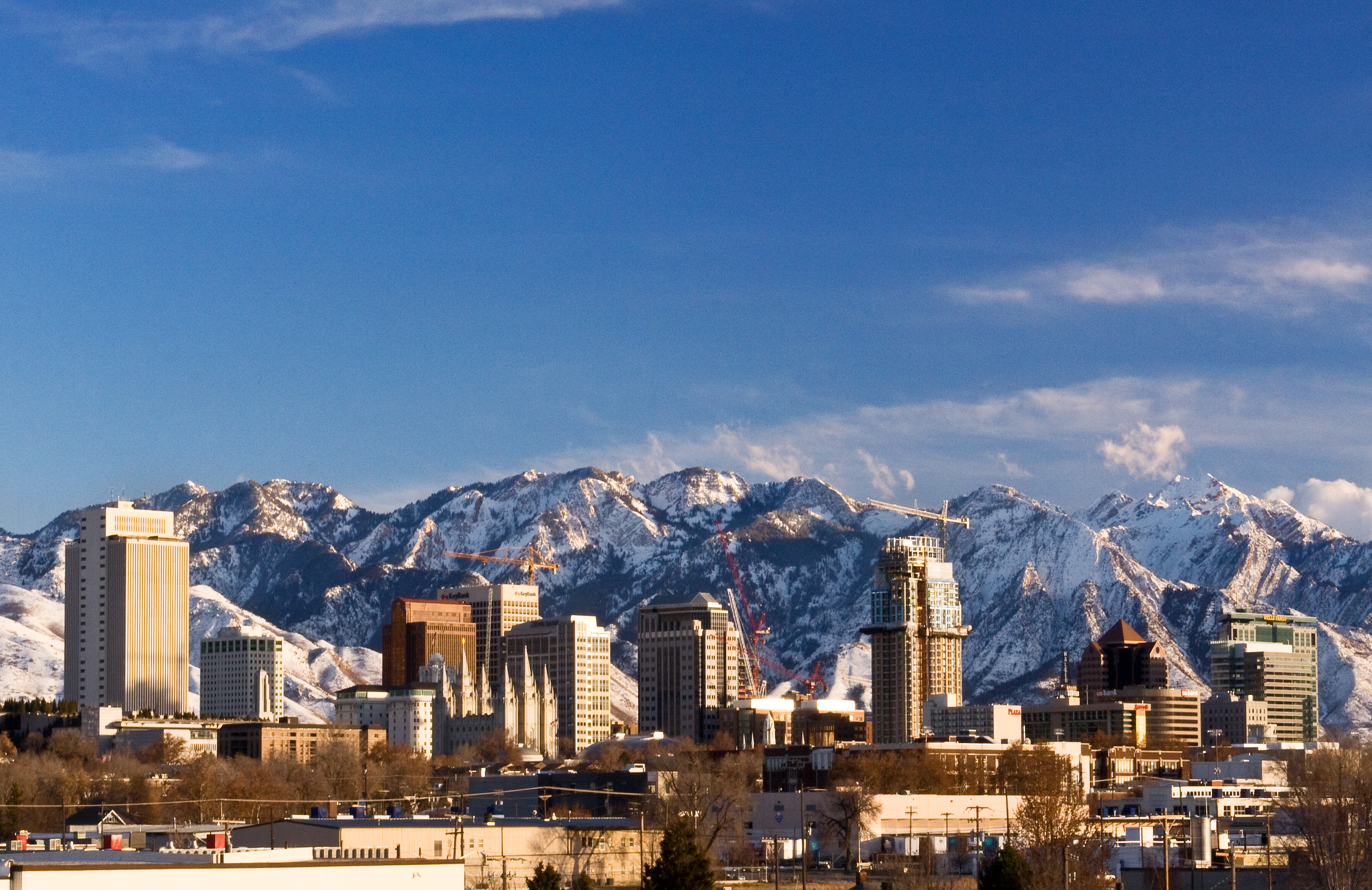
Salt-Lake-City_Matt-Morgan

It’s been a while since my last post about the Salt Lake City Occidentals, an African-American barnstorming based in that Utah city circa 1910. I recently submitted an article on the Occs for Salt Lake Magazine, and in this post here I discussed the squad’s historic 1909 showdown in Los Angeles with a picked nine of Japanese Americans in the City of Angels.

I’ve been wanting to get back to the Occidentals on this blog for about a month now, but with the holidays and everything, it’s been difficult to write much of late. Plus, as per my usual, I’ve been focused on some health situations that’ve made it a challenge to put much pen to paper, or fingers to keyboard, so to speak.

But anyway, back to the Occidentals …

In addition to barnstorming like crazy throughout the West — and, in so doing, touting themselves as “colored champions” of that region, with sufficient success to back up that boast — the Occidentals seem to have had some connections to Salt Lake City’s somewhat seamy underbelly.

That includes links to, among other stuff, a shady saloon owner who might have doubled as, well, a pimp. Or at least an early 20th-century Utah version of one.

First, there was one of the Occidentals’ players/managers, Frank Black, who had a few run-ins with the law during his stint helming the barnstorming aggregation. In September 1908, for example, Black, who was manning third base for the team at the time, was sought by sheriff’s deputies after he allegedly pointed a revolver at one of his players, a U. Campbell, during a squabble over — what else — money. Reported the Sept. 21, 1908, Salt Lake Tribune:

“Campbell stated that he was in the Americus club at 43 Commercial street settling up some money matters with several members of the team, and that Black was dissatisfied with the deal and drew a revolver and threatened to shoot him.

“Campbell claims that a few days ago in paying the members of the team he [Black] gave each $4.15 too much by mistake, and [Black] made the demand that it be given back to him.”

A deputy phoned Black, who agreed to appear at the police station and explain his side of the affair. He was released without bail on the promise that he’d return the next morning.

I couldn’t find the outcome of that case; it wasn’t unusual at the time for newspapers to report arrests and not following up on the judicial outcomes of the cases. Also, keep the Americus club and Commercial Street on the back burner — they’ll come up a little ways down.

About three and a half years later, that scene seemed to repeat itself, only this time with the Occidentals’ star pitcher at the time, Al Mooney, and Thornton Jackson, one of the city’s first African-American police officers.

This time around, Mooney and Black dickered over the whereabouts of the pitcher’s playing uniform and some cash Black allegedly owed Mooney. According to the Feb. 19, 1912, Tribune:

“Black explained to his favorite pitcher the necessity of procuring the uniform instanter [sic]. The argument grew so warm that it disturbed the repose of Thornton Jackson, the newly appointed colored patrolman, who took the two ball players to the police station.”

At the cop offices, Thornton heard the two sides of the verbal battle and ordered the baseball-playing pair to settle up or face formal arrest. Thus, said the Trib:

“The two players left the station together, without having their names placed on the blotter. Patrolman Jackson, having restored peace, went back to his beat, satisfied that he had performed his duty.”

(Jackson’s story is in and of itself a pretty fascinating one. After about five years on the beat, Jackson suddenly resigned from the police force in 1913, with no explanation given by either himself nor the chief of police. Shortly after that, the commission gave Jackson a job at the local waterworks department after “Jackson [had] written a letter to each of the commissioners, asking for work and pleading that because of his sick wife and numerous progeny he is in destitute circumstances.” The Georgia-born Jackson, who had served in the Army during the Spanish-American War, died in 1927 at the age of 65.)

Frank Black’s wife, Gertie, also seems to have run into trouble on occasion. In September 1908 — a week after Black’s run-in with Campbell, the pitcher — Gertie Black was being sought on iffy charges. Stated the Tribune:

“Sheriff C. Frank Emery and his gang of sleuths continued their ramblings about the streets of Salt Lake Friday, keeping a sharp lookout for women who they thought were trying to violate the law.

“As a result, two women were arrested — Mrs. Gertie Black, wife of Frank Black, who played third base on the Occidental baseball team this season, and Beatrice Martin.

“Mrs. Black was released shortly after her arrest on $300 cash bond, given to Justice F. M. Bishop. … Each is charged with vagrancy.

“All the former ‘sporting’ houses of Commercial street and Victoria alley were dark last night, just the same as they have been since the beginning of the crusade against the women on Tuesday night.”

And that’s where the tale gets really interesting, and it weaves together several strands of situations and brings together marital strife, criminal activity and an overtly racist civic “crackdown” on African-American-owned business.

As we’ve already seen, the city’s white majority held feelings of paternalism (in the case of Patrolman Jackson) and suspicion (in the case of Gertie Black’s questionable arrest) at worst toward the black community.

As for the marital issues, it seems that Gertie Black might have divorced Frank Black _ or maybe not — and married another man, Charles C. Rucker, in 1916 in Salt Lake City.

Regardless of her exact marital status, Gertie Black died in April 1952 of a heart ailment in Salt Lake at the age of 54. In newspaper obituaries, she was described as the widow of frank Black, but she had no known survivors.

Thus, Frank Black died before 1952, but I have yet to pin down an exact date of death for the local baseball luminary.

However, what I do have is a reason for the couple’s possible marital discord — a reason that also segues into a larger tale of alleged corruption and overt racism in the city.

Under the sensational headline, “Colored ‘Vags’ Arrested, the Aug. 31, 1906, Deseret Evening News reported:

“Early this morning three colored men and two white women were arrested by the police and lodged in jail on the charge of vagrancy. It is alleged, by the police, that the men have been living with the white women. The names of the prisoners are, E.T. Withers, Bill McKenzie, Frank Black, Maud Montell and Ada Wilson.

“Bonds in the sum of $100 each was [sic] demanded by the bail commissioner, and the prisoners managed to furnish the same. They will be arraigned before Judge C.B. Diehl and will be tried tomorrow morning.”

With that two-paragraph article, the paper opened a Pandora’s Box of complicated, interwoven plotlines — as well as linked the narrative to the city’s prevailing racism of the day.

We have baseball manager Frank Black allegedly shacking up with a white woman, which clearly honked off the city’s white authorities enough to arrest him as a “vag.”

And we have that very charge of vagrancy, which, while vague — and also applicable to Gertie Black’s charges in 1908 — strongly hint at a suspicion of prostitution and “ill repute” on behalf of some of the city’s women.

Then we have another arrestee in the 1906 case, Bill McKenzie, who is, in many ways, the epicenter of this yarn …

First, remember way up earlier in this story, when in 1908 Frank Black allegedly pulled a  hefty-sized gun on pitcher U. Campbell? Campbell had been at the Americus club on Commercial street with several other Occidentals players. In fact, the establishment had its own amateur black baseball team who played other city teams and challenged all amateur aggregations statewide.

The Americus club was located a 43 Commercial Street. Which, as it turns out, was smack dab in the middle of Salt Lake City’s seedy red-light district.

It was in the Commercial Street neighborhood where, alleged city authorities, African Americans came for hookers — often white ones, which irked the officials to no end — illicit gambling, booze and, on several occasions, murder and violence. That included, apparently, the Americus club, a popular hangout for members of the Occidentals.

The hub of the neighborhood was William “Bill” McKenzie, an African-American entrepreneur who owned a tavern at 33 Commercial Street and became the bane of the city’s overwhelmingly white law-enforcement officials and politicians.

That’ll wrap up Part 1 of this topsy turvy tale of baseball, politics, institutional racism and criminality, with Part 2 to come in the next day or two …

A peppery young catcher

White,Burlin

I just finished an article for Discover Maine magazine about a game played in 1949 between the Boston Colored Giants, a barnstorming Negro League team based in the Hub that had existed since the 1920s, and the Goodall-Sanfords, a semipro team from Sanford, a textile mill town in York County, Maine.

The details of the game, for the purposes of this blog post, really aren’t that important, other than it was halted after seven innings because of rain with the Giants up, 6-3.

What I’d like to focus on a bit is the players on the Boston Colored Giants’ roster — or, rather, one player in particular, catcher Burlin White.

White was the catching half of the Giants’ celebrated, long-running battery that featured the legendary Cannonball Will Jackman on the mound. While Jackman himself is a fascinating subject — a Texas native one of the acknowledged greatest hurlers in blackball history who also chose to stay out of the national limelight in favor of becoming a New England luminary — his story, especially in in the last couple decades, has gradually become more well known.

For example, check out this essay by the late Dick Thompson. In addition, a phenomenal outreach and educational foundation based on Jackman’s life and values has been in operation since 2009.

But I can say that, at least for me, Burlin White presents unchartered waters. While a decent amount has been written about him, such as on Gary Ashwill’s Agate Type blog here, I embarrassingly hadn’t heard of Burlin White until beginning the Discover Maine article, an ignorance I’m a bit ashamed of.

I was so unaware of White’s story that this line in an article from the June 4, 1949, Portland Press Herald describing the upcoming Giants-Sanford contest threw me for a loop:

“The famed battery of Will Jackman and Burleigh White will be with the visitors in this first appearance of the season at the local park.”

When I read that archived article, I thought I should delve into the background of this “Burleigh White” fellow to fill out the magazine article a bit. But when I did some archive and online searches for that moniker, I pretty much came up empty.

That, naturally, puzzled me a wee bit. If this pitching-catching combo had indeed been “famed,” I pondered, then why can’t I find anything about the receiving part of the duo?

It took me a while and more than a little consternation (and an audible cuss word here and there) to trip across White’s real name and, after that, his background and career.

005217835_05626

Burlin White — per his World War I and World War II draft cards, his Social Security records and his military file — was born on Feb. 5, 1895. The question, though, is where he was born …

Some records, including Census sheets, his WWI draft card and Seamheads — not to mention the always trusty Wikipedia (some sarcasm there) —  assert that White was birthed in Richmond, Va.

However, I think that’s incorrect.

Why? ’Cause I’m an adopted Hoosier, gosh durn it!

The 1930 U.S. Census indicates that White (as well as both his parents) was born in Indiana, and his WWII draft card states that he was from Richmond, Ind.

Richmond, Ind., is a small city in the eastern part of the Hoosier State, right on the Ohio state line. Richmond, Ind., is home to the Indiana University-East campus, as well as the Indiana Football Hall of Fame. (From what I recall, it’s also the hometown of my college buddy Doug Haller, who worked at the Indiana Daily Student with me, where we both covered the IU football team’s 1993 season.)

Buttressing this argument is the fact that just about every biography — not to mention much of the early press coverage of White’s baseball journey — has him starting his paid baseball career with the West Baden Sprudels, a famed semipro spa team based in French Lick, Ind., in the rolling hills of southern Indiana. (Today, French Lick is probably best known as Larry Bird’s hometown.)

It then makes more sense that the scrappy, young White made the journey to French Lick from Richmond, Ind., than from Virginia.

Regardless, by 1915, White had joined the Sprudels; his name starts popping up in a few box scores from the team’s barnstorming games across the Indiana countryside. However, it doesn’t seem like he was the squad’s everyday catcher — he wasn’t in the lineup for most of the West Badens’ matches with the vaunted Indianapolis ABCs, for example, and he rarely was on the receiving end of pitches from the squad’s star chucker, Steel Arm Johnny Taylor.

But someone took notice, though — from West Baden, White moved up to the blackball big time when he signed on with the Chicago Union Giants in 1916 and the Atlantic City Bacharach Giants the next year.

His baseball career was interrupted briefly for service in the Army in 1918, first at Camp Dix in Ohio, then on the Western front in France with the 349th Colored Regiment. He was eventually promoted to sergeant of an artillery company, according to this article from the Logansport Pharos-Tribune upon his discharge in early 1919

Logansport_Pharos_Tribune_Thu__Mar_6__1919_

By then, he was already making a name for himself as a catcher, a fact reflected by the large photo of him in the may 4, 1918, issue of the Chicago Defender that was accompanied by this caption:

“Peppery backstop of the Atlantic City Bacharachs, formerly with the Chicago Union Giants and the West Baden Sprudels, and who last year played a stellar game with the Bacharach nine, was called to the colors on April 25. …”

Once discharged from the military after the end of the war, White resumed his career with several semipro and professional Negro Leagues teams, often with semipro and barnstorming teams, but also with top-level organizations like the Bacharachs, the New York Lincoln Giants and the Harrisburg Giants.

In 1924, for example, White signed on with a team based in Buffalo, N.Y., named the Steel City Giants, which the Philadelphia Tribune termed a “newly organized ball club, owned by C.R. Estill of Lackawanna district … [who] have caused a sensation in recent games with the fastest semi-pro teams in the western portion of the state.”

As the 1920s wore on, White apparently both retained his connection to Indiana and began his long partnership with Will Jackman, with whom he teamed early on when the two were both playing winter resort ball in Florida. Per the April 18, 1925, Pittsburgh Courier:

“Burlin White, one of the most sensational players of the Palm Beach season, writes from West Baden, Ind., that he is there conditioning for the coming season.

“He writes that he would like to hear from managers desiring a first-class catcher.”

White continued into the 1930s, when he, among other career moves, hitched up with the Cuban East Stars and, more importantly, launched his second baseball life as a manager.

That includes signing on for the dual role with the Boston Royal Giants, one of the forerunners of the Boston Colored Giants. Per the Baltimore Afro-American in August 1937:

“Burlin White, manager of the Boston Royal Giants, issued a call this week for two pitchers, a catcher, two infielders, a shortstop and a third baseman.

“Players are requested to write Mr. White at 365 Northampton Street, Boston. The Giants are scheduled to begin a Southern tour September 15.”

As that brief article indicated, by the late 1930s White had already settled in the Boston area, where he rented an apartment in the largely African-American neighborhood around Northampton Street, re-teamed with Cannonball Jackman and helmed the Royal/Colored Giants into the 1940s.

miusa1939b_082613-03539

White even helped guide — or almost did — that aggregation into a new but eventually scrubbed circuit coined the Negro Major Baseball League of America.

I hope to eventually look more closely at this fascinating but soon terminated league itself one of these days, but for now I’ll just report that, as described by the press in spring 1942 — when White was nearing 50 years old — the NMBLA included (or would have, had it lived), the following franchises: the Cincinnati Clowns, Chicago Brown Bombers, Detroit Black Sox, Baltimore Black Orioles, Minneapolis-St. Paul Gophers and Boston Royal Giants.

As originally planned, the nascent league would have had Major R.P. Jackson, former Negro American League president and long-time member of the Chicago City Council, as president, and former collegiate football star and then-current newspaper editor Fritz Pollard Sr. as VP.

It seems as if the Cincy Clowns — formerly called the Ethiopian Clowns — were pegged early on as the favorites for the NMBLA’s fledgling 1942 campaign. However, Burlin White, as the skipper of the Boston Royals, begged to differ, according to a May ’42 African-American wire service article that quoted him as asserting:

“The consensus seems to be the Cincinnati Clowns have the championship all but stowed away, with the Chicago Brown Bombers figured for the runner-up spot. Well, all I can say is that we’ve got a mighty fine ball club in the process of making for Boston and no one’s going to find us a pushover.”

As things played out, the new league obviously never really got off the ground, and I hope to look into the NMBLA’s fleeting history and perfunctory demise at some point on this blog.

But for now, it’s pretty impressive that, regardless of how harebrained the idea might have been, Burlin White (and, by extension, the Boston Royal Giants) played a decent-sized role in the plans for a whole new Negro League, a fact that speaks to how respected and well regarded White had become as a player, manager and executive in the world of African-American baseball.

White’s active career in the American pastime continued for a few more years — as stated above, White was part of the Colored Giants unit that came to Sanford, Maine, in June 1949 when White was well over 50 — before he retired to suburban life in suburban Massachusetts, where he served as an ambassador for the Negro Leagues and segregation-era African-American baseball, including suiting up for old-timers’ games.

Burlin White died in 1971 in Bedford, Mass., when his legacy as a sturdy, top-notch (albeit largely journeyman) catcher-manager was secure. White’s name might not be the most spoken or well known name when it comes to Negro Leagues history, but it’s also undoubtedly one of the most esteemed and plentiful in blackball annals.

The injustice lives on


FowlerBud-1

Does Bud Fowler belong in the Hall of Fame? (Photo from the BHOF)

I earnestly love the Baseball Hall of Fame; I’ve been there many times, and it’s only a few hours from my hometown of Rochester, N.Y. Since the publication of Only the Ball Was White — Larry Lester wrote a phenomenal commentary here about the influence of Robert Peterson’s seminal 1970 tome — the Hall has gone a long way to making up for the decades of segregation in its hallowed halls and the century-long exclusion of persons of color from organized baseball.

But has it done enough? And has it returned to that de facto ostracizing of segregation-era African-American players, managers, owners and executives.

Unfortunately, many in the Negro League research community and extended fandom — including me — think so.

In 2006, a special Negro Leagues committee elected 17 new segregation-era figures into the Hall. In a July 31, 2006, article about that magnanimous gesture, Pulitzer Prize-winning New York Times  columnist Ira Berkow wrote after the induction ceremony, quoting Rachel Robinson:

“In the sunshine on this broadly glorious afternoon, and looking elegant, at age 83, as she sat in the first row at the Baseball Hall of Fame induction ceremony, Rachel Robinson said: ‘For me, personally, this is a historic day. I’m very proud. It’s been a long time in coming.’

“Rachel Robinson, widow of Jackie Robinson, was referring to the 17 players and executives of Negro leagues and pre-Negro leagues who had been named to the shrine. A committee of a dozen researchers determined who they considered most deserving of, essentially, no longer being excluded from the Hall of Fame.

“‘I’m not going to moan and groan about how long it took,” she said. “Social change takes time. We feel very impatient when it doesn’t happen fast enough, but, in this one area, anyway, this brings a kind of completeness.’”

That was a pretty nifty thing for the Hall of Fame to do; especially bold and immensely gratifying was the induction of so many blackball legends.
However, at the same time, that massive induction class was declared the final Negro Leagues admittees into the Cooperstown institution.

That’s it. Kaput. Done. Over and out.

No more Negro Leaguers. No more pre-Negro Leaguers. They were once again excluded from the Hall of Fame.

And the injustice seemingly began again. And that was almost a decade ago.

But how, exactly, is this an injustice? How is it the resumption of segregation?

Because, while pre-integration era African-American figures are no longer eligible for admission, every year the Hall elects several white baseball figures from that time period.

eagles rap dixon

And what about Rap Dixon?

That comes in the form of the Pre-Integration Era Committee, a 16-member panel of voters and SABR members, mostly from the media.

Each year the group selects white [my emphasis] men — and it is undoubtedly only men — from the time before Jackie Robinson came along.

Again, no Negro Leaguers. At all.

This year’s Pre-Integration Committee vote came today (Monday, Dec. 7) at the Baseball Winter Meetings in Nashville. Ten men in all were in the pool of potential inductees; each one needed receive at least 75 percent of the votes of the Pre-Integration Committee.

There were 10 men on the ballot (no women, of course), and none of them earned enough votes to garner induction status, but Doc Adams, Bill Dahlen and Harry Stovey came closest. Here’s an excerpt from the press release from the HOF’s Web site on the vote:

“The National Baseball Hall of Fame and Museum’s Pre-Integration Era Committee announced balloting results Monday for its 2015 election of players, managers, executives and umpires. The ballot featured six former players, three executives and one of baseball’s earliest organizers and was considered by a 16-person committee featuring four Hall of Famers, four veteran baseball executives and eight historians/media members.

“Doc Adams received votes on 10 of the 16 ballots for a percentage of 62.5, while 19th century players Bill Dahlen and Harry Stovey each received votes on eight of the 16 ballots (50 percent).

“Sam Breadon, Wes Ferrell, August “Garry” Herrmann, Marty Marion, Frank McCormick, Chris von der Ahe and Bucky Walters received three or fewer votes each.

“The Pre-Integration Era Committee considered the ballot of candidates whose contributions to the game were most significant from baseball’s origins through 1946. Committee members could vote for zero to four candidates on each ballot.

“The 16-member Pre-Integration Era Committee commissioned with the review of the 10-name ballot met Sunday and Monday in Nashville, Tenn., …”

Now, it’s hard to quantify the argument that more segregation era African-American figures belong in the Hall. It’s hard to come up actual numbers that show that segregation-era black baseball stars are severely underrepresented in the Hall. But a while ago my buddy Ted Knorr attempted to do so, with fairly clear results. Here’s an email he sent to me:

“There are 344 players in the Hall — 315 MLBers; plus 29 Negro Leaguers. Of those 344 players (NOTE: players only), 166 began careers during the segregated era — 137 MLBers (83 percent) and 29 NLers (17 percent).

“Since Integration, an additional 78 Hall of Fame players began their — 45 (58 percent) of whom could have played MLB prior to integration, and 33 (42 percent) who could not.

“Given greater opportunity for Negro Leaguers to play baseball at the highest level during the segregated era, it is interesting that the Hall of Fame roster would indicate greater achievement during the integrated era.

“The truth is that the achievement is more accurately recognized today than yesterday. It is important, as an educational 501c3 non-profit, that the Hall of Fame renew its practice, ended in 2006 (in place 1971-2006), of recognizing those Negro Leaguers worthy of the Hall of Fame.”

Ted vehemently believes that, for example, his fellow Harrisburg native, stellar outfielder Rap Dixon, belongs in the Hall, and he’s provided a plethora of supporting evidence. Blog posts about the subject are here and here. He added in that email to me:

“In order to equal the demonstrated and recognized level of Negro League Hall of Famers during the segregated era as in the Integrated Era (42.3 percent), it would take an additional  71 Negro League players.

“However, I don’t necessarily feel that 71 additional Negro Leaguers need to be inducted. I do feel that all players remaining on the 2006 ballot — 19 by my count — should be inducted as soon as possible by the Hall. After all, MLB paid $250,000 for the study that was used by the Hall of Fame appointed panel to induct 17 players and personages in 2006, and we might as well use the results of that effort.

“Following that action, ideally in 2016 (the players and families have waited long enough), I think another $250,000 should be invested by MLB in further statistical compilation, further biographical work and the induction of up to 52 additional Negro Leaguers in order to properly fulfill the educational mission of the Hall as it realistically portrays baseball in the first half of the 20th century.”

Ted added:

“It is my opinion that the greatest omissions with regard to deserving Negro Leaguers are Gus Greenlee (a non-player), John Beckwith, John Donaldson and Dick Redding. For an outfielder, Rap Dixon would be my choice; and a second basemen, could be George Scales (or Monroe, DeMoss, Allen or Hughes).”

All of those are certainly worthy of induction (although one or two might be problematic, such as Greenlee, the (in)famous owner of the Pittsburgh Crawfords who made his fortune largely through numbers running and other shady dealings in the underworld), and I personally believe Cannonball Dick Redding is particularly deserving. After all, I’ve blogged a lot about him, such as here, here and here.

Another Hall of Fame advocate is Jeffrey Laing, who feels — as do I, and as do many other blackball enthusiasts — that ubiquitous, seemingly ageless 19th-century star Bud Fowler more than earned a spot in Cooperstown.

Fowler played for decades for dozens of teams across the entire country, manning just about every position on field at one point or another and even launching numerous new teams and ventures as manager, owner and promoter.

But Bud is still shut out, despite his innumerable achievements before and around the turn of the century, and Laing, who wrote this comprehensive biography of Fowler, isn’t happy. Here’s an excerpt from an e-mail he sent me last month encapsulating his arguments for Fowler’s massive importance to the history of the American pastime:

“Fowler gave the lie to the racialist theory that was a strong cultural strain in creating and maintain the colored line: He was intelligent, perseverant, industrious and emotionally fit for the extremely competitive nature of 19th-century baseball. His exclusion from Cooperstown is a travesty.

“It appears that the lack of newspaper sources — box scores, interviews, and profiles — by both black newspapers (who were concerned more with political and social issues rather than sports) and mainstream (white) media (who viewed the black game and players as “minor” in importance and interest) is a major contributing factor in Fowler’s being ignored.

“So, too, I believe, is the lack of reliable statistics on the team and individual levels.  Finally, the fact that Fowler was never extended a contract for a second year by any club for whom he performed may suggest that he was a curiosity more than a talented player who faced daunting social and cultural odds.”

But despite such eloquent advocacy on Fowler’s behalf, for now at least its all for naught.

True, there are valid arguments for the exclusion, and there could be several reasons, regardless of validity, for the Hall’s ongoing position.

That includes counterpoints to the lobbying for 19th century players like Fowler.

When I asked Peter Mancuso, chair of SABR’s 19th Century Research Committee, he said he couldn’t really take any particular public stance on the issue. However, as someone who advises the Hall of Fame on matters — although he stressed that he has no say in the election of inductees — he speculated about a few possible reasons why (again, he made no judgment on these arguments either way) the Hall might continue to eschew induction of 19th-century African-American players:

“One reason might be that the HOF has in the fairly recent past inducted a large number of African-American players using a fairly exhaustive process to select the very best.

“Another reason, in regards to the 19th-century African-American players, only Fleetwood Walker actually had a ‘major league’ playing season. Of course, the need to dig deeper into 19th-century African American’s baseball careers — albeit minor league or independent team play — is necessary to elevate public’s  awareness of these individuals.

“Again, sheer speculation. Bud Fowler has been getting the attention of our Overlooked 19th-Century Baseball Legends project, because they recognize that he should have been a major leaguer if the racial playing field had been level in his day. Whether he will rise to HOF selection status is still yet to be seen, [but] one could only hope so.”

And Peter points out a key actuality — 19th-century blackball figures are certainly eligible for the Overlooked Legends recognition.

redding_dick_1

Or the Cannonball?

Plus, the Hall also bestows the prestigious Buck O’Neil Award, details of which can be found at this Hall site.

But, to wrap things up, here’s an excerpt from a commentary by Trentonian contributor Steve Buttry in the Oct. 5, 2015:

“Jackie Robinson ended segregation in major league baseball, but not in the Baseball Hall of Fame.

“The Hall of Fame has a Pre-Integration Committee that considers only white players and contributors from long ago for honors in Cooperstown. But the Hall no longer has a Negro League Committee to consider the stars excluded from “major” league baseball. Those two facts revive and perpetuate the exclusion of a bigoted era that is a shame to the sport and our nation.

“I hope this result is unintentional (as many actions with racist results were and are), but that doesn’t make it excusable. …

“Adding still more players from the Bigotry Era cheapens the Hall of Fame in two ways:

“1. Whatever their achievements, the “major league” hitters before 1947 didn’t have to face Satchel Paige, probably the best pitcher of his time, and other Negro League pitching stars. And the “major league” pitchers didn’t have to face some of the best hitters of their time, such as Josh Gibson and Cool Papa Bell. So all of the career statistics and other achievements in baseball before 1947 should be discounted.

“2. At all levels of Hall of Fame selection — the Baseball Writers Association of America voting and second-chance elections by various Veterans Committees — standards were not as demanding of players before integration as they have been since.

“Lots of players from recent decades who will never make the Hall of Fame had better careers than players from the 1920s and ’30s who are already in Cooperstown (especially the cronies and teammates of Frankie Frisch, who spent six generous years on the Veteran’s Committee).

“Last year the Golden Era Committee, considering players whose prime years fell between 1947 to 1972, rejected all 10 players on the ballot. African American Dick Allen and dark-skinned Cuban Tony Oliva each came up one vote short of election, receiving 11 of 16 votes (75 percent of the vote is required). Other minority players rejected by the Golden Era Committee were Maury Wills, Minnie Miñoso and Luis Tiant.

“Each of those players clearly measured up to or surpassed multiple counterparts from the Jim Crow Era who are in the Hall of Fame.”

I apologize greatly for the length of this post, but I think this issue is pressing and urgent enough to require address immediately, and there’s a plethora of evidence and examples to support the general opinion expressed by several commentators in this post — that the Hall of Fame has once again shut out the Negro Leagues and thus rekindles and perpetuates the segregation that plague America’s pastime for so long.
So … what do you think?