No Clowning around in the stands

1385395573000-bush-4-1-

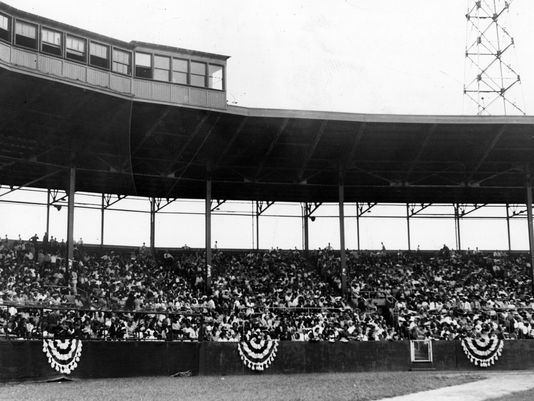
Bush Stadium, way back when …

Well, I’m back after a much-too-long hiatus, and I have a couple subjects upon with I’d like to expound and/or report. One is a very serious topic that I’ll try to start tackling tomorrow and over the weekend, but I’ll keep the exact nature of the subject quiet for now. I’m also going to attempt very hard to pull together updates on the situations of both Ducky Davenport here in NOLA and Alexander Albritton in Philly.

But today, a much lighter, even quirky story of a young white Indianapolis teenager combing through a crowd of nothing but black faces …

A couple weeks ago, Chris Rickett, an old friend from my college days at the Indiana Daily Student — he and I, in fact, are bonded by an unforgettable incident that should be well known to those who read this who were in the IDS at the time — messaged me on Facebook and told me about his step father, Phil Nolting.

Phil, as it turns out, spent several summers while a teenage student at Indianapolis’ Arsenal Tech High School in the early 1950s trudging up and down the steep stairs at Indy’s old Bush Stadium, hawking peanuts, Cracker Jack — singular, people, not the plural Jacks! — and beer during baseball season.

Most of the time, Mr. Nolting criss-crossed the stadium aisles at Indianapolis Indians games, when the city’s longstanding minor-league franchise in Organized Baseball did their thing on many a sultry central Indiana night 60-plus years go.

But, Nolting says, when the Indians were out of town on a road trip, Bush Stadium would play host to what has, in historical hindsight, become the city’s most famed hardball team — the Indianapolis Clowns on the Negro Leagues.

And young Phil, along with his brother and a handful of other pals from Arsenal Tech, would ply his adolescent trade for the Funmakers’ home games — that is, when the Clowns weren’t barnstorming like mad for much of the season.

It was, to say the least, an interesting situation for Nolting.

“My and my brother used to joke that we were the only white people out there,” Phil says.
That’s because the first couple years of the 1950s were a very, very heady time in Indianapolis, including when it came to race relations. As Phil noted to me, “Integration was just starting to take place.”

Athletically, Indiana has always been, of course, a basketball-first state, and the early 1950s were huge years in Indianapolis in that regard. This was the era of the famed “Milan Miracle” (the true story on which the movie “Hoosiers” is based), but that was followed by an even more culturally and racially significant event — the hoops team from Indy’s Crispus Attucks High School, led by the Big O, the incomparable Oscar Robertson, became the first all-African-American team to capture the state championship.

That was a watershed moment for sports and race relations in a state that just a quarter-century before had played host to the national KKK headquarters and whose government was quite literally in the hands of the Klan — they were everywhere in Indiana.

And, with the crucial Brown v. Board Supreme Court ruling on segregation still a couple years away, Indianapolis, at the time, could be viewed as walking a tenuous line between being a geographically Northern State but, it many ways, a culturally and socially Southern State.

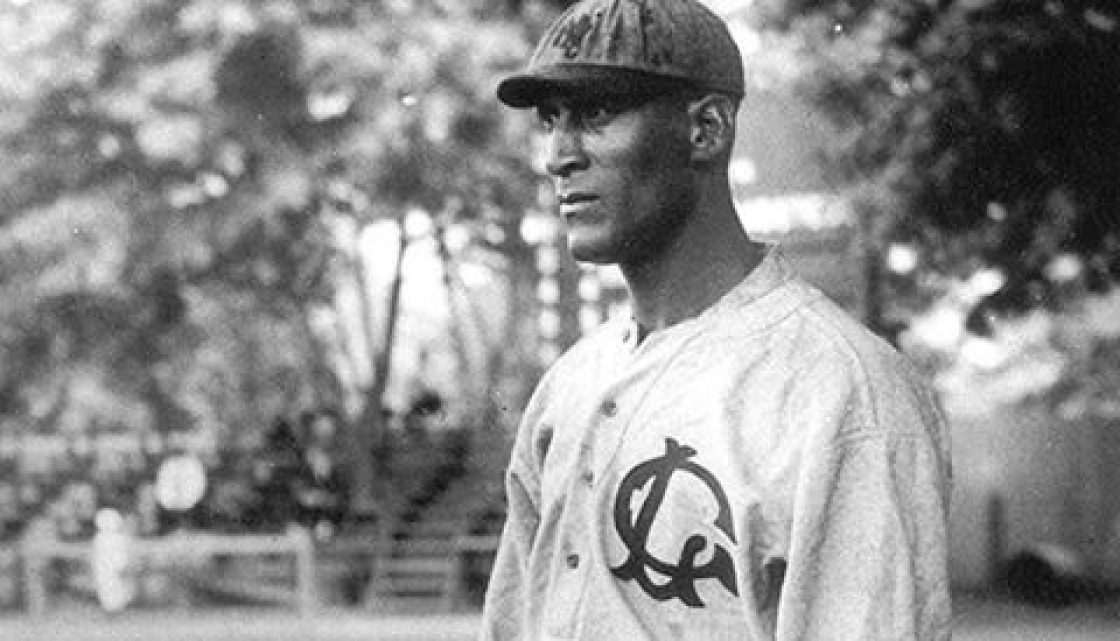
Into this mix came the Indianapolis Clowns, who weren’t the city’s first great Negro Leagues team — that distinction, aside from squads in the 19th century, would go to the ABCs — but probably its most famous, thanks to their on-field antics and, well, clowning, which mixed extremely well with their genuine hardball acumen.

The Clowns were so good and, therefore, so popular, that Phil Nolting says the Funmakers routinely outdrew the Indians of “Organized Baseball” when they did manage to convene home games at Bush Stadium.

“Back then, the Clowns brought bigger crowds than the Indians,” Phil says. “The stadium was full. The Clowns were really popular, as I recall.”

But, he added, “It was an all-black crowd.”

Which made for a few jarring, or at least unusual, experiences for the white teenager from Arsenal Tech and his buddies roaming the crowd as vendors. But for the most part, things went smoothly for both the kids and the fans.

“We had our problems,” he said, “but really it was fun. This is when integration was still going on, but we never had any problems.”

And because Indianapolis is famous for something else — its auto racing, its 500 and its Brickyard — Nolting says he and his peers would work the crowds at car races, including the Indy 500, then hike down to Bush Stadium that evening for an Indians or Clowns game.

Also significant to Nolting’s tenure as a popcorn and Jack hawker — even though neither he nor many people in the stands knew at the time — was that it coincided with the arrival to the Clowns’ roster of a baby-faced youngster from Alabama named Henry Aaron.

aaron

Phil says he vaguely remembers Aaron’s name being on the roster cards and announced over the loudspeakers, but Nolting was too busy selling his product — which involved having his back to the field much of the time — to pay close attention to the future Major League home run king, or any of the players, for that matter, on both the Clowns and the Indians. That includes the times Satchel Paige, for example, made a stop at Bush Stadium to pitch.

“It’s a shame we didn’t really know who the players were,” Phil says. “You hear a lot about them now, but back then we were working. We couldn’t really see or know who they were.”

As the years have gone by, and as Phil and his buddies reflect on their Bush Stadium experiences — including being thiiiiiiiiis close to Hank Aaron — they do regret a bit the fact that they couldn’t attention more to the games and players themselves.
But he says one of his friends as since become an avid reader of baseball history, including the Negro Leagues, and he and Nolting conversed quite frequently about their rich experiences.

“My buddy and I from back then, we’d talk often about it,” Phil says. He reads a lot about the Negro Leagues, because its become quite a popular topic to study.”

It certainly has.
Batavia’s Baker

IMG_1453

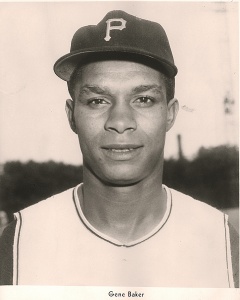
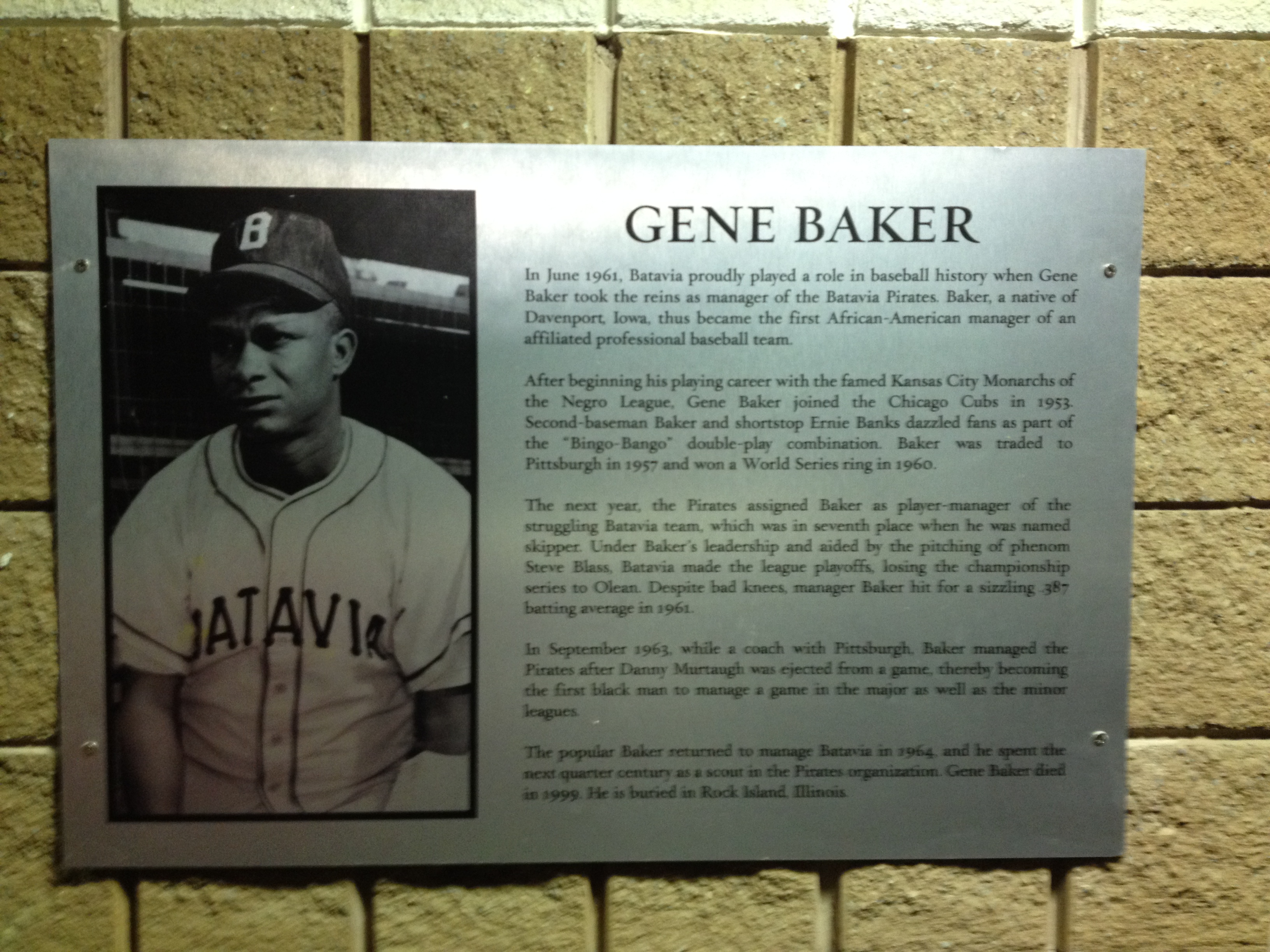
That above is the large metal plaque at Batavia’s Dwyer Stadium in upstate New York honoring Gene Baker, who enjoyed two stints as the manager of the Batavia Pirates, Pittsburgh’s then-Class D affiliate.

Today, the short-season A team occupying Dwyer is the Batavia Muckdogs, an affiliate of the Miami Marlins (funnily enough, just like the New Orleans Zephyrs). But the Muckdogs make sure to honor Baker for what he accomplished in Batavia more than a half-century ago.

I snapped that picture while my friend Mike and I were taking in a ‘Dogs game while I was visiting family and pals in Rochester last month. Before reading that sign, I had no idea what a huge role Batavia, and Baker, played in the complete integration of Organized Baseball.

As a second baseman-turned-utility-infielder, Baker integrated the Chicago Cubs along with a guy named Ernie Banks in 1953. However, despite an All-Star nod in 1955 and a World Series ring, Baker’s playing career didn’t go nearly as well as his double-play mate and future Hall of Famer, thanks largely to a crippling knee injury. He finished his playing days with the Pirates in the early 1960s. A great SABR Bio Project essay on Baker’s playing days appears here.

However, the Bucs kept their promise to find a place for Baker within their organization after he retired as a player, and he was named manager of the Batavia Pirates for the 1961 season.

With that move, the Pirates and Baker, according to numerous opinions and sources, made history as Baker became the first African-American manager anywhere in American Organized Baseball. While some pundits feel, for example, that Nate Moreland actually earned that distinction before Baker did by helming the Calexico franchise in the Arizona-New Mexico League, Calexico was an independently-owned franchise that had no Major-League affiliate

Thus, in historical hindsight, many observers and researchers do believe, in fact, that Baker was the first to break that barrier, and he did it in Batavia, about a 45-minute drive from my hometown of Rochester. Stated the June 28, 1961, issue of The Sporting News:

“The Pirates, finding a new job for Gene Baker after dropping him from their active list, sent the infielder to Batavia (NYP) as manager, June 19. The 35-year-old veteran, who broke into the major leagues in 1953, is the most prominent Negro to be given a managerial post. …

“In making the appointment, General Manager Joe L. Brown said, ‘Gene has been most valuable to us in the past as a player, instructor and scout. He is a fine gentleman with outstanding baseball experience and knowledge. We know he will do a fine job in the managerial field.'”

Count legendary Baltimore Afro-American columnist Sam Lacy among those who believed Baker blazed trails in Batavia. Lacy interviewed Baker by phone in late June 1961, shortly after Baker, a native of Davenport, Iowa, arrived in the small, upstate New York city. In Lacy’s subsequent July 1 article, Baker painted a very grateful and optimistic picture. Stated the new skipper:

“‘This could be the beginning of a brand new era in baseball.

“‘I can only hope that I can do the job that is expected of me. It means so much to all concerned. …

“‘This is a wonderful opportunity. Not only for me but for other fellows more deserving than I. If I can only deliver for them, it will mean so much to the colored player and to baseball in general.

“‘The reception I got Monday night was heartwarming. Fans and players alike  wished me well and pledged their full cooperation. Nothing like it has ever happened to me before.

“‘The Pittsburgh organization is tremendous. It has given me every opportunity to progress.

“‘With God’s help, I hope to vindicate their judgment. And if I do, I’m sure there’ll be other teams to follow suit — just as they have done in other respects.”

But, as Lacy pointed out, the task ahead of him certainly wouldn’t be easy — at the time, Batavia was floundering in seventh place. But Baker assured the scribe that with a little tinkering and the encouraging of the squad’s multiple young, talented prospects, the B-Pirates could stabilize the ship and even climb into the top four in the New York-Penn League.

Lacy wasn’t the only sports scribe who took notice of Baker’s appointment to the B-Pirates — the news traveled to Norfolk, Va., where New Journal and Guide columnist Cal Jacox hailed the development under the headline, “Progress Continues In Baseball”:

“With the appointment last week of Gene Baker as manager of the Pittsburgh Pirates’ Class D farm club at Batavia, N.Y., organized baseball opened a new area of employment for colored players who have completed their major league careers.

“For years, there has been speculation as to when a colored ex-big leaguer would become a full-time pilot. … [T]he names of Jackie Robinson and Roy Campanella were prominent in the managerial sweepstakes. … But fate decreed otherwise and, instead, Baker has the distinction of being the first former major leaguer to get the call. …

“Ever since 1947, organized baseball has been moving forward in its relationship with the colored players … They’re seeing action in probably all of its leagues … Their play is outstanding and their presence on the field is accepted by the fans even in the deepest Dixie … In tapping Baker for the pilot’s post the management of the Pittsburgh Pirates thus continued the steady march of progress that has, over the years, become a trademark of the national pastime.”

Back in upstate New York, Batavia seemed to welcome Baker with open arms, as a July 1, 1961, Afro-American brief reported:

“‘We welcome Gene Baker to our town and our club,’ declared Norris T. Dwyer, president and general manager of the Batavia Pirates …

“Dwyer assured the AFRO that ‘everything will be done to make him comfortable and to assist him in the job he’s attempting to do. No one in this office doubts that a young man of his character and experience will succeed.’

“On the subject of his new manager’s race, Dwyer said, ‘Gene is a baseball man. That’s all we want here.”

The Bucs management’s faith in Baker paid off, and big-time — within about two and a half months, Batavia climbed from seventh in the NY-Penn League to second, and they made the league playoffs. Late in the season, Baker even shrugged off his bum knee and manned third base in a bunch of games for the B-Bucs in their run to the league finals.

240x300xGene,P20Baker,P20HS,P201-300.preview.jpg.pagespeed.ic.RrlUnKHfhl

Once again, news hound Lacy was all over the story; in a Sept. 2, 1961, article in the Afro, the journalist expounded on Baker’s achievements in upstate New York:

“Baker’s success has been phenomenal. And the front office of the world champions at Pittsburgh are jubilant.

“‘We are elated over Gene’s good work,’ declared Bob Clements, Buccaneer scout in charge of the New York area. ‘Mr. Brown (owner Joe L. Brown) was with me in Jamestown (NY) when the team played there last week. And he was greatly pleased with the team’s progress under Baker.'”

Lacy also interviewed Baker himself, who was effusive in his comments to the sportswriter:

“Naturally, I’m happy about [the team’s success]. But the praise shouldn’t go to me alone. The team did it.

“We started hitting and the pitching firmed up for us. … We just started climbing, and that’s all.”

Gene Baker’s achievements rightfully earned him a promotion in 1962, with the big-league Bucs moved him up to the Triple-A Columbus Jets, where he became the first African-American coach in Organized Baseball. He also did a little playing for the Jets, although he struggled a bit when he did so.

In ’63, Baker moved up again, becoming a coach for the big-league club, becoming the second African American to break that barrier, after the legendary Buck O’Neil. In fact, in September of that season, Baker even, albeit briefly, became the first black man to manage a major-league team when Pirates manager Danny Murtaugh and coach Frank Oceak got tossed from a game against the Dodgers.

However, for reasons that are somewhat unclear, Baker was bumped back down to Batavia for the 1964 season, but after that he served as a Pirates scout for 23 years.

Baker eventually retired to his hometown of Davenport, where he died in 1999 at the age of 74 and, because of his meritorious Naval service during World War II, was buried in Rock Island National Cemetery.

There probably remains debate as to whether Gene Baker was, in fact, the first African American to manage a team in organized baseball; a few other candidates do exist, such as Moreland, but much of the discussion involves the parsing of details and situations at the time.

But there are three facts that are quite clear about Baker. One, he was the first former African-American big leaguer to manage a team in Organized Baseball; two, he achieved unqualified success during that 1961 season; and three, partially as a result of No. 2, Baker remains beloved in Batavia, including by the current Muckdogs, as the plaque at the top of this post displays.

A baseball murder 75 years ago …

Had this come out on philly.com on Monday. Another obscure but fascinating and revelatory nugget from that city’s African-American baseball history:

http://mobile.philly.com/sports/phillies/?wss=/philly/sports/phillies&id=323456231

The Courier comes through, but the statues are gone

I know the conference was several weeks ago, but this article about the event just came out in the New Pittsburgh Courier. I talked with the writer of the story, Michael B. Rose, who ended up doing a pretty good job with the article. This is from the Courier’s Aug. 27 article:

http://newpittsburghcourieronline.com/2015/08/27/negro-leagues-baseball-convention-held-in-pittsburgh/

Also, you might have seen this already — is was, quite understandably, a hot topic at the Malloy conference in Pittsboig — but the Pirates recently removed the statues honoring local Negro League legends. This is from the Pittsburgh Post-Gazette:

http://www.post-gazette.com/opinion/brian-oneill/2015/07/30/Brian-O-Neill-Statues-honoring-Negro-Leagues-gone-from-PNC-Park-entrance/stories/201507300007


Talk about completely floored …!

YZWun_ClDwY0xaB4qtRCCsZh5JeCV2p36bIwNa4Pbf8G0BZiccGDKOtUx229zf6uqWW132_Q=w1196-h452

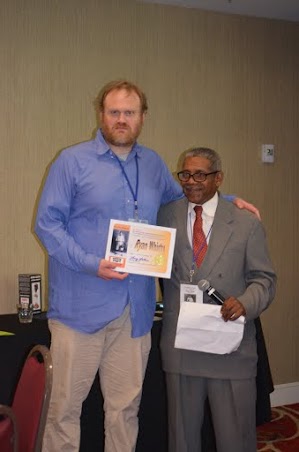
That’s me on the left receiving the Lifetime Achievement Award from Mr. Roger Webb. I chose this picture because the “deer in headlights” look on my face perfectly sums up the state of shock I was in. Many thanks to James Brunson for the photo.

For about two weeks, ever since the Malloy conference in Pittsburgh, I’ve been fomenting a post about receiving the conference’s Tweed Webb Lifetime Achievement Award, one that talks a bit about Mr. Webb himself and why the SABR Negro Leagues Committee has an award named after him.

However, life has predictably gotten in the way, and I’ve been conducting a great deal of personal introspection and examination lately, so I’m just now writing the post.

I reflect back to the recent conference’s concluding dinner and awards banquet, and, for me, there were two very moving facets of the event. One was the beautiful tribute to the late Dick Clark, who co-founded the Negro Leagues Committee and for so many years had been its heart and soul.

The other touching moment came when committee co-chair Larry Lester — who has been mourning the loss of Dick Clark, one of his closest friends and biggest inspirations — also speak of traveling to St. Louis and meeting Tweed Webb at Mr. Webb’s home.

Larry spoke about how much meeting such an important and influential black baseball historian — someone who was so widely respected and admired by his peers for his tireless and often thankless work in preserving the legacy of the Negro Leagues and African-American baseball greats — impacted the course of his own life and the trajectory of his own incredible (and incredibly influential in its own right) career as a researcher and chronicler of the American pastime.

It made me wish badly that I could have met Mr. Webb myself and learned from the feet of the master, because he seems to be the type of man and type of person who had so much to teach and so much knowledge to impart to those who were willing to listen.

How esteemed was Mr. Webb? In July 1975, Atlanta Daily World columnist Chico Renfroe succinctly and properly described him as “Black Baseball’s historian.”

Mr. Webb’s close friendship with another St. Louis great, Hall of Fame speedster James “Cool Papa” Bell, whose life and career was almost peerlessly supported and chronicled by Mr. Webb, led the latter to be sought out by Associated Press scribe Butch John for comment and input in a July 1990 article about the Negro Leagues, especially the blackball activity in Mississippi, Bell’s home state.

Tweed always maintained that Cool Papa played two decades to soon; if Bell had come along after the integration of the Majors, he could have set base-swiping and run-scoring records that might very well still be standing today, Rickey Henderson be darned.

Last week I asked Larry and SABR Negro Leagues committee do-it-all’er Leslie Heaphy, via email, for their thoughts on Tweed Webb. Here’s what Leslie wrote:

“I never had the pleasure of meeting him like Larry did but have always heard of him and been aware of his work as a historian and story teller. He worked hard to provide info for the early Negro Leaguers elected to the Hall of Fame.”

And this is what Larry wrote:

“Meeting Tweed Webb was a major turning point in my sports life. As a life-long baseball fan, I enjoyed the surface knowledge about the game, and knew little more. Upon meeting Mr. Webb, he taught me how to research, how to interview athletes, and also how to separate their facts from hyperbola. On one occasion I watched him correct a player several times as the player tried to taffy the truth. He knew his stuff … because he had seen them all.

“Webb introduced me to SABR, and encouraged me to join the organization in the 1980s.  Joining SABR connected me with other like-minded aficionados of the national pastime. He was a humbly proud man with great attention to detail and emphasized accurate accounts of baseball history in every capacity.

“It was truly an honor to meet this unheralded St. Louis historian.”

What more can be said about Tweed Webb? That pretty much sums up how incredible a journalist, historian and man he was.

Add in to Webb’s immeasurable influence the heft of a lifetime achievement award named in his honor, to say the least I was never expecting to receive the award at the Malloy conference.

In fact, I spent much of the banquet taking notes on the proceedings, with the intent of reporting on the comments, presentations and awards, with nary a glimmer of thought to the prospect of receiving an award. That was especially true because just two conferences earlier, I had been thrilled and humbled to received the John Coates Next Generation Award. That, in itself, was extremely gratifying.

So at the banquet a couple weeks ago, I was taking notes on Larry’s introductory thoughts about Mr. Webb as a lead-up to the bestowing of the honor. As Larry paused to announce the name of the recipient, I had my pen in my hand and my eyes trained on my notebook in preparation of writing down the name of the winner.

So when I heard my name, everything kind of, well, went foggy for a moment. I glanced up from my notebook, and for a fleeting moment simply looked straight ahead and blinked me eyes. I then turned my head slowly toward the podium and almost blurted out with incredulity, “Umm, excuse me?”

Then I saw Leslie looking at me with a big smile on her face, and the clapping snapped me back into focus. But I was still a little physically unsteady when I got up from the table and walked slowly to the front of the front, my mind just repeating, “Don’t trip, don’t trip, don’t trip,” with one additional thought of, “Oh man, I really hope my fly is up.”

After that, it was all kind of a blur. I just remember shaking the hand of Tweed’s son, Roger Webb, thanking him profusely and telling him what an honor it was. We posed for pictures briefly, I shook his hand again, then scurried back to my table, where I took my seat next to — this is true — SABR Executive Director Marc Appleman and across from Pirates Director of Player Personnel Tyrone Brooks!

My tablemates congratulated me, and while I had to practically hold my jaw in place lest it fall to the floor, my thought was, “I don’t deserve this.”

I thought that not because I didn’t believe I have done good, worthy work as a journalist and Negro Leagues historian, but because I felt there are so many other committed, dedicated, hard-working and deserving Negro Leagues devotees, researchers and writers who have been doing this much longer than I have.

That was the truly humbling notion of the whole thing — that out of such a great number of extremely worthy people, the SABR Negro Leagues Committee chose me.

Because of that, I felt, feel and will always feel completely honored, grateful and humbled to receive the award, and my deepest and eternal appreciation and gratitude to those people who were behind the honor. Thank you very, very much.

But now, back to work. There is still limitless African-American baseball history to explore and discover, and I, along with all of my esteemed and wonderful colleagues, still have a challenging, thrilling and gratifying task ahead of us.

So, to wrap this all up, I say, “Let us all keep up the fight and continue to proudly carry the Negro Leagues banner, and see you in La Crosse in 2016!”

Mr. Paige and Mr. Veeck

Sorry for a little lag there between posts — I’ve been getting back in the groove after returning to NOLA from my little jaunt north. I have a couple more posts stemming from the Malloy conference — one on Tweed Webb later in the week, and this one today based on the interview I had with Robert Paige at the conference.

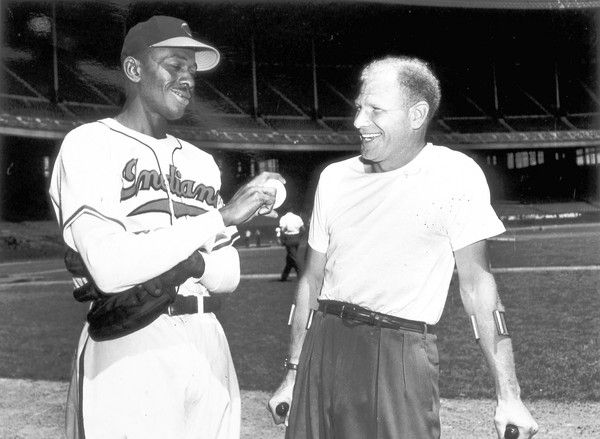
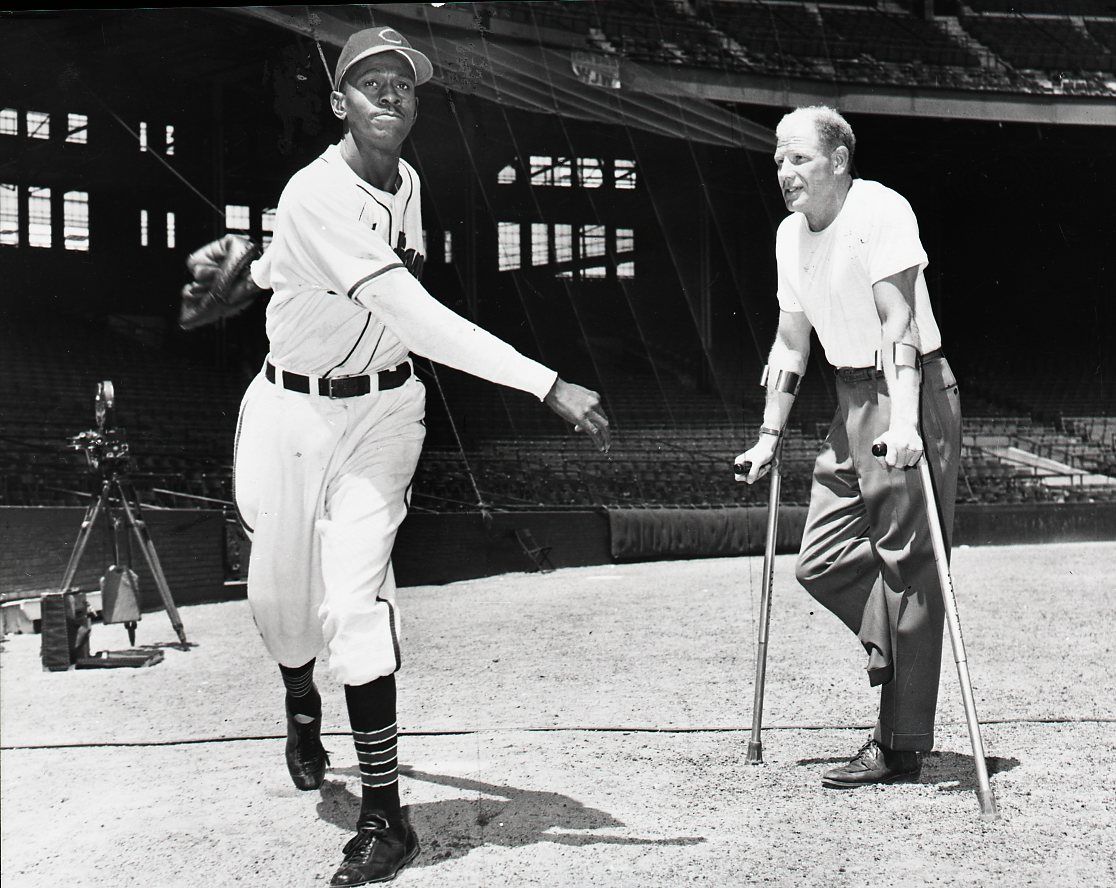
CLEVELAND - 1949. Satchel Paige shows Bill Veeck, owner of the Cleveland Indians, his new fastball grip before a night game at Municipal Stadium in Cleveland in 1949. (Photo by Mark Rucker/Transcendental Graphics, Getty Images) (baseball pro) (Decade 1940s) ** TCN OUT **

************

PITTSBURGH — In 1948, around about the time fabled Indians owner Bill Veeck signed legendary Negro Leagues pitcher Satchel Paige to the latter’s first Major League contract, Veeck personally hauled Satchel with him to Paige’s hometown of Mobile, Ala., quite a trip for the pair.

Veeck’s mission? To solve, once and for all, how old Paige actually was. Because ever since Paige began his paid baseball career in 1924 with his hometown Mobile Tigers, and as his legend as a hurler supreme grew into almost mythical proportions, Paige frequently provided reporters and other members of the public with a birthdate range of almost a decade, anywhere from 1900 to 1908.

Paige did that, actually, largely because he didn’t know himself. In fact, that chronological slipperiness was part and parcel of the mythology surrounding the tall, lanky man whom many believe was the greatest pitcher of all time, regardless of race or era.

When they got to Mobile, Veeck rounded up the rest of Satchel’s family and personally accompanied them to the local health department to pull Satchel’s birth certificate and unlock the mystery of Paige’s birthdate.

The answer: July 7, 1906.

That made Leroy “Satchel” Paige just over 42 years old when he first took a Major League mound during that ’48 championship season for the Tribe. And it heaped massive pressure on the shoulders of a middle-aged man with proving the naysayers wrong and justifying Veeck’s seemingly madcap decision to sign a 42-year-old rookie pitcher whose arm had probably tossed thousands of games by then.

“The expectations to go out and perform had to be massive,” said Satchel’s eldest son, Robert Paige, last week as he was attending the Society for American Baseball Research’s 18th annual Jerry Malloy Negro Leagues conference, held this year in Pittsburgh. “I can only imagine.”

“The whole world is looking at you,” Robert continued. “You’re a 42-year-old rookie, and you’re expected to go out and compete with these teenagers and prove that you’re still capable and able.”

But, according to the son, his father — just like during his entire, 20-plus career in the Negro Leagues — never had any doubt in his abilities or his famous arm.

“There wasn’t a thought [about failure],” Robert Paige said. “There was nothing he knew more. He knew he could pitch. And when you know what you can do, you do it.”

Oh, Satchel did it all right. Over the last half of the 1948 season, Paige went 6-1 with an incredible 2.48 ERA with two shutouts and 43 strikeouts. Many historians believe Paige played a crucial role in the Indians’ World Series triumph that year, which remains the team’s last title.

Paige had repaid Veeck’s faith in him, and the experience bonded the two exquisite showmen for life. The pair was so close that when Veeck purchased a majority share of the St. Louis Browns in 1951, he once again inked Paige to a Major League contract.

9d673c6e-6c60-4805-b950-cf99ee04f07b_lg

As a result of that lifelong friendship, while Robert Paige and his siblings heard their father frequently talk about the man who took a chance on him.

Robert Paige’s comments came while he was waiting in the lavish lobby of the Wyndham Grand Downtown in Pittsburgh to travel to PNC Park with other Malloy Negro Leagues conference attendees to watch a Pirates-Dodgers game.

Paige was the conference’s special guest, and it was a rare occurrence for the 62-year-old Paige, who for many years has been reclusive, private and reluctant to open up about his knowledge of the life and legacy of his famous father.

Robert and his sisters had long since placed their guard up against the type of money-hungry, attention seeking journalists, memorabilia dealers and other self-centered parties who had tried to gain the family’s trust, only to exploit and take advantage of them for personal gain.

But recently, thanks to the encouragement of Negro Leagues researchers and historians, Paige has slowly come out of his shell. However, he is still very careful about his public appearances and speaking engagements, as he told the audience at last week’s Malloy conference in Pittsburgh.

“I don’t do this,” he said. “This is not me.”

But as he spoke, Robert Paige gradually opened up and regaled the crowd with stories from his childhood, recounting the challenges, trials and joys of growing up — going hunting for rabbits with his dad and Hall of Fame third baseman Judy Johnson; playing in the backyard with another Hall of Famer, Warren Spahn, who loved his mother’s cooking; having breakfast with Negro League greats like Cool Papa Bell, Double Duty Radcliffe and Goose Tatum; being known simply as “Satch Jr.” into his adolescence; not fully understanding how important his father was until Robert’s sister showed him an entry about their father in an encyclopedia.

Or, as Robert revealed in an interview that evening, hearing about how high a regard in which his father held Bill Veeck, the man who rolled the dice on a 42-year-old pitcher, a gambled that paid off in World Series rings for owner and hurler.

“Our father spoke nothing but praise about Mr. Veeck,” Robert said last week.

A wonderful night

fEFVshYX9D31MIWqePEtKNS_NMwJU4c2AErUNOfZ1fP4IuLUeyB828alemFPttQRpsm8v8uS=w1223-h455

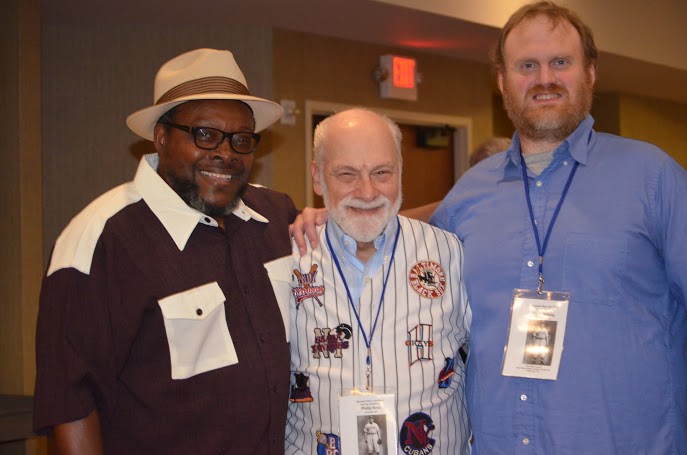
From left, that’s my friends and two of my research inspirations James Brunson and Phil Ross, and that balding ginger on the right is me, face still somewhat frozen in shock. It’s after the wonderful Malloy banquet on Saturday.

OK, back in action and writing again after a couple days off. This post will be about the banquet Saturday night that concluded the 18th annual Jerry Malloy Negro Leagues Conference, and I’ll try to talk a little bit about the presentations at the conference over the next day or two.

It was a night of wonderful words, good food, fellowship and, at least in my case, some surprises. My two roomies, Ted Knorr and Lou Hunsinger, staked out spots at a table in the very front of the room, not knowing that a part of it had been reserved for special guests, like Pittsburgh Pirates Director of Player Personnel Tyrone Brooks and SABR Executive Director Marc Appleman, both of whom, actually, were very gracious to say a few words before dinner.

“Every year this conference continues to get better,” Appleman told the crown of about 70. “It just goes to another level each year. Like Larry [Lester] said, it does feel like a family reunion. I feel like I know everyone here. This is something that Larry, Leslie [Heaphy] and this year George [Skornickel, chair of the local Forbes Field Chapter] just did so great this year, and the home office [of SABR] really plays just a supporting role.”

Brooks related to the group how eager the Pirates were to donate a great deal of time, effort and funding to help pull the conference together.

“I’m so pleased to be here,” he said. “I see the passion for baseball in everybody here. I’m completely blown away by the knowledge base here in this room. Keep up the great work you’re doing. This is just tremendous.”

Before dinner, a few awards and honors were presented, and it began with Robert Paige, the eldest son of the legendary Satchel, being giving a plaque in the shape of a home plate as thanks for his enlightening and delightful presentation and Q&A Friday. Also honored was Skornickel for his tireless efforts to make sure this year’s Malloy conference came together at the last minute.

Then we had some tasty grub for dinner — bistro steak with wild mushroom sauce and pesto rubbed chicken with tomato sauce — as a PowerPoint photo show honoring the late, great Dick Clark, who for so many years co-chaired the SABR Negro Leagues committee with Larry Lester and was the heart and soul of the conference in many ways.

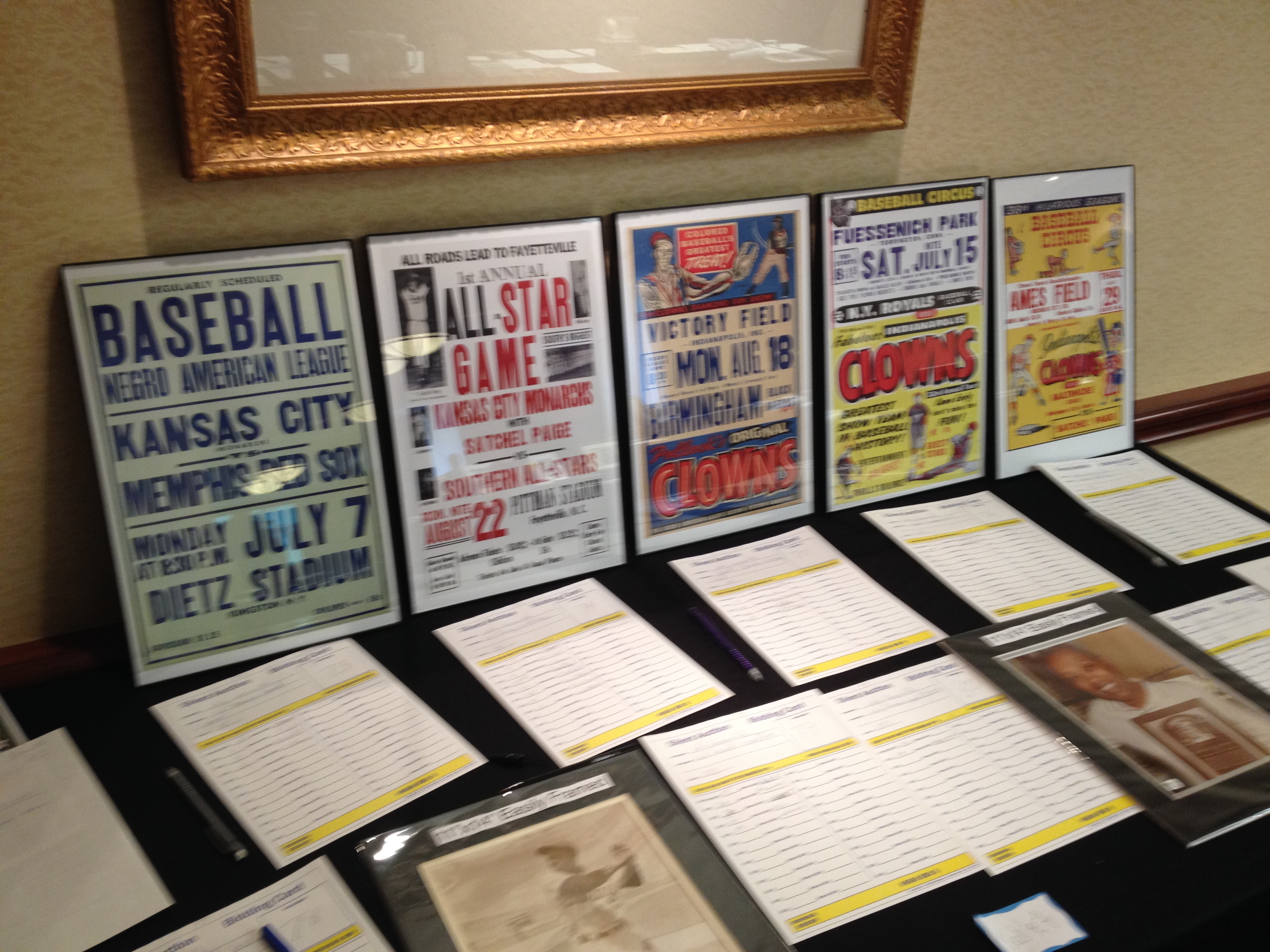
Also taking place was a silent auction on some fantastic memorabilia and collectibles, as well as music by local keyboardist and singer Larry Beile.

After we finished chowing down, so to speak, more awards and recognitions were given out, including nods to this years college scholarship winners, high school seniors Jeff Boelter and Kari Whiteside. The Dick Clark Significa contest winner grabbed a second ring — Karl Lindholm of Cornwall, Vt.

The big awards began with the Robert Peterson Recognition Award, named after the author of the groundbreaking book, “Only the Ball Was White.” The honor recognizes outstanding research in the form of published books over the last year. This year’s talented twosome were William Plott, for his comprehensive and trailblazing tome, “The Negro Southern League: A Baseball History, 1920-1951”; and Jim Overmyer for the outstanding “Black Ball on the Boardwalk: The Bacharach Giants of Atlantic City, 1916-1929.”

Both books were published by McFarland Publishing, which specializes partially in baseball history, including dozens of releases about African-American hardball. Every year the conference is supported by McFarland, including the attendance of the fantastic Gary Mitchem.

The John Coates Next Generation Awards, which honor young, up-and-coming researchers, historians and writers, were bestowed upon Shawn Morris and Robert MacGregor.

The biggest, highest honor of the evening was the Fay Vincent Most Valuable Partner (MVP), named after the man many baseball fans, journalists and historians call “The Last Commissioner.” Vincent was always a tireless supporter of the Negro Leagues and did so much to increase public knowledge and understanding of black ball, including playing key roles, too many to mention, in getting numerous segregation-era African-American players in the Hall of Fame.

The award went to, and quite rightfully so, to Roy Langhans, who for decades has embodied the spirit and devotion to the Negro that Fay Vincent himself possessed so deeply.

A hearty congratulations to all the award winners for an incredible job well done. For more information on the doings of this year’s conference, go to the Malloy Web site, and for some great posts and pics of the weekend, check out everything on the Facebook page.

Well, there is one more thing I should add, and it’s something I just wasn’t sure how to approach because, umm, it involved me. At the banquet, I was so extremely humbled, honored and completely stunned to receive the Tweed Webb Lifetime Achievement Award. I didn’t want to brag about getting it, but I also wanted to note that I received it, especially because I was given it by Tweed Webb’s son, Roger Webb.

What I’ll do in my next post is to discuss Tweed Webb himself and why he and his legacy have been so crucial in the preservation of the memory and knowledge of the Negro Leagues. You’ll see why I’m so humbled to receive an award named after him.


My article on Double Duty

I’m still working on a post or two about the Malloy conference — I promise it’s coming — but in all the hustle and bustle of the conference I almost forgot I had this article on the great Double Duty Radcliffe come out in the Mobile alt-weekly last week:

http://lagniappemobile.com/double-duty-mobiles-forgotten-baseball-hero/

There’s no chance we’d miss this

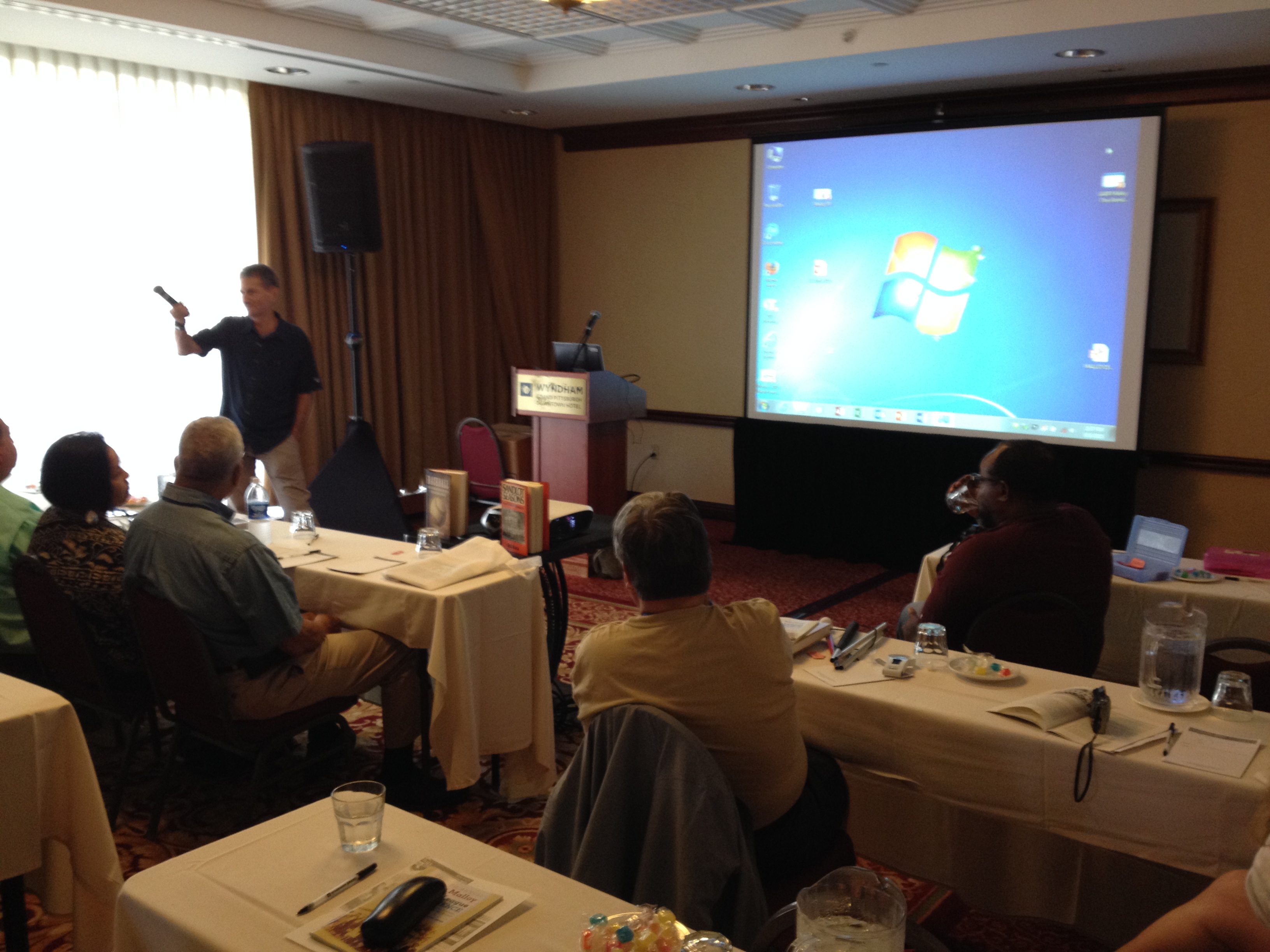
IMG_1416

“Welcome to the 18th annual Negro Leagues family reunion.”

With those words, SABR Negro Leagues Committee co-chair Larry Lester launched this year’s Jerry Malloy Conference yesterday morning bright and early at 9 a.m. at the Wyndham Grand Hotel in downtown Pittsburgh.

Then, this morning, my day began by meeting with Michael Rose, a reporter from the New Pittsburgh Courier, who had contacted me about doing a story about this family gathering here where the three rivers come together. When Michael’s story comes out in the Courier, you can be sure I’ll post a link to the story on this blog.

Thus, it’s been an eventful and quite exciting start to a conference that’s without a doubt a major highlight of my year every time I come, which now stands at four years and counting.

But, as we found out yesterday morning, this event almost didn’t even happen. In fact, I don’t think many of us here in attendance realized how close we came to not gathering at all this year.

As Larry told us in his introductory statements yesterday morning, the death of our longtime and beloved co-chair Dick Clark, who for so long was the heart and soul of the Malloy conference, hit everybody hard, but Larry especially took the news with great difficulty. Larry’s sorrow, as he told us, drained him of the desire and emotion needed to organize the conference by himself, nearly leading him to cancel the event for this year.

“I didn’t want to do it without Dick,” Larry told us. “With Dick missing, I decided not to move forward. I just didn’t think I’d be able to do it. Many of you knew him. He was a great guy, and there wasn’t a racist bone in his body. He’s the one who really put this conference together.”

Into the void stepped George Skornickel, the chairman of the local Forbes Field Chapter of SABR, who felt that he had to do something to help Larry out and make sure the Malloy conference soldiered on in 2015.

“George said, ‘I’ll do it,'” Larry said. “And I’ll tell you, he did it.”

Larry said it costs about $35,000 to put on a Malloy conference, and after all the registration and fees are in, the officials planning and hosting still have to raise about $25K of that to make it happen. But SABR members and other baseball historians and fans came through this year with donations to the Society home office in Arizona with all ranges of checks — $100, $1,000, you name it — and it happened.

There will be a tremendous presentation at tonight’s conference-ending banquet and awards ceremony in honor of Dick Clark, and you can be sure none of us will miss it.

IMG_1420

So far, the event has been a thrill, and I’ve gotten to see so many old friends — Larry, Leslie Heaphy, Ted Knorr, James Brunson, Karl Lindholm, Phil Ross — and meet a bevy of new ones, such as Miss Michelle Freeman, a Malloy first-timer, a native of Kansas City who now lives in suburban Baltimore and heads up the wonderful Leon Day Foundation, which promotes and honors the legacy of that legendary Negro Leagues pitcher and Hall of Famer. Michelle was also instrumental in starting up the brand new SABR Babe Ruth chapter in Baltimore.

Mr. Knorr and I are roomies at the conference for the third year in a row, and this year we’re joined by Lou Hunsinger of Williamsport, Pa., who thus far has been a sterling addition to our little room at the Wyndham Grand. Lou is actually the public address announcer at the Little League World Series every year, which is pretty darn cool, if you ask me. I must apologize right off the bat here to Ted and Lou for waking them up after 1 a.m. Thursday because I was writing my last blog post about Luke Easter’s time with the Homestead Grays at that ungodly hour!

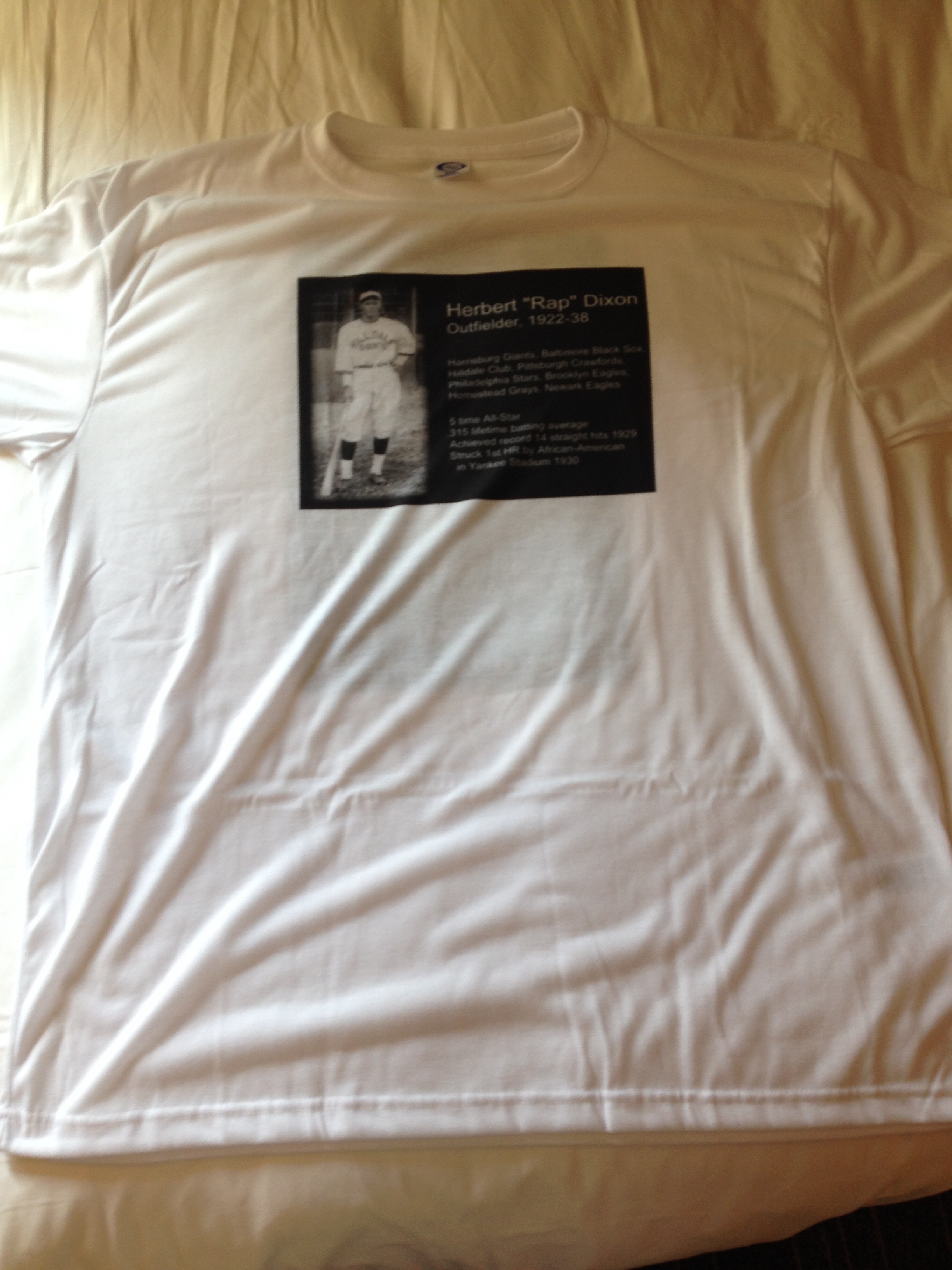
I was also able to get my hands on my prized purchase from this conference — a custom-made Rap Dixon for the Hall of Fame T-shirt (size XXXL so it can fit over my way-too-large belly) from Ted:

IMG_1426

These fantastic comrades, plus the fantastic presentations, are what makes these Malloy conferences so special for me. As Larry said, “We have the best baseball minds in the country right here today.”

I’ll get more into the presentations themselves in a later post, maybe tomorrow (Sunday) evening, because there’s already been so many incredible ones, with more to come.

But right now I need to truly thank Robert Paige Jr., the son and eldest child of the great Satchel Paige, who made a rare public appearance yesterday for an hour-long Q&A session that was by turns both touching and uproarious. Robert, or Bob, is a towering fellow — he stands at 6-feet-8 — and one of the most gregarious and talented storytellers I’ve been witness to in a while.

Bob graciously granted me a one-on-one interview before he headed over to be honored at PNC Park before the Pirates-Dodgers game for an article I wrapped up last night for the Kansas City Star. As of now, the story is scheduled to appear in tomorrow’s paper, and I tried to capture the essence of Bob’s talk, his experiences growing up with the best pitcher in baseball history as his father, and what it’s like carrying on his dad’s legacy. I’ll post a link to the article when it’s out.

IMG_1423

University of Pittsburgh Professor Dr. Rob Ruck (standing on left) discussing his Negro Leagues documentary, “Kings on the Hill: Baseball’s Forgotten Men.”

I’m also looking forward to meeting with members of Jimmie Crutchfield’s family, who are attending this year’s conference. Crutchfield, a member of the great Pittsburgh Crawford teams of the 1930s, was the very first beneficiary of the nationally known blessing and foundation known as the Negro League Baseball Grave Marker Project.

Yesterday’s introductory comments also included a few words from SABR Executive Director Marc Appleman, who’s attending his fifth Malloy conference this year.

“It’s always a highlight of my year to come to it every year,” Marc said. “It’s great to see everyone. I see a lot of familiar faces. This really is a big part of SABR. Out of all the hundreds of calls we get to our home office, most of them are for the Negro Leagues Committee.”

On that note, I’ll humbly sign off for the evening and do my best to post something after tonight’s banquet, then discuss some of the presentations that were made this weekend in a post that’ll hopefully come Monday.