The Albritton plot thickens

102814_Byberry_600

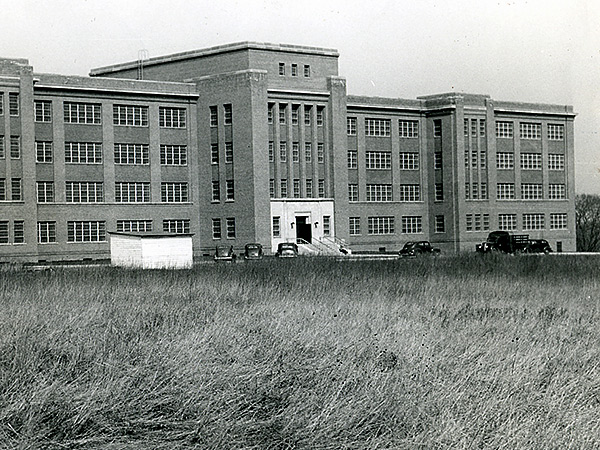
Byberry hospital

The running theme continues … Former Negro Leagues players whose final resting places remain a total mystery. Last week I looked at Delaware native Ed Stone, and in this post I’ll come back to Philadelphia’s Alexander Albritton, who was beaten to death in Byberry mental hospital in 1940, as detailed in this story I did for philly.com.

Albritton’s death certificate states that he’s buried in Eden Memorial Park in Collingdale, Penn. However, Eden staffer Mina Cockroft says that facility has no record of any Albritton whatsoever at any point in time, and she double-checked.
She then suggested I contact three other Philly-area cemeteries — Mt. Lawn in Sharon Hill, Mt. Zion in Collingdale and Merion Memorial Park in Bala Cynwynd.

I called all three, and the first two, Mt. Lawn and Mt. Zion, are like Eden — no Albritton’s anywhere at any time.
However, Merion does have at least four Albrittons — Ralph in 1935, Leah in 1954, John in 1958 and Frances in 1998.

Now we could be on to something, because several of those names pop up in Census records as possible relatives of Alexander. Alex had a brother named John, who was born circa 1886), and he has children named Ralph (né about 1916) and Frances, born around 1930.

hart_stone_015

But there’s a couple hitches regarding Merion Park. One, apparently the cemetery endured a fire in 1947 that destroyed many records of burials before that year.

Plus, an employee of Merion says that if a certain cemetery is listed on a death certificate — like Eden on Alexander’s record — 99 percent of the time, that is indeed where the person is. She said she’ll do a more detailed search for any Alexander Albritton, but she doesn’t expect to find him there.

That leaves a couple further options at tracking down where Alexander is. One is the funeral home that conducted the burial ceremonies and other events connected to his death and final resting place. The death certificate lists that as Black & White Funeral Home at 1410 S. 20th Street in Philadelphia.

Black & White no longer exists, but that address is still home to a mortuary — Mitchum Funeral Home. However, I’ve left multiple messages there and have yet to receive a call back.

Which winnows the possibilities down to a single one — living residents or descendants of Alexander Albritton. Unfortunately, according to a surviving family remember related by marriage all children and grandchildren of Alexander and his wife, Marie, have passed away. In addition, this relative says the Albritton family never discussed either Alexander’s career in baseball or his tragic death at Byberry.

As a side note, it should be noted that I took a flyer and gave the Pennsylvania state hospitals administration to see if staffers there could be of any help in this matter, and of course these bureaucrats refused to provide any.

“I can’t give out that information,” one nudnik told me. “Nobody can answer any questions about any case. We might permission to even look up the records.”
Sooooooo … there we are.

As a tangent to this conversation, I found out a little big about the lives of Alexander and Marie’s children, and it’s by and large not a pretty picture. In 1938, a 22-year-old man named Joseph Albritton was arrested for fatally shooting a former friend in the head after the former was reportedly beaten and robbed after a “numbers” game went bad at a tap room.
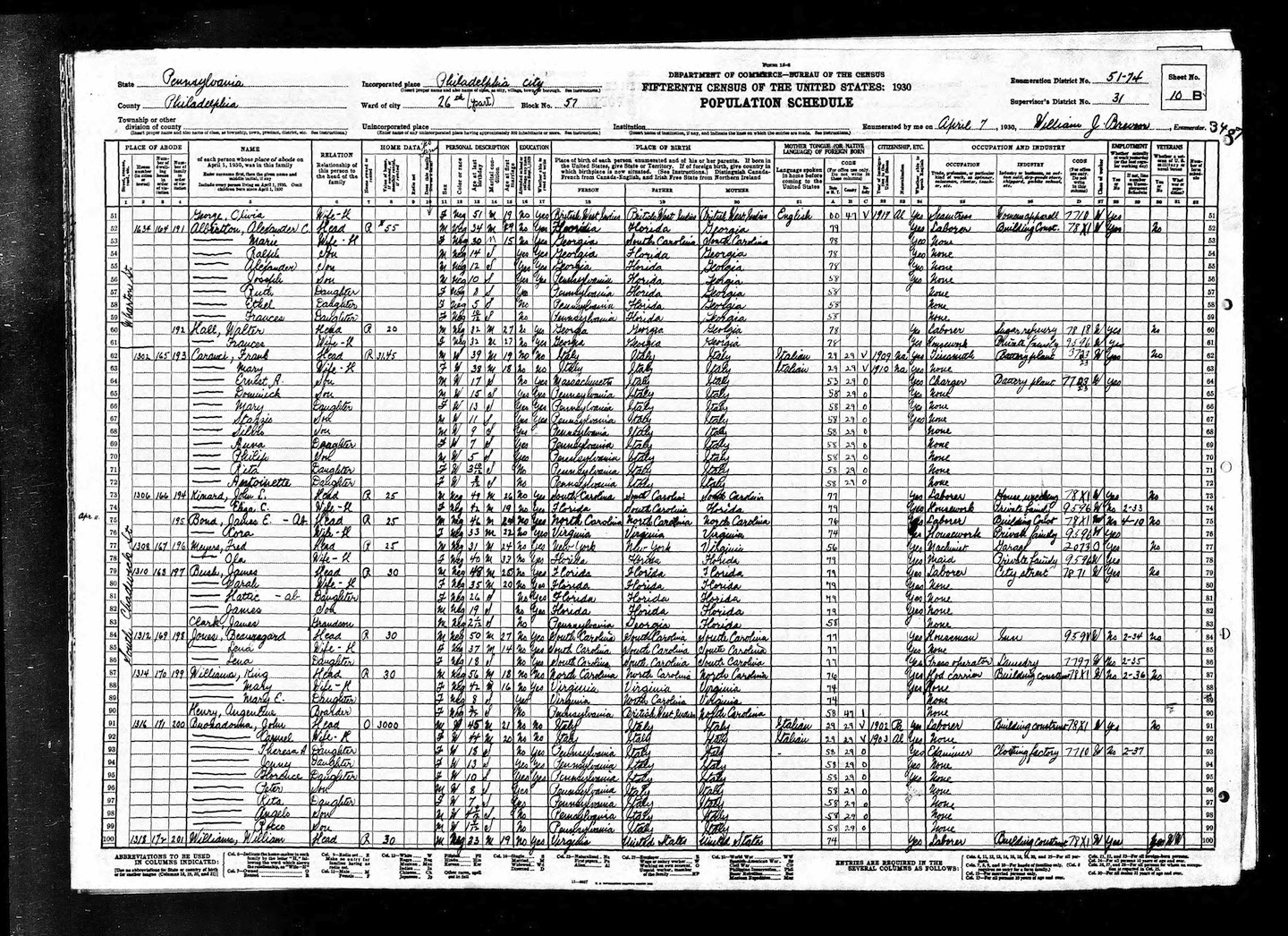
Census records confirm that Joseph Albritton was indeed the son of Alexander and Marie.
4639447_01037

Alexander Albritton and family in the Census

But Joseph wasn’t the only Albritton offspring who ran into legal trouble. In 1966, Alex and Marie’s daughter, then-37-year-old Frances “Goldie” Albritton, a factory worker, allegedly shot to death — and here a sad pattern develops — a former friend in a bar.

Even one bright spot in the Albritton family tree appears to have been snuffed out tragically. Victor Alexander Albritton, Alexander and Marie’s son, was an active duty Marine Corps sergeant who married Janice Crawford in 1948 at the age of 40. However, Victor died five years later at the much-too-young age of 45.

So, all in all, the Albritton saga is just a depressing one all the way around. I’ll keep trying to track down Alexander’s burial site, but at this point I’m not very optimistic, and that’s just very disheartening … Yet another Negro Leaguer, and his family, lost in a cloudy haze of tragedy.
Where is Ed Stone?

ed_stone

A common theme seems to be developing with the players about whom I research and write:

Where are they buried?

First, in this article I wrote for philly.com, we find that the remains of Alexander Albritton, who pitched briefly in the Negro League big time, apparently disappeared after he was beaten to death at Byberry mental hospital, aka Philadelphia’s house of horrors. I’ll explore that mystery in an upcoming post.

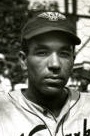
But right now, I’ll return to my Delaware theme with the case of Edward “Ace” Stone, a star outfielder, briefly, in the Negro Leagues. Stone got his start in paid baseball circa 1933 with the Wilmington (Del.) Hornets before stints with, among others, the Atlantic City Bacharachs, the Newark Eagles, the Philadelphia Stars, the New York Black Yankees and the Kansas City Monarchs.

Best known for his howitzer of an arm that some compared to that of the great Roberto Clemente, Stone also frequently hit in the middle of the lineups of some of the best teams in blackball history.

But in addition to his ability to whip the ball from the wall to home plate, Stone was also somewhat notorious for another reason: He was easily lured south of the border, playing much of his career in the Mexican and Cuban leagues, a fact that was lamented by both infuriated Negro League owners and perplexed media types.

The 1946 season seems to have been a tipping point, when in mid-spring, Stone bolted from the Philadelphia Stars and their owner, the clearly chapped Ed Bolden, for Mexico. Stated Pittsburgh Courier columnist W. Rollo Wilson in the paper’s May 11 issue:

“The Pasquel brothers of Mexico stopped feasting on the white major league clubs long enough last week to bit off another Negro National League player. This nip was right at home, for the athlete taken was Ed Stone, vintage outfielder of the Philly Stars, Ed Bolden’s entry in the eastern loop. Stone, one of the real sluggers of the club and whose long hits have kept many a rally going in past years, has already left for south of the border, where he will be assigned to one of the power-packed clubs of so-called ‘outlaws.’”

A couple months later, Randy Dixon of the Philadelphia Tribune opined that the defection of Stone was a big reason for the Stars’ languid performance so far that year. Penned Dixon:

“ … the Philadelphia Stars failed to cop the first half bunting because of the serious dents in personnel occasioned when big Ed Stone, an outfielder, bolted to Mexico and Marvin Williams, second baseman from Texas, remained in Venezuela. …

“It could have been different had a long distance hitter been in the lineup. That is where Williams and Stone come in. They represented the fence-busting backbone of the Boldenmen. With them out of action, it became a case of needing a batch of low-run pitchers such as Barney Brown or Leon Day to compensate.”

And so on and so on …

It is perhaps Stone’s propensity for pursuing his career in Latin America that led to so many gaps of knowledge in his off-the-field life story. Let’s begin with his origins …

First there’s the issue of his hometown. One of the very, very few even halfway comprehensive biographies of him is found here on the site Pitch Black Baseball, which gives his hometown as “Black Cat, Delaware.”

But there is no official city, town or municipal jurisdiction called “Black Cat” in the state of Delaware. But I did find this neat blog post on the site Delmar DustPan, which explains that “Black Cat” was actually a small community near Wilmington that earned its name from the famous night club that served as the hamlet’s cultural and economic center for a few decades in the first half of the 20th century. The blog post speculates that this is what is being referred to when bios of Ed Stone list his hometown as Black Cat.

(That’s all aside from the fact that I haven’t been able to find any contemporary references during Stone’s playing career and life that mention his hometown as anything but Wilmington.)

Then there’s the issue of Stone’s birth date, which is even cloudier. The Pitch Black bio lists it as Aug. 21, 1910. But the documents I’ve been able to find give a variety of different dates …

The Social Security Death Index, for example, states his birthdate as Aug. 21, 1909. But  various ship manifests list the date as Aug. 23, 1909; Jan. 2, 1909; Aug. 22, 1909; and Aug. 22, 1910.

Actually, some of the manifests are pretty interesting for other reasons. All of them list Wilmington as his birthplace, except for one, which seemingly inexplicably gives it as Newport, Del.

Also, one manifest states that in a 1939 voyage, Stone sailed from NYC to San Juan, Puerto Rico with his wife, Bernice Stone, née Baskerville on Oct. 23, 1912, in Newark, N.J.

IMG_0882

All-star team!!!

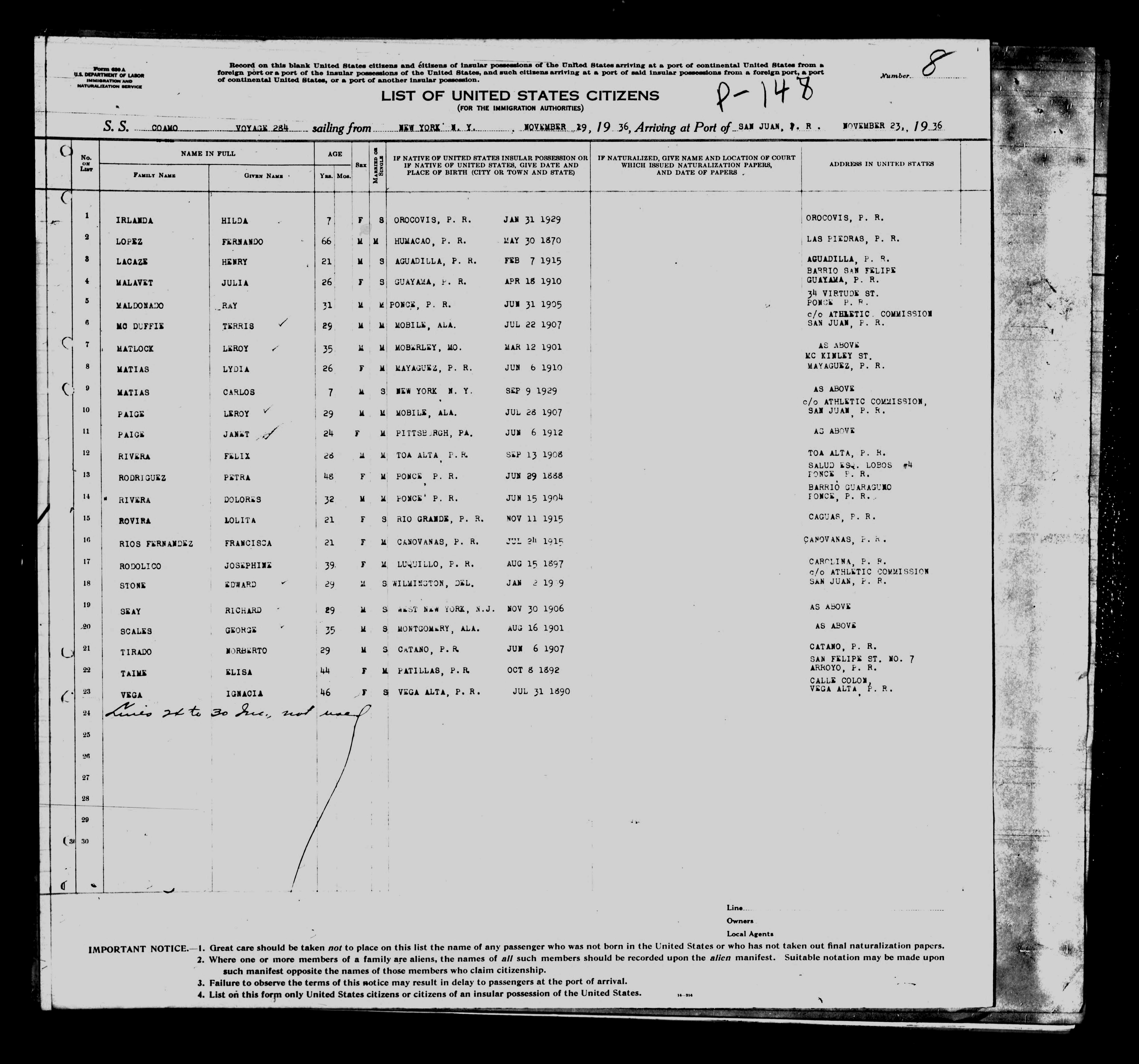
Others feature him on the same page with a slew of other Negro Leaguers who were traveling to and from Latin America for winter ball. One, from November 1936, includes a veritable all-star team — Terris McDuffie, Leroy Matlock, Dick Seay, George Scales and … ol’ Satchel himself. Another manifest has Stone couple with Buck Leonard.

The final documents I turned up were a few Census reports. The one from 1930 has 20-year-old Ed living alone in the unincorporated New Castle County (Del.) hamlet of Christiana with his father, 60-year-old widower Daniel Stone, who was apparently born in North Carolina. Ed Stone’s occupation is listed simply as “day worker,” while Daniel is toiling in a factory.

The 1940 Census has 30-year-old Ed living in Newark with Bernice and her parents, the Baskervilles, and his occupation is “baseball player.”

IMG_0875

There is now one final, looming mystery: Where is Ed “Ace” Stone buried? To first take a quick step back: When and where did he die? Social Security says March 1983, with his last SS benefit going to Long Island City in Queens, N.Y. But both Pitch Black and this entry on Find-A-Grave say he expired on April 11, 1983, in the Bronx. I’ve been able to uncover no immediate obits for him, and I’m looking into whether I can ask for a death certificate.

But the most puzzling part of all of this, and one that harkens back to the mystery of Alex Albritton’s burial location (on which I’ll have more to come, hopefully by the weekend), is that, as you can see on the Find-A-Grave site, his burial is “unknown.”

Yeah, somewhat creepy. I found this entry on a message board, and this Negro Leagues Baseball Museum article on Ed and his son, Russell. But finding Russell Stone is proving difficult, and barring getting my hands on either an obit or death certificate, finding Stone’s eternal resting place might be durn near impossible.

So if anyone out there has any information on Ed Stone, and especially where he’s buried, let me know!

The lowdown on Rap Dixon

Rap_Dixon_Large

This one’s for my buddy, Malloy Conference roomie and Harrisburg boy Ted Knorr, who possesses a singular devotion for two things: teaching people about the heritage of African-American baseball in his hometown, and getting outfielder Herbert “Rap” Dixon in the Hall of Fame.

Now, coinciding with that is the fact that I’m just wrapping up a story for Pennsylvania Magazine about the Negro Leagues in the Keystone State. So, naturally, I cyber-interviewed Ted for the story — the first draft of which stands at about 3,400 words — about his love of Harrisburg blackball, his impressions of the Negro Leagues in the average Pennsylvanian’s consciousness and, of course, Mr. Rap Dixon.

Much of this post will be in Ted’s own words, beginning with how he developed his devoted interest in the Negro Leagues:

“My earliest baseball memory was having a Brooklyn Dodger uniform given to me by my grandmom (of Brooklyn) … later my father (her son) told me about Satchel Paige, the Homestead Grays and the Pittsburgh Crawfords of his adopted hometown (and my birthplace), Pittsburgh. So I had a long ignored foundation when I joined SABR in ’79 and finally attended a conference in ’84, where I met John Holway … I was hooked.”

He adds, “My passion is fueled, I suppose, by my training as a school teacher.”

Before we discuss Rap specifically, it’s important to note that the Baseball Hall of Fame, that most hallowed of sports institutions, ushered in a huge class of segregation-era blackball figures in 2006, then declared that, Wham! The Hall’s doors were again closed to Negro Leaguers, a travesty that many enthusiasts of African-American baseball have been decrying and trying to change for the last eight-plus years.

One of those enthusiasts is Ted, who believes that numerous players still merit induction, including several, like Spots Poles, who played in Harrisburg at one point or another.

But specifically he’s an advocate for Rap Dixon, part of arguably the greatest outfield in baseball history — the 1924-27 Harrisburg Giants trio of Hall of Famer Oscar Charleston, Fats Jenkins and Dixon.

Aside from the fact that Rap’s contemporaries consistently testified to his greatness with tales of amazing talent and incredible feats, Ted believes that, compared to white players from Rap’s area who are in the Hall of Fame, Dixon’s numbers more than qualify him for induction.

rap-dixon-paul-w-faust-impressions-of-light

I’ll let Ted explain, beginning now. (I’ll note that there’s so many names for possible hyperlinks that I’ll forgo that on this post):

Rap Dixon is a spectacular largely untold story, a story best told in statistics, opinions and legends.

His statistics, as established by the $250,000 MLB funded, Hall of Fame assigned, Negro League/Researchers and Authors Group study, merit the Hall of Fame. Of the five Negro League outfielders (Spottswood Poles, Fats Jenkins, Alejandro Oms, Roy Parnell and Dixon) remaining on the 2006 ballot, his SABRmetrics are the best.

The opinions, particularly those voiced long ago, on Rap also happen to be the best among those on the ballot, with the first three Negro League outfielders inducted in to the Hall of Fame – Monte Irvin (1973), Cool Papa Bell (1974), Charleston (1976) – all agreeing on Rap Dixon’s merits … Monte Irvin feeling Dixon is the most worthy of the five (based on his composite feelings in five separate sources), and both Cool Papa Bell and Oscar Charleston going further – Bell naming his all-time outfield to include Hall of Famers Turkey Stearnes and Monte Irvin and Rap Dixon, while Oscar Charleston favored Hall of Famers Cristobal Torriente and Martin Dihigo and Rap Dixon.

Thus, all three of the first three Negro League Hall of Fame outfielders agree that Rap Dixon is the best of the five outfielders remaining on the ballot, with two of them placing Rap Dixon as the greatest right fielder of all-time.
Alas, it is the legends – like miracles required by the Catholic Church for sainthood – that define the man. The litany sounds more like fiction, but each of the following is documentable:

As a player:
·         As a rookie in 1924, Rap Dixon was a member of the greatest outfield in Negro League history with Oscar Charleston and Fats Jenkins. They are the only Negro League outfield intact for four years. Only nine MLB outfields meet the four-year standard.

·         In 1927, Rap Dixon toured Japan playing so well that the Emperor awarded him a Loving Cup Trophy.

·         In 1929, Rap Dixon cracked 14 consecutive hits to set an unbroken, after-85-seasons, Major-League-equivalent record.

·         In 1930, Rap Dixon hit the first HR by a Negro Leaguer in Yankee Stadium. I refer to the House that Ruth Built as the House that Dixon Rehabbed.

·         In 1932, when Gus Greenlee opened his purse, telling Manager Oscar Charleston to field the best team his (Greenlee’s) money could buy … Charlie had Rap Dixon in right field for the Pittsburgh Crawfords.

·         In 1933, Dixon was elected, by the fans, to the initial East-West Classic. Dixon was a six time all-star.

·         In 1934, when the Concordia Eagles captured the Caribbean title, they featured Luis Aparicio Sr, Lorenzo Salazaar, Tetelo Vargas, Hall of Famers Martin Dihigo and Josh Gibson, and Rap Dixon.

·         In 1935, Rap Dixon was 6-for-18 with three homers and a double in leading the New York Cubans to the brink of the Negro National League championship only to lose when Dihigo tossed gopher balls to Charleston and Gibson of the Pittsburgh Crawfords late in game seven. Undaunted, Charleston picked Dixon up to barnstorm against Dizzy Dean after the season. Rap Dixon did not disappoint, going 2-for-4 against ol’ Diz.

eagles rap dixon

As a manager:

·         In 1934, Rap was the first professional manager of future Hall of Famer Leon Day.

·         In 1937, when the suspended Satchel Paige, Josh Gibson, Cool Papa Bell and the rest of the Trujillo All Stars returned from the Dominican Republic, they solicited Rap Dixon to manage their barnstorming tour, which culminated with the Denver Post Tournament championship.

·         In 1942, Rap took an integrated Harrisburg Giant team (with four white players) to Philadelphia to play the Hilldale Club.

Thus, Rap Dixon is not just a great player with spectacular statistics and kudos from his peers, but a legend who was a baseball ambassador, leader in the advent of integration, manager of men, and a teammate of more Negro League Hall of Famers than any player not yet inducted.

Hi. It’s me again. After reviewing all that, it’s for me not to agree with Ted — Rap Dixon deserves to be in the Hall of Fame. Let’s get him in there! Seriously, what more does the Hall need, except a swift boot to the fanny?

Look out, Delaware …

… I’m coming for ya!

That’s right. In keeping with my admittedly whimsical and mercurial researched interest, I’ve been thinking about looking into the Delaware blackball scene. Why? I like exploring, quite simply, and the Blue Hen State seems like fertile ground for such endeavors. It just seems like under-explored territory.

So, with that, I’ll use this post as a segue from my focus on NOLA and Louisiana the last couple weeks to not just spotlight Delaware, but to examine and search for answers to a handful of mysteries that’ve been bugging me lately (one of which will involve a Delaware native).

ghost4

Oliver Marcell

So what’s a connection between the Pelican State and the First State? Why, the irascible Oliver Hazzard Marcell, of course. The legendary third baseman with the equally legendary hot temper and penchant for getting into drunken scraps is a native of Thibodaux, La., who first cut his teeth for teams in New Orleans before moving on to fame, fortune and a bitten-off nose.

But in 1933, when his career was on the downward side, Marcell — that’s the proper spelling of his name — plunked himself down in Delaware — Wilmington, to be precise. Why? Because he signed on as the manager of the Wilmington Hornets, a semipro team that had existed for a while but that in summer 1933 joined the new Eastern Negro Baseball League, which, according to reports emanating from the nascent circuit’s meeting in Chester, Pa., would include franchises in Wilmington, Atlantic City, Chester, Newark and Jersey City. The loop’s schedule was set to start in early July, with every team playing four games a week, two at home and two away.

The movers and shakers behind the new organization believed that each franchise was already drawing well enough in good baseball towns to provide sufficient financial support for the enterprise to survive. (This despite the fact that the entire country was mired neck-deep in the Great Depression.)

“All clubs are playing before good crowds and with the added inventive [sic] of league competition the interest should be even greater,” reported the July 8, 1933, Baltimore Afro-American. The article named Marcell and Sam Johnson as the guys at the helm of the Hornets, and future Hall of Famer John Henry Lloyd as the skipper for the Atlantic City squad.

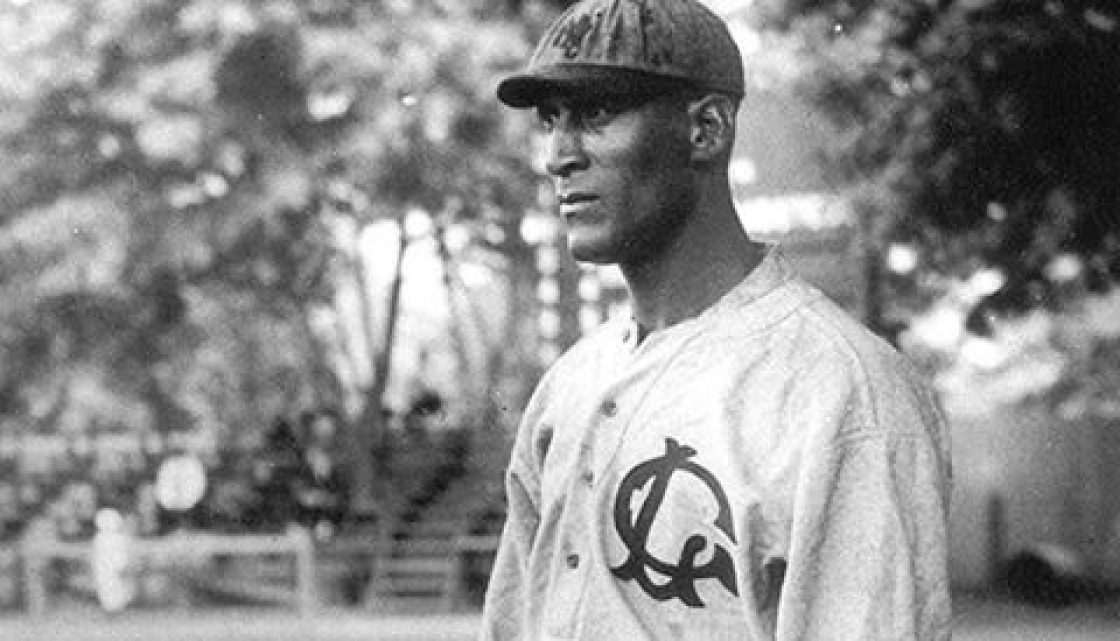
lloyd

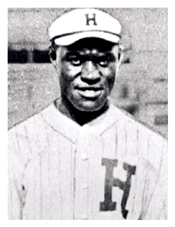
“Pops” Lloyd

The league’s formation was the lead topic in the Pittsburgh Courier’s W. Rollo Wilson’s July 8 column. Wrote Wilson:

“Such a league ought to serve a worth-while purpose and be in effect what I have always contended for — a minor loop for the development of stars for the big clubs. With such men as Marcell and Lloyd in there teaching the kids the finer points of the game much good can come out of such a body. In their days and times Ollie and John Henry were rated the best in the business in their particular positions and Lloyd has established a reputation as an instructor of young talent.”

But in actuality, Marcell had already been with the Hornets for a few months, and Wilson sang Marcell’s praises weeks before the formation of the ENBL, especially in a June 10, 1933, column under the subhead, “MARCELLE PUTTING WILMINGTON ON MAP”:

“That old-time third baseman — the best of the race I have ever seen — is back in the baseball picture in a big way and his thousands of admirers will be glad to know that he is the playing manager of the Wilmington (Del.) Hornets, already rating as one of the better clubs of this eastern section. …

“Wilmington is a good ball town, and Marcelle will give the public a team which will make hot competition for the best of them. Here’s wishing him and Sam Johnson, the owner, the best of luck in a tight year.”

Wilson wasn’t the only writer ballyhooing the ENBL, Marcell and Lloyd. Afro-American columnist Bill Gibson, in a July 15 piece, echoed Wilson’s sentiments that the new loop would serve as a stepping stone and teaching ground for young players with talent destined for the big-time:

“A sort of middle ground has been a long-felt need — a place where these youngsters can be farmed out for seasoning. I was, there, able to tell Oldtimer [a visitor to Gibson’s office] of the efforts of Ben Taylor here in Baltimore and of Ollie Marcelle, at Wilmington, Del., and of John Henry Lloyd in Atlantic City.

“The two last-named managers only recently entered teams in an Eastern League which it is hoped will stimulate interest in semi-professional baseball and at the same time develop and polish off players who may have aspirations to climb. Taylor, Marcelle and Lloyd are of the old school of baseball and they not only know baseball flesh when they see it, but they have patience in nursing it along until it becomes of age.”

But, like so many ventures in the American pastime during the Depression, it wasn’t to last, for the ENBL or for Marcell in Wilmington. By early September, an internal shakeup had bumped Marcell out of the Hornet managerial position in favor of Highpockets Hudspeth, and the new circuit died a rapid, ignominious death.

Marcelle reportedly retired from the game a year later and, according the James A. Riley in “The Biographical Encyclopedia of the Negro Baseball Leagues,” “he faded from the sport scene and into obscurity.” Riley’s entry on Marcell makes no mention of the legendary player’s brief stint in Wilmington, and neither do the vast majority of bios on Marcell.

That’s how obscure Marcell’s tenure in the Blue Hen State was — obscure, but not insignificant, certainly for Delaware, which, I am learning, has a richer blackball heritage than I ever expected.

And thus do I shift from Louisiana to Delaware. The next chapter, which will hopefully come later this week? The mystery of the fate of Delaware native and one-time superb Negro Leagues outfielder Ed “Ace” Stone …

Amazing news

WARNING: SEMI-RESTRAINED BRAGGING AHEAD!

Something incredible happened to me last week, the week of giving thanks, and I’m certainly grateful for this …

I’ve been asked, and I eagerly and gratefully accepted, to play a close consulting role in a movie being developed about a Negro Leaguer on whom I’ve been doing a bunch of research and writing. I can’t give away any more details on it at this point, but this could be the big career break for which I’ve been wishing for so long. It would also bring to light the story of a man and player who remains grievously hidden in the shadows.

I’ll keep posting updates as they come along and as things develop. For now, I’m just stunned with amazement and gratification at what could lie ahead.

I also want to thank every single person who reads this blog and supports my modest work. You all have helped greatly in making this happen.

Onward and upward!

A stone for the Skipper

noot0009

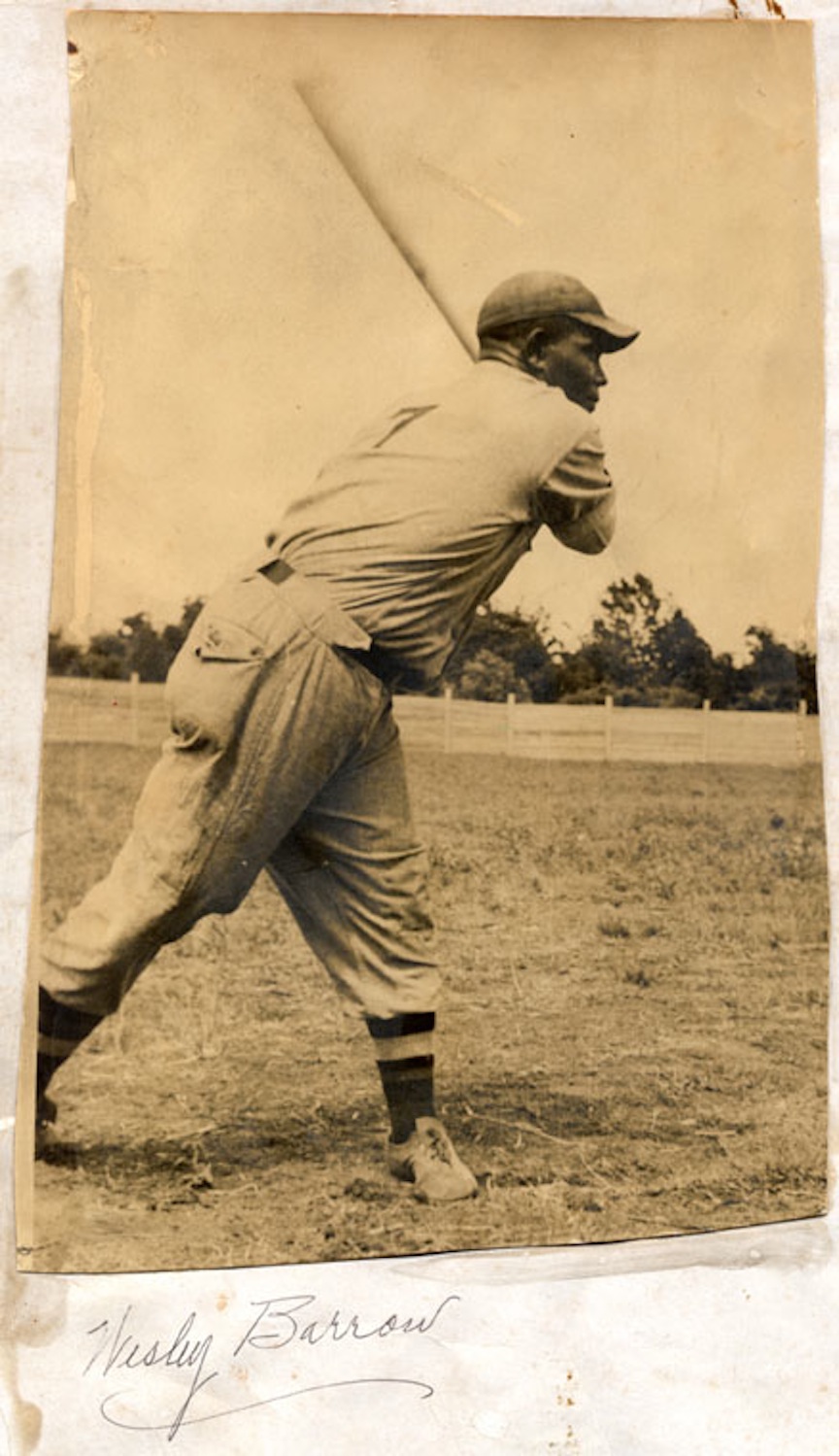
(Photo from Old Timers Baseball Club collection, Amistad Research Center, Tulane University)

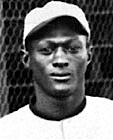
It’s happening! Local NOLA black baseball great Wesley Barrow (above, in his playing days) is getting a grave marker!

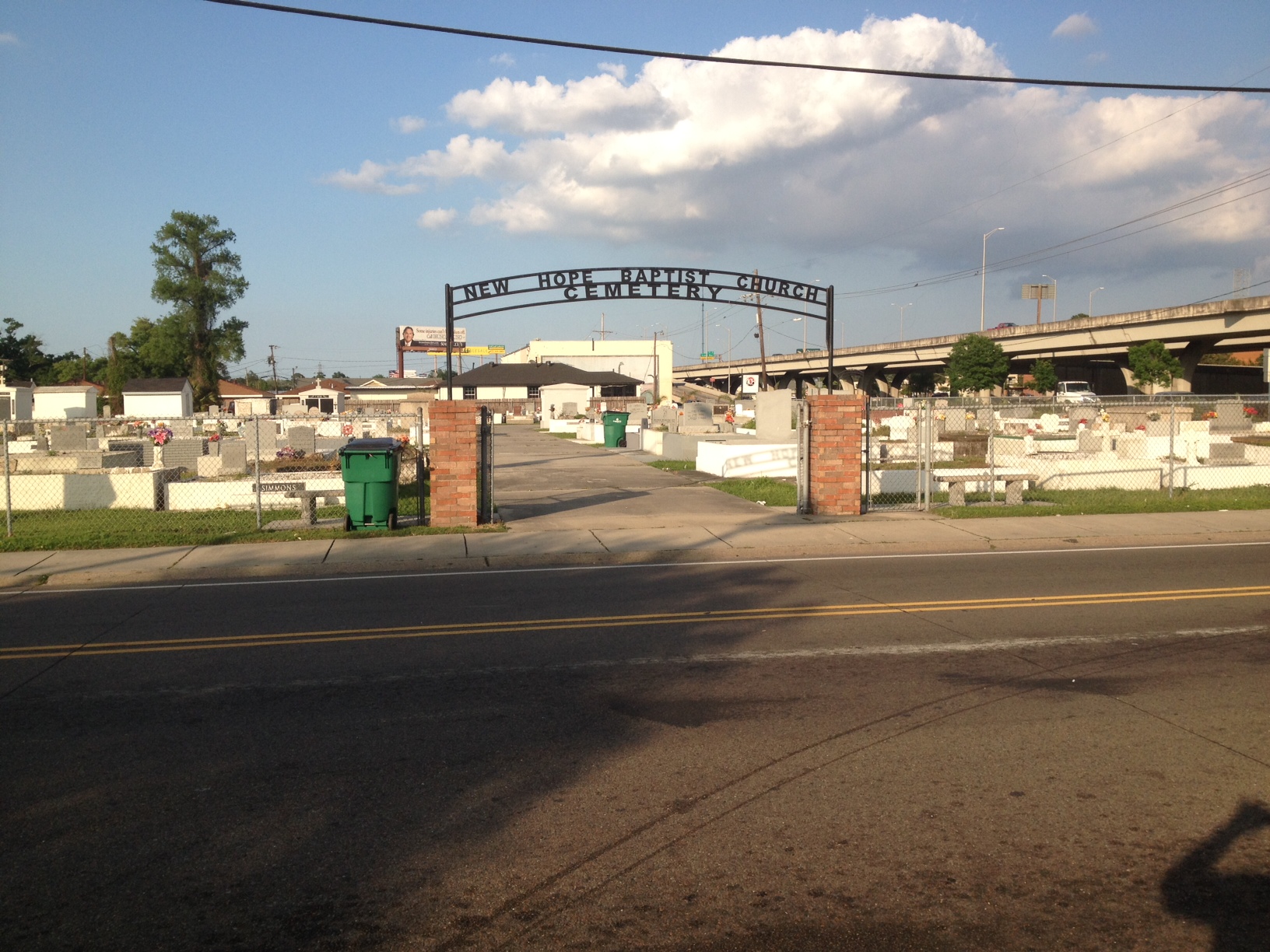
When Rodney Page, the son of legendary Big Easy African-American promoter-owner Allen Page, read my post about the Skipper being buried in an unmarked grave, Rodney e-mailed me and told me he’d be glad to pay for a stone for the spot, which is pictured below.

IMG_0826

Rodney and Gretna City Councilman Milton Crosby, who’s in charge of rehabbing the New Hope Baptist Cemetery (and so far doing a fantastic job) where Barrow is buried, are in the process of connecting about getting the details done.

photo

I’d love to see a stone in place and a dedication ceremony set by Christmas because the Skip died on Christmas Eve, 1965, but a lot has to be done and taken care of between now and then for that to happen, so I’m not sure when it can all take place.

Everyone who knew Wesley Barrow and whose lives were touched by his wisdom, dedication and kindness would be welcome to attend a dedication ceremony. Also, any such people who are reading this, you are invited to post comments or testimonials about the Skipper, or to e-mail them to me.

Dear Joe, Dear Dwight

Yesterday I dug into the files of the Old Timers Baseball Club, a former group of ex-Negro Leaguers here in NOLA dedicated to the preserving the history and legacy of African-American baseball. The group’s founder and long-time president, Walter Wright, donated his collection of correspondence, photos, documents, articles and ephemera to Tulane University’s Amistad Research Center late in life.

Wright’s, and now Amistad’s, collection is a treasure trove of fascinating materials and remembrances of a time long ago. Walter Wright never really made it to the big big time in the Negro Leagues, but he was such a mainstay on the New Orleans scene, and his post-baseball career as an educator in the New Orleans Public School System made him a beloved figure in this city.

3459

Walter C. Wright (from All State Sugar Bowl Web site)

As the head of the Old Timers Baseball Club, he oversaw the annual Old Timers baseball reunion game, which each year honored a different former Negro Leaguer, including, one year, future Hall of Famer Bill Foster. For that edition of the contest he received personal testimonial letters to Foster’s mound prowess from Foster’s manager with the Chicago American Giants, Dave Malarcher, himself a NOLA and Louisiana product.

Wright was also an eternal optimist, and he was thankful how much support gradually grew over time for remembering and honoring the Negro Leagues, and he enjoyed spreading that cheer. Two examples of that are hidden in the files of the Old Timers Baseball Club Wright donated to the Amistad Center, one of which is a May 15, 1975, letter to then NBC announcer and former MLB player Joe Garagiola, who had consistently been vocal in his desire to see the Negro Leagues recognized and respected. Here are some excerpts from that letter on behalf of the Old Timers Club:

“This is just our way of introducing ourselves as an organization that strongly supports your ideals and ideas as they relate to the world of sports, especially baseball.

“We feel deeply indebted to you for the concentrated focus that you have aimed so expertly at the Negro and his exploits on the baseball field and yet because of your youth and limited associations with the Negro player, we fell it is our responsibility to offer you whatever assistance we can give.

“You, we are sure, have played an important role in the selection of qualified Negro baseball players who have been enshrined in the hall of fame and yet it is because of this that we want to help you be aware of certain pitfalls. One that gives us much concern is the fact that so far the area of concentration in search of Negro greats of the past has been mainly in the Pittsburgh-Philadelphia section. The players who have been selected so far are men who have exhibited greatness and we are thoroughly pleased but let’s consider Kansas City, Milwaukee, Detroit, Atlantic City, Memphis, Birmingham and New Orleans. Please accept this not as a criticism or protest but as a constructive observation.”

Wright then offers to help arrange an interview by Garagiola of Bill Foster, who at the time was the deal of men at Alcorn State University in Lorman, Miss. (At that time it was Alcorn A&M College.)

This year, Wright’s recognition of Garagiola’s contributions to the memory of the Negro Leagues takes extra significance because the latter was the recipient of the prestigious Baseball Hall of Fame’s 2014 Buck O’Neil Lifetime Achievement Award.

In another letter, this one dated May 27, 1987, Wright contacts former Mets star pitcher Dwight Gooden, who at that time was just getting out of substance-abuse treatment for cocaine problems and was working out in the minors. Wright, as head of the Old Timers Club in New Orleans, wrote to Gooden to offer support and advice:

“We are a baseball club made up of black baseball players from the leagues of yesteryear, 100 members. Our aim is to:

“1) Annually, pay tribute to those men of yesteryear who have contributed to the game of baseball.

“2) Keep the game of baseball alive in the New Orleans Community.

“3) Give leadership to the youth of our city.

“… we want you to be know that to us and millions like us you are still the greatest. Come back with your head high, not as an expression of boastfulness but of simple humility and pride.

“You cannot undo what has already been done but you certainly can make it become a part of your total education and store house of experiences that should make you a better man because of it all.

“Keep in mind that whatever affects you affects us all, that when you cried millions of us cried with you. Let’s vow that from here we’re going to put the pieces together and keep on smiling.

“If you ever again feel that you are weakening just look to the bull pen and see several million anxious faces ready to take the job for you and complete the job at hand.

“That’s a pretty good bull pen, don’t you think?”

Granted, there’s a certain amount of naivete there in Wright’s note to Gooden, and who knows what the struggling star pitcher would have accepted the letter, if he read it at all. But the fact that Wright was moved to, on behalf of his colleagues in the Old Timers Club, take the time to write an inspiring letter of support and encouragement to a player whose name and public image had been tarnished immeasurably took a level of caring and faith in the human spirit that is more than admirable.

So on this day of thanks, try to remember these words from Mr. Wright to Mr. Garagiola and Mr. Gooden, and feel grateful that there still are people like Walter Wright in the community, people who still believe in the goodness of men and women and our ability to overcome adversity and reach out to those in need.

Thank you, Mr. Wright. May your spirit and inspiring light shine forever.

Much to be thankful for …

I was going to head into the Thanksgiving holiday with a depressing post about Philadelphia Negro League pitcher Alex Albritton’s apparent lack of any grave at all, but you know what? Between now and Sunday, I’m posting only good, upbeat news, things for which I and we all have to be thankful. So much negativity around us, and I’ll admit that the frequently somber and even macabre tone of this blog occasionally adds to that. After a while, you just need a break.

So for four or five days, nothing but good news, and actually, I might have a lot of it, starting tonight. 🙂

Herb and the Hog

groundhog3

photo

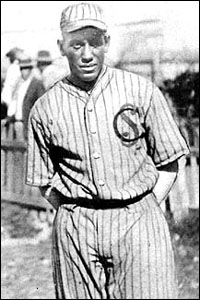
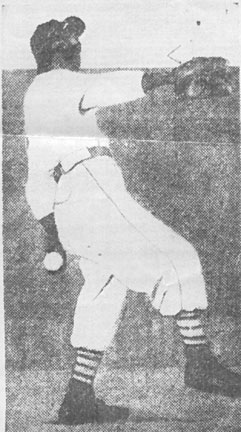
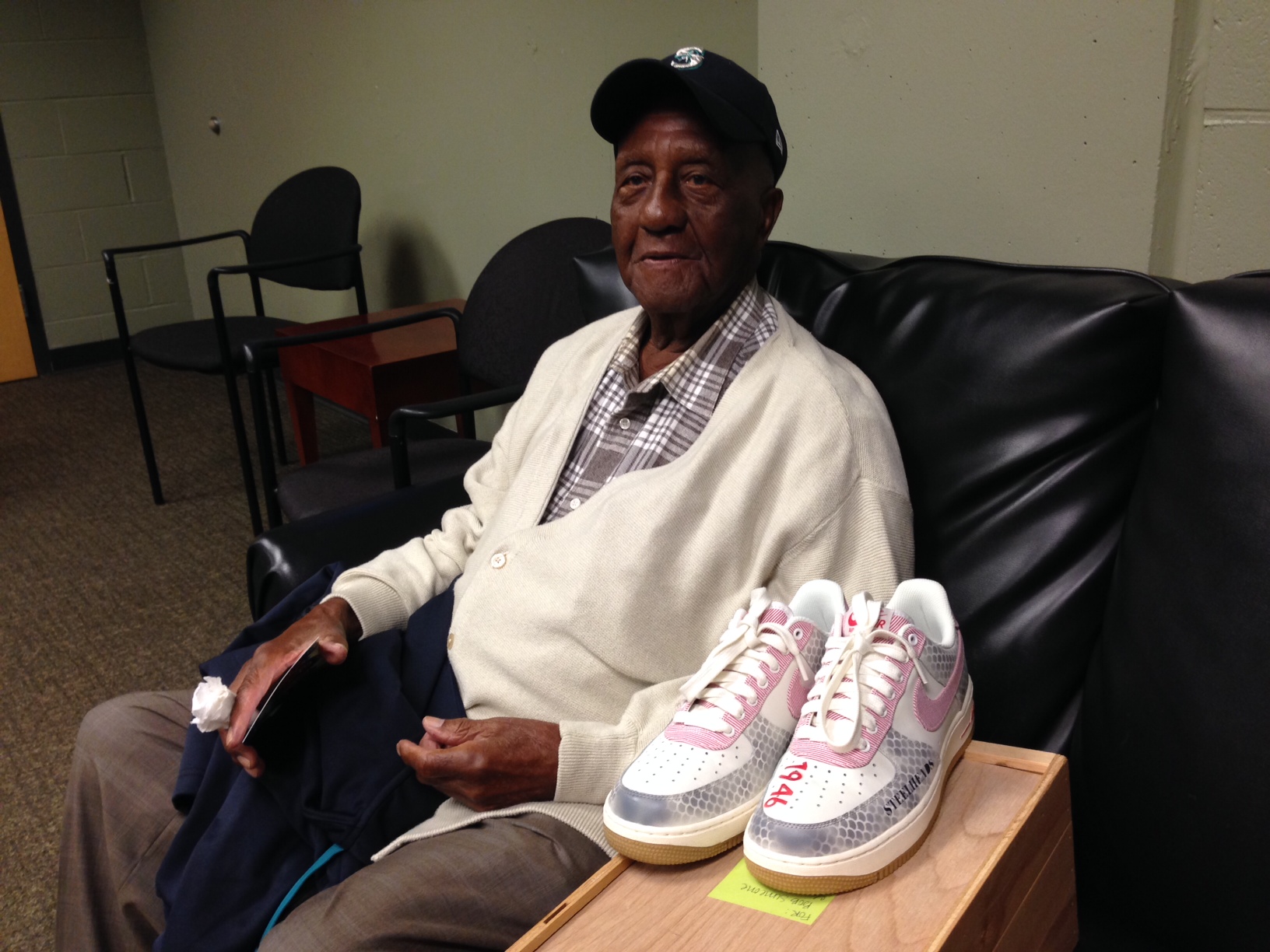
Groundhog Thomas (top) in his playing days, and Herb Simpson (bottom) during his trip to Seattle this past July.

A precious few people still living remember Frank “Groundhog” Thomas (or Thompson). That list includes our old friend Herb Simpson, who, at 94, is one of the last, if not THE last, surviving Negro Leaguer in the New Orleans area.

A couple nights ago, I gave Herb a call to see if he might have any idea about the big Hog mystery — whatever happened to Thomas once he retired from baseball circa 1954. According to just about every biography I’ve read about the Hog says something along the lines that he “faded into obscurity,” and no one even knows when or where the sawed-off (and quite homely, by all accounts) pitcher died.

Both Herb’s and Thomas’ baseball careers were birthed in and around New Orleans around the same time — late 1930s and early 1940s — and their lives and hardball trajectories crossed paths frequently. Herb does remember the Groundhog, but not too much.

“He was a pretty fair baseball player,” Herb said of the Hog.

Then there was the big question: Do you know anything about Thomas’ fate?

“I haven’t heard about him in many years,” Herb said. “I don’t know what happened to him.”

The running theme continues. I’m planning on writing a longer piece detailing Thomas’ rise from obscurity in the New Orleans area after the holiday, but here’s a little teaser about how he got his start in paid Negro Leagues baseball.

He first started hurling his fireball for teams based in Houma, La., and 1943 appears to have been his breakout year, when the region’s main African-American newspaper, the Louisiana Weekly, started covering the Hog and his team, the Houma Jax Red Sox, in earnest.

At one point during the ’43 campaign, Thomas — he was still known by the surname Thomas at that point; it wasn’t until he made the Negro League big time that his moniker somehow morphed to Thompson — reeled off an incredible string of victories against regional semipro and industrial squads from NOLA and the surrounding area.

062643

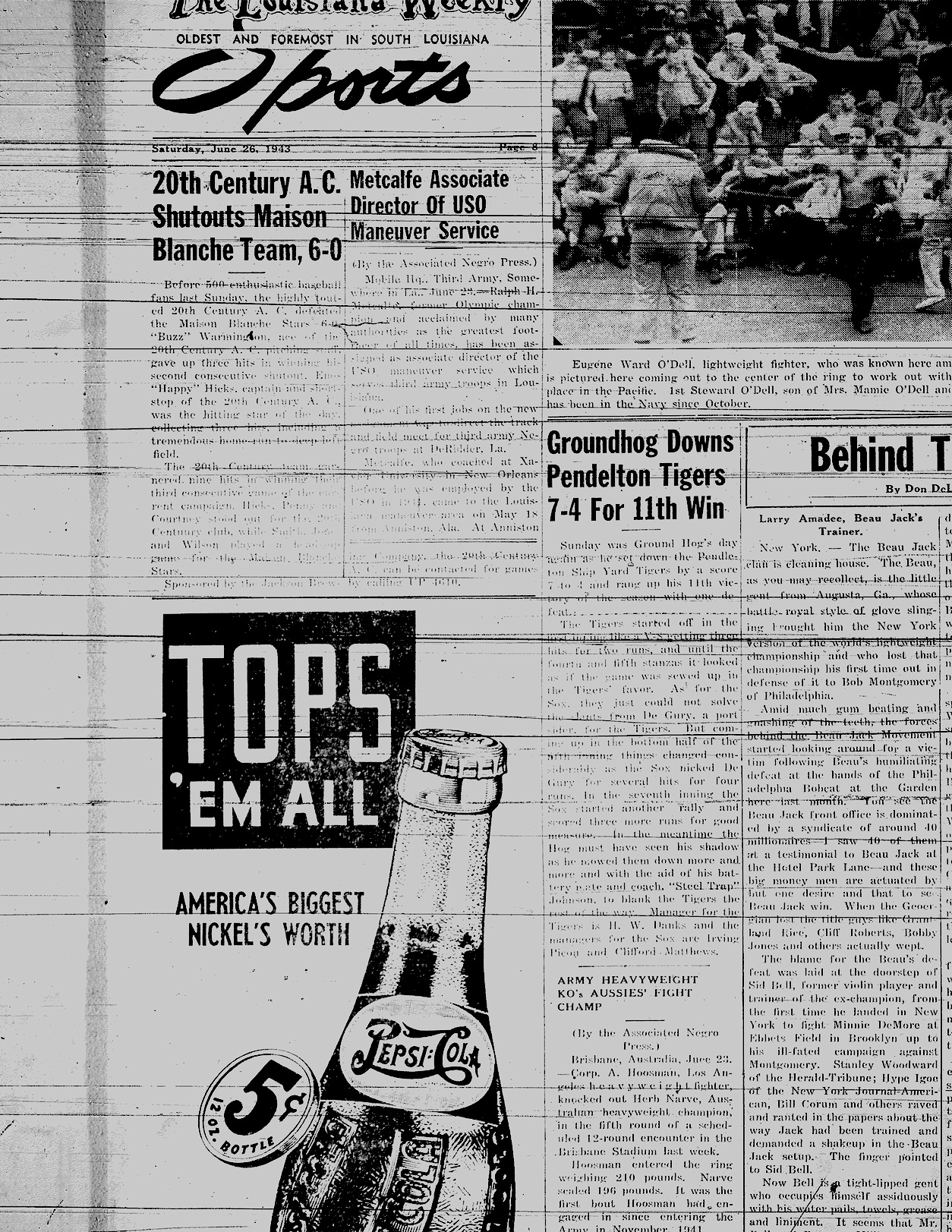
One of those contests came in late June 1943, when the Tigers downed the Pendelton Tigers, a squad from a New Orleans ship yard. It took a little doing — the Tigers grabbed control of the clash early, but the Sox settled down in the fourth and fifth innings and took over — but the Hog eventually caught fire. Reported the June 26, 1943, Louisiana Weekly:

” … the Hog must have seen his shadow as he mowed them down more and more and with the aid of his battery mate and coach, ‘Steel Trap’ Johnson, to blank the Tigers the rest of the way.”

At the time, the Houma squad was managed by Clifford Matthews and the Houma-based talent scout Irving Picou, who reportedly tipped off his friend, Abe Saperstein, who subsequently shepherded Thomas/Thompson to the pinnacles of blackball.

But then came a contrary report a couple years later from Hall of Fame sportswriter Wendell Smith from the Pittsburgh Courier, who wrote this in the Dec. 1, 1945, edition of his renowned column, “The Sports Beat”:

“Irving Picou, owner and manager of the Jax Red Sox of Houma, La., claims that the Birmingham Black Barons are trying to steal his ace pitcher, Frank (Groundhog) Thompson. He says, however, he has Thompson signed to a contract for ’45 and ’46 and will sell him to anyone but Birmingham, who used the stock hurler the latter part of the past season.”

A few months later, the Cincinnati Crescents barnstorming team, skippered by none other than Louisiana and Big Easy product Winfield Welch, inked Thompson to a contract for the 1946 slate.

The mysterious sage of the Groundhog is ever ongoing …