The Devils inside

Yes, OK, fine, I’ll admit it: Even after almost two decades, I have a rather bitter distaste for the Bloomington Herald-Times newspaper in Indiana.

That lingering antipathy was forged more than 20 years ago out of a rivalry we IU students had for the local city paper as staffers for the Indiana Daily Student, a rivalry born of admitted jealousy for the local “professional” journalists.

That seething animosity emerged despite the plain fact that the H-T writers were always very friendly and even occasionally helpful toward us IDSers, making our animosity for them of the petty and irrational type.

The IDS sports desk, perhaps in particular, resented sports dudes at the H-T. Why? Again, base jealousy. The H-T had the access and connection to the IU athletic department and its administrators, coaches and players, especially when it came to basketball, of course, which at the time was still marshaled by Bobby Knight. Looooooooooongtime H-T sportswriter and editor Bob Hammel, for example, was friends with Knight. They were downright pals. On top of that, Knight, he of the seemingly eternal grudges, didn’t speak to the IDS at all. He hated us for years because at one point decades earlier one IDS reporter did something to royally piss him off — which, naturally, wasn’t at all hard to do — and Knight held it against us for ages

And it extended to football, too, which I covered and at which time the pigskin program was actually pretty good, thanks to coach Bill Mallory. Now, on occasion I witnessed Hammel, Mallory and the rest of the coaching staff eating Dagwood’s subs for lunch together in Mallory’s office. His office! The inner sanctum!

(To be fair, Mallory liked me a lot during my two years on the gridiron beat, and always made time to talk with me. He even liked me after a certain incident before the 1993 IU-Purdue game that involved obscenities from a player that ended up on SportsCenter. He offered to provide job recommendations if I ever needed them. In the famous words of Edie McClurg, he was a righteous dude.)

Aaaaaaaaanyway … to this day the mere mention of the H-T makes me arch my back and hiss. Again, petty and irrational and proof that I have no right bashing Bobby for holding grudges. But when the H-T’s Andy Graham recently wrote a story — with heavy input from Hammel — about Negro Leaguer and Bloomington native George Shively, it both piqued my curiosity and made my blood boil.

I knew it was a story I had to jump on, and one I needed to do so much better than poor, naive Andy. He entered the wrong playground. The Negro Leagues is my specialty, and he just kicked grains from the sandbox in my face.

So I needed to dig deeper into the George Shively story and find some obscure yet spellbinding stuff. Which is what I did, or at least try to do, with this chapter from Shively’s career, a chapter I’ll divide into three sections, beginning with this one, which in itself has two parts …

***********

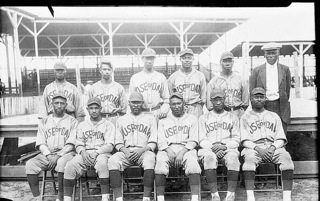
In 1919, after several years with the pre-Negro National League Indianapolis ABCs, the 26-year-old Shively kicked on up to Kokomo, Ind. — please refrain from any references to the horrible Beach Boys song — to play for the Kokomo Black Devils, a semipro squad a notch or two down from the ABCs in terms of quality.

Why exactly Shively, a stellar left fielder, would leave a first-class operation in the big city for a start-up townie team located 50-plus miles north of Indy remains unclear, but it probably had a lot to do with the owner of the Black Devils, a prominent, wealthy and white Kokomo clothier named Charley Lyons.

Lyons, who will make up the second installment of my Shively-turned-Kokomo saga, was by all accounts an eccentric, well-to-do man-about-town who liked driving fast cars (to the point of going on trial for speeding and publicly lamenting that his Ford couldn’t hit 90 mph), wearing $3,000 watches, playing handball, taking months-long trips to Europe and, apparently, pulling together a “colored” baseball team as a little side project.

Lyons announced the impending formation of the Devils in April 19, boasting that the club would beat the pants off any challengers, black or white. Stated the April 24, 1919, Kokomo Daily Tribune:

“Kokomo is to have a real colored baseball club, one which will be the equal of the famous A. B. C.’s or any other class A semi-pro ball club In the country. Ample financial arrangements have been made for the club and it is announced that the organization is backed by some of the most substantial business men of the city.

“It is also announced that some of the best colored ball players in the country will be seen in action here among whom more than likely there will be Clark. Kokomo’s favorite spectacled dusky baseball player, formerly with the A. B. C.’s who will act as manager of the local club.”

All grammar is from the original (as is the term “dusky”). I’m also unsure of who Clark is. It’s also interesting that at this point, Lyons was keeping his name out of it, although the subhead calls them “Lyons Black Devils.” But nonetheless, expectations were (unreasonably, as shown out) high for the Devils.

Of mice and men … Charley’s plan for hardball greatness quickly went astray and didn’t start off that phenomenally once the Devils actually hit the diamond. It’s not that they were horrible, they just were … blah.

They managed to win their debut game, a 6-4 victory in 10 innings over a mighty aggregation of … rubber factory workers. The Herculean feat was done in front of nearly 1,000 fans at Athletic park.

“The dusky demons proved their mettle all right, and if they can only preserve their morale throughout the season they should close with a top record,” reported the May 19 Tribune.

The team suffered a huge blow a week later, however, when one of the town’s favorite “colored” athletes, “Circus” John Byers — who will be the focus of my third installment of this tale — formed a rival club called the Western Black Sox. As per the May 26 Tribune:

“The Western Black Sox, ‘Circus’John’s aggregation of colored baseball talent, have mapped out a western route for July which will keep them busy for a while. Leaving Kokomo on the first of that month, they are scheduled to play Chicago Heights, Beloit Wis., and other teams in the west.

“For June the Sox have arranged games with Muncie, Marion and other nearby towns, including a series with Columbus.”

Then game the 1919 version of snark:

“Incidentally ‘Circus’ John wishes the newly organized ‘Black Devils’ success — until they meet the Black Sox. It looks as though $50 or $100 might be hung up in a series for these two dusky teams to struggle for …”

Lyons, who was by now the much publicized owner of the club, was irked enough to throw beaucoup bucks at the situation. That, my guess is, included luring a first-class, young outfielder and native Hoosier up to Kokomo with quite the generous job offer. Stated the May 29, 1919, Tribune:

“The strengthened Lyons ‘Black Devils’ have taken upon themselves the task of avenging the defeat which Frankfort’s Central Loop team administered to the [white minor-league] Kokomo Red Sox Sunday. Decoration Day the colored team will cross bats with the bunch from Frankfort at Athletic park. The game will not be called until 3:30, after the parade and all the exercises of the day are over, so there will be no interference with the Memorial Day program.

“The Lyons aggregation has been busy trying to strengthen all the weak spots in their lineup and have been lucky enough to acquire George Shively, famous left fielder of Taylor’s A.B.C.’s to cover the same position with the locals and captain the team. He will also be lead-off man in the batting array. …”

Two notes to that quote. One, it seems peculiar if not patriarchic that the paper would automatically assume the town’s African-American squad gave a poop about its white Kokomo counterpart and the latter’s loss to Frankfort, let alone be instilled with a burning desire to “avenge” that defeat. And ironically, as we shall see, the Black Devils’ popularity in Kokomo allegedly some led to the death of the white Red Sox later in the season.

The second note … Thus we finally have George Shively entering the Kokomo picture in 1919. However, Shively seems to have made an equally swift exit from the picture as well — I couldn’t immediately find any further mention of Shively in the ensuing media coverage of the Devils’ 1919 season. Indeed, it’s well known that in mid-1919, Shively bolted his Hoosier roots for big-name blackball teams out East, forever leaving behind any association with the semipro ranks.

So Rabbit Shively comes and goes in a heartbeat, becoming an obscure footnote to a slightly less obscure footnote of Indiana African-American baseball history.

But even after Rabbit ran, the Black Devils forged ahead throughout the summer of 1919. The rest of the Devils’ tale that season turns into one laden with racial implications in a state with a, shall we say, complex history of race relations, especially in the 1920s, when the KKK literally ran state government. I’ll unravel that saga later this week, in Part 1A of the Kokomo story …
Parallel experiences, parallel cultures

Yo-lou-babe&theboys(8x10)-B&W

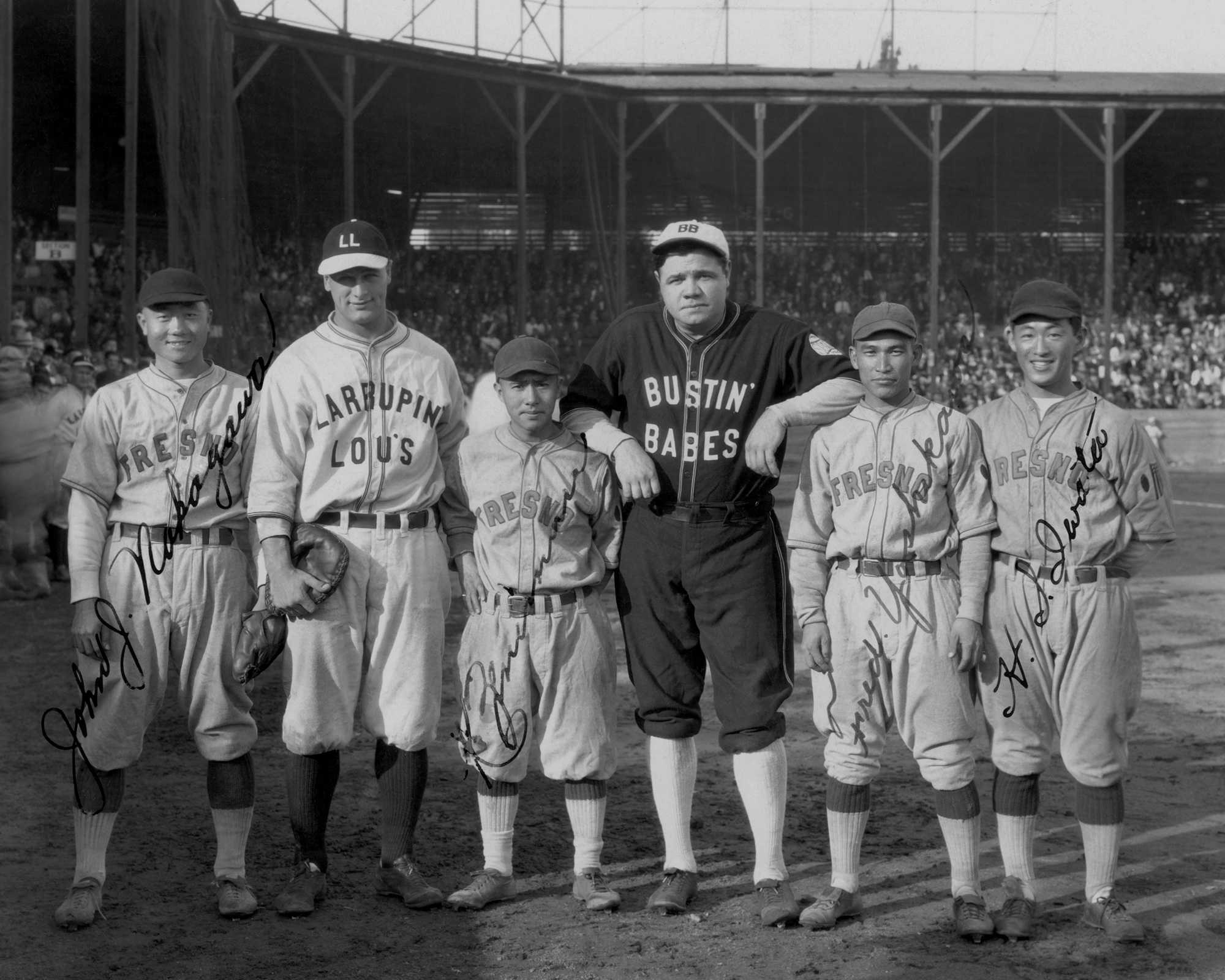
Early Nisei players competing alongside a couple familiar faces. (Photo courtesy of Kerry Yo Nakagawa)

As I work on my story on the Berkeley International League of the 1930s, I’m interviewing various people connected to the league or students of ethnic baseball in the Bay Area in the first half of the 20th century.

That effort brought me last night to Kerry Yo Nakagawa of Fresno, a member of SABR and an expert and author on the subject of Japanese-American, or Nisei, baseball played by first-generation Americans of Japanese descent.

I wanted to speak with Kerry because there were many Nisei who took part in the BIL, contributing to the remarkable mélange of colors and cultures represented in Byron “Speed” Reilly’s semipro circuit.

Our conversation centered around how the Nisei, like many other immigrant cultures, often used baseball to integrate and assimilate into American culture and gradually become accepted as Americans.

(Although in the case of Japanese-Americans, that process was greatly interrupted by World War II and the shameful internment camps, one of the dark blots in American history. But even then, Kerry noted, Japanese-Americans still played baseball, even under the shadow of military and governmental oppression.)

Toward the end of our talk, I asked Kerry about how the story of Nisei in baseball paralleled the experience of African Americans who fought to obtain a level playing field, at least inside the lines. In addition to competing in the BIL, Japanese Americans in the East Bay formed their own barnstorming teams and regional leagues, much like African Americans had the Negro Leagues.

Crucially, Kerry said, baseball did serve as a reflection of American society in general, adding that the sport “does mirror both the Japanese-American experience and the African-American experience.”

“They were very similar,” said Kerry, the author of a book about Nisei baseball in Cali. “Both cultures felt that baseball was their American pastime, too, their Americana. They looked at the game as a way to make sure people knew they could play at a very high level.

“It gave them the respect of their peers, and the admiration of their friends and family in the stands, and they should as much appreciation for that [devotion] as they could by playing as well as they could.

“It really felt like a dual situation [for each culture],” he added. “They thought, ‘This is the game we play. This is our American experience, our Americana.’”

In that way, Kerry said, baseball helped both Nisei and African Americans feel like, well, Americans, despite the bigotry and prejudice they faced and, in reality, continue to face to this day.

He and I also talked specifically about the role hardball played in the culture of Japanese Americans in the East Bay area, in cities such as Berkeley and Oakland, in the 1920s and ’30s.

“For them, putting on a baseball uniform was like waving the American flag,” Kerry said. “Not only was it their Americana, but it was their way of showing they had the skills and the talent to be the best players on any diamond, that they could be as good or better than anyone out there. Outside the lines, it was a little blurry, but inside the lines, baseball was very black and white — if you can play at a high level, you were given a lot of respect.”

Sound familiar? The story of Nisei integration into baseball and into American society in general was facilitated by the sheer talent and skills, much like the experience of not only Jackie Robinson (and Larry Doby and Henry Aaron and Willie Mays, etc.), but of Negro Leaguers who showed up major leaguers in all-star exhibitions, barnstorming tours, Latin American leagues, etc. Something to ponder, for sure …

Update on 1925 murder

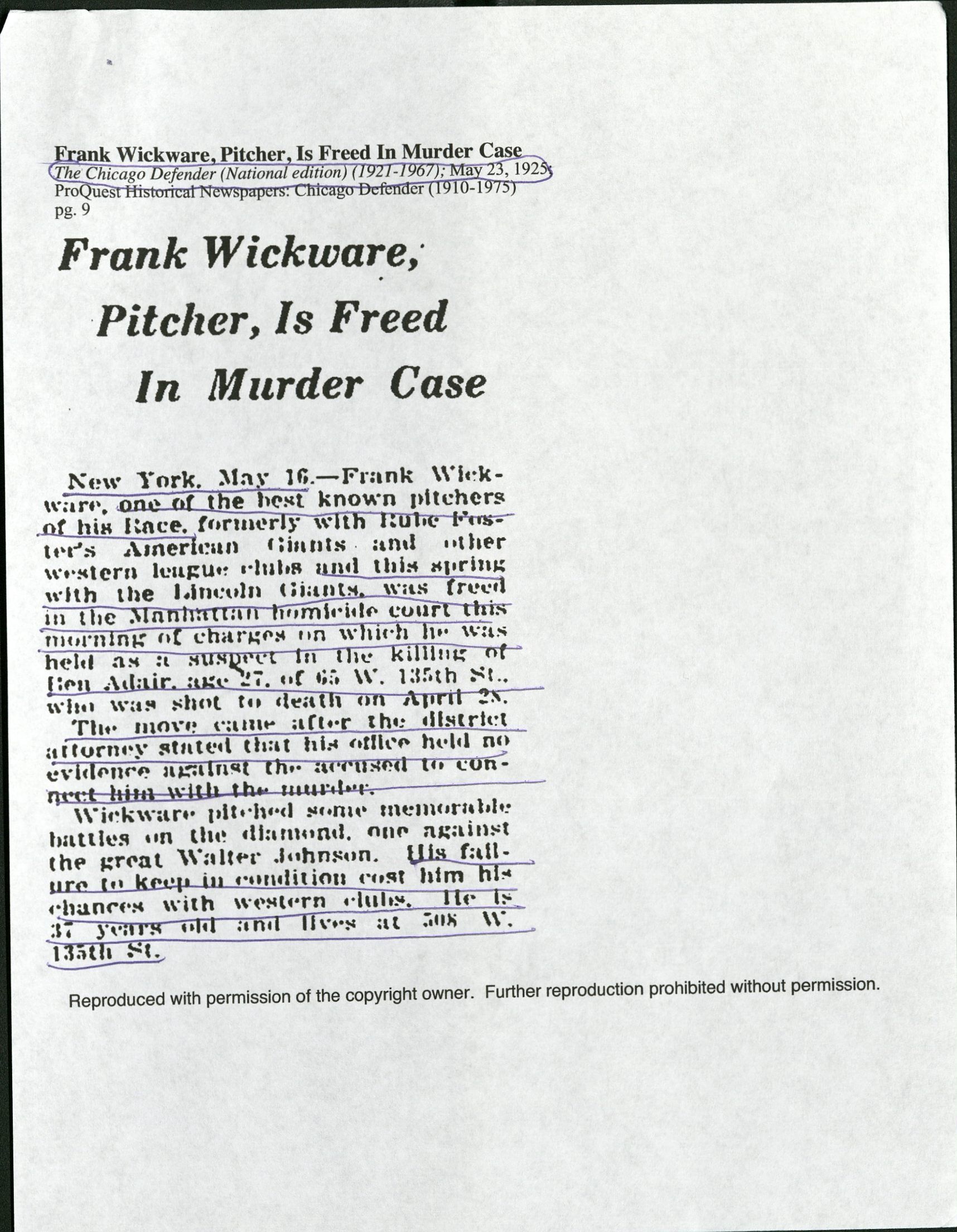
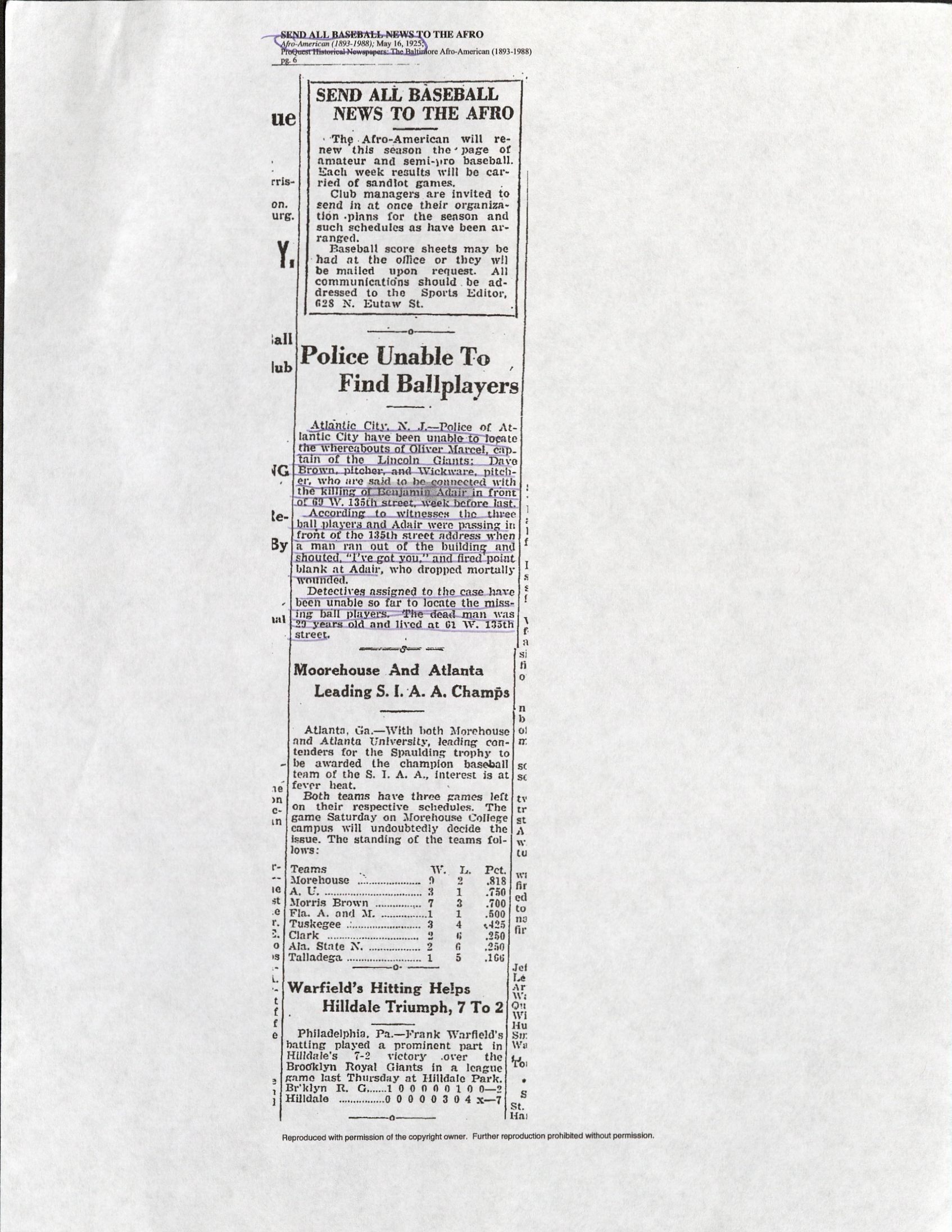
This is from time ago — see posts here and here — but I just wanted to give an update of my peek into the as-yet-unsolved 1925 murder in Harlem of young resident Benjamin Adair, a South Carolina native who was gunned down with no motive immediately apparent, but star Negro Leaguers and New York Lincoln Giants players Oliver Marcell, Frank Wickware and Dave Brown were allegedly at the scene of the crime. However, details have never been completely nailed down beyond spotty and often speculative contemporary media reports, like these:

KIC Image

KIC Image

So several months ago I emailed a Freedom of Information Request inquiry to the NYPD for any files relating to the case that might be public record. I never heard anything back.

So yesterday and today I made a few calls to the police department. Yesterday I spoke with a woman at the departments office of public information, who took note of my fairly severe stuttering and, somewhat insultingly told me to e-mail a follow up because of “your condition,” which she said would make e-mail more productive. She then gave me an e-mail address, I wrote to it, and promptly had my message bounce back as undeliverable.

Soooooo, I called back today and talked to a marginally friendlier public information officer, who transferred me to the PD’s FOIL request processing often, where I spoke with an extremely courteous, friendly and helpful woman to actually thanked me for my call. She looked into my request and found no record of it, for which she was very apologetic. She then suggested I send another formal request, this time on hard copy through the postal mail, which I will try to do next week. She also noted that once the department received the request, it would immediately send back an acknowledgement of receipt letter within a week, which was encouraging.

I asked her what the chances are that a file from a cold cold case that happened nearly 90 years would still exist and be reachable, not to mention releaseable as “public record.” She was very frank but friendly.

“Each case is different,” she said. “If for some reason we can’t locate it, we’ll let you know. But there are so many factors.”

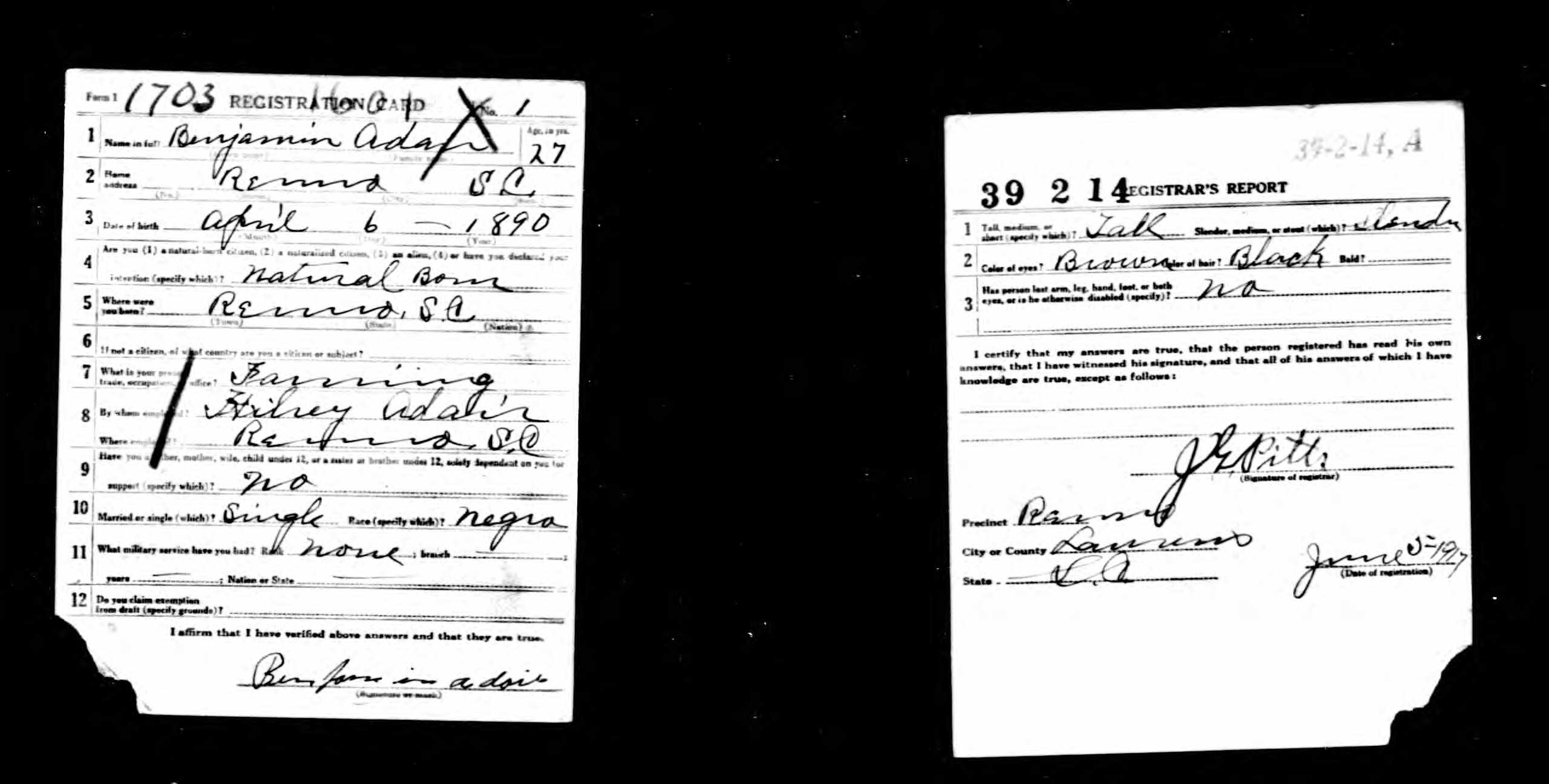
So, once I send the request, fingers crossed. I do have Ben Adair’s death certificate, but unfortunately, I don’t have have scan or JPG of it so I can’t post it. But here’s Adair’s WWI draft registration card:

SC-1877671-2286

Odds and ends from the Louisiana Weekly

I’ve been combing through old microfilm of the Louisiana Weekly newspaper, New Orleans’ long-running African-American newspaper, and I’ve come across some pretty cool stuff, contained herewith.

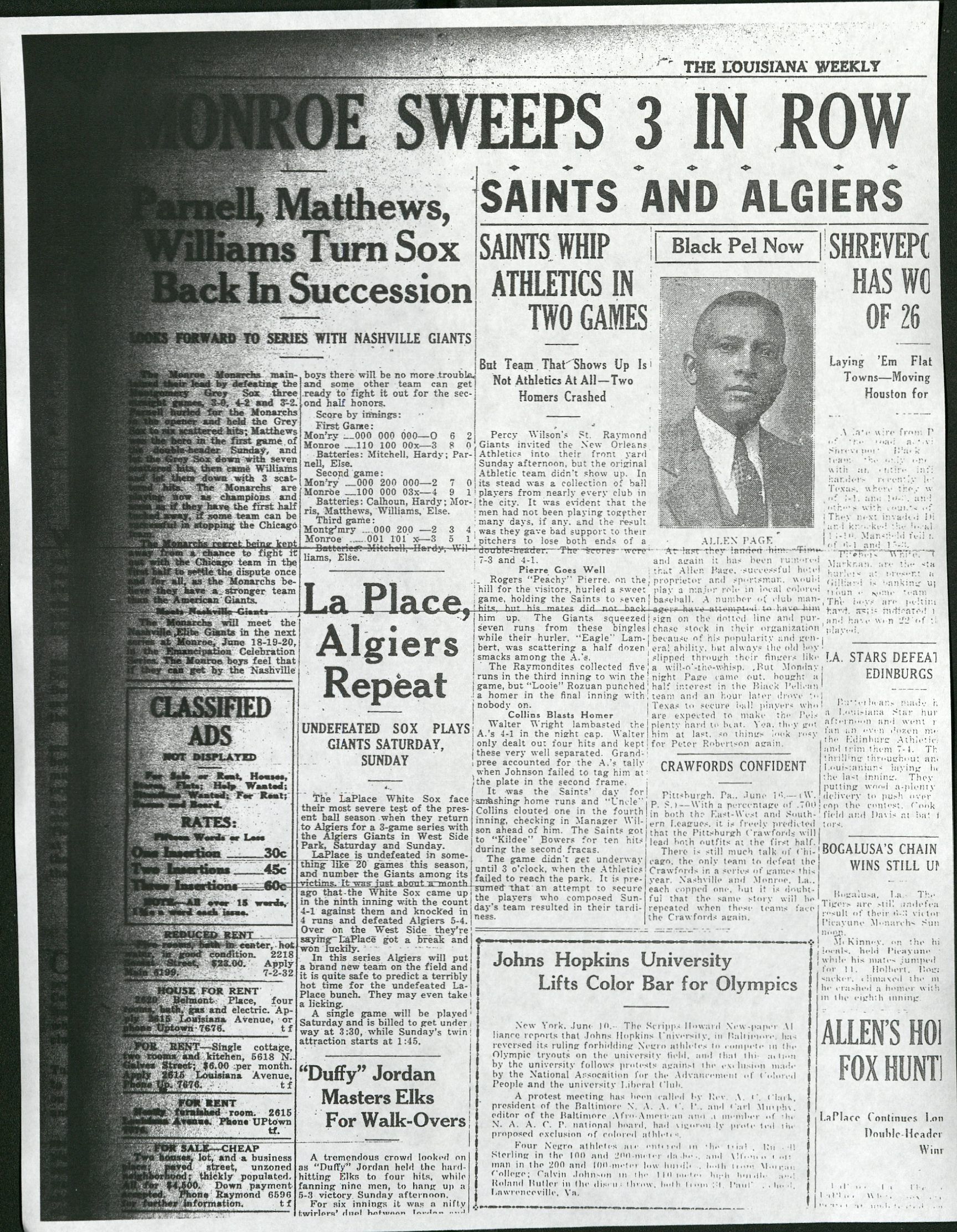
This first image is from mid-1932. That year was a big one for blackball in Louisiana: The Monroe Monarchs won the Negro Southern League during the one season in which it was a “major league” blackball circle; Crescent City Park opened in NOLA as one of only two public ball fields open to the city’s black residents; and Allen Page, a businessman, entrepreneur and popular hotel owner, launched a new era in Big Easy black baseball circles when he made his first foray into local sports circles by first becoming half-owner of the New Orleans Black Pelicans, then full owner later in the year. Thus began his long tenure as arguably the most influential figure on the Louisiana Negro Leagues scene and a prime player on the national stage. Here’s a clipping of the Weekly article announcing his new ownership of the Black Pels:

KIC Image

Next up is a clipping from October 1932 about Mildred Powell, who as a teenager led a local NOLA team of boys to a string of victories. This piece shows a picture of her, then hints at another up-and-coming female pitcher who will twirl for a team of guys very soon. Move over Toni and Peanut!

KIC Image

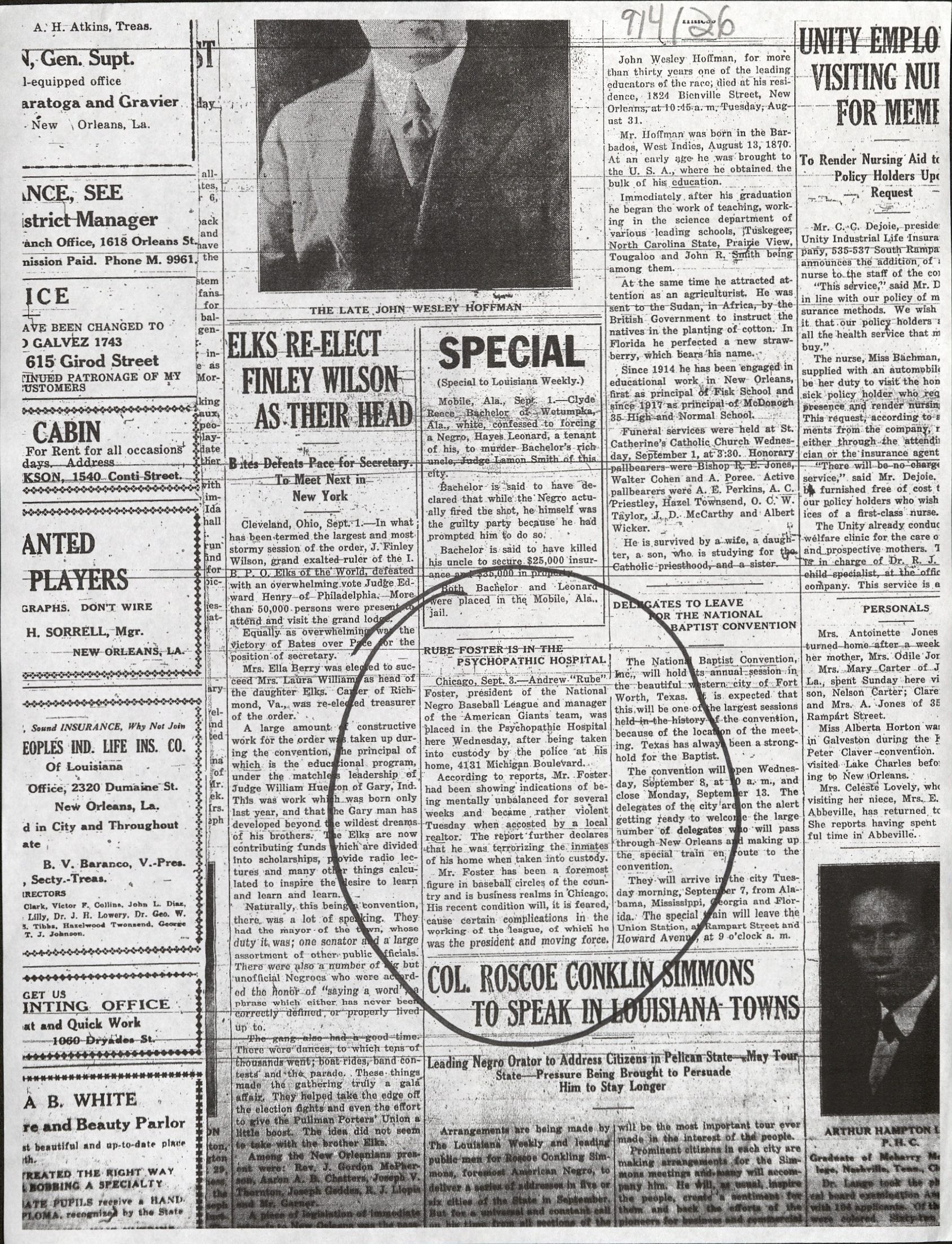
Now here’s an article that shows exactly how massively important Rube Foster was. When he was committed to an asylum in the late 1920s, it created massive shockwaves through not only the Negro Leagues world, but African-American society in general, where he was a revered figure. That includes in New Orleans, where his commitment made the front page of the Louisiana Weekly, which at that point was just a year or two old and still had scant sports coverage:

KIC Image

Finally, something quirky … In my research I keep coming across a NOLA-based pitcher named Edgar Populus, who toted the nickname “Iron Claw” because he reportedly had only one arm, a disability that apparently didn’t prevent him from being in high demand on local hurling mounds. I hope to do some more research into him in the near future, which of course I’ll report on here …

Hopefully good stuff soon …

Apologies for not getting anything substantive up for a little while — kind of took a little break from blogging to nail down and work on some deadline assignments. However, hopefully that will change later this week, when I hope to have some good stuff, including:

• Some more stuff about the Berkeley International League of the 1930s. I landed an assignment on the circuit for San Francisco Weekly newspaper, so I’m studiously and diligently trying to pull some good concepts and history together;

• Kind of using the story of early Negro League star George Shively’s burial in an unmarked grave in Bloomington, Ind., I’ll try to examine the team he briefly captained in 1919, the Kokomo, Ind., Black Devils, who were owned by a white man, Charley Lyons, an eccentric clothier and entrepreneur who had a penchant for fast cars and running into the local legal system in that city in the north-central Indiana region;

• Some more stuff about should-be-legendary Negro Leagues manager Winfield Welch’s roots as a player/manager in New Orleans, and historical notes about his tiny hometown of Napoleonville, La.

• Perhaps some odds and ends stuff I’m tripping across here and there …

Felix and Captain Embry

 ???????????????????????????????

Felix Wallace

I know I said my next post about Felix/Dick Wallace would be about his contributions to the famed 1909 St. Paul Colored Gophers, but I’ve come across something that’s quite, quite puzzling. Yes, as is often the case with what snares my acute attention, this is probably minutia, but it nonetheless has me captivated …

Anyway, here’s my first post on Mr. Wallace. Popular but brief biographies of Wallace, a native of Owensboro, Ky., have him playing for the Louisville Giants in 1907 before hitching on with the “world colored champion” Colored Gophers in early 1909.

But then I came across an article in the Indianapolis Freeman from early in the 1909 season. Under the headline of “VINCENNES B.B. CAMP” reads this text:

“Capt. Wm. Embrys, formerly of the Louisville Cubs, has a fast bunch of ball players known as the Idaho Stars. They recently played the Evansville O.K.’s in a double header at the latter’s home.

“Vincennes expects a winning team of the Stars when the season closes.

“Wallace, who is playing second base for the St. Paul Gophers; Davis, Monroe, Jackson and a number of others are students of Embyrs [sic].”

A few explanatory notes … after doing some research, I think the guy’s name is William Embry, not Embyrs or Embrys. Also, Vincennes is a small city in southwest Indiana, a little ways away from the Ohio River and Evansville, and about 140 miles west of Louisville. And also, the Idaho Stars of Vincennes appear in the papers one other time in 1909, after they split a doubleheader with the Evansville O.K.’s.

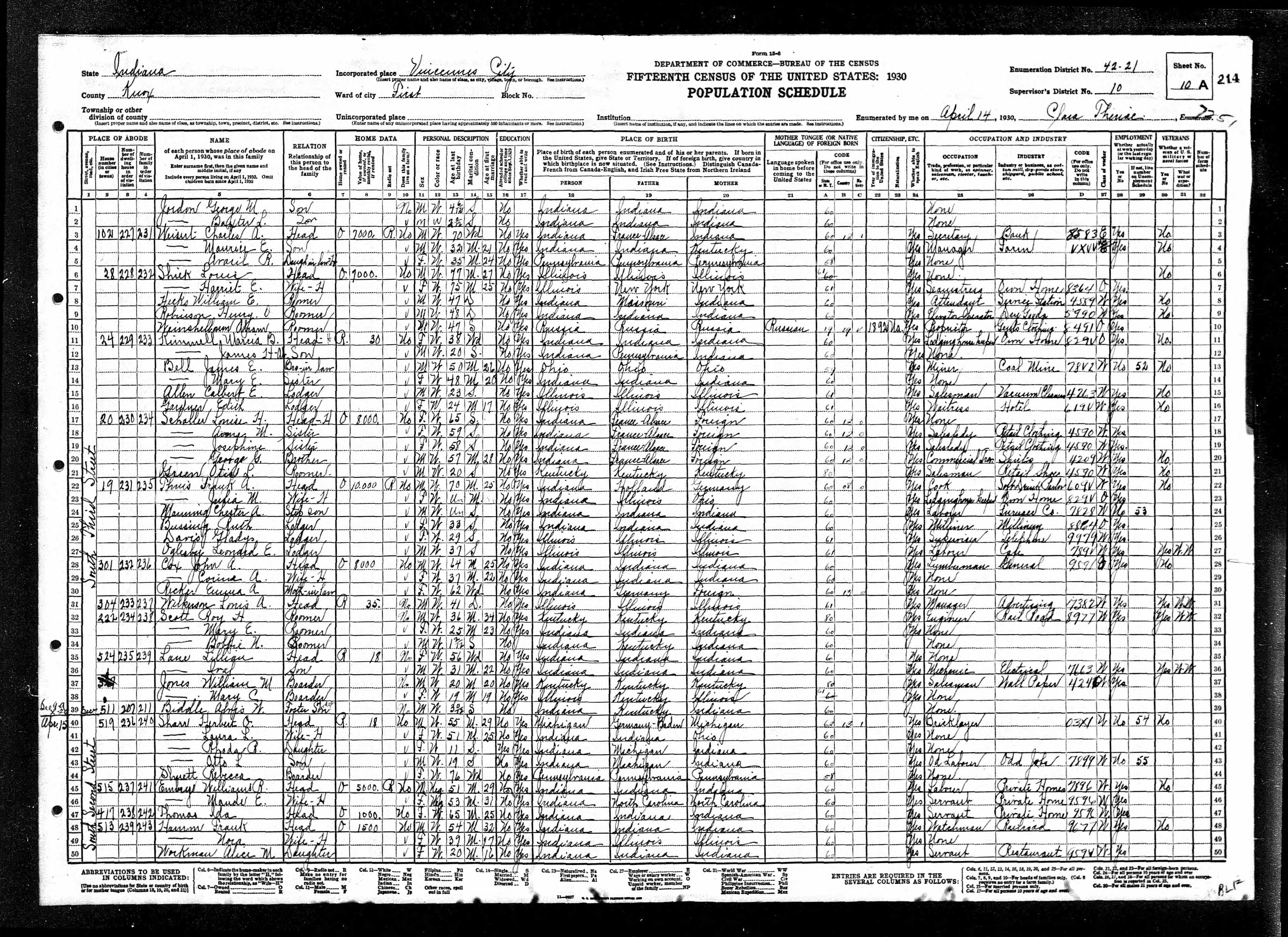
The 1900, 1910, 1920 and 1930 federal Censuses do list an African-American “William Embry” in Vincennes, as (variously) a “hostler,” a “laborer” at “odd jobs” and “laborer” for “public,” and a “servant” for a “private family.” In the 1900, 1910 and 1930 documents, Embry and both his parents are listed as being born in Indiana. In the 1920 version, his birthplace is Indiana but both his parents are listed with “unknown” birthplaces.”

4584691_00897

1930 Census page listing William Embry in Vincennes, Ind.

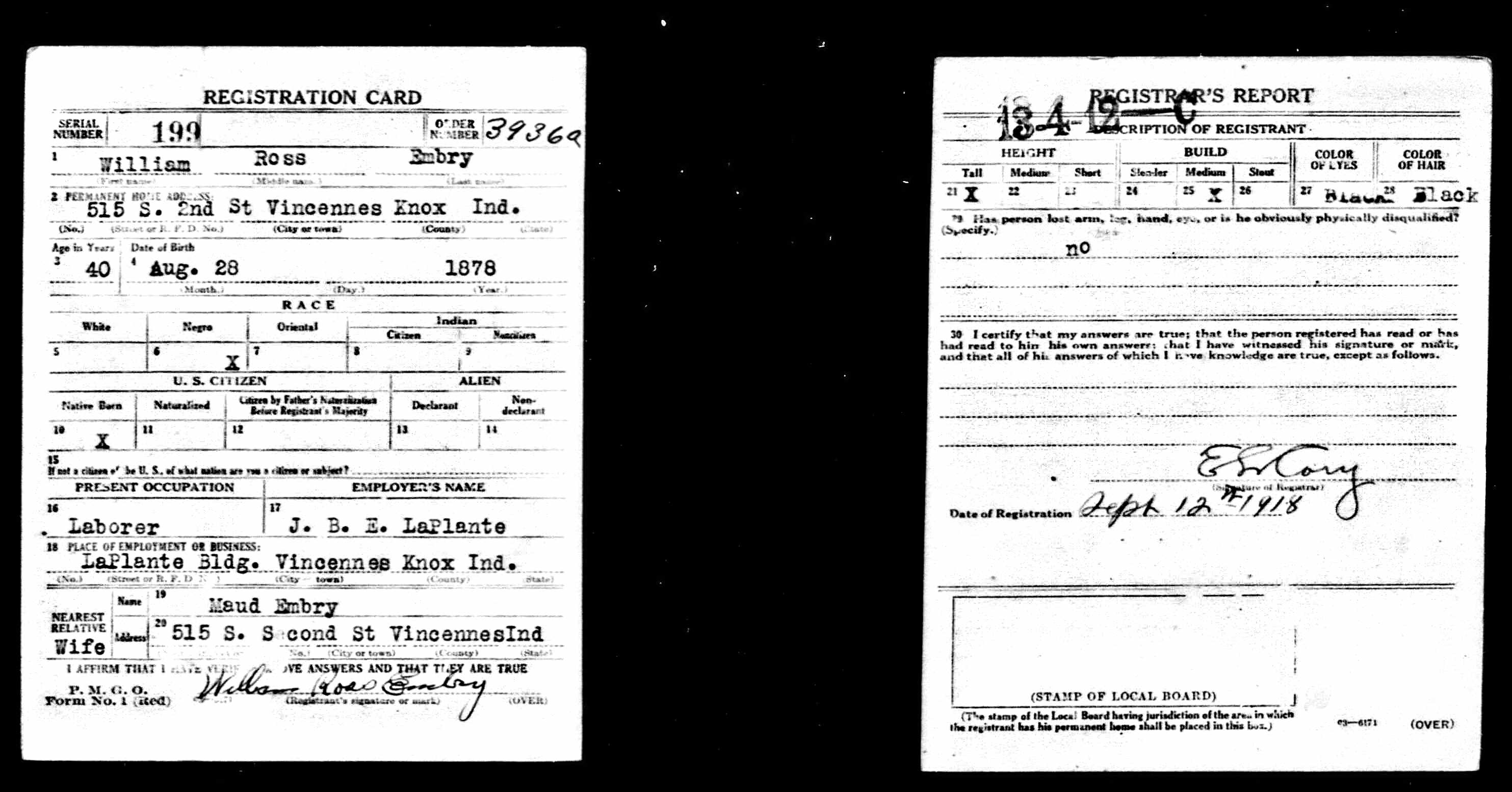
Using the three documents, Embry’s birthdate seems to have been circa 1878, making him about 30 years old at the time of the 1909 Freeman article. And Embry’s World War I draft card lists his birthdate as Aug. 28, 1878, and a residence in Vincennes. On the card, he states that he’s a laborer for a J.B.E. LaPlante in the “LaPlante Bldg.”

005248332_04673

By the time of the 1930 Census, Embry and his wife, Maud, owned their own home worth $5,000 in an otherwise all-white neighborhood.

William Embry is also listed in numerous years of the Vincennes city directory during that time. His listed occupations range from houseman to porter to janitor. However, the 1906 and 1910 directories confirm that this is the William Embry we’re looking for: In those books, his occupation is ballplayer.

However, I found almost no connection between Embry and Louisville except one: A marriages listing for “Negroes” in Jefferson County (which contains the city) in 1908 that includes Embry and Maud.

Now, the Louisville Cubs — or at least the ones I think the Freeman was talking about — don’t seem to have existed before 1909. In addition, media reports about them and their games — mostly in the Freeman — don’t include any mention of an “Embry,” although their is occasional inclusion of an “Emory” or “Emery.” So I couldn’t find any real evidence that does link William Embry to the Cubs.

The Cubs, though, seem to have been quite a good semipro team, one that wiped the floor with other squads in Kentucky, Indiana, Ohio, Alabama and Tennessee. In May 1909, the Cubs squashed the Indianapolis White Sox, 9-2, in front of 400 fans. The Freeman noted that “[T]he Cubs played superb ball, their defense being perfect. Stung by defeat from the Sox in April, the Cubs went after them with a vengeance and got it good and plenty.”

That same week the Cubbies used a ninth-inning rally to nip the Birmingham Giants, 2-1, with the Freeman calling the contest “the best played game of the season. The local boys demonstrated that they are the best players in the South.”

Right after that, the “Little Bears” again beat the Alabama crew, this time by a count of 3-2 in front of a whopping 4,500 fans. “… the Louisville Cubs confirmed the report that they are the best semi-professional team in the South … in a well-played game. Significantly, it seems the pitcher for Birmingham was none other that “Steel Arm” Johnny Taylor, who would join Felix Wallace with the 1909 St. Paul Gophers.

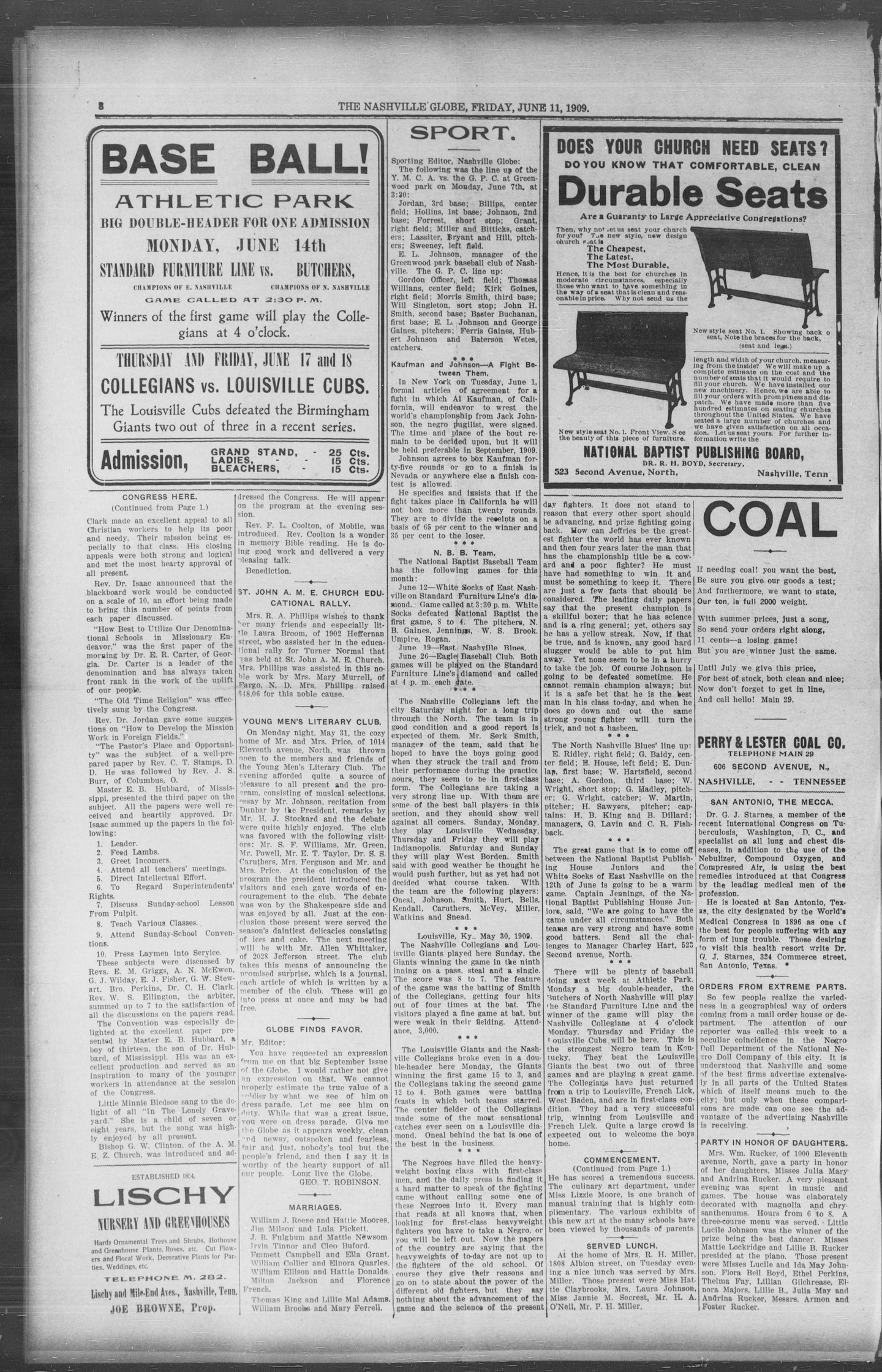
Other cities also got psyched when the Cubs game to their burgs. The June 11, 1909, issue of the Nashville Globe features a big ad for an upcoming two-game set at Athletic Park between the Cubs and the Nashville Collegians. The ad states that the Cubs “defeated the Birmingham Giants two out of three in a recent series.”

 seq-8

The result of the Nashville series? “The Louisville team boys took all three by good scores,” stated the Globe. “The games were batting feats in which all the Louisville players took a splendid role.”

So what was Felix Wallace’s connection to the Cubs and/or Embry? That, it seems, is the question. The one Freeman article explicitly links Wallace to Embry by calling the former a “student” of the latter. And the Freeman’s 1909 coverage of the Cubs does, throughout the season, mention a Wallace playing second base, Felix’s position.

And this Wallace appears to have been really good, frequently helping to turn double plays and, at the plate, slashing doubles and triples and clubbing the occasional home run. The June 5 issue of the Freeman states that “Wallace continues to furnish gilt-edged ball around second base,” while the later in the month, against the Tennessee Standard Giants:

“Wallace had a good eye on the ball, and swung the willow and sent the sphere out of the way for a home run. He also made several two and three-base hits.”

The most intriguing of this Wallace’s feats came in May against Birmingham, when he conquered one of the best pitchers of the day, stated the Freeman:

“Steel Arm John was easy for Wallace. Four times up, three hits, and on each hit a man scored. Guess that helps win games. What say you, knockers?”

Wouldn’t it have been incredible if this was Felix Wallace mastering his future St. Paul teammate?

But that could be highly unlikely, because there’s seemingly no way that this could be Felix. While Taylor indeed didn’t join the Gophers until mid-season 1909, from all appearances Felix Wallace was in St. Paul for the entire campaign that year.

And there could be further evidence that the Wallace of the 1909 Louisville Cubs isn’t Felix. The Aug. 21 Freeman states in a headline that “Wallace Now Captain of Cubs.” But the ensuing article asserts that “Wallace’s color is the only thing that keeps him out of rast [sic] company — oh, by the way, it is Captain Deamus now.”

Deamus Wallace??? Other coverage at different times during the 1909 season also mentions a “Deamus” playing for the Cubs.But in all kinds of searches, even a simple googling, uncovers now “Deamus Wallace” anywhere ever at anytime. And Felix Wallace did have the leadership skills to be a team captain; he took that role for the 1909 Gophers.

So what’s going on? Who is William Embry? Who is Deamus Wallace? When was Felix Wallace connected to Embry? And, for that matter, how were either Embry or Felix ever connected to Louisville and/or the Cubs?

It’s all very puzzling and intriguing, so much so that, as is often the case with stuff like this, it’s sticking in my craw very badly …

Snapshots of NOLA blackball

06173902410

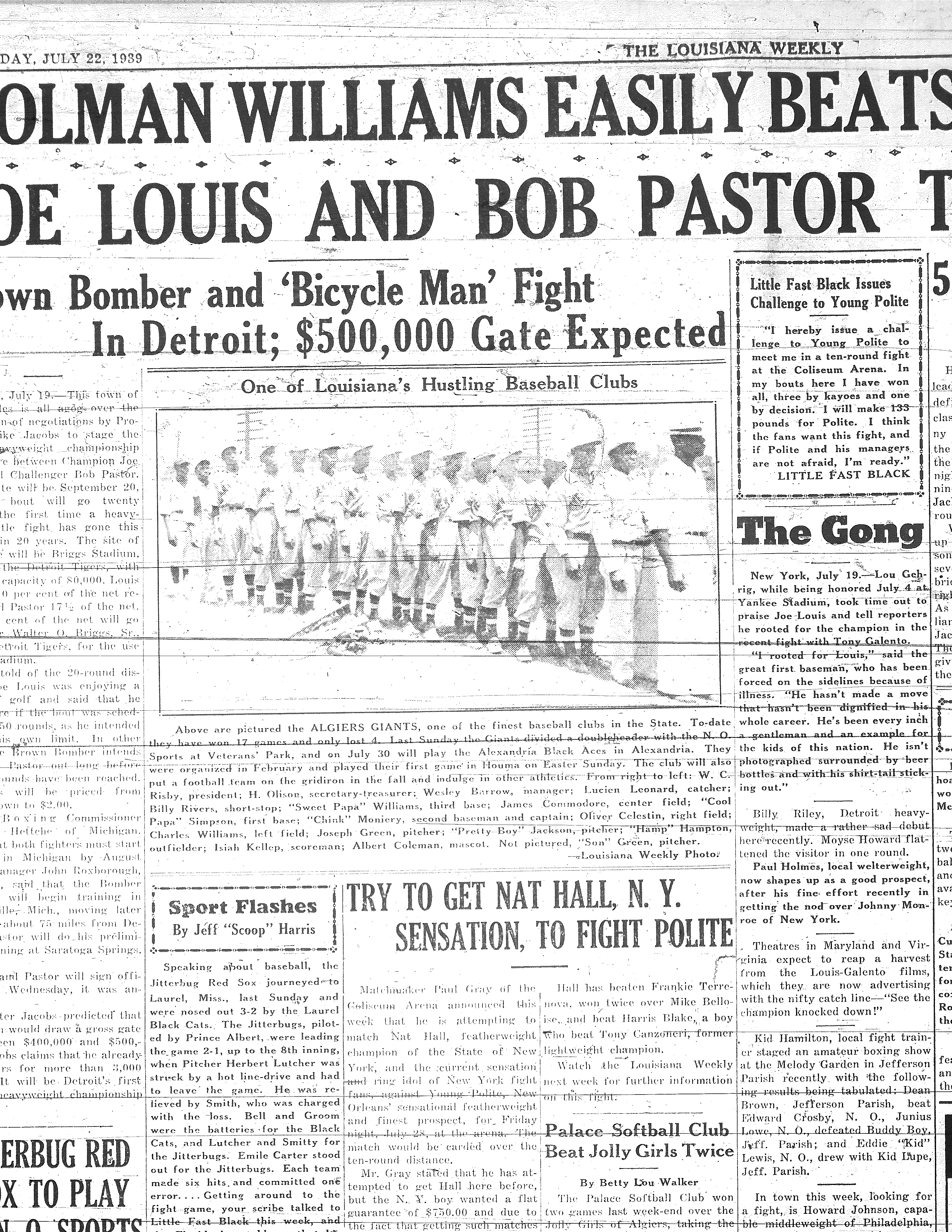
I was perusing microfilm of the circa-1940 Louisiana Weekly for a story I’m doing, and I came across a few cool and/or weird things. One is the above picture of the 1939 Algiers Giants from that NOLA neighborhood. It includes one of the most important blackball managers in New Orleans, Wesley Barrow (after whom a beautifully renovated stadium in Pontchartrain Park is named), and my old friend Herb Simpson before he hit the big time. Note that Herb’s nickname in the photo caption is “Cool Papa.” His most well known nickname is “Briefcase,” but he apparently had a few others, including this one and, as I’ve also come across, “Lefty.”

Welch 0614412420iyi55

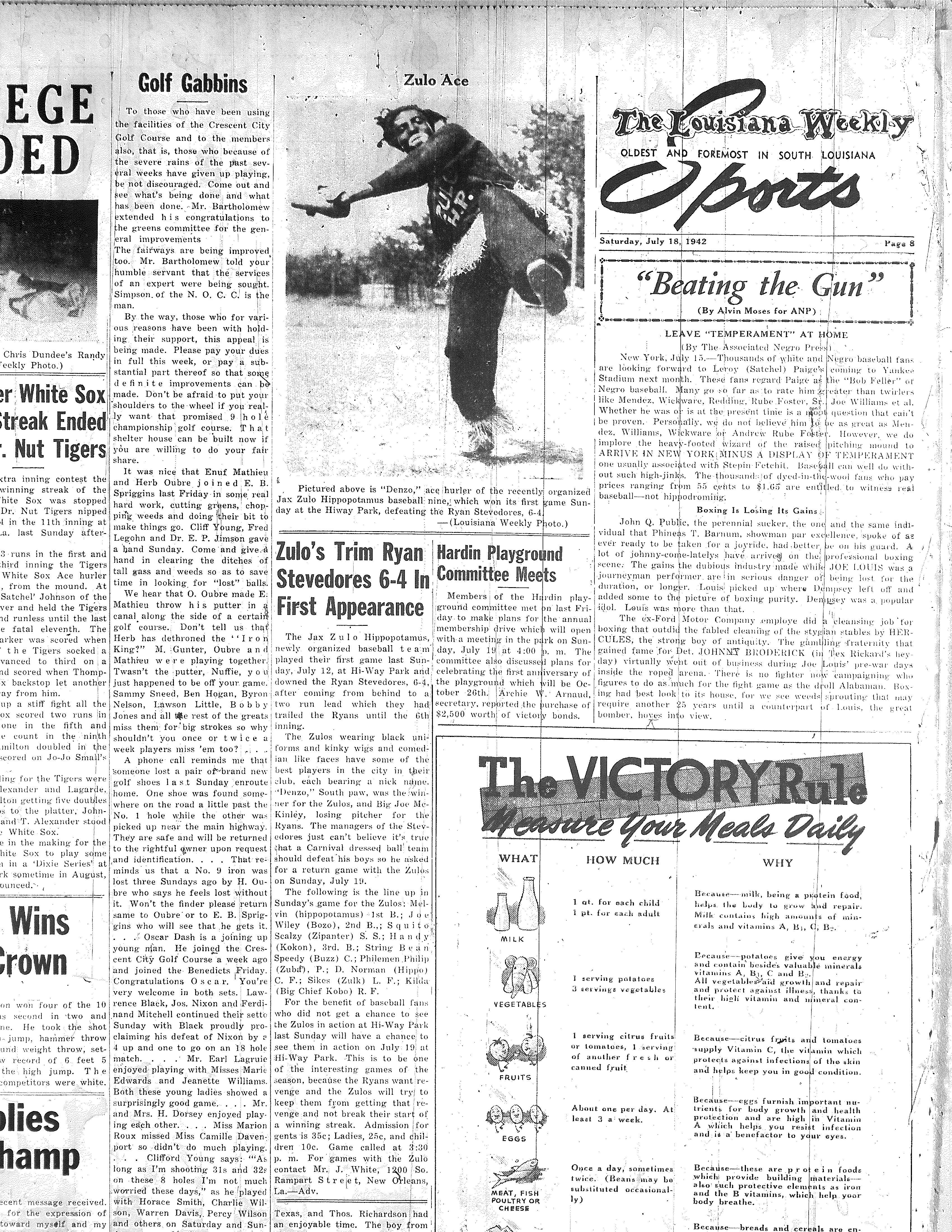
This sample is from July 1942 and features an article about a local NOLA team called the Jax Zulo Hippopotamus beating a squad of area stevedores. The photo above the article is the Zulo’s “ace hurler” named “Denzo,” who is adorned with the accouterments typical to these type of clowning, blackface teams, such as the Zulu Cannibal Giants, Ethiopian Clowns, etc. Note “Denzo’s” grass skirt and Sambo blackface. I guess in my mind these sort of teams were embarrassing minstrel shows that denigrated the otherwise-proud history of the Negro Leagues and African-American baseball.

Welch 0614412418iyil

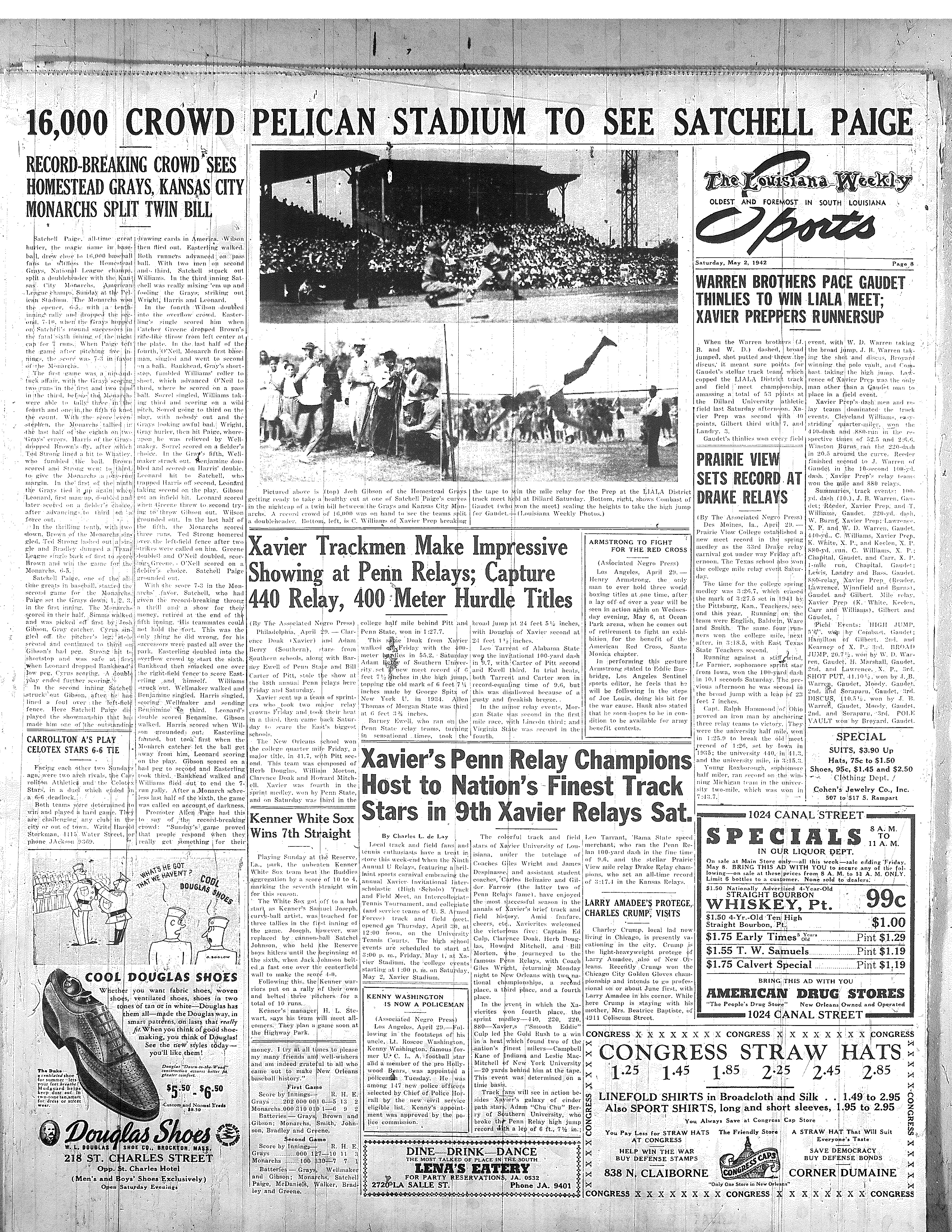
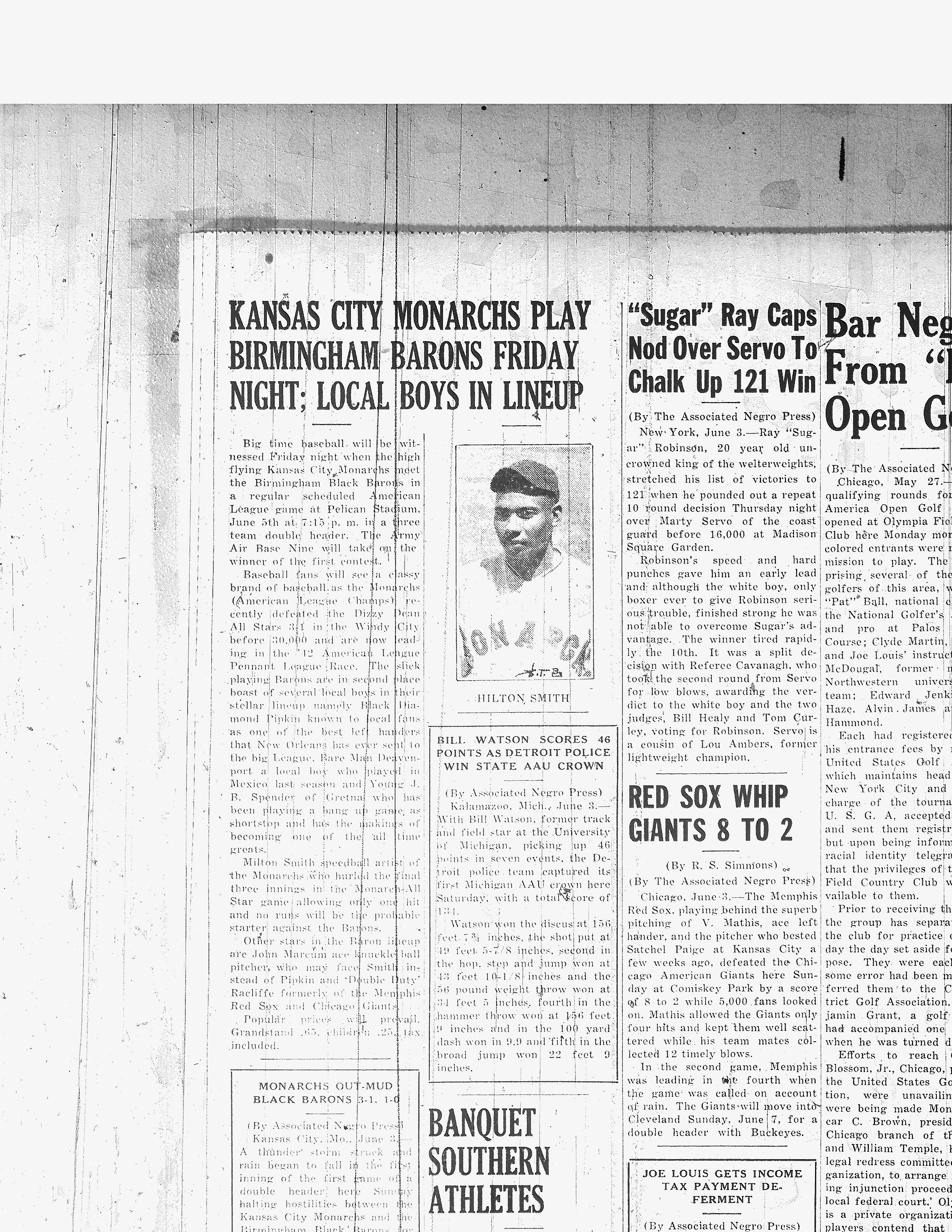
The clipping above and the one below are to show that the Crescent City did indeed have much big-time blackball come its way, most of it courtesy of sports promoter and hotel owner extraordinaire Allen Page, who was an underappreciated off-the-field “player” on the countrywide Negro League scene. He attended executive meetings of the Negro National League, attracted and promoted games between big-time squads like the K.C. Monarchs and Homestead Grays, he created the long-running North-South All-Star game, he owned numerous local teams, and he recruited NOLA’s only “major league” baseball franchise, black or white, the New Orleans-St.Louis Stars.

Welch 0614412419iyiluuu

Finally, just to add a quirky postlude … when going through old issues of the Weekly, I’ve noticed that many players went simply by nicknames, and not just members of clowning teams. There was, of course, the popular and fairly successful Black Diamond (real name Robert Pipkins), about whom I’ve always wanted to write and research, but there were also guys like “Iron Man” and “Black Snake,” and those are just the ones I remember offhand in studying black baseball in Louisiana.

I’ll say it until I’m blue in the face: New Orleans and the rest of Louisiana remain underrated and overlooked hotbeds of Negro League activity, and I love uncovering that history, by myself if I have to.

A Chinese guest star

478a_lg

Lee Gum Hong, aka Albert Bowen

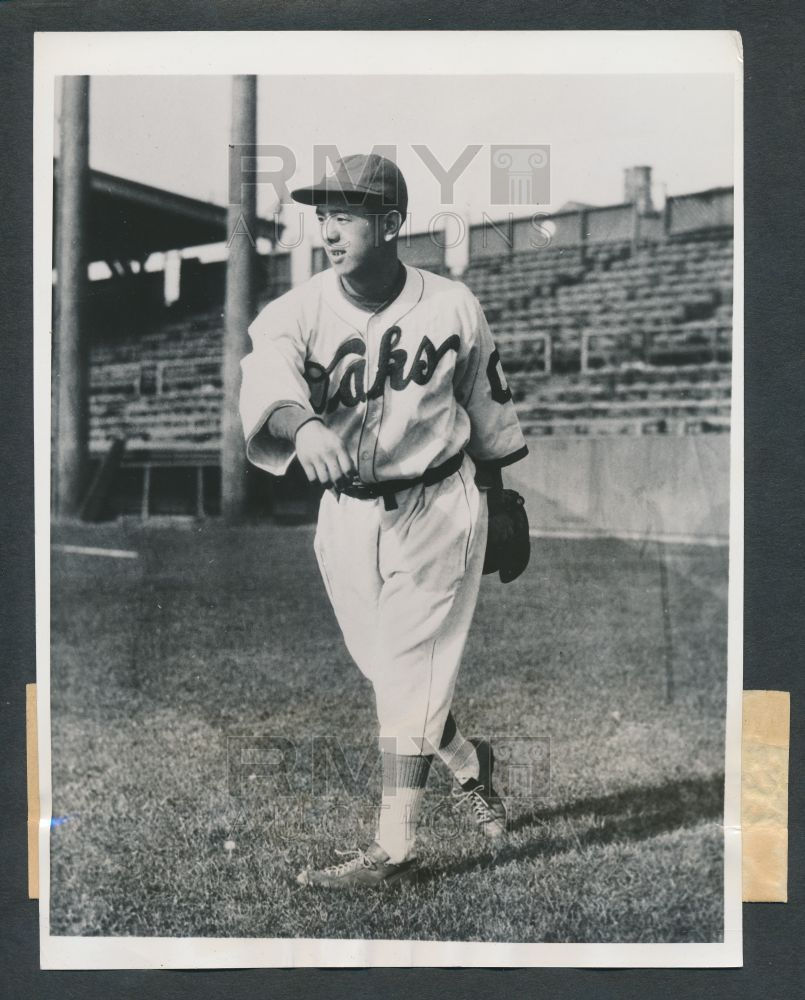
The biggest news in Lee Gum Hong’s life came in late September 1932, when he became the second person of Chinese descent — some press reports at the time erroneously called him the first — to play in organized baseball after being signed by the Oakland Oaks of the Pacific Coast League. Lee, who was born and raised in Alameda County and attended and pitched for Oakland High School, was more popularly known as Albert Bowen, one of a trio of baseball-playing brothers that also include George and Edward Bowen.

It was in September of ’32 that Al Bowen took the mound for the Oaks to square off against the Sacramento Senators. But this was no ordinary contest, because opposing Bowen and the Oaks was Sacs twirler Kenso Nushida, the first Japanese-American to play organized ball. There’s a good chance that the Oaks inked Bowen for the novelty factor, a PR move designed to boost sagging attendance with the contest against Nushida, and quite possibly to exploit Japan’s recent invasion of China by playing up the hardball duel as one between representatives of countries at war.

Despite several strong innings of hurling, Bowen was tagged with the 7-5 loss thanks partially to poor defensive support from his teammates. With more than 3,000 fans — many of them from the Bay Area’s burgeoning Chinese populace — attending the match, the two teams held a rematch a few days later, this time with Bowen notching a 7-1 victory over Nushida for his only professional hardball W — he was released by the Oaks at the end of the season.

But those contests against Nushida weren’t the only remarkable efforts put forth by Bowen, who used a fiery fastball to handcuff batters on the East Bay semipro circuits for the Wa Sung Athletic Club, a longstanding Chinese-American social organization in the area, as early as 1926, when he was just 15 years old. He was, for example, the ace of the Wa Sung hurling staff while the squad was in the revolutionary Berkeley International League in 1936.

But in late 1935, during the famed Oakland Tribune California state semipro tournament, that Bowen performed perhaps his most important, and certainly most underrated, feat — he pitched for the otherwise all-black Berkeley Pelicans in the tourney.

For a fan of African-American baseball like myself, such an effort is monumental, representing a cultural crossover that had been virtually unheard of before.

Let’s set aside the fact that historical research into the surprisingly strong hardball tradition in the Chinese community, especially on the left coast, is not just incomplete, but virtually and woefully non-existent. While much work has been done digging up the history of Japanese-American baseball, little, if any, parallel efforts in the the Chinese tradition have been undertaken.

So the existence of the Wa Sung club team — and its fair amount of success in the Bay Area semipro scene — represent a possible starting point for rectifying that tragic historical omission. That and, of course, Al Bowen’s brief stint in the PCL.

68256e726d9c44f2bf2566590867746f_thumb

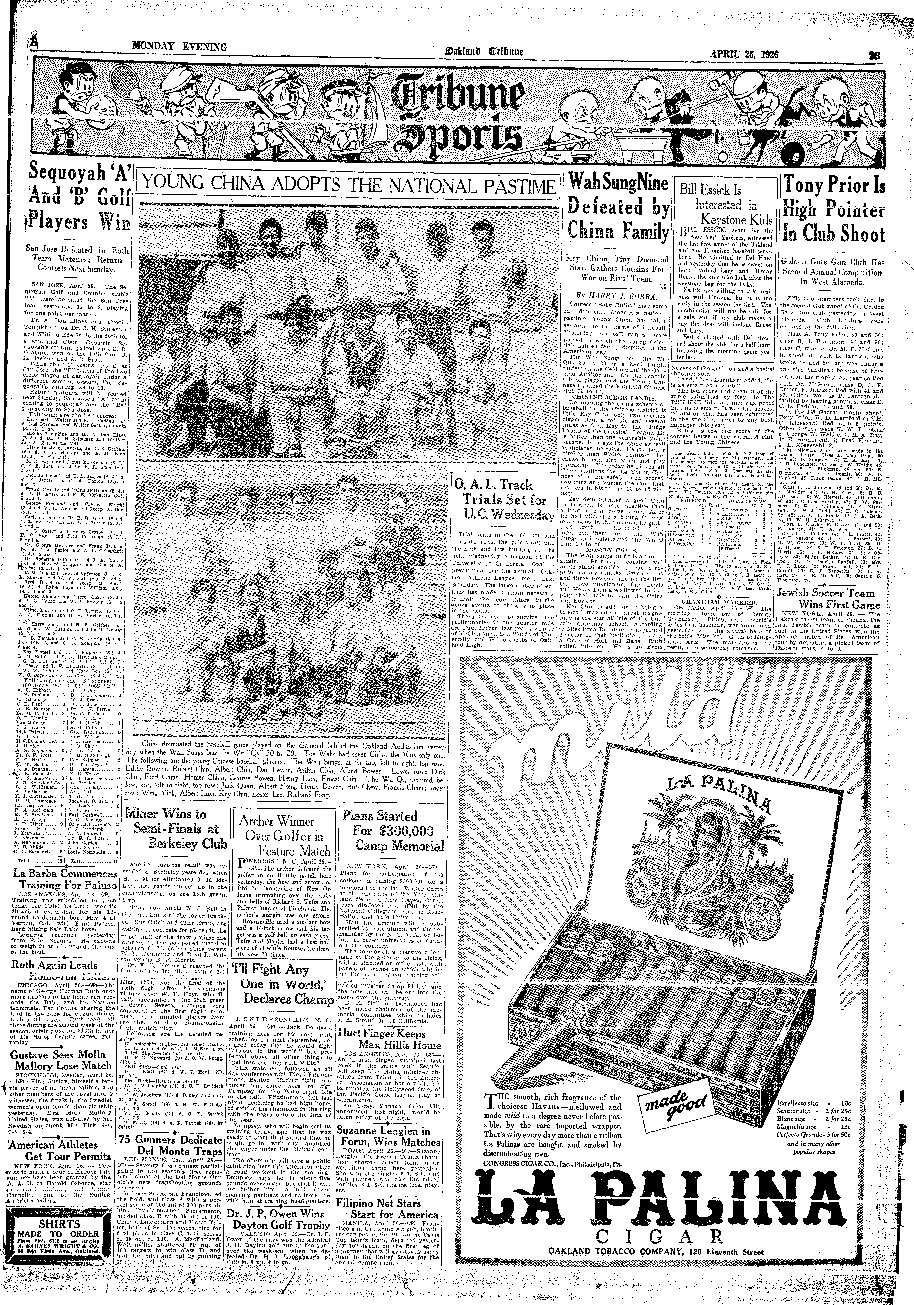
In April 1926, the Oakland Tribune ran an article and a couple photos of two Chinese-American baseball clubs, including the Wa Sung, a squad that already included the Bowen brothers. Stated the paper:

“Chinese ‘Babe Ruths’ may someday dominate America’s national pastime. Young China has taken seriously to the game of baseball. Yesterday two ball games were played in which the young Celestine settled family disputes in the American way.”

Parallel to these developments was the emergence and strengthening of the black baseball scene in the Bay Area, a situation perhaps exemplified by the long-running success of the Berkeley Colored League, sponsored and overseen by California sports impresario and promoter Byron “Speed” Reilly. Among the numerous African-American club and semipro squads that blossomed in this environment was the Berkeley Pelicans.

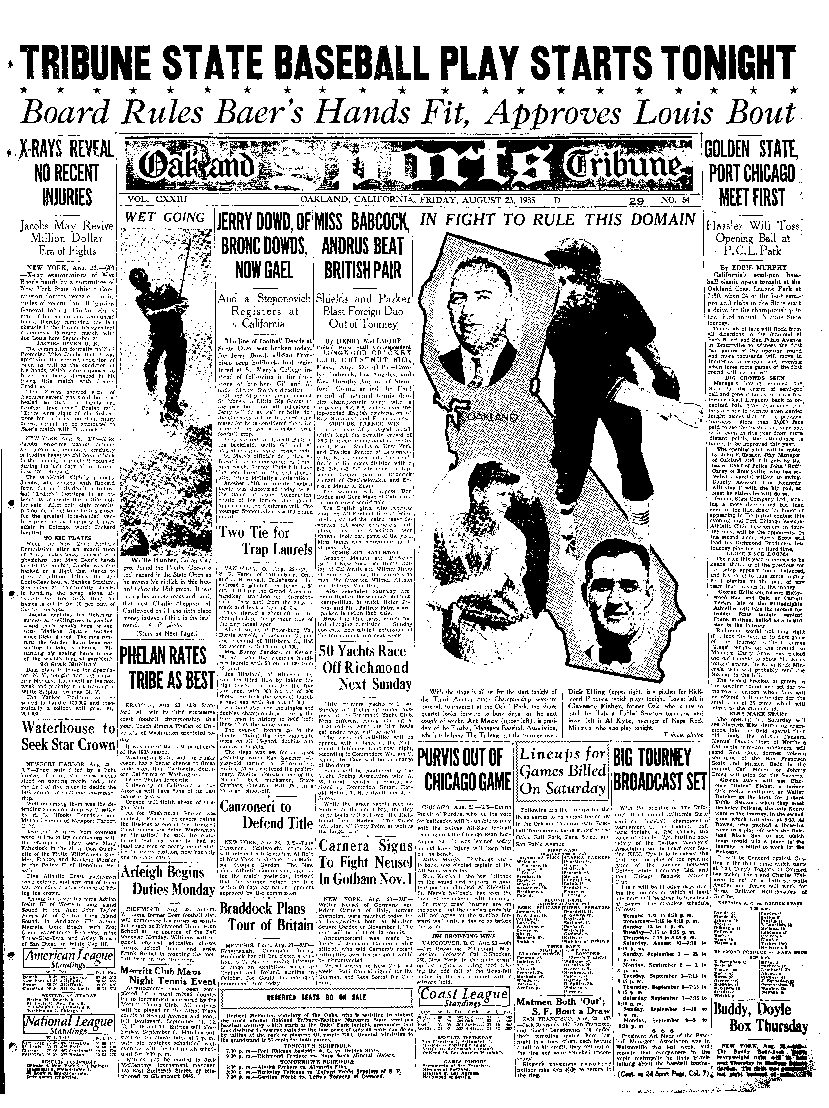
The two communities merged beginning in August 1935, with the launching of the third annual Tribune state semipro tourney. The Pels, with Al Bowen leading the way, started out well in the event, beating the Oakland Black Sox in an early-round clash, as reported by the Tribune:

“That brings us to the Pelicans, Berkeley Negro team with a Chinese pitcher, who gave the Oakland Black Sox only three hits last night as his mates garnered 13 off Brown, Stout and Perry. … Bowen twirled steady ball of the winners and also had a perfect evening at the bat, getting a single, double, triple and base on balls in his four appearances at the plate, and scoring three runs. Neither of the runs made off him were earned.”

As the state tourney progressed and the competition got stiffer for the Pels, the Berkeley squad began to wear down. Three weeks after that initial win, Bowen, after a stellar start, tired in the middle innings in a 6-1 loss to the Tallant Tubbs. The Pelicans were then booted from the tournament with a 5-2 loss to the Alaska Packers.

00615835b1fa41a99826e8092fb1c924_thumb

But Bowen’s contributions to the Berkeley Pelicans over success in 1935 didn’t go unnoticed. In its September 1935 issue, the local baseball publication, The Basehit, ran an article about the Pels and particularly noted Al Bowen’s presence on the mound for the African-American squad:

“The Pelicans have as one of their pitcher a Chinese boy. This boy, Albert Bowen, has been pitching for the Wa Sung A.C. and a few years ago had a try-out with the Oaks.”

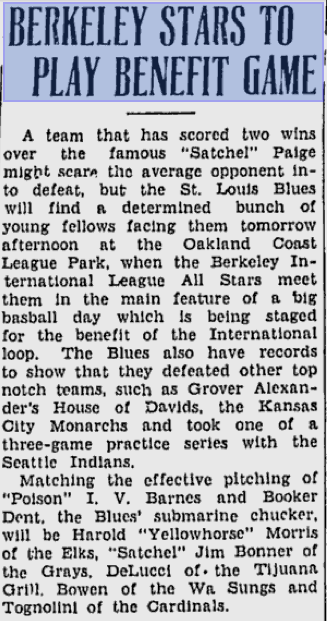
However, 1935 wasn’t the only hardball campaign in which Lee Gum Hong lined up alongside black players in the Bay Area. Near the end of the 1936 Berkeley International League season (in which the Wa Sungs took part with the Bowen brothers), a team of all stars gathered from the various BIL squads squared off against the St. Louis Blues in an exhibition match-up and fundraiser for the BIL. (The BIL for a time included the Berkeley Pelicans, with Jack Smith and Leon Angie as representatives in the league’s founding executive circle.)

Berkeley Stars To Play Benefit Game-5-1-1936-i

Al Bowen was a part of the international league all star team’s pitching rotation. Another hurler for the BILs? Our old friend and Oakland native Harold “Yellowhorse” Morris, whom I’ve chronicled before because of his membership on the Van Dyke Colored House of David based in Sioux City, Iowa. In the charity game, Morris represented the Athens Elks. (The BIL squad also included George Bowen as a catcher.)

In an ensuing installment of the Lee Gum Hong/Albert Bowen story, I’ll detail, using archival research and personal interviews, Bowen and his familial background, including his residence in an otherwise all-black neighborhood.

Lotsa stuff tomorrow, but for now, a great link

I’m working on a couple things for (hopefully) tomorrow, one on Felix Wallace and his connection to the St. Paul Colored Gophers, and one on a trailblazing Chinese pitcher from Berkeley, Calif.

For now, though, here’s a link to a story on Ray “Hooks” Dandridge by the CBS affiliate in Dandy’s hometown of Richmond. It’s really, really good, so check it out.

More later!

Van Dyke House of David: Sandy Thompson in NOLA

download

That’s right, back to Harry Crump’s Van Dyke Colored House of David of Sioux City, Iowa. This team is just fascinating, as are many of its players, like Yellowhorse Morris and others. It’s incredible the mix of athletes Crump pulled together for this barnstorming aggregation, from somewhat mythical vagabonds like Yellowhorse Morris — an Oaklander, by the way, a fact that intersects with the international baseball scene in Berkeley, Calif., — to obscure player/manager/catcher Guy Ousley (who’s so obscure that I can’t even pin down the correct spelling of his name, or whether that’s even his real name) to the topic of this post, James “Sandy” Thompson (below, courtesy of Seamheads), one of the many Van Dykes who at one time enjoyed “big time” careers in the Negro National League (and, for the 1932 season, the Negro Southern League) but who were now trying to elongate their fading hardball tenures as long as they possibly could.

sandy_thompson

Sandy Thompson came to my particular attention because, I learned, that in 1935, he managed … the New Orleans Black Pelicans! Right here in NOLA!

Obviously by then, he was on the backside of his career, attempting valiantly to stretch out his time as much as he could by being a player-manager for a “minor league” teams in the South land.

But before I get to 1935, a quick rundown of his career up until then …

It appears that while Sandy Thompson had his moments — he was a slashing, contact hitter and competent outfielder — his time in the Negro “majors” was often fairly unremarkable. In fact, as you can see from his Seamheads bio, such as it is, his birthplace, death place and dates of each appear to be unknown.

I have a suspicion and lead that he began his pro/semipro career with a team in Hot Springs, Ark. In any regard, he arrived in the “big time” in 1920 with the Dayton Marcos, one of the founding teams of the original Negro National League. He then proceeded to play for the ill-fated Milwaukee Bears, the Birmingham Black Barons, and, probably most significantly, the Chicago American Giants for several years.

Thompson appears to have frequently no more than a role player, often sitting near the bottom of the bottom order, sometimes near the top, and occasionally legging out doubles and triples. But once in a while he made a splash in the national black media.

To wit … in early 1926, Cum Posey got all bent out of joint because Rube Foster allegedly plucked Thompson from the Black Barons and placed the outfielder on Foster’s own American Giants. In his regular column/PR piece for the Pittsburgh Courier in January 1926, Posey, claiming to be “writing this article as a baseball fan and not as a baseball manager …” (Whatever, Cumberland), lambasted his managerial and business rival Foster for the move:

“How is it that Foster deliberately takes [most likely Roy] Pondexter and Thompson, the two real players of the Birmingham club, and places them on [the] the American Giants without allowing such clubs as Detroit, Kansas City, St. Louis, Indianapolis to bid for the services[?] If Foster owns these clubs it is syndicate baseball and is not deserving of public support. If Foster does not own these other clubs he is using his position to take advantage of the other clubs and is not fair to these clubs. Either way you take it, it is wrong.”

Ouch. Well, regardless of the ethical implications of Foster’s moves, the jump from ‘Bama to the Windy City benefited Thompson — that season the CAGs won the blackball national championship be defeating the Atlantic City Bacharachs in the Negro World Series.

However, in 1927 Thompson hopped back to Birmingham, and while still with the Barons in July ’28, Thompson, according to the Norfolk New Journal and Guide, “was given a 10-day suspension because he failed to show up at the park for a doubleheader between the Black barons and the Detroit Stars.” Whoops.

After that, Thompson ping-ponged between Birmingham and Chicago, then reportedly played for the Cuban Stars East in 1933. That’s when, two years later, the news came down that he was managing the NOLA Black Pels. As per the American Negro Press in March 1935:

“Formerly of the Chicago American Giants when that club was enjoying much prestige, Sandy Thompson, veteran outfielder, will take over management of the new New Orleans Black Pelicans this … season, Allen Page, owner of the club announced.”

And so intersects the careers of Thompson and one of my all-time favorite (and sorely overlooked) Negro Leagues figures, New Orleans sports impresario Allen Page. From all appearances, it looks like the 1935 season was just as much about Page as it was Thompson in the Big Easy.

That’s because the 1935 Black Pels appear to have been a massive effort by Page to reinvigorate the erstwhile Black Pelicans name with new ownership, a new park (Crescent Park) and a stacked roster that included slugger and Baton Rouge native Pepper Bassett (later known as “the Rocking Chair Catcher”) and pitching ace Lefty Glover.

O1UJZvUxKQyHW3hOkScctl8ysSQMJSZH

Pepper Bassett

Page spent the better part of his career attempting, and at times succeeding (see this article), in making the Crescent City a Negro Leagues hotspot by, among other actions, arranging and promoting exhibition contests between the biggest Negro National and American leagues, creating the sorely underchronicled North-South All-Star game, and, in the case of the 1935 Pels, doing his best to create a “major league” caliber team based in his beloved hometown.

Page’s 1935 effort with the Black Pelicans was capped by the landing of former big-timer Sandy Thompson, a moved that had NOLA blackball fans, including the reporters at the Louisiana Weekly, all agog. Per the March 9 issue of that paper:

“Sandy Thompson, old veteran, who has had plenty of baseball experience, will take over the management of the new New Orleans Black Pelicans. Sandy has played with some of the best clubs in the country and in many sections his name is a by-word.”

That’s how the article begins. But the entire rest of the piece talks about Page’s creation of Crescent Park and his big plans for it that year.

At first, the Louisiana Weekly devoted a great deal of coverage to the ’35 Black Pels’ early-season schedule, which included home stands against higher-level African-American league and barnstorming teams, such as the Zulu Cannibal Giants (who, on their visited stayed at Allen Page’s popular hotel and were hosted by the Convention, Tourist and Entertainment Bureau of the Afro-American Chamber of Commerce, which was chaired by, or course, Allen Page), the Atlanta Black Crackers, the Detroit Giants, the Omaha Tigers (yep, of Nebraska, and they thumped the Pels, and whose most well known alumnus was Lorenzo “Piper” Davis), the big big time Nashville Elite Giants (who crushed the Black Pels, 14-3, in front of 7,000 fans at Heinemann Park in early May), the Birmingham Black Barons (for whom, Weekly writer E. Belfield Spriggins claimed, the Pels had been “revamped”), the Louisiana Stars (a deceptively strong team from tiny Donaldsonville, La., and it’s also worth noting that by that time Page had also opened his Crescent Park Beer Parlor) and the Shreveport Stars, managed by Louisiana native (and soon-to-be- star skipper for the Black Barons) Winfield Welch.

Occasionally, the local press did, albeit briefly, turn the spotlight on Sandy Thompson, as the squad fared pretty well against stiff competition — not dominating, but not being dominated, either. In late March, Louisiana Weekly sports editor Eddie Burbridge asserted that “[T]he Black Pelicans. under the able management of Sandy Thompson, served notice on all Colored baseball teams in the country when the Pels split two games with the strong Zulu Cannibal Giants …”

The paper reported Thompson’s onfield contributions decently, but, as noted, by then he was on the downside of his playing career and wasn’t a significant factor on the diamond, his role reduced to that of a capable pinch hitter and bunter.

In late April, Burbridge again stumped for the Black Pelicans in a column, this time in anticipation of a four-team doubleheader at Heinemann. Burbridge noted that the “well-known Sandy Thompson, formerly American Giant, Chicago, is the playing manager for the Pels.” But the bulk of the article was about the rest of the squad and Page himself, who Burbridge said “has gone to big expense in gathering together the stars of the South, and is giving New Orleans the best club they have had in years.”

Of course, a key part of Page’s construction of the 1935 Pels was the hiring of Thompson as manager, but the outstanding story line in New Orleans might have been that, in a way, that season was Page’s “coming out party,” the year in which he firmly established himself as an ambitious entrepreneurial and promotional force to be reckoned with, not only regionally but nationally.

Because of that, the once-big-time Sandy Thompson might have gradually become a side note to the saga. He served a purpose, one cunningly and craftily carved by Page in the latter’s rise to (overlooked) greatness. Thompson was, most likely, simply PR for page’s grander designs. However, even with that, Page was kind enough to give an aging ballplayer a decent paying gig, generously helping to extend Thompson’s career just a bit longer. If Page benefited from the presence of a former Chicago American Giant, the relationship was, in some ways, certainly symbiotic. They both got something out of it.

Anyway, by mid-June, the Black Pels had hit the road “for an indefinite period,” wrote LW columnist Cliff Thomas, who also promised:

“The Pels plan to tour the Southern State sebfore [sic] returning to New Orleans, and they are planning to have the best team [in the] south when they return here.”

After that, coverage of the 1935 New Orleans Black Pelicans completely dried up. In early fall, Thompson got a few brief mentions in the national black press, and at one point he attended an annual meeting of the Negro American League. The Black Pelicans appear to have fallen apart before the 1936 campaign, with Page opting instead to purchase the local Algiers Giants semipro club and turning them into the New Orleans Crescent Stars for that season.

And that was all for Sandy Thompson, and honestly, I can’t figure out what happened to him, making him yet another former member of the wonderfully unique Van Dyke Colored House of David who vanished into the ether of baseball history. A sad, tragic story? We’re not sure. Frankly, it depends what happened to Thompson once his hardball career finally came to an end.

But for a fleeting few months, he was the talk of the Big Easy, a last hurrah of a journeyman player who today blends in with the thousands of faces that make up Negro League history.