Chilly in late July!

IMG_0447

We had a relatively restful day today, when we headed to Everett to watch an AquaSox game, and easily the best line of the night came from Herb, the professional and savvy ballplayer, was asked what he thought of the error-filled, wild-pitch-strewn, passed-ball-jammed game.

“It’s not as good as I’d thought it’d be,” he said, shaking his head.

The first few innings were especially filled with horrible, horrible pitching, and judging from Herb’s nice first ceremonial first pitch — he was being honored on the AquaSox’ Turn Back the Clock Night — he could have taken the mound and hurled better than them bums.

We were all the guests of Dave and Kathy Hope, ‘Sox season ticketholders, who got us comp tickets in the Diamond Club section right behind home plate. It was the first time I’ve ever had a waitress at a baseball game. It was pretty frickin’ cool.

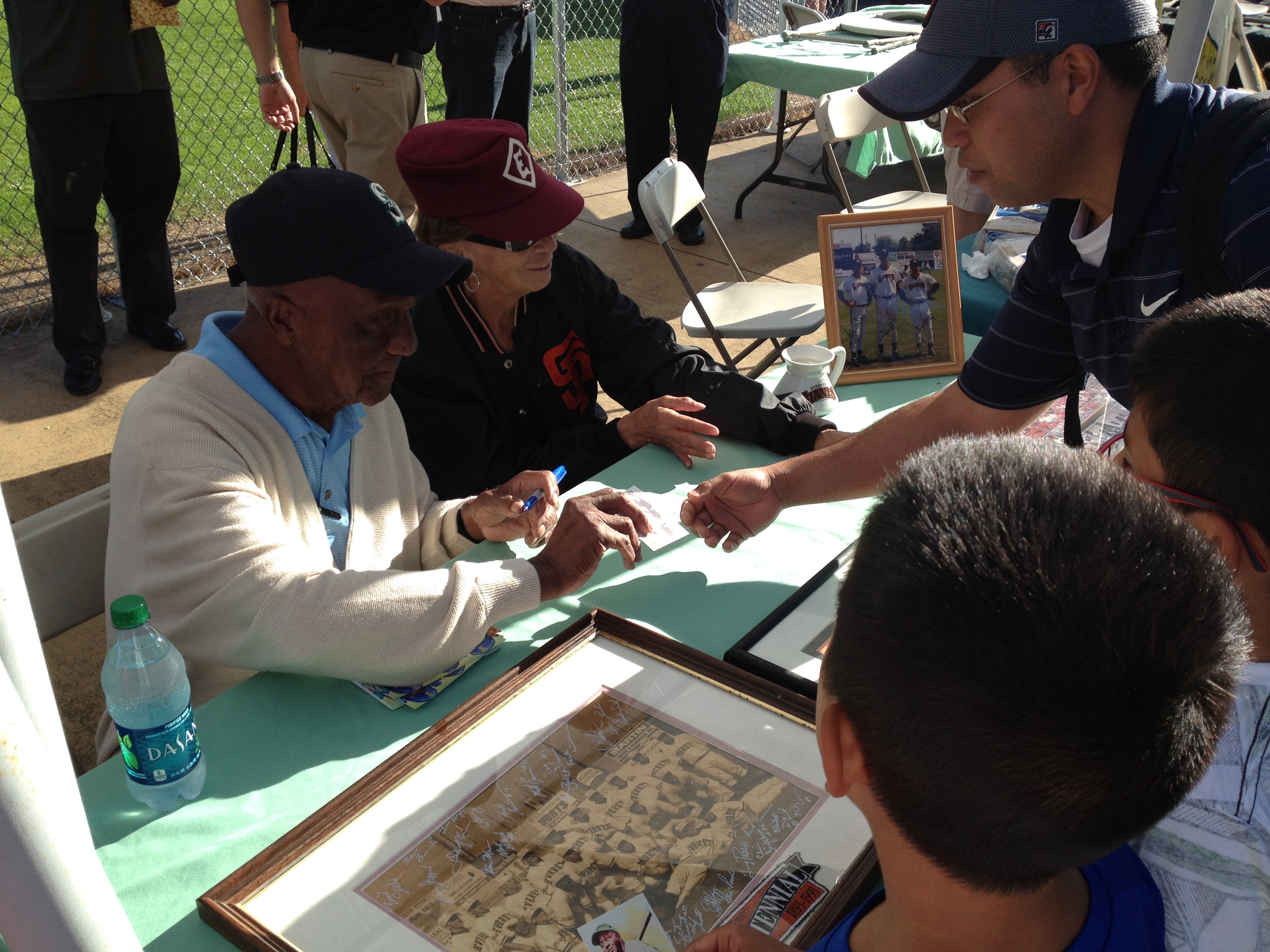
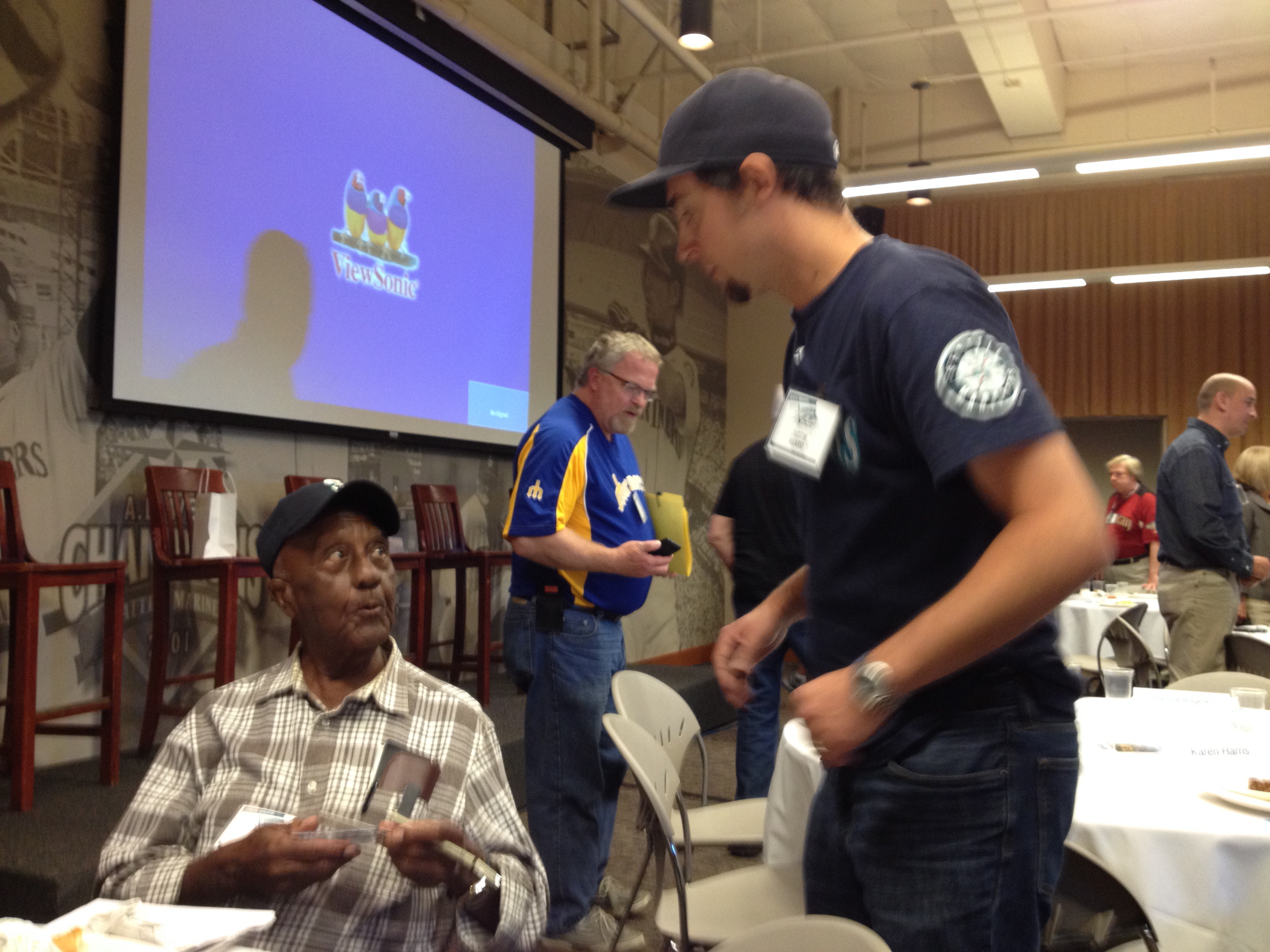
Herb also signed autographs before the game, and after a somewhat slow start, a stead stream of fans lined up for his John Hancock. That’s him doing thusly in the pic above. The coolest part came when one father and a group of kids brought specially made baseball cards featuring Herb that were produced by a local business for the occasion.

The other notable thing about the game — at least for us New Orleanians — was the fact that when the sun went down, it got chilly at the ballpark. Chilly in late July! If it had been a Zephyrs game at this time of year, it still would have been, like, 88 degrees at 8:30 p.m.

Many, many thanks to the Hopes for hosting us. I also want to especially note that my brother, Nathan, drove up from Portland for the evening, and he came to the game with me. Because he and I live so far apart, and because I’m constantly financially strapped and unable to fly to Oregon, Nathan and I almost never see each other, so it was really, really good to hang out with my bro.

BTW, the AquaSox lost to Boise, 7-6, tonight. 😦 But I was able to buy a gift for my soon-to-be stepson, Eli — an AquaSox bouncy ball:

IMG_0459

More details from Friday’s exciting day

I wanted to give a few more interesting nuggets and stories from Friday’s big first day in Seattle. I’ll start with this photo:

IMG_0428

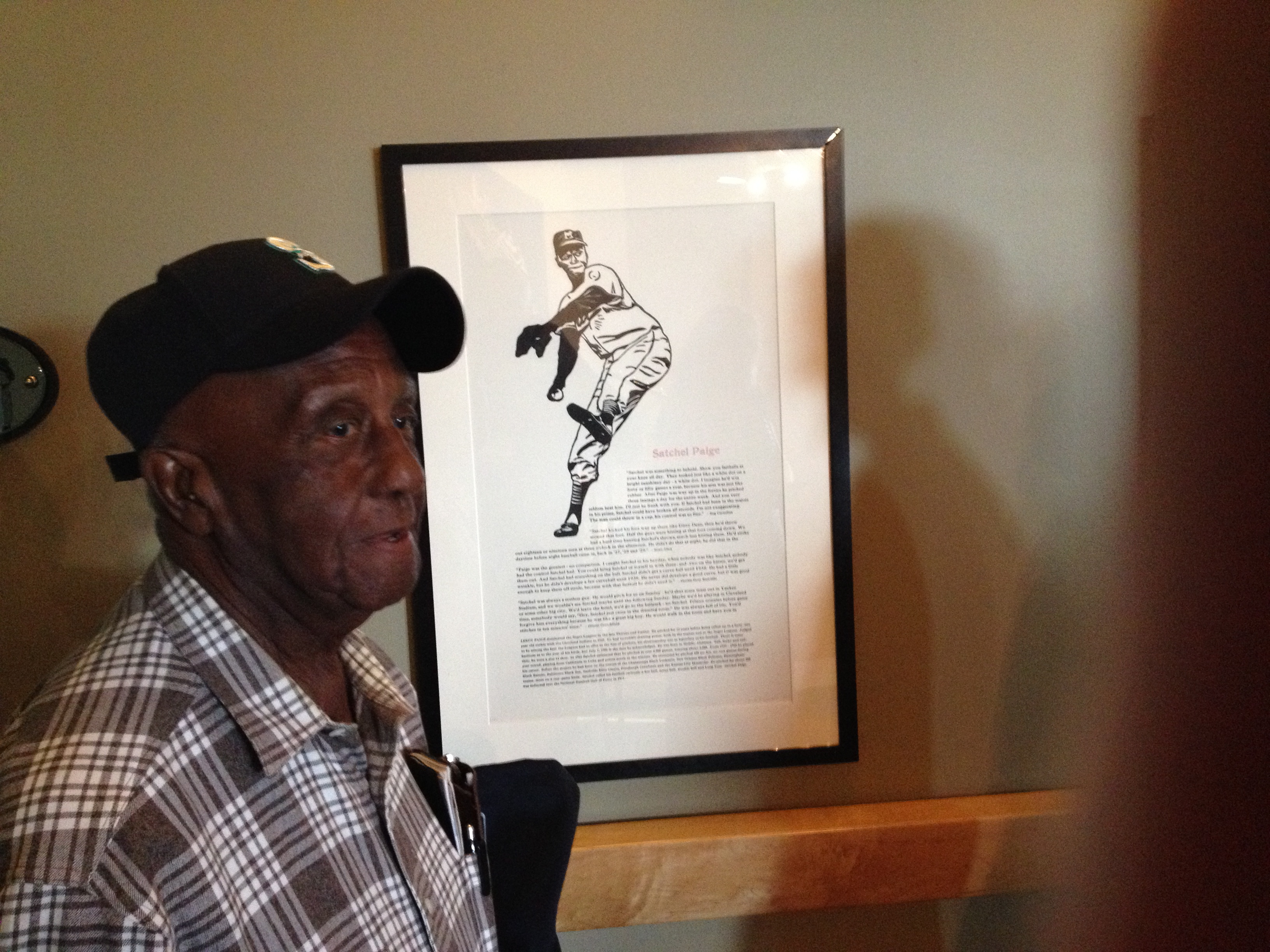
The 6th level (suite level) entrance features a wall of framed portraits and bios of several Negro League Hall of Famers, including this one of the inimitable Satchel Paige. One of Herb’s best stories from his baseball career is how he got two hits off of Satch in a game — a single and a double — and how ol’ Leroy congratulated him in person and bought him a Coke.

Another anecdote from yesterday comes from the RBI Club annual luncheon, at which we were guests. In addition to some tasty eats, the meeting included talks and appearances by a bunch of local Mariners, sports and media personalities, including SuperSonics legendary long-distance sharpshooter “Downtown” Freddie Brown; official Mariners broadcaster and “Voice of the Mariners” Rick Rizzs; ROOT SPORTS pregame and postgame host Brad Adam; and multimedia master and author of an upcoming biography about legendary Hall of Fame Mariners announcer Dave Niehaus.

The highlight of the luncheon (other than the recognition of Herb) was a brilliant, off-the-cuff presentation my M’s third base coach and grizzled MLB veteran Rich Donnelly, who regaled the audience with a slew of side-splitting anecdotes about his decades of involvement in the American pastime.

Coach Donnelly was seated at the table with Herb, Felton, myself, Lorri, Pete, Brad and others. When RBI Club head Bob Simeone gave me a shout-out at the start of the meeting portion of the luncheon, he noted that I was a journalist and researcher who specializes in the Negro Leagues.

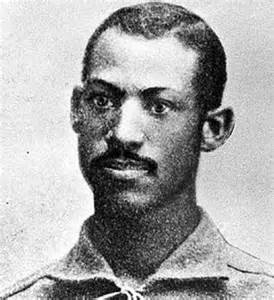
A few minutes later, Coach Donnelly made a point of leaning over to me and revealing an incredible personal nugget of info: That he is from the same hometown, Steubenville, Ohio, as Moses Fleetwood Walker, the first widely accepted African-American to play in the major leagues. This was way back in the 19th century, when the sport was spelled “base ball” and the color line had yet to be drawn.

Coach Donnelly noted how proud he was to share a hometown with Fleet Walker (and Fleet’s brother, Weldy) and that he attended a recent memorial service for the hardball trailblazer.

th-2

Moses Fleetwood Walker, who shares a hometown with Mariners third base coach Rich Donnelly.

Finally, we capped off the evening at the Northwest African American Museum, where Herb was the guest of honor at a reception. I had a chance to swing through the “Pitch Black” exhibit (which I hope to write more about soon) courtesy of a tour by fellow SABR member David Eskenazi, and as I posted last night, we heard poems written by two local youth in honor of Herb’s visit.

Almost as soon as we walked into the gallery, we were struck by a huge version of a team photo of the Spokane Indians from six decades ago, when Herb integrated the team and the Western International League. Right there on the right end of the top row of players was Mr. Simpson himself. When Herb saw the picture, he was immediately drawn to it, walked up, pointed to his smiling face and broke out into a brand new smile last night. You could tell how important a sight it was for him.

A little ways into the reception, museum exhibitions coordinator Chieko Phillips gave a short presentation about Herb, his career and his importance to Seattle history. She also stressed his importance as a World War II veteran and the meaning of his service to our country. She said the city is proud of him and his accomplishments.

“Here in Washington, we get to brag a little about him,” she said.

She noted that he was a gap hitter whose career also included time with top-level Negro League teams like the Birmingham Black Barons, the Homestead Grays and the Chicago American Giants.

She said that because the West Coast Negro Baseball League lasted only about two months, the Seattle Steelheads unfortunately initially “faded into historical obscurity,” but thanks to the efforts of numerous local researchers, writers and historians, “the legacy of Herb Simpson and our Steelheads lives on.”

She capped off her comments by introducing Malcolm and Betty, the two local students and museum junior curators who penned poems about Herb and his contribution to baseball history.

“These poems are for you, Herb,” she said, drawing a huge smile and grateful nod from the man of the hour.


Photographer extraordinaire covers Herb

Here’s a link to a gallery of fantastic photos of Herb by Seattle area freelance photographer Rick Takagi, who took the series of shots at Safeco yesterday. Just follow the link at the bottom of the page, and the password for the gallery is “rbi.”

‘The sport I love’

Well, we concluded are incredibly packed day Friday at the Northwest African-American Museum for a reception in Herb’s honor and to tour the organization’s fantastically researched and displayed exhibit, “Pitch Black: African American Baseball in Washington,” which was put together by the effervescent Chieko Phillips, the museum’s exhibition’s director.

I’ll write more about the trip to the NWAAM (hopefully) tomorrow — all of us are totally whupped by now — but for now I wanted to post this, because this might have been the absolute highlight of the day:

IMG_0440

OK, first of all, yes, I think that is indeed my dopey thumb in the top left-hand corner. My profuse apologies to the people in the photo and to amateur photographers everywhere.

But obviously seated in the middle is Herb Simpson, but on the left is Malcolm Prevo, a rising sophomore at Kennedy Catholic High School, and on the right is Betty (I hope I have this right) Lemlemayehu, a rising sophomore at Evergreen High School.

Malcolm and Betty are junior docents at the museum who composed poems in honor of Herb, and the pair of new generationers read their works aloud to the assembled crowd in the gallery. Both poems were extremely moving and quite, quite impressive, and congrats to both Betty and Malcolm.

After the two teens read their work, I got a moment to chat with them about meeting Herb Simpson, the man for whom they dedicated their writing. The question was especially striking for Malcolm, who himself is a baseball player for Kennedy Catholic. He’s a catcher, btw. The next Josh?

But here’s what Malcolm had to say about Herb:

“Just seeing him and knowing that he’s been through a lot and learning about him, it reminds me that he fought for what he believed in, and he deserves this [recognition]. Without people like him, I wouldn’t be able to play baseball, the sport I love, like he did.”

I think I’ll just leave it at that. 🙂

To new friends

IMG_0439

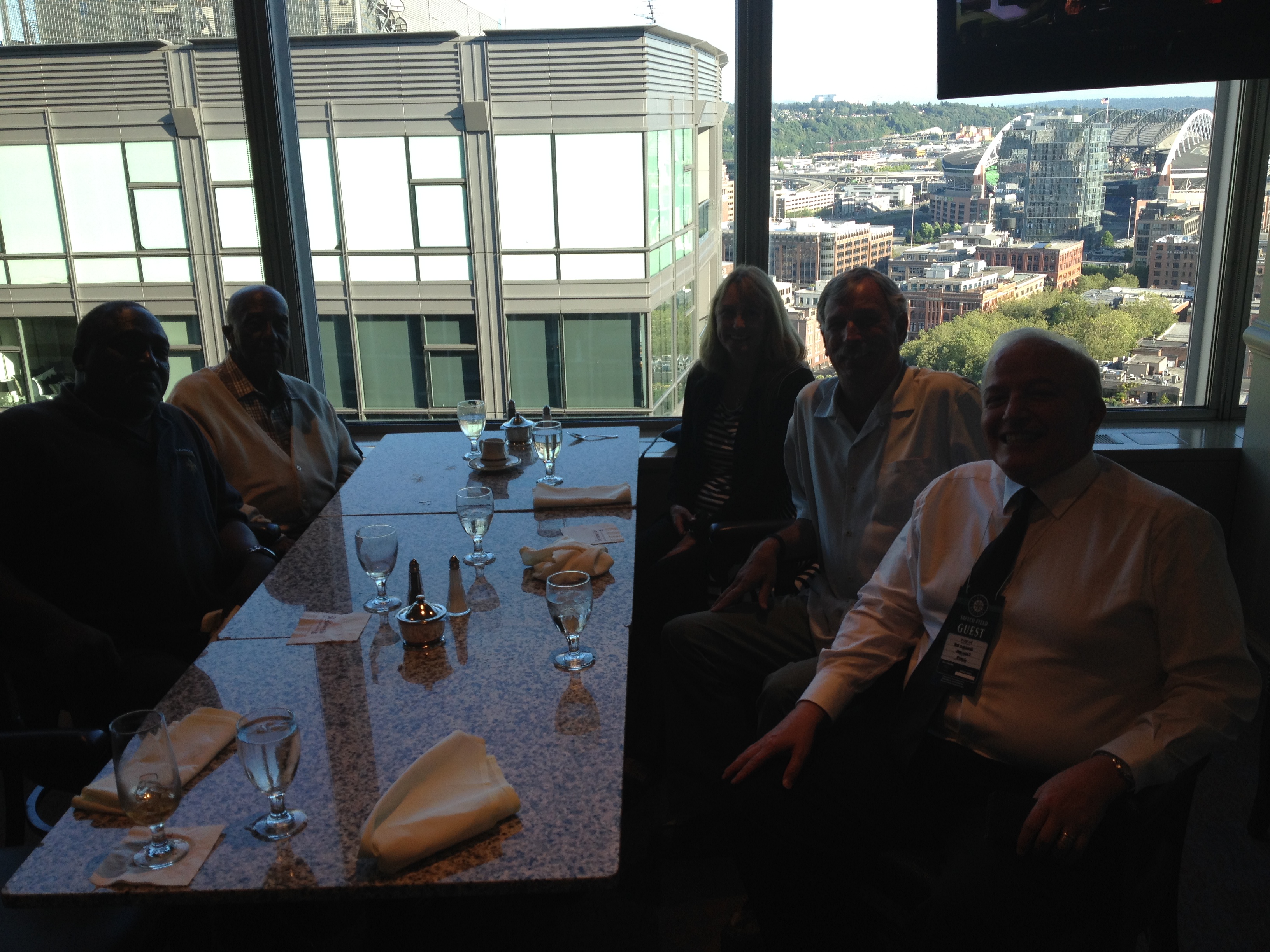
OK, unfortunately, I’m a terrible photographer, especially with just an iPhone, because if it wasn’t totally shrouded in shadow, this would be a great pic. On the left are Felton and Herb, on the right are Lorri, Pete and Bob from the RBI Club, some of the most gracious hosts humble visitors could ever ask for.

We had a incredible dinner of filet and salmon at The Harbor Club restaurant overlooking Puget Sound, a photo of which is below. The six of us had a wonderful “new friends” experience at the restaurant — many thanks to Harbor Club GM Craig McCrone for the great atmosphere and out-of-this-world food — before heading off to the Northwest African-American Museum.

Anyway, as promised, here’s a shot of the sound from (I think) the 17th floor:

IMG_0432

Safeco Field welcomes us

Right now, I’m getting ready for a quick nap before we shuffle off to the Harbor Club for dinner, then to the Northwest African American Museum for a reception in Herb’s honor.

We just got back from Safeco, where Herb stood and sat very patiently — he was certainly more patient than this Irishman would have been — for a 45-minute photo session on the sun-bathed field. Here’s a photo of Herb, standing in the middle, being snapped by photographer Rick Takagi, who is yet another wonderful, helpful person we’ve met so far (another incredible host, ace M’s beat writer Mikaela Cowles, is at the far right holding up a sun shield):

IMG_0410

We then attended the RBI Club’s annual luncheon at the stadium, and I’ll blog more about that later, probably tomorrow. But for now, he’s a photo of Herb signing an autograph for one of the many Seattle fans who approached him at the luncheon:

IMG_0417

I’ll try to get a couple pictures and a few paragraphs up later tonight about our upcoming evening, then try to write a detailed account of all today’s goings-on tomorrow before we zip up to Everett for the AquaSox game.

Herb races Jesse — and almost wins

Here’s a story I did that was just published today on SportsPressNW.com on Herb. Thanks to Art Thiel at the Web site for giving me the chance to report and write it, and thanks to everyone who was gracious enough to let a rapidly balding ginger interview them for the article.

Got lots more to come over the next 24 hours or so … very, very busy day in the Pacific Northwest today.


Settled in Seattle

Well, we’re here! Landed at Sea-Tac about 15 minutes early, we hooked up with our shuttle to the hotel, and now we’re settled in our rooms at the Courtyard Marriott (which is pretty gosh durn awesome, by the way).

Just wanted to rattle off a quick post. The flight didn’t seem as long as I thought it would, and I got a little writing done in the process. When we landed and got off the plane, some of Herb’s first words were, “It’s cold here!”

Compared to NOLA, it certainly is. When we landed, it was about 60 at the airport. Right now, at 12:30 a.m. N’Awlins time, it’s 78 in the Big Easy, according to wwltv.com.

We drove past Safeco on the way to our modest lodgings, and the lights were on and looking beautiful. Unfortunately, our driver told us that the last he heard, the M’s were losing to the Orioles, 4-0.

Tomorrow promises to be one whale of a day … photo shoot at the stadium at 10:30 a.m., followed by a luncheon with the RBI Club, then a reception at the Northwest African-American Museum in Herb’s honor in the evening. I’ll try to post as much as I can along the way.

Finally, before I sign off for the evening, I just want to say an advanced thanks to Bob, Lorri, Pete and everyone at the RBI Club for making this experience of a lifetime possible. Also thanks to Rebecca Hale with the M’s PR department.

So … see you from Safeco tomorrow!

T-minus 6:20 …

We’re all getting prepped to head to Seattle this evening. I spent about 90 minutes at Herb Simpson’s house Tuesday, and I asked him if he was ready for the big trip. “I’ll make myself ready,” he said with a laugh.

In the meantime, I wanted to share a couple press releases and Web site links relating to Herb’s trip to the Jet City:

Here’s a link to the Mariners’ press release about African-American Heritage Day Sunday.

• And this is the Everett AquaSox’ press release about their Turn Back the Clock Night, which will honor Herb.

• The Northwest African-American Museum will host a reception for Herb tomorrow night as part of the facility’s ongoing exhibition on black baseball in the Northwest.

• Finally, here’s a link to the Mariners RBI Club, the booster group that’s hosting Herb, Felton and me.

The curious case of Benjami … I mean, Shumza Sugimoto

At least a year ago now, fellow SABR member and historian Rob Fitts, an expert in Japanese baseball history and the author of several books on the subject (seriously, the guy is good), e-mailed me to ask about one Shumza Sugimoto.

It seems that, in early 1905, media reports surfaced that Sugimoto, a Japan native and outfielder, was getting a tryout and had signed a contract with John McGraw and the New York Giants. This report was out of the blue, in just about every sense. If it was true, and especially if he did, in fact, end up playing for the Giants, Sugimoto might very well have been the first Japanese player in the Major Leagues.

McGrawJohn-LOC-Bain-11245r_0.preview

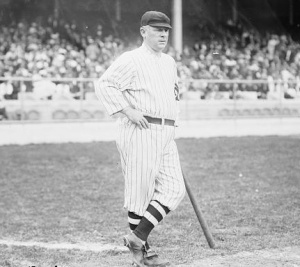
Did John McGraw sign a Japanese player named Shumza Sugimoto?

And that would be a huge discovery among Nisei baseball historians and researchers. It also wouldn’t be a surprise, given McGraw’s well known progressive (at least for the era) on race in baseball, a fact also evidenced by his oft-stated desire to sign African-American players.

But apparently experts in Asian baseball had ever heard of this guy. Thus their shock when these media reports were dug up and uncovered.

So why did Rob reach out to me? While I’m certainly intrigued by the history of Asians and Asian Americans — I did an article or two on the passing of Wally Yonamine, the first American of Asian decent to find stardom in baseball in Japan — my actual work rarely crossed into those subjects.

Well, here’s why Rob contacted me. From the Feb. 25, 1905, Sporting Life magazine:

“Shumza Sugimoto, the Japanese ball player, who is now at Hot Springs [where the Giants held spring training] , and may be taken South by McGraw, does not like the drawing of the color line in his case, and says he will remain a semi-professional with the Creole Stars of New Orleans if his engagement by the Giants will be resented by the players of other clubs.”

First off, such news that “organized baseball” was all astir over the possibility of a player of another ethnic group competing in the system reflects that it wasn’t just black players who were shut out from white baseball for decades.

But beyond that, the “Creole Stars of New Orleans”? That’s why Rob contacted me — it seems I’m more or less, by default, the expert on African-American hardball in NOLA and the rest of Louisiana.

And the name “Creole” definitely indicates that the Big Easy team would have largely been black. So Rob was curious whether I had come across anything relating to Sugimoto in N’awlins.

My short answer: I had not. In fact, I had never seen any reference in local media to a New Orleans team called the Creole Stars. There were the Creoles and the Crescent Stars, but no Creole Stars.

And after Rob contacted me, I scoured several local historical societies, museums and repositories — including the Louisiana Research Collection and the Amistad Rsearch Center, both at Tulane University, as well as the Historic New Orleans Collection — for any reference to Sugimoto or the Creole Stars.

I found nothing. Zip. Nada. Zero.

Part of the problem certainly is that, at that time, there was no African-American newspapers in New Orleans; a few that were published in the late 19th century had ceased by then, and the Louisiana Weekly didn’t start up until 1925. So there was a huge gap in coverage that would have resulted in no mention of a Japanese player on a Negro Leagues team.

In subsequent e-mails with Rob, he revealed that he has since done a boatload of research himself into an alleged Shumza Sugimoto, including checking out dozens of high school and college baseball rosters in Japan from that time period, and found nothing else about him.

I, meanwhile, as a Japanese friend of mine from grad school, intrepid business reporter Takashi Nakamichi, if he could go through archives of Japanese newspapers during that era, and Taka couldn’t come up with anything, either.

Which didn’t surprise Rob, given his own futile efforts and research.

Then how in the world did a Shumza Sugimoto even get a tryout with the legendary John McGraw? That is the crucial question, and one that can only be “answered” by speculation and guesses.

And the notion that such a player laced up spikes for a Crescent City African-American team? Who knows, really, but all the evidence — or, I suppose, the lack thereof — says no.