Malloy Conference goes to baseball’s home

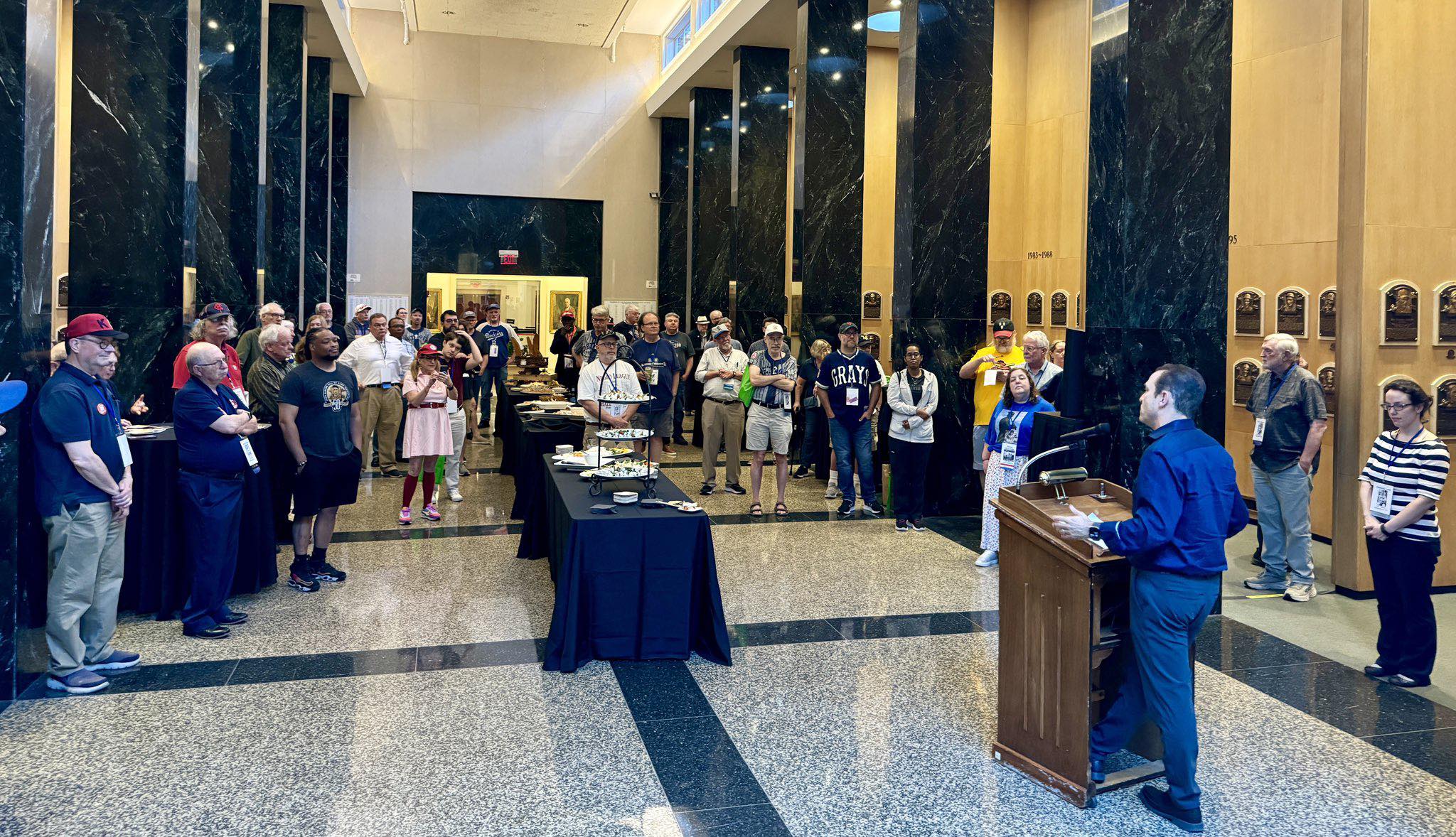
National Baseball Hall of Fame President Josh Rawitch (bottom right, at podium) addresses the attendees of the 2024 Malloy Conference at its opening meet and great in the hallowed Plaque Room. Photo by Jacob Pomrenke.

When you’re visiting the National Baseball Hall of Fame in Cooperstown, N.Y., there’s something quite stirring about entering the Plaque Gallery and seeing all the bas relief, rectangular, wooden plates hanging on the walls, each one displaying the image and short biography of one of the figures who have been enshrined in the Hall.

There’s a solemnity and an aura of greatness that permeate the Plaque Gallery and place visiting the massive room near the top of many a baseball fan’s bucket list of things to do before they die.

It was against this backdrop that dozens of Negro Leagues researchers, scholars and fans gathered on the evening of June 6 for a meet-and-greet reception for another edition of SABR’s annual Jerry Malloy Negro Leagues Conference.

The Malloy conference had never been held in the hallowed halls of Cooperstown, but apparently the Hall of Fame had been the ones to reach out to us about holding the Negro Leagues conference in Cooperstown.

And I, for one, felt incredibly honored to be welcomed by such an illustrious institution as the NBHOF, and I’m sure many of my friends and peers felt the same way. However, the feeling might have been mutual, or at least that’s what NBHOF President Josh Rawitch told us in his opening remarks.

“It’s an incredible honor to have this group here,” Rawitch told us. “You could have gone anyplace, and you came here. To pick us is an extraordinary, true honor for us. …

“This place is unbelievable,” he added about the Hall of Fame. “It’s truly one of the most spectacular places on the planet.”

Long-time Malloy attendee (and my perennial conference roommate) Ted Knorr also gave a few thoughts, which included, quite significantly, a call to elect more segregation-era Black baseball figures to the Hall. He noted this while the Hall of Fame continues to tinker with the election in a way technically allows more Negro Leagues to get in while at the same time essentially being no change at all, for all practical purposes.

In light of this, perhaps one question to ask is why the Hall had been so eager to host the Malloy gathering. More specifically, I found myself pondering whether the HOF’s overture to the SABR Negro Leagues Committee might have been essentially a public relations move by an institution that continues to receive criticism from Black ball advocates for consistently failing to adequately honor Negro Leagues greats with induction.

The fact is that the Hall persists in snubbing many Negro Leaguers who more than deserve induction, despite middling changes to the voting rules and token gestures of respect for those African-American legends, showing a still stunning level of disrespect for and ignorance of Negro Leagues history. So maybe hosting the Jerry Malloy conference was an effort by the Hall to blunt or mute such criticism and make itself look just a little better, or at least less awful.

(I want to note that the opinions and interpretations of the preceding two paragraphs are my own personal beliefs and thoughts and do not necessarily represent anyone else within the Negro Leagues community or the Malloy committee itself.)

A collage of some of the presenters and panels at the conference. Clockwise from upper left: Tom Shieber and Mary Quinn; Lisa Doris Alexander; a display about the Newark Eagles; Missy Booker; Paul Julion; and Steven Greenes. Graphic courtesy of Jacob Pomrenke.

Having said all that, I wanted to highlight a few themes that ran through the three-day conference.

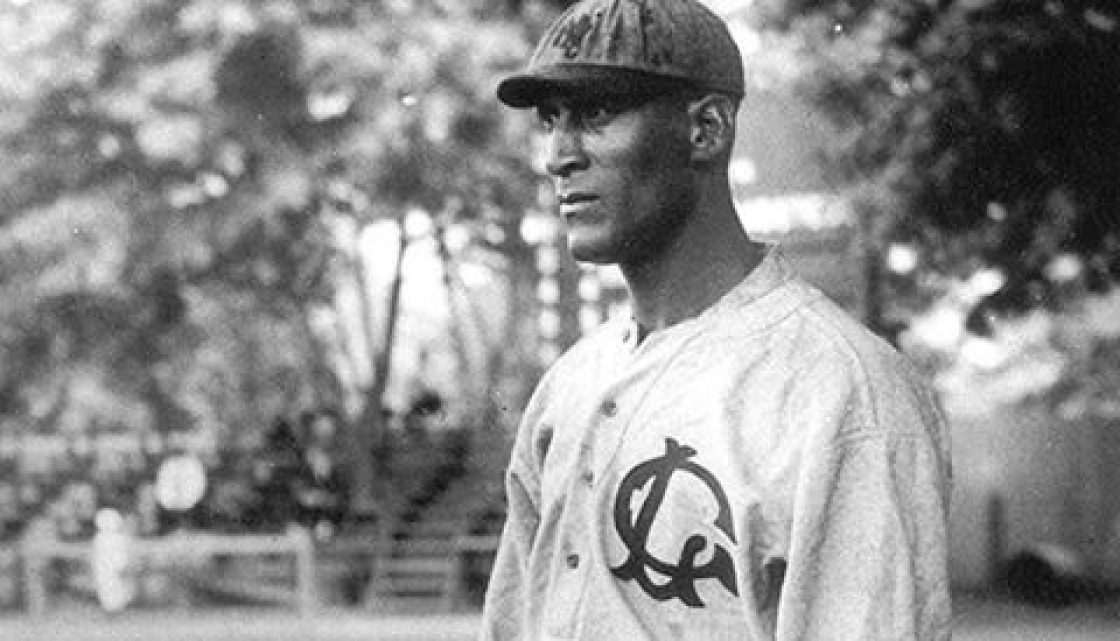
The first, quite naturally, was the emphasis on the life, career and legacy of Bud Fowler, the 19th-century African-American star player, manager, owner and executive whose ambition, courage, resilience and persistence laid the spiritual groundwork for all of the Black baseball teams, leagues and business ventures that came after him. For details about Fowler’s life and impact, check out this, this and this. Also, here’s info on the fantastic biography of Fowler by the late Jeffrey Laing.

Bud was not only recently inducted into the HOF (along with Buck O’Neil) in 2022, but he was also a native of Cooperstown and had deep roots and connections to the central New York State region.

To start, Bud is on the cover of the 2024 Malloy Conference’s souvenir program, and on the Sunday after the conclusion of the official conference proceedings, a carpool was planned to visit Fowler’s grave in nearby Frankfort, N.Y.

But the best homage to Fowler at the conference was on Friday afternoon with the hour-long panel on Bud, moderated by the stupendous Alex Painter, who dubbed the panel “the Fowler Hour.” Unfortunately, one of the panelists, 19th-century Black baseball author and expert James Brunson, was unable to participate, leaving Alex and educator/historian Brian Sheehy as the dynamic Bud Fowler duo.

Sheehy, who had extensively researched Bud’s time in Massachusetts, where he played as a ringer of sorts for multiple integrated teams at the beginning of his long career in pro baseball, gave a presentation about this time in Fowler’s career. Sheehy addressed the several lingering question marks and mysteries about Bud’s escapades in the Bay State.

“He was actually a nomad,” Sheehy said of Fowler. “It’s important for us to remember that, and it’s important for us to fill in that story.”

Following Sheehy’s talk, Painter unspooled the tale of the Indianapolis Colored Baseball League of 1902, one of Bud’s final efforts to jumpstart an organized African-American baseball circuit – and, Painter said, one of Fowler’s most little-known ventures.
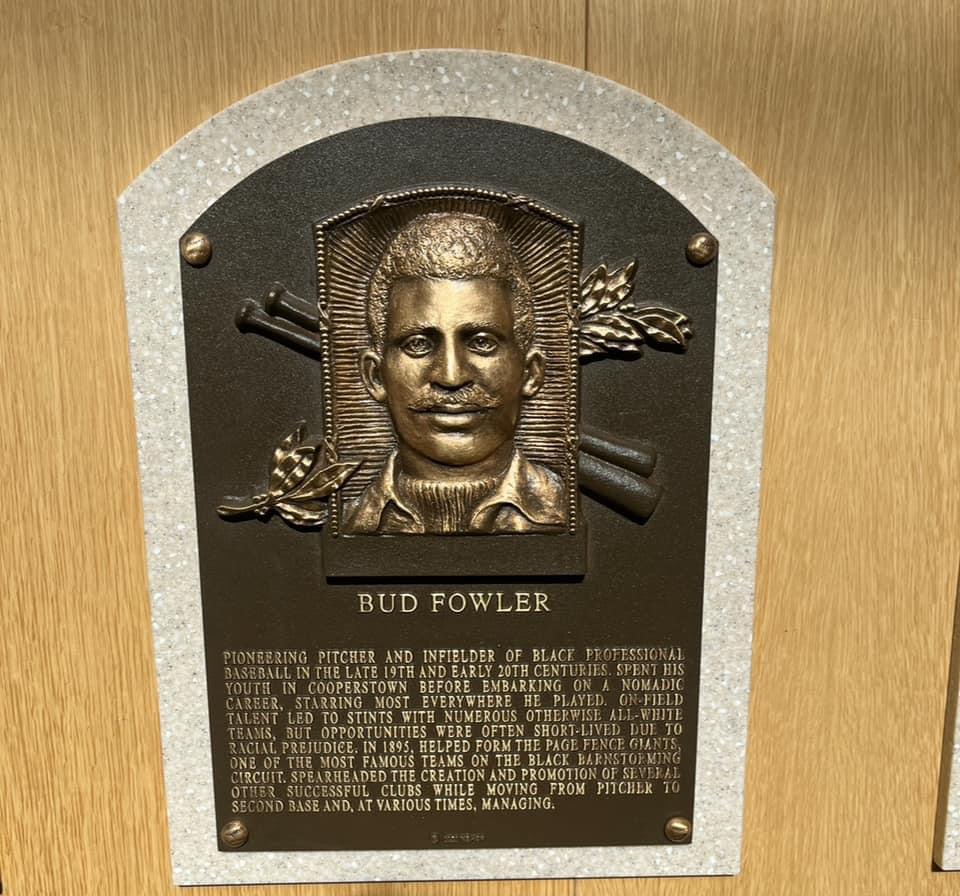
Photo courtesy Mitch Lutzke.

“He understood what the benefits of an organized Black baseball league could mean,” Painter said.

While the ill-fated ICBL didn’t last very long at all – it didn’t come close to completing a season – it did spawn the soon-to-be-legendary Indianapolis ABCs, one of the greatest Black teams in history. The league also, unfortunately, might have triggered Bud’s physical decline when one of Bud’s baserunning slides led to a broken rib that apparently pierced his kidney. The injury seems to have triggered deteriorating health that led to his death in 1913, just short of his 55th birthday.

Alex noted that during Bud’s last years, “[H]e was keenly aware of his place in baseball history.”

The second topic that particularly piqued my interest was less of an actual theme but more of a dandy doubleheader that hit close to home for me – baseball trading cards.

Like many of the men and women who always attend the Malloy Conference, I collected baseball cards as a kid. A lot of them. And one of the biggest regrets of my life is eventually selling most of them off several years ago. It’s a pain that never goes away.

But a pair of presenters on Saturday afternoon during the conference buoyed my spirits a bit by discussing a few landmark card sets that helped bring the Negro Leagues into the lives of baseball fans who otherwise hadn’t known much about pre-integration Black baseball.

The first speaker was Rich Puerzer, a perennial Malloy attendee and presenter, who this year regaled the audience with the story of the Laughlin Negro League Baseball Card Sets. The Laughlin line of Negro Leagues trading cards were the creation of Robert “Bob” Laughlin, a cartoonist and card-making entrepreneur who came out with his first line of Negro Leagues cards in 1974, a set dubbed “The Old-Time Black Stars” and totaling 36 cards. That was followed by a 12-card set honoring the famous Indianapolis Clowns team in 1976, then a third line in 1978 called “The Long Ago Black Stars,” boasting 36 cards.

Puerzer discussed Laughlin’s motivations and goals for creating the three lines; how he went about compiling, designing and printing them; and the cards’ importance to the documentation and teaching of Black baseball history.
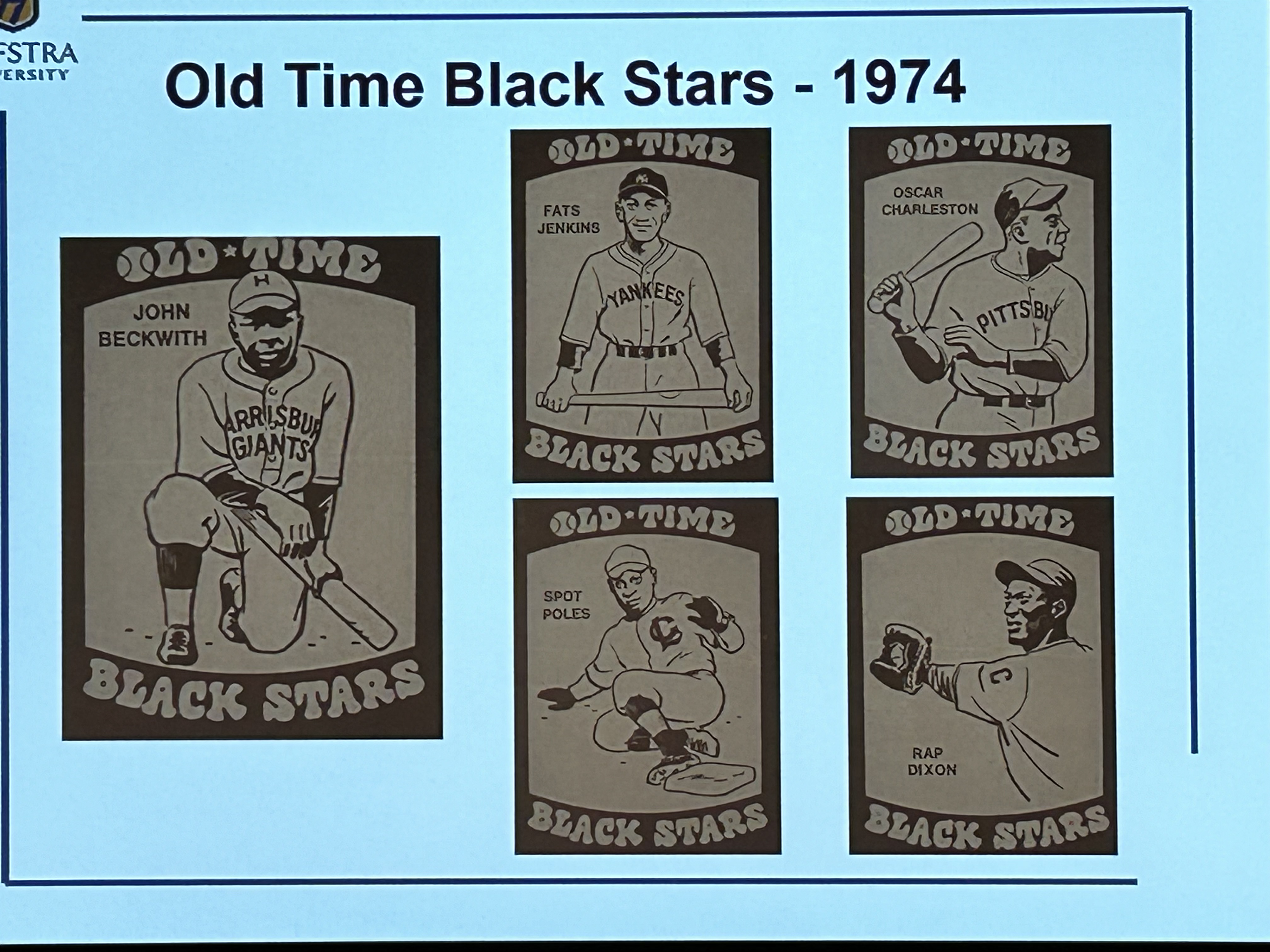
Some of Laughlin cards as shown during Rich Puerzer’s presentation.

Puerzer said that while the Laughlin sets weren’t as popular as the Topps company’s annual MLB sets, Laughlin – who was a bit of an outsider in the sports card world, Rich said –  was nonetheless “truly ahead of this time.”

Puerzer said that for many collectors, the ’74 Laughlin line – which he noted possessed “a simple elegance“ – was “something of a passport to the Negro Leagues.” He added that the 1976 and ’78 sets were just as beautiful and impactful as the landmark 1974 set.

“Several of them are really beautiful cards,” he said. They bring the humanity of the players to the fore with a simple and beautiful style.

With the Laughlin sets, Puerzer said, the Black baseball figures “finally received their due. Many of them were on a baseball card for the first time.”

Puerzer was followed by Steven Greenes, who gave a presentation titled, “Negro League Baseball Cards and Memorabilia as a Roadmap to History,” which filled in all the trading cards and other ephemera of Negro Leaguers leading up to the groundbreaking Laughlin sets. 

Greenes noted how cards of Black players existed back to the mid-19th century, with a lot of them made in Cuba, Mexico and the Dominican Republic that depicted African-American players who competed in the integrated leagues or teams in those countries.

Other important cards or products of Black players included copies of ta team photo of the famed Page Fence Giants team in the 1890s; a card of pitcher Jimmy Claxton in a 1916 line of cards of Pacific Coast League players by the Zee-Nuts candy company; and an extremely rare 1951 card depicting Josh Gibson’s days playing in Puerto Rico.

Post-integration, the first mainstream United States company to issue a card of a Black player was Leaf’s 1949 Satchel Paige card, which Greenes called “the rarest and most significant post-war baseball card.” He added that authentic cards of Gibson from various lines are the most sought-after Negro Leagues cards.

However, he added, “just about every Negro Leaguer had one or two cards of them made.” He said that “the value of such cards mirrors the public’s love and knowledge of the Negro Leagues,” and noted that amidst the boom in sports card collecting during and after the Covid-19 shutdowns, “no other cards have increased in value more,” with some increasing by 10 times the value.

“People are really recognizing these players as the greats they were,” Greenes said.

(As a side note, I was one who used the pandemic shutdowns to start collecting sports cards again, including baseball ones. I fully admit that my renewed passion stems in large part from a desire to relive my childhood and regain some of the magic that collecting brought me in my youth. And it goes without saying that Cooperstown’s downtown is jammed with card memorabilia shops. Seriously, it’s like every third storefront. It’s glorious.)

The now iconic statue of Buck O’Neil at the Hall of Fame.

The third theme that permeated the 2024 Malloy Conference was the presence of several relatives or descendants of important figures in Black baseball history, starting with Max Martinez Almenas, a descendant in the great Martinez baseball family.

Almenas related how the four Martinez brothers – Antonio “Tonito” Martinez, Horacio “Rabbit” Martinez, Aquiles Martinez and Julio “Julito” Martinez – helped pioneer baseball in the Dominican Republic and left their indelible mark on the significant but overlooked importance of Dominicans in the Negro Leagues and baseball throughout the Americas as a whole.

Max, the grandson of Tonito and the grand nephew of the other three brothers, is directing a documentary by the Martinez Beisbol Films production company titled, “The Martinez Brothers: The Untold Story of Talent, Tragedy, and Legacy.” Here’s a description of the documentary in the Malloy Conference program:

“Our narrative delves into the personal and professional hurdles they overcame, showcasing their journey through a visual feast that captures the essence of triumph and sorrow. The documentary promises a compelling voyage into the heart of the Martinez legacy, highlighting their contributions, struggles, and the profound impact they left on the sport. It is a story of resilience, family bonds, and an enduring legacy that inspires generations.”

Said Max during his presentation: “There are many people that know the history, but many more need to be taught the history.”

He added that the Martinez brothers were among “the first wave of Dominicans in baseball [in the U.S],” and that “they established the original pipeline of professionals from the Dominican Republic to Major League Baseball.”
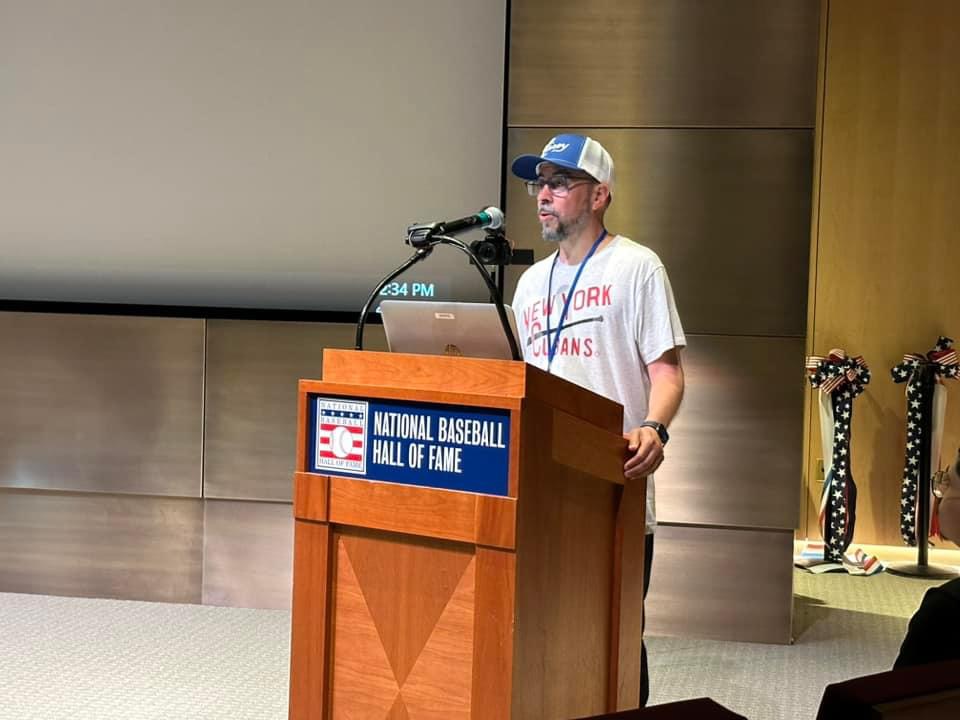
Max Martinez Almenes gives his presentation about the Martinez brothers. Photo courtesy Adam Darowski.

Right after Max’s presentation came one by J.B. Martin IV, the great grandson of Dr. J.B. Martin Sr., a Memphis dentist who, along with his brother (and fellow dentist) B.B. Martin, founded and operated the Memphis Red Sox from 1920 to 1959.

The Red Sox shifted from league to league and from level to level, including stints in the Negro Southern League, the first Negro National League and the Negro American League. J.B. Martin built Martin Stadium for the Red Sox, who were one of the few Black baseball teams to own their own stadium.

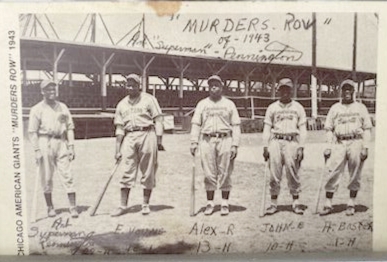
Into the 1930s and ’40s, Martin spent a lot of time in Chicago, where he eventually became co-owner of the famed Chicago American Giants, who were past their prime but still played in the Negro League “majors.” J.B. Sr. and served as president, at various times, of the Negro Southern League, the Negro American League and the Negro Dixie League.

At the Malloy conference last month, J.B. Martin IV regaled attendees with tales of his great grandfather and the Red Sox. Martin IV said he works to educate the public about his great grandfather, as well as campaign for the senior Martin’s possible election to the Baseball Hall of Fame.

“His accomplishments were important to the Negro Leagues, and his achievements deserve recognition,” the younger Martin said.

Because the Memphis Red Sox were a family-operated affair, and because they owned their own ballpark, Martin IV said the team enjoyed “a unique situation in Memphis, and they drew a lot of the best players.”

Martin Sr. was also a prominent figure in the local Republican Party, and his progressive activism earned the ire of the Memphis Democratic machine that governed the city with an iron grip and threatened the Martins’ safety and extensive, successful business interests.
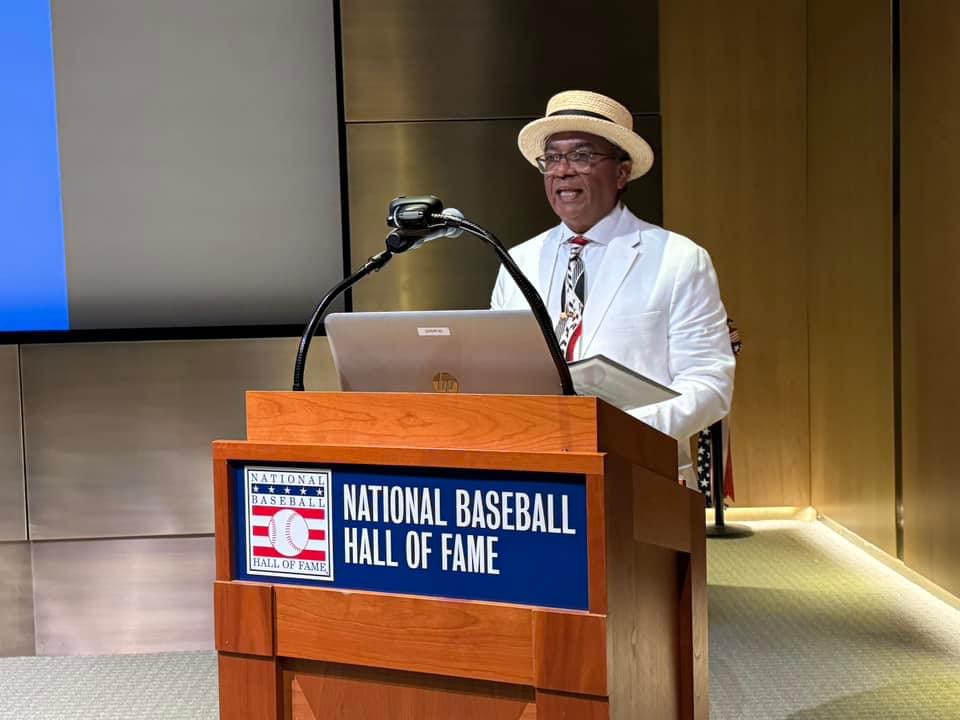
J.B. Martin IV discussing the life and career of his great grandfather. Photo by Jacob Pomrenke.

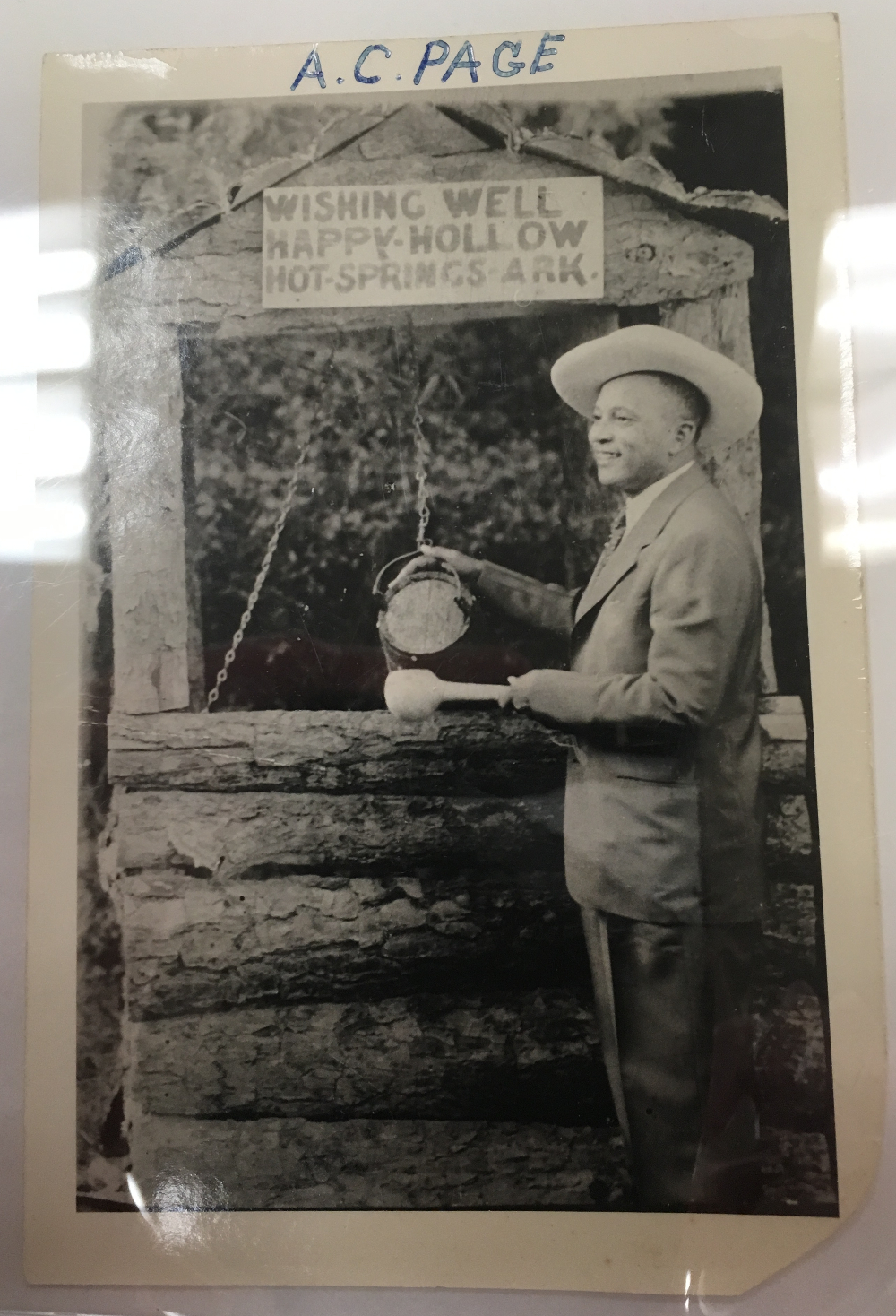
I’ll cap off the bulk of this post with thoughts by another descendant of a legendary figure in segregation-era Black baseball in the South, Rodney Page, who also attended the conference and whose father, Allen Page, was arguably the greatest and most influential person in the Black ball scene here in New Orleans for three decades.

Allen Page founded, bought and owned several pro and semipro clubs in the Big Easy, and he frequently played a role in the national Black baseball competition and management. Rodney said at the conference that his father knew J.B. Martin well; the seniors Page and Martin were both among the most prominent Negro Leagues operatives, promoters and executives in the South. Rodney noted that his father was friends with Martin, who often visited the Pages in New Orleans.

“I know a little bit about J.B.,” Rodney said drolly.

Rodney commented at the conference that there are not enough businessmen in the Baseball Hall, even though it was the money men and women who often took the type of chances that could make or break a team or a league. He said that African-American entrepreneurs in the Jim Crow South, including those in the baseball business, took great financial and personal risk to create a lasting, thriving economic entity.

“I know that first-hand,” Rodney said.

He added that Martin absolutely belongs in Cooperstown.

“To me, and I’m biased, this should be a slam dunk,” Rodney said of Martin’s HOF prospects. “From my perspective,” he added, addressing J.B. Martin IV, “it was the owner and executive and promoter who moved the Negro Leagues from the sandlots to significance. Your great grandfather was one of those.”
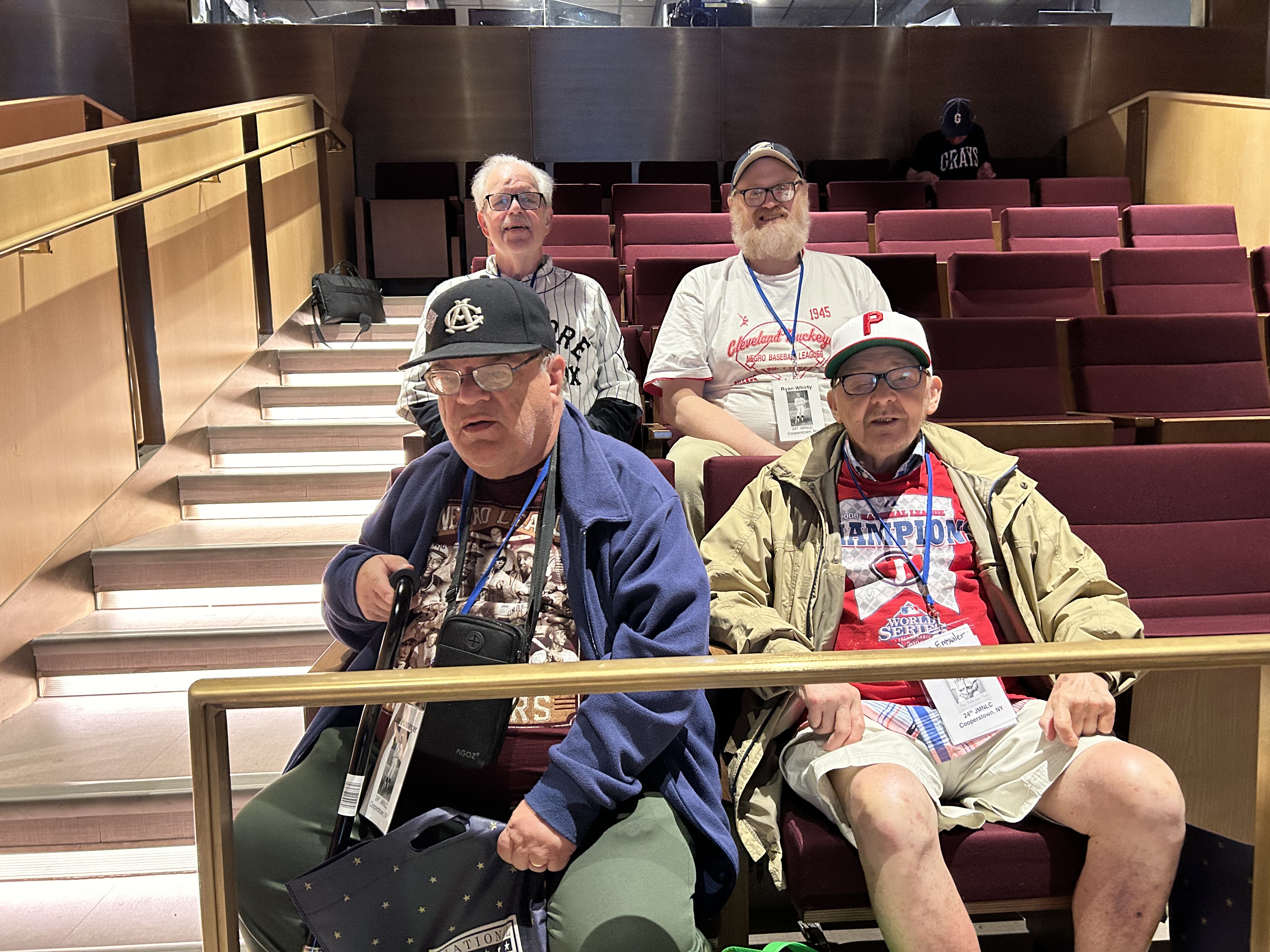
The Four Stooges of Lake View Motel, Room 2. Clockwise from top left: Ted Knorr, me, Bruce Emswiler and Lou Hunsinger. Photo by Phil Dixon.

I capped off my visit to Cooperstown on the morning of June 9, when I sat down for a short interview with Rodney Page. Several conference-goers – including me and my roommates Ted Knorr, Lou Hunsinger and Bruce Emswiler, as well as Rodney and friend and fellow perennial Malloy attendee Al Davis – stayed at the Lake View Motel, located along Otsego Lake a few miles north of Cooperstown proper.

On Sunday, I quizzed Rodney about his thoughts of this year’s conference, what he got out of all the events during the Malloy, and how it relates to his father, Allen Page, and Rodney’s own passion for the Negro Leagues.

He said the conference was his first-ever trip to Cooperstown and the Hall of Fame, and he said he definitely wasn’t disappointed and that the setting hit him on a personal level and that he felt a poignant connection to the Hall and to the sport of baseball via his father.

“It’s important to honor the soul of the game,” he said of the Hall. “We need to respect the participation of the individuals of the Negro Leagues and the respect the soul of the Negro Leagues.”

Regarding one of the conference presentations in particular, Rodney said he was thrilled that J.B. Martin IV attended the conference and gave a presentation about Martin’s great grandfather. He said his father, Allen Page, and the senior Martin were close business associates, adding that he was grateful to have known Martin Sr. through Allen Page.

“It was amazing to have been in his presence, and to hear his name so much,” Rodney said.

He added that the entrepreneurial spirit, determination and courage on the part of Allen Page and the Martins to survive and thrive in a segregated society was astounding and inspiring.

“All of the Martins and what they represented, for them to be so successful during Jim Crow, and facing the challenges for a Black man and a Black owned business …,” he pondered. “Think about what that represents, what it means.”

Regarding Allen Page, Rodney noted that his father owned multiple successful hotels, and he also gave a great deal of his time and money to help his community and the people in it. Allen paid folks’ hospital bills, for example, one of many ways Allen used his resources to assist others, efforts that earned him a famous (at least in New Orleans) nickname: “The Mayor of Dryades Street.”
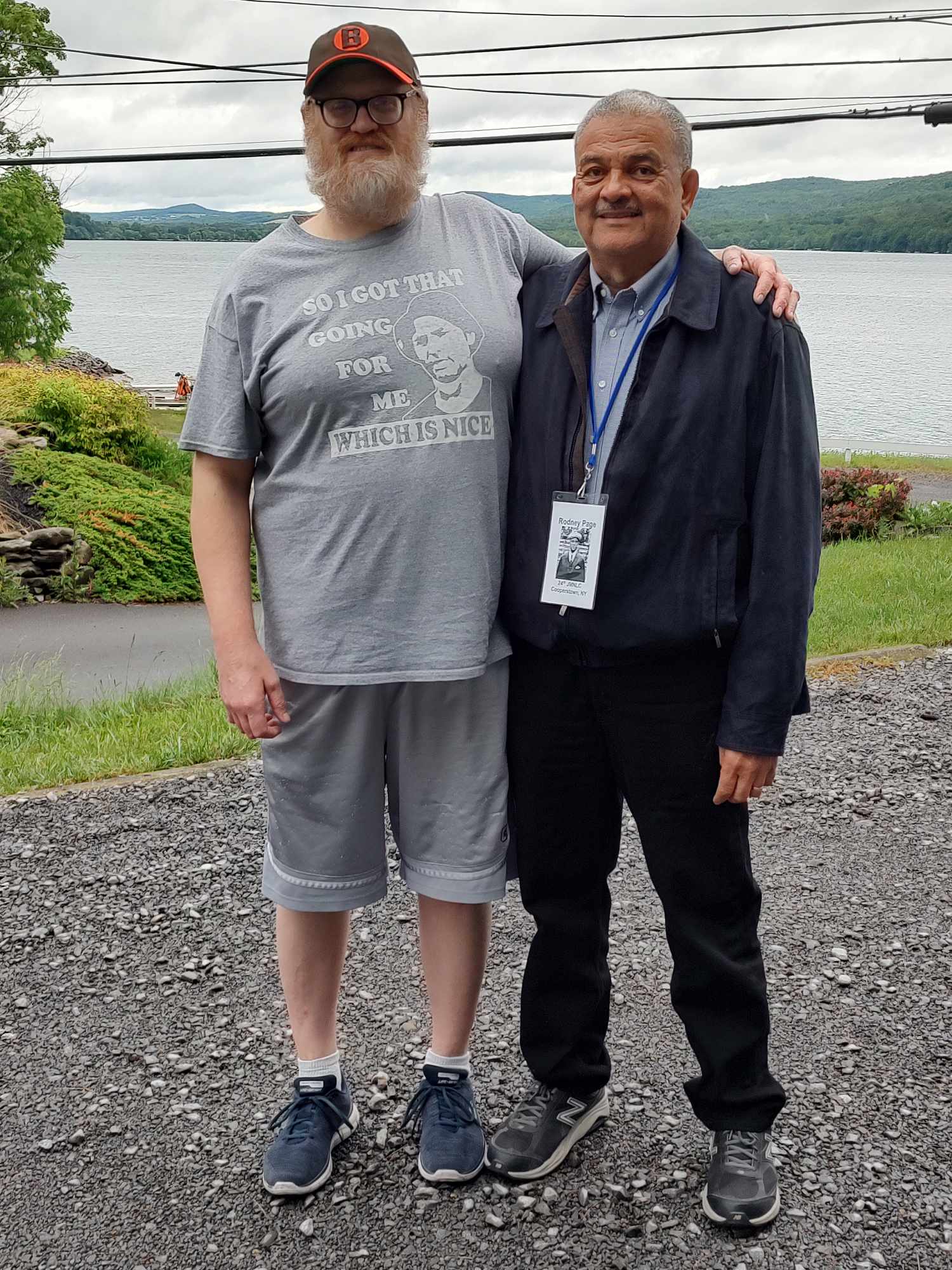
Rodney and I. Photo by Alfred Davis.

“He helped a lot of people,” Rodney said. “That’s just the type of man he was. He was for the community, and for the people.”

Now that he’s retired, Rodney said he can focus more of his time on honoring his father’s legacy, spreading the word of what Allen – and his managers and players and business associates – was able to accomplish, and on delving even deeper into his father’s life. That includes hiring a professional genealogist to dig up more of the Page family tree and learn about where his father and the rest of his family came from and overcame.

Rodney added that he wishes more of the public would know about the Negro Leagues history of New Orleans, especially the contributions and impact of his father. He said he is amazed that knowledge of Black baseball in New Orleans still lags behind that of other cities, in the South and beyond.

That goes for the legacy of his father.

“It’s amazing that he’s forgotten, [despite] all he did for the city, and for the people of this city,” Rodney said.

To remedy that situation, Rodney simply wants to show people the greatness of his father and of Black baseball in the city.

“I just want to tell the truth about [his father’s legacy],” he said, “to tell the story.”

Rodney said that his father – like so many Negro Leagues legends – refused to buckle in the face of the immense challenges thrown at him by a bigoted, segregated and unjust society. Allen Page was a fighter, Rodney said, one who never, ever gave up.

“You can choose to be a victim, or you can choose to be a victor,” Rodney said, adding that seeing how African Americans like Allen fought back infused him with his father’s same unbending spirit.

“That’s what inspires me,” he said. 

He added, with words that could apply not just to his father but to all of Black baseball:

“It’s a story of transcendence. To come from nothing and to persevere and transcend [Jim Crow], that’s the story. That’s his story.”

Epilogue: This article highlights only a fraction of all the good goings-on from the 2024 Malloy Conference, and encourage readers to read other articles, posts and other accounts from the week (such as here, here and here) as well as check out SABR’s official Negro Leagues Committee page!
Negro League stats added to official MLB record

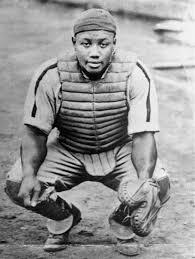
Josh Gibson

So close, and yet still so far.

That’s the thought that has kept floating through my head since the recent news that Major League Baseball had finally merged statistics from several top-level Negro Leagues with the existing numbers for Organized Baseball that, at the time those Black leagues operated, was strictly racially segregated.

The integration, pardon the expression, of Negro Leagues statistics into the official MLB record books has finally and rightfully formally placed the segregation-era accomplishments of men like Oscar Charleston, Satchel Paige, Buck Leonard and many other excellent athletes alongside all-time white greats like Lou Gehrig, Nap Lajoie, Ted Williams and, of course, the most famous baseball player of all time, Babe Ruth.

But the biggest headlines were reserved for the most breathtaking change of all – legendary Black slugger Josh Gibson is now the career batting leader, eclipsing the immortal Ty Cobb. (More info and varied commentary on the big news can be found here, here and here.)

The merging of statistics was a long time coming – decades and decades – and took many years of dedicated hard work on the part of several Negro Leagues researchers, who combed old newspaper archives and other historical sources to compile numbers and data that meet the rigorous standards of excellence that were required of them, and that they demanded of themselves. (For articles on that process, check out this, this and this.)

The combining of data represents another step toward righting the racist wrongs that were inflicted on our national pastime – and the players, managers, executives and owners of color who were shut out of Organized Baseball for six decades – by segregation.

Progress toward achieving true racial and social justice in baseball history have been periodic and ongoing for well more than a half-century; the highest-profile of these advancements has been the gradual and (hopefully) ongoing process of inducting deserving Negro Leagues figures into the National Baseball Hall of Fame. (For background on that HOF induction effort, go to this, this and this.)

Naturally, accompanying those steady, periodic advancements has been criticism and reluctance to fully and justly honor Negro Leaguers, beginning with stubborn resistance to inducting pre-integration African-American greats into the NBHOF.

Such recalcitrance and skepticism has ranged from outright, ugly, naked bigotry to more subtle, fairly well argued points, most prominently the criticism that the Negro Leagues simply couldn’t measure up to the quality of play and voluminous of statistics that already existed for Organized, i.e. white, baseball.

Those concerns about whether the Negro Leagues were worthy equals to the Major Leagues generally boil down to two lines of thought, in my opinion:

One, that the shortage of official records and the limited amount of formal “league” games just hasn’t produced enough Negro Leagues data to merit equal comparison to the record or Organized Baseball.

And two, that the Black leagues simply weren’t as good as the white leagues and therefore cannot be compared to Organized Baseball. The argument goes that Satchel Paige didn’t have to pitch to Joe DiMaggio or Jimmie Foxx, and that Cool Papa Bell and Willie Wells didn’t have to face Walter Johnson or Grover Alexander.

The first line of questioning, in my mind, is certainly valid. I disagree with the criticism, but in a sport that depends on statistical analysis and numerical precision, I definitely understand the argument about an inadequate sample size.

My primary response to that argument is that, while there certainly are a fair amount less of Negro Leagues statistics compared to Organized Baseball, we need to remember why that is – because of a tragic, sad situation that occurred through absolute no fault of the Black players’ own. There are fewer numbers because of bigoted segregation that was forced on Black society. Despite the significant challenges institutional racism presented for African Americans, Black baseball did the absolute best it could given the situation. Moreover, why should we continue to punish these men and minimize their greatness for something that wasn’t their fault? To continue to do so is patently unfair and unjust.

The second track of criticism against bringing the Negro Leagues its rightful due and equality – that the Black leagues simply weren’t as good as the white organizations – is at best ignorant and illogical, and at worst virulently racist and hateful.

If someone possesses such bitter, angry emotions, there’s not much any of us can say to change their minds. Someone who’s that hateful just doesn’t want to change.

But if one’s belief that the Negro Leagues just weren’t as good is more based in ignorance instead of outright racism, that’s something with which we can work, because even after decades of progress made in unearthing, evaluating and promoting the history and legacy of the Negro Leagues, it would be understandable if simply more people had heard of Ty Cobb and Babe Ruth than Josh Gibson or Buck Leonard. In that case, I encourage those who are willing to expand their horizons and knowledge to start by reading the work of Robert Peterson and John Holway, and proceed from there, because there’s a lot of awesome stuff writing about or covering the Negro Leagues.

Then, finally, we can argue for the Negro Leagues’ worthiness by just using logic – it might be true Black players didn’t play the best possible competition pre-1947, but if so, that also means that neither did the white players. To cite an oft-quoted comment from writer, journalist and author Ken Rosenthal:

“If you want to argue that Josh Gibson didn’t face the best competition, well, neither did Babe Ruth.”

But even if we as advocates for the Negro Leagues can continue to crusade for and research segregation-era Black baseball, that quote by Rosenthal raises a whole different concern, one that unfortunately continues to weight heavily on the pursuit of true fairness and equality and one that, sadly, might never be completely or even adequately resolved.

Because if neither the Black leagues nor white leagues of pre-1947 baseball featured the best possible competition because each structure omitted one whole demographic, wouldn’t that naturally de-legitimize both types of leagues and garner each set of statistics and other quality-centric evaluation huge, eternal asterisks?

This could lead us to one painful conclusion – that, in a way, it’s pointless to truly examine and evaluate any pre-1947 baseball, and that those segregated decades are forever simply lost and wasted for everyone. We may be able to evaluate and study history in different, ever-evolving ways, but we can’t change it.

Such a realization is truly saddening, and truly frustrating. It seems to imply that no matter what anyone does, no matter how much work we do, no matter how committed we are to achieving fairness and justice, we’ll never completely achieve such goals.

The notion that the greatness of Cy Young and Joe Williams and Pop Lloyd and Tris Speaker and hundreds of others just, in a way, doesn’t matter, at least when it comes to accurate evaluation of their accomplishments and greatness feels like a knife in the heart for all baseball fans. To even consider the idea that the work of all those players, well, that it doesn’t fundamentally matter, has me fighting back tears writing this.

Because of the stupidity and bigotry and limitations of our ancestors, the wrongs of history will never be truly resolved, and that the chasm we face toward achieving  justice and equity will never, ever, be completely bridged. The damage, as they say, is done.

And guess what? That’s not just the case in baseball, either. Baseball springs forth from and embodies our larger American society as a whole, and, as a result, those 60-odd lost years of our national pastime that forever taint the sport that we embrace as our American game symbolizes the 500 years our land has been scarred by bigotry and hate and oppression.

Just as the sport of baseball can never truly be reconciled with our ideals, then that half-millennium has likewise caused lingering and irreparable damage to American society as a whole.

How can we, as a people and as a nation, ever hope to fully compensate and address the centuries of slavery, genocide, segregation and violence that mar our history? Have we simply dug ourselves too big a hole to ever climb out of? Is true societal equity and justice ever even possible, or, well, is the damage already done?

I’ll admit that I am an eternal pessimist and cynic. I fully acknowledge that I usually view life with shit-covered glasses, and that I always expect the worst out of humanity. That’s a weakness of mine, and I continue to battle against it.

And maybe I’m wrong, or at least that I worry way, way too much, about the status and future of our society. Maybe I’m underestimating us and our ability to make lasting, equitable change. I sure hope I am.

And where hope exists, the chance of something better persists. We cannot stop striving, and that includes achieving fairness and justice in our national pastime and its long, imperfect, stained and steller history. We owe that to all the great Negro Leaguers, and we owe it to all those white players who were likewise robbed of an opportunity to compete against the best.

We owe it to all those who came before us to do our best by digging deep down and finding our better selves. We owe it to ourselves as researchers, writers and fans.

Tragic lives in new Grave Marker Project efforts

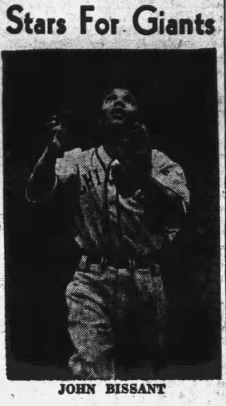
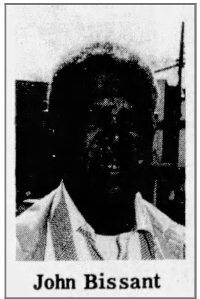
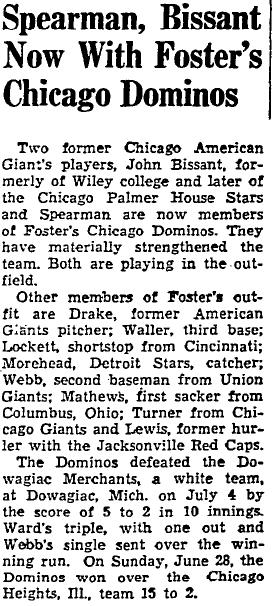
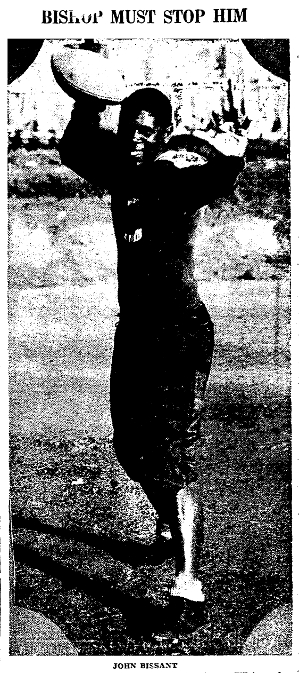
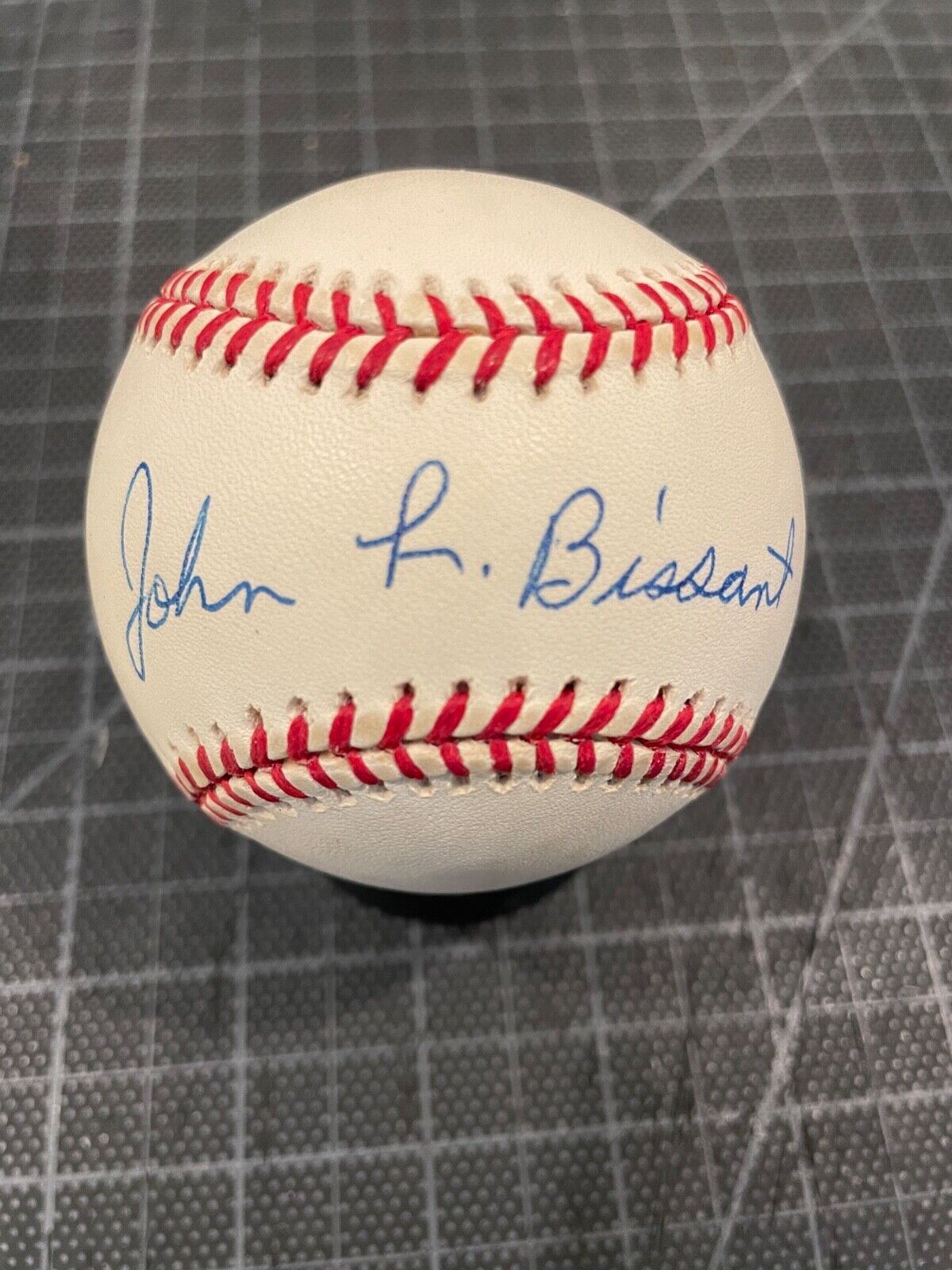
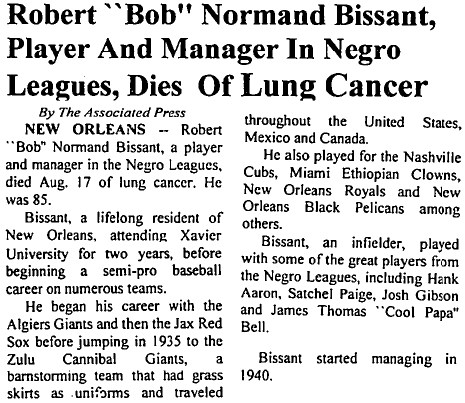
I recently chatted with Jeremy Krock, the founder of the Negro League Baseball Grave Marker Project to see what projects the NLBGMP has in the pipeline. I also wanted to ask him about the possibility of the NLBGMP working toward getting markers placed at the graves of a couple players here in New Orleans — particularly John Bissant and Lloyd “Ducky” Davenport, both of whom I’ve discussed fairly frequently on this blog, such as posts here, here and here.

Cannonball Jackson (photo courtesy of Peter Gorton)

And, as it turns out, both subjects had connections to one of the top touring teams in the 1920s, and they both died tragic, early deaths, demises that underscore the sadness surrounding their anonymity when they were buried.

One of the efforts on which the Marker Project has focused is that for George Jess “Cannonball” Jackson, one of the great African-American pitchers in the Midwest in the 1920s. Jackson, who was born around 1891, pitched for Gilkerson’s Union Giants, a largely barnstorming team based in Spring Valley, Ill., in the 1910s and ’20s. He also suited up for other teams in the Midwest — including the All-Nations, a professional barnstorming team whose lineup included Black, white, Native-American, Japanese, Hawaiian and Latino players; Brown’s Tennessee Rats, a barnstorming team based in, ironically, Missouri; and the Minneapolis-St. Paul Gophers — and ended up in Dubuque, Iowa, where he pitched against the Dubuque White Sox, among other clubs.

Unfortunately and sadly, Dubuque is where the Cannonball Jackson story ends. On Dec. 14, 1924, Jackson was struck on his head with a blunt instrument by an acquaintance, a blow that fractured his skull. He staggered to the boarding house in which he was staying. According to news reports, Jackson arrived at the home in “a dazed condition,” and when he didn’t regain consciousness the next morning, Jackson was taken to a local hospital where he died early on Dec. 16. He was subsequently buried in an unmarked grave in Dubuque’s Linwood Cemetery. He was 32 or 33 years old.

After less than a week of police investigation into the crime, a man named Frank Johnson confessed to the crime with a charge of manslaughter and was quickly sentenced to eight years at the state penitentiary at Fort Madison.

All of this took place in less than two weeks, which, compared to today’s criminal justice system, represents lightning speed and really takes the Sixth Amendment right to a speedy trial seriously.

Krock contributed an entry on the Web site Find A Grave for Jackson that reads:

“Legendary pitcher in [B]lack [s]emi-pro/barnstorming baseball. Played for Tennessee Rats, All-Nations, Gilkerson’s Union Giants, Minneapolis Gophers. Killed by skull fracture inflicted by an acquaintance in Dubuque.”

However, not much is known beyond his tragic demise. His Iowa death certificate, for example, features several lines filled out with “don’t know” or left blank; such designations are shown for his marital status, date of birth, names of father and mother, and birthplace.

Jackson’s death certificate

Even when lines are filled out, the mysteriousness of Jackson’s life are reflected. The line for residence says “Floater,” which probably indicates that he was a drifter with no fixed home and a clouded backstory. His occupation is stated as “baseball player and laborer,” while space for the informant’s name shows “stranger.” Cause of death is stated as “skull fracture (hit over head with a club,” with “hemorrhage” as a secondary cause.

(I want to note that George “Cannonball” Jackson shouldn’t be confused with Bill “Cannonball” Jackman, an African-American pitcher who freelanced for several teams and gained fame, especially in the Northeast, particularly New England, in the 1920s and into the ’40s.)

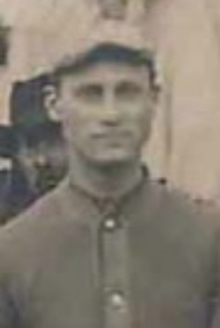
Another project on the burner for the NLBGMP is a stone for the grave of the owner and manager Gilkerson’s Union Giants, Robert Gilkerson. Gilkerson played the keystone sack for several teams in the first two decades of the 20th century before taking the helm of his eponymous barnstorming, semipro club, which was originally based in Chicago.

A December 1936 article in the Kansas City Call, a prominent African-American newspaper, “Gilkerson has been identified with the national pastime since 1903. … he showed a lover for the game and developed into one of the best second basemen in that section [western Pennsylvania].”

The paper reported that he joined the Smoky City Giants, a Pittsburgh-based team founded by none other than newly minted National Baseball Hall of Famer Bud Fowler, in 1904, then eventually joined the Leland Giants, owned and managed in Chicago by another Black baseball legend, Rube Foster, and Gilkerson then hooked up with the traveling Union Giants, operated by W.S. Peters. Gilkerson played for the Union Giants for several years before buying the team in 1917 and eventually moving it to Spring Valley, Ill., where it thrived as a traveling team into the 1930s.

Robert Gilkerson

The Call article also included some comments from Gilkerson himself about the current state of the American pastime at the time, and his words help illuminate Gilkerson’s personality and beliefs. He commented:

“The dry spell this summer throughout the nation [presumably the Great Depression] put a big dent in the popularity of baseball. However, I believe the game is come back into its own. Baseball leagues will go a long way in reviving the sport. Although we are a traveling club, having played in 38 states at various times during the last 20 years, still I believe in organized baseball.”

In the article, Gilkerson also plays the curmudgeon when discussing what he viewed as the state of the national pastime:

“[T]here isn’t the same fight in these fellows today as there used to be. There is too much handshaking, too much socializing. When the old guys used to take the field against each other, there was blood in their eyes and murder in their hearts. They went in there to battle to the last ditch. Then again money was not emphasized so much in those days as it is now among the younger players. Still this generation of players has a world of possibilities and I hope to live to see the day when Negro ball players once more reach they had when the immortal Rube Foster was in his heyday.”

Gilkerson, who was born in Newtown, Va., in 1886, was apparently held in high esteem where he and his team ventured. Wrote Joe Ryan, for example, the sports columnist for the Sioux City (Iowa) Journal newspaper in July 1929:

“One of the most interesting men in semi-professional baseball is Robert Gilkerson, owner of Gilkerson’s Union Giants, who will play a two-game series against the Stock Yards club [a local team], starting today. For more than 20 years ‘Gil,’ as he is called, has been touring this section with [N]egro baseball clubs and all of them have been good. He always manages to get together a great bunch of baseball players. They take their opponents as they come, asking no favors from anybody, and when the season ends you usually find that they have won about 90 per cent [sic] of their games.”

Curiously enough, “Gilky” also operated a barnstorming basketball team under the Gilkerson’s Union Giants moniker. According to the Chicago Defender in April 1931, Gilkerson’s hoopsters had compiled a record of 66-14 so far that season, including a winning streak of 38 games. The following year, in March 1932, the Quad-City Times of Davenport, Iowa, asserted that the Union Giants were “claiming the colored basketball title of the country” and added that “[f]or the two games played in this city by Gilkerson’s quint the Turner gym was packed and they have been one of the most popular teams to appear here this year.”

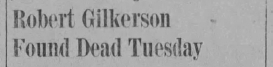
Sadly, much like Cannonball Jackson, Bob Gilkerson suffered a tragic fate — although Jackson was murdered, Gilkerson committed suicide.

Bureau County Democrat, March 24, 1944

Gilkerson was found dead on the floor of the kitchen in his house in mid-morning on March 21, 1944, by a neighbor. Gilkerson had apparently shot himself in the head with a .38-caliber revolver. He was 58. The Bureau County Democrat newspaper of Spring Valley wrote, “‘Gil,’ as he was popularly known by a wide circle of friends here and throughout the base ball [sic] world, was one of the pioneers in the barnstorming business.”

Gilkerson was buried in an unmarked grave in at Miller Cemetery in Spring Valley.

(While Gilkerson’s suicide might have come as a shock to some, there might have been early indications that he suffered from some sort of mental illness, possibly undiagnosed — a Chicago Defender report from January 1922 stated that Gilkerson was a patient at a hospital under the care of the family physician, “being treated for a nervous breakdown.” The Bureau County Democrat article from March 1944 claimed that at the time of Gilkerson’s death, he “had been in poor health” and had a neighbor helping to care for and assist him at home.” Other media reports asserted that Gilkerson might have been worried about finances, according to Gil’s attorney, but added that Gilkerson had recently been relieved by positive developments related to money.)

Shifting topics a little bit, I also asked Jeremy about the possibility of the Project working on markers for one or more New Orleanian baseball greats like Bissant and Davenport. Jeremy said such efforts on the part of the NLBGMP would certainly be a possibility.

However, he noted that as with most of the Project’s beneficiaries, the owners/administrators of the cemeteries involved in the targeted graves — in both the cases of Bissant (Carrollton Cemetery No. 1) and Davenport (Holt Cemetery, a potter’s field), that would be the city of New Orleans itself — would need to give permission and/or lay down rules and guidelines for the NLBGMP to follow with the installation of markers.

Jeremy also noted that, obviously, the surviving family members/loved ones would need to be on board as well. In John Bissant’s case, his family are definitely on board, but Davenport’s family situation is a bit murkier at this point. But we shall see. …

Creole Pete, the sequel

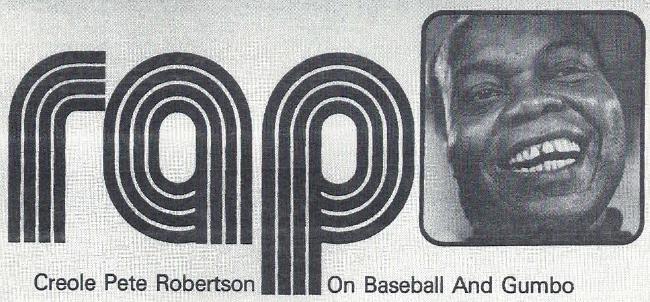
From Black Sports Magazine in 1974

Editor’s note: Here’s another slice of prime Creole Pete Robertson, following the first entry here. For this one, we jump ahead some to Pete’s arrival in New York City following his move in the 1930s from the Big Easy to the Big Apple, where he eventually established himself as a vital and vibrant part of the African-American community by bringing his passion for N’Awlins food to the denizens of NYC.

This is taken from my lengthy essay about Pete that I started more than a couple years ago. I apologize for kind of jumping around within the narrative and shifting between time periods from one post to the next. Because this project has dragged out a good deal, I want to publish what I can now.

But first, a few paragraphs about Robertson’s extremely tight friendship with another New Orleans native son who eventually also settled in New York City and made a global name for himself: None other than Satchmo himself.

Pete Robertson (left) and Louis Armstrong with a fan backstage after a concert. (Photo courtesy Ricky Riccardi and the Louis Armstrong House and Museum.)

One final, New Orleans-themed note about Creole Pete: Robertson was extremely close with the Big Easy’s favorite son, none other than Louis Armstrong. By many accounts, Satchmo and Robertson were as tight as siblings; in fact, Pete frequently called Louis his “brother.” The Louis Armstrong House in Queens includes about a dozen archived materials involving Robertson, including pictures, a telegram, articles and a Christmas card.

When Armstrong died in July 1971, the Amsterdam News asked Robertson for his reaction.

“He was just like my brother,” Pete said. “I lost a part of me when Louis Armstrong died.”

The Amsterdam News’ Les Matthews described the scene at Satchmo’s funeral in Flushing Cemetery after the service.

“‘Creole Pete’ Robertson, a lifelong friend whom many thought was Armstrong’s brother did not want to leave the Flushing [C]emetery,” Matthews wrote. “There was a strong bond between the two men.”

A quirky anecdote illustrating the NOLA-born connection between Pete and Satchmo, courtesy of a 1955 Jet column about one of Louis’ concerts:

“At his opening at Broadway’s Basin Street, Louis Armstrong spied two long tables of his native New Orleans cronies, hosted by Al Cobette and Pete Robertson, [and] quipped, ‘There’s a lot of gumbo eaters here tonight.'”

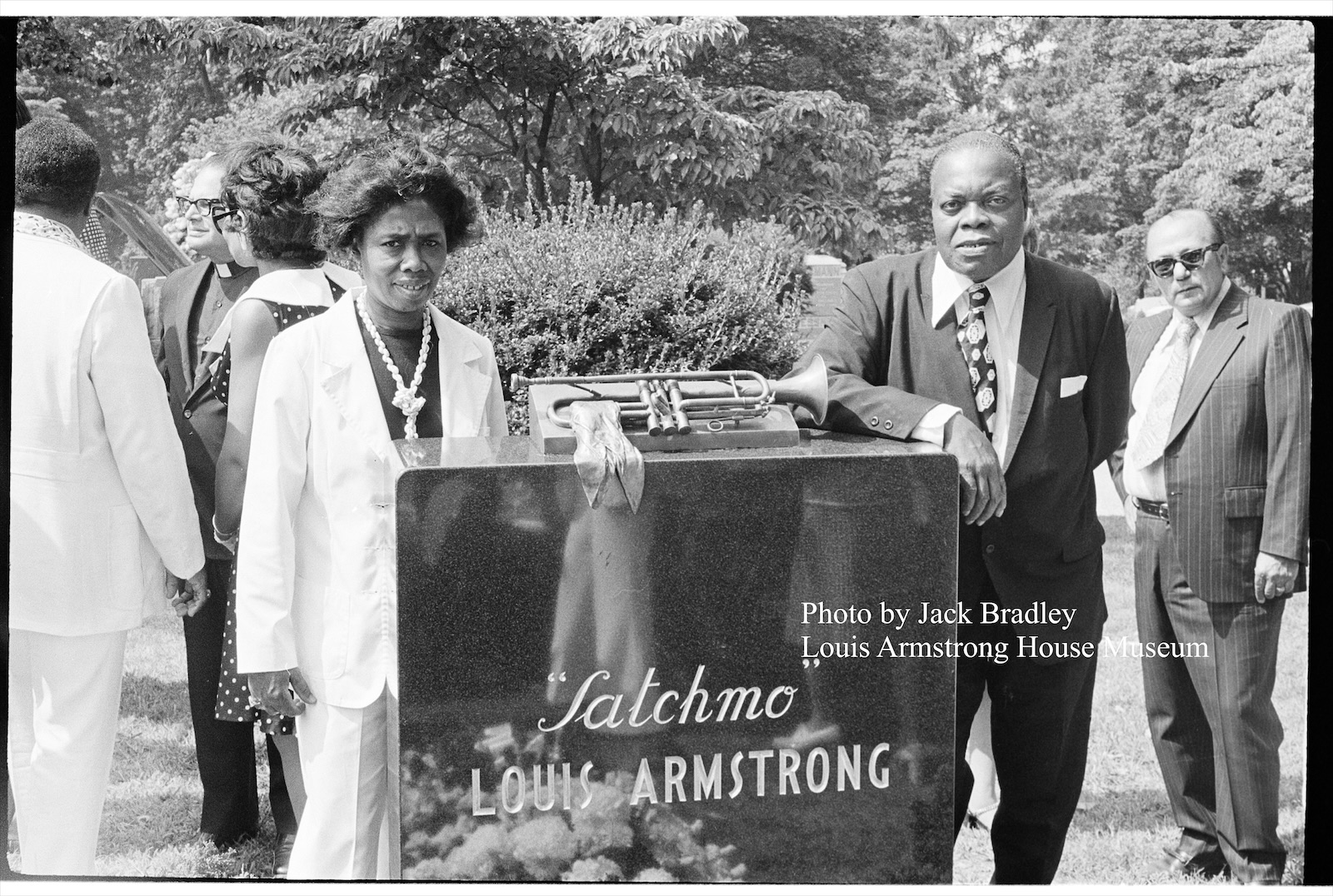
Robertson with his wife at Armstrong’s grave. (Photo courtesy Ricky Riccardi and the Louis Armstrong House and Museum.)

I’ve been in touch with Ricky Riccardi, director of research collections at the Louis Armstrong House and Museum, to get perhaps a deeper appreciation for Creole Pete’s relationship with Satchmo. Riccardi is one the preeminent modern scholars, researchers and writers regarding Armstrong; his incredibly comprehensive new biography of Louis, having published two biographies of Armstrong, including 2020’s “Heart Full of Rhythm: The Big Band Years of Louis Armstrong.” Riccardi also earned a Grammy for his liner notes for the Mosaic label album, “Complete Louis Armstrong Columbia and RCA Victor Studio Sessions 1946-1966.”

Ricky graciously wrote up a short essay about the relationship between Robertson and Armstrong for this blog; here’s a few excerpts from the article by Ricky, to whom I extend my heartfelt thanks for all his assistance and input about Creole Pete:

Born in Mississippi in 1905, Robertson spent part of his youth in New Orleans, where it’s possible he first met Armstrong; they certainly looked alike to enough to sometimes be mistaken for brothers!
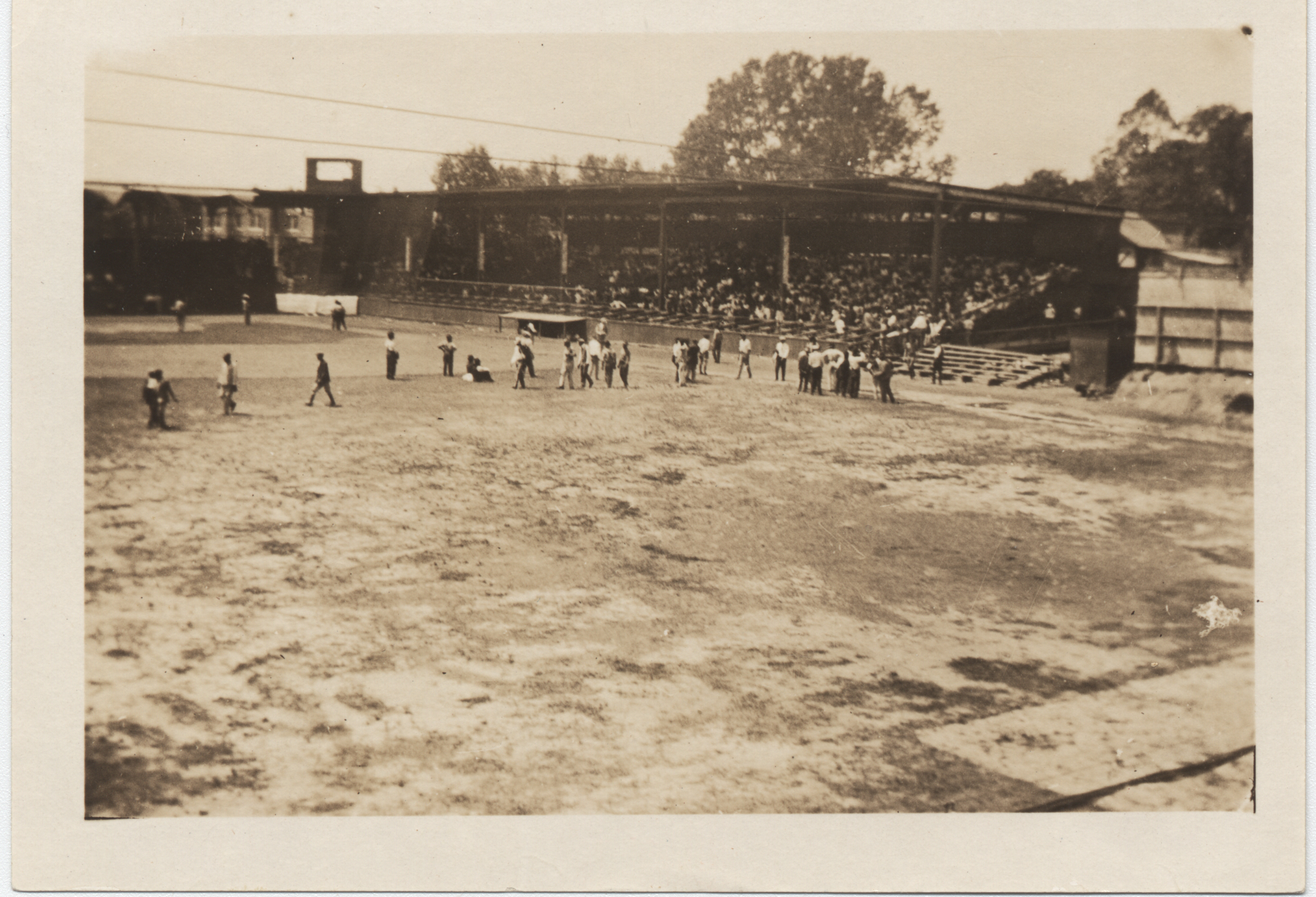
Robertson spent time in the Negro Leagues, where he was catcher to the legendary pitcher Satchel Paige, but he made his most lasting impact on the citizens of Harlem with the opening of Creole Pete’s at 2700 7th Avenue in 1938. Armstrong almost immediately became a regular; Creole Pete’s remained his venue of choice in New  York City when he craved a taste of home.

More importantly, Creole Pete himself became a friend. Digging through the Louis Armstrong Archives, one finds photos of Creole Pete backstage with Louis throughout the 1950s and 1960s, at venues such as Freedomland in the Bronx; one photo of Robertson even turned up in one of Armstrong’s collages; There are telegrams and Christmas cards from Creole Pete and his family. Even after Louis’s passing, Creole Pete remained in his orbit, invited to Louis’s widow Lucille to the dedication of Louis’s headstone in 1973 and to participate in a New Orleans Jazz and Food Festival at the Rainbow Room that same year.

Though he remained — and remains — far from a household name, these archival treasures illustrate a close bond between Armstrong and Robertson that lasted several decades, a testament to their friendship and the power of good home cooking that often brought them together.

— Ricky Riccardi

For more of Riccardi’s article to me, see the quotes section below, because he relates quite a tale about Louis and Pete. Again, many thanks to Ricky and the Armstrong House for the contributions, including the incredible photos!

The bond remained strong throughout Pete’s and Satchmo’s lives, both in their hometown town down South and when they each relocated to the Big Apple. For a little info on Louis’ life in NOLA, check out this piece, but when it came to the second chapter of Robertson’s life — that of his time in New York — we start in the late 1930s, when he moved to New York.

(According to George Palmer of the Amsterdam News, Robertson moved to New York City on the oddly specific date of Aug. 2, 1938 and opened the restaurant in 1943.)

While living in the Empire State, Robertson’s life continued to be a hurlyburly of money, influence and even a little intrigue. Before he opened his famous restaurant, Robertson operated an illicit “after hours” club in Harlem, but he decided to get out of that fast lane because New York cops began squeezing him for bribes.

But once he got his cafe up and running, he and his Creole joint quickly became staples of Harlem society and nightlife. For almost two decades, Pete boasted a lavish down-home Louisiana menu and a massive, star-studded clientele. (According to an Aug. 6, 1975, article by George Palmer in the Amsterdam News, Robertson’s famous nickname, “Creole,” was coined by actor and entertainer Nipsey Russell, who frequented Pete’s gumbo joint.)

“I looked all over Harlem trying to find a good spot and a safe spot,” Robertson said in a 1974 interview with Black Sports Magazine. “Finally I found a location on Seventh Avenue and that’s when I opened up Pete’s Creole Restaurant. Boy! That was home for all the celebrities — Sugar Ray Robinson, Joe Louis, Phil Rizzuto of the New York Yankees, Bob Feller, Satchel Paige, they all used to be there.

“I was open 24 hours and business was terrific every night,” he added. “I did my best business between 2 a.m. and 9 a.m. Everybody in show business used to come to Creole Pete’s Restaurant when they got off work. A lot of people used to come just to see the celebrities.”

He then added: “Well, when I first came to New York, they didn’t have a real first-class restaurant in Harlem. Being from the South, I believed in eating, and eating good. Most New Yorkers were from the South and they loved that soul food. But my number one special was Creole food, because I was from New Orleans.”

The menu included (in Pete’s own words), “Louisiana Creole gumbo, Creole shrimps [sic], Creole Chicken, Creole pork chops, hot sausage Creole style … and Louisiana Creole gumbo.” He called Creole dishes “the greatest of foods,” and, he added not so modestly, “I consider myself the No. 1 person in making it.”

Pete even bragged that his gumbo would fix up a hangover better than Pepto Bismol.

Pete Robertson. (Photo courtesy Ricky Riccardi and the Louis Armstrong House and Museum.)

“If you’re a person that drinks and you have a tendency to get a little sick from drinking, you can always eat that Louisiana Creole gumbo and it’ll always straighten you out,” he said. “It has so many different vitamins in it and so many different sauces, herbs and spices that it’ll sober you right up.”

Pete’s cuisine digs gained some mention in Jet magazine in 1952, when the publication, under its “New York Beat” section, noted that Robertson “spent more than $20,000 in redecorating his House of Gumbo Cafe, then sent to his native New Orleans and imported a chef and ten creole [sic] beauties as waitresses. Five of them made over $150 in tips alone the first week.”

One of the earliest, and most effusively comprehensive, articles about Pete’s still-new restaurant was the December 1994 “Harlem Night Life” column by Wally Warner in the New York Age.

In the column, Warner cites Curley Carter, a chef imported from New Orleans who was responsible for creating and cooking up the joint’s already-famous gumbo.

“If you took his kitchen away from [him],” Warner wrote of Carter, “he’d probably want to die. Curley has been cooking for over thirty years. His English isn’t very articulate to describe his artistry of food. He welcomes you into the kitchen to sample his sauces and other dishes. They taste very good, so you ask him the secret to his culinary genius, but with so many continental terms to unmask – he just smiles and say [sic], ‘That’s the way I always do it. His own favorite dish is craw fish [sic] bisque, creole [sic] style, with candied yams, string beans and sauce.”

From the 1940 U.S. Census, tallying residents from Queens, New York, where Pete lived on 106th Street.

According to Warner, another Pete’s staple was seafood, and lots of it, including “[o]ysters, clams on half shell, deviled crabs, shrimps [sic], Spanish mackerel, weakfish, sea bass [and] filet of sole.”

The bottom line, Warner wrote, was that Creole Pete’s digs were all about no-frills, unpretentious, downhome charm.

“The price is fitted to your purse,” the columnist enthused. “Don’t go to Pete’s looking for glittering trimmings; the restaurant is undecorated except for a few still lifes of celebrities on the wall. The atmosphere is restful and the service is deft; this reflects the reason why Pete’s is one of the busiest restaurants in Harlem, satisfying the discriminating appetites of celebrities, professional people and the average John Q. Public …”

In 1954, Daily News lifestyle columnist Robert Sylvester reported on Robertson’s business, with special emphasis on Pete’s Creole stew concoction.

“You get a big dish of gumbo for exactly $1 and you can also get wonderful barbecue ribs,” Sylvester wrote. “… I promise you it’s a big bit for a single buck.”

The coverage in the Daily News was significant — it showed just how popular Pete’s joint had become that word of the restaurant had crossed over into the mainstream press. In fact, Sylvester and the Daily News again hyped up Robertson and his Creole chow in 1958, when the scribe reported on a party given by famed jazz trombonist Tyree Glenn at Glenn’s home in New Jersey for radio personality Jack Sterling. The wang dang doodle was catered by none other than Robertson, and Sylvester lauded Pete for the latter’s two career aptitudes.

“The other night [Glenn] gave a party for Jack, and since he wanted to do something special for Jack and his CBS crew, Ty dug up Creole Pete Robertson,” Sylvester penned. “Pete has two distinctions. He was Satchel Paige’s first catcher and he can make a New Orleans gumbo which is enough to make you wake up in the night screaming for more.

“If you’ve never eaten gumbo,” Sylvester added, “you haven’t really lived. It’s got rice and ham and chicken and a hundred strange spices and a broth, and right in the middle of every portion is a small cooked crab. Man, it is pure heaven.”

Pete with Lucille Armstrong, Louis’ wife. (Photo courtesy of Ricky Riccardi and the Louis Armstrong House and Museum.)

In February 1947, the restaurant even garnered a few words on the Daily News sports page, where legendary sports editor scribe Jimmy Powers — who was a steady, vocal proponent of integration in baseball for much of his storied career — sang the joint’s praises.

“Peter Robertson, retired ball player, now has one of Harlem’s best eating establishments, specializing in Louisiana gumbo,” Powers wrote.

(Pete also brought the same savvy he employed as a baseball magnate to his restaurant business, and he wasn’t above trying to butter up the local media for some free advertising, so to speak. In May 1952, he hosted local journalists for a lavish Creole feast, prompting the New York Age’s Edward Murrain to claim that the members of the press were “still panting from the effects of the wonderful food ‘Creole’ Pete Robertson put on for the fourth estate at the opening of his renovated restaurant …”)

Robertson wasn’t just a Creole culinary master and businessman supreme while he was in NYC. During his time as a bigwig in Harlem life, Robertson took on a slew of challenges, including briefly running for the informal title of “Mayor of Harlem” in 1948. (More on this below.)

Another sign of the esteem in which Robertson was help among the folks of Harlem and New York City came in May 1964, while the New York City Council was discussing creating an all-civilian review board to conduct investigations into citizen’s complaints of police abuse, brutality and other instances of NYPD misconduct. The Amsterdam News’ James Booker and Les Matthews conducted “man-and-woman-on-the-street” interviews with local politicians and civic leaders, including Robertson.

“The creation of a civilian complaint board is a good thing,” Pete told the journalists. “An outsider can usually see better than someone that’s inside. The body must have the right people, however.”

In addition to his reputation as a restaurateur civic leader, Pete cut a dashing figure in Harlem thanks to his knack for fashion. Wally Warner of the New York Age noted that Robertson stood at five-foot-11 and tipped the scales at 185 pounds, with brown eyes and “large, muscular hands. … His taste in dress is both fussy and flamboyant, running from light gray suits and carefully matched sport ensembles; he favors double-breasted suits.”

Robertson also welcomed to his restaurant a galaxy of national stars and new and old friends from the worlds of music, sports and politics; chaired the Harlem Citizens’ Committee; founded the Harlem chapter of the Louisiana State Club; and provided catering services for charity events, such as the Amsterdam News Welfare Fund Midnight Show at the Apollo Theater.

(The 200-member Louisiana State Club, mentioned above, apparently was quite active in Harlem, working to bring a further taste of the Big Easy to those in the Big Apple. In 1953, for example, the club celebrated that most New Orleans of events, Mardi Gras, with a three-day ball that cost more than $6,700. Robertson, naturally, served as “King of the affair,” noted Jet magazine.)

In 1960, he founded and served as president of Creole Pete’s L&M Social Pleasure Club, reported the Amsterdam News, which stated that the “purposes [of the club] are precisely what the name implies. … It plans to promote good fellowship of New Yorkers who are natives of Louisiana and Mississippi, their families and friends. … The club does plan to aid civic and educational activities.”

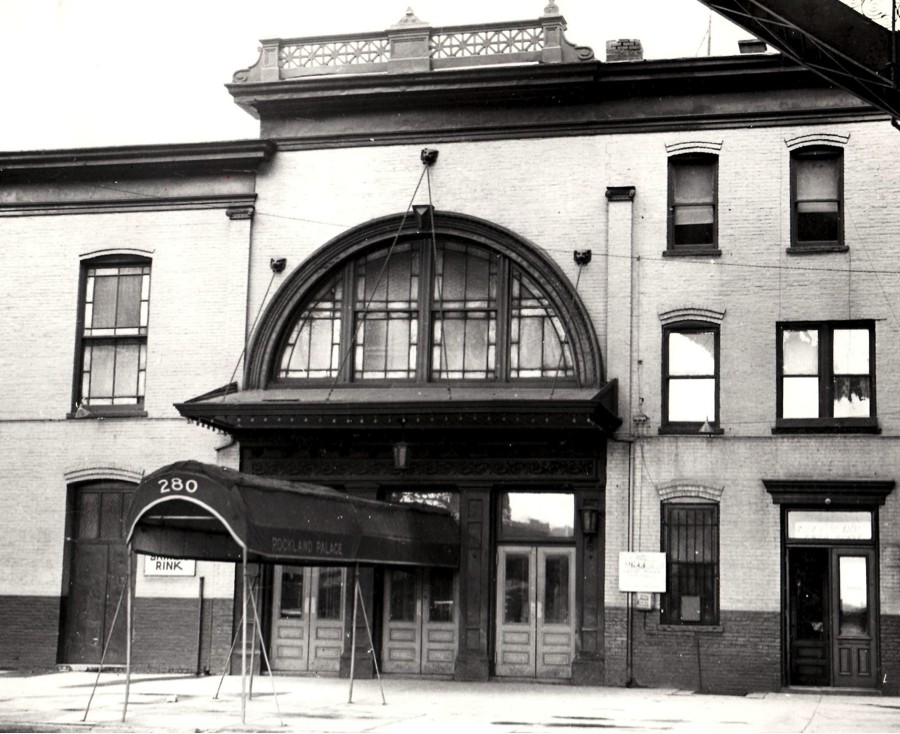
Creole Pete also liked boxing. Or rather, he liked watching and promoting it, a passion that led him to try to bring prime-time fights to Harlem’s Rockland Palace in the late 1940s. In November 1948, the New York Age reported that Robertson, “well known sportsman,” expected to open the venue to fights in January.

The Palace, it said, was the “scene of many historic ring battles,” including fisticuffs involving, among other pugilists, Jersey Joe Walcott, Elmer Ray, George Brothers, Panama Al Brown, Cocoa Kid (Herbert Lewis Hardwick), Kid Chocolate and Lorenzo Pack. According to the Age, Robertson had already booked Sugar Ray Robinson to open the boxing series. It’s unclear, however, if Robertson was successful in actually bringing matches to the Rockland Palace.

The Rockland Palace.

(The Rockland Palace is its own unique story. Founded by the Odd Fellows, over its decades and decades of existence, the venue welcomed an array of events, including concerts, political rallies, church sermons, sporting events and banquets. It housed the home court of the Harlem Yankees pro basketball team, and it was often a locus of LGBTQ social activities, including lavish drag balls.)

Even in the last phase of his life, Robertson helped lay the groundwork for something special in a third community. After selling his Harlem restaurant in 1955, Creole Pete eventually moved to the Nassau County community of Roosevelt on Long Island, and by the early 1970s he became a significant figure in his new home.

(An interesting note: according to issues of Jet in in the late 1950s/early 1960s, Pete had by then become a head chef-cook at a restaurant/cafe owned by ex-heavyweight boxing champ Jack Dempsey.)

Informal and unspoken patterns of segregation — such as housing red-lining, white flight and disproportionate government spending — led to Roosevelt developing into a majority African-American community where many middle-class Black New York City residents, such as the Robertsons, moved to after leaving the big city for the quieter confines of the suburbs. Despite a long history riddled with challenges to its educational system and a lack of representation in county government, Roosevelt blossomed into one of the Northeast’s most economically better off and culturally rich Black communities.

But Robertson’s family was also not immune to tragedy. Pete’s eldest son, Pete Jr., was murdered in 1979. Another son, Pablo, starred in basketball, eventually playing with the Harlem Globetrotters and blossoming into one of the flashy early stars of the famed Rucker Park community basketball courts. However, just 10 years after his father passed away and 11 years after his brother, Pablo died at the age of 46.

Pablo Robertson.

But even with the parade of stars as friends, the accolades for his tasty gumbo at his bustling restaurant, and his social and political influence, Robertson never lost the love of the national pastime that he nurtured in New Orleans.

He served on committees that planned and raised money for Jackie Robinson Day and Roy Campanella Day, which honored two of the earliest integraters of baseball and Brooklyn Dodgers stars, as well as a similar celebration for the New York GiantsMonte Irvin

In 1948, the Amsterdam News reported that Robertson was “rated the best baseball authority in Harlem,” and in 1950 the New York Age stated that Robertson was ecstatic “over his two kids who are big enough to dig baseball.”

Robertson’s vast knowledge of and passion for baseball led to him being one of several Harlemites interviewed by the Amsterdam News in 1949 about how Negro League Baseball could survive after all the Black game’s best players had been plucked by the Majors.

In his comments, Robertson said schools and other community institutions should start growing their amateur baseball programs, and he proffered that existing Negro League teams should enter “Organized Ball” as whole entities, which he theorized would help white America learn about Black baseball.

Ultimately, he said, the Negro Leagues still retained the potential to thrive.

“With proper handling, the [Negro] league could definitely be improved,” he said. “There is more interest in the game today than there was formerly and this is one of the main factors which would help the sport, which should have a place in the national sport picture. The Negro leagues [sic] cradled the boys who are in there now and gave them the chance to be seen.”

While he kept one eye on the Negro Leagues, Robertson also paid keen attention to what was happening in the Majors, which, by the 1950s, had drawn many African-Americans’ attention away from Black ball.

In June 1951, Jack Dalton of the New York Age talked to Robertson — who had always maintained his renown as a baseball fanatic — about the fever pitch of baseball competition in New York.

“Peter Robertson, who knows more about baseball than ninety-nine percent of the New Yorkers, claims that the Giants will have all the Yanks [sic] business within the next year,” Dalton wrote.

Such a prediction would have been a popular one in the Big Apple, especially among the city’s Black baseball fans, many of whom keenly cheered for the Giants, whose lineup featured several African-American players, including Willie Mays, Monte Irvin and Hank Thompson, while the Yankees wouldn’t integrate for another five years.

(Robertson and other Black baseball fans were keen supporters of Irvin, who crossed over from the Negro Leagues to the majors during a Hall of Fame career; in August 1951, Pete was part of a group working toward having a Monte Irvin Day at the Polo Grounds.)

Louisiana Weekly, March 17, 1973

But for now, the tale of Pete Robertson, both in life and now in death, is a huge success story. Although he left the Crescent City in the 1930s and became a big wheel in Harlem and on Long Island, Robertson remained a New Orleanian and a Louisiana man through and through — as a baseball player, owner and lifelong fan, and as a man with culinary expertise and an eccentric, extroverted personality.

In the aforementioned 1974 article in Black Sports Magazine, Creole Pete extolled the virtues and excitement of the city where he forged his career and began his incredible life.

“… Creole food is a certain type of food that [Creoles] create. I’m not a Creole, but I know how famous the food is. Everybody who’s been to New Orleans and had Creole food always wants to get it again. And I could really fix it.”

But when it comes to creating something New Orleanians love, Robertson was, for 20 years, a master of the Crescent City baseball scene. He loved food, and he loved baseball, and he always approached the latter, just like Creole cooking, with zeal.

His beloved Big Easy never forgot him, either. In June 1958, while Robertson was enjoying three weeks of vacation in New Orleans, plans were laid out for a “Night in Honor of Creole Pete,” reported Elgin Hychew of the Louisiana Weekly newspaper. The publication added that Pete [had] been away from New Orleans 25 years and is famous for his New York eating place which is known the world over.” The gala was held at the famed Dew Drop Inn and hosted by club owner Frank Painia, and according to an ensuing article headline in the Weekly, it was a “howling success.” (More on the celebration below.)

Robertson, with his wife Eloise, made another return to New Orleans for in March 1973 for Mardi Gras as well, when he was similarly feted and received very warmly by his lifelong friends and loved ones in the Crescent City.

In particular, he gathered with a bunch of his old Big Easy baseball chums at Mule’s Restaurant and Bar, which stills stands today on Laharpe Street in New Orleans. It apparently was an evening of boisterous reminiscing about the golden days of N’Awlins Black baseball 40 or so years earlier. Joining Pete were Percy Wilson, Robert “Black Diamond” Pipkins, Herman Roth, Milfred Laurent and Edward “Squatter” Benjamin.

Finally, for now, a bunch of quotes from and about Pete Robertson that I wanted to show readers without further elongating the main text of this already too long screed; I figured that if I included the quotes as a little addendum, it wouldn’t bog down the main body of the post. So, here we go!

First, we have thoughts on Pete’s Creole Restaurant, from Pete and from fans

From an article by Major Robinson in the Amsterdam News from April 11, 1987:

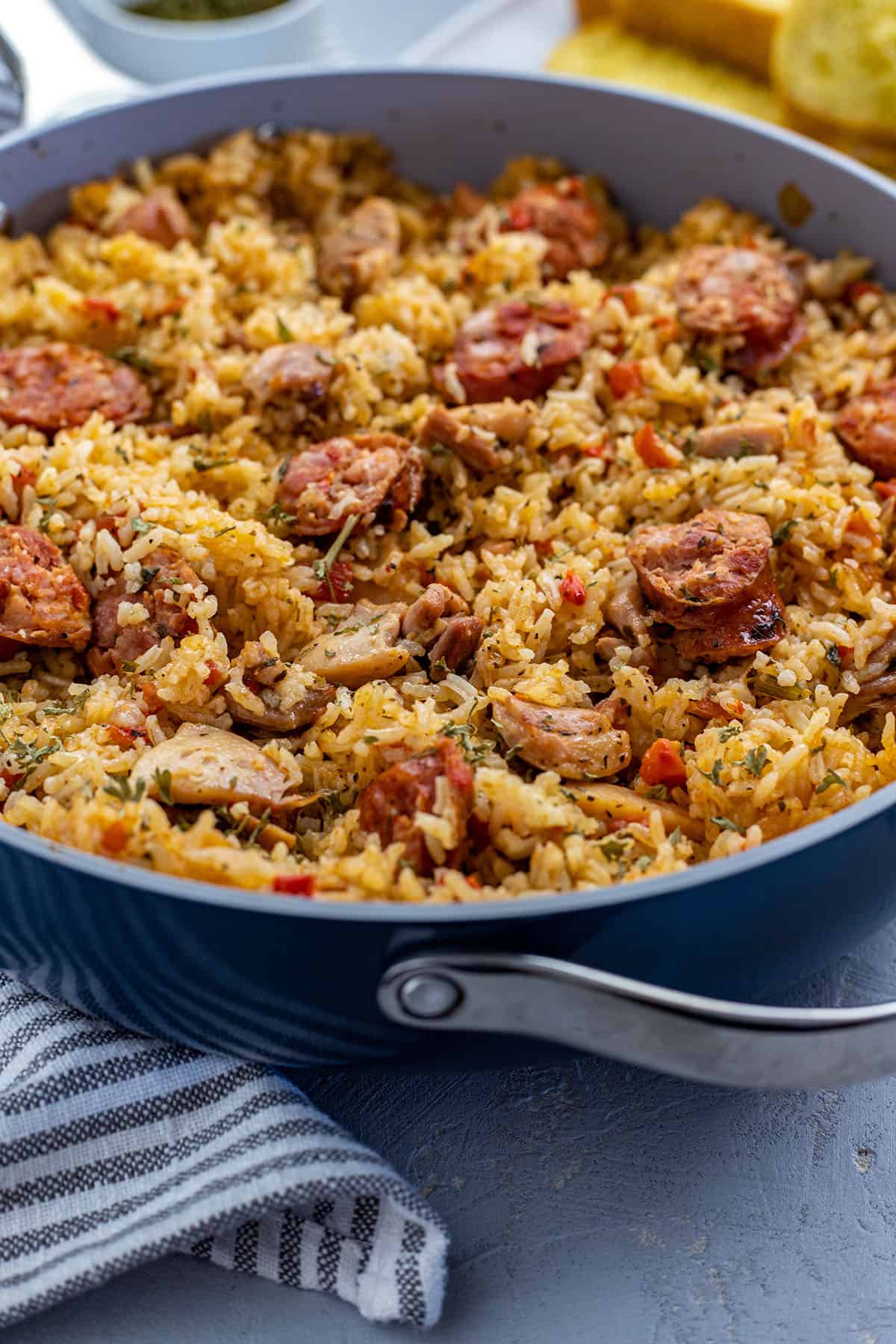
“Or what about Creole ‘Pete’ Robertson, a former Negro League baseball player from New Orleans, whose specialty was hot and spicy dishes such as dirty rice and gumbo. Often after a game at the Polo Grounds or Yankee Stadium one could find celebrated pitcher Satchell [sic] Paige polishing off a plate of Jambalaya (Cajun rice, shrimps [sic], chicken, beef sausage with a plate of red beans and rice on the side).”

From New York Age night life columnist Wally Warner in March 1946:

“Peter Robertson, owner of Pete’s Restaurant … has developed a smart continental-style restaurant by using the personal touch. He thinks in terms of friends instead of customers. This has resulted in busy days for all concerned — starting with breakfast and continuing on through dinner and late supper.

“No one calls Pete Mr. Robertson more than once; he makes everyone too much at home for formalities. A connoisseur of years standing, Pete likes to supervise each order with a waiters [sic] concern for service. For dinner for instance, he’ll take a menu and sidle over to [a] table and ramble off suggestions, telling at the same time how he prepares his dishes. And when he’s through you may find yourself deviating far from the routine of your regular diet …”

From Pete himself, in Black Sports Magazine, December 1974:

“Louisiana Creole gumbo carries practically every vitamin in the book. Most dishes carry one vegetable; Louisiana Creole carries five vegetables: onions, peppers, celery, okra and tomatoes. Now the meats. The meats that go into it are smoked sausage, smoked ham hocks, chicken, turkey, veal. The brain food in a gumbo is shrimps and crabs. It is served with rice. It’s not a stew and it’s not a soup; it’s between the two. That’s the original Louisiana Creole Gumbo.”

Jambalaya

In an article by Robert Sylvester of the New York Daily News in September 1954:

“Pete Robertson operates his gumbo palace 24 hours a day at Seventh Ave. and 132d St. You get a big dish of gumbo for exactly $1 and you can also get wonderful barbecued ribs. Gumbo is served in a bowl. It has rice and okra and chicken and ham and other stuff. It also has special herbs which Pete brings in from New Orleans. In the middle, floating in the stew, is a small crab boiled in its shell. I promise you it’s a big bit for a single buck.”

We now go to Pete Robertson, baseball philosopher and kingpin, with a few quirky and colorful comments from the man himself. Throughout his life, no matter what other challenges he tackled and ventures he launched (entrepreneurial, charitable or otherwise), Creole Pete remained intimately connected to the sport he played, managed and loved. He never ventured too far away from his first love. To wit …

In July 1953, the Associated Negro Press’ Al Moses somewhat randomly quoted Robertson musing on players’ natural mitts:

“Most of the important ball stars had what I call pocket hands,” Moses quoted Pete as asserting. “The horsehide seemed to fit perfectly in their giant paws, seldom falling out.”

Robertson also pontificated about what the future held for Negro baseball for an article in the Amsterdam News in August 1949:

“With proper handling, the [Negro] league could definitely be improved,” he said. “There is more interest in the game today than there was formerly and this is one of the main factors which would help the sport, which should have a place in the national sport picture. The Negro leagues [sic] cradled the boys who are in there now and gave them the chance to be seen. Now schools and other institutions have added this game to their programs and more and more are playing it as a direct result. I think the best way to revive the game would be for the Negro teams to enter organized ball as classified ball teams. The public is not too well informed about the Negro teams of today and by entering organized ball they would have a better chance to be seen and heard from.”

Pete was also frequently asked about his opinions on hot news topics of the day.

By Amsterdam News reporter Milton Mallory, who in November 1953 collected sidewalk interviews that included Robertson, about the possibility of a lottery in New York:

“Yes. I think [the] lottery should be legalized, it would take some of the heavy taxes off the business man. The City and State would receive enough money to build better schools and highways and maybe come out with a little reserve for miscellaneous.”

An article by the Amsterdam News’ James Booker and Les Matthews, about the idea of a civilian review board for the NYPD, in May 1964:

“The creation of a civilian complaints board is a good thing. An outsider can usually see better than someone that’s inside. The body must have the right people, however.”

Then, the Amsterdam News in May 1967 quoted Pete regarding Muhammad Ali’s stand against the Vietnam War draft:

“Well, he said he is a minister and he should be exempt. I believe that Muhammad Ali’s outspoken attitude played a big part in the decision of the judges. I don’t think they should take his title away either.”

As mentioned previously in this post, Pete was so popular in his NYC surroundings that he briefly ran for the title of “Mayor of Harlem” in early 1948. Although the position was largely ceremonial, and although he withdrew from the campaign after a few months, the fact that Robertson was drafted into the race reflects his massive popularity among his fellow Harlemites.

While he was still in the race, in February ’48 Creole Pete outlined his “platform” for the “mayoral election,” as detailed in the Feb. 7, 1948, edition of the Amsterdam News. Here’s a few thoughts from him about what he’d be able to bring to his “constituents” if he was elected …

“My general and overall plan for the improvement of Harlem is very simple and easy to understand. It is my belief that the surest means of eliminating practically every civic evil in Harlem is through the constructive guidance of our young people in the elevation of recreational and sanitational standards through our own efforts.

“It has long been agreed by everyone that something should be done along these lines but as yet no one has ever outlined exactly WHAT [caps in original] should be done. I have what I believe to be a workable plan that will demand something of all yet not be unduly expensive to any one person or group of persons. …

“I do not choose to make any empty campaign promises. I will simply state that if the people of Harlem select me as their ‘Unofficial Mayor’ I shall sincerely lend my every talent and resource to the performance of that office.”

Here are thoughts by the unnamed writer of the article:

“As a candidate in the “Harlem Mayorality” race, Peter Robertson is perhaps the best known and most colorful figure of all. The popular restaurateur, more popularly known as ‘Creole Pete,” has long been prominent and active in Harlem’s civic programs. By possessing all of the attributes which go to make a good citizen with keen public consciousness, Pete’s qualifications for the position of Harlem’s “Unofficial Mayor” are many and worth the listing.

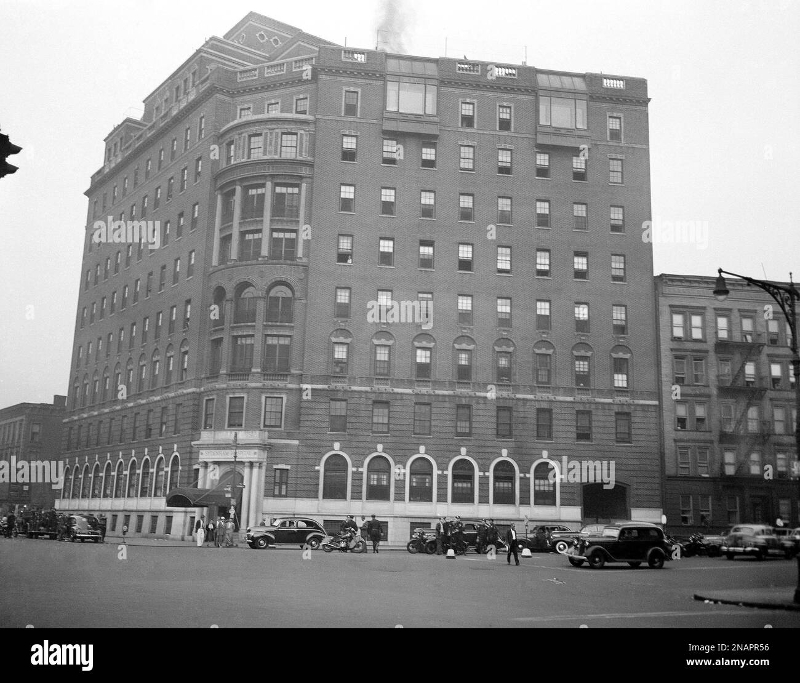
“’Pete’ has done many things to promote the general welfare and to develop a better way of life in Harlem, and not the least of these have been his many substantial donations to many of the community charitable enterprises. He was one of the very first to come through most liberally with donations for the Harlem Serviceman’s Center, the Sam Langford Fund, the Amsterdam News Welfare Fund, the New York Baptist Fund and the Sydenham Hospital Fund to mention a few.

Sydenham Hospital.

“It has always been with great pride that ‘Pete’ has noted the achievement of any Harlemite or member of the Negro race. During the recent Jackie Robinson ‘Day’ campaign, ‘Pete’ served as a committeeman, working diligently and devoting much time and effort. Because of his labors he was responsible in raising one of the largest amounts of money accounted for in the entire drive.

“Being a family man, and the father of two fine, robust boys, ‘Pete’ has a heartfelt concern for the less fortunate children of Harlem. Because of this concern he has always been a heavy contributor to the Mother Goose Kindergarten Nursery and the Riverdale Orphanage.

“A tall, always smiling man of boundless energy, ‘Pete’ has innumerable social interests. He is very active in the Young Men’s Christian Association program and is a member of the Metropolitan Stevedore Club, the Independent Political Association and the Louisiana State Club. He was founder and organizer of the latter.

“Known and admired by all of Harlem’s hundreds of stage, screen and radio folk, ‘Pete’ has been assured by them of their support to his campaign and, if he is elected, he has their promise of cooperation with the administration.”

Finally, we’ll finish out with a bang, with another excerpt from Ricky Riccardi’s article to me. Enjoy, and thanks as usual to all who are reading:

“In September 1952, Louis Armstrong sat down for a radio interview backstage at the Paramount Theater with broadcaster Sidney Gross. As Gross began taping the conversation, Armstrong taped it, too, adding to his private collection of hundreds of reel-to-reel tapes. Early in the interview, Gross noticed Armstrong eating a bowl of gumbo and asked him how it made him feel. “Well, I feel like I’m right in the heart of New Orleans right now.’

“Wasn’t that wonderful? Gross asked, before addressing his audience. “Incidentally, everybody down at WSMB, tonight I was introduced by Creole Pete, who’s one of the great cooks in New York, brought along a steaming bowl of Louisiana Creole gumbo.’

“How’d you like it?’ Louis asked.

“Oh, it was really wonderful,’ Gross replied.

“You made  yourself proud, you know that? You stepped up there!’ Armstrong said, before noting that joining them for the feast was vocalist Velma Middleton, Louis’ valet Hazes “Doc’ Pugh, and Creole Pete Robertson himself. Louis decided to give his friend one more plug of the air.

“You want to take the family to Pete’s restaurant sometime,’ Armstrong implored. “It’s up there on 131st and 7th Avenue in Harlem so you can really rest and relax and spread out on that table and really have a ball at Pete’s.’

“I must do that,’ Gross promised, caused Armstrong to insist, “You must visit him, anyway.’ That particular feast was paid for by the famed arranger Gordon Jenkins, who was sharing the bill with Armstrong at the Paramount. “Music maestro Gordon Jenkins’ gumbo food bill, when he played the Paramount Theater with Louis Armstrong, was $300. He had Creole Pete Robinson [sic] bring him the New Orleans dish every night backstage,’ Jet magazine reported on September 27, 1952.”

The story of Creole Pete, part 1

Editor’s note: More than two years ago, I wrote this article for The Louisiana Weekly newspaper about how the Negro Leagues Baseball Grave Marker Project has provided a grave stone for “Creole” Pete Robertson, a New Orleans native who became a fixture on the Black baseball scene in two cities.

Using that article as a jumping-off point, I began work on a blog post that expanded upon the Robertson story, but I eventually got bogged down with the length of the burgeoning post and also became distracted by other projects.

As a result, I decided to publish the post in sections to make it more digestible and less interminably long. Here’s the first such entry; it includes much of the text from the original Weekly article, but also includes some new editions. So, without further ado, let’s get going …

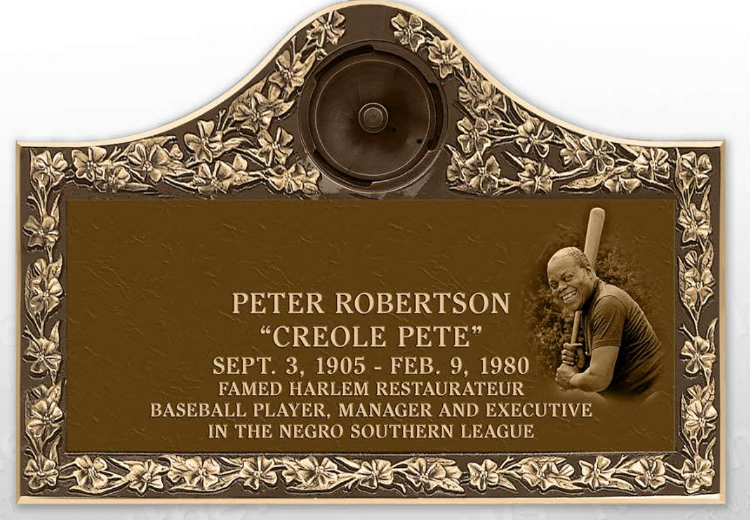
On Feb. 10, 1980, Peter “Creole” Robertson, a former restaurateur who became a major figure in the Harlem community for nearly 20 years, died at Nassau Medical Center in East Meadow, N.Y., on Long Island at the age of 75.

According to an obituary in Newsday, Robertson arrived in New York City in 1938 and five years later opened his wildly popular, 24-7 restaurant at 7th Avenue and 129th Street in Harlem. The noted that the food joint “attracted many celebrities, including Louis Armstrong, Nipsey Russell and Redd Foxx, with its creole [sic] gumbo and other creole [sic] specialties.”

An article in the Baltimore Afro-American added that Robertson also “promoted many dance and sporting events in the city.”

Robertson’s funeral was held at Bethel AME Church on Long Island, but, despite his fame and influence in New York City and Long Island, he was buried in an unmarked grave in Pinelawn Cemetery in Farmingdale, N.Y.

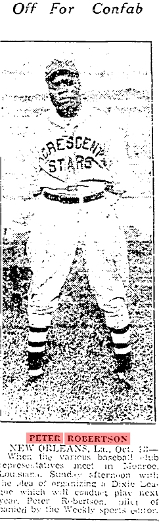
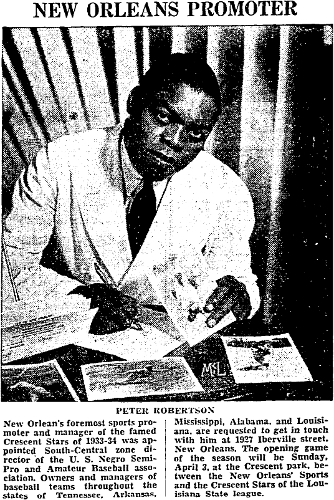
However, tracing back the years, rewinding the tale of Roberston’s life, his story, and his fame, first blossomed in New Orleans. Born in 1905 in Natchez, Miss., Robertson came to the Big Easy at the age of roughly 18 — at the behest of Tom Wilson, a Nashville-based baseball magnate, who pegged Robertson as an ambitious rising talent — and eventually built a small empire as a baseball impresario.

Starting as a slugging catcher for the New Orleans Black Pelicans of the Negro Southern League in the 1920s — he reportedly served as the backstop for none other than Satchel Paige, although there’s no concrete proof that Paige actually played for the Black Pels — Robertson grew in stature and influence in the bustling hive of Black baseball activity in New Orleans.

He eventually managed and owned multiple semi-pro and professional teams, including the powerful Crescent Stars in the early 1930s, and became a prime force in the construction of Crescent City Park, which became Black New Orleans’ premier baseball grounds for much of the 1930s and beyond. “Creole Pete” also helped draw top-level Negro League teams from the North and Midwest for exhibitions and other hardball events in New Orleans.

His goal, according to local media, was to replicate the success of the legendary Rube Foster of Chicago, the founder of the first Negro National League and eventual inductee into the National Baseball Hall of Fame in Cooperstown, N.Y.

“Peter Robertson lives baseball,” stated the July 15, 1933, issue of The Louisiana Weekly. “Has lived it for years. His chief ambition ever since the day he drew on a catcher’s mitt and decided to play the game was to become a second Rube Foster.”

It’s for those reasons, for his towering influence over 1920s and 1930s Negro League baseball in New Orleans — that his unmarked grave on Long Island, about 1,200 miles from his roots in the Big Easy, is in the process of receiving a stone marker, courtesy of the nationally recognized Negro League Baseball Grave Marker Project.

Created by Jeremy Krock, an anesthesiologist in Peoria, Ill., in 2004, the NLBGMP has raised money and worked to successfully purchase and place headstones or markers at the graves of dozens of Black baseball legends whose careers largely took place during the tragic era of segregation.

Starting with outfielder, Negro League All-Star and championship winner Jimmy Crutchfield, the NLBGMP has brought dignity to the final resting places of team owners, managers and players, including Hall of Famers Pete Hill and Sol White, as well as superstars and Hall of Fame candidates like John Donaldson, Grant “Home Run” Johnson, Bruce Petway, Dan McClellan, Sam Bankhead and “Candy” Jim Taylor. Most recently, the project dedicated a marker in St. Louis for Henry Bridgewater, who founded and created the St. Louis Black Stockings, an important early “colored” ball team in the 19th century.

The Grave Marker Project works with the Society of American Baseball Research to achieve its goal, and author Larry Lester, the co-founder and chairman of SABR’s Negro Leagues Committee, lauded Krock and the NLBGMP for their ongoing efforts.

“The Grave Marker project continues to build momentum and recognition as more unmarked graves are discovered and eventually honored with custom-made headstones, courtesy of Dr. Krock’s commitment in recognizing  these forgotten legends of the game,” Lester said. 

Lester added that Creole Pete is a perfect candidate for a marker.

“Because of his wide-range of skills, professions and his place in the communities, I think he truly deserves a headstone,” Lester said.

According to Krock, the Robertson effort began when another SABR member, Ralph Carhart of New York City, gave a lecture at the New York State Association of Cemeteries in 2017. Following the lecture, representatives from Pinelawn Cemetery reached out to Carhart about whether any ballplayers might be buried in unmarked graves in the cemetery, and, using the SABR Negro Leagues Committee’s databases, Krock and Carhart discovered Robertson’s grave.

Krock said that Pinelawn continues to work with SABR and the NLBGMP to install a stone at Creole Pete’s burial site. The design of the marker has already been OK’ed, and it features a portrait of an older, smiling Robertson in a batting pose with a bat over his shoulder. The text on the stone reads:

Peter Robertson

“Creole Pete”

Sept. 3, 1905 – Feb. 9, 1980

Famed Harlem Restaurateur

Baseball Player, Manager and Executive

In the Negro Southern League

Krock credited Pinelawn Cemetery with taking the reins of the effort to find funds and move ahead with the stone, which is currently on order.

“The cemetery kind of took it upon themselves to do it and purchase the marker,” he said.

Krock said that SABR and the NLBGMP are working with the cemetery to possibly identify more unmarked graves of baseball figures at Pinelawn.

“[The Robertson effort] was just luck that the owner of the cemetery heard Ralph speak and reached out to us. It’s a wonderful opportunity.

“This is how a lot of our projects go,” he added. “If we hadn’t done this, no one would have.” 

Atlanta Daily World, Oct. 13, 1932

And beyond the Robertson project and any other individual NLBGMP efforts, Krock said all baseball figures, and all people, deserve dignity in death.

“As far as we’re concerned,” he said, “there’s no one who’s not worthy of a grave marker. It’s just a matter of identifying the graves and raising the money for a marker.”

Regarding Robertson in particular, Krock added that the process of delving into Robertson’s career made it obvious that Robertson was an ideal candidate for the NLBGMP.

“It was fascinating researching how his career went as a player, manager and owner,” he said. “He did all of those, and we’re proud to be a part of this project. He had a fascinating life.”

Creole Pete most certainly did.

After playing for the Black Pelicans for several years, Robertson tired of the seasonal nature of the baseball business — he reportedly washed dishes during the off-season to earn money at one point — and decided to take up cooking, a skill he inherited from his mother and grandmother. He found a year-round job working in the restaurant of a large New Orleans department store.

He saved money while working at the store and eventually raised enough capital to start his own baseball team, the Crescent Stars, circa 1930. He strengthened the team enough that top-level Black teams teams — like the Chicago American Giants, Homestead Grays, the Kansas City Monarchs and the New York Black Yankees — routinely stopped in the Big Easy for exhibition games with the Crescent Stars.

“I had this team — ‘30 and ‘31 — and at that time none of the major Northern teams came down,” Robertson said. “They didn’t come South because they never could make any money down there. There wasn’t any team good enough, but in two years time I had built up a team down there strong enough to play these teams from the North. And I invited them down with the guarantees that they’ll make money. …

“I was able to take all these teams down there and draw, and make money, because I had built me up the kind of team that could beat these people. And we used to beat them.”

He later bemoaned the fact that these same outside teams routinely poached the Crescent Stars’ best players, which became a factor in him folding up shop in New Orleans and heading North himself.

Chicago Defender, April 4, 1938

“After those teams from the North began to come down there and see [the Crescent Stars’ players] they started stealing them,” he said. “They started stealing all of my ballplayers, boys I’ve been training three and four years. The New York Black Yankees brought Zollie Wright and Red Parnell to New York. The Philadelphia Stars took a guy named [Ducky] Davenport. The Chicago American Giants took two or three players.”

“Well,” he added, “you couldn’t blame the boys. They had a chance to go North, get out of the South and get more money than we could pay them. And, after that I didn’t want to go to the trouble of building up another team, because they would just steal them. Then I decided I’m going North [italics in original].”

In addition, Robertson immersed himself in the annual doings of the Negro Southern League, and he periodically attempted to generate enough interest and funding for other regional, state and city-wide leagues.

In the lead-up to the 1932 campaign, for example, Robertson played a key role in a move to create something to be called the Tri-State Baseball League, which would potentially include teams from Louisiana, Arkansas and Mississippi and could, theoretically, challenge the NSL for dominance in the South’s Black baseball scene.

Robertson, as owner at the time of the New Orleans Black Pelicans, traveled up to Monroe, La. – home of the powerful Monroe Monarchs – in late January 1932 for the first official meeting for the fledgling league. While a dozen or so cities reportedly expressed interest in joining the circuit, the Louisiana Weekly stated that a “Big Four” franchises would lead the way – the Black Pelicans, the Monarchs and clubs in Little Rock, Ark., and Jackson, Miss.

However, by late February, the prospects of a successful launch of the lead dimmed, apparently despite all the enthusiasm from Pete, who, according to the Weekly, “has made plans to rebuild the Black Pelican Club and thrust it into the [league] hook-up, is rather dubious about some things these days.” The paper reported that Robertson hadn’t heard from the league headquarters in Monroe for weeks.

But regardless of whether or not the league would take off – it wouldn’t – Robertson was reportedly determined to give the Crescent City the best possible team.

“But reply or no reply [from Monroe],” reported the Weekly’s Earl Wright, “league or no confederacy the big former Black Pelican catcher says he is going to put a baseball team on the diamond.”

Within a couple weeks, the chances of a Tri-State Baseball League disintegrated when the Monroe Monarchs, who by then were arguable the best Negro Leagues team south of the Mason-Dixon Line, bailed on Robertson and the other team hopefuls to become the anchor of a revived NSL.

(The decision by the Monarchs to jump circuits was probably a smart one, and certainly understandable, especially because with the demise of the first Negro National League in 1931, the NSL was improbably emerging as the nation’s one and only Negro major league in 1932. Monroe emerged as the best team in the 1932 NSL and lost out on claiming the league title thanks to a questionable turn of events and bureaucratic smoke and mirrors that gave the crown to Cole’s American Giants. For more detail on the entirety of the 1932 Blackball season in the South, definitely check out Tom Aiello’s fantastic book, “The Kings of Casino Park: Black Baseball in the Lost Season of 1932,” an excellent history of the Monroe Monarchs.)

Thus began the baseball seasons of 1932 and ’33, which ended up representing both Robertson’s pinnacle as a baseball magnate, and a crucial turning point in his career, his life and the sport he loved in New Orleans.

More Creole Pete stuff to come …

Wrapping up the John Bissant story

Herald-Press (Saint Joseph, Mich.), May 21, 1946

Another follow up on the life, career and legacy of John Bissant, Negro Leagues great and arguably the greatest all-around athlete New Orleans has ever produced. For some earlier posts, check out this, this and this.

In this post I want to kind of outline a little more about John’s athletic career, which, when reviewed from modern times, is pretty incredible. Aside from his baseball achievements and exploits, Bissant, who was born in 1914 in New Orleans, excelled on the gridiron, on the hardwood and on the cinders, first at historic McDonogh 35 High School in New Orleans, then the Texas HBCU Wiley College, and then on numerous professional and semipro football and baseball teams across the country and in this city.

John Bissant’s talent and achievements stemmed from his status as a well rounded, multi-tool athlete whose abilities were adaptable for just about any sport. Whatever you asked him to, he could do it, beginning with his fleetness afoot.

One facet of Bissant’s athletic prowess was his speed, for example, and he used it, perhaps most obviously on the cinders and on the gridiron, to his and his team’s advantage. Articles from his time with the Chicago American Giants, as well as other teams, often report that he occasionally took part in foot races on the field as a side attraction at games.

For instance, a May 1943 article in the Cincinnati Post that previews a Negro American League doubleheader between the American Giants and Cincinnati Clowns reported that Bissant was slated for a 100-yard sprint showdown with members of the Clowns:

“Johnny Bissant, Chicago outfielder, is generally regarded as the fastest man in Negro baseball, but the Clowns dispute this, claiming that their own Reece (Goose) Tatum, Freddy Wilson and Charley Harris can match strides with anyone.”

The Clowns swept the doubleheader, but it’s unclear who won the races, if they were run.

As a side note, the teams also held a “slowest player” race, with Baton Rouge fella Lloyd “Pepper” Bassett, aka the Rocking Chair Catcher, at the time with the Cincinnati Clowns, as a favorite in that one.

John Bissant, second from right, in 1943 with Chicago American Giants teammates Art Pennington, Ed Young, Alex Radcliffe and Herbert Buster. (Photo courtesy of Charisse Wheeler.)

Contemporaneous media reports frequently mentioned Bissant’s fleet feet in the outfield, where he chased down fly balls and flashed the leather frequently. In July 1941 a newspaper in Medford, Ore., called him “the club’s speed merchant” and that Bissant was paired in the Giants’ outfield with close friend Ducky Davenport, “another streak of lightning,” while In June 1942, a paper in Benton Harbor, Mich., noted that Bissant “holds several sprint championships and is one of the fastest negro [sic] players in the national pastime,” while a July 1944 article in the Belleville (Ill.) News-Democrat called Bissant “the team’s ace outfielder, and is a hard hitter as well as a great ground-coverer.”

As an outfielder, Bissant had the good fortune to team with other standouts – including NOLA lad Davenport – to form fearsome lineups in the outer garden for the American Giants. In June 1943, an Illinois paper noted that Bissant and Davenport were joined by Art Pennington in an “outfield [that] is considered the best in the [NAL].”

The South Bend, Ind., Tribune, in previewing a game between Bissant’s Chicago Brown Bombers and a northern Indiana semipro team, offered a concise but glowing estimation of the New Orleans legend. At the time Bissant was usually stationed in left field.

“Bissant is tagged as the fleetest of the Bombers’ outfield,” the newspaper stated. “Because of his fleetness he sometimes patrols center giving the Bombers added protection on the strength of Bissant’s ability to roam into right or left to haul down apparent hits. He is death on [the] bases and specializes in base thievery to the chagrin of rival catchers.”

Louisiana Weekly, March 26, 1977

Actually, during and after Bissant’s playing career, newspapers often referred to Bissant together with Ducky Davenport as a duo of greatness; because both of them were from New Orleans – they competed against each other in high school here – and were both speedsters who prowled the outfield for the American Giants, it was natural to mention both in the same breath.

However, even then, Bissant garnered the highest praise, partially because he was so well rounded as an athlete.

“Bissant was a natural, as was Davenport,” stated the Louisiana Weekly in April 1970, “but [Bissant’s] wonderful physique, speed and power gave him the advantage, and his best sport was probably football, although he lettered in track [and] basketball, as well as baseball and football.”

As a result of his completeness as a player, his athletic glories were many. A few of Bissant’s accomplishments, honors and activities as a pro baseballer:

  • Played in the 1945 East-West All Star game in Comiskey Park in Chicago. (I should note that I couldn’t find any solid evidence that he actually appeared in the game.)
  • Starred at historic McDonogh 35 High School, from which he graduated in June 1935. McDonogh was the first four-year public high school for African Americans during the first half of the 20th century, and it boasts several pro athletes, as well as groundbreaking politicians and Civil Rights activists, including Ernest “Dutch” Morial, New Orleans’ first mayor of color; Joan Bernard Armstrong, a racial and gender trailblazers in the Louisiana state court system; and Rev. A.L. Davis, a founder of the Southern Christian Leadership Conference.
  • Broke into the Negro League majors in July 1937 with the Cincinnati Tigers of the Negro American League, managed by Double Duty Radcliffe. Bissant only played a handful of games for the Tigers after being lured away from the New Orleans Black Pelicans; during this brief stint in the Queen City, John was teammates with fellow Louisianans Ducky Davenport, Gene Bremer and Lionel Decuir. The Tigers themselves had folded by the end of the ’37 season.
  • Apparently defected briefly from the American Giants to suit up for an extremely short-lived, largely barnstorming semipro team, the Chicago Dominos (or Dominoes), in summer 1942. According to media reports, the club was owned by one Jimmy Foster,  managed by Harlem Globetrotters impresario Abe Saperstein, and composed of guys who decided to work in factories in the wartime defense industry.
  • Apparently shared/alternated managerial duties of Chicago American Giants in 1944 with fellow New Orleanian Ducky Davenport and the great, severely underrated Bingo DeMoss. It should be noted that Bissant also served as team captain in 1947-48 under manager Candy Jim Taylor.
  • Selected for the South team seventh annual North-South All-Star Game at Pelican Stadium in New Orleans in October 1946.
  • Played in another contest billed as a “North-South all-star” game with two picked nines from the NAL ranks; New Orleanian Bissant was slated to play for the North team, ironically. The game was scheduled for Hudson Field in Dayton, Ohio.
  • Played in charity fundraising games in New Orleans, including at the Times-Picayune newspaper’s Christmas Gift Fund all-star game in 1947. Also taking the field were fellow local guys Herb Simpson and Wesley Barrow.
  • Honored by the Crescent City Old Timers Baseball Club in 1970. The Old Timers Club was a New Orleans institution that brought together former Negro League players and managers from New Orleans and Louisiana for 20-plus years. Bissant was a regular member of the organization.
  • Served as an instructor at the Old Timers Club at the group’s youth clinics in the 1970s..
  • Selected for the National Black Sports Foundation Hall of Fame, probably in 1975.
  • Invited by the Atlanta Braves to be honored at the team’s 1997 Negro Leagues reunion and recognition event for “Black Living Legends of Negro Baseball.” Also in attendance was Herb Simpson.

In a review of his career, here’s what I came up with, across several sources, in terms of some of the teams with whom Bissant played over the years:

Chicago Defender, July 11, 1942
  • Caulfield Ads (?) (1934) — The semipro Caulfield Ads were owned and managed by Fred Caulfield, a businessman in New Orleans who was extremely active in Black baseball in the city beginning in the late 1910s and running through the ’40s. What media coverage I’ve found about the 1934 Ads (which is very little) only lists the last name of “Bissant,” with no first name given. That leaves open the possibility that it could be John’s uncle, Champ Bissant, or his cousin, Bob Bissant. If the player listed is indeed John Bissant, it would mean that he was still attending McDonogh 35 High School at the time.
  • Cole’s American Giants (1934), a post-Rube Foster iteration of the club owned by Robert Cole and Horace Hall and piloted by holdover manager and Rube disciple Dave Malarcher. The team was part of the second Negro National League at the time, winning the first-half league title but losing the championship series to the second-half-winning Philadelphia Stars. However, although Riley states that Bissant was on this club, Seamheads doesn’t include any record of him for the season.
  • Shreveport Acme Giants (1935-36), a largely barnstorming team loosely based in the city of Shreveport in northwestern Louisiana. The history of the Acmes is quite fascinating and worthy of its own detailed chronicling. The team was managed by Louisianan Winfield Welch, whose career spanned several decades and included piloting several teams in the New Orleans area, the Alexandria Black Aces, multiple Shreveport teams, the Cincinnati Crescents and, most prominently, the big-league Birmingham Black Barons, whom he guided to two Negro American League pennants. Anyway, at this time in question, the Acme Giants included several guys from New Orleans and Louisiana, as well as the one and only Buck O’Neil, who was just beginning his career in pro baseball and used the Acmes as a launching pad for bigger and better things. The team toured up into the Midwest, the northern Plains and into central Canada; some of its members, including a few New Orleanians, ended up hopping to Canadian teams, while others ended up with the Cincinnati Tigers of the mid-to-late 1930s. (I should note that I wasn’t able to confirm that he definitely did play for the Acmes, but that by no means he absolutely didn’t.) And on that note …
  • The Cincinnati Tigers (1937) of the NAL (see aforementioned discussion of this team). Bissant jumped to the Tigers in July 1937 from the American Giants.
  • The New Orleans Black Pelicans (1938).
  • Caulfield Red Sox (1938) — Another one of Fred Caulfield’s clubs.
  • Shreveport Black Sports (1938). I found a bunch of articles referring to them, including, for example, one from the Longview (Texas) News-Journal newspaper from May 1938 that reported that Bissant swatted a three-run home run to help the Sports stake a 3-2 win over the Fort Worth Black Panthers. The Black Sports were also managed by Winfield Welch and were members of the Texas Negro League. It makes sense that Bissant would play for a team based in Shreveport because Wiley was only roughly 65 miles from the Louisiana city in Marshall, Texas, making it easy for Bissant to play for the Sports during summers out of school.
  • Chicago American Giants (1939).
  • Birmingham Black Barons (1940).
  • Chicago American Giants (1941-48). The CAGs frequently played exhibition or spring training games in New Orleans. In the 1940s the Giants were well past their prime years that included their founding and early ownership by Rube Foster in the 1910s and ’20s, and later owner Robert Cole in the 1930s. In the 1940s the club was owned by J.B. Martin, who also served as a league executive in the second Negro National League and the Negro Southern League and as president of the NAL while he owned the Chicago American Giants. As far as Bissant goes, it’s important to note that while his overall tenure with the American Giants spanned nearly a decade, his time with the CAGs wasn’t one continuous stretch; he frequently jumped to other teams here and there, as this piece will show.
  • Chicago Palmer House Stars (1940-43), a barnstorming team that won three straight Illinois state semipro championships, and they took part in the National Baseball Congress World Series in Wichita, Kan., and the Denver Post tournament, both annual events to determine national semipro champs. The Palmer House is a historic downtown Chicago luxury hotel that, in the 1930’s and ’40s, sponsored several baseball teams, including one African-American one. The hotel was owned by Potter Palmer III; the Stars baseball team itself was owned by L.M. Gamble, and, during its most successful stint, it was managed by Alex Radcliffe, the brother of the legendary Ted “Double Duty” Radcliffe and a player and pilot with a very distinguished record of his own. It appears Ducky Davenport was also on the roster at certain points. The team was referred to in different ways in the media; sometimes they were called the Chicago All Stars, or the Chicago Colored All Stars. (The lack of consistent naming definitely muddies the historical record and can be very confusing. For example, I wouldn’t rule out one or more of these various monikers actually representing different teams, or at least variations of the Palmer House club.) The Palmer House Hotel is still in operation today as a Hilton property. For more detailed info on the Palmer House Stars, check out this excellent article by Leslie Heaphy.
  • Chicago Brown Bombers (1942-43?) of the very short-lived, somewhat half-baked Negro Major Baseball League, the “brainchild” of white team owners/promoters Abe Saperstein and Syd Pollock. The league only lasted for a season, with few records and no standings left behind. The Bombers were managed in 1942 by Bingo DeMoss and owned by L.H. Gamble; they might actually have evolved from the previously listed Palmer House team. (Another version of the Brown Bombers played in the United States League in 1945; the USL was created by Gus Greenlee and Branch Rickey as a stealth way to evaluate Black baseball talent and bring players into Organized Baseball.) As far as Bissant is concerned, he appears to have started the 1942 season with the Bombers, defecting from the Palmer House club that he played for the previous year. However, in the middle of the 1942 campaign, he jumped to the next team listed below. Then found articles on the Brown Bombers from May 1943 that previewed the upcoming season, but it’s unclear how many games the Bombers played in ’43. The articles do list Bissant as an outfielder on the team still, but I couldn’t find an actual box score from early 1943 that proves that Bissant actually did take the field for the Bombers in 1943. What is certain is that by the early summer of ’43, Bissant was back in the fold with the Chicago American Giants.
  • Foster’s Chicago Dominoes (1942). A July 1943 article in the Chicago Defender states that Bissant, “formerly of Wiley college [sic] and later of the Chicago Palmer House Stars,” had recently signed on with the Dominos. The Dominoes seem to have offered a fair amount of clowning at games; one newspaper called them a “razzle-dazzle” club who “display a brand of baseball akin to the basketball gyrations of the colored Globe Trotters [sic], stablemates of the Dominoes and piloted by Abe Saperstein.” It appears that Bissant finished out the rest of the ’42 schedule with the Dominos. Overall, chronicling Bissant’s exact pathway through the early 1940s is extremely difficult, because he jumped around a lot, at least before ending up back with the American Giants in mid-1943.
  • Kohlman All Stars (1947), a New Orleans semipro team. By now Bissant was well past his prime and apparently picking up baseball action where he could, largely in the Big Easy. The Kohlmans were managed by legendary New Orleans player/manager Wesley Barrow, and the club also included fellow local lads Herb Simpson and Billy Horne, both one-time Chicago American Giants as well. In October 1947 the Kohlmans welcomed an all-star team from McComb, Miss., for an exhibition fundraiser to benefit the Times-Picayune Christmas gift fund.
  • New Orleans Creoles (June 1948) of the Negro Southern League.
  • New Orleans Black Pelicans (1955). Also on the roster were Bob Bissant, Robert “Black Diamond” Pipkins and Morris “Tar Rock” Arthur.

That listing is by no means complete, especially when it comes to Bissant’s presence on local New Orleans teams both before and after his time in the Negro Major Leagues. The best source for such info is the Louisiana Weekly, but a complete run of the paper’s archives isn’t available on any databases, and it’s been difficult getting to libraries that do have a complete run on microfilm.

Now, although best known on a national scale as an accomplished baseball player, it’s necessary to emphasize the fact that Bissant was a multi-sport star, also excelling in basketball, track and especially football.

Bissant’s greatest success on the gridiron came at Wiley College, a small, liberal-arts HBCU located in Marshall, Texas. Founded in 1873 – just eight years after the end of the Civil War – by the Freedman’s Aid Society of the Methodist Episcopal Church. Wiley, known today as Wiley University, has been known as one of the best and oldest HBCUs west of the Mississippi. Today, its enrollment tallies about 1,100.

Wiley students played a key role in the development of the Civil Rights Movement in Texas; together with students at the now-defunct Bishop College, another HBCU located in Marshall, Wiley students organized and participated in the first sit-ins protesting segregation in the Lone Star State. In addition, one of the national Civil Rights Movement’s most esteemed leaders, James Farmer, graduated from Wiley.

The Wiley varsity football team, meanwhile, used to be a regional HBCU powerhouse; Wiley helped co-found the Southwestern Athletic Conference and claimed 10 conference titles between 1923-57 under legendary head coach Pop Long.

Unfortunately, the Wildcats no longer have a football team, and in the years since their pigskin glory days, the school was dropped out of the SWAC in all other sports and is now a member of the Gulf Coast Athletic Conference, which includes smaller schools competing in the National Association of Intercollegiate Athletics (NAIA).

However, at a time when Wiley did have a pigskin program, John Bissant shined for the Wildcats on the field for several years. He arrived in Marshall for the fall 1935 semester and while he logged a fair amount of action during his freshman season, it was his second year in 1936 that really saw the Bissant legend start to grow at Wiley.

Chicago Defender, Oct. 1, 1938

Tipping the scales at a compact 167 pounds, give or take a couple, John became a fixture in the starting lineup at right halfback, piling up yards and touchdowns. In addition to carrying the rock, Bissant was also adept at both slinging and receiving the ball. (The sport looked somewhat different in the late 1930s, when the modern concept of a quarterback hadn’t yet developed and a dizzyingly diverse ground game remained the foundation for most college offenses.) Bissant could also placekick on extra points or field goals, as well as snare interceptions on defense at a time when most college teams featured numerous two-way players.

The 1937 season witnessed John staking out a permanent spot at or near the top of the SWAC statistical rundowns, leading the conference in scoring at various points. At the end of the ’37 campaign, nationally syndicated columnist James Parks listed Bissant at halfback on Parks’ postseason HBCU All-American team.

The 1938 season was Bissant’s senior year, and by the end of things he was one of the most lauded, most successful halfbacks in the HBCU football world. He was the SWAC’s leading scorer for ’38, and at the end of the campaign he was named to multiple first-team All-SWAC and All-America lists, including James Parks’ as well as that of Randy Dixon, another popular national Black media journalist who called Bissant the best all-around back in the game.

Quite interestingly, John Bissant garnered the nickname “Geech” or “Geechie” while playing at Wiley, although it’s not clear how he garnered that sobriquet. John’s granddaughter, Charisse Wheeler, told me that she’d known about his nickname, but she wasn’t sure where the moniker came from.

Word of John’s gridiron prowess traveled well, and his services were sought after as both a coach; he was an assistant coach for Florida A&M in the 1939 Orange Blossom Classic, an annual HBCU football bowl game, for example. Later on, in 1948, Bissant served as an assistant coach for the New Orleans Delta Midgets, who were likely another local semipro squad.

John also played semipro football himself at various times in his athletic career, including local NOLA clubs like the New Orleans Pirates in the late 1930s/early 1940s, and the Southsiders, one of the teams that made up the New Orleans Negro Independant Football League later in the 1940s.

Bissant also hit the gridiron for the Chicago Brown Bombers football team in fall 1940. Actually, it appears that he might have caught on, or at least connected, with the Bombers when the Windy City aggregation came to New Orleans to play the Pirates.

Given that he had a reputation as a speed demon, John also ran track in high school and for the Wiley Wildcats, often competing in the relays. At the 1939 Tuskegee Relays, for example, he ran legs of the 440-yard and 880-yard relays.

Strangely enough, I haven’t been able to see any definitive evidence that Bissant played for the Wiley baseball team. I’ve reached out to the special collections department at the Wiley library a few times but haven’t heard back.

Anyway, after retiring from baseball, John Bissant worked at several jobs in the New Orleans area, including at NASA’s Michoud Assembly Facility; Lykes Brothers Steamship Company, a shipping business; Glazer Steel and Aluminum; and a security guard firm.

John Bissant died on April 1, 2006, in Houston, Texas, at the age of 92; he had evacuated to Houston from New Orleans because of Hurricane Katrina. In its obituary of Bissant, the Times-Picayune called him “a Negro League Baseball Legend.” 

Hopefully someday we can persuade the Greater New Orleans Sports Hall of Fame and/or the Louisiana Sports Hall of Fame to induct John Bissant. Right now both halls of fame each have several inductees from the Negro Leagues, but so far Bissant isn’t among them.

The last Negro World Series: a son’s perspective

Rodney Page (photo courtesy Rodney Page).

Editor’s note: I recently wrote an article for The Louisiana Weekly newspaper here in New Orleans about the very last Negro League World Series, which was held in 1948. One game of the series was played in the Crescent City, with legendary businessman and sports promoter Allen Page organizing and hosting the event.

For my article, I got a few thoughts from Rodney Page, Allen’s son, and he generously agreed to do so. I used some of his comments for my article, but I wanted to show people the entirety of the amazing few paragraphs he put together about the 1948 NLWS, and his father’s role in baseball history. Here are those full comments. Many thanks to Rodney for his work.

Seventy-five years is a long time to honor and celebrate a significant event. Seventy-five years also coincides with a “diamond jubilee,” which resonates with the Negro League World Series of 1948. One of those World Series games was played on the Pelican Stadium baseball “diamond” in my hometown of NOLA.  

Photo courtesy of Amistad Research Center.

Another connection is that I was born 75 years ago (Sept. 4, 1948) in NOLA at Flint-Goodridge Hospital, located at the corner of Louisiana Avenue and Lasalle Street.

The host and promoter of this World Series game in 1948 was my father, Allen Page. This is a testament to his significant contributions to the entire Negro Leagues baseball experience. His contributions were not just local in NOLA, but included regional and national affiliations, promotions, and endeavors. The 1948 Negro World Series is an example of that. Consider the risks and the connections necessary in bringing this showcase to NOLA.

Allen Page (photo courtesy Rodney Page).

The hero’s journey does not always end in resounding victory. Sometimes the reward, the victory, is in the process. The process of overcoming and transcending enormous challenges and obstacles. The societal changes from segregation to integration and all of the gains, and losses, of this shift in the social landscape of America. From my perspective, this is part of the deeper story of the Negro Leagues, and Allen Page.

The true story of Allen Page is his indomitable spirit, which speaks to the heart of self-reliance, self-definition and self-determination.

Rodney Page

Some say this was the last Negro Leagues World Series, as Black baseball’s decline was rapidly approaching due to the integration of MLB. An interesting pattern is apparent in the journey of Allen Page. The final resting place for the once outstanding St. Louis Stars and the Newark Eagles was in NOLA.

In addition, one of the final NLWS games was played in NOLA. Allen Page was in the midst of all three significant events in the rich history of Negro Leagues baseball.

In my eyes, my father is a hero. Knowing where he came from and what he accomplished has given my life enormous inspiration and pride. He dared greatly and risked often and much. The true story of Allen Page is his indomitable spirit, which speaks to the heart of self-reliance, self-definition and self-determination. He transcended and excelled despite the shackles of the Jim Crow South and overt racism in America. A legacy of firsts was in his DNA.

Rodney Page, Sept. 14, 2023

Allen Page’s popular and successful hotel in NOLA (photo courtesy of Rodney Page),

The Hall of Fame goes silent

The National Baseball Hall of Fame.

I was hoping I wouldn’t have to write this, but I need to go ahead with it, quite unfortunately …

Many of us in the Negro Leagues research and fandom community have consistently expressed dissatisfaction with the haphazard, slapdash and dismissive way the National Baseball Hall of Fame in Cooperstown, N.Y., has handled the induction of segregation-era Black players, managers, executives, umpires and other representatives of a time when American society denied them the right to compete against and alongside white individuals and teams.

The rules of eligibility for such Negro Leagues greats and the methods of election and induction for them has been inconsistent, ever-changing and wholly inadequate, resulting in only a fraction of the qualified pre-integration figures of color actually being inducted so far, and to a stunningly disproportionate level of representation when compared to the number of white players from the same era who have achieved induction.

The Hall always seems to be well behind the curve on this issue, always reacting to scorn and criticism of the induction process in hastily, jumbled and inconsistent fashion. I’ve written about the Hall of Fame’s dereliction of duty and complete ignorance of and lack of respect for Negro Leaguers over the years. You can read my posts on this topic here, here, here and here. For articles in other media about the induction controversy, check out this, this and this.

A group of us Negro Leagues enthusiasts has been so dismayed and even angered at the Hall’s failures that we started the 42 for 21 Committee, dedicated to advocating for segregation-era baseball figures of color and their much needed, rightful election to the Hall. For info on 42 for 21, you can look here.

The current rules and guidelines for Hall of Fame induction can be found here; details of the “Era” committees process are here; and this link reviews the history of voting rules changes over the years. All three are links to the National Baseball Hall of Fame Web site. For other media articles about this topic, you can check out this, this and this. It’s all very confusing, honestly.

Members of the 42 for 21 Committee met this past July in Detroit at the annual SABR Jerry Malloy Negro Leagues Conference to start working out an advocacy strategy.

After that meeting, I figured that, as the respectable, quality journalist I am (more or less), I’d go right to the source of the controversy and interview a representative at the Hall of Fame to get the institution’s comments on the controversy and criticism.

As a result, I reached out to the Hall’s media relations office and asked about setting up such an interview; I suggested an email exchange for said interview, and the staff there said to go ahead and send questions and they’d try to line up answers from a HOF executive. I often prefer email interviews because it’s much more flexible time- and scheduling-wise, and since the questions and answers are written out, there can be fewer concerns about misquoting and lack of accuracy.

To put it bluntly, I’ve been extremely disappointed – even after a couple follow-up nudges, I’ve received no answers at this time.

After vetting the questions with a couple SABR peers, I emailed them to the Hall on Oct. 5, and the media rep said the next he’d get them to someone who could answer them. After two weeks I hadn’t heard anything back, so I followed up with media relations on Oct. 19, and the rep said he’d remind the leadership team about the interview questions.

A week later I hadn’t heard back and sent another email, this one saying that I would have to report that the Hall had been unresponsive and failed to answers my interview questions. That email got no response. That was on Oct.26.

And here we are.

A couple notes at this point … One, I wanted to detail my interactions with the Hall in this enterprise to offer full transparency with how the communications unfolded to give full context for the primary thrust of this post.

Second, I fully well understand that I’m not the New York Times or ESPN or The Athletic, and that my questions were very pointed and almost a little confrontational. However, I believe my queries are important and that the Hall needs to address them in some way, form or forum, even if they opt to not respond directly to me.

So, what did I ask them? Here are the questions I sent:

1) What are your thoughts on the criticism the Hall has received regarding the lack of segregation-era Black inductees? Do you think such criticism is fair?

2) Have you seen the work of the 42 for 21 Committee? How would you respond to its efforts and statements about nominating a more well rounded and informed panel of experts who are better equipped and more knowledgeable when it comes to selecting HOF inductees from the Negro Leagues?

3) The proportion of white major leaguers in the Hall compared to the Black players from the pre-integration era is still heavily skewed and in no way comparable. What are your thoughts about the possibility that such a lack of Black inductees can be rectified?

4) Is there the possibility of more changes in the induction process to make the results more equitable?

5) Even with what some observers view as constant tinkering with the induction process, some critics assert that process still does a woeful job of achieving equality, fairness and justice for the many segregation-era candidates of color who still deserve induction. What are your thoughts on that situation?

6) Is there anything else you’d want to say on the matter of segregation-era candidates of color and the processes that have been used to induct such candidates?

Like I said, I acknowledge that the questions are very blunt and somewhat combative. However, I think that’s a reflection of just how frustrated and disappointed many of us are in the Hall of Fame’s continued obstinacy and unwillingness to right ongoing wrongs and bring full equity and justice to a process and a mindset that has led to the institutionalization of racism and ignorance that’s plagued a our national pastime for well more than a century.

Clearing up a few John Bissant mysteries

Saint Joseph (Mich.) Herald Press, June 2, 1942.

This is a fairly short follow-up post to my previous ones (here and here) about John Bissant, his family and his grave in New Orleans’ Carrollton Cemetery. …

There’s been some confusion and lingering question marks about a few details in John’s life, and I wanted to maybe clear some of them up by connecting once again with Charisse Wheeler, Bissant’s granddaughter.

I chatted once more with Charisse, this time via text, a week or two ago and posed her a few questions, the first being about the specifics of John’s burial situation. Given that he, like just about all other people of color in New Orleans for centuries, was relegated to a segregated, “colored” section of burying ground in death, the current circumstances of his final resting place are somewhat frustrating and, honestly, depressing.

The little corner of Carrollton Cemetery carved out for African Americans is filled with ramshackle graves, fading and falling tombstones, and weeds and overgrown grass. When it rains, the plots are frequently muddy and difficult to access. Such is the result of the social and economic conditions rendered by the repressive, unjust system of Jim Crow.

To that end, Charisse told me that there are Bissants scattered all through the sectioned-off area of Carrollton Cemetery, and some of the family graves include more than one person. That includes athletic legend John Bissant, who died in Houston in 2006 and who’s interred with his wife (Charisse’s grandmother), Delores (died 1994), and his daughter (Charisse’s aunt), Barbara (died 2018).

The grave lacks a sufficient stone or marker, a situation Charisse and her relatives are working hard to remedy. (I’m hoping to see if the grave can be a future project of the famed Negro League Baseball Grave Marker Project as well.)

The second question I brought up with Charisse was the confusion I had when looking through old newspaper archives Ancestry because I discovered a bunch of John Bissants scattered through the various records, including multiple “Junior” and “Senior” monikers.

That perplexity led me to ask Charisse about the succession of John Bissants in New Orleans and which one was which. It turns out the John Lawrence Bissant of Negro Leagues lore is John L. Bissant Jr., son of John L. Bissant Sr. and father of (technically) John Bissant III. 

However, in the 2006 Times-Picayune obituary of baseball great John Bissant, he’s referred to as John Sr., and his son is listed as John Jr., even though technically John the Chicago American Giant is himself John Jr., and the man listed in the obit as John Jr. is actually John III.

This is not mine, unfortunately.

Charisse said that for some reason, when the actual John Sr. passed in 1957, the family began calling Charisse’s grandfather/baseball great John Sr. and began addressing John III as John Jr.

Confused? I sure was. And while such details might seem like relative minutiae, they’re actually quite important when doing historical research, which often on paper doesn’t reflect individual family traditions and quirks that can cloud the record.

The third topic on my mind is one that’s puzzled me, as well as other Negro Leagues aficionados (including my pal James Tate, who’s queried several times about it), is the relationship between John Bissant (the star athlete one) and Bob Bissant, who also played some pro and semipro baseball and was quite the athlete himself.

Bob, an infielder, played locally in New Orleans for a slew of teams, beginning in the 1930s with the Algiers Giants, a longtime team based across the river on the eastbank of the city;  the Jax Red Sox, operated by businessman and baseball magnate Fred Caulfield; the New Orleans Athletics; and that famed peculiarity of a club, the Zulu Cannibal Giants, they of facepaint and grass skirts. In the 1940s he also captained the Black Pelicans, and coached the Houma Red Sox (the town of Houma is located about an hour southwest of the Big Easy).

Bob graduated from the local sandlots and ballfields to, like John Bissant, spend some time on teams near the upper echelon of professional Blackball, including the Nashville Cubs; the Miami Ethiopian Clowns; and, in the ’40s, the Baltimore Elite Giants of the second Negro National League. At the time, the Elites were managed by New Orleans baseball guru Wesley Barrow. (To clarify, however, media reports from early 1947 stated that Barrow had signed Bob up to play for Elites that season, but Bissant isn’t included on the Seamheads database’s roster for the Elites from that year.)

Bob Bissant also played a year or two in 1930s on a team that barnstormed in Canada, and in 1946, ventured to the Pacific Northwest to join the Portland Rosebuds of the ambitious but short-lived West Coast Negro Baseball League. The Rosebuds were owned by Olympic legend Jesse Owens and managed by none other than Wesley Barrow, whose presence undoubtedly helped convince Bob to go to Oregon.

Like many of his Negro Leagues peers in his hometown, Bob Bissant was quite active with the Old Timers Baseball Club of New Orleans, as much or perhaps more than John was, attending the banquets and honor ceremonies. He played in several of the group’s annual reunion all star games at Wesley Barrow Stadium, and in 1980, the club honored him as veteran player of the year.

Atlanta Daily World, Aug. 26, 1999

Bob Bissant died in 1999 at the age of 85 and was interred at Providence Memorial Park and Mausoleum in the neighboring suburb of Metairie.

Because of Bob’s heavy involvement in the Black baseball, both as an active player and a retiree, I frequently came across references to Bob Bissant when going through the microfilmed archives of the Louisiana Weekly’s sports section. Since Bob and John were close in age and mentioned in newspaper coverage in the same time period, I’d assumed that Bob and John were brothers.

However, as I just learned from Charisse, that assumption was incorrect. Turns out they’re actually first cousins – their fathers (John Sr. for John and Champ Bissant Sr. for Bob) were brothers.

And there’s another facet to this familial tale – one of Bob’s brothers (and another first cousin for John Jr.), Champion Bissant Jr., also played a little ball here and there, mostly as a pitcher,meaning there were at least three Bissants who laced up cleats and took to the athletic fields. On top of that, too, Champ Jr.’s and Bob’s father, Champion Sr., was also a key player in the New Orleans Negro Leagues scene, owning and managing the  Bissant Giants, whose homefield was Bissant Baseball Park, which Champ Sr. built on the Orleans/Jefferson parish line.

Chicago Defender, Jan. 8, 1955

Finally, Charisse shed some light on the relationship of John Bissant and Lloyd “Ducky” Davenport, another native New Orleanian who made good in the Negro major leagues, especially, like John, with the Chicago American Giants.

Ducky (whose own anonymous grave is another sad tale on its own) was born in the Big Easy in 1911 and died in 1985. Like John Bissant, he played on local teams before landing gigs in the majors, beginning with Ed Bolden’s Philadelphia Stars of the second Negro National League.

He eventually enjoyed significant stints with the Cincinnati Tigers, Memphis Red Sox, Birmingham Black Barons, Cleveland Buckeyes (including the 1945 season, when the Bucks won the NAL pennant and the Negro World Series) and Chicago American Giants (including the 1943 campaign, when he led the club in batting at .313), all of the Negro American League.

(Davenport’s time with the Black Barons is perhaps the most interesting, at least to me. Ducky played for Birmingham during the 1941 and ’42 seasons; during the former year he came off the bench, but in 1942 he started in the outfield. The Black Barons at the time were managed by Louisiana legend Winfield Welch, a Napoleonville, La., native who managed several New Orleans and Louisiana clubs before hitching up with the Barons. While in Birmingham, Welch set up an informal but productive pipeline of talent from the New Orleans area up to the Black Barons; among those players, besides Ducky, was J.B. Spencer, from the NOLA suburb of Gretna, who later played for some of the dynastic Homestead Grays teams. Spencer was on the Black Barons roster at the same time Davenport played with Birmingham.)

Davenport was also selected to play in six East-West All-Star Games, and multiple North-South All-Star Games (which were held in NOLA and organized by legendary local entrepreneur and baseball magnate Allen Page). Ducky also spent a little time in the Mexican League.

Over parts or all of 10 seasons, largely as an outfielder, in the Negro majors, Ducky – who also earned the moniker of “Bearman” Davenport in Crescent City baseball circles – appeared in 242 games and batted a quite respectable .291, along with a .350 on-base percentage, .377 slugging and .726 OPS, all according to Seamheads. He has slashed 46 doubles, clubbed 11 triples, tallied 91 RBIs, swiped 30 bases and posted a WAR of 65.0. He batted and threw left.

Davenport was a relatively small guy, too; he was 5-foot-6 and 155 pounds, and he reportedly waddled when he walked, hence his nickname.

Most pertinent to this post, though, is the large amount of time Davenport and John Bissant spent with the same teams and on the same rosters; the pair was practically joined at the hip during their careers.

Ducky Davenport

In 1937, John and Ducky both played for the Double Duty Radcliffe-managed Cincinnati Tigers (along with pitcher Eugene Bremer and, briefly, Lionel Decuir, both also from New Orleans), and, most prominently, they reunited on the 1943-44 Chicago American Giants, with both New Orleans lads starting in the outfield.

Bissant and Davenport were extremely close their entire lives, Charisse told me. She noted that the two baseball stars became friends in New Orleans when they were 8 or 9.

“Ducky was [John’s] best friend,” Charisse said.

She said Ducky was a familiar face for the Bissant family, including Charisse.

“He’d always be at our house when I was growing up,” she said. “They were very close and stayed in touch until Ducky died [in 1985].”

The entire time, she added, baseball was never far from the friends’ minds.

“I loved to hear them argue and tell their stories about baseball,” Charisse said.

She added, “[Davenport] actually lived in my grandparents house, in a separate house, for a while.”

But what about Davenport’s famous nickname? Where did it come from, I asked Charisse.

She said she’s not sure how the moniker started, but she and her whole family just always knew him as Ducky.

“It just stuck with him over the years, even in baseball,” Charisse said.

She added: “My mom said that when she was a little girl, that’s all everyone ever called him.”

(It’s worth noting, though, that in his 1994 article about Davenport, Lewis asserted that Ducky walked with a sort of waddle, and, at a scrappy 5-foot-four and 150 pounds, Davenport indeed looked like a waterfowl when he patrolled the outfield during his career.)

I’ve blogged a little bit about Ducky Davenport, in particular about the sad situation with his grave – he was buried at Holt Cemetery, New Orleans’ primary potter’s field. And not only does Ducky not have a grave marker or headstone of any sort, no one is sure where his grave even is in Holt.

That’s about all for this time, but I’m going to try to have one more John Bissant post coming soon!

McNulty Park and the intersection of Black sports and trauma

African-American residents of Tulsa being detained during the 1921 race massacre. (Photo from University of Tulsa Department of Special Collections.)

Editor’s note: The following essay was written and graciously submitted by my Facebook buddy and fellow baseball historian Johnny Haynes. It’s a pretty fascinating and saddening look at how baseball, race relations and tragedy collided in May 1921 in Tulsa. I’ve only lightly edited it.

Just like the Superdome in New Orleans during Hurricane Katrina, sports venues have long borne witness to non-related pain and trauma throughout history. As baseball is the original American pastime, so too have baseball diamonds. 

In 1919, McNulty Park opened for the new Tulsa Oilers of the Class A Western League and was soon a frequent destination for white major league teams and players, including Babe Ruth.

Negro League baseball had been played in Tulsa for well over a decade, and in 1920, an unnamed Tulsa team was listed as a member of the Texas Colored League. The north end of Tulsa was home to the Greenwood community, a prosperous area that housed most of the city’s Black residents.

On May 31, 1921, the white Oilers and the Oklahoma City Indians finished a doubleheader, unaware of what was happening beyond the ballpark’s walls.

One day earlier, a young man named Dick Rowland tripped walking into an elevator, accidentally landing on a white woman named Sarah Page. A bystander who heard her scream called police and he was arrested, with a sensationalized story printed in the newspaper the next day.

As the Oilers were boarding the train and the Indians were waiting for the next one, a group of armed Black residents from Tulsa who were concerned that Rowland would be lynched collided with a group of white residents at the courthouse. As the white group attempted to disarm the Black group, a shot rang out and a gun battle ensued that would envelop the entire city.

McNulty Park in its earlier days. (Photo from Tulsa Historical Society.)

Almost simultaneously, houses caught fire, stoked by arsonists on the ground and airplanes dropping crudely made incendiary bombs. Residents who came out with their hands up were either forced back inside, shot or whisked away by civilians. Bodies were also thrown back into the burning houses, a scene witnessed by Oklahoma City players who had their train out of town delayed. Trains themselves, for that matter, were attacked, and hospitals caring for the injured stormed. The National Guard arrived and was subsequently deputized alongside “all whites” and became officially sanctioned to join the mob.

The Black residents who weren’t killed were rounded up, detained and marched by gunpoint into the city convention hall, then the baseball stadium as their homes burned. Women and children were allowed to take seats in the grandstands, while the men were held on the ballfield. None could leave until white employers came to vouch for them.

McNulty Park was photographed on that day, depicting what would look like a capacity crowd at a game were it not for the strange formation of men sitting on luggage and standing around hopelessly under armed guard. Other photographs show men being unloaded from trucks outside the stadium like cattle. The Coffeyville, Kan., Morning News described conditions in the park:

“Inside the park was color and heat – stifling, odorous heat – the crying of babies, the sound of many voices and the moaning of women; and negroes [sic] – thousands of negroes [sic] huddled together as far as the eyes could see from one end of the grandstand to the other. The majority of them accepted the inevitable in good part; crowded and hot and sticky as it was.”

Martial law was declared the following day, and perhaps because there was nothing left to burn, the riots ended. 

The toll will probably never be fully accounted for. Thirty-five city blocks of homes, businesses, churches and schools were razed, resulting in a reported $4 million in property loss. An estimated 10,000 residents were homeless overnight. The Oklahoma Bureau of Vital Statistics officially reported 36 deaths, though modern estimates range from 75-300. At least 800 people were hospitalized. Predictably, only the names of the white residents who died were printed in the newspapers.

Just 10 days later, McNulty Park was back to hosting ball games, like the massacre never happened. The Tulsa Tribune advertised a doubleheader between the Elks club teams of Tulsa and Oklahoma City on June 12. Returning too would be Blackball.

On June 4, with smoke still literally hanging in the air, the Black Texas newspaper The Dallas Express announced that “the Tulsa White Sox has organized a very fast team and will be heard from soon.” The very act of forming a baseball team seems out of place given the tragedy, but it was one of the only acts of defiance left for people who lost everything.

In 1922, the Black Oilers were incorporated and were members of the Texas Colored League in 1923 and 1929, spending most of their time in independent ball. One of the teams the Black Oilers would host in late September 1922 would be the Wichita Monrovians, who would take on and outplay the Ku Klux Klan’s team in Wichita.

In 1925, the Chicago American Giants and Kansas City Monarchs were juggernauts of the still young Negro National League when they linked up for a three-game set in Tulsa from Aug. 19-21. Despite receiving no compensation from insurance or otherwise, the Black residents who stayed did their best to rebuild, and seeing two big league teams was a welcome distraction.

Another scene from McNulty Park on June 1, 1921, show African-American men as detainees. (Photo from U. of Tulsa Special Collections.)

The games coincided with the 26th annual convention of the National Negro Business League, a meeting of Black entrepreneurs and businessmen from across the country. “The games played at Tulsa, Okla … between the American Giants and Kansas City, will not count in the official standing,” reported the Chicago Defender. The Tulsa Tribune stated the opposite in their advertisement of the game. 

Negro National League founder and American Giants owner and manager Rube Foster was not unaware of what happened in late spring 1921 at the ballpark. The “Red Summer” that saw violence occur in 26 cities across the country, including Chicago, precipitated the formation of the NNL in 1920. For Foster, a calculating man who had a reason for every single thing he did, the decision to visit Tulsa was likely formed by several things. For one, it was an opportunity to flex for Negro League baseball, which was quickly becoming the largest Black business in the United States, to other business owners.

The NNL teams’ appearance at McNulty also seemed cathartic and offered both healing and an act of defiance in a city where so much sadness and buried anger still lingered. For the Monarchs’ future Hall of Famer Bullet Rogan, the game was a homecoming of sorts – Rogan spent his childhood in Oklahoma City.

In the opening game of the series, the Monarchs routed the American Giants, 10-4, on long home runs by George Sweatt and Newt Allen. Game two went to the Monarchs again in a 13-9 slugfest, reported in the Enid Daily Eagle. No score has been found yet for the third game.

The American Giants would finish just behind the Monarchs in the NNL standings in 1925, who would go on to win the league pennant over the St. Louis Stars but lose the Negro World Series to Hilldale, five games to one. Several Black teams would subsequently call Tulsa home, including the Black Oilers, T-Town Clowns and Tulsa White Sox.

Rube Foster

Just a few years after the massacre, in 1929, McNulty Park was torn down and replaced by a grocery store. Today, a Home Depot parking lot sits on the site.

This story, however, underscores a few things. This history still must be taught, beginning to end. I’ve considered myself a longtime baseball fan and history nerd but never knew any of this story. The Greenwood Massacre is required teaching in Oklahoma schools as of 2020, but not anywhere else.

If the white players who were playing at the time were shaken by the terror they witnessed, then one can imagine that the Black players who just lost their homes, businesses and livelihoods faced even more unfathomable heartbreak. And yet, as generations of Black players would do in the face of oppression, they played ball anyway.

Editor’s note: If anyone else would like to submit something for publication on this blog, definitely feel free to emails me at rwhirty218@yahoo.com. Thanks, and special thanks to Johnny Haynes for today’s post!