White marker ceremony goes splendidly

Image

Just wanted to add a quick update on the dedication this past Saturday of the grave marker placed at Hall of Famer Sol White’s previously unmarked burial site in Frederick Douglass Memorial Park on Staten Island. I wrote about the event in, no pun intended, advance for the Staten Island Advance newspaper.

Sol White was a remarkable Renaissance man in African-American whose influence on the game was immediate and continues to be felt today. The fact that he was buried in a pauper’s grave — after dying in a Long Island psychiatric hospital, no less — was nothing less than tragic, and thanks to the Negro Leagues Baseball Grave Marker Project, that tragedy was rectified Saturday.

I wasn’t able to be there, but Patricia Willis, head of the Friends of Frederick Douglass Memorial Park, a group dedicated to rehabbing the cemetery in which Sol White lies and that partnered with the NLBGMP on the White marker effort, e-mailed me this description of the ceremony a few days ago:

 The ceremony was wonderful. The clouds went away, there was just the right amount of people there, the music was so enjoyable and the speakers and their remarks were absolutely on point and inspirational. Everyone said it was beautiful! I hope Sol White is saying the same thing.
 
We’re working on getting some pictures of the event posted within the next few days, so keep checking back!


Mr. Simpson goes to Seattle — again!

Image

Found out that the ever-youthful, spry and handsome Herb Simpson (above, in his playing days), NOLA’s most famous surviving Negro Leaguer, will again be the guest of the Seattle Mariners at the team’s annual African-American Heritage Day, which this year is scheduled for July 27. It’ll be the second year in a row Herb travels to Seattle to be honored by the major league team.

Herb is the last surviving member of the Seattle Steelheads, that city’s entry in the short-lived and ill-fated West Coast Negro Baseball League in 1946.

In addition, I’m about to work on an article for the Spokane Spokesman-Review about Herb and his half-season with the Spokane Indians (details in the link above) in 1952.

Plus, and this simply humbles me, the Mariners’ RBI booster club has invited me to attend the festivities in July as a media representative. I’m incredibly honored by the invite — but, as you can see, not above bragging a bit about it 🙂 — and if there’s some way we can pull off the finances of it, I’m headed to the Jet City in a couple months! Hopefully while I’m there I’ll see Nancy and/or Ann Wilson, and possibly Geoff Tate. We’ll see.

Binga marker dedication June 28!

Got a bunch of hot items today …

BingaMarker

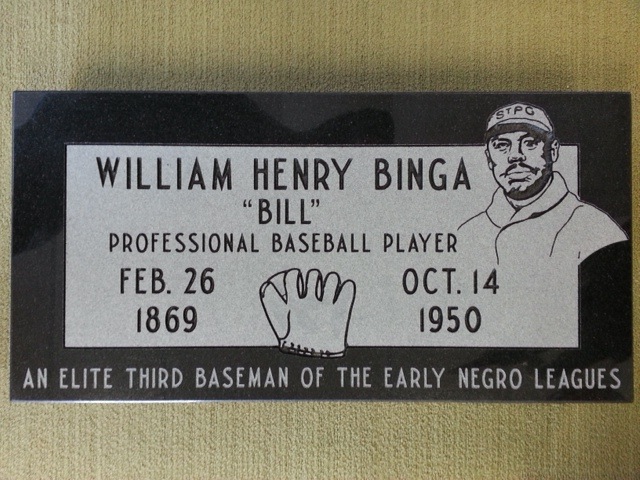
The first is that the dedication of the William “Bill” Binga grave marker (above) has been scheduled! It’s slated for Saturday, June 28 at 11 a.m. (CST) at Crystal Lake Cemetery in Minneapolis, according to Peter Gorton, the Minnesota baseball guru who has headed the project up for the Negro Leagues Baseball Grave Marker Project.

Bill Binga was a star and crucial figure in pre-Negro Leagues African-American baseball in the first couple decades of the 20th century. But in addition to being a top-notch ballplayer, he was also part of an accomplished and influential family and heritage, which I discussed in this article for the Hour Detroit magazine Web site.

The Binga’s grave marker has been funded by the Dave Winfield Foundation; Hall of Famer Winfield, of course, played for the Twins for several years.

Will Herb Simpson be a token in NOLA?

I recently published a post about lifelong New Orleans resident and former Negro Leaguer Herb Simpson being inducted a couple weeks ago into the New Orleans Professional Baseball Hall of Fame. I also posted about the apparent sorry state of local baseball legend Wesley Barrow’s grave in New Hope Baptist Cemetery in Gretna, La. Well, I’ve got a couple updates about those topics …

Regarding Barrow, I drove past the cemetery yesterday (Sunday), and it appears that the facility was cleaned up a little recently, i.e. mowing was actually done, etc., and there were a handful of people visiting the park as well. Of course, yesterday was Mother’s Day, so maybe that’s what all the hubbub was about. Maybe …

About Herb and the Hall of Fame … a couple weeks ago, I sent this e-mail to Dave Sachs, the PR guy for the New Orleans Zephyrs, who sponsor the local hall:

Hi Dave,
Does the induction of Herb Simpson — the first Negro League figure to be so honored — mean other such figures will be considered in the future, i.e. Allen Page, Oliver Marcell, Dave Malarcher, Wesley Barrow, etc., etc.?
Ryan
I have yet to receive any response whatsoever, which is a little unsettling. To be fair, Dave has said in the past that he’s not really the precise contact person for the Hall. However, also in the past, I’ve had trouble contacting the person who is the precise person for that. That all makes me nervous that Herb Simpson was inducted as a sort of token representative of the Negro Leagues. I’m certainly glad that Herb was given the long-overdue honor, but he should only be the first.
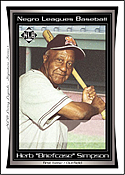
Here’s a baseball card that in recent years recognized Herb. It’s from Legends of the Negro Leagues:
Image


Malloy early-bird deadline

Trying to get in two or three short-ish posts today …

This one is just a reminder about the Society for American Baseball Research’s Jerry Malloy Negro Leagues conference this August — Thursday is the deadline for the early-bird registration.

It should be a very interesting gathering; the topic is African-American baseball in Detroit and the rest of Michigan, much of which remains a somewhat unexplored topic. Plus I’ll be giving a presentation there on Detroit native William Binga.

Sorry, had to get that little personal plus in. 🙂 Hope to see you in the Motor City!

Another “unknown” in Douglass park

Tomorrow a large group of fans, philanthropists, historians, community activists, political officials and clergy will gather at Frederick Douglass Memorial Park on Staten Island to officially dedicate the grave stone that has been placed on the previously unmarked burial place of black baseball legend and Baseball Hall of Famer Sol White. Here’s my story on the event in the Staten Island Advance.

But there is much, much more work to be done at Douglass park, which is currently being nurtured back to health by a dedicated group of community advocates. But in addition to the massive task of bringing this historically vital cemetery back to life — which includes, for example, cleaning up and placing a marker at the grave of classic blues singer and “Queen of the Blues” Mamie Smith — there’s another significant Negro Leaguer who lies in an unmarked grave in the park.

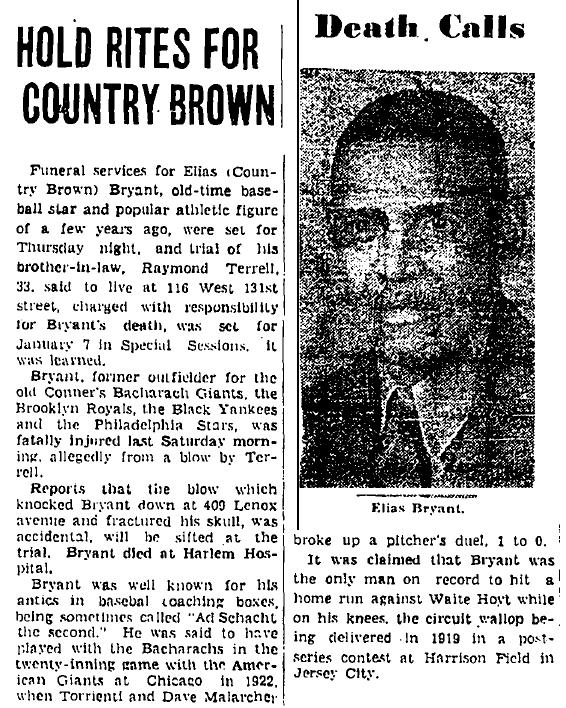
That would be Elias “Country Brown” Bryant, a clever, slashing hitter in the 1920s or thereabouts. He was also one of the more famous “baseball comedians” in history, able to both change a game with his timely hitting as well as crack up the crowd with comic antics. Here’s what a 1926 article in the Amsterdam News said about Country Brown (he was playing for the Bacharach Giants at the time):

“With Country Brown and Roy Roberts on the coaching lines the fans are sure to be kept in good humor [in a game against K.C.] with their comedy antics and clever coaching. Brown, without a doubt, is the most comical player in the colored ranks and aside from his clowning stunts he is capable of playing a splendid article of ball.”

Unfortunately, Bryant’s saga didn’t end well whatsoever. At Christmastime 1937, Country Brown was killed when he was crushed in the head by his brother-in-law. Bryant was pronounced dead a short time later at Harlem Hospital and buried in a pauper’s grave on Staten Island at Douglass park, just like hundreds, if not thousands, of poor African-American residents of New York City. For more info about Country Brown’s death, check out Gary Ashwill’s blog entry on the subject, which includes the following vintage article:

Image

Help is needed to bring dignity in death to Country Brown, just like it will be tomorrow for Sol White. Please consider supporting either the Friends of Douglass Park or the Negro Leagues Baseball Grave Marker Project to further the effort.

Geddy doesn’t want to talk to me

Image

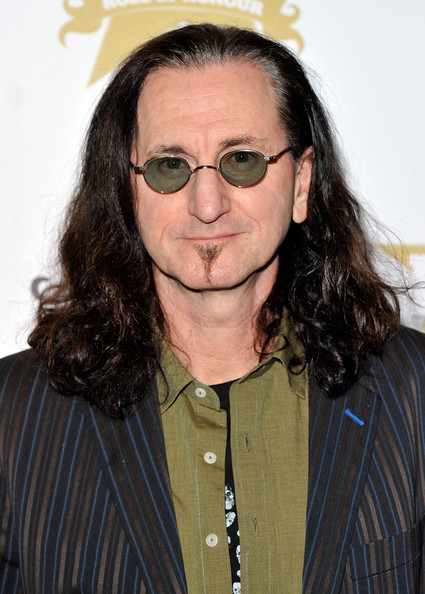
I was hoping to somehow land an interview with Geddy Lee, the singer/bassist for the classic/prog rock band Rush because of his love of baseball and its history and, especially, his massive donations to the Negro Leagues Baseball Museum. So I e-mailed the band’s talent agency, SRO-Anthem, and got this reply:

Thank you, but we’ll politely have decline the request at this time.”

I was a huge Rush fan in high school. My favorite album was “Hemisphere.” Now I’m a sad, sad panda.

The truth is out there

I just traded e-mails with a couple very knowledgeable sources about the 1925 murder in Harlem of South Carolina native Benjamin Adair and the possible connection to the incident of baseball stars Dave Brown, Frank Wickware and Oliver Marcell.

One of the people I’ve been e-mailing with is Gary Ashwill — who just today published a post to his blog much like mine here — one of the most dogged researchers of the Negro Leagues and other baseball topics I have ever met. He’s blogged in the past about Dave Brown at one time being charged with Adair’s murder and the apparent arrest of Brown roughly a dozen years later in Greensboro, N.C.

But Gary isn’t positive that the Dave Brown nabbed in the Tar Heel state on a totally unrelated charge is, in fact, the great Dave Brown, Negro Leagues twirler extraordinaire. It simply remains a mystery regarding whatever ended up happening with Dave Brown.

The second person I traded messages with was an ex-NYPD officer who said that the Adair case would, at this point, be housed in the NYPD Cold Case unit because it technically remains unsolved. He also warned that matters “things not always being what they appear to be, don’t rule out mistaken identity.  Not every murderer kills the person he/she intended to kill.” 

Perhaps that fact, he said, is why such incidents as mysterious murders are so intriguing to people. Just look, for example, at the unbelievably massive research/writing/speculation/fictionalization that has been done on Jack the Ripper in the last 150 years.

The Adair case, combined with my probing of the last years and deaths of Sol White and Dick Redding in Long Island mental hospitals — a challenge that Gary has offered to help me with, btw — as well as several other subjects, has just finally made me realize how much mystery and just plain unknown there is in the history of the Negro Leagues. Just so, so much remains unsolved, and perhaps always will be.

And some of it just makes no sense on the face of it. Take, for example, the case of 19th century St. Louis businessman, political activist, gambler and base ball mogul Henry Bridgewater. The guy was a titan in the 19th century blackball scene. He was also extremely wealthy. And yet he’s on the list of possibilities for the Negro Leagues Baseball Grave Marker Project. Professor James Brunson, the preeminent expert on black base ball in the 1800s, told me the fact that such a successful rich man is seemingly buried in an unmarked grave just, well, makes no sense. Perhaps, James said, Bridgewater’s headstone was stolen or otherwise lost. The situation just begs the simple question: Why?

Another case in point: The origins of Hall of Fame hurler Cyclone Joe Williams, a subject that has piqued my interest because Joe was reportedly of mixed black and Native-American ancestry. We know that he came from somewhere in Guadalupe County, Texas, probably the small town of Seguin and was born sometime in the 1880s.

But the following information just amazes. With the aide of Bill Staples Jr., I’ve found that the 1900 Census lists two families in Guadalupe County that could be the ones we’re looking for. One family has a “Joe William” (no s) born in 1886, with a mother named “Lillie William.” But the other family has a “Joe Williams” born in 1880 with a mother named “Lottie Williams.”

Given that at the time, birth certificates weren’t required in Texas, and that, unfortunately, both families were African-American, and the establishment in the South, including Texas, didn’t exactly concern itself too much with anything to do with their black residents — as long as they stayed away from whites, of course — the ongoing confusion about Cyclone’s roots is as understandable as it is frustration.

ill, by the way, tends to believe that the “Joe William” born in 1886 is, in fact, the one that went on to a Hall of Fame pitching career, and I definitely agree with him.

But the mysteries don’t end there. If Cyclone was, in fact, part-Native American, exactly what tribe is he linked to? Some biographies say he was part Comanche; others say Cherokee. Two very distinct and unique cultures.

And trying to chronicle Joe’s Indian ancestry will almost certainly enter into a rat’s nest of mystery, given the massive upheaval in the American West in the 19th, caused by our country’s theft of the natives homeland and livelihood, all in the name of “Manifest Destiny” and “the White Man’s Burden.” What are country did in the 19th century was, quite simply, genocide.

So, when you take the two strains of Joe Williams’ heritage, one is almost certainly rooted in slavery, and the other is grounded amidst a backdrop of genocide. How can anyone possibly prove where Joe Williams came from?

I apologize for rambling here. It’s just that at times like these, it’s hard not to get overwhelmed with all the work we researchers, historians and journalists have to do, and with the knowledge that, no matter how hard we work, we might never know who killed Benjamin Adair, or why Dick Redding was committed to and died in an insane asylum/house of horrors, or if Joe Williams was Comanche, Cherokee or even Indian at all.

But while it’s overwhelming, it’s all the more reason to keep at it, to keep pursuing the truth. Not to veer too far off the path, but to quote one of my heroes and favorite TV shows (Fox Mulder and “The X-Files”), “The truth is out there.”

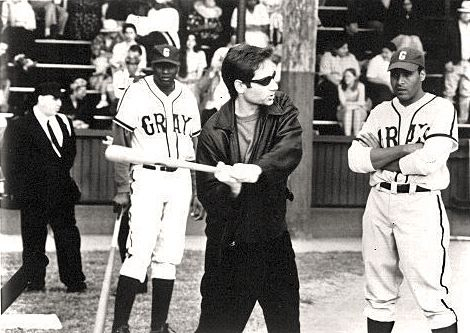
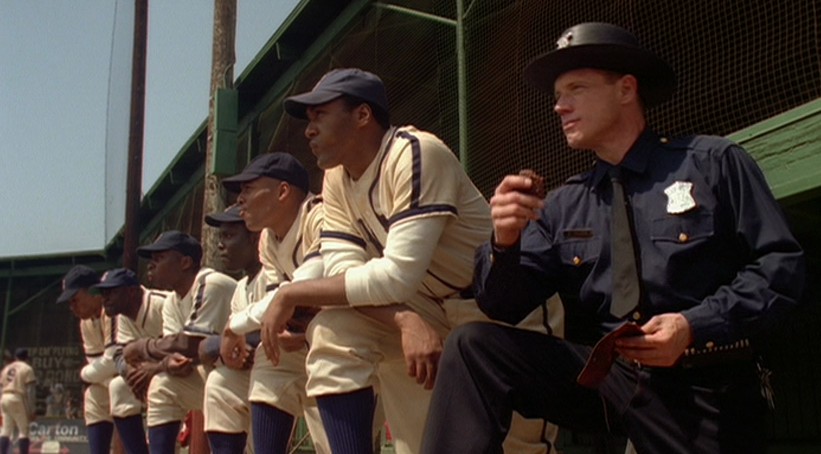
Obviously the truth we as Negro League historians doesn’t involve little green men or flukemen … or does it? tumblr_lkjr66r2Cc1qg6jp5o1_500 There was an episode of The X-Files called “The Unnatural,” which was a brilliant look at the Negro Leagues placed in the context of alien visits. I know, it seems impossible, but if you can ever watch it, definitely do. It’s very touching and might even choke you up in the end.
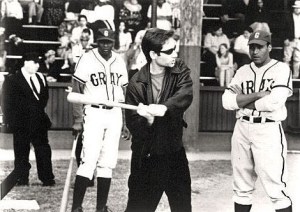
It also features David Duchovny wearing a Josh Gibson jersey. Pretty cool. (And yes, that is indeed Jesse L. Martin, aka Det. Green from “Law & Order,” playing the role of Josh Exley, an homage to the real Josh). ExleyGreysDale
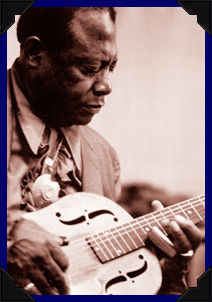
Bukka the baseball player?

Image

In addition to being a baseball history enthusiast, I’m also a major music fan, and my favorite genre is the blues. Those two interests might intersect with the guy above, Booker T. “Bukka” White, a singer/guitarist/occasional piano player who recorded and played live for roughly a half-century, beginning in the late 1920s and running until his death in 1977. Bukka was an early purveyor of the country, i.e. largely acoustic guitar-based, blues as espoused by everyone from Blind Willie McTell to Son House to Blind Lemon Jefferson.

As it turns out, the stories of many early blues musicians are very similar to those of Negro Leaguers — fascinating and mysterious, thrilling but clouded by fragmented memories and tall tales. In White’s case, one of those tall tales and points of braggadocio might have been an apparent boast that at one point, he supplemented his music income by playing semipro/professional baseball with all-black, segregation-era teams.

This assertion has been repeated so many times biographers that it’s become accepted fact. But the true fact is that there’s just about zero actual evidence to support such a claim. In the book, “Traditional Tennessee Singers,” edited by Thomas G. Burton, White is quoted as saying he starred for the stellar Birmingham Black Cats.

The problem is, however, if such a team even existed — let alone included Bukka on its roster — there is pretty much nada in terms of a record of it. I scoured several online newspaper and other databases, and all of the Negro Leagues experts to whom I spoke had never come across any evidence that White did, in fact, play pro ball and had never heard of a team called the Birmingham Black Cats.

There was, of course, the Birmingham Black Barons, that city’s primary Negro Leagues team for years, and there was the lower-level, barnstorming team, the Laurel (Miss.) Black Cats. Dr. Layton Revel of the Center for Negro League Baseball Research, who would know if anyone did, says it’s possible that White meant the Laurel Black Cats, given that he was born and raised in Mississippi. Dr. Revel adds that he’s never found any mention of a Booker or Bukka White with the Birmingham Black Barons.

So did Bukka White play in the Negro Leagues? It’s of course possible, given that White is a very common name that whows up in countless game box scores over the years. But on the other hand, there is zero evidence that any of those Whites are him.

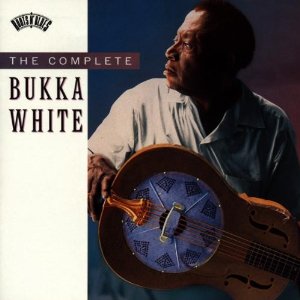
But, man oh man, his music is fantastic. If you want a starter CD to test out Bukka’s stuff, try this one, a popular Columbia compilation:

Image

Dignity at long last for Sol White

Here’s an article I had published Sunday in the Staten Island Advance on the grave marker dedication for Sol White this coming Saturday:

Thanks to Gary Ashwill, Patricia Willis of the Friends of Douglass Park and Jeremy Krock of the NLBGMP for being willing to answer some questions for my story. If you’re within a day trip’s driving distance of Staten Island, think about attending the ceremony Saturday. I wish I could be there, but, alas, NYC is a wee bit of a drive from NOLA.

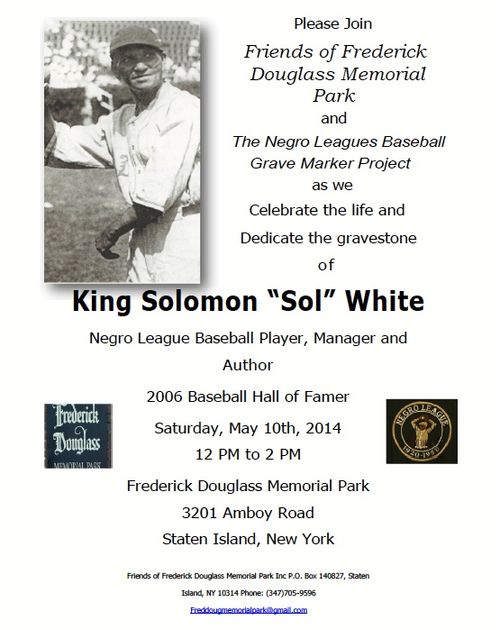
Here’s a poster/flyer for the event, courtesy of Gary’s blog:

6a00d8341ccce053ef01a73dbb9089970d-500wi