Snapshots of Waxey Williams, Part 1

Many apologies for not putting up anything new for a week or so — May is Jewish American Heritage Month, and I’ve been busy research and writing about Lipman Pike, the first Jewish superstar, the sport’s first great power hitter and one of the game’s first openly professional players. I actually just had this article published at philly.com.

ClarenceWilliams

Anyway, I’ve been assigned to write an article for the Press of Atlantic City about fantastic turn-of-the-century African-American catcher Clarence “Waxey” Williams, who, while being born in Harrisburg and living (and playing) in his hometown for much of his life, ended up dying and being buried near Atlantic City.

Williams is currently high on the priority list for the Negro League Baseball Grave Marker Project, which is the hook of my story for the press. As a result, I’ve been doing beaucoup research about Waxey, his life and his career. Of course, I still have a lot more to look into, but I wanted to do a couple blog entries about some tantalizing nuggets from the contemporary mainstream media’s coverage of Williams, as well as his roots and his genealogical background.

This post will zero in on some of the more fascinating ways the newspapers covered Williams and the teams for which he played, especially the great Cuban Giants and various Harrisburg squads.

Williams is best known as one of the first players on the roster of the Cuban Giants, the sports first professional African-American team, in 1885. For much of their existence, the Giants were based in Trenton, N.J., a city which seemingly, as far as I could tell from media reports, treated the squad with a mixture of pride, puzzlement and paternalism (apologies for the alliteration, I couldn’t resist). That included descriptions of Waxey Williams.

dt.common.streams.StreamServer.cls

Let’s begin with one of the Trenton Advertiser’s preseason evaluations of that year’s Cuban Giants club, in which the paper went player by player. Here’s how the publication described Clarence Williams:

“Catcher No. 2. Clarence Williams was born January 27th, 1866, at Harrisburg. Played left field for the Harrisburg’s [sic] in ’82, caught for the Middletown base ball club, of Pennsylvania, in 1883, and played the same position for the Williamsport professionals in the early of the season ’85, and joined the Cuban Giants the later part of the season. He is a heavy batsman, a fine base runner and good catcher.”

Within a couple years, Williams had apparently become somewhat of a fan favorite in Trenton and elsewhere, in large part because of his enthusiastic approach to coaching and encouraging his teammates.

One article in 1887, under the headline, “Williams’ Great Luck,” highlights his feat of scoring two runs in one inning against the New York Reserves. It also refers to Williams multiple times as the Cubans’ “mascot,” a tag that, at least contextually in such articles, seems to mean more of a coach than, say, the Phillie Phanatic. Stated the Times:

“In the seventh Clarene Williams coached his fellow-players. There were two men on the bases when Whyte took up the bat. Clarence paralyzed the Reserves by his ‘R-o-o-t the Air!’ and other encouraging coaching terms. …”

A week later, on May 7, 1887, the Trenton Times wrote thusly:

“Clarence Williams is popular with the occupants of the stands. His peculiar coaching at first base brings down the house every time.”

In 1890, Williams had shifted to the almost-all-white Harrisburg team on the Eastern Interstate League, where he and Frank Grant brought the only diversity to the squad and the athletic proceedings.

In February of that year, the Philadelphia Inquirer described how the Harrisburg players were getting in shape for the impending season by cultivating their home diamond and ground themselves. However, according to the Inquirer, in what smacks of the old stereotype of the “lazy Negro”:

“Clarence Williams, late of the Cuban Giants, does not take so kindly to landscape gardening.”

The press also reported the events when Williams got into a legal jam in August 1891, when he was arrested when the Cuban Giants — to whom Williams had returned — ventured back to Trenton and defeated a local (apparently white) club. Here’s how a wire service article described what happened next:

“After the game a riot broke out, caused by Thomas, the catcher of the visitors, cuting a ball belonging to the Trentons. “Selden, Thomas and Clarence Williams were the ringleaders in the row with followed. Some desperate head pounding occurred before the disturbance was quelled. The special officers arrested the members of the colored club and took them to jail, but no one speaking against them to make charges they were released. Later warrants were issued for Selden, Thomas and C. Williams, and officers are now looking for them.”

It’s not immediately apparent what became of that legal dust-up, but it’s … interesting, to say the least, that pretty much the entirety of the “riot” was blamed on the African-American team in general and especially the three named players.

But that, apparently, wasn’t the only time Williams was accused of violent acts. By 1896, Waxey had actually become a police officer in Harrisburg, but his tenure as a cop didn’t go all that well, it seems. Penned the Sept. 16, 1896, Harrisburg Patriot under the header, “Clarence Had Foresight”:

“Clarence Williams, the baseballist policeman, who ws under suspension for brutally clubbing a man, probably read the writing on the wall and forestalled dismissal by sending his resignation to Mayor Patterson yesterday morning.

“Williams’ letter was brief; after the usual tender of resignation, he wished the mayor ‘all the successes you deserve.’ The mayor promptly accepted the resignation, but did not make any appointment yesterday, although he announced that he had made up his mind as to who would be appointed.

“Alex Barber, a well-known colored politician of the Fourth Ward, will be appointed in the place of the ex-catcher of the Cuban Giants, who will probably swing a baseball bat next Spring instead of the police mace which got him into trouble.”

Was the case against Officer Williams and his subsequent departure from the Harrisburg PD trumped up or exaggerated because of his race? That remains unclear and certainly could be debatable. But there is an interesting pattern here emerging — that of the media latching on to Williams’ alleged violent outbursts and rabble-rousing, fair or not.

But the turn of the century brought the media’s focus back to Waxey’s performance on the baseball diamond. For example, in June 1903, when Williams had shifted to the Cuban X-Giants (one of the offshoots of the original Cuban Giants), the Trenton Times reported on the Waxey’s gutsy hustle on one play in a game against a Trenton white team:

“Would any one think that Clarence Williams, who cannot remember just how long he played ball before the civil war, would have the nerve to bunt and try to beat it out to first? That’s just what he did Saturday. He bunted right down towards first base, and no one tried to say him nay. Cook, who should have covered the bag, looked in wonder as Clarence carried his burden of 250 pounds down the line and deposited it on Tommy Travers’ sack. Tommy had to go and get the ball but it was too late to do business with Clarence.”

OK, first of all, the phrase “deposited it on Tommy Travers’ sack” is a little creepy, if I might be so bold and blue. But beyond that, the article’s claim that Williams had started playing ball well before the Civil War is ludicrous given that it’s generally accepted that Williams was born in 1866, a year after the war ended. So where the paper got that info is mystifying.

There’s also the question of whether there are any racial connotations when the paper uses the term “have the nerve” to beat out a bunt. Does that innocuously mean simply that any ballplayer would be gutsy for trying to do so? Or is there a more subtle and sinister implication that an “uppity colored player” had the gall to do so to against a white team.

We may be able to glean a little of the Trenton Times’ attitude in the very same issue of the paper, only a few short articles down the same column:

“We thought we had a pretty good team until the Giants came here and that’s no fairy tale, but the big blacks made us look so foolish that in the future we will have nothing to say. You win, ‘Mistah’ Williams, and we do not hesitate to say that we think your bunch of midgets could have scored about twice that many runs had you desired. Some day we hope we will have a team that will keep you warmed up while playing but at present we are forced to admit that we are too easy.”

Sure, that is, at least for the times, a pretty nice compliment to the X-Giants and a self-deprecating, realistic assessment of the home team’s generally lousiness. But even then, with terms like “big blacks,” “Mistah” and “bunch of midgets,” there’s embodied shades of stereotypes and racial connotations.

Since this post is already getting fairly lengthy, I’ll stop there, but just from that you get a gist of the media’s attitude not just toward a burly, talented, African-American player, but also journalists’ regard and perception of black baseball players of the day.

I’ll try to have two more Waxey entries over the next couple weeks, one on his genealogical background, and another on his leading an all-star team to Cuba.

Winfield and Wesley go live

I’m working on some fresh blog fodder that I’ll hopefully have up soon, but for now, I had a couple stories published over the last couple weeks …

This one I wrote for the Louisiana Weekly newspaper about the Wesley Barrow grave ceremony …

This one I penned for Louisiana Life magazine and myneworleans.com on the great but vastly underrated manager and Napoleonville, La., native Winfield Welch …

Enjoy, and many thanks, as usual, for reading!

Ducky Davenport, where are you?

Holt_Cemetery,_New_Orleans,_Louisiana

Holt Cemetery, New Orleans

Honestly, the more I dig into the question of where Negro League All-Star and NOLA native Lloyd “Ducky” Davenport is buried, the more stymied and, frankly, the more bummed I get.

Every new piece of information I pick up just frustrates, confuses and/or dismays me, and there’s been so many of them flowing in that it’s hard to know where to begin here. So let’s start with this …

My colleague and mentor Gary Ashwill at Agate Type emailed me after my first post on Ducky and asked me, among other things, from where the “established” birth and death dates for Davenport came. Those dates, according to multiple online sources are Oct. 28, 1911, and September 1985 (no exact date).

When I thought about it, I really didn’t know how those dates were established. In fact, the only record I could find of any document properly fitting this Lloyd Davenport’s birthday was a airline passenger manifest that gave it as Aug. 20, 1911, a more-than-two-month discrepancy from what’s been “established.” I’ve found no draft card, no death record … nothing like that for a person fitting Ducky’s description.

41258_320637-00188

But while fumbling around ancestry.com, I think I’ve finally found where those dates came from — a Social Security death index for a man with those exact same dates named … George Davenport. The record states that his SSN was issued in Illinois, which would make sense given that Davenport played a couple years for the Chicago American Giants.

But George Davenport? What?!?!?!

I gave this info to Gary via email, and he responded that while he’s come across numerous cases of misidentification of people by Social Security and other databases, but rarely an instance when the first name is completely different.

Upon further review, I suppose it’s not totally beyond the bounds of reason that Lloyd was given the misnomer of George by the government — I’ve gathered, through Census and other records, that George was the name of Ducky’s paternal grandfather, who was born in Mississippi in about 1852, moved to New Orleans (where he toiled, I believed, as a porter) and died in January 1910.

But Social Security’s apparent flub might not be the only time Ducky was misidentified by the powers that be. In September 1939, when NOLA Negro Leagues promoter and executive extraordinaire Allen Page was putting together his first North-South All-Star game, the Times-Picayune listed, in really tiny type, the lineups for the two teams. One of the outfielders was stated as “Walter Davenport, who batted .315 with the Memphis Red Sox, a native of New Orleans …”

Umm, no, T-P, that’s Lloyd Davenport, not Walter. Doy. I’m pretty sure of that, because Ducky did play for the Red Sox in ’39.

But I think I know from where the mainstream — and, in the 1930s, fairly racist — paper got that name. Walter Davenport was Ducky’s father’s name. Walter Davenport was born in 1884, according to Census records and his World War I draft card. I haven’t been able to pin down a death date yet.

But wait! Even more confusion! Because another one of Walter’s sons — and therefore, Lloyd’s brother — was named Walter Davenport Jr., who was born in 1906 and died in 1948, according to Social Security and death records. However, what I think is Walter Jr.’s WWII draft card lists a birth date of June 30, 1909.

004735992_01235

But regardless, I’ve found no record that Walter Jr. ever played pro ball.

Also complicating matters is that there appears to be another African-American Davenport family, including a Walter Davenport, existing in New Orleans at the same time on a parallel track. I think I’ve followed the correct Davenport familial line by matching up city directory addresses and other documents, but I’m certainly not ready to rule out a connection between the two Davenport families.

While all this name confusion has been unfolding, I’ve done a couple other things to see if I can find Lloyd Davenport in death. One was to follow up the lead given by a 1994 newspaper article that states he died in 1988, not 1985. As mentioned before, the online archives for the New Orleans Times-Picayune and other mainstream papers don’t report any deaths of a Lloyd Davenport in 1988.

So I tried the Louisiana Weekly, the local African-American paper. I went through every single issue in 1988. The hard copies. By hand. Had fingers covered in ink.

But I found nothing, zip, nada, zero. So there goes that idea.

Then I called the offices of Holt Cemetery back. Holt is one of the city’s biggest burial grounds for the local indigent, a so called potter’s field. Several members of Lloyd Davenport’s family, including his parents Walter Sr. and Rody, are interred there.

Given the revelation of the SSA’s seeming misidentification of Ducky’s name upon his death, I asked a staffer at Holt — which is owned by the city of New Orleans — if there was a record of any Davenports buried there anytime in 1985.

Nope.

But I asked her a couple other questions as well, and the answers depressed me even further. I posed if there are any sort of “family plots” at Holt. She said no, not really. Then I asked if the graves in the cemetery are marked are unmarked.

She said that in all likelihood, they’re unmarked.

Sigh.

There’s also indications that Lloyd Davenport could very well have been buried there, though, based on a few court records I’ve found in newspaper databases that indicate he had some financial trouble later in life.

Davenport_LLoyd

In June 1961, the Aetna Acceptance Corp. received a roughly $550 judgment against him in First City Court, while in January 1967, Home Finance Services received a roughly $330 judgment against Lloyd in First City Court.

Those court records also seem to indicate that Ducky did live, and quite possibly die, in his hometown instead of somewhere else, which helps firm things up in terms of place of death.

One final thing … In my previous post I discussed how one of Ducky’s grand-nephews, Roy Hopkins Davenport, died of a gunshot wound a half-block away from his father’s, Alvin Davenport Jr.’s, home in Gert Town in August 2005.

After I wrote that post, I was reminded that Katrina happened that month, but Roy’s death occurred a couple weeks before the storm came. But that still left open the details of that death, because the Times-Picayune didn’t cover it beyond a brief obituary.

So I asked my buddy, David Hammer, at WWL TV, to see what archival reportage the station might, and David and his supervisor, Dominic Massa — many thanks to both, btw — did find coverage of the death …

It seems that between 11:30 p.m. Aug. 15 and 6 a.m. the next morning, there were actually four murders in the city, a shocking spate of violence. The final one of the four was Roy Hopkins Davenport’s. According to the WWL reports, 28-year-old Roy was allegedly shot by 23-year-old Michael Jackson (yes, that appears to be his real name), who was being sought by police. Roy died at the scene on the 7200 block of Fig Street and was, as his published obituary stated, buried in Holt Cemetery.

That’s all the details that were in the TV reports, so I still don’t know about a motive or what happened to Jackson. But we know now that one of Ducky Davenport’s descendants was murdered, an event that only adds to the entire aura of gloom over Ducky’s story and the search for his burial location.

I’ll keep doing more digging, but as stated in my last post, it’s looking more and more likely that the only way to solve this mystery is by contacting people who might be living relatives of the great, and mysterious, Lloyd “Ducky” Davenport. And again, if anyone might have any information or clues that could held solve this mystery, please feel free to email me at rwhirty218@yahoo.com.

A painful inquiry

Davenport,Lloyd

The question I’ve come to pose to myself is this: how do you even approach someone about a highly sensitive subject when their lives — and to a large extent their entire bloodline — have been riddled with hardship?

I’ve now become fascinated by the fate of New Orleans native and longtime Negro Leaguer Lloyd “Ducky” Davenport. Ducky’s playing career was certainly solid — he played in the blackball big time for about 15 years for teams like the Birmingham Black Barons, Chicago American Giants, Memphis Red Sox, Cleveland Buckeyes and Cincinnati Tigers — but he wasn’t a superstar by any means.

According to contemporary reports and fellow players, Ducky — who got that nickname because he seemed to walk with a waddle thanks to his stumpy legs — was a premier fielder in the out garden and a savvy hitter and baserunner. As contemporary and fellow New Orleanian Bob Bissant told reporter Ted Lewis in 1994:

“He was a little bitty guy, but he could hit the ball, and he could run a lot faster than anybody though. He could play just about any position, and he was a good football and basketball player, too, when we were kids.

“He could beat you just about every way but with the home run, and he probably hit a few of those, too.”

But Davenport, who also had a cup of coffee in the minors toward the end of his career circa 1950, wasn’t a Hall of Famer by any stretch of the imagination, and when he retired from the game, he kind of disappeared, possibly into the crowded, gritty streets of his hometown of NOLA.

The story is, unfortunately, a familiar one, for vintage ballplayers of all races — a hardscrabble career followed by a vanishing into the ether after stepping away from the sport. But while that’s depressing, what’s even more heartrending is that now, roughly three decades after he died, no one seems to even know where he’s buried.

And I don’t mean that his grave is unmarked in a known cemetery. I mean that it’s a complete mystery in which burial ground, if any, he ended up at all. The findagrave.com posting for him lists his burial as “unknown.”

What’s more, I can’t even seem to pin down in which year he died, let alone which month and day. Some online sources say he passed away in New Orleans in September 1985, but Lewis’ 1994 article in the New Orleans Times-Picayune states he died in 1988. And unfortunately, there’s pretty much no one left — at least no fellow ballplayers — who knew him personally and could attest to what happened to him in death.

What’s worse, I couldn’t find any evidence that Ducky himself had any children and, therefore, that he has any directly descendants. Plus, assuming he did die in New Orleans — and all known evidence points to that likelihood — I can’t seem to find any sort of obituary about him at all … Not in the Times-Picayune for either 1985 or 1988, or in the Louisiana Weekly, the local African American newspaper, from 1985. (I do still need to check the paper’s 1988 issues, but that could turn into a needle-haystack proposition.)

I do have a few leads, however, albeit vague ones. The primary hint is that both his parents, Walter and Rody Davenport, were buried in Holt Cemetery, one of New Orleans’ biggest and most popular “potter’s fields,” where residents of little means were often interred. Holt has struggled over the decades to remain kept up and in decent condition, which is certainly not unusual for a pauper’s cemetery.

005152060_01262

Holt Cemetery is now apparently owned and maintained by the city of New Orleans itself. But after speaking with a staffer at Holt, she said there’s no record of a Davenport being buried there in either 1985 or 1988. While she added that doesn’t complete negate the possibility that Ducky is buried there — she said the records they have were copied from earlier issues of the forms — it’s still unlikely.

So that leaves few avenues for investigation, a primary one being attempting to hunt down any sort of living relative of Ducky Davenport.

But that has proven problematic in its own right. Ducky, as stated, didn’t have any children of his own, but what about his siblings, Walter Alvin Davenport and Charley Davenport? If they had offspring, it would mean I might be able to locate nephews and/or nieces, or more likely given their age, grand nephews and nieces.

So let’s focus on Charley first. Well, actually, there’s not much there on which to focus. I couldn’t find out really anything about him — possible marriages or children, or even when he died. On that later count, the only clue I have is that in the 1953 obituary for his and Lloyd’s mother, Rody, he’s listed as “the late Charles … Davenport,” meaning he died before 1953. That’s all I got.

However, Ducky’s other brother, Walter Alvin Davenport, provides a little more promise. He died, according to the Times-Picayune, in December 1948 at the age of 42. Although the paper doesn’t provide anything in the way of a formal obituary — a situation that certainly wasn’t unusual for a mainstream Southern paper reporting the death of a black man in the 1940s — the single-line listing under “Deaths,” states that he died at Charity Hospital, an LSU-connected, now-closed facility that, in the first half of the 20th century, provide medical services to the poor an indigent.

004735992_01235

That seems to indicate that Walter, like his (and Ducky’s and Charley’s) parents, was struggling financially, to put it mildly, which could mean that he was also interred at Holt Cemetery.

In addition to that, Walter Alvin Davenport did have children. Although right now it’s somewhat unclear to me who Walter’s wife was or with whom he had those children, and even which Davenports listed in various Census and other records in New Orleans were his kids, there’s one child who is clear — Alvin Davenport, who was born around 1930 to Walter and Beatrice Davenport.

But there’s a lack of clarity here as well. While I’m still collecting and sifting through information, Beatrice and Walter Jr. might have divorced; while they and Alvin are listed in the 1930 Census as living together on South Johnson Street, later records show Alvin living with Beatrice, who has a different last name — Steptoe, I believe, but right now I can’t locate that record in my files, although I know I’ve seen it. (I’m old.)

And the 1940 Census lists Walter now living with what appears to be another wife, Mary, on Willow Street. Mary seems to have had a previous husband who died, Mac McCree. Mary herself passed in October 1986, about 38 years after the death of her second husband, Walter Alvin Davenport.

But given the 1930 Census placing Alvin with Walter and Beatrice, and the 1940 listing including Walter in Beatrice’s household, it’s clear to me that, at least, Alvin is indeed Beatrice and Walter’s son.

4300978_00499

Now, I’m still trying to string together when Alvin Davenport and Beatrice Davenport/Steptoe died, but I have indications that Beatrice and Walter had other children in addition to Alvin — namely, a 2013 obituary for an Edward “Red” Davenport that states he was the son of the late Walter and Beatrice Davenport and the brother of Delores White, Beverly Edwards, Carolyn Freeman and “the late Roy and Alvin Davenport.” Those are leads I intend to pursue soon, especially because Red’s obituary states that he was also buried in Holt Cemetery.

But for now, we’ll focus on Alvin Davenport. While, yet again, I can’t completely pinpoint when Alvin died, I did find a current home listing for what is in all likelihood his son, Alvin Davenport Jr.

And that, dear friends, finally brings us back to the very beginning of this post: how do I approach a couple that has endured tremendous hardship themselves and who don’t know me from Adam?

Because Alvin Jr. and his wife, the former Karen Mannery, have had not one, but two children die at tragically early ages. The first came in 1996, when their 15-year-old son, Rodney, died of cancer.

Then, in 2005, another son, Roy Hopkins Davenport, according to an obituary in the T-P, “died Tuesday of a gunshot wound at the corner of Broadway and Fig streets. He was 28.”In addition, Roy Hopkins was interred … in Holt Cemetery. Details of Roy’s death are unclear, because apparently the T-P didn’t cover it as a news story, so I’m not immediately sure if he was murdered or died of accidental causes. On top of the tragedy of Roy’s death, is even more tragic — and, unfortunately, not too surprising — that the city’s mainstream daily newspaper didn’t even bother to cover the violent death of a black man.

So how do I approach Alvin Jr. and Karen Davenport and ask them if they know where their great uncle, Negro Leaguer Lloyd “Ducky” Davenport, is buried? How do I approach them at all?

There’s also one more complication: I haven’t been able to find much of a phone number for the couple. But even if I could find one, how do I cold call them? Again, these poor people don’t know me from Adam.

I could just go to what’s listed as their home on Broadway Street, but — how do I put this as delicately as possibly — it’s in Gert Town, which is not the best part of town. Or at least a part of town where a mysterious white man knocking on a stranger’s door would raise some flags for the street’s largely working-class, African-American population. (Roy Hopkins Davenport’s death location is, actually, just a half-block away from his parents’ house.)

So that’s where things stand right now. In essence, I’m really not much closer to finding out where the great Ducky Davenport is buried — or, for that matter, even when he died. For all I know, he could have passed away in some other city than his hometown. Anything, at this point, is possible.

So if anyone out there knows anything about the fate of Lloyd “Ducky” Davenport, please feel free to contact me at rwhirty218@yahoo.com.

A park to honor a Gretna legend

IMG_1232

It apparently took his death for the City of Gretna to finally acknowledge Negro Leaguer and Gretna native J.B. Spencer‘s contributions to both the history of baseball and the city community.

Spencer, an infielder whose career included a stint with the Homestead Grays during their prime in the 1940s, died in May 2003. Two months later, the city renamed the park on Fried Street J.B. Spencer Park in a move that was long, long overdue.

Not only did Spencer play in the golden age of the Negro Leagues, but after retiring from baseball he worked for the city of Gretna’s recreation department for three decades, including a tenure as park supervisor.

According to a 2003 New Orleans Times-Picayune article covering the park name change, the move was recommended by City Councilman Jonathan Bolar. At the time, the paper quoted Mayor Ronnie Harris about Spencer: “His memory will live on in a park he truly loved.”

IMG_1222

That kinda gives you the warm and fuzzies, but you have to keep in mind that both the T-P and the city of Gretna virtually ignored Spencer’s contributions to baseball and community history right up until his death.

And there’s another factor here: unlike Gretna’s sprawling Mel Ott Park (named, of course, after the New York Giants Hall of Famer, whole was also a Gretna native), Spencer Park has always struggled to be kept up and maintained. That could be due to the notion that it’s located in a majority African-American neighborhood and serves mostly black kids and youth baseball leagues from that area.

It wasn’t until 2012 that upgrades to the park were adopted. The City Council approval of those upgrades in November 2012 was covered by the New Orleans Advocate, which noted that the funding would go toward refurbishing the lighting systems at the park, which was damaged during Katrina.

The project went ahead after the city clinched several hundred thousand collars in Community Development Block Grants and FEMA funding. Prior to that, the paper noted, the Gretna administration never had the money to fund such upgrades.

Leading the charge for the project was Councilman Milton Crosby, who recently also helped get a grave marker placed at the burial spot of local Negro Leagues managerial great Wesley Barrow.

“I don’t know if it was a priority until I started pushing it,” the Advocate quoted Crosby as saying. “I’m trying to look out for my community area. … We need recreation. People in the community are always asking me.”

IMG_1228

Will Spencer Park continue to receive the upkeep it needs and deserves? We’ll have to see. But as you can tell from the picture above, you can’t even really make out an actual diamond at the park’s primary ball field. That doesn’t seem good …

JB Spencer Park

IMG_1225.JPG

Now that Wesley Barrow has a grave stone and, at last, dignity in death, it’s time to move on to a few other New Orleans Negro Leaguers. Like, for example, Gretna’s own JB Spencer, who played in the Homestead Grays’ infield at the height of their success.

One thing on which I want to focus is the park in Gretna that’s named in his honor, and over the next few days I’ll write more. But before I go, I wanted to post this picture of the refreshment/storage/bathroom building at the park.

As you can see, it’s emblazoned with the logos of several vintage Negro Leagues teams in Spencer’s honor and to help teach the community about the history of African-American baseball.

More to follow … And always, many, many thanks for reading!

Reflections on a rainy day

IMG_1191

From left to right: Former Black Pelican Paul Lewis, Gretna City Councilman Jackie Berthelot, fellow Councilman Milton Crosby, World Series champ and Zephyrs commentator Ron Swoboda, primary grave marker donor Rodney Page, and sportscaster and UNO staffer Ro Brown.

We started to gather, a few of us, at New Hope Baptist Church Cemetery a little after 1 p.m. Saturday. I sat in the McDonald’s across Lafayette Street from the burial ground — I often do work there during the day, evening and on weekends — and watched as 90-plus-year-old Paul Lewis pulled into the cemetery in his gold-colored truck and started talking with Ro Brown, a mainstay on the local sportscasting scene for many years who now works in the University of New Orleans athletic department.

(Ro, by the way, was sporting a wicked awesome Negro Leagues Baseball Museum jersey. I said wicked awesome because I spent two years in Massachusetts. Some people in the Bay State even call soda “tonic.” Or, more precisely, “taw-nik.”)

I decided that I’d better gather up my things and head across the street to meet them. The skies were already looking ominously dreary and overcast, but then again, that’s the way they had looked all day up until that point Saturday, so maybe, I prayed, the rain will hold off for us.

I had been monitoring the local weather radar for a little while, in fact, and it didn’t look like anything heavy in the way of precipitation was on its way to disrupt the dedication ceremony we had planned for months. After all, NOLA Negro Leagues legend Wesley Barrow, whose brand-new grave marker we were coming together to consecrate and celebrate, deserved to be honored without the devious work of ol’ Jupiter Pluvius, as the old Louisiana Weekly editions used to describe rain.

I crossed Lafayette Street and joined Paul and Ro in the conversation, which involved Mr. Lewis reminiscing about the indelible impact, aka the Skipper, had had on his life. But after a few minutes of chatting, I felt them, sensed them plunking on my arms and face — the first drops of rain.

Maybe, a pondered aloud to my companions, it’ll pass over with just a little downfall of the wet stuff, nothing major. But the wet stuff gradually — slowly but surely — started getting worse and worse, steadier and steadier, harder and harder. This, the thought flashed across my mind, is not good.

Gretna City Councilman Milton Crosby, who had worked with me to plan the whole effort to purchase and dedicate a headstone for Wesley Barrow’s previously unmarked grave — a shameful state in which it had rested since he died on Christmas Eve 1965 — soon arrived, dressed to the nines in an elegant brown suit and his trademark City of Gretna hat, clutching an umbrella.

We all piled into Mr. Lewis’ truck to take shelter from the hardening rain, all in the shared hopes that it would pass without it getting much worse by the time the dedication ceremony officially kicked off as planned at 2 p.m. I had arranged for several representatives of the local media to cover the event, but as the rain became more and more forceful, I had a feeling that few, if any, of those reporters would come for this gradually soaking event.

IMG_1180

By the time City Councilman Jackie Berthelot pulled into the cemetery in his car, the skies had opened up completely, dumping sheets of rain on us mercilessly. We huddled to discuss whether we should continue with the dedication ceremony or postpone it until another day.

“We’re here now,” Councilman Crosby said, a smile on his face. “Let’s get this done.”

We deliberated for a minute or so and decided — let’s do this. A quick prayer, some brief words by those of us in attendance, and call it day — a short but, considering the circumstances in which we suddenly found ourselves, extra meaningful ceremony to honor a great man who influenced thousands of young African Americans over 40 years in America’s pastime.

When Ron Swoboda, a former Major Leaguer who was a crucial member of ’69’s Miracle Mets World Series champion team and now the color commentator for New Orleans Zephyrs broadcasts, showed up in a typically natty polo shirt, khakis and loafers, we all knew — if Ron could take time out of his busy day and show up in a torrential downpour to praise a man he never met, we can go ahead and do this.

By now the rain was coming down in sheets, and massive puddles were congealing on the grass surrounding the cemetery graves. We all splooshed our way toward the Skipper’s burial spot, clutching umbrellas that were constantly under threat of being whisked away by the brutal wind — or at the very least being turned inside out, or outside in, I suppose.

Councilman Berthelot said a brief prayer, and the men who had gathered took turns giving moving testimonials to both Wesley Barrow and the Negro Leagues in general. I had planned on taking notes as people spoke so I could include quotes in these blog posts, but the wind, rain and resulting clutching of an umbrella — which, by the time the ceremony, was bent and twisted beyond usefulness anyway — made note-taking impossible. Thus I’m winging it as I write this.

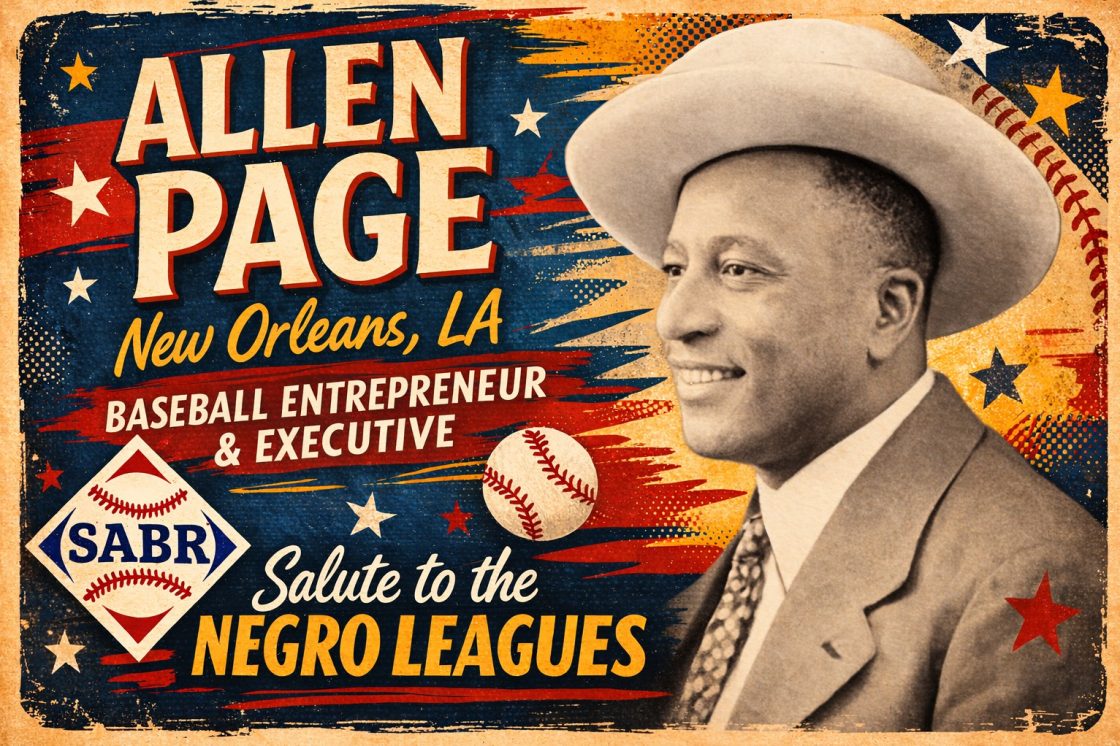
Rodney Page, son of the great sports promoter, owner and businessman Allen Page, spoke about playing for Wesley, as did Councilman Milton Crosby. Ro Brown, draped in a a rain-splattered and wind-blown blue poncho, clutched his plastic hood as he delivered his thoughts.

As we were gathered, my good friend and WWL TV reporter David Hammer arrived, as he had pledged, to join us for the ceremony, a gesture that meant a great deal to me personally and, I know, to the rest of those at the event.

But by far the most impressive, and, even more, the most moving dedication came from nonagenarian Paul Lewis, who played under Wesley Barrow on the New Orleans Black Pelicans.

Mr. Lewis, donning a World War II veteran cap on his head and a determined look on his face, sloshed through the puddles and spots of mud with his walker and umbrella to get to Wesley’s grave and pay his verbal and spiritual respects to a man who indelibly shaped his character and his future. When he spoke, his voice was craggy but firm, quiet but forceful. Wesley Barrow, Mr. Lewis said, was, quite simply, the greatest mentor he had ever known. Teaching was the most important duty for the managerial legend. What more needed to be said?

IMG_1192

We wrapped up the ceremony, loaded into our cars and went our separate ways. A quartet of us — David Hammer, Ro Brown, Rodney Page and I — departed, crossed the street and clustered at a table in McDonald’s so Rodney could show us the goldmine of vintage photos and articles of his father in his scrapbook. We joshed, we laughed heartily, we dried out as we sipped sodas and leafed through Rodney’s book.

After about an hour, we said our goodbyes, shared hearty handshakes and hugs, and went our separate ways. How the other three reflected on their experience that afternoon, I’m not sure. But I went home, shed my wet attire, fired off a quick blog post, jumped in the shower and headed to Zephyr Field for the Z’s 5-0 domination of the Nashville Sounds in the opening game of their eight-game homestand.

I’m back at Zephyr Field now, end of the second, Zephyrs up 2-0. It still hasn’t really hit me, exactly what that hardy group of us accomplished yesterday. Maybe I’ll never fully understand or comprehend it. Maybe I’m not really supposed to. How do you grasp the magnitude of the impact a man like Wesley Barrow had on a whole city, even parts of the entire country?

Well, enough philosophizin’ for now. All I have left to say is that if you’re ever in the N’Awlins area, perhaps driving down the Westbank Expressway and pass New Hope Baptist Church Cemetery, pull into the graveyard, find Wesley Barrow’s grave — the new marker has two crossed bats and a ball in between — and say hi to a New Orleans legend. He’ll appreciate it, and so will we.

IMG_7817

The official line, lol …

IMG_1191

Here’s text the official press release on the ceremony I just sent out. More hopefully tomorrow …

FOR IMMEDIATE RELEASE
Contact: Ryan Whirty
690-6551

Small group braves torrential rain to honor NOLA Negro Leagues legend

GRETNA — A small but hardy group of City of Gretna officials, former players and media members Saturday afternoon huddled around the freshly painted grave New Orleans Negro Leagues legend Wesley Barrow at New Hope Baptist Church Cemetery in Gretna to honor a man who managed, mentored and influenced hundreds, if not thousands, of New Orleans-area youth.

Clutching wind-blown umbrellas and standing in puddles, the group held a brief ceremony dedicating a new grave marker for Barrow’s burial spot, which had been unmarked for nearly half a century, since the man known as “the Skipper” died on Christmas Eve in 1965.

A community effort led by Gretna City Councilman Milton Crosby, who played for Barrow on the Black Pelicans, and local journalist and researcher Ryan Whirty strove to raise money to purchase and place the new marker at Barrow’s grave. Both were in attendance at the event Saturday.

Also attending the ceremony was Rodney Page, the son of former Negro Leagues promoter and owner Allen Page. Rodney Page donated several hundred dollars toward purchasing the burial marker, and at the event Saturday he spoke of his own memories of playing for Barrow as a youth.

One of Page’s favorite stories came when, as a teen, Page threw out a player at home on the fly from the outfield. As Page retold at the ceremony, he had been proud of what he thought was a stellar play. However, Barrow chastised the young Page by barking, “Little Page! Hit the cutoff man!”

Another attendee at Saturday’s ceremony was another ex-Black Pelican who played under Barrow, nonagenarian Paul Lewis of LaPlace, who told the group that for Barrow, the most important trait of managing was being a good mentor and role model, lessons Lewis said he took to heart.

Also among the group gathered Saturday was former Major Leaguer and World Series champion Ron Swoboda, who now works as the New Orleans Zephyrs’ color commentator. Swoboda spoke of his encounters with former Negro Leaguers and how important the all-black teams and leagues were prior to and just after the advent of integration begun by Jackie Robinson. After leaving the cemetery, Swoboda hustled to Zephyr Stadium to work Saturday night’s Zephyrs game.

Finally, longtime sportscaster Ro Brown, who now works in the athletic department at UNO, also spoke of Barrow’s importance to the NOLA community and the impact he and other Negro League figures had on so many youth in the New Orleans area.

The ceremony Saturday was begun with a prayer by Gretna City Councilman Jackie Berthelot and lasted about 30 minutes.

Attached to this email are photos from the ceremony, as well as a picture of the grave marker itself.


Impeccable timing

IMG_1185.JPG

I refer, of course, to the weather at the Wesley Barrow grave marker dedication, which is shown above. From the plethora of umbrellas, you can probably guess that it rained.

Not just rained, though. Torrential downpour, just as we started to gather. But we, we of hardy soul and soaked clothes, decided to go for it anyway. There were about 10 of us, and we stuck it out and dedicated Wesley Barrow’s grave marker.

I’m writing on my phone now, so I’ll try to write more as soon as I can. Here’s another photo:

IMG_1183.JPG

Why HBCU baseball history matters

SUBaseball_13

Southern University baseball coach Roger Cador (photo courtesy SU Athletic Department)

Roger Cador has been coaching baseball at Southern University in Baton Rouge, and in that time, he’s seen the importance of America’s pastime at HBCUs like SU gradually decline despite a rich history that stretches back a century or more.

And as the drop-off in interest has taken place, so has the desire among researchers and the public to document and preserve that history. That, Cador says, is unfortunate.

“It’s a story that’s extremely important for the making of the history of American baseball,” Cador says.

He says it’s crucial to remember the sociopolitical conditions in which many HBCU baseball programs developed in the late 19th century and early 20th century. The crucible of segregation and prejudice that existed during Jim Crow shaded everything about the black educational experience. That includes athletics, even into the mid-20th century.

“This happened at a time when baseball was king,” Cador says. “It was played in the deep South and at its height in the 1950s, in the 1960s, in the 1970s. We had a different country then, when people of color were denied social justice.”

Despite this, HBCUs have managed to produce numerous Major League players, led by Hall of Fame base swiper Lou Brock, whose tenure at none other than Southern proved to be a very fruitful experience that helped him blossomed into an elite player.

lou_brock-210x300

The great Lou Brock

Cador also pointed to two-time MLB All Star and 1969 World Series champion Tommie Agee, who attended Grambling, as another example of a top-level star to come from an HBCU. Agee was joined on ’69’s Miracle Mets by Alabama A&M product and childhood friend Cleon Jones, who batted a quite respectable .281 over an MLB career that lasted from 1963 to 1976.

“There were several guys who played in the big leagues at some point,” Cador says. “That says a lot about how important [HBCU baseball] was. There were a lot of great people that played baseball and were important to baseball.”

But the fertile history of HBCU hardball stretches back decades before that; for example, one of my favorite Negro Leagues players, and one of my favorite topics to write about, Gentleman Dave Malarcher, was a graduate, in the 1910s, of New Orleans University (now Dillard), where he led the varsity squad to an undefeated record over three seasons.

But, somewhat ironically, it was the integration of baseball that slowly crippled HBCU ball, much like it did the professional Negro Leagues. That dynamic was triggered in the South right here in New Orleans, when, in 1966, Tulane’s Stephen Martin became the first varsity athlete to compete in any SEC sport. (That was Tulane’s last year in the SEC.)

With the desegregation of college baseball, Cador says, HBCUs had a hard time competing for the attention of both young African-American players as well as African-American coaches, a phenomenon that sucked much of the lifeblood from HBCU programs, a complex development that continues today.

Cador goes so far as to say that major universities hoodwinked parents of African-American prospects into believing that HBCU baseball no longer mattered as a way to lure the youth to their own teams.

“Right now, with the height of baseball at the Division I level, it’s difficult for HBCUs to get coverage,” Cador says. “Everything is so big.”

That trend has been coupled a general decrease in interest in baseball among black youth, who now prefer to play football and basketball over the American pastime despite the rich, historical importance and influence African-American baseball.

But every once in a while, a few HBCU programs manage to return to the national spotlight, like Cador’s Southern Jaguars did in the early 2000s, when they toppled top-level teams like LSU and Southern Miss and had 24 players drafted by professional organizations.

Cador’s 2015 squad is currently a streaky 14-18.

SUBaseball_1

(Photo courtesy SU Athletic Department)

Such resurgences prove that HBCU baseball can be poised to make a major comeback on the national scene, even right now, Cador says.

“We are in a good situation where we can try to get the good players back,” he says. “We have the right things we need to attract them.”

In the meantime, it’s up to historians and researchers, as well as coaches and officials at HBCUs, to strive to preserve the legacy of baseball at historically black colleges and universities.

“[Many historians] don’t know the history,” Cador says. “I know the history.”