The Seattle-Cincy-NOLA connection, courtesy of Abe

2858_112051026345

Abe Saperstein presided over it all

I’ve been working on a story timed for Black History Month for CityBeat newspaper in Cincinnati about the Negro Leagues scene in the Queen City, but I couldn’t quite pull it all together in time. But I have gotten enough to write a shorter story for the paper and a couple posts here on the ol’ blog, so this will be the first of two pieces on Cincy here …

And this first story is one I just had to do because of its intrinsic connection to New Orleans. Introducing the 1946 Cincinnati Crescents, a barnstorming squad that was piloted by … none other than Napoleonville, La., native Winfield Welch, who was one of the best managers in the Negro Leagues in the 1940.

But there’s even more of a Crescent City connection to this quality traveling Cincy team. The guy who was pegged, at least early on, as the ace of the pitching staff was Groundhog Thompson, the stubby little NOLA native who got his nickname because he looked like, well, a groundhog.

groundhog3

The Groundhog


However, aesthetic bodily features aside, Thompson — whose last name might actually have been Thomas, but for purposes of this post will go with the former — was one of the best pitching prospects in black baseball in the early 1940s. Unfortunately, the Hog didn’t quite pan out in the big-time Negro Leagues, so in ’46 he reunited with Winfield Welch on the Cincinnati Crescents roster. (As a side note, the Crescents’ mound rotation included other Louisianians, like Johnny Markham and Robert “Black Diamond” Pipkins.)

But who were in Cincinnati Crescents?

They were one of the many brainchildren of legendary sports owner/promoter Abe Saperstein, who was best known, of course, as the founder and owner of the Harlem Globetrotters hoopsters. And in 1946, Saperstein was quite the busy little beaver in black baseball.

On one count, he joined with Olympic champion Jesse Owens to form the West Coast Negro Baseball League, the first major venture into region-wide Negro Leagues ball on the left coast. But not only did Saperstein preside over the circuit, he owned its Seattle entry, the Steelheads — who, of course, featured NOLA native Herb Simpson, who recently passed away.

(The WCNBL had several more links to the Big Easy as well, most prominently with manager Wesley Barrow, who managed the league’s Portland Rosebuds and who encouraged Herb to come up to the Great Northwest to play for the Steelies. A few of us down here in NOLA are currently in the process of obtaining a marker for Barrow’s grave.)

But at the same time Saperstein and Owens were forming the WCNBL, Abe was pairing with Winfield Welch to bring together the Cincinnati Crescents, an independent barnstorming (or mainly barnstorming) team named after one of New Orleans’ nicknames.

And in many ways, the Seattle Steelheads and the Cincy Crescents were one and the same organization, despite being thousands of miles apart geographically.

That link was even formalized in early spring 1946, when the Philadelphia Tribune (and possibly other African-American newspapers) reported thusly:

“One of the surest signs that baseball is at last on the right track and headed for the same widespread cooperation that organized league baseball enjoys is the announcement by the Seattle team of the new West Coast Baseball League that a tieup has been made with the Cincinnati Crescents, the club W.S. Welch is assembling. The two teams will train together in the South … and play a spring schedule of games together. Seattle will have first call on all players Welch will not keep for the Crescents.

“In return, Seattle will give Cincinnati first call to purchase any players they may wish to sell. In no way, however, is Seattle to be regarded as a farm club.”

I found that last sentence to be intriguing, especially when viewed in light of the article’s very first sentence trumpeting the Seattle-Cincy deal as a harbinger of the type of networking that had existed in organized baseball for years.

But one of the basic foundations of organized baseball has always been the farm system and the link between major league teams and the minor-league franchises in their talent ladder. But the last sentence of the Philly Tribune article seems to discount the farm-system concept.

And indeed, the Negro Leagues never really established any sort of farming method at all, although some top-level teams did have informal arrangements with lower-tier teams. Perhaps the best example of this is the loose relationship between the Kansas City Monarchs and the Monroe Monarchs.

But back to the 1946 plot line … in the same issue of the Tribune as the aforementioned article was another one headlined, “Gus Welch in Ohio Readying Crescents.” The story refers to Welch as a “great manager of baseball” who was pulling together a team with a moniker that was “a throwback to one of the great teams he managed that first brought him into the national spotlight, the New Orleans Crescent Stars.”

The article also notes:

“Welch will meet with Cincinnati leaders, who have promised him their full cooperation, asking only in return that he put on the field the same type of aggressive, hustling aggregations that he has had in recent years.”

It’s a deal on which Welch definitely followed through, beginning with the inking in March of the famed Ted “Double Duty” Radcliffe as a field manager-catcher-pitcher. Stated the Philly paper:

“Welch plans to build around the crack mound corps with young, dynamic and hustling players of the type for which he has become famous. The aggressive clubs he is noted for have been built up on this formula. Virtually all of the players who have become great under him were youngsters he developed and brought along carefully. He tolerates only winning ball players and they must hustle, and keep hustling, to play for him.”

After training with the Steelheads at one of New Orleans’ HBCUs, Xavier University, began plowing through an ambitious schedule, including a series with the mighty K.C. Monarchs in April and a barnstorming tour with the La Palomas squad from Havana.

The Crescents, who played what few home contests they had at Crosley Field, the Reds’ headquarters, then launched an eastern tour in June with a game in my home stomping grounds of Rochester, N.Y., against the famous bearded House of David aggregation.

tumblr_kxnhxyqejf1qz762fo1_1280

An incarnation of the Chattanooga Choo Choos

The Cincys stopped in Atlanta and Birmingham in July, then took part in a doubleheader at NYC’s Polo Grounds in September by taking on the Chattanooga Choo Choos of the Negro Southern League.

One clash in particular  stood out during the Crescents ’46 tour — a thrilling twin bill showdown for, perhaps, bragging rights in the Queen City in mid-July. That’s when they split a twin bill with arguably Cincinnati’s most famous Negro Leagues team, the Cincinnati Clowns, at Crosley Field.

The Crescents’ story didn’t end in 1946, though. In fact, the team once again became another crucial cog in the Saperstein sports empire. After fielding another hoboing squad in ’47 — when they managed to finished second in the prestigious Denver Post Tournament — the Crescents opened their 1948 season on late April of that year when they arrived in Chattanooga to play … Saperstein’s Harlem Globetrotters hardball team!

The clash was promoted in an April 17, 1948, article in the Atlanta Daily World, which described the Globies this way:

” … [T]his is the fourth season Abe Saperstein’s brilliant club has been in operation — the Globetrotters have come to be known and respected as a formidable factor on the diamond. Like their namesakes of the basketball court … the baseball Globetrotters mix high-grade thrilling play with the dash of showmanship so pleasing to the fans. A Globetrotter appearance is always a a novel an interesting occasion.”

The article then called the Crescents a “sparkling entry in the field of independent traveling Negro baseball teams … the Crescents have an even greater personnel than the one [that] grabbed off second place” in Denver the season prior.

harlem

The diamond version of the Globies

“With the Crescents are a number of top-ranking colored players,” the story added. “The team has a formidable hitting attack and boasts the pitching, defensive ability, speed and hustle to give any club a tense session.” In addition, the piece said Welch himself was “regarded as the top pilot in all Negro baseball …”

We ain’t done yet. To add to the madcap Saperstein empire, the Globetrotters of 1948 were piloted by Paul Hardy, who in 1946 had managed … the Seattle Steelheads! Another tangent to explore!

image

Herb Simpson with his Steelies jersey

Because, as the Cincy Crescents were putting together a solid record during the 1946 season, the West Coast Negro Baseball League, and the Steelies along with it, collapsed by early summer, proving a failure for Saperstein (and Jesse Owens) despite the venture’s ambitious plans.

With the disintegration of the WCNBL, the Steelheads evolved into a Saperstein-sponsored all-star team that subsequently launched a quite successful tour of Hawaii. On the team was a handful of New Orleans products, including the recently-passed Herb Simpson.

But further muddling matters was the fact that another Abe-funded team, the Cincinnati Crescents themselves, also played a series of 13 games in Hawaii in fall 1946 with the Hawaii Senior Loop Braves.

Convoluted and confusing? Definitely. I myself have trouble following it all. The trails from New Orleans to Cincinnati to Seattle and back to New Orleans form quite an interesting geographic triangle, all presided over by a man better known for creating a world-famous, clowning basketball team.

A mystery of ethnic identity

I’ll start this off with a quote about Native-American identity from the Web site for the Four Winds Tribe, the Louisiana Cherokee confederacy, which is based in DeRidder, La.:

“American Indians of western Louisiana agreed to publicly identify themselves appropriately, in 1995. These people had long been oppressed and out of fear of retaliation from the federal government had chosen to hide their true identities. Earlier there could be no public acknowledgement of their rich heritage.

“Those who owned land feared it would be taken from them if they admitted they were American Indian, so therefore, many many census records reflect the racial status as ‘White, Free Person of Color, Black or Free Person,’ obviously an incorrect category. These people were denied the right to be proud (publicly) of their roots. Several generations have been deprived of their human rights due to this extreme injustice.”

The quote addresses a theme that runs through Native-American history, a very tragic and heart-rending theme — that of the racial, ethnic and cultural identity of the American Indian. As I wrote in this post about Cyclone Joe Williams’ ethnic make-up, as well as this article I turned out about how Native-American baseball player Jim Toy, who spent virtually his entire life, and certainly his baseball career, “passing” as white.

The gist is very basic — life for many Native-Americans has historic been so difficult and rife with racial prejudice that Indians were frequently hiding their cultural roots from the public and “pass” for other races, even identifying as African-Americans, who as it was didn’t exactly have an easy row of it in American history.

Enter Wabishaw Spencer Wiley, a catcher for the legendary Lincoln Giants teams of the 1910s who served as the primary receiver for Williams and Dick Redding, among others all-time great black pitchers.

It’s thus an interesting quirk of baseball history that Hall of Famer Joe Williams, whose ethnic makeup walks the line between black and Indian, would form a battery with Wabishaw Wiley, a respected player of his era who would spend his entire life wavering between identifying as African-American and Native-American. Why would Wiley at times officially list himself as black while at other times calling himself Indian? Because, as several other cases in baseball history illustrate, American citizens were frequently better off identifying as something they, in reality, weren’t.

Wiley is a perfect example of such hindsight-derived public confusion. In essence, was this man who played in black baseball during the pre-Negro Leagues era African-American, or was he Native-American?

In some official documents, such as the 1910 and 1920 Censuses, Wiley described himself as “mulatto.” On other forms, like the 1940 Census, he states that he’s “Indian.” And on still other forms, like the 1930 Census and his World War I draft card, he called himself “Negro” or “African.”

005264791_00484

Tied up in his racial birth identity is the issue of where and when he was born. Many documents state that he was from Oklahoma — Muskogee, to be precise — but a few others say he was from Louisiana, a fact that makes me even more interested in his case, given my affinity for Louisiana black baseball.

Take, for example, Wiley’s WWI draft card, which states that he was born in “Vernon, “La.,” and the 1910 Census — at the time he’s a student at Arkansas Baptist College in Little Rock, Ark. — lists him as a native Louisianian.

VP-Logo-sign

Now, there isn’t a town or similar municipality in Louisiana named Vernon, but there is a Vernon Parish. Today, Vernon Parish is best known as the home of the Army’s massive Fort Polk. But it’s also part of the region that, in history, served as the hone of a significant Native-American population — like, for example, the Four Winds Confederacy discussed at the start of this post.

The area that now comprises Vernon Parish, as well as a handful of other modern parishes, was frequently a sort of way station for Native-Americans from the southeastern U.S. as they migrated — once in a while voluntarily, but much more often forced to do so by our own government — from their ancestral homelands to the lower Midwestern states, particularly Oklahoma. However, there were also several tribes who were from western Louisiana historically as well.

So, if Wabishaw Wiley was, in fact, Louisianian by birth, there’s a decent chance that he could have been Native-American. There’s other (admittedly quite circumstantial) evidence, such as the presence in past Census records of Wiley families scattered throughout Vernon and its neighboring parishes, and the fact that several turn-of-the-century federal tribal rolls include a bunch of Wileys (as well as Wylys).

And of course, if Wiley was born in Oklahoma, where today thousands of citizens of indigenous descent live on reservations and in other communities thanks to the aforementioned forced relocation, there’s possibly an even better chance that Wiley was Indian, mixed-race or a free person of color living among native tribes.

In a future post, I’ll try to go into detail about Wabishaw Wiley’s life, especially his second career as a much-honored dentist, and his roots, both geographic and ethnic.

Stone heads south (of the border)

ed_stone

Took a few days off, had another cool project to work on. It’s actually for someone who hired me as a researcher, but I myself have become enraptured by it. Maybe I’ll try to tell a little bit about it in an upcoming post. It’s not Negro Leagues-related, but it does have to do with African-American history.

But for now, let’s revisit Wilmington, Del., native and outfielder Ed “Ace” Stone, about how I just turned in a story to Delaware Today magazine. The article revolves around the mystery of where Stone is buried — and when and where he even died, exactly. I’ve discussed that topic specifically here and here, but something else about Stone also captivates me — his notorious penchant for jumping to Latin America.

After playing for some hometown semipro teams in Wilmington and then with the Atlantic City Bacharach Giants, Stone signed up with the Brooklyn-turned-Newark Eagles just as new owner Abe Manley was starting to assemble a Negro Leagues powerhouse that eventually included Hall of Famers Willie Wells, Ray Dandridge, Mule Suttles and Leon Day, in addition to other top-level stars, like second baseman Dick Seay, who joined with Suttles, Wells and Dandridge to form the “Million Dollar Infield.”

In fact, Seay figures into one of Ed Stone’s first forays into Latin America. An April 1939 article in the New York Amsterdam News outlining the Eagles’ upcoming season refers to Seay and Stone’s imminent, expected return from Puerto Rico.

out (1)

The Eagles traded Stone to Ed Bolden‘s Philly Stars a few years later, and he continued to establish himself as a solid but not great center fielder with power at the plate.

But in spring 1946 — just as Jackie Robinson (and Johnny Wright) were undertaking their season with the International League’s Montreal club — Stone got into major hot water with the Negro Leagues powers-that-be by hopping over the Rio Grande. I’ll let the Pittsburgh Courier’s W. Rollo Wilson explain in a May 11, 1946, article:

“The Pasquel brothers of Mexico stopped feasting on the white major league clubs long enough last week to bite off another Negro National League player. This nip was right at home, for the athlete taken was Ed Stone, vintage outfielder of the Philly Stars, Ed Bolden’s entry in the Eastern loop. Stone, one of the real sluggers of the club and whose long hits have kept many a rally going in past years, has already left for south of the border, where he will be assigned to one of the power-packed clubs of so-called ‘outlaws.'”

From Mexico, Stone apparently decided to head even further south; a July 1946 article in the Philadelphia Tribune claims that “Ed Stone, burly outfielder and a native of Wilmington, Del., … was marooned in Venezuela.”

But another article in the Tribune a few weeks later has Stone back in Mexico, playing for Monterrey. However, apparently Stone first competed for the Torreon Club before signing up with Monterrey.

Stone stayed in warmer climes in 1947, playing for Mexico City with, among other top-shelf Negro Leaguers, Ray Dandridge. However, it seems Stone’s tenure in 1947 wasn’t exactly a smooth one — in February, Stone was one of a dozen players to hold out for more bucks in an effort to earn equal pay as their white brethren. Here’s the February 22, 1947, Baltimore Afro-American:

Jorge Pasquel, president of the Mexican Baseball League, is due here Thursday to attempt to put down a wholesale uprising and American diamond stars who were the backbone of his South-of-the-Border circuit last year. …

“The players … have served notice on Pasquel that they do not intend to return to Mexico for the 1947 season unless each receives a sizeable [sic] increase in his 1946 salary.

“The group is said to be in open rebellion against the Mexican League head for his action in signing a large number of white major leaguers at substantially higher salaries than they were receiving.”

That conflict was apparently resolved, though, at least to Stone’s satisfaction, for the Delaware kid expressed his intention to once again play in Mexico in 1948. But that seems to have earned him (and a bunch of other players) an informal “ban” from playing back Stateside in the Negro Leagues. A February 1948 column by George Lyle Jr., though, stated that the NNL would life its ban if the majors removed their similar one, and if that happened, Stone would be among the players welcomed back to the U.S. and, for Stone, the Philly Stars.

But that appears to have been it for Stone in terms of flying south; he spent his last couple years in the Negro Leagues playing mainly for the Black Yankees. But the team-hopping undertaken in the past by Stone and a slew of other players remained a sore spot for many on the Negro Leagues scene. That included Lyle, who, in a June 1950 column, lamented those players’ penchant for am-scraying south:

“What is the real reason behind these players’ moves? Money, of course, is the big item, and yet I know that some of the guys were getting what they asked in the way of salary.

“Can it be the romantic idea of life lived in those hot-blooded countries to the South? Well, hardly, for many of them have told me about the incredibly poor living conditions that exist. And the food can do things to a guy’s stomach …

“Whatever the lure — we’ve lost a number of top players to Latin America — players whom we could ill afford to let go, for their contributions to the national scene could have meant more major leaguers.”

On a final note, it’s fascinating to track Stone’s movement between the latitudes with ship and plane passenger manifests. One such list for a March 1936 voyage from San Juan, Puerto Rico to NYC pegs Stone as a 26-year-old native of Newport, Del. Another passenger on the trip? None other than Hall of Fame first baseman Buck Leonard.

IMG_0879

Another manifest, this one describing the passengers of an autumn 1935 voyage of the S.S. Borinquen from the Big Apple to San Juan, lists Stone as a native of “Welington, Del.” Listed right below him is his Eagles teammate, Dick Seay.

A manifest from September 1939 on a sailing from New York to San Juan lists Stone traveling with his wife, Bernice, while a January 1940 document includes Bernice traveling sans husband back to the States from PR.

Stone’s later trips to Mexico are documented by airplane passenger lists, while another mentions him and Bernice flying on American Airlines from Miami to Havana, Cuba, in March 1948.

But the absolute best manifest is the one below. It’s for a November 1936 voyage of the S.S. Coamo from NYC to San Juan. Why’s it awesome? Because, aside from Ed Stone, the manifest lists a few other pretty decent baseball players — Terris McDuffie, Leroy Matlock, Dick Seay, George Scales and some dude named Leroy Paige, whose birthdate, and this is just a feeling, is listed incorrectly.

IMG_0882

A Tiger before a Giant

IMG_1054-3

In honor of Super Bowl Sunday tomorrow, I thought I’d put up a little football-related post …

While doing research on an upcoming article for Pennsylvania Magazine, I came across a semipro team called the Main Line Tigers, who appear to have existed in various forms in the Philadelphia area for at least a couple decades spanning the 1920s to the 1940s.

In June 1946, the Philadelphia Tribune reported on the Tigers’ 7-6 win over the Havorford Cubs on the Bryn Mawr Polo Grounds on Memorial Day. Among the stars for the Tigers that day was … Pro Football Hall of Famer Emlen Tunnell!

In addition to eventually being a superb defensive back for the New York football Giants, Tunnell also excelled in baseball for Radnor High and the Coast Guard.

I couldn’t find any more references in the Tribune’s archives to Tunnell playing for the Main Line Tigers, but the fact that he was a good enough baseball player to compete for a semipro team reflects the kind of superb, all-around athlete Tunnell was.

I haven’t had a chance to do extensive research and reading about the Main Line community in Philadelphia and the social context in which the Tigers played, nor Tunnell’s youth and background, but a cursory search shows that the “Main Line” string of communities in suburban Philly earned its name from the Main Line of the Pennsylvania Railroad, which shoots in a northwest direction from downtown Philadelphia.

The “Main Line” communities include Lower Merion Township, Radnor Township, Gladwyne and Villanova, which apparently are among the wealthiest communities not only in Philly but in the entire country.

Encompassing parts of some of those townships along the Main Line is the census-designated place of Bryn Mawr, Tunnell’s native community — and one featuring average family incomes well over $100,000 and home values approaching $900,000 on average.

MTkzZGVlNDctODc4Mi00NDRhLTk2NGQtNjYyY2NjMTY3MWI2_content_2014_09_downtown_bryn_mawr

Downtown Bryn Mawr

Other Bryn Mawr natives or one-time residents are everyone from entertainers like Katharine Hepburn, Teddy Pendergrass, Jim Croce, Jayne Mansfield, Kat Dennings (hubba hubba!) and one of my absolute fave musicians, Warren Zevon, to politicians like longtime Michigan Senator Philip A. Hart, Congressman and diplomat Richard Swett, and none other than President Woodrow Wilson.

Radnor High School, Tunnell’s prep alma mater, is one of the best public high schools in the country and one that has been integrated for a long time, apparently including Tunnell’s time there in the early 1940s.

Tunnell was from the Radnor Township neighborhood of Garrett Hill, which seems to be very different from other Bryn Mawr and Main Line communities in that it’s decidedly working class and industrialized. It also has long been integrated, including during Tunnell’s youth.

According to a September 1966 article on Tunnell in the Philadelphia Tribune:

“Tunnell was a pretty good athlete as a kid. He played baseball, basketball and football at Garrett Hill, Pa., a place that never used the word ‘integrated.’ In those days everyone lived together — Irish, Italians, Germans, English, Negroes, you name it.”

The article then refers to Tunnell’s “fun, but poor life, on the Main Line …”

Much of Tunnell’s background is doubtlessly filled in by his 1966 autobiography, “Footsteps of a Giant,” but I haven’t been able to get my hands and/or eyes on a copy of the book. I’m also sure football historians and Giants fans also might know more about Tunnell’s youth and adolescence.

But from what limited info I have, it all begs the question of whether the Main Line Tigers might, by some chance, have been integrated, or at least played against white teams. Again, Tunnell’s autobiography and/or football historians could know such things, so to a large extent I’d defer to them.

But for now, it’s still quite intriguing. Anyone know more about this?

Fantastic news … and how the Barrows got their name

IMG_0826

Wesley Barrow’s as-yet unmarked grave

All kinds of landmarks events coming in today! One, this is officially my 200th post on this humble little blog. But even more importantly, Gretna City Councilman Milton Crosby reported to me that the Wesley Barrow grave marker is at last ordered and on its way!

We still have a fair ways to go to fulfilling this project — we may need a little more money for the final payment when the stone arrives, we still have to get it in the ground at New Hope Baptist Church Cemetery in Gretna, and we need to schedule and promote an official dedication ceremony — but at long last the ball is moving forward and, God willing, our plans and hopes will soon come to fruition with proper recognition for a New Orleans Negro League legend.

In honor of this development, I’m going to do a post about a key and fascinating part of Wesley Barrow’s life — his residence on and work at the Georgia Plantation, a massive sugar cane-growing enterprise in Lafourche Parish.

Wesley Barrow’s family traces back to a clan of sharecroppers in West Baton Rouge Parish, with Parker Barrow as the patriarch, at least after the family emerged from slavery after the Civil War. Parker, né circa 1845, had prodigious progeny — at least nine kids, by my count so far — including Wesley Barrow Sr, who eventually established his own family in the parish. That family included Wesley Barrow Jr., the man who would become the NOLA baseball guru.

This is where the story gets paradoxically both convoluted and revelatory. How did the African-American Barrows get their surname, and how did Wesley Barrow Jr. end up toiling at the Georgia sugar plantation all the way down in Lafourche Parish?

Let’s start with Wesley Barrow Jr.’s World War I draft card, which, in addition to misspelling his name as “Westley,” indicates that he is indeed a Junior. His birthdate is listed as Nov. 11, 1899, although that conflicts with existing Social Security Records, which list it as Nov. 11, 1900. That’s a quibble in relation to this tale, however.

005152039_00500

On the draft card, dated Sept. 12, 1918, Wesley lists his address simply as “Mathews, La.,” occupation as “field laborer,” his employer as “C.S. Mathews” and his his place of employment as “Mathews, La.”

Enter the backstory …

“C.S. Mathews” would be wealthy planter Charles S. Mathews, who belonged to an aristocratic family that dated back to George Mathews (1739-1812), a general in the Revolutionary War whose son, Judge George Mathews, served first as a justice of the Superior Court of Louisiana Territory, then as a justice on the state of Louisiana Supreme Court.

IMAGE_OBV_140739

Georgia Plantation token

The Mathews family was apparently held in such high esteem that it had an entire town named after it in Lafourche Parish, located on Bayou Lafourche. That’s where Wesley Barrow and his kindred dwelled in the 1910s, on a plantation overseen by the white Mathews family for generations, culminating in the early 20th century with Charles S. Mathews and his mother, Penelope.

The Mathews family owned numerous plantations, including the Butler-Greenwood in West Feliciana Parish, Coco Bend and Chaseland on the Red River in Rapides Parish, and Georgia Plantation near Raceland in Lafourche Parish. Because Raceland is adjacent to modern-day Mathews, it was most likely, then, on Georgia Plantation that Wesley Barrow’s family toiled as sharecroppers.

The 1920 federal Census — the one taken less than two years after Wesley Barrow signed his draft card — seems to document the population of the massive Georgia Plantation in Lafourche.

Fifty-seven-year-old Charles S. Mathews is listed as residing in the seventh ward of Lafourche Parish, along with his 41-year old wife, Kathleen. Charles’ occupation is listed as “owner” of a “plantation.” Living next to him is an Edward Dickinson, a white man who’s the manager of the plantation.

bayou

Bayou Lafourche

There’s also hints that life on the plantation was, shall we say, colorful; on the same listing page as Mathews and Dickinson. The sprawling farm business housed a carnival troupe complete with a manager and “showmen”; a wrestler and printer for a “show”; a pilot of a showboat; stenographers, engineers, teachers and a “timekeeper”; and a manager of a general store. All of those residents are white and clustered around the Mathews residence.

But the vast majority of the people listed on the plantation are laborers either in the fields or in a sugar refinery, and most of those residents are black, with all of them in effect being sharecroppers.

Scattered among these field hands are a handful of Barrow residences, although none of them list either Wesley Barrow Sr. or Jr. However, 55-year-old Wesley Senior is stated on the 1930 Census on the Lafourche plantation as a “laborer” and a “sugar planter.”

The 1910 Census, though, could be even more revelatory in terms of how the Wesley Barrow family got its surname, because the documentation of the Georgia Plantation in Lafourche Parish that year lists both Mathewses and Barrows of both races together in the same household or living close to each other. Such a condition again presents evidence that slaveowners — and, after the war, wealthy white plantation owners — produced offspring of mixed-race heritages.

26c166eb8b8f656649c43168fc0f01ed

Butler Greenwood Plantation house

That linking originated at the Butler Greenwood Plantation in West Feliciana Parish; while that operation was owned and managed by the Mathews family — it was, in fact, the Mathews’ family’s primary business — it apparently also featured well-off white planters springing from Robert Hilliard Sr., who was born in 1795 and died in 1823, leaving a young widow, the former Eliza Pirrie.

The bloodline continued with Robert Hilliard Barrow Jr., a colonel in the Army who lived from 1824 to 1878 in West Feliciana Parish. Col. R.H. Barrow Jr. married his cousin, Mary Eliza Barrow, who was originally from Edgecombe County in North Carolina.

The Hilliard Barrow family tree eventually led to the highly decorated Gen. Robert Hilliard Barrow, the 27th commandant of the U.S. Marine Corps who died in 2008 after growing up on his own family’s plantation in West Feliciana near St. Francisville.

But way back in 1850, the Census lists Col. Robert Hilliard Barrow Jr. and family living in West Feliciana Parish. R.H. Barrow is listed as a “planter” who owns a whopping $220,000 of real estate, which, accounting for inflation, translates to more than $6 million today. Listed on the same page are two other Barrow “planters,” Bartholomew, who owns $3,000 of real estate; and David, who possesses an incredible $300,000 of land, or nearly $8.2 million today.

By the time the 1860 Census rolled around on the eve of the Civil War, the Barrows had massively expanded their economic empire near St. Francisville. R.H. Barrow owns $126,000 in real estate and a staggering $326,000 in personal property, which in all likelihood includes numerous slaves. Meanwhile, David Barrow is obscenely wealthy for his era, owning a total of more than $1.5 million in property, or a massive $38.3 million in today’s dollars.

4231222_00140

Tangentially, later Census reports bear out the fact that the white Barrow clan mixed with their slaves and, later, women sharecroppers. For example, in 1900 in West Feliciana, a white family headed by Robert Barrow lives right next door to a black family with a James Barrow as patriarch. In the 1920 counting, West Feliciana includes two families next to each other, one a Barrow clan, the other Hilliards. Most of the members of both families are listed as mulatto. Finally, in 1930 a “Negro” family headed by one Hilliard Barrow is living in West Feliciana.

With the wealthy white Barrow men producing mixed-race children with their slaves, the black Barrow bloodline begins, resulting in, among other strains, the one starting with Parker Barrow and running through Wesley Barrow Sr. to Wesley Barrow Jr.

The clan apparently migrated to West Baton Rouge Parish, where Parker Barrow laid down what seems to be lifelong routes. However, the family of one of his offspring, Wesley Barrow Sr., then moved to the Georgia Plantation in Lafourche Parish, where Wesley Sr. stayed as late as 1930, when that Census lists him as a laborer on the sugar plantation.

Wesley Jr. worked on the plantation well into his teens, but he eventually migrated to the big city of New Orleans, perhaps in search of better employment and, hopefully, a little baseball. When he arrived in NOLA, he lived for a time as a boarder in the city of Gretna on the Westbank and toiling as a common laborer before hopping across the river to Socrates Street in New Orleans in the early 1930s.

And that, my friends, is where the story of Wesley Barrow Jr.’s long life, career and legend in NOLA began. But that is a long, lovely tale that must be told later … Perhaps when we have a grave marker dedication celebration!

Progress on Ed Stone … kind of

out (1)

June 27, 1942, New Journal and Guide clip

Have I made any progress on the Ed Stone story? Well, yes and no. Am I any closer to figuring out when, where and/or how he died as well as where he’s buried? Nope. That’s the bad news.

The good news is I’m definitely getting movement on filling in his background, both in terms of roots and ancestry, as well as his playing career. In fact, on that count, I’ve found a pretty fair amount of stuff, so much so that it might take two posts.

So, first things first. I did an e-mail interview with scholar and author Neil Lanctot, who kind of specializes in Philadelphia, New Jersey and Mid-Atlantic Negro Leagues. If was a somewhat clipped interview because, as he wrote me, “I don’t know much about Stone.”

“He was not a star in the Negro Leagues,” Lanctot added, “but he was obviously a solid ballplayer — he was recruited to play in Mexico, which was basically AAA-level baseball.”

Lanctot added that Stone worked in a defense plant during WWII while also playing baseball, and that he reportedly went to Howard High School in Wilmington. (That’s something I’ll try to look into.)

As far as Stone’s playing career, the only thing Neil could really offer was that in 1942 — the year of the newspaper clip above — he earned $185 with the Newark Eagles, compared to the team’s highest-paid player, the one and only Willie Wells, who cashed in $275 a month.

Then there was the big question I asked Lanctot: Do you have any knowledge of the details of Stone’s death and/or burial? Neil said, unfortunately, that he did not.

So it looks like I’m running out of options to find out the ultimate fate of Edward Stone, outfielder in the Negro Leagues, especially because I’ve failed in my attempts to get in touch with either of his sons.

So in the meantime, I’ve done some more database research about Ed Stone, including his family history and his playing career. In this post, I’ll take some snapshots from his time on the diamond.

One pretty cool things I found out is that Stone’s paid baseball career might have started earlier than I thought, and not in Wilmington. Previously, my first sighting of Stone — or a guy I assume to be him — is in a May 1932 article in the Philadelphia Tribune about the Wilmington Hornets’ 22-15 loss to a team called the Bartram Artisans. The third slot in the Hornets’ lineup is filled by a center fielder named Stone, who tallied one hit and one run.

But it looks like the Wilmington native’s career began at least a year earlier, in 1931, with the Bacharach Giants of Atlantic City. That would have made Stone just 21 or so at the time.

A July 1931 story in the New York Amsterdam News features a report on the Bees’ 4-2 loss to Hilldale, in which the New Jersey squad’s center fielder and leadoff hitter is named Stone (who cracked two hits and scored a run in the contest). The same man also appears to be listed in an article in the Tribune a month later about the Bacharachs’ 7-4 triumph over the North Phillies in which Stone goes hitless but scores a run.

ed_stone

Then, in January 1932, Pittsburgh Courier columnist Rollo Wilson pegs an outfielder named Stone preparing to suit up for a revitalized Harrisburg Giants team being assembled by Col. William Strothers. However, later articles from 1932 list a player named Stone manning the infield, not the outer garden. In addition, 1932 features multiple articles including center fielder Stone back with the Wilmington Hornets batting clean up.

The calendar then leafs over to May 1933, with more proof that Ed Stone started his pro career in Atlantic City. A report in the Philly Trib describes the formation of an aggregation called the Wilmington Giants, who are “composed of players from the Bacharachs, Philadelphia Giants, Newton Coal Company, Lincoln University, Delaware City Monarchs, and many of the original Hornets.”

It adds, “The team boasts of such veterans of the game as Naylor of Lincoln University, Stone and Loatman of the Bacharachs” and a bunch of other seasoned players. The likelihood that this Stone is indeed Ed Stone is fairly high, given that he’d be playing for his hometown team of Wilmington. The article would thus link Ed Stone somewhat conclusively to the Bacharach Giants.

But the Wilmington Giants apparently didn’t last very long, or at least center fielder Stone hopped back to the Wilmington Hornets within a month later, because he’s listed in a Tribune cover of a Hornets’ victory over Enoch Johnson‘s All Stars.

What’s pretty cool, though, is that, according to a June 10, 1933, column by Wilson, the Hornets are managed by none other than the Ghost himself, Oliver Marcell, who, claims an article subhead, is “Putting Wilmington on [the] Map.” Along with asserting that the new gig has revitalized Marcell and his career, it also pegs “Eddie Stone” as a member.

Stone’s presence on the Hornets’ roster is confirmed in a Baltimore Afro-American article that same day, a reportage of the Wilmington team’s embarrassing 8-2 defeat at the hands of the Johnson Stars. Stone, though, led his squad with two hits.

But then, of course, we have more team-hopping: Just a couple weeks later, the Philadelphia paper includes a left fielder named Stone in the lineup for the Bacharachs in their upcoming five-game set with the Hilldales. By now it’s starting to get tough to track Stone’s team-hopping, but in August 1933 Stone slashed three hits in the Atlantic City squad’s 8-0 whitewashing of a team from Salem.

From there, Stone’s Negro Leagues career took off, beginning with a fairly lengthy — well, at least for him — stint with the Brooklyn-turned-Newark Eagles. In an ensuing post, perhaps this weekend, I’ll take a look at Stone’s notorious reputation for bailing on Stateside teams and heading south of the border to play, where he made more money and received more respect than he ever could staying in the States.

A very warm welcoming … and a pop quiz

sabr

I’m cooking up another something about Ed Stone that I’ll try very hard to post on Monday. My article for Delaware Today magazine is do a week later, so I better get moving on this stuff anyway.

But tonight I want to report on the incredible meeting today of the Pelican-Schott chapter of SABR on National SABR Day. This was my second chapter since joining SABR, and it couldn’t have gone better. I and my Negro Leagues rabble-rousing have been roundly met with open arms, intrigued visages and lively discussions. I even gave a Negro Leagues quiz, which I’ll attach to the end of this post for anyone interested in trying their luck. Today most of the other chapter members, well, bombed the quiz, but then again, I bombed Brother Neal’s quiz as well.

I also told the group about the efforts to put a marker on Wesley Barrow’s grave, and everyone was thrilled and impressed that that was happening. After the meeting, one member offered additional financial help, and chapter President Derby Gisclair — who, despite being a Yankees fan, was sporting a Cubbies hat in honor of Ernie — said to keep chapter members updated so the group can take part in the dedication ceremony.

I was also playfully yet forcefully challenged to put my money where my mouth is and bring in concrete stats for Negro Leaguers so they can be compared to those of MLB players. I then, in a group email, later admitted that stats, as Austin Powers might say, aren’t my bag, baby. I’m more fascinated by the social conditions that have always swirled around and influenced Negro Leagues history greatly. My focus on this, I think, is well represented by this recent post I did about the county in Mississippi that was home to recently deceased Negro Leaguer Henry Presswood and how it had a well known reputation for lynchings, so much so that it was dubbed “Bloody Kemper.”

I should quickly note that the chapter members who, as one later perfectly termed in an email, “threw down the gauntlet” and challenged me about stats were the same ones who also went out of their way to thank me for my refreshing contributions to a group that they admitted had previously been painfully devoid of any talk about the Negro Leagues.

That’s probably what I liked the most about today’s meeting — it was both welcoming and challenging. I’m also unbelievably amazed by how much these guys know the game of baseball. It blows me away and impresses me incredibly. At times during the meeting today it was hard for me not to feel a little intimated by their knowledge and understanding of the sport. In short, and to use francais, these guys know their s***, and it’s already challenged me to up my game and bring it like they do every meeting. And I love it, because being around them will, quite simply, make me a better historian and journalist, and for that, I am already deeply grateful and indebted to them. Thanks, my new friends. 🙂

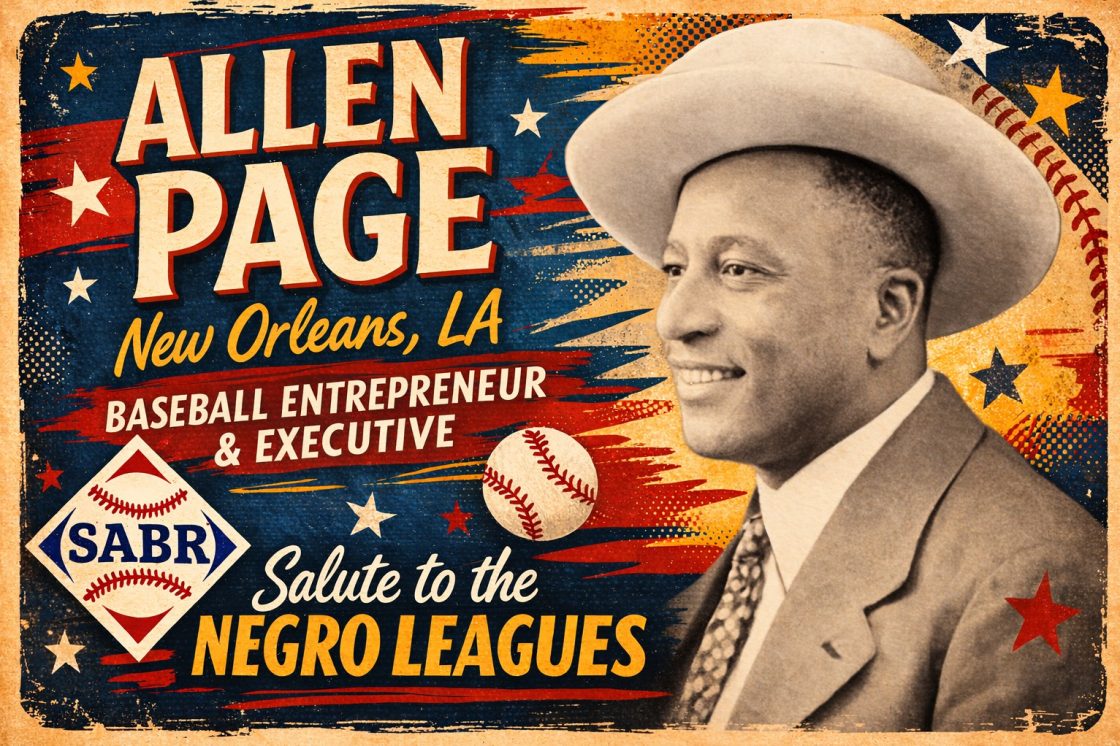
Finally, after the meeting Derby and I discussed how the Zephyrs definitely want to make a concerted effort to get more Negro League figures in the Zephyrs-sponsored New Orleans Professional Baseball Hall of Fame, and they want to work with me closely on coming up with a list of first-year Negro Leaguers nominees. My initial thoughts … Allen Page, Oliver Marcell, Johnny Wright, Dave Malarcher, J.B. Spencer, Winfield Welch and, of course, Wesley Barrow. We’ll see what happens in the near future.

OK, enough self-indulgent rambling — here’s that quiz I gave the group this morning. The first six questions are ones about the nationwide Negro Leagues scene, and the second half-dozen are about NOLA and Louisiana Negro Leaguers. So … how well will you do? Answers next week …

1. What team won 10 Negro National League titles between 1937 and 1948?
a. Pittsburgh Crawfords
b. Birmingham Black Barons
c. Homestead Grays
d. Chicago American Giants

2. What notorious racketeer and numbers runner built the Pittsburgh Crawfords into a pennant-winner?
a. Gus Greenlee
b. Rube Foster
c. Ed Bolden
d. Cum Posey

3. What late Negro Leagues great was the very first “beneficiary” of the now nationally known Negro League Baseball Grave Marker Project?
a. Jimmie Crutchfield
b. Sol White
c. Mule Suttles
d. Spottswood Poles

4. What was Hall of Famer Willie Wells’ best-known nickname?
a. Ese Hombre
b. Cool Papa
c. The Black Ty Cobb
d. El Diablo

5. What Hall of Fame great did Buck O’Neil name as the greatest player he ever saw, regardless of color, league or time period?
a. Josh Gibson
b. Dick Redding
c. Pete Hill
d. Oscar Charleston

6. In which city was the first Negro National League launched in 1920?
a. Chicago
b. Kansas City
c. Philadelphia
d. Pittsburgh

1. What NOLA-based team claimed the “national colored championship” in 1888?
a. Pinchbacks
b. Dumonts
c. Cohens
d. Crescents

2. Who was the hotel owner who became NOLA’s greatest 20th century African-American baseball promoter, team owner and executive?
a. Wesley Barrow
b. Allen Page
c. Fred Norris
d. Walter Cohen

3. What Napoleonville, La., native managed the Birmingham Black Barons to two Negro American League pennants in the 1940s?
a. Winfield Welch
b. Wesley Barrow
c. Pete Robertson
d. Willard Brown

4. Which New Orleans University alum succeeded the great Rube Foster as manager of the Chicago American Giants?
a. Oliver Marcell
b. Allen Page
c. Winfield Welch
d. Dave Malarcher

5. Which team won the 1933 Negro Southern League title?
a. New Orleans Creoles
b. New Orleans Black Pelicans
c. New Orleans Crescent Stars
d. Algiers Giants

IN MEMORIAM
With what team did Algiers native Herb Simpson integrate the Single-A Western International League in 1952?
a. Spokane Indians
b. Seattle Rainiers
c. Portland Rosebuds
d. Victoria Athletics

A tribute to El Diablo

wellsW

Editor’s note: Thursday is the 26th anniversary of the death of Hall of Famer and Negro League legend Willie Wells. In honor of the day and of the man, the following is a short essay by my dear friend Rodney Page, the son of an unsung black baseball legend in his own right — New Orleans promoter, team owner and executive Allen Page. Allen Page and Willie Wells were themselves close friends, and in this commentary, Rodney, who now lives in Willie Wells’ hometown of Austin, speaks of himself meeting Wells and being privy to an amazing conversation between Willie and Allen. Many thanks to Rodney for doing this and digging deep into his memory and his heart.

Willie Wells

A Personal Story – A Forever Memory
“Good – Better – Best.” Those were the words Stella Wells said her father, Willie Wells, often spoke. “You always do your best!” was the strongest memory of her father’s words.  Those were the words spoken to me on a personal visit I shared with then-91-year-old Stella Wells, the only daughter of Willie Wells, on June 17, 2013 in Austin, Texas. Keeping her father’s memory alive drives her life. Her stories and memories of her dad inspired me greatly that day. That inspiration continues in my life on a more frequent basis as I continue to research and uncover much about my father, Allen Page, and his contributions to Negro League baseball and his overall legacy.

Willie Wells and Allen Page will always be connected in my heart and mind as a result of a day in the heat of June 1977 (unfortunately I do not remember the exact date) when I took my father, Allen Page, to visit Willie Wells at his home on Newton Street in Austin.

My dad was passing through Austin from Los Angeles on his way to Mississippi to visit his birthplace and kin. There had been recent newspaper articles about Willie Wells and his Negro League baseball exploits, and I assumed that he and my father knew each other, and yes, they did.

The knock on the doorframe was barely a tap as the door and windows were open. It was a very quaint house without air condition. It was the home of a Negro League legend. More importantly, it was the home of a man of great presence, intelligence and wisdom. That day has instilled in me one of the strongest, most powerful memories of my life, as I draw on it so often. It also gave me a glimpse into a very real and rich Negro League history from the perspectives of two of its major contributors.

Willie Wells came to the door, shirtless, and when he and my dad saw each other they cried like babies with the joy of seeing each other for the first time in almost 30 years. If tears could speak, I can only imagine what they might have said in that moment. What a poignant moment that I’ve revisited many times since. They immediately began reminiscing about a time that had passed. The names and stories flowed. Time seemingly stood still for them and for me. So many names, so many stories. I will offer a few as memory serves.

Wells_Willie

Of course they spoke of Satchel Paige, reliving the tale of Satchel calling in the fielders and then striking out the batter. And, yes, much discussion and laughter concerning Satchel’s famous hesitation pitch. They also spoke specifically about the character that Satchel was known to be.  Another highlight was the remembrance of Cool Papa Bell and the tale that he was so fast that he could turn off the light switch and be in bed before the light went out. As you might suspect, great laughter and joy.

They went on to speak of Josh Gibson, syphilis and his death. Mules Suttles, Buck Leonard, Buck O’Neil, Judy Johnson, Alex Pompez and so many others were topics of conversation. The oral history was and continues to be so rich and memorable. Willie Wells went on to speak of his playing down in Mexico and how he and the others were treated with so much respect, and like real men. Unfortunately, they were both keenly aware of the treatment they had often received in America. My high school baseball coach, Pat Patterson, a Negro Leaguer himself, also spoke of the different feeling and treatment in Mexico.

Of course, the topic of Jackie Robinson came up, and the oral history was spoken and confirmed. My father brought it to the front that Willie Wells was a much better player than Jackie, but he was too old to be chosen to break the color line. The history continued with the fact and confirmation that Willie Wells helped groom and prepare Jackie Robinson to make the leap to the major leagues and break the color line. All of this was shared and discussed in very matter-of-fact manner with no anger or animosity toward anyone. Even then, I was struck by the calm, resolve and acceptance of both men. Acceptance yes, resignation and/or fatalism – no!!! Both were men of great dignity!

I remember so clearly that the conversation progressed to the point of Willie Wells mentioning that he was not bitter about not making it to the major leagues and not having the opportunities that others were afforded in America. He realized with so much clarity and wisdom that he was ahead of his time. He was accepting of his place and time in life. The man was filled with so much intelligence, so much wisdom. He was a very deep, thoughtful soul.

2364_112992390287

His wisdom truly came to the front when he shared a profound statement with my father. He said: “You know Page, young people today don’t realize that you gain privilege in life by being responsible; today, young people want privilege before demonstrating responsibility.”

Wisdom of the ages, true and relevant today every bit as much as it was then. Wow! And those words of Willie Wells live on in and through me as I have shared them often in teaching, coaching, mentoring and inspirational speaking. Responsibility before Privilege – provides me with a familiar and constant mantra. They also give me opportunity to share about the richness of the Negro Leagues and some truly outstanding and significant human beings, let alone ball players.

What a day, what a visit! That day has proven to be one of the richest and most meaningful of my life. For me personally, that day/visit continues to grow in significance, impact and deep meaning.

Willie Wells. El Diablo. What a man, what a soul. May your wisdom, intelligence and dignity be honored as much as your baseball prowess. May your memory live on. Indeed, you were ahead of your time as were so many of your contemporaries. For me, for that one day, you were right on time!

With great respect and appreciation – and always Responsibility before Privilege,

Rodney Page
Jan. 20, 2015

Herb Simpson story

I had a story on Herb Simpson passing and his funeral come out today for a sports Web site in Seattle. Check it out if you want …

Herb Simpson, last Seattle Steelhead, dies at 94

Hopefully tomorrow I’ll have an update on the Wesley Barrow grave marker effort.