“Less black?”

In the press box at Zephyrs Stadium — NOLA is playing the first of a four-game set against the Iowa Cubbies. It was pouring all morning, then the heavens cleared and now it’s sunny.

During the pregame, I had an interesting conversation with the New Orleans Advocate‘s Zephyrs beat writer, Darrell Williams, if he doesn’t mind me dropping his name. The banter in the box entered Negro Leagues territory with mention of Toni Stone.

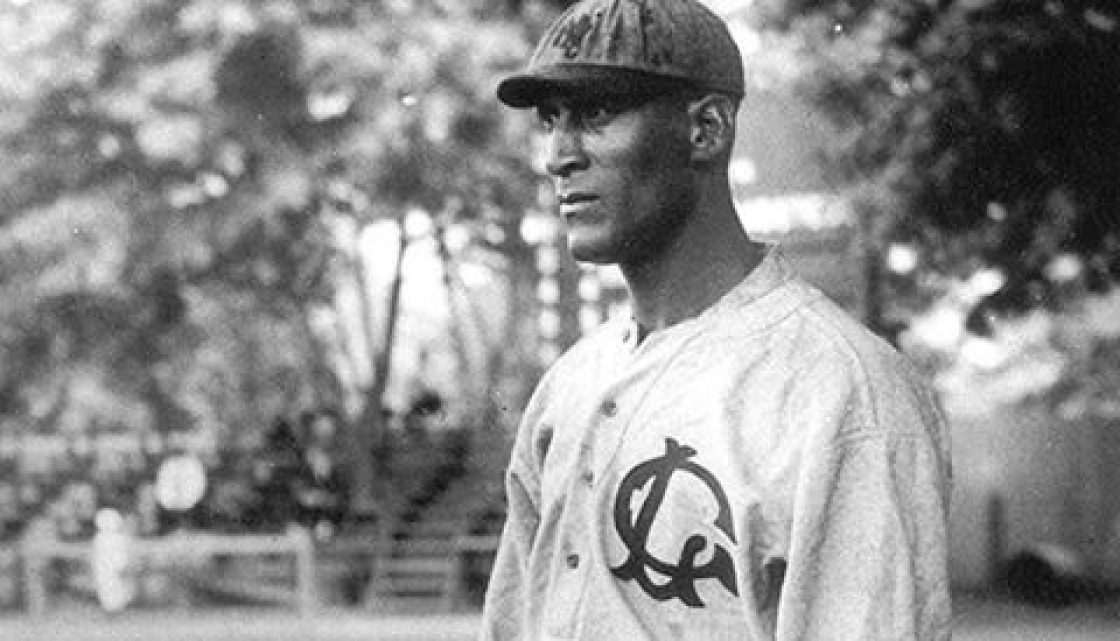
One thing led to another — I know comic Brian Regan said “one thing led to another” lazy writing — and I stated that I believed Oscar Charleston was the greatest all-around baseball player in history, bar none.

Darrell, who’s African-American, said, “Who’s that? I’ve never heard of him.”

I, in keeping with my often irascible personality, responded with incredulity and indignation.

“How can you not know who Oscar Charleston is?!?!?” I retorted in astonishment and with more that a touch of sanctimony. “You’ve black! How can you not know who Oscar Charleston. You need to be proud of your own culture!”

Darrell wasn’t pleased with that statement. He answered with his own dollop of indignation that was half joking and half truly angry.

“I can’t believe you said that!” he blurted. “Just because I’m black, I should know who this guy is? That’s such a racist statement, and you don’t even realize it!”

That assertion kind of blind-sided me a fair amount, and it made me reflect almost immediately on what I had asserted to Darrell and, on a deeper level, my own attitudes about race and African-Americans in baseball and in baseball history.

My statement to him was borne out of my long-held frustration and amazement that I, as a pasty white boy from a high school whose number of black students numbered in single digits, frequently know so much more about African-American history — whether it be sports, music or politics — than many average African Americans.

To me, that ignorance is just tragic for a segment of the American population that has struggled so long and so hard for equality, freedom and respect.

For comparison, I reflect on my own heritage. I’m one-fourth Newfie — my paternal grandmothers’ family is from Newfoundland, which has an amazingly distinct, rich culture and history. But many Canadians across the rest of Canada deride Newfoundland that country’s version of a hick state, an island filled with dumb, uneducated, lazy rednecks. Newfoundland is “Canada’s West Virginia.” (I will add that I don’t feel that way about West Virginia, but many people I’ve talked to use that term to sarcastically describe Newfoundland.)

As a result, I’m proud to be a Newfie. It’s a badge of honor. Newfie’s have fought for respect and have worked to engender self-pride and knowledge of our culture. So would I would view Newfoundland natives who are ignorant of their own culture and history to be “less Newfie” than others? Is that far to tie that tag on such people?

And ergo, is my statement to Darrell accurate or even fair? And is it racist?

After a bit of jibing back and forth, Darrell acknowledged that he was just messing with me, which I understood.

But my questions remain, and it’s the one I pose to you: Should African Americans be somehow “required” to know about their culture and history, including the Negro Leagues? And, if they don’t have that knowledge, are they somehow “less black” or “not sufficiently” proud of being black than African Americans who are more knowledgeable?

I’d love to get your thoughts …

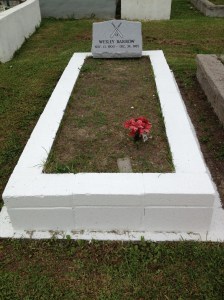
Wesley Barrow and NOLA integration

IMG_1160

As a follow-up to yesterday’s post about the Wesley Barrow marker finally being erected at New Hope Baptist Church Cemetery, I wanted to use that, as well as a conversation with one of the Skipper’s former players, as a jumping-off point for an historical glance at baseball integration in New Orleans and Wesley Barrow’s role in it …

Last week I talked on the phone with Mr. Gerald Sazon, who played on Barrow’s Black Pelicans for roughly five seasons in the late 1940s into the ’50s. Like another local former Negro Leaguer, Paul Lewis, Mr. Sazon was introduced to me by Ro Brown, a former local sportscaster and current administrator at UNO.

And like Mr. Lewis, Mr. Sazon holds Wesley Barrow as a mentor of the highest regard.

“That was something back in the day, especially playing for Wesley Barrow,” Sazon says. “I was 14 years old playing with these guys twice my age, you know. It was a learning process for me at the time.”

Sazon says Wesley Barrow was able to teach him a great deal about the national pastime despite the fact that life as a semipro Negro Leagues manager was, to say the least, a challenge.

“He knew the game,” Sazon says, “but it’s sometimes hard to manage somebody on the same level as you are. But we can all get together to play a game, and all in all they respected him. But [every player] had their own opinions. We certainly had some characters.”

Sazon says the Black Pels played five or six games a week, especially Sunday contests. On the road, the Black Pels often had to double up in a single bed in hotel rooms to cut costs:

“We would go out to different towns all over Louisiana and Mississippi. People would follow us and come out to see us play. People looked forward to us playing.

“We had Diamond Pipkins, Bob Bissant, Speedball Johnny, guys who really made a mark in baseball, even Herb Simpson. You had guys who played in the Cuban Leagues, or in Canada. Me being just a young kid, seeing the reactions of [Barrow] to all of these guys [was impressive]. It was all good.”

In particular, Sazon recalls being part of an historic, landmark contest. It was July 31, 1954, and the Black Pels squared off against the Keesler Tarpons, a squad from the Keesler Air base in Biloxi, Miss.

The Tarpons were an all-white club except for their ace pitcher, former Kansas City Monarch Al Cartmill, and Sazon recalls that the clash was the first game between a white team and a black team at Pelican Stadium, the home of the Southern Association’s New Orleans Pelicans, who never integrated, even up to their folding (along with the whole SA), in 1960.

So the contest was a big deal.

“We were the first black team to play a white team in the old Pelican Stadium,” Sazon says. “We lost by a run, but it was just a stirring thing.”

Coincidentally, at the same time, in the July 31, 1954, issue of the Louisiana Weekly, the city’s African-American paper, sports columnist Jim Hall reported on two seemingly significant developments along the same lines:

“New Orleans’ City Park will lift its Jim Crow on ’55 … The N.O. Pelicans will hire their first tan player late in the winter.”

Peculiarly, though, Hall had such seemingly big news buried at the very end of his column. (As both a postlude and a prologue, the white Pelicans did indeed sign a bunch of black players for the ’55, but the team cut or otherwise shed them all before Opening Day. I’ll try to have more on that later.)

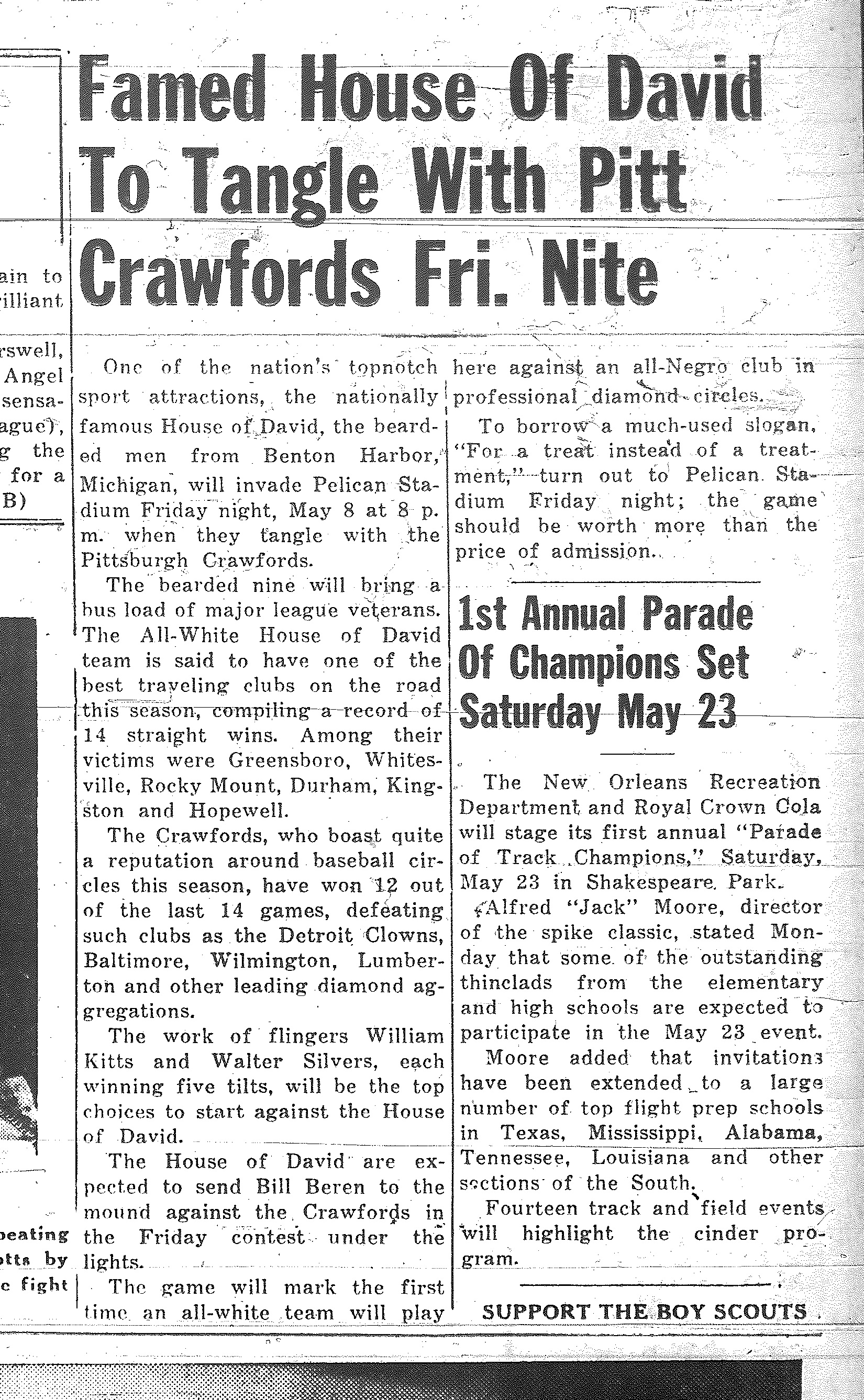
Anyway, while the Keesler-Black Pels contest of 1954 was a crucial moment in the integration of hardball in New Orleans, more than a year before there was very nearly a preceding interracial contest when, in mid-spring 1953, a contest between the famed religious barnstorming team, the House of David, and the Pittsburgh Crawfords (who were related to the great Craws teams on the mid-1930s pretty much in name only) was carded by legendary NOLA promoter Allen Page. Stated the Louisiana Weekly:

“The game will mark the first time an all-white team will play here against an all-Negro club in professional diamond circles.

“To borrow a much-used slogan, ‘For a treat instead of a treatment,’ turn out to Pelican Stadium Friday night; the game should be worth more than the price of admission.”
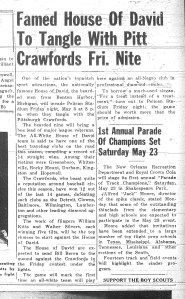
Untitled

But the game never happened; nary a pitch was thrown. In the Weekly’s May 16, 1953, issue, Jim Hall explained what happened to nix what would have been a momentous occasion — the teams were slated to play an earlier game against each other in Baton Rouge, but, Hall wrote:

” … the Crawfords called off their Southern tour and returned to Pittsburgh, claiming they were losing money of the Dixie trip, while a number of the House of David players had ‘jumped’ the club and returned to their respective homes. …”

But there’s more … in June 1954 — a month before the Black Pels-Keesler contest — the African-American squad was scheduled to play the Navy Braves Algiers aggregation, an all-white team, in a two-game stint at Pelican Stadium. Stated the Weekly:

“For these encounters with the Braves, Manager Wesley Barrow is expected to field his strongest lineup of the season.”

(That lineup, btw, included Milton Crosby, who is now the Gretna city councilman with whom I’ve been working on the Barrow marker!)

Then, finally, there’s an interesting case that took place in late summer 1955, just more than a year after the game that Sazon described with Keesler. I’m let the Aug. 27, 1955, Louisiana Weekly say it:

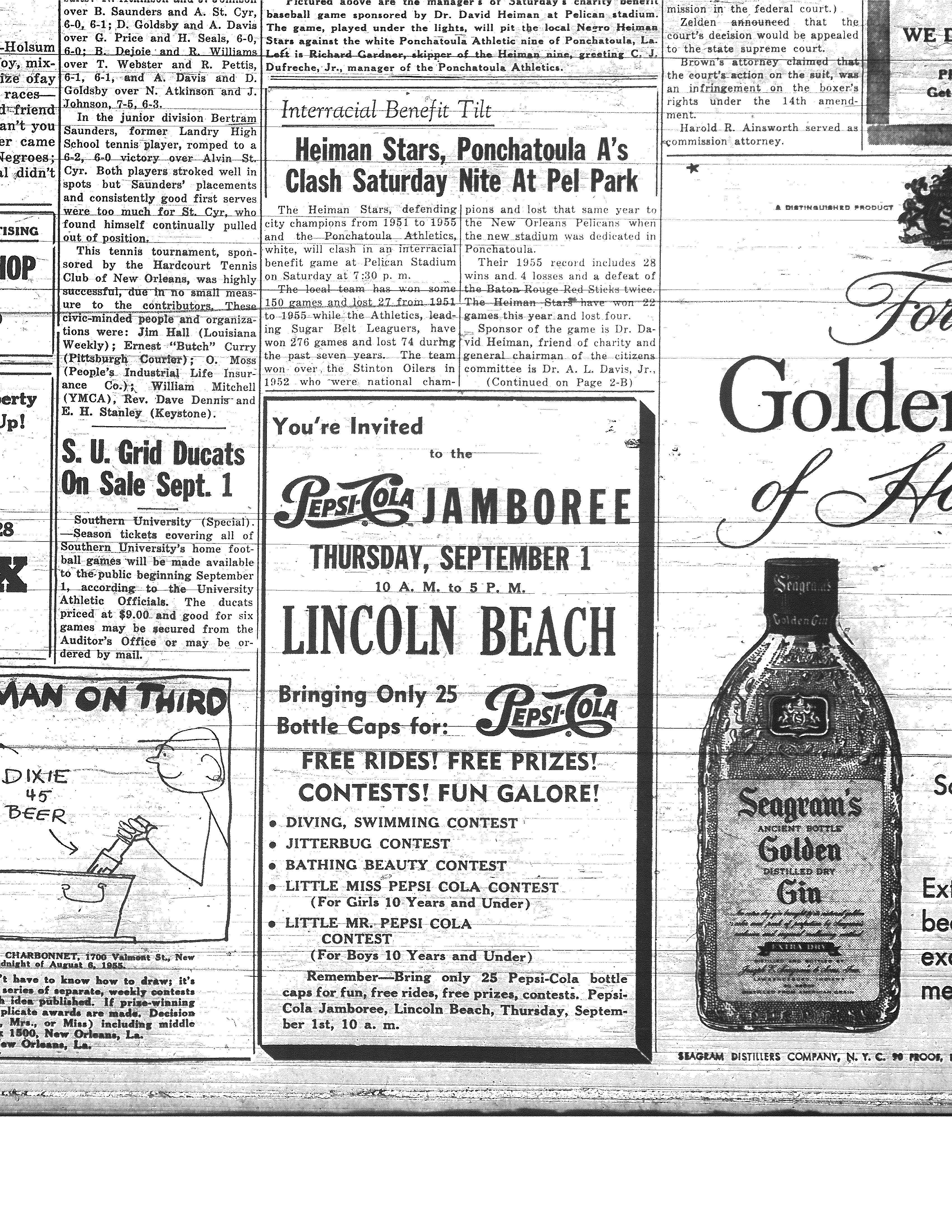
“Thousands of New Orleanians, both white and Negro, are expected to turn out … for the city’s benefit interracial baseball game sponsored for charity by Dr. David Heiman, friend of charity and philanthropist in the Crescent City, at Pelican Stadium.

“The game will be played under lights between the Heiman Stars, Negro nine of New Orleans, and the Ponchatoula Athletics, white.

“Funds from the game will be given to sick and underprivileged children, Leland College … and to Union Baptist Theological Seminary.”

Another Weekly article also pumped the clash up:

“The Heiman Stars, defending city champions from 1951 to 1955, and the Ponchatoula Athletics, white, will clash in an interracial benefit game at Pelican Stadium …

“The local team has won some 150 games and lost 27from 1951 to 1955, while the Athletics, leading Sugar Belt Leaguers, have won 276 games and lost 74 during the past seven years. …”

So although the New Orleans Pelicans — the city’s top white minor-league team for decades — never integrated at all, they were willing to let their stadium be used for more open-minded, and open-hearted, baseball men and women of the region.
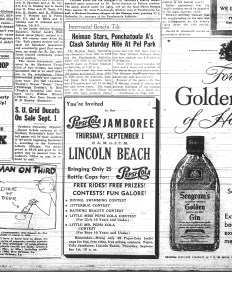
Black Pels 8 082755

And Wesley Barrow, along with his players, including Gerald Sazon, were often along for the ride. All this makes clear that the N.O. Black Pelicans were much more instrumental than their lily-white counterparts in the progressive racial movements that took place here in the Big Easy. Credit most certainly also must be given to white organizations like the Keesler Air base team and the Ponchatoula Athletics for helping to bring this city forward.
At long last, the marker is up!!!

IMG_7817

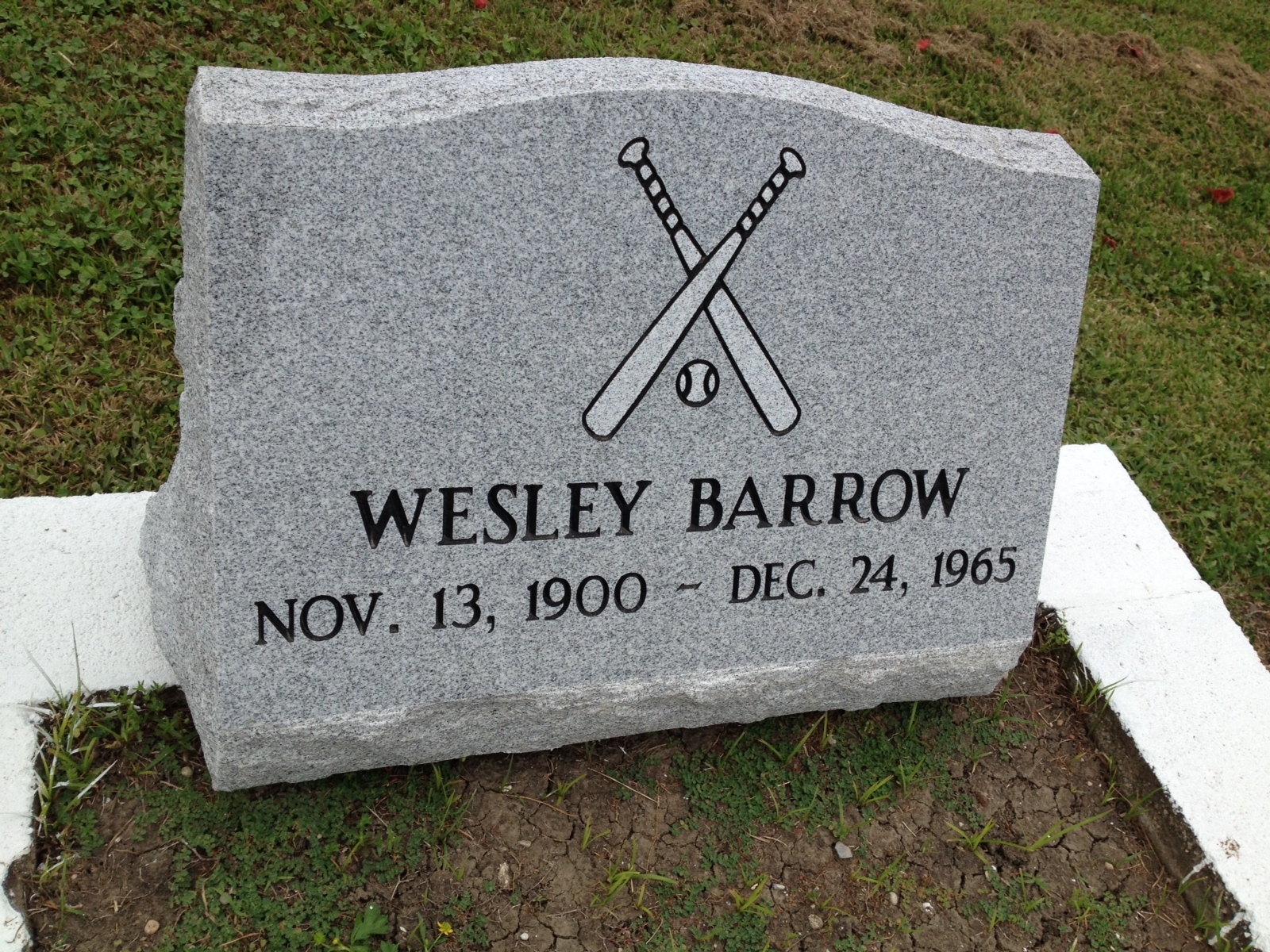
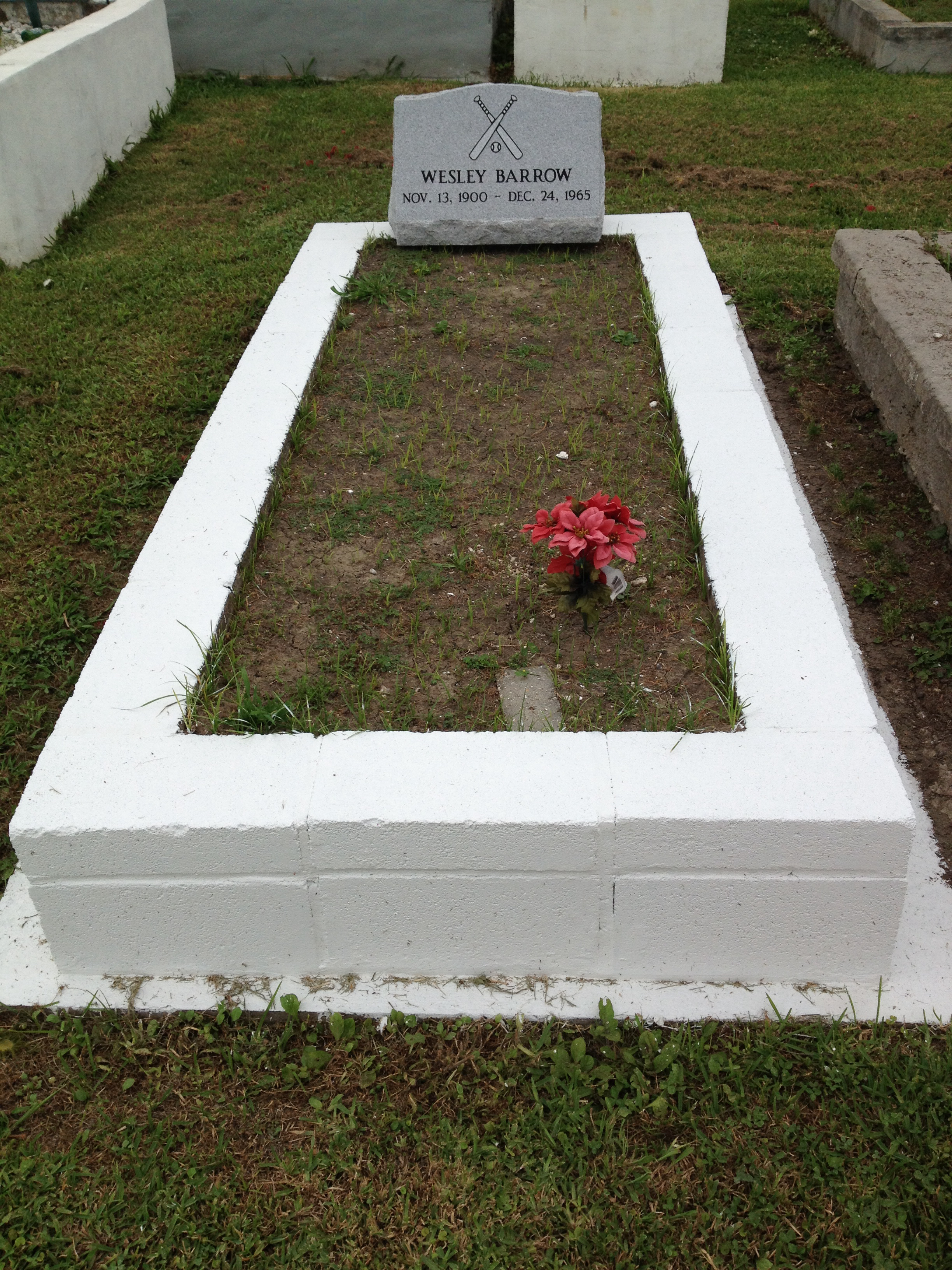
There it is! The Wesley Barrow grave marker is finally in place at New Hope Baptist Church Cemetery in Gretna! And the surrounding stone time just got fresh white paint as well.

I’m sitting in the pressbox at Zephyr Field for the New Orleans Zephyrs’ opening night game against the Omaha StormChasers — the latter is leading 1-0 in the bottom of the second on a cloudy but so far dry night — and it feels quite fitting that Wesley Barrow’s long-overdue honor was completed on the same day that the new local pro baseball season started.

OK, an RBI single up the middle just helped the Zephyrs knot it up with two outs.

This Z’s season I’m going to try to — pun possibly intended — integrate coverage of the Zephyrs with issues of African-Americans in baseball. I want to try to connect the history with the present, and hopefully I’ll be able to pull it off.

As the spring turns into summer, please feel free to comment on whether you like the melding of topics and how the process is going in general.

And don’t worry — I’m still gonna have plenty of Negro Leagues and black baseball history stories as per usual. For example, tomorrow I’ll expound on the Barrow marker finally coming to fruition with an interview and a pretty neat historical angle spring from that interview.

Keep checking back, and many thanks as usual for reading!

Up next for the NLBGMP: Waxey Williams

ClarenceWilliams

Waxey Williams

I spoke to Jeremy Krock last night, the founder of and driving force behind the nationally known Negro League Baseball Grave Marker Project, to just get an update on how the project’s efforts are going and what African-American stars of old are up next for a new grave marker.

And, as usual, Jeremy and the army of volunteers in the project are busy at work and trying to get to as many worthy candidates as possible.

“We’re kind of juggling a few projects right now,” Jeremy said with a touch of understatement.

He indicated that there are really two efforts in particular that are well on their way to completion this year. The one that’s probably the closest is Bill Francis, a sparkplug of an infielder who spent many years with the Chicago American Giants and several with the Hilldale Club, the Bacharach Giants and a few other teams, including one or two in Latin America.

I wrote a story on Frances for philly.com a couple years ago, but I think the link doesn’t work anymore. Because I’ve written about several of the NLBGMP’s efforts, Jeremy asked me to draft text for Francis’ headstone, which will be placed at his unmarked grave at Lincoln Cemetery in Blue Island, Ill. (There’s actually several completed and upcoming figures on the grave marker project’s list in that same cemetery.)

As is the case with just about every freelance story I turn in, my draft text for the Francis marker was a wee bit lengthy, and, as Jeremy said last night, “We still need to condense that a little bit.” But, he added, “That one will be done this year.” Another slight hangup is that no quality photo exist of Francis, so the Project will have to go against its usual protocol and install the marker without a picture of Francis.

The other effort well underway to completion this year is Clarence “Waxey” Williams in Atlantic City Cemetery in Pleasantville, N.J. Williams was a top catcher in the couple decades before and after the turn of the century.

93132703_136705962916

Waxey Williams’ currently unmarked grave

SABR member and writer Michael Everett of Linwood, N.J., is spearheading the Williams effort, which was fortunate enough to find a group of willing donors, a situation that almost automatically sends projects to the top of the NLBGMP’s ever-growing list of hopefuls.

“We don’t really know when that will be completed, but it will be this year,” Krock said of the Williams effort. “We kind of take [the projects] in order. When we also get a big hunk of money from somewhere, then we do that project right then.”

Another Negro Leagues figure targeted as a beneficiary of the Project is semipro manager Fred Goree, who was brought to the NLBGMP’s attention by new SABR member Ron Auther, who posted an article about Goree on Auther’s excellent blog here. Goree’s story is truly a tragic one, and a burial stone would give him a much needed posthumous boost in dignity and respect.

One man on the list that I’ve taken somewhat of an interest in is Henry Bridgewater, a late-19th-century base ball, political and economic kingpin in St. Louis who died there in 1904 and was interred in an unmarked grave in St. Peter’s Cemetery.

Over time I’ve become fascinated by 19th-century African-American base ball (two words back then) teams, especially before the true professionalization of the “colored” game. Bridgewater owned such aggregations in St. Louis that were among the best in the country. Bridgewater was also quite a character, a saloon owner with his fingers in a lot of pies, including rumored connections to and involvement in the underworld.

Bridgewater was initially brought to my attention by SABR member, author and Northern Illinois prof James Brunson, the preeminent expert on 19th-entury blackball as I was researching the New Orleans Pinchbacks of the late 1880s.

In all, Krock acknowledges that, as time goes on, while the NLBGMP gives dignity and respect to more and more baseball greats, the list of candidates continues to grow at an even quicker rate, a situation that is both encouraging and disheartening.

“It’s a never-ending projected,” he said. “Whenever we get volunteers like this, they can share some of the workload to help out.”

For more information on the Negro League Baseball Grave Marker Project, click on the link above. To volunteer, e-mail Jeremy Krock at jlkrock@comcast.net or Larry Lester at larrylester42@gmail.com.

The Vigilants of Cincinnati

Peter-H-Clark-dm

Peter H. Clark

A little dip into the 19th century with a story that was *supposed* to be published in a paper in Cincy …

In July 1874, a reader calling himself “Vigilant Play” wrote in to the Cincinnati Daily Times, pondering why the city’s white base ball teams — the game was spelled in two words back then — for some reason steadfastly declined to cross bats with one of the best African-American, or “colored,” nines in the country, the Cincinnati Vigilants.

To the writer, such adamant refusal seemed inherent quizzical and remarkably stubborn.

“Now, why the white clubs refuse to play our club, I can’t see,” wrote Vigilant Play, adding the claim that the Vigilants were “the champions of Ohio.” “The Vigilant Club is composed of as good players as the Arctics [a white team]. Is this giving our colored boys a show? The Arctics, Favorites and Hunkidories have to work for a living as well as we Vigilant boys do, and we will play any of the above-mentioned any day next week, except Sunday.

“It seems as if the white clubs are afraid of us,” he added boldly.

Essentially, the writer asserted, the Vigilants weren’t getting their just do as a top-quality base ball aggregation in the Queen City. However, today, one could easily argue that the Vigilant Club hasn’t garnered the respect of historians in general, many of whom laud 19th-century African-American teams from cities like Philadelphia, New York, Baltimore and even Indianapolis as crucial not just to the development of the American pastime among the black community, but to the overall history of the game itself.

But perhaps the Vigilants don’t deserve such short shrift. Author and Northern Illinois University professor James E. Brunson, the preeminent researcher on 19th-century African-American base ball, argues that the Vigilance Club carved a significant place in black baseball history because it linked the nascent sport with education.

Brunson notes that Peter Humphries Clark, the “Father of Black Baseball” in Cincy who founded the Vigilants in 1871, served as principal of Gaines Colored High School and, between 1866 and 1873, “steered young student-athletes toward baseball. They formed the nucleus of the Vigilance.”

That funneling of high-school graduates to the Vigilant Club apparently worked, too — Brunson points to the fact that the squad claimed a record of 165-0 between 1871 and 1874. In August 1875, the Cincinnati Daily Star reported that the Vigilance had recently returned to Cincy from an extended road trip “showing an untarnished record … and up to this time have never been defeated.”

And, as evidenced by the published challenge issued in 1874 to the city’s white squads, the Vigilants weren’t afraid to take on all comers, either.

“They played and defeated white and black teams,” Brunson says. “By scheduling road tours in the early- to mid-1870s, they became seasoned and formidable players.”

However, as with so many African-American base ball teams, there was more than met the eye with the Vigilants. |n their case it was politics, education and the uplift of the African-American politics during the era of Reconstruction.

Those qualities came in the form of Peter H. Clark himself, a mixed-race sociopolitical activist, both as a leading abolitionist before the Civil War and a proponent of equal rights and racial advancement via education and political “agitation” at a time when the Queen City was still clinging to segregation.

Clark was a close friend and disciple of the great Frederick Douglass, but over the years Clark, who was born around 1829 in Cincinnati, the son mixed-race of a barber who paid to have his son attend the best schools available to black children at the time.

However, despite his closeness to Douglass, Clark wasn’t afraid to switch party allegiances in order to help the black population make advances in society. In fact, in the late 1870s joined an early socialist party, for whom he ran for political office in 1878. This stridency was detailed by author Nikki Taylor in her 2013 book, “America’s First Black Socialist: The Radical Life of Peter H. Clark.”:

“In the final analysis, Clark deserves a seat at the table with the giants: very few figures in American history can lay claim to having fought for African American freedom on all fronts: from abolition to access to public education, citizenship and voting rights to political power, access to trades to unionism to socialism, or across several periods in history — antebellum, Civil War, Reconstruction, and post-Reconstruction eras. In fact, there were few significant moments in African American history in this period that Clark did not witness, participate in, speak about, or protest.”

Perhaps a prime example of Clark’s tutelage, influence, and emphasis on education and the Vigilance base ball team was a Gaines graduate named Andrew J. DeHart, a star student at the school — he was chosen by Clark, for example, to lead one of the school’s spelling bee teams in April 1875 — and a shortstop for the Vigilants in 1876.

After graduation, DeHart went on to earn a doctorate and become a minister before serving as a teacher and principal of Cincinnati’s colored Frederick Douglass Elementary School for many years.

It was that type of well rounded, active and educated members of the black community that Clark hoped to produce through education at Gaines and athletic pursuits like the Vigilance Club.

By coming on-field success with educational and sociopolitical advancement, the Vilgilance Club’s place in the history of the national pastime is secure and positions the aggregation as deserving of historical attention and reflective respect.

The Vigilants certainly garnered respect in their own time as well.

“It is the champion colored club of the United States at this present time,” printed the Daily Times in July 1874. “It was organized March 1, 1871, and has played one hundred and sixty-five games and lost none.”

Hyperbolic? Perhaps. But not too far off, either. But such documentation, even when exaggerated a little, is crucial in preserving the legacy of early black base ball teams, each one of which, says Brunson, plays a vital historical role in the national pastime.

“In my view,” he says, “there is no insignificant black baseball club of the 1870s. They are important simply for the fact that there stories need to be told.”

Van Dykes story

I was finally able to get an assignment to write a story on the Van Dyke Colored House of David — for the Des Moines Register here. I think you have to answer a couple lame survey questions to be able to read it, for which I apologize. There’s also a link to a sidebar story in the main story.

A post for a weekend of family

In honor of this holiday weekend — today is Easter, and it’s also Passover this weekend — in which family plays a huge part, I’ll do a short post about an interview I did late last week …

Apparently word got out inside the family of Gentleman Dave Malarcher that I’m looking to speak with some of his surviving relatives. That prompted Alvin Malarcher, Dave’s grand-nephew, to call me from his home in Tacoma, Wash., where he now lives after a career in the Air Force.

Alvin’s grandfather, Valentine Malarcher, was Dave’s brother. Alvin, like much of the Malarcher family, grew up in Convent, La. He’s now 66 years old and retired from the aviation industry.

Because Dave Malarcher spent the final two-thirds of his life living in Chicago as a real estate agent after retiring from baseball, Alvin only met his great uncle two or three times, when the latter would visit his hometown in St. James Parish occasionally, such as when Dave’s mother passed away in 1956.

“He didn’t make too many trips down there,” Alvin says.

But even though Alvin didn’t get to know Dave Malarcher too well, he was around the Negro Leagues legend enough to realize he was a special man.

“He was a very calm person,” Alvin says of his great uncle, “a very soft-spoken person.”

Alvin says that among his own siblings, he himself was the only one to play baseball like Dave Malarcher. “So I guess I followed him,” Alvin says warmly.

Alvin adds that he himself “used to go [to Convent] quite often, every year or two, but now that I’m older I don’t travel very much. But I still have a lot of sisters and a couple brothers there.”

Alvin’s own life coincidentally intersected with something I’ve written about before — military baseball in the Pacific Northwest. That included teams from McChord Air Base, where Alvin Malarcher happened to be stationed at one point, a stint that helped him decide to retire to that area. Afte2r leaving the USAF, Alvin worked for Boeing, frequently visited his nephew in British Columbia (which is also where Alvin met his wife), and worked at the USPS for many years before retiring in 2010.

But Alvin still feels intimately connected to St. James Parish, as well as his famous great uncle. And is the family proud of its Negro Leagues legend?

“There’s no doubt about that,” Alvin says.

I can’t think of gophers …

… and not immediately think of Carl Spackler.

However, here’s an article I just had published today in City Pages, the alt-weekly in Minneapolis, about the 1909 St. Paul Colored Gophers. This one was truly a labor of love, and many thanks to editor Pete Kotz for being so patient and understanding with me as we worked this through …

http://blogs.citypages.com/blotter/2015/04/for_one_shining_season_in_1909_the_eyes_of_baseball_were_on_st_pauls_black_baseball_team.php