New book chronicles tragic deaths in Black baseball

Author Chris Jensen with a poster showing his new book.

Editors note: My friend and colleague, Chris Jensen, recently had published his comprehensive and moving new book, Tragedy in Black Baseball: Early Deaths of 136 Negro Leaguers, 1871-1950, through McFarland Publishing. I highly recommend checking it out; it’s extremely engrossing, empathetic and a little saddening, and it shines lights on dozens of noble, hard-working, talented people whose deaths, like many of their lives, have been overlooked, obscured or even erased from previous history books. The following is a lightly edited, email interview I recently conducted with Chris about his book and the process of researching and writing it.

RW: What was the genesis of this book? Why did you decide to write about this subject?

CJ: During the five years I spent researching and writing my first book, Baseball State by State (which came out in 2012), I kept coming across Negro Leaguers who died too young under tragic circumstances. I tend to get interested and then obsessed when I see patterns. Each time I encountered another tragic death I would copy the material into a Word document, building up a nice folder of intriguing information.

With basic details fleshed out for about 40 player deaths, I realized I had enough material to turn into a book project. Dave Wyatt’s “Death in the Game” article in the Feb. 24, 1917, edition of the Indianapolis Freeman listing 38 Black players who had died in the previous decade was a puzzle that begged to be tackled. I tried to identify who these 38 players were and what happened to them.

I was only able to flesh out the details for 20 of the players Wyatt mentioned – 15 of them made it to the final cut for the book. Then I set out to turn over every rock in my research to determine how many Negro League players died early, tragic deaths. In the end, my research uncovered nearly 200, although details were frustratingly elusive for some of the player deaths.

I decided to write about this subject because I wanted to put these Negro Leaguers’ life stories in the history books and give them greater recognition for their career achievements. Negro League players were deprived of the right to play in the major leagues for too many years, so that alone bothered me. To discover so many Negro Leaguers died young under suspicious circumstances, without any justice served, bothered me immensely. I wanted to make sure their stories got told and passed on to future generations of baseball fans, because these forgotten stars had already been deprived of so much. 

RW: For some, the subject of tragic, early deaths might seem a little dark, but why do you feel it’s important to highlight the fact that so many pre-integration African-American players died so young?

CJ: Many Negro League players, and especially pre-Negro League players, lived and died in anonymity. Some of their greatest feats on the baseball diamond are lost to posterity. African-American players were forced to play in a shadow league due to racial discrimination. They didn’t play for glory or recognition, but that doesn’t mean their stories are less deserving to be told. They are to be saluted, respected and appreciated for their talents, with some measure of dignity that was not provided to them during their lives.

I’m especially proud that my book calls attention to the outstanding work being done by Jeremy Krock with his Negro Leagues Baseball Grave Marker Project. What Jeremy and his group of volunteers have done over the past 20-plus years to bring lasting recognition and restore dignity to long-forgotten Negro League players is truly inspiring.

RW: Why do you think there are so many examples of such tragic passings in the world of Black baseball? Are there any economic, social or cultural factors that might cause such a situation?

CJ: For Negro Leaguers diagnosed with cancer, heart disease, influenza or tuberculosis – just to name a few examples – lack of access to quality health care limited their chances of getting successfully treated. Hospitals were segregated, and the medical profession determined that African Americans were an inferior race and therefore didn’t deserve top-notch care. In 1877, state governments began passing Jim Crow laws to deny equal rights to African Americans, which made all aspects of everyday life more difficult. The Great Migration to northern states created a housing strain and exposed Blacks to new stresses and an environment in which alcohol was more readily available and used to cope with these stresses. Alcoholism was a contributing factor in several of the tragic deaths featured in my book. Race riots in Chicago and other cities bred fear and uncertainty, while Negro Leaguers like Fred Goree learned the danger of traveling through sundown towns.

The Great Depression caused extra financial devastation to Black communities and placed ongoing hardships on Black teams, leagues and players. The only Negro League franchises that remained profitable were those run by men engaged in illegal gambling and bootlegging. Several of the player deaths were directly attributed to bootlegging. While whites also faced financial devastation, their 25-30 percent unemployment rate during the Depression was not as severe as the 50-plus percent unemployment rate for Blacks. With white workers forcing minorities out of lower-paying jobs, Black families no longer had disposable income to spend attending baseball games, and the lack of financial resources placed enormous strain on Negro Leaguers wondering where their next paycheck was coming from. Black teams were forced to travel long distances to play games, which had unintended negative consequences. Porter Moss, Smoky Owens and Buster Brown all died tragically as the result of a chain of events that started with their team bus breaking down.

There has been one Negro League player lynched (James Bowens), one threatened with lynching (Bud Scipio) and one executed (Jim Moss). More than 20 Negro Leaguers were murdered with little or no justice meted out to punish the perpetrator. The same cannot be said of white major leaguers during the segregation era.

RW: What were your biggest challenges writing this book?

CJ: Fleshing out the biographical information proved challenging for some of the players. Census records didn’t always jive with birth records, death certificates and military draft registration cards. Newspaper reporting on Black baseball teams was spotty, with names misspelled, game accounts lacking and details on player deaths wildly inaccurate. Also, it was upsetting to see so much overtly racist coverage in newspapers, especially in the pre-Negro Leagues era.

RW: Are you pleased with how the book turned out?

CJ: I love how the cover turned out, which features illustrations by Nick Wilson of Josh Gibson, Rap Dixon and John Merida. Overall, I am very pleased with the book’s content but wish I didn’t have to leave out so many players who died too young under tragic circumstances. I was given a word limit by my publisher, so featuring more players would’ve meant writing a lot less about each one.

The Negro Leagues were on a downward spiral once Jackie Robinson broke the color barrier in 1947, so it made sense to cut things off at 1949. That resulted in leaving out the stories of 20-plus Negro Leaguers who died tragically from the 1950s into the 1980s. It was disappointing to not be able to tell the stories of Phil Cockrell, Charlie Peete, Luke Easter, Hank Thompson, Sam Bankhead and others.

RW: Finally, which deaths that you touched on in this book were the most tragic or unexpected? Were there any particular cases that spoke to you?

CJ: I’d like to say all the player deaths spoke to me, but the reality is that some deaths were just unfortunate. Tuberculosis killed lots of people in the early 1900s and not just Black baseball players. I’ll mention just a few of the cases that made a big impact on me. 

Octavius Catto was the Martin Luther King Jr. of the 19th century, a true civil rights icon but also a legitimate baseball pioneer with the Pythian Base Ball Club of Philadelphia. He helped form the National Equal Rights League with Frederick Douglass and rallied support to pass the Thirteenth Amendment abolishing slavery. Catto was instrumental in getting Pennsylvania to ratify the Fifteenth Amendment granting Blacks the right to vote. So, it was deeply ironic and tragic that Catto was assassinated on Election Day in 1871, the first year Blacks could vote. It was surprising and disturbing to learn that when “A Quest for Parity: The Octavius V. Catto Memorial” was unveiled outside Philadelphia City Hall in 2017, it was the first of 1,700-plus statues in the city to honor an African-American individual.

James Bowens is one of 4,743 people to be lynched in America and the only professional baseball player. The mob that lynched Bowens in Frederick, Md., in 1895 was stirred up by sensational but untrue accounts in the local newspaper. Bowens, who professed his innocence to the end, was killed in an unbelievably cruel and inhumane way with no due process. He was dead before his alleged victim was alert and properly able to identify her attacker.  

What is most disturbing about Fred Goree’s 1925 death is that it took nearly a century for his descendants to learn the true details of his death. Goree, the manager and possible owner of the Chicago Independent Giants, was savagely beaten and then shot to death by a police officer who had pulled him over for alleged speeding, in a clear case of racial profiling. It was cold-blooded murder with multiple witnesses. White newspapers, none of whom spelled Goree’s name correctly, portrayed him as the instigator who left the cop no choice but to defend himself. The St. Louis Argus newspaper, representing the African-American community, told the real story of the shooting based on eyewitnesses who were in the car with Goree. The details of Goree’s death and the sham trial that exonerated his murderer got clouded over as the years went by, and family members didn’t see the Argus article until 2016. 

Jeremy Krock was moved to action by Goree’s story and ensured he had a proper grave marker. And you, Ryan, are among the journalists who have called attention to Goree’s tragic killing. It takes a village of researchers and historians to ensure stories of Black baseball are told accurately and with historical context. I’m pleased to be part of that process.

The tragic death of Porter Moss is another important one that has not been told accurately in print until my book came out. It was long believed that Moss died at age 34 in 1944 of a gunshot wound on a passenger train in Tennessee, a situation that culminated with a white doctor boarding the train and refusing to treat Moss because of the color of his skin. That version of the story was backed up by teammate Verdell Mathis in a 1993 interview with the Cincinnati Enquirer. That’s a pretty big accusation and numerous podcasts, articles and even doctoral dissertations have condemned the inhumane actions of the white doctor over the years. 

Except that’s not what happened. SABR researchers Russ Speiller and Gary Cieradkowski unearthed a July 21, 1944, article in the Atlanta Daily World (an African-American newspaper) that states the white doctor gave Moss an injection (perhaps morphine for pain) and told his friends to take him to the next station where an ambulance would be waiting to treat him. Moss needed more medical attention than a doctor with a black bag could provide in the baggage room of a train. It was not discrimination or malfeasance that sealed his fate, but being in the wrong place at the wrong time. 

Black baseball players like Catto, Bowens, Goree and Moss demonstrated a resilient spirit and love for the game that transcended the adversity they faced. I hope their stories get told and retold for many years to come with newfound respect for what they endured.

42 for 21 lays down the gauntlet

This is a follow-up from this post a week and a half ago, about a webinar concerning the National Baseball Hall of Fame’s inability and/or unwillingness to allow induction for more Black players from the segregated era.

As has been promoted on this blog and elsewhere, the 42 for 21 Committee has advocated for several years for justice and fairness in the Hall’s selection process, which continues to fail miserably at giving more-than-deserving Negro Leaguers a truly open and equal chance to pass through the hallowed halls of Cooperstown.

Last Wednesday, the committee issued another pointed proposal for the HOF selection process, challenging the Hall to revise its Eras committee system. Here’s the text of that press release:

FOR IMMEDIATE RELEASE

4 March 2026

The 42 for 21 Committee believes that the Hall of Fame needs to restructure its Era Committees to give Negro Leaguers and pre-league Black Baseball players a fair chance at election in the future. If not, their inaction will likely result in excluding additional Segregated Era Black players from being added to the Hall.

The Hall should restructure the Classic Era Committee into two committees, one for players and one for managers, umpires, and executives. There is no reason to lump these together in the Classic Era, especially when the Contemporary Era has separate committees for players and non-players.

The Hall should also limit the time span of the Classic Era to 1950 and earlier, which would be consistent with previous Era Committees. The span of the defunct Early Baseball Era Committee from 2016 to 2021 ended in 1949; prior to that, the 2010 to 2015 Pre-Integration Era Committee span ended in 1946.

Careful analysis of upcoming Classic Era Committee elections shows that Negro Leaguers and their predecessors are probably going to be shut out under current rules. The huge span of the Classic Era – 1871 to 1979 – and the large number of remaining attractive candidates from 1951 to 1979 mean that there will probably be few slots for Negro Leaguers on the ballots. 

That century-long time frame, plus the small number of ballot slots (10), plus rules that restrict committee members to casting only three votes, will create a logjam that will place future Negro League candidates at a severe disadvantage. That logjam will take many years to undo because the Classic Era Committee is scheduled to meet only once every three years.

Exacerbating the problem is that Negro League players and managers/executives/umpires will be competing with each other on the same ballot, and that previous Era Committees have included few members with expertise on the Negro Leagues. 

The combination of the above factors will result in a perfect storm that will sink the chances of deserving Black candidates for the Hall of Fame from the Segregated Era. The Hall of Fame has not been afraid to change the rules for the election of veterans in the past, and it should not be afraid to do so now.

************

The 42 For 21 Committee was founded in 2021 to advocate for “Justice for Negro Leaguers” – especially for more robust consideration of many meritorious but overlooked Black Baseball candidates for the Hall of Fame. The significance of the number 42 is self-evident.

More information at www.42for21.org, including the results of our poll of Negro Leagues experts who nominated 43 well-qualified candidates for renewed consideration by the Hall of Fame’s Classic Era Committee.

So far, there’s been little if any reaction from the Hall of Fame or anyone else with the power or influence to sway the Hall in a positive, just way. But that’s not really surprising. The Hall’s stubborn recalcitrance is nothing new. Neither is our dismay and frustration.

Anyone interested in offering support or assistance, or if they just have any questions, can call Sean Gibson at (412) 589-1906 or Gary Gillette at (313) 614-9006, or email 42for21@gmail.com.

I’ll just close with some comments from Dan D’Addona, the sports editor at the Holland (Mich.) Sentinel, and a devoted and talented Negro Leagues researcher, advocate and fan:

Dan D’Addona with the late Negro Leaguer Ron Teasley.

The Problem with the Era Committee

By Dan D’Addona

While the Era Committees have righted several wrongs and elected some deserving players, the move to having one era span from baseball’s origins to 1979 changed everything and is particularly detrimental to Negro Leagues candidates.

There are just eight finalists on every ballot with voters being allowed to vote for up to three. Numbers-wise it is tough for anyone to get in, but this ballot is spans so long it is worse for Negro Leagues players.

Popular deserving major leaguers like Luis Tiant, Ken Boyer, Thurman Munson and Tommy John have been finalists. If they are again, then you add the top pre-integration candidate Bill Dahlen and that leaves three spots at the most for Negro Leaguers. Cannonball Dick Redding, John Donaldson, Vic Harris and Grant “Home Run” Johnson have been finalists in this format.

So how are voters, who are Hall of Fame players as well as executives and a couple of media members and two Negro Leagues historians, supposed to come to a consensus on there?

Luis Tiant or Cannonball Dick Redding? Bill Dahlen or Home Run Johnson? Tommy John or John Donaldson?

It will be tough for any candidate to get 75 percent, but it will require the Negro Leagues historians to educate the committee and likely narrow in on one candidate at a time.That would lead to, say, the election of Luis Tiant and Cannonball Dick Redding.

But even that would take the right education, the right people and the right timing on the Era Committee.

Donate to Home Plate Don’t Move

I will never put Home Plate Don’t Move behind a pay wall, but I would certainly invite donations if you wanted to chip in. If not, it’s totally fine. I appreciate you checking out and reading my blog and any other support or contributions you’re willing to offer.

One-Time
Monthly
Yearly

Make a one-time donation

Make a monthly donation

Make a yearly donation

Choose an amount

$5.00
$15.00
$100.00
$5.00
$15.00
$100.00
$5.00
$15.00
$100.00

Or enter a custom amount

$

Your contribution is appreciated.

Your contribution is appreciated.

Your contribution is appreciated.

DonateDonate monthlyDonate yearly

Negro Leagues Night at Tulane!

Got some more news, this time from here in New Orleans …

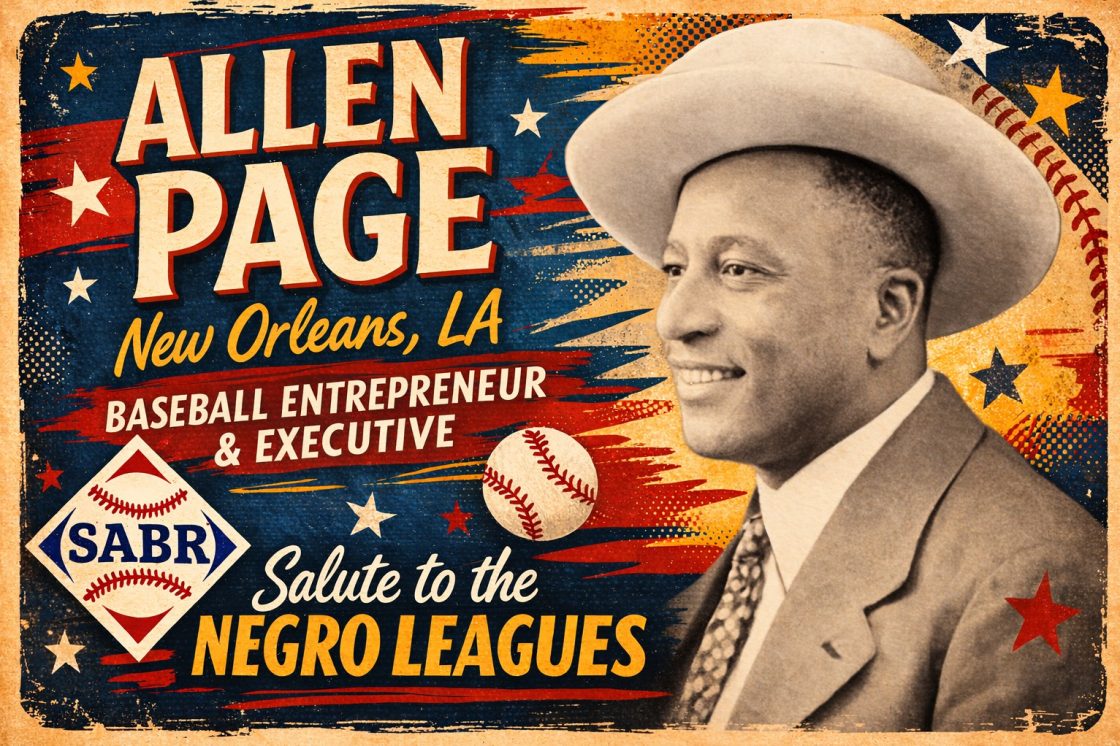
On Saturday, April 25 at 6:30, the SABR Schott-Pelican New Orleans chapter will co-host with Tulane University a “Salute to the Negro Leagues” Night at Tulane’s Turchin Stadium during the Green Wave baseball team’s conference game against UTSA.

We didn’t let the city’s sad lack of a professional baseball team deter our SABR chapter from finding an event at which we could celebrate the legacy of the Negro Leagues here in New Orleans. Representatives from the chapter approached Tulane officials late last year with the idea, and the Green Wave folks heartily agreed to do it.

The night will include the attendance of multiple family members of various New Orleans greats, and many of those Big Easy Negro Leagues legends – such as Johnny Wright, John Bissant, Allen Page, Lloyd Davenport, Herb Simpson and Oliver Marcell – will be recognized during the game.

There’ll be a poster giveaway for fans, and our SABR chapter will have a table set up where fans can purchase baseball books, read articles by local writers, and learn about SABR membership and benefits.

We’ll have more details the closer the game gets, but for now, if anyone has any questions, they email rcuicchi@aol.com or rwhirty218@gmail.com.

Hope to see y’all there!

Webinar cuts to the chase on the HOF

There’s been a lot of stuff happening lately in the world of Negro League scholarship and fandom. For example, the SABR Negro Leagues Committee is gearing up for its annual Jerry Malloy Conference, scheduled this year for June 18-21 in Memphis.

On my end, the John Bissant grave marker project continues to move forward; we’ve got the text for the marker written, and we’re in the process of finding a contractor to produce the stone. In addition, the Schott-Pelican Chapter of SABR here in New Orleans is working to put together a Negro Leagues Day at a Tulane University baseball game next month (more on that later).

And this past Saturday, Feb. 28, the Josh Gibson Foundation/Negro Leagues Family Alliance – which was co-founded and now headed by Sean Gibson, Josh Gibson’s great-grandson –  hosted its regular Negro Leagues webinar, this one on the topic of getting more Negro Leaguers inducted into the National Baseball Hall of Fame. The webinar featured presentations by Negro League advocates and aficionadoes Ted Knorr and Gary Gillette of our 42 for 21 committee.

Meanwhile, along those lines, on Wednesday, March 4, the 42 for 21 committee formally proposed a major revision to the Hall’s Era Committee system, which historically has been completely inadequate and unjust toward potential Black figures from the segregation era. I’ll discuss that in my next post, which hopefully will be posted this upcoming Monday morning. 

The National Baseball Hall of Fame

But right now, I’m going to give the lowdown about the webinar this past Saturday, and I’ll just dive right into it, because there were a bunch of sharp, pointed and passionate comments by several people, all along the lines of righting an ongoing wrong being stubbornly perpetrated the Hall of Fame.

Sean Gibson hosted the webinar, and he began by noting that the Family Alliance fully supports the efforts of 42 for 21 and the overall Hall of Fame push.

“We support this effort of getting more Negro League baseball players into the Hall of Fame,” he said. “The mission of the Negro Leagues Family Alliance is to always try to do our best ti use our name and brand to help other Negro Leagues players’ family members to advocate for them and causes like this. I just want to say on behalf of the Family Alliance, we do support this effort.”

The webinar really kicked into gear with longtime SABR Negro Leagues Committee member Ted Knorr giving a comprehensive rundown of the painfully convoluted, tortured history of the various panels and voting bodies, running back to the selection and induction of Satchel Paige in 1971, that were successively formed and disbanded that have elected, or failed to elect, segregated-era Black players, managers, executives, pioneers and umpires.

Satch and his Hall plaque

Ted also listed the various polls done by Negro Leagues experts over the decades aimed at selecting the all-time greatest Negro League figures, beginning with the famed 1952 Pittsburgh Courier poll of writers, players, managers and other experts at the time.

Ted’s listing of these polls included several that have recommended which segregation-era African-American baseball figures need to be inducted into the Hall as soon as possible, up through the “42 for 21” vote taken in 2021 by a group of Negro Leagues historians, writers, researchers and scholars.

Given how detailed Ted’s presentation on these committees and polls, I won’t summarize them in the post, but you should absolutely watch it with this link, which is also given above. However, I will include Ted’s rundown of the current 42 for 21 top 10 of segregated-era Black baseball figures who need to be inducted into the Hall. The current list is minus the three men who were listed in the original 42 for 21 list that have since been inducted by the Hall – Bud Fowler, Buck O’Neil and Minnie Minoso.

Here’s the countdown of the list of 10:

Rap Dixon

Overall, Ted noted:

“There’s going to be a wide range of opinion, and I think everyone in this room, and every open-minded person, realizes that a four-and-a-half to one ratio doesn’t do a good job of educating the public on the history of baseball. It’s my view, and this is just my opinion, that talent and achievement among Negro League players could fill 58 to 80 plaques in the gallery. There at 28 at present. That’s a shortfall.”

I also liked a comment that Ted made as an aside to his presentation – he noted that the induction of Fowler, O’Neil and Minoso in 2022 was celebrated by Negro Leagues advocates and gave us hope that more segregation-era Black figures would soon follow that trio into the Hall.

Unfortunately, Ted said, “It obviously misled us for the next four or five years.”

Gary was next up in the webinar, and I think I’ll conclude this post with his complete comments that he made Saturday, because his words some up the beliefs of many of us:

“Many thanks to y’all for joining us today. You’ve heard what my colleagues Sean Gibson and Ted Knorr have to say, and I hope that you have been impressed by the recitation of the historical evidence. It is undeniable that Black players from the National Pastime’s Segregated Era are substantially underrepresented in Cooperstown.

“I have some additional comments I’d like to offer for your consideration. Unfortunately, I don’t believe that — in the memorable words of the Captain in ‘Cool Hand Luke’: ‘What we’ve got here is … failure to communicate.’ Communication between the Hall of Fame and the baseball public is just fine; what is not fine is the Hall’s defense of its careful gerrymandering of its electorate.

“The carefully chosen words and the actions of the Hall of Fame speak clearly to their apparent goal of restricting future election of Black players, managers, executives and umpires from the Segregated Era to the Hall.

“Weirdly, while critics of proposals to elect more Negro Leaguers to the Hall often decry the supposed ‘quota systems’ of these initiatives, it’s actually the Hall itself that is intent on enforcing an informal, but strict, quota system of its own.

“If you think that’s unfair, I ask you: When has the Hall of Fame been proactive when related to including Negro Leaguers, as opposed to being reactive to public pressure?

Ted Williams giving his HOF induction speech.

“I’d like to see a show of hands for all those who think that, absent Ted Williams’s unexpected and brave plea at his 1966 induction, the Hall would not have taken another decade or more before setting up its first Negro Leagues Committee.

“No hands? As I expected, we all know that it was only the major public embarrassment that an icon like Williams could generate that forced the Hall to act. Yet unbelievably, the Hall initially proposed a new, Jim Crow Hall: a ‘separate but equal’ wing for the Negro Leaguers. The Hall was quickly forced to retreat from that indefensible position after a tidal wave of criticism.

“Even then, the attempt to constrict the number of Negro Leaguers continued, as the Hall pressured its initial Negro League Committee to disband after electing only nine players – not coincidentally, those nine neatly filled out a starting lineup with one player per position. (That lineup was enabled by the convenient assignment of versatile great Martin Dihigo to the keystone sack.)

“What will it take to get the grand panjandrums in Cooperstown to lower the de facto barriers they have set up to prevent more Black Hall of Famers from the Segregated Era from being added to the hallowed Plaque Gallery – the sanctum sanctorum of the National Pastime?

“No one knows for sure, but it certainly won’t happen without another sustained public outcry about the ridiculously unfair structure of the Era Committees. Let me read to you the exact text from the Hall of Fame’s Web site describing the history and function of the Era Committees:

“‘ERA COMMITTEES ELECTION’

“‘The Era Committee has been a part of the Hall of Fame voting process since the first class of electees in 1936, with the first Era Committee electees coming in 1937.

“‘The Era Committees, formerly known as the Veterans Committee, consider retired Major League players no longer eligible for election by the BBWAA, along with managers, umpires and executives.’

“Notice anything? One of the salient facts about the various incarnations of the Veterans/Era Committee system is its almost complete failure to elect any Negro League managers or umpires. Is anyone capable of keeping a straight face when they say that a half-century of segregated baseball could not produce one Hall-worthy manager or umpire? Really? Seriously? Pull the other one!

“As for Segregated Era executives, the Veterans/Era Committees have elected only one executive, Black baseball titan Rube Foster. What about the other four executives elected, you ask? Effa Manley, Alex Pompez, Cum Posey and J.L. Wilkinson were elected in the special 2006 process, not by any Veterans or Era Committee. What about Sol White, Frank Grant, Bud Fowler and Buck O’Neil, you point out – all of whom are shown as Executives on the Hall’s official Web site? They are more aptly described as Pioneers, one of five categories for induction, but that category has essentially been abandoned by the Hall for no good reason.

“The sad truth is that only Rube Foster – a no-brainer selection whose greatness even the brainless could recognize – is the only executive, manager or umpire from the Segregated Era that has been allowed through the bronze portals of the Hall in the half-century since 1971. 

“When Satchel Paige was finally inducted into the Hall of Fame in ‘71, he said in his speech that ‘there were many Satchels and many Joshes.’ We can forgive his rhetorical hyperbole there, and one can easily argue there was no pitcher as great as Paige and no player as great as Gibson.

“Paige’s point, however, is spot-on. There were many great Black players in the Segregated Era – far more than have since been immortalized in bronze in Cooperstown. It’s great that underappreciated outfielder Pete Hill has a plaque, yet the brilliant but almost unknown outfielder Rap Dixon does not. Shortstop Pop Lloyd was inducted in 1977, and Willie Wells in 2006, but King Richard, the great shortstop Dick Lundy, has been excluded along with Grant ‘Home Run’ Johnson – perhaps the best Black player of the 19th century. Intimidating, flamethrowing hurlers like Paige and Joe Williams have been honored, but Cannonball Dick Redding remains on the outside, virtually anonymous.

“In conclusion, I’d like to repurpose an oft-referenced phrase from American history that seems appropriate to describe the Hall of Fame’s history in this regard. In the Supreme Court’s precedent-shattering Brown v. Board of Education ruling in 1954, the Court ordered that segregation should be ended ‘with all deliberate speed.’ Unfortunately, that unclear language gave enough latitude for recalcitrant Southern states to disingenuously drag out the desegregation process.

“It has now been 55 years since the legendary Satchel Paige took his rightful place in Cooperstown, yet we are still struggling to end discrimination against the great Black players.”

Donate to Home Plate Don’t Move

I will never put Home Plate Don’t Move behind a pay wall, but I would certainly invite donations if you wanted to chip in. If not, it’s totally fine. I appreciate you checking out and reading my blog and any other support or contributions you’re willing to offer.

One-Time
Monthly
Yearly

Make a one-time donation

Make a monthly donation

Make a yearly donation

Choose an amount

$5.00
$15.00
$100.00
$5.00
$15.00
$100.00
$5.00
$15.00
$100.00

Or enter a custom amount

$

Your contribution is appreciated.

Your contribution is appreciated.

Your contribution is appreciated.

DonateDonate monthlyDonate yearly

‘The Weekly Negro News Magazine’

Here we have our final post about some of the various databases I have available to tap, and this one takes the conversation about Black baseball and jumps it from Jewish newspapers (the topic of my previous two posts, here and here) to a famous African-American publication, Jet Magazine.

Jet was launched in 1951 as a digest-sized, straightforward, hard-news publication and dubbed itself “The Weekly Negro News Magazine.” (It’s now solely online.) Jet was founded in Chicago by John H. Johnson, who wanted to provide Black Americans the type of positive media coverage and representation that was still sorely lacking in the American culture and social zeitgeist. The publication was owned and operated by Johnson Publishing Company for decades until it was sold in 2016 to the Clear View Group, a private equity firm.

(Jet also had a sister publication, Ebony, that was similarly launched and owned by Johnson and his company. overseen by one company. Founded in 1945, Ebony was originally modeled after Life Magazine, and it gradually evolved into a sleeker news, culture, analysis and commentary magazine than Jet before transitioning, a long with Jet, to online-only within the last decade after purchase by the Clear View Group.)

When first founded, Jet quickly became a vital, bold, fearless publication that unflinchingly covered the Civil Rights Movement and the fight against societal, systemic racism.

John H. Johnson

Most notably, in the summer of 1955, it covered the funeral of Emmett Till and published a photo of Emmett’s bloated and mutilated body, which was displayed in an open casket by his mother. The image shocked the country and stirred many in the Black community and a few white allies to kickstart the modern Civil Rights Movement.

Despite its undeniable impact on news coverage in America, Jet also reported on “lighter” topics, like culture, entertainment and, of course, sports, including baseball. However, by the time Jet was launched in 1951, integration of the major leagues was quickly sapping the Negro Leagues of their talent, recources, financial prospects and vitality within Black America.

As a result, Jet never had a chance to cover the Negro Leagues in their heyday. However, the magazine did report pretty well on these waning years of organized African-American baseball, especially the signing of Black players by major league clubs and the performance of those players in the Major and Minor leagues.

For example, in December 1952, the magazine reported that the American Association’s Minneapolis Millers, at that time the top farm team of the New York Giants, had sold former Negro League star and future Hall of Famer Ray Dandridge to the Sacramento Solons of the Pacific Coast League. (Two years earlier, at the age of 37, Dandridge had been the American Association MVP while playing for the Millers.)

In March 1953, Jet noted that Willard Brown, a former Negro League star outfielder and another future HOFer, had been signed away from the Kansas City Monarchs by the Dallas Eagles of the Double-A Texas League; and in October 1969, the magazine announced the death of Hank Thompson, an ex-Kansas City Monarch who spent several years in the Majors with the St. Louis Browns and New York Giants.

(Coincidentally, in March 1952, the magazine reported a previous signing by the Dallas Eagles – second baseman Ray Neil of the Indianapolis Clowns, who, in inking a deal with the Eagles, became the first African American to do so in the Texas League. Unfortunately, the Dallas club released Neil before the start of the season, and Neil never played in Organized Baseball.)

Some other former Negro Leaguers mentioned in Jet multiple times:

  • Fleet-footed Sam Jethroe, who in April 1953 was sent down from the Milwaukee Braves to Toledo of the American Association; and three months later was accused of “lax playing” by Toledo teammates.
  • Former Newark Eagle and future Hall of Fame inductee Monte Irvin, who, as noted by Jet, unsuccessfully ran for a seat in the New Jersey Assembly on the Democratic ticket in 1951; spent the 1951-52 off-season from the New York Giants teaching baseball to youth in recreation centers on the New York-New Jersey area; and in 1956 signed with the Chicago Cubs.
  • Minnie Minoso, another ex-Negro Leaguer and future Hall of Famer, who copped American League Rookie of the Year honors from the Sporting News in 1951, stated Jet; signed his 1953 contract with the Chicago White Sox for $20,000; and was hospitalized in October 1957, as reported by Jet, for a respiratory infection and elbow trouble.

One former Negro League star who got a relatively large amount of ink in Jet was big Luke Easter, a giant slugger who crushed towering home runs for the Homestead Grays before hopping to the Cleveland Indians in 1949.

Luke Easter

The magazine chronicled Easter’s career with the Indians in the early- to mid-1950s, and then into the later 1950s and beyond in the minor leagues, where he became something of a folk hero. Jet began publishing after Easter’s tenure with the Grays, so the publication never really covered his time with them.

While Easter was with the Indians (now renamed the Guardians), Jet reported on the injuries that limited his playing time and production, and the magazine made note of his tape-measure circuit clouts, as well as his contract news.

But it was Easter’s lengthy career in the minors and his post-playing retirement that the magazine really followed. In addition to noting how Easter frequently led various leagues in homers and RBIs, the post-MLB coverage of Easter included the indefinite suspension he drew in August 1955 for tossing balls to kids in the stands; his setting of the International League’s season home run mark in 1956 with 35 for the Buffalo Bisons; a $100 fine for his role in instigating an in-game brawl in June 1958; and being named the Indians’ first black coach in 1969.

Sadly, Easter was murdered by robbers in Euclid, Ohio, at the age 63, and Jet dedicated an entire page to remembering the legendary slugger. The piece ended with a quote from Bill Veeck, the eccentric baseball owner/executive who signed Easter to the latter’s first big-league contract with Cleveland in 1949.

“It’s really sad,” Jet quoted Veeck as saying. “He was a heck of a guy. I remember him hitting 25 homers in one month in the minors. If he could have come into the majors sooner, there’s no telling how great he might have been.” (Veeck was noted for embellishment and hyperbole.)

In addition to the activities of individual former Negro League players, Jet also periodically tracked the status of the fading Negro American League, which, by the time Jet came started publishing, had already been decimated by the exodus of its players into Organized Baseball post-integration.

In May 1954, the magazine announced the opening of that year’s NAL season, noting that only four teams were now in it. Five years later, Jet reported that the NAL was willing to take offers from the American and National Leagues to become an official minor league under a financial partnership. However, the NAL, the publication noted, would not take organizational tie-up offers from individual AL and NL teams. (The NAL would further fade into obscurity and fold within a few years.)

(In that same April 23, 1959, issue of the weekly, it’s worth noting, Jet reported that Pumpsie Green had been sent back to the Boston Red Sox’s top farm club, the Minneapolis Millers of the American Association following spring training. Three months later, Green made his BoSox debut to integrate the Boston club, the very last Major League team to do so.)

As a side note, in March 1954 Jet noted the formation of the Eastern Negro League, a group of clubs from the East and the South that planned a two-division circuit with eight teams in each division, for 16 total. (The ENL didn’t last very long, for a couple seasons at most.)

(Coincidentally, and in news that became, in hindsight, much more significant that the ENL, in that same March 25, 1954, issue of Jet, the weekly noted the signing by the NAL’s Indianapolis Clowns of two women players, Connie Morgan and Mamie “Peanuts” Johnson, as well as a new field manager – none other than the great Oscar Charleston.)

Jet also kept tabs on the once-great teams of the Negro Leagues as they struggled to survive as integration continued to sweep across Organized Baseball. In February 1956, for example, the publication reported that according to Kansas City Monarchs owner Tom Baird, the Monarchs were faced with the prospect of either leaving Kansas City or disbanding. Baird cited two causes for the dilemma – skyrocketing costs, and the entry of the Major Leagues into the local market, with the arrival of the Athletics.

As time went on, into the 1970s and ’80s, Jet reported on the induction of pre-integration African-American players into the Hall of Fame in Cooperstown. In March 1967, the magazine made note of the death of pitcher Wilber “Bullet” Rogan, and more than 30 years later, Jet reported on Rogan’s election to the Hall in 1998.

“Known for a quick, no-windup delivery, a blazing fastball was Rogan’s primary pitch,” the publication stated before adding that Rogan was also adept in other positions (particulary outfield) and at the bat.

Oscar Charleston

Likewise, in October 1954 – roughly three years after its launching – Jet gave a handful of lines to the great Oscar Charleston, who was and is considered by some (including this humble writer) as the greatest player of all time, regardless of color, league or era. Then, in 1976, as Charleston was being ushered into the HOF, the publication dedicated a full page to his memory and, by extension, the memories of many Negro League legends.

“He was a compactly muscled 190-pound athlete who stood 5 feet, 11 inches and who, like to many of his fellow Negro League players, was forced to wallow in baseball obscurity,” the magazine stated.

“But that didn’t stop the late Oscar Charleston from playing with a passionate fury, relentlessly attacking any pitcher’s best stuff,” it added.

The article concluded with nods to other Black baseball greats and added that many Negro Leagues legends deserved their own calls from the Hall.

“There is still a rich quantity of Negro League stars awaiting a Hall of Fame nod,” it stated. “Last year the [Hall of Fame’s] special committee [on the Negro Leagues] talked of dissolving. Fortunately for those Black players whose only blockade into the Major Leagues was white racism, the committee continues to breathe.”

Other legends whose HOF inductions were reported by Jet included pitcher/manager/team owner/executive Rube Foster, third baseman Judy Johnson (March 1975) and pitcher Leon Day (March 1995), who, the magazine noted, received the Hall’s call while he was in his bed at St. Agnes Hospital in Baltimore.

“I thought this day would never come,” Day said, a comment to the New York Times that Jet included in its own article. “I’m feeling pretty good. I’m not as sick as they think.” 

Day died six days later.

Jet also noted the passings of shortstop Willie Wells (April 1989), third sacker Ray Dandridge, (March 1994) and Effa Manley (May 1981), co-owner of the Newark Eagles.

On the subject of Effa Manley, four years before her death Jet published an article about her then-new autobiography, co-authored with sports reporter and publicist Leon H. Hardwick, entitled “Negro Baseball … Before Integration.”

In the Jet’s article on Effa and the book, the magazine asserted that while Effa’s husband, Abe Manley, using profits from his numbers racket to fund the Eagles, recruited the club’s players and “mapp[ed] the team’s field strategies. …it was Mrs. Manley who took care of the books and saw to it that on every first and 15th day of each playing month the Eagles’ paychecks would fly to the players’ pockets.”

The magazine added that “[h]er personal story is as colorful as the brand of ‘devil-may-care” of baseball played in the Negro Leagues. …

“An admitted Babe Ruth fan years before she moved up to management, Mrs. Manley recalls with fondness the days that her Eagles stocked such playing gems” as Monte Irvin, Larry Doby, Biz Mackey, Wells, Mule Suttles, Dick Lundy and Day.

Effa Manley

In being interviewed for the Jet story, Effa expressed sadness that integration killed the Negro Leagues – she said the Black circuits “could have been a magnificent farm system for the major league teams” – and sharply criticized Branch Rickey for starting the trend of major league team owners poaching talent from the Negro Leagues.

“Branch Rickey was terrible for what he did,” she told the magazine. He got some of our best players for nothing even though we had a vested right to our players.”

Manley also said the Negro Leaguers who were starting to trickle into the Hall of Fame in the 1970s should have been placed in a separate wing in the Hall, because such a section would allow for more segregation-era Black figures to be inducted overall.

“I’d settle for seeing 25 or 30 of those Negro League players in the Hall of Fame at once,” she told the magazine, “but in my book there’d be even more. Negroes should know how great they are. It’s ridiculous for Negroes to think they’re inferior.”

(There are currently 37 Negro League figures in Cooperstown, including Effa Manley, who was inducted in 2006, along with 16 other segregation-era Black baseball representatives, the last Negro Leaguers to date to go in.)

In ensuing years, Jet also highlighted other ways Negro League greats have been recognized and honored over the decades. Primary among that are periodic articles about the Negro Leagues Baseball Museum in Kansas City – in December 1990, the publication reported on the founding of the museum; in 2008, Jet revealed how rappers Kanye West, T-Pain and Big Boi were part of a special CD aimed at benefiting the NLBM; and in February 2010, the magazine discussed how the museum was experience devastating financial difficulties. (The NLBM is now gladly on solid fiscal ground and doing phenomenally.)

A few other recognition events for Negro Leaguers covered by Jet:

  • The Chicago White Sox in 2008 hosting a tribute to the 75th anniversary of the first edition of the famed annual East-West All-Star Game. The salute included the Double Duty Classic game, featuring 30 inner-city high school players and the attendance of several legendary MLB and Negro Leagues greats.
  • The 1990 edition on the Baseball Encyclopedia including the names and statistics of Negro Leaguers for the first time. That year the compendium listed about 130 segregation-era Black players. Jet quoted encyclopedia editorial director Rich Wolff: “When I realized that some of today’s big-leaguers do not even know who Jackie Robinson was, I realized it was time we did something about it.”
  • The erection of a monument honoring Josh Gibson and Rube Foster in a park in Marietta, Ga., the site of the Twelfth Annual Georgia Negro Baseball Tournament in 1960.
  • The National Baseball Hall of Fame in June 1991 hosting more than 60 former Negro Leaguers during a special reunion in Cooperstown, with Henry Aaron and then-NL President Bill White scheduled to attend. Stated then-Hall President Ed Stack in Jet’s article: “The Hall of Fame is delighted to pay tribute to these pioneers of the game.”

I want to conclude with how Jet chronicled the later life of the one and only James “Cool Papa” Bell, because the publication devoted a good deal of page space to the legendary Black baseball speedster and outfielder.

Cool Papa Bell

In October 1954, the magazine reported the 51-year-old’s formation of an all-Black barnstorming team to travel with an all-white club; in summer 1986, Jet included a picture of Bell, then 83, tossing out the first pitch at a Boys Club stadium in his adopted hometown of St. Louis being renamed after him.

That was followed in March 1990 by a brief feature article updating readers on Bell’s memories and current life; the story was accompanied by a photo of the baseball great holding a framed image of his Hall of Fame plaque. On a more dour note, later in 1990 Jet reported on the theft of $300,000 in memorabilia owned by Bell and the legal case against the alleged pilferers.

Then, in March 1991, the magazine ran a long article about Cool Papa’s death at the age of 87 (the article erroneously said 88) after a long illness. Stated the story: “Bell was thought to be the fastest man ever to play baseball and was a terror on the basepaths.” The piece also noted, however, that Bell was also an excellent hitter, something in which the late outfielder prided himself.

Fortunately, though, the baseball legend was posthumously honored about three years later, as Jet reported, with the renaming of a street in Jackson, Miss. (he was born in Mississippi), as Cool Papa Bell Drive; the effort to rename the roadway had been headed up by Bell’s daughter, Connie Brooks.

While Home Plate Don’t Move will never be put behind a paywall, donations of any size are welcome. To donate to the blogging effort, click here.

A little more from Jewish newspaper archives

Hank Greenberg

Here’s a little companion piece to my last post about Jewish journalist Haskell Cohen and the archives of The Jewish Advocate and The Jewish Exponent. To complement that previous article, I’ll look at a few of the editorials the two newspapers wrote over the years about baseball, race, bigotry and integration.

I’ll forgo a lot of my own blather and just feature direct quotes from the editorial pages of the two illustrious publications. First from The Advocate:

April 10, 1947, about Opening Day

“To people, visiting our shores for the first time, the shouting and yelping of fans at a baseball game might seem an incredible display of mass hysteria and a useless waste of human energy. But to us of America the crowd at a baseball game is America.

“It has been said by educators that the key to the elimination of prejudice among the youth lies in the playground. Let children of all races, creeds and faiths play together and they will grow to understand each other and respect each other. If that is the truth, then baseball is the best example of that verity.

“As this season opens there are a number of Jewish players on several major and minor league teams. But a sign of the times is the expected inclusion of a Negro on Brooklyn’s baseball club. A sport that can break such barriers is a wholesome contribution to American life.”

April 12, 1951, about that year’s start to the baseball season

“And yet, there is another under-current of the game – the gathering of men and women and children of all colors and races and faiths under one roof in tribute to artists of the game whether they be white or black or Jewish or Christian We know of no study estimating the value and influence of baseball in breaking down racial and religious barriers. But no one who ever visited a great ball park can ever cease wondering at the basic amity of the fans, at least while the ballgame is in progress.

“There were times when big league baseball was only a white man’s game. But since courageous and imaginative Branch Rickey dared the innovation of Negro players, the game has taken on a truly national character.”

July 12, 1951, in response to an ugly, violent incident of bigotry-driven heckling and trash-talking at Comiskey Park

“One of the greatest baseball traditions is the right of fans to freely boo and applaud. But when a bunch of rowdies abuse that prerogative by venting abuse against ballplayers merely because they are Jews or Negroes, the national game is facing a situation it must eradicate at once if it is to survive within our democratic pattern. …

The hoodlums who vituperate Jewish and Negro players are not baseball fans. They are fanners – fanners of hatred and racial bigotry.”

“Baseball is our national game, and it is, therefore, painful to see its precincts transformed into an avenue of bigotry. Fortunately it can be said that the game is largely free of the evil of which we are now complaining. What the rowdies did was not only anti-Jewish but anti-American as well. The hoodlums who vituperate Jewish and Negro players are not baseball fans. They are fanners – fanners of hatred and racial bigotry.”

Here’s now a few from The Jewish Exponent:

April 20, 1951

“The story of widespread prejudice against Negroes in organized baseball is well known. Five years ago it would have been unthinkable to suggest that Negroes could make their way into the baseball picture. But few remember that 30 years ago the same hostility was felt toward Jewish ballplayers. Every method calculated to keep the Jew away from Big League diamonds was employed – but, of course, to little avail.”

July 13, 1951, concerning the same incident of bigotry at a White Sox game mentioned above

“Ordinarily, sportsmanship and tolerance go hand in hand. These virtues apply equally to players and spectators. That, at least, is what we like to think. But experience has proved that this is not true. …

“ … Scarcely more than four years ago, one Big League manager [likely Ben Chapman] was cautioned for making gestures about Hank Greenberg’s ‘Jewish nose.’ This same manager made life miserable for Jackie Robinson when the great Negro star broke into [organized] baseball. Today, both Robinson and Greenberg are still in the Major Leagues while that manager is down in the lowly minors – perhaps not even low enough for him.

“Can it be that after the ‘color line’ has been broken down in baseball, there still is resentment over a ballplayer’s religion? Why should this be in view of the tremendous examples of fair play, decency, integrity and athletic ability exhibited day in and day out over a period of years by the Greenbergs and the Robinsons?

“Apparently such unsavory practices as ‘throwing a game,’ hitting below the belt and downright cheating must move over to make room for a bosom companion – prejudice.”

“Apparently such unsavory practices as ‘throwing a game,’ hitting below the belt and downright cheating must move over to make room for a bosom companion – prejudice.”

Aug. 21, 1953, in a piece by sportswriter Bill Wolf

“The ugly face of race prejudice has once again been seen in sports, this time in major league baseball. The victims: Dodger catcher Roy Campanella and infielder Jackie Robinson.

“While the incidents do not involve any Jewish players, they are of paramount interest to Jewish sports fans. For as it has been demonstrated time and again, when racial attacks are made on Negroes, the danger of anti-Semitic incidents increases.

“Fans will recall the incident a number of years ago, when Sid Gordon was the target of anti-Semitic remarks in St. Louis. Two years before that St. Louis players had also hurled insults at Jackie Robinson. Bigotry is a common enemy of all who seek democracy in sports.”

Legendary writer connects Jews with Black baseball

Haskell Cohen

So today we have another installment of “cool stuff from various databases.” (I previously did a couple such posts here and here.) I perused a few of them and came across ones compiling the archives of two Jewish newspapers: The Jewish Advocate, based in Boston, and The Jewish Exponent, based in Philadelphia.

I decided to search these archives for articles and commentaries about Negro League baseball, integration of the sport, and race issues in general in the national pastime. I found some pretty good stuff, and I noticed one trend in particular: the columns and articles of Haskell Cohen.

Cohen was an extremely deft, incisive reporter and scribe who’s most well known for his key involvement in the growth and strengthening in the 1950s and ’60s, serving as the nascent league’s publicity director for nearly two decades. He also created the NBA All-Star Game, which he modeled after the MLB All-Star contest.

But he was also a prolific journalist, including as sports editor for the Jewish Telegraphic Agency, a news wire service, for 17 years, and as a contributing editor to several magazines, such as Parade and Spot.

In addition, Cohen founded the United States Committee Sports for Israel (now Maccabi USA); served as the first chairman of the International Jewish Sports Hall of Fame’s selection committee (he’s also an IJSHOF inductee); and was a member of the Naismith Basketball Hall of Fame board of trustees, and the U.S. Olympic Basketball Committee.

But for our purposes here, we’ll focus on the reporting and commentaries he provided for the Jewish Telegraphic Agency and various newspapers and similar publications. Through the archives of The Jewish Advocate and The Jewish Exponent, I first collected some columns he wrote for the JTA, then branched out a bit from there.

One running theme in Cohen’s columns was covering the activities of several Jewish executives, promoters and owners in Black baseball, particularly Abe Saperstein of Chicago, Philadelphia’s Eddie Gottlieb, and Syd Pollock of New York, all of whose involvement in Black ball circles, especially as promoters, was somewhat controversial at the time, and continues to be somewhat today. 

Eddie Gottlieb

(Supporters argued that the influence and financial backing they brought to the table was a positive for the Negro Leagues, while critics asserted that the Jewish executives bumped African-American promoters and executives from crucial roles in the sport, exploited Black talent, and siphoned revenue that could have been going to Black-owned teams and promotion services.)

In September 1946, Cohen reported on the financial difficulties being then experienced by Saperstein in Black baseball promotions, including the quick folding of the West Coast Negro Baseball Association, a short-lived league that Saperstein oversaw with Olympic hero Jesse Owens. However, Cohen added that Saperstein hoped to turn things around when he took his Black all-star team to Hawaii for an extended tour. (For more on that Hawaii tour, check out this article.)

In a column from June of the following year, Cohen noted the attendance of Gottlieb and Pollock at the joint meetings of Negro American League and Negro National League in New York City. Cohen also often also reported on Saperstein’s connections as a scout with the Cleveland Indians (now the Guardians), whose owner, Bill Veeck, paid Saperstein to comb the ranks of Black baseball for potential talent for the MLB team; Cohen asserted in a November 1948 column that it was Saperstein who bird dogged Satchel Paige for Veeck and the Indians.

Cohen then, in July 1950, reported that it was now Gottlieb who was promoting Paige; Cohen wrote that “Paige is now under contract to Eddie Gottlieb, who is securing $1,500 to $3,000 weekly for the aged pitcher’s services.”

But Cohen was also willing to take Jewish sports executives to task, such as in July 1945, when he sharply criticized the antics of the Cincinnati Clowns, including relatively harsh words in particular for the team’s owner, Pollock.

“Sid [sic] [has] a funny team but his burlesque of Negro people, for gag purposes, is in very bad taste,” Cohen wrote. “… Sid [sic] is beginning to tone down on this stuff and if he goes all the way in refining his talent[,] the Clowns are really going to come into their own as one of the nation’s funniest ball clubs.”

With that, we’ll use a nice segue to Cohen’s occasional mention of who, at that time, was the biggest Jewish name in baseball – Hank Greenberg, of course. In December 1949, Cohen reported how Veeck had sold his interests in the Indians, and the columnist pondered what role, if any, Saperstein would retain with the club, including his activity as a scout of Negro League talent.

But the main thrust of Cohen’s piece was how Greenberg was going to stay on as the general manager for the team, as opposed to the original plan for the Hebrew Hammer, which called for him to be team president.

Hank Greenberg

Then, in February 1951, after the integration of organized baseball had gotten well underway, Cohen quoted Greenberg discussing the latter’s view of racism and bigotry in baseball, particularly in Cleveland, where, Greenberg said, open-mindedness and acceptance were the rule. Cohen quoted Greenberg saying:

“We in Cleveland have adopted the motto that ability counts, not race, color or creed. It is only natural, therefore, that the Cleveland Indians lead the way by judging players on performance only. Our daily lineup includes two Irishmen, an Englishman, a Scotsman and two Mexicans, Protestants, Catholics and Jews, Negroes and Whites and all Americans who work and play together in perfect harmony. This speaks for itself.”

A few years earlier, in May 1947 – just a month or so after Jackie Robinson had stepped on the field for the Brooklyn Dodgers – Cohen noted in a JTA column that Greenberg, and Jews in general, had been steadfast in their support of Robinson. Penned Cohen:

“Jewish baseball fans in Flatbush are keeping a wary eyer open watching the progress of Jackie Robinson, Negro first baseman with the Brooklyn Dodgers. Since the Brooks do not have a Jewish player on the roster, the many Jewish inhabitants of the batty baseball borough, have more or less adopted the colored lad. His every movement on the field and at bat are applauded by the fans who are predominantly of Jewish extraction.”

Cohen added that since his Brooklyn debut, Robinson “has been finding the going rather tough in more ways than one. … As yet, he has not been accepted by members of the league, not even by his own teammates.” However, the scribe continued, Greenberg was one of the solitary figures in the majors “who has extended a welcome hand …”

The scribe added that during a recent contest between the Dodgers and Greenberg’s Pittsburgh Pirates, Robby and Greenberg had collided on a play, soon after which Greenberg had asked Jackie if he’d been hurt in the incident. Robinson said he was OK, and, according to Cohen, “Greenie then remarked, ‘Stay in there, you’re doing fine, keep your chin up.’ These were the first words of encouragement Robinson had heard since the beginning of the season. He told newspapermen: ‘I always knew Mr. Greenberg was a gentleman. Class always tells.’”

In addition to Jewish publications and wire services, Cohen occasionally even did a little stringing for The Pittsburgh Courier, one of the most prominent African-American newspapers of the day.

For example, he covered a Baltimore Elite Giants doubleheader sweep over the New York Black Yankees at Yankee stadium with an article in the May 26, 1945, issue of The Courier; and in the Sept. 4, 1948, edition of the paper, Cohen reported that two members of the Negro National League’s New York Cubans – pitcher Jose Santiago and future National Baseball of Famer Oresto Minoso, later, of course dubbed Minnie – had been sold to the Cleveland Indians for an undisclosed amount.

Minnie Minoso

Finally, Cohen contributed a lengthy feature article to Spot Magazine in July 1942, about none other than legendary Josh Gibson. In the piece, Cohen detailed Gibson’s career trajectory, achievements and impacts on Black baseball. Because Josh’s exploits have already been well chronicled elsewhere and, as we know, quite numerous, I won’t refer to Cohen’s reporting on that subject. I’ll just wrap up this post with a hefty quote from the first section of Cohen’s article, and I think Cohen’s words will speak for themselves:

“When then isn’t [Gibson] in the National or American League, catching for the World Champion Yankees, the Dodgers or one of the other pennant contenders? An unwritten law of the majors bans from its fields all colored – a prissy prohibition that is out of line with big time baseball’s reputation for sportsmanship. Thousands of fans, both famous and humble, have strenuously objected to Jim Crowism on the diamond, pointing out that it is ironical to find discrimination in America’s national game, that the big leagues deprive themselves of much valuable talent, and that it’s not quite logical for a sport that had a Black Sox scandal to exclude representatives of a race that boasts such outstanding sportsmen as Joe Louis, Henry Armstrong and Jesse Owens. Be that as it may and many another colored star can’t play with white boys.

“After 12 years in colored baseball, and at the age of 30, Gibson has compiled so many records with his hickory stick that it is doubtful if the great Babe himself did any better.”

Ironic twists of fate for Goree’s killers

St. Louis Post-Dispatch, Oct. 3, 1925

Karma. Existential justice. Reaping what you sow. Bad juju.

Whatever you want to call it, it seems like it might have been at play following the law-enforcement lynching of African-American baseball team owner Fred Goree a century ago.

The two deputies who speciously pulled over Goree’s new Cadillac – in a fairly obvious case of “driving while Black” – walked him from the car, and beat him to death, later claiming that it was Goree who began attacking them.

When St. Louis (Missouri) County deputy constable Clarence Edgcombe “Pat” Bennett and a companion, Charles Schuchmann, murdered Goree on Aug. 1, 1925, as Goree and friends were in the St. Louis area for a game featuring the Chicago Independents, Goree’s team, the two officers just might have invited fate to turn against them.

After an investigation, a St. Louis County coroner’s jury exonerated Bennett directly and Schuchmann implicitly of any blame for the killing of Goree; the jury apparently believed Bennett when the deputy testified that Goree attempted to grab Bennett’s gun when the baseball owner was shot. This despite the testimony and assertions of other witnesses that Goree’s skull was, in fact, crushed and he was actually on the ground when he was shot.

Even though the deputy constables escaped the legal system more or less unscathed, the universe, perhaps, wasn’t quite pleased.

Because within four years, both Bennett and Schuchmann ended up the victims of gun violence – the former having his jaw shattered when shot in the face by alleged robbers, the latter dying from what Schuchmann’s death certificate called a “gunshot wound in head [during an] unavoidable accident.”

Bennett was born in St. Louis in 1895 to Clarence Edgcombe “Clay” Bennett Sr., a foreman at a printing press, and the former Amelia Graham. Clarence Jr. was one of 11 children in a family that at first lived in the City of St. Louis but later moved to St. Louis County.

(It’s important to note that St. Louis County was at the time and still is separate and distinct from the City Of St. Louis, which split off from the county in the 1870s. This fact made it a bit challenging to do research for this series on Fred Goree.)

Clarence Jr. – for the sake of clarity, I’ll refer to Bennett Jr. as Pat from here on out – as a cook in the Army during WWI; he was reportedly wounded and gassed during battle while a part of the 138th Infantry, Missouri National Guard.

Bennett became a deputy constable in 1922, roughly three years before killing Fred Goree. He was appointed a deputy sheriff in 1936 by St. Louis County then-Sheriff-elect A.J. Frank, under whom Bennett served until 1941. Bennett unsuccessfully ran for St. Louis County Sheriff in 1952 as a Republican while he was working as an ironworks foreman. Bennett had also previously and unsuccessfully run for justice of the peace in St. Ferdinand Township in 1930.

Pat Bennett’s World War II draft card

Bennett married Emma Lovern (or LaVerne) Hartung (nee 1906) in 1925 in Bond County, Ill., which is just over the Mississippi River from St. Louis. The couple lived in St. Ferdinand Township, part of St. Louis County, for much of their lives and had one child, a daughter, Donna Rose, who was born in 1931.

The family later moved to the City of Jennings in St. Louis County.

Pat and Lovern then moved to the TampaSt. Petersburg area in Florida, where Pat died in 1971 at the age of 75. (Lovern then might have moved back to the St. Louis area, where she died in 2001.)

Perhaps significantly, Pat’s obituaries (from both the St. Louis Post-Dispatch and the Tampa Bay Times) make no mention of his career in law enforcement.

And it’s back to his time as a constable we now go, because what happened to him after the murder of Fred Goree is pretty stunning – namely, being shot in the face while reportedly fighting with a trio of robbers.

According to reports in the Post-Dispatch and Globe-Democrat newspapers, the incident occurred in the wee hours of the morning on May 12, 1926, when Pat Bennett, accompanied by his brother, Grant (who was unarmed and not a constable officer), reportedly witnessed three suspicious men approach another vehicle that was parked on the side of the road and that contained two men and two women.

The Bennetts reportedly grew suspicious of the trio of men as the three men approached the other, parked vehicle and allegedly searched the two couples. The brothers – Pat had his gun in his hand – got out of their vehicle and attempted to sneak up on the suspected robbers, who nevertheless allegedly saw the Bennetts. One of the suspects shot twice, with one of the bullets hitting Pat in the face. The alleged robbers abandoned their car and fled on foot, while Grant Bennett and the occupants of the other vehicle (the potential robbery victims) assisted the wounded Pat and took him to get treatment. The car used by the suspects allegedly had been stolen from in front of a residence earlier in the night.

The bullet had struck Pat Bennett in the nose and split into three fragments, two of which lodged in his jaw. The third exited his left cheek. He was reported by the Post-Dispatch in serious condition at St. Mary’s Hospital.

Both the article in the Post-Dispatch and the one in the Globe-Democrat mentioned the previous year’s incident in which Goree was killed and noted that Pat Bennett had been exonerated in the killing.

The only follow-up information that I could find about the 1926 incident was from an article in the May 15, 1926, issue of the St. Louis Star and Times newspaper, which reported that one suspect, Raymond Hogan, in the shooting of Pat Bennett had been arrested. Hogan was the son of notorious gangster Edward J. “Jellyroll” Hogan. I wasn’t able to find any further information about Hogan’s case.

As of the May 15 article, Pat Bennett was still in critical condition at the hospital, but he obviously recovered eventually and continued his career in law enforcement.

Schuchmann wasn’t so lucky, however. 

St. Louis Post-Dispatch, Oct. 4, 1928

Before we get into his fate, let’s take a quick look at Charles J. Schuchmann’s personal background. He was born on Sept. 1, 1907, the seventh child of Joseph J. “Jesse” Sr. and Mary (nee Weirman or Wierman) “Dolly” Schuchmann, who had nine children total (five boys, four girls). 

The Schuchmann family traced back to the Baden-Wurttemberg region of what is now Germany; numerous members of the clan emigrated from there to the U.S. in the early-to-mid-19th century. Several Schuchmanns worked as either butchers or grocers/food peddlers; on the federal Census, Jesse was listed as a butcher in the 1900 and 1910 editions, and as a “huckster” in 1920 and 1930 (specifically selling vegetables in the latter).

Charles’ maternal grandmother was the former Louisa (or Louise) Dehatre, part of the DeHatre family of St. Louis. The DeHatres were one of the earliest families to settle in the area, stretching back to the late 1700s, and they owned several prominent businesses in and around St. Louis.

Charles Schuchmann’s precise role in Goree’s death is somewhat unclear, but by most accounts he was actively involved. According to Bennett’s testimony in a coroner’s inquiry following Goree’s murder, Goree had reached for Bennett’s gun during a scuffle during the roadside stop.

“The negro was getting the best of me,” Bennett told the coroner’s jury, as reported by the St. Louis Post-Dispatch, “and I called to Schuchmann for help. He ran to me and struck Goree twice on the head. Goree’s grip on the revolver relaxed and I told Schuchmann not to hit him again.”

Bennett testified that the gun then went off in the scuffle, with the shot reportedly striking Goree. The deputy said that he (Bennett) succeeded in wresting the gun from Goree and shot at the victim twice, both hitting Goree, who died a little while later while receiving treatment.

However, the St. Louis Argus, an African-American newspaper, reported a different account of what actually transpired. 

“The reports of several eye witnesses of the slaying … have given plain evidence of a case of cold-blooded murder … and local white dailies failed to present facts to show that [Bennett] was in the wrong,” stated the Aug. 7, 1925, issue of the Argus.

The newspaper cited testimony by Goree’s two companions in the Buick, Frenchie Henry and Harold Gauldin, that directly contradicted the accounts of Schuchmann and Bennett.

The trio of Black men – who were on their way from the St. Louis area to Effingham, Ill., to pick up members of Goree’s team who’d been stranded in the latter city on their way to the team’s scheduled game in the St. Louis suburbs – weren’t the aggressors in the confrontation, Henry, Gauldin and other witnesses said.

The witnesses reportedly stated that Bennett seemed drunk and became infuriated when Goree pleaded with Bennett to let the team owner make arrangements for the safe retrieval of the players in Effingham. The witnesses further reported that upon losing his temper and calling Goree a “damn n*****,” Bennett drew his gun – the white men had testified that Goree had suddenly reached for Bennett’s gun out of the blue – and when Goree grabbed hold of the gun in self-defense, it went off during the ensuing struggle.

According to the witnesses, Bennett then did call to Schuchmann for help, and Schuchmann did rush to Bennett’s aid. But while Bennett had testified that Schuchmann had “struck Goree twice in the head” before stopping on Bennett’s order, the witnesses gave a starkly different account. Stated the Argus:

“[T]he youth came and beat Goree over the head with a black jack for a period which Gauldin estimated lasted three minutes [itals mine].” The article further asserted that post-mortem examination found 15 lacerations on Goree’s head and that “his skull was crushed.”

The Argus stated that according to their witnesses, Goree then appeared to lose consciousness, at which time Bennett dismissed Schuchmann back to the patrol car and proceeded to shoot Goree’s prone, unconscious body twice.

While the coroner’s just obviously and basically dismissed Gauldin’s and Henry’s accounts out of hand, the pair’s statements paint a much more damning picture of Schuchmann’s role in the murder.

That is especially galling given that exactly why Schuchmann was accompanying Bennett isn’t clear. He was just shy of his 18th birthday and, evidently, not connected with the Constable’s Office or law enforcement in any discernable way, or at least not at that point. He apparently did, in fact, become a deputy St. Louis County deputy constable, which was his listed occupation on his death certificate a little more than three years later.

Charles Schuchmann’s death certificate

In fact, Schuchmann was a deputy for the St. Ferdinand Township constable’s office, a position you would think would require a decent knowledge of firearm safety, but apparently Schuchmann missed that day of training because he appears to have been quite careless in the incident that killed him.

According to ctestimony from Charles Schuchmann’s younger brother, Jesse Jr., the two brothers, along with a third brother, Phillip, were target practicing with their revolvers near the Schuchmann home in St. Louis County, during which Phil and Jesse placed a bottle on a tree stump and were shooting at it. At some point, Charles approached the stump to examine if a bullet had hit the bottle (it hadn’t), apparently doing so right when Jesse had squeezed off a shot.

Since I don’t own, shoot or know much about guns – I think the last time I used a firearm was 40-ish years ago at the rifle ranch at Boy Scout summer camp (I enjoyed archery a lot more than those stupid rifles) – I’ll quote directly from the account in the St. Louis Globe-Democrat of Oct. 4, 1928:

“As [Charles] spoke and before he had time to move away, the pistol which Jesse held was discharged and the bullet struck Charles in the mouth. Jesse said he was not aware that an automatic pistol was self-cocked and had not realized he was pressing on the trigger.”

Charles was rushed to a hospital but was DOA – he was 21 years old – and Jesse was held on bond for an inquest the following day. The 24-year-old Jesse was cleared of any guilt when the coroner’s jury ruled the shooting an accident.

Charles was buried in St. Ferdinand Cemetery in Florissant, a suburb in St. Louis County. His death certificate listed a date of death as Oct. 3, 1928, and gave the cause of death as “gun-shot wound in head … unavoidable accident.” It might not have been avoidable, but it does seem like it was careless, at least more so than what a law-enforcement officer would display.

So, again, whether what happened to Clarence Bennett and Charles Schuchmann, respectively, was a matter of karma or simple coincidence probably depends on each reader’s more existential beliefs in how life operates. Do you think they were cases of poetic justice or just coincidence?

Alex Albritton’s brief major-league career

New York Age, Sept. 15, 1923.

This post represents the closing of the book, several months overdue, on the Alexander Albritton saga that saw Albritton go from Negro League pitcher to tragic victim at a psychiatric hospital.

Albritton, who pitched for several African-American baseball teams during the segregated era in the 1920s before seemingly having a nervous breakdown and being committed to the horrific Philadelphia State Hospital, a notoriously inhumane psychiatric facility, where he was beaten to death by an orderly in 1940.

In addition to the article I wrote in 2014 for the Philadelphia Inquirer, I’ve discussed Albritton’s life, career and death on this blog several times, such as here. But this current post is a continuation of the one here in which I examined his actual performances on the baseball diamond.

In the baseball-centric Albritton post, I initially concluded that, despite a significant career as a pro and semipro pitcher, he was never an official major-leaguer because he never pitched in any official league games, i.e. games between teams in the same league that counted to league standings.

However, after I’d drafted my post, my SABR friend Kevin Deon Johnson emailed me that my conclusion – that Alex Albritton was never a major-league player – wasn’t accurate. Kevin, it turns out, did find several official league contests in which Albritton competed, meaning that yes, Albritton was, in fact, a major league pitcher.

Kevin found nine such games that took place between 1923 and 1925, all in the Eastern Colored League. Four of the games were from the 1923 season, while Albritton was hurling for the Baltimore Black Sox. Then three of them happened in 1924, when he took the mound for the short-lived Washington Potomacs. The final two contests took place in 1925, while Alexander pitched for the recently-moved Wilmington Potomacs.

Across those nine contests, Kevin’s spreadsheet shows, Albritton went 0-2, with one save. His only complete game came on Oct. 7, 1923, when Albritton pitched for the Black Sox against the Hilldale Club. The Darbyites tagged Albritton for 11 hits and eight runs over the nine innings, with Alex picking up the loss in the 8-3 contest.

Albritton was hung with his other major-league loss on Aug. 25, 1923, against the New York Lincoln Giants, when he pitched four innings, gave up four runs (all earned) and got tagged for five hits.

He then notched his sole major-league save a couple weeks later, on Sept. 9, 1923, versus the Lincoln Giants after hurling for a single inning during the contest, which the Black Sox ended up winning, 12-8.

One of the reasons I had trouble identifying Albritton in game coverage was that he frequently went under different names in articles and in box scores. At times, box scores for the games in which he played as an official major leaguer listed him as “Allbritton,” with two Ls; as “Britton”; or even just “Britt.” One article identified him as “Al Britton.”

Baltimore Sun, Aug. 26, 1923. Notice Albritton’s abbreviated name at first base and George Britt as a pitcher for the Black Sox.

To make extra sure that all of these names and spellings referred to the same person, Alexander Albritton, I double checked with Kevin Johnson, who told me via email that there were Negro Leaguers with those shorter surnames, such as George Britt and John Britton. 

And in fact, George Britt, as a utility player, did suit up for the Black Sox while Albritton did in the early to mid-1920s. Moreover, to muddle things up even more, Alex Albritton’s common nickname was “Britt,” while apparently George was listed in game reports as “Britton.” (Fortunately for our purposes, John Britton played professionally in the 1940s and ’50s, well after the primes of Alex Albritton and George Britt.)

All of that confusion can make it even more challenging to parse through box scores and game reports, a task already made difficult by the lack of comprehensive record keeping and reporting during the heyday of the Negro Leagues.

Now, tangential to the spelling of his name in game coverage was his relative versatility on the diamond; many times boxscores had him playing first base, for instance, on days he wasn’t starting on the mound.

Here’s an example … in the Baltimore Sun’s Aug. 26, 1923, coverage of a clash between the Lincoln Giants and Black Sox (the former won, 12-3), the Baltimore section of the score listed a “Britton” leading off and playing first base for the Black Sox. However, “Britton” only had two at bats.

Then, further down in the chart, a pitcher named “Britt” is listed but shows no at bats or other hitting statistics. These listings could be interpreted to mean, say, that Alexander Albritton started the game at first base but was later called on in relief on the mound. Or it could be read to mean that George Britt pitched in relief but Albritton manned the initial sack for much or all of the game.

Other moniker oddities: during the summer 1924, the Wilmington Evening Journal, in its box scores of Washington Potomacs games, listed Albritton as Albritt, particularly when he pitched. Meanwhile, the Harrisburg papers referred to him in box scores as Britton.

Thus ends my haphazard, somewhat comprehensive retelling of the tale of Alexander Albritton, a man whose fortunes shined for a brief stanza of time before everything turned horribly, horribly wrong and tragically fatal. I wish I, and we, knew more about exactly how his life crumbled and his mind decayed, about the man who ended Albritton’s life, about Alexander’s all-too-brief career as a major-league pitcher, about the decrepit, horrific, inhumane institution in which his life was snuffed out by madness and medical malpractice.

Another character in the Fred Goree story

Frenchie Henry’s World War II draft card.

Before any more time passed since my previous post about the 100th anniversary of the lynching of African-American baseball team owner Fred Goree by two law-enforcement officers on Aug. 1, 1925, in St. Louis County, Missouri, I wanted to return to the subject, as promised.

One of the subjects surrounding the Goree tragedy on which I wanted to explore is the other people involved in the story. Revolving around the two main actors – Goree himself and the man who primarily committed the murder, St. Louis County deputy constable Clarence Bennett – was a small cast of side characters.

At the top of that cast list is Frenchie (or Frenchy) Henry, who was accompanying Goree in the latter’s new Buick when Goree was pulled over for very specious “official” reasons (but more likely for “DWB,” or Driving While Black), which led to his murder.

Because Goree was driving to a game scheduled near St. Louis for the baseball team he owned (likely the Chicago Independents), it’s been assumed that Frenchie Henry was a player on the Independents, but I haven’t been able to confirm that. (That inability to nail down Henry as a player is largely the result of the lack of clarity or dearth of information about the Chicago Independents team itself, a topic I explored in my previous post.)

So who was Frenchie Henry? His story begins in the Deep South town of Yazoo City, Miss., where he was born in June 1906 (some sources say 1904) to parents Anderson and Mollie (or Mary) (nee Grant) Henry. At different times, Anderson worked as a farm laborer or a carpenter.

Pre-Civil War Census slave schedules show several slaveholders with the last name of Henry in Yazoo County; the white Henrys might have belonged to the same family, with a man named Dixon (or Dickson) Henry as a patriarch. It’s likely that Anderson Henry, or at least his parents, were owned by one of the slaveholding white Henrys.

An Anderson Henry appears in the 1870 Mississippi state census in Hinds County, which is adjacent to Yazoo County, although if that was our Anderson Henry, he would have been around just 15 years old. Mary Grant is listed in Yazoo County in the 1880 U.S. Census. 

While Anderson Henry and his family lived in Yazoo County for maybe a couple decades, they at some point moved, with young Frenchie in tow, to Montgomery County, Mississippi, eventually settling in the county seat of Winona, which at the time was about half the size of Yazoo City, population-wise. (In 1920, Yazoo City had about 5,200 people.) Frenchie was one of a whopping 17 siblings, 11 of them apparently older than him, and five younger.

Also living in Yazoo City at the time was the Moore family, which included Cora Lee, Frenchie Henry’s future wife, who was born around 1907 to Edward and Maggie (nee Tillman) Moore. Edward worked as a brick mason. Given that Yazoo City was a relatively small town/city at the time, it seems likely that Frenchie and Cora knew each other as kids.

Downtown Yazoo City today.

Like the Henrys, the Moores had left Yazoo City by the time of the 1920 Census, which has them listed in the Mississippi Delta city of Clarksdale in Coahoma County. Clarksdale was arguably the locus of early blues history, lore and tradition, including, just outside of town, the intersection of Highways 61 and 49, where Robert Johnson allegedly sold his soul to the devil in exchange for musical genius. (A few years ago I did an interview with author Michael Lortz about his book, “Curveball at the Crossroads,” which tells a variation of the Johnson crossroads legend.)

Sometime between 1920 and 1930 – likely before 1925, when the Goree tragedy took place –  Frenchie (and, apparently, one or more of his siblings) joined the Great Migration and moved to Chicago, where he likely met Fred Goree and began playing on Goree’s baseball team(s). It was in this decade that Cora Moore headed north to the Windy City as well.

I wasn’t able to find Frenchie taking part in any more baseball activity beyond Goree’s Chicago Independents, unfortunately. As far as what he did for employment, I’m also not really sure. According to media coverage from the Goree murder, Henry worked at that time as a car washer for the Pullman train company. His World War II draft card, which was signed Feb. 16, 1942, states that he was unemployed at the time, while the 1940 Census, when he was still living in Chicago, lists him as a “cement worker.”

Now, what precisely happened to Frenchie and Cora Henry in the 1920s and ’30s is, well, unclear. Like I stated earlier, I wasn’t able to find any definitive, or even circumstantial, evidence that Frenchie was involved in baseball besides being with a team owner at the time that said owner died. (Also remember that I haven’t found any further concrete evidence – besides the coverage of his murder – of Goree’s involvement in the sport, and I’ve likewise found only scant mentions of any team called the Chicago Independents or some variation of that name. I detailed those media references in my previous post.)

However, regarding Frenchie’s personal and/or non-baseball activities during that nearly two-decade span, there does appear to be a fascinating, and maybe even unseemly, possibility.

The 1930 Federal Census seems to have no listing for Cora and Frenchie living together in Chicago. However, it does list a Cora L. Henry, born in Mississippi in roughly 1907, residing by herself in Chicago at a boarding house on Bowen Avenue. She’s listed as married and working as a houseworker for a private family.

So I think it’s safe to say that that is indeed Cora Lee Henry. But what about Frenchie? Where was he? In another example of a recurring theme here, I found no Frenchie (or Frenchy or French) Henry in Chicago in the 1930 Census.

But … I did turn up one Frank Henry listed as a 23-year-old (so born in about 1907) African American from Mississippi. Given that Frenchie is a somewhat common nickname for Frank (or, less regularly, vice versa), this could very well be our friend, Frenchie Henry.

But then why is he listed separately from Cora Lee?

Because Frank Henry was living in the Cook County House of Correction.

That’s right: Frenchie might have been incarcerated.

Cook County Jail, circa 1920s.

On the other hand, though, I’ve come across no articles or other documents that call him Frank, so maybe the jailbird Frank Henry isn’t, in fact, Frenchie. (But just as an aside, there was a Frank Henry in Chicago at the same time who, let’s just say, ran afoul of the law once and again. He worked as an undertaker with several funeral parlors and allegedly stole some money from the Elks Club. He then was accused of embezzlement from a funeral home, but the case was eventually thrown out. Whether or not this Frank Henry was the one in Cook County jail, I’m not sure conclusively. However, I’m reasonably sure that the undertaker Frank Henry was not, in fact, our ol’ Frenchie.)

Regardless of the status of their relationship in 1930 – or Frenchie’s legal situation – Frenchie and Cora had their first child, daughter Pauline, in 1932, followed by four more children, all daughters – Dorothy, Cora Lee, Yvonne and Betty.

By 1940, Frenchie and Cora were back together and living on St. Lawrence Avenue in the Windy City, and by the time Frenchie Henry registered for the World War II draft in February 1942, he was living at 508 E. 38th St. His older brother, Elias Henry – and not, notably, Cora, his wife – was listed as the person who would always know Frenchie’s address.

That curiosity might make the fact that the 1950 federal Census denotes only Cora with their five daughters, and Cora’s marital status is listed as separated and living on Chicago’s 38th Street – seemingly right next door to where Frenchie was living in 1942. I couldn’t find Frenchie in the 1950 U.S. Census, unfortunately. 

But there’s something else strange, however. The 1940 Census seemingly lists Cora Lee and her daughters twice in different locations in Chicago. In addition to the one I already mentioned, Cora and the girls – and, notably, not Frenchie – are placed living on St. Lawrence Avenue, just a block down from where the 1940 Census also lists the whole family, including Frenchie. 

All these different but strangely similar addresses seemingly cloud the picture of Frenchie Henry’s time in Chicago, and we can add that to the already substantial list of other mysteries, like how Frenchie connected with Fred Goree; what Frenchie did for a living; and if he played any further baseball besides Goree’s Independents.

The elder Cora Lee Henry died in September 1984, after serving many years as a community rights activist, according to an obituary article in the Oct. 2, 1984, Chicago Defender. Her community efforts included working with the Ida B. Wells tenant organization, the Parent-Teacher Association and the Maryland Avenue Baptist Church, the last of which she did missionary work for, according to the article. The story also noted that she was a graduate of Wendell Phillips High School, Chicago’s first major high school for African-American students.

(Interestingly, the Defender piece noted that Cora moved to Chicago when she was 8, which would have made it around 1915, but the 1920 Census lists Cora still living with her family in Clarksdale, Miss.)

Chicago Defender, Feb. 1, 1977

But what happened to Frenchie Henry himself? I couldn’t find much info at all about the latter years of his life, just that he died on Jan. 28, 1977, more than seven years before his wife. Unlike Cora Lee, Frenchie didn’t get much of a sendoff when he passed, just a standard, eight-line, block obituary in the Feb. 1, 1977, issue of the Defender.

He was buried in Alsip, IllinoisBurr Oak Cemetery, a somewhat famous burial ground that includes the graves of dozens of African-American athletes, musicians, artists, politicians and other famous figures, including a bunch of Negro Leaguers, some of whose graves received markers through the Negro League Baseball Grave Marker Project.

Several of Frenchie’s siblings joined him in Chicago at varying points. As stated, Elias Henry, who was a few years older than Frenchie, moved to the Windy City and apparently remained close with his little bro. Elias worked at Carnegie Illinois Steel, located in Joliet, Ill., at one point, and he also was employed as a laborer at what a Census taker called a “food manufacturer.” Elias lived in Chicago with his wife, Roberta, for most of his life, but he died in Detroit, Mich., in 1974 at age 72.

Another older brother, James, spent the majority of his life in Mississippi (including a stint in Bolivar County, Miss.) with his wife, Mattie, but he died in Chicago in 1964 at 60 years old. Frenchie’s oldest sibling – and the first of Anderson and Mary’s children – Elizabeth married the Georgia-born Frank Harris and lived, like James Henry, for a while in Bolivar County before the couple moved to Chicago before 1930. Elizabeth died in the Windy City in 1957 at the age of 71. In addition, Alberta Henry got married (I’m not sure to whom) and divorced and lived in Winona before moving to Chicago, where she died in 1979 at 81.