The case for the Hall: Frank Warfield

55403

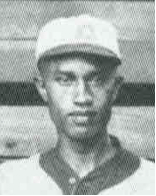
Last week I looked at the Hall of Fame case for Negro Leagues catcher Bruce Petway. This week the focus is on Frank Warfield, an Indianapolis native who gained fame — and notoriety — as a second baseman and manager from the mid-1910s to the early-1930s.

The argument for Warfield’s inclusion in the Hall is a bit more tenuous than that of Petway because, unlike the latter, Warfield had a reputation for volatility and ill-temperedness that occasionally bordered on violence. His penchant for ugly confrontations contributed to the hanging on him of the nickname “Weasel,” which seems less than flattering.

In addition, his achievements and status don’t seem to be as highly respected by his peers and historians. In other words, he just wasn’t as good as Petway. But we’ll try to lay things out and see where he falls.

One of the strongest arguments for Warfield is his record of overachievement — he was a little guy (about 5-foot-7) who exceeded expectations because of his grit and determination. An April 25, 1931, Baltimore Afro-American article under the headline, “They Laughed at Sox Manager When He First Sought Job,” explains his somewhat remarkable development as a player:

“Because he was  so small of stature, most baseball managers laughed at Frank Warfield, manager of the Black Sox, when he tried to get a chance to do his stuff on the big teams …

“Warfield, who is one of the best second sackers in the game, started his baseball career on the old sand lots of Indianapolis …

“After playing on these lots for a considerable time, he tried to get a job playing with the big boys, but because of his smallness, no manager would listen to his plea.”

The article goes on to list some of the many attainments:

• A key cog in Hilldale’s three-year run (1923-25) of Eastern Colored League pennants (in the article Warfield asserts the Darby team was the best for which he played);

• Guiding the Baltimore Black Sox to a crown in 1929 and to several victories over assorted white all-star teams;

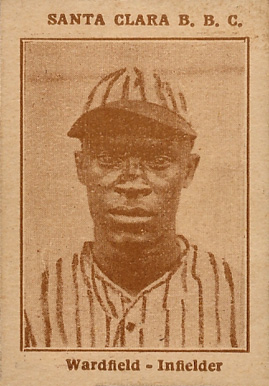
• Competed for strong Santa Clara squads in the Cuban Leagues.

• Much of his Negro Leagues exploits came while he was player/manager of various franchises, reflecting his splendid baseball acumen and ability to oversee other players and get them to perform at the top of their games.

Also remarkable was the fact that he broke in with the vaunted ABCs at the tender age of 15, which evinces his gutsiness and ambition.

Finally, while with Baltimore, he combined with Oliver Marcell, Dick Lundy and Jud Wilson to form the first “Million Dollar Infield,” predating the similarly-monikered Newark Eagles foursome nearly 20 years later.
111Warfield-148x206

However, Warfield’s numbers seriously weaken his case for the HOF. According to Seamheads, his career batting average in the Negro Leagues was a rather pedestrian .265, while his cumulative on-base percentage and slugging figures were .a bit more substantial .336 and .342, respectively.

He was also a speed demon, amassing 147 stolen bases, 118 doubles and 44 triples 843 Negro Leagues games, numbers that boost his case for the Hall.

Defensively, Warfield posted a fielding percentage of .949 and totaled 1,467 putouts, neither of which are too shabby.

In that way, it seems, Warfield was much like Petway — an excellent fielder, baserunner and manager who was hampered by light hitting stats. However, Warfield’s achievements as a team leader appear to have been highly esteemed at the time, especially his accomplishments with Hilldale. Here’s what the Feb. 9, 1924, Philadelphia Tribune stated:

“Hustling from the rank and file of the baseball world to the leadership of possibly two of the greatest aggregations of colored ball players ever gathered together, depicts in brief the meteoric rise of one, Frank Warfield, demure and unassuming, evasive of notoriety that accompanies par excellence achievements in any given line, yet possessing all of the essential qualities that go to make up a truly great ball player and being imbued with that indomitable spirit characteristic of all leaders, the diminutive second sacker has taken his place in the calcium glare. …

“Forsaking the shores of Lake Michigan last spring for those of the broad breezy Delaware, with the express intent of doing all the second basing that would be required by the Philadelphia Hilldale Club, Frank got by with the job with so much alacrity that the owners and the majority of the fans voted him a howling success, which is about as much as any ball player could desire, providing, of course, that the monthly stipend is hitting on all six.

“Coming down the stretch of a successful season, but with the crucial test to be reached, last October, the Hilldale craft, when apparently without a ripple on the surface, suddenly listed, careened and when it righted itself the berth of captaincy yawned with the vacancy of a cavern. Ed Bolden, who guides the destiny of the Hilldale outfit, summed up the possibilities for a field leader and hunted the mantle on quiet Frank. How the club finished out in front in the league race, how they turned back the Athletics and wound up the season in a blaze of glory is now history and ere Frankie hied himself from the Quaker City, he was named as the [?] captain of the Hilldale Club. …

“Truly with each club [Hilldale and Santa Clara], ‘Weasel,’ as some of his team mates have dubbed him, he has been staked to two of the best outfits that ever sported cleated hoofs and speculation is rife, regarding which team would emerge the victor, if a possible meeting between Hilldale and Santa Clara could be effected.

“But as it requires a big man for a big opening, despite Frank’s deficiency in statue [sic], the undersized Indiana youth has attracted the fans of Cuba and the States and now ranks with the select leaders in Negro baseball.”

Aside from incredibly convoluted and unnecessarily flowery languages — “cleated hoofs”? “calcium glare”? “yawned with the vacancy of a cavern”? — that passage, while superbly encompassing Frank Warfield’s proficiency as a manager, kinda glosses over (or, truthfully, outright contradicts) Warfield’s penchant for angry outbursts and involvement in physical conflagrations.

Because, well, there’s his temper, and what a temper it was.

His most notorious … let’s call it an incident … occurred in February 1930 while he was in Cuba as player/manager for Santa Clara. While Warfield and teammate (for both Santa Clara and the Black Sox) and fellow hothead Oliver Marcell were shooting dice — some reports say they were playing cards instead — a fierce fight erupted over the proceedings while several other players looked on. Let’s let the Feb. 8, 1930, Afro-American take it from there:

“Marcelle [sic] is said to have been losing heavily and asked Warfield for some money he claimed the Black Sox manager owed him from last summer. Upon the latter’s denial of the debt, Marcelle is said to have made a lunge at Warfield, and in the ensuing scuffle, Marcelle’s nose was badly bitten.

“The injured player is said to have obtained a warrant for Warfield’s arrest. It is understood that a hostile feeling had existed between the players for some time, started during last season. On several occasions Warfield is said to have removed Marcelle from the game because he was not in condition or not up to form.

“This engendered a resentment that smouldered [sic] until its outburst here. Both players are popular here and in the United States as well and the altercation came as a distinct surprise to the fans who turned out to see them in action. The case is scheduled to come up for an early hearing but the prevailing opinion is that because both of the players are Americans, the charges will be quashed.”

Keep in mind that these two guys were teammates at the time! In addition, Marcell’s nose wasn’t just “badly bitten” — according to historical accounts, his snoot was pretty much ripped off entirely. The injury is believed to have effectively ended his career, one that could have earned Marcell himself a spot in the Hall of Fame if it wasn’t for the physical trauma and his often uncontrollable temper. (Here’s an article I wrote a couple of years ago about “Ghost” Marcell.)

But Warfield was involved in a bunch of other highly publicized meleés as well. In July 1931, for example, a game matching the Black Sox and the Homestead Grays at Baltimore’s home grounds erupted into an ugly scuffle after Grays manager Cum Posey vehemently argued an umpire’s call in the eighth inning.

Posey — who was inducted into the Hall of Fame in 2006 — leapt from the Homesteaders’ dugout and rushed the field, promoting Sox player-manager Warfield to do the same. Warfield took offense to Posey’s presence on the diamond and demanded the the Grays pilot be removed.

According to the July 18, 1931, Afro-American, Posey allegedly responded with a cuss word or two, spurring Warfield to get up in Posey’s face. Cumberland, now completely incensed, punched the Weasel in the jaw, prompting several police officers to spring into action as multiple players attempted to restrain Posey.

According to the newspaper, if the cops hadn’t have intervened “there would have been some casualties.”

The paper added that it was, at the time, unclear whether Warfield had egged Posey on with his own volley of name-calling or physical jabs. Warfield denied anything “untoward” and alleged that Posey had called him names before. So nana nana boo boo, stick your head in doodoo.

The final example of Warfield’s rough temperament came in July 1925, while Warfield was on the Hilldale roster and the Darby clan squared off against Harrisburg. Allegedly, Harrisburg’s Dick Jackson got into a rumpus with Warfield, and Hilldale’s Clint Thomas reportedly tried to separate the combatants, only to be foiled by Hall of Famer and Harrisburg mainstay Oscar Charleston, who allegedly urged folks to let the two fight.

What apparently ensued was a fracas of the highest order, and it spurred spurred legendarily prickly Hilldale owner and Eastern Colored League president Ed Bolden to fire off a lengthy lament to the Pittsburgh Courier, which had earlier reported on the scrape:

“Under the caption of Oscar Charleston and William Nunn, sporting editor of The Pittsburgh Courier, I notice some charges and uncalled for lies in an attempt to spread propaganda against the Eastern Colored League and Hilldale.

“Some charges are so absurd that they are not worth answering I am TOLD [caps in original] that on Sunday, July 18, the Harrisburg players slammed one of the umpires and fought all over the Baltimore Park. For 15 years, we have had peace and harmony at Hilldale Park.

“Jackson, of Harrisburg, called Warfield a vile name. Thomas pushed them aside. Charleston rushed up pushed Thomas aside and said let them fight. Jackson hit at Warfield, Warfield ducked, knocked Jackson down and pounced on him. I do not encourage fighting on my team.

“Charleston’s poison tongue and foul tactics will never win the pennant. Baltimore, Bacharachs and Harrisburg have been materially strengthened through the UNDERHAND [caps original] methods of [Washington Potomacs owner] George W. Robinson. If Hilldale cannot win the pennant through wholesome sportsmanship and clean baseball, I do not want it.”

(The Courier returned fire by directing an open letter to Bolden, accusing him of fraud as ECL president via schedule more games for his on team and fudging league standings. The paper claimed it was simply asking questions — the source of Glenn Beck’s catchphrase? — with its previous report and that Bolden failed to adequately respond to them. The paper charged Bolden with, essentially, sensationalizing the Warfield-Jackson fight, as well as speaking out of both sides of his mouth when it came to his policy on fighting by his players.)

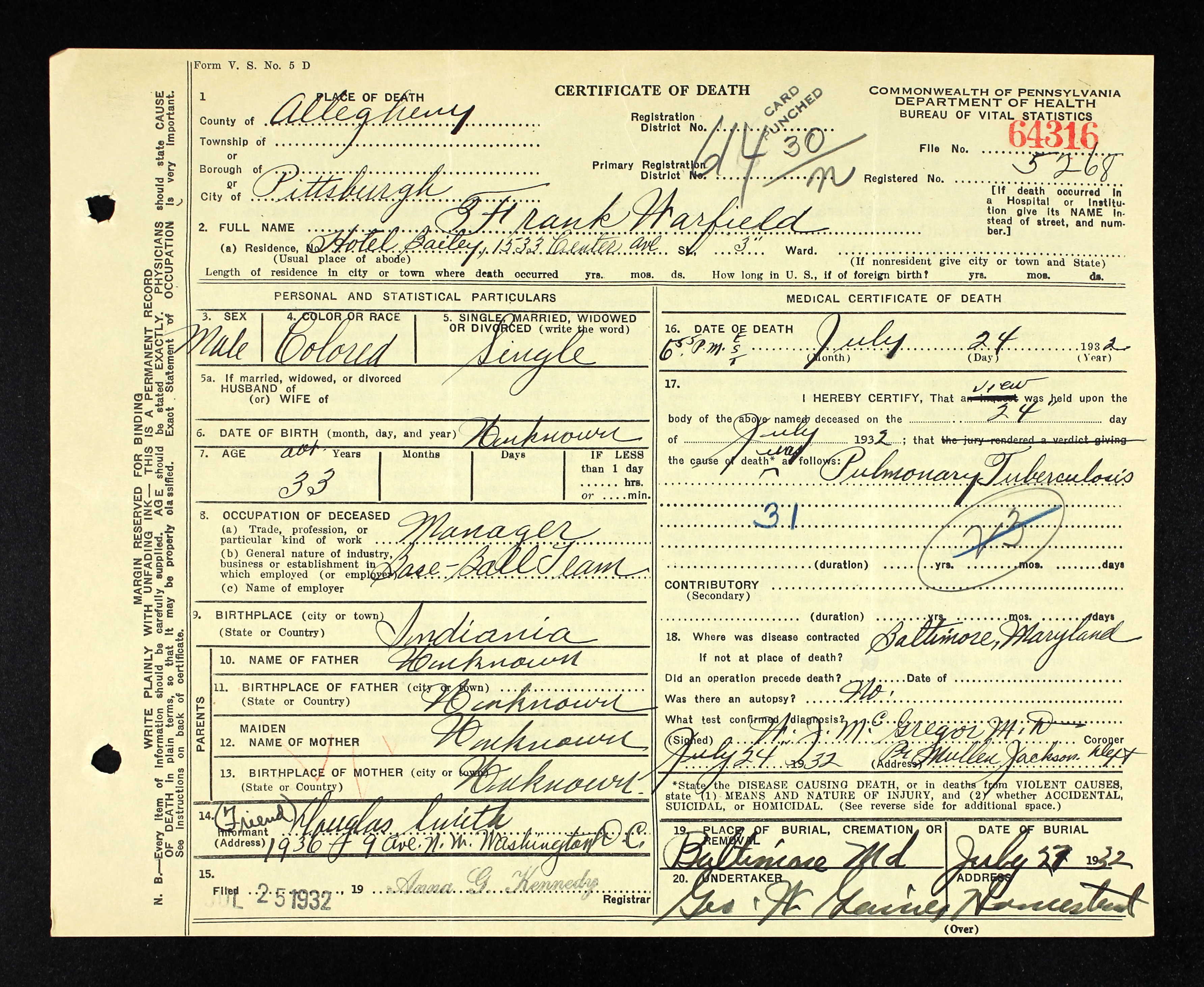
The Francis Xavier Warfield story came to a conclusion (at least corporeally) quite suddenly, on July 24, 1932, in Pittsburgh. According to his death certificate, the cause was pulmonary tuberculosis that was contracted in Baltimore, where he lived while suiting up for the Black Sox and which served as his adopted hometown. The document lists his occupation as “Manager” of a “Base-Ball Team.”
42342_2421401574_0631-03186W

His exact age at death remains a little unclear, with different records listing different dates of birth. The death certificate states his birthdate as “unknown” and pegs his age as “about 33.” His World War I draft card gives his DOB as April 26, 1898, while certain Social Security records say Sept. 14, 1894. Birth records list the DOB as Aug. 15, 1898, but Find A Grave asserts April 26, 1897. Finally, the 1900 Census says September 1889!

(What’s also unclear is the Weasel’s place of birth; while it’s clear that he did, for the most part, grow up in Indy, possible birth locations include Indy; Warrick County, Indiana; and Christian County, Kentucky, where his ancestral roots appear to have been.)

The Afro-American reported the circumstances, citing “an internal hemorrhage” as the cause. The paper added:

“Death was almost instantaneous. Warfield had been in good spirits and in apparently good health, and only Saturday night talked over long distance telephone with friends here. Early in the season, he contracted a cold, and while it did not respond to treatment as rapidly as expected, it was not thought to be of any serious consequence.

“For several weeks, Manager Warfield graced the bench during games, although he occasionally took part in practice. His place at second base was taken by [Sammy] Hughes … and the youngster handled the position so well that Warfield did not feel it advisable to take him out of the game, so he directed the team from the bench.

“Just 34 years old, Warfield was at the peak of his managerial career when death came. …”

James Riley, however, in “The Biographical Encyclopedia of the Negro Baseball Leagues,” relates a slightly different tale of Warfield’s demise:

“He was still officially serving in the capacity of playing manager when he died of a heart attack under vague circumstances. A known ladies’ man who liked to flash big money rolls, he was in the company of a woman when he was rushed to the hospital, bleeding. His death was almost instantaneous after suffering an internal hemorrhage.”

But back to the Afro article, which went on to eulogize Warfield with his achievements and personality traits, the description — such as “[a]lways quiet and modest” — of which by the paper seem to contradict the numerous accounts of his short fuse and proclivity for scrums.

However, the newspaper also assessed Warfield’s hardball faculties pretty accurately:

“In addition to having baseball brains, Warfield was a fast base runner and a good hitter, throwing and batting right handed. It has been often said of him that he could get more passes to first base than any other man in baseball. He had a knack of worrying pitchers as he ‘waited out’ their pitches and some of the best hurlers in the game used to dread to pitch to him, not because he was such a heavy hitter, but because he worried them.

“Years ago, some team mates named him ‘The Weasel,’and true to that namesake, Warfield proved to be a clever strategist. He was a master of the sacrifice bunt and he beat out many an infield hit. He studied the game and while pitchers were often credited with winning games, it was the strategy of Warfield that was really responsible.”

And this is what the Pittsburgh Courier wrote:

“Death, coming after a brief illness, robbed Negro baseball of one of its finest and most able performers and one of its most respected players by fans and officials alike.

“… His work as an infielder was brilliant but steady, and many clubs made bids for his services. His fine record as a player and a gentleman and his contribution to baseball ranks him with such immortals as Rube Foster and C.I. Taylor. …

“Possessed of a cool, even temperament, and with plenty of business as well as baseball brains, Warfield made an ideal manager. In addition to handling the team on the field, he was efficient as a business executive of the club and took charge of most of the financial affairs.

“The remains were shipped to Baltimore for burial, his present home where hundreds of messages of condolences from both high and low in the baseball world attested to the esteem in which he was held.”

And from the Philly Tribune:

“Warfield was long considered one of the most astute performers in the game. …

“It was under the banner of the Darby Daisies … that Warfield reached the heights as a player. He was termed the ‘miracle man’ and was generlaly [sic] rated as the peer of all Negro second basemen.”

So, the question could be … How do you elect to the Hall of Fame a man who bit off a teammate’s nose, who drew a Hall of Fame manager into a fight, and who helped trigger an ugly brawl on at least one additional occasion? (And that’s not to mention his relatively lightweight numbers at the plate.)

Because of the arguments that can be made in favor of him, that’s why — his incredible managerial aptitude (that were so good that he garnered comparisons to Rube Foster), his fleet-footedness, his shining defense, his record of success despite originally being dismissed as a little squirt.

Again — as with many HOF candidates, regardless of era or ethnicity — it’s quite cloudy and hazy. Greatness is never completely three-dimensional: Ty Cobb and Cap Anson were angry, racist jerks; Ted Williams and Josh Gibson were at best so-so on defense; Ozzie Smith and Bill Mazeroski were pedestrian at the plate; Nolan Ryan and Phil Niekro piled up almost as many L’s as W’s. And that’s not to mention the many greats who might always be on the outside looking in — Pete, Joe, Barry, Mark …

For me, Frank Warfield is a toss-up when it comes to Hall of Fame induction, with his stormy personality being the best argument against him, and his underrated managerial acumen the top “pro” factor.

How about you?
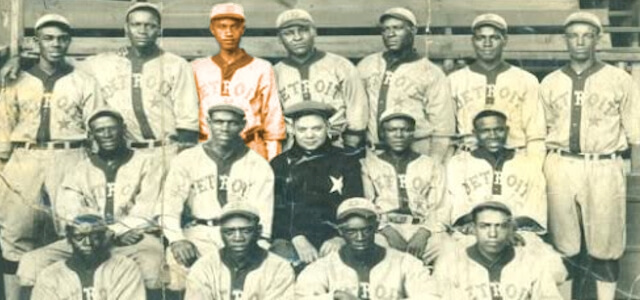
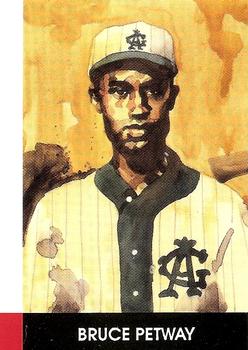
The case for the Hall: Bruce Petway

1920-detroit-stars-negro-league-baseball

Kind of building on my post from a week or two ago about Frank Duncan (as well as earlier ones about Rap Dixon, Bud Fowler and others), here’s another post about a Negro Leaguer who could — or should — be in the National Baseball Hall of Fame. That is, of course, if the Hall does what’s right and once again opens its doors to segregation-era African-American baseball figures.

Today: the case for Bruce Petway.

A native of Nashville, Tenn., Petway has often been dubbed — by both contemporaries and ensuing historians — the best African-American catcher of the first quarter of the 20th century.

That’s especially true for his defensive skills; with a whip of an arm and the trailblazing ability to throw runners out while still crouched, Petway definitely deserves some love from the HOF and baseball history enthusiasts.

In early 1930, for example, legendary pitcher/manager/executive/baseball Renaissance man Dizzy Dismukes placed Petway at the top of his list of the greatest backstops of all-time in black baseball. Citing, among other achievements, Petway’s famed ability to catch a certain petulant Tiger stealing, Dizzy laid out a convincing argument. He wrote:

“Topping the list is none other than Bruce Petway, whom I claim to have been the greatest throwing catcher I ever saw. His best days were spent during the base-running craze. There were not as many fast men afoot playing baseball then as now, but there were more base runners. One could possibly count all the thefts against Petway during a season on one hand and then have a few fingers left.

“Some said Petway was not a good receiver but Petway would intentionally drop balls to encourage base runners to start, as very few had the nerve on days when he was in charge of the mask and protector. Petway himself was a great base runner and had an uncanny judgment of foul fly balls. During Ty Cobb’s palmiest days as baseball’s greatest base runner Petway, with [Hall of Famer John Henry] Lloyd receiving his throws, stopped him cold while in Cuba.”

Also chipping in with his opinion was the great Sol White, another jack-of-all-trades legend who also became a seminal author, columnist and historian of African-American baseball. In April 1927, White penned a lengthy letter to esteemed Pittsburgh Courier scribe W. Rollo Wilson, in which Solomon, like Dismukes, ranked his choices for greatest catchers. Wrote White in that dispatch:

“Bruce Petway had one of the best throwing arms I ever saw. He was a student of the game, worked hard and was always willing to try anything for the good of the team. I choose Petway for this reason — while other catchers have the snap throw they do not have it perfected like he did. Notice that some catchers use their shoulders with the ‘snap’ and that makes a ball heavy and hard to handle. Such throws are not conducive to effective baseball from the standpoint of continuous play. What infielders want and like is a ball coming to hand that they can grab, handle, touch the runner and get it away for a possible killing at another base. I want to call the attention of the fans who saw Petway in his day and ask if they can note the difference in his style to that of the leading receivers of his era, [Frank] Duncan, of Kansas City, and [Biz] Mackey, of Hilldale.

Fleet Walker, Clarence Williams and Bruce Petway are, in my opinion, the best catchers of all time. …”

But Petway started garnering widespread acclaim by the end of 1909 — just a few years after his professional debut with the Cuban X-Giants — when the Indianapolis Freeman’s Harry Daniels gushed when naming Buddy the greatest “race” catcher of his day:

“Petway [is] … the greatest since Arthur Thomas’s time. Petway at present time is the best throwing and base-running catcher colored base ball has seen.”

Buddy also early on gained a reputation as a gutty and gritty backstop who was willing to lay everything on the field. Said the Freeman in July 1910:

“Petway, the champion colored catcher, plays with broken bones and other injuries just the same as if nothing had happened. He is a ball player of the first water.”

And what about modern-day experts? They echo the sentiments of Dismukes and White. Here’s what prolific SABR scribe Brian McKenna blogged in 2011:

“Petway’s main contribution though was behind the plate. He was the finest defensive catcher of the first quarter of the century. His skills, particularly with his arm, were admired wherever he traveled – and he traveled extensively year-round in the East, West, South, North and to the island of Cuba.

“In short, he had a strong, accurate arm and was tough on base runners. Moreover, he was particularly heralded for his fielding of bunts. Petway was naturally compared to major leaguer Johnny Kling who was renowned for the same skills. They both pegged the ball to the bases, even second, from a squat.”

Or how about what SABR Negro Leagues Committee Co-Chairman Larry Lester penned in his 2013 essay, “Bruce ‘Buddy’ Petway: A Bad Brother”:

“Buddy was the baddest brother to ever wear the tools of ignorance. Ebonically speaking, Buddy was ‘bad.’ Translation: Good is bad, and bad is about as good as it gets. His slender build allowed him to have jack-in-the-box popupability to deter potential base stealers. Down from his shin guards, up with a nanosecond snap release, his throws to second were on time, on line, low and accurate for tagging ease. ‘No way with Petway’ was the cry of many base bandits.

“Unlike most catchers with ketchup in their blood, Petway was a big threat  on the basepaths. His happy feet saddened the faces of opposing catchers. In fact, he led the Cuban League in 1912 with 20 steals as a Habana Red. The fleet switch-hitter with awesome bunting abilities and base running skills often batted leadoff, a rarity for any catcher.”

Larry concluded his essay succinctly and quite appropriately that “Bruce Petway is perhaps the greatest catcher not in the Hall of Fame.”

Why did I want to spotlight Mr. Petway? Well, there’s several reasons, I guess … One is the fact that this July — Independence Day, in fact — will be the 75th anniversary oh his death in Chicago, an important milestone in the continued blossoming of his legacy and historical importance.

A second reason is that Petway played alongside countless other blackball legends during a career that spanned 1906 to 1925. That included Hall of Famers Pop Lloyd, Pete Hill and, of course, the great Rube Foster himself, the architect of the storied Leland Giants squads of the 19-oughts and the powerful Chicago American Giants clubs a decade later. While with the Giants, Petway caught Foster and helped galvanize Rube’s distinct, influential brand of “small ball” as a crafty, slashing leadoff hitter and bunter and a wily demon on the basepaths.

But Petway also shared rosters with other blackball legends — like Frank Wickware, Spot Poles, Grant “Home Run” Johnson and the afore-mentioned Frank Duncan — who, despite stellar resumés, continue to get short shrift from Cooperstown.

Third, and connected to Reason No. 2, is that Petway, like many blackball leading lights of his day, shined in the Cuban Leagues. There is, naturally, the previously noted zapping of the Georgia Peach, but, as highlighted by Lester, Petway also starred for Cuban winter aggregations like Habana Red and graced an earlier baseball trading card.

84753599_135126319740

When venturing to Cuba, Petway was in outstanding company; various ship manifests from the island show him traveling with Pete Hill, Waxey Williams, Harry Buckner, Bill Gatewood, Pop Lloyd, Tullie McAdoo and Judy Gans.

Then Reason No. 4 (I know, it’s a hefty list, but Bruce was a hefty talent and left a hefty legacy): he became a top-notch skipper and player-manager as his physical prowess waned, especially with the Detroit Stars during their circa-1920 heyday. By many accounts, Petway was a smart, crafty strategist who employed a steady hand that engendered calm and confidence amongst his charges.

Here, for example, is the caption under a huge picture of Bruce in the May 19, 1923, issue of the Chicago Defender. (The header over the photo states, “HE DID THAT THING —”):

“Manager of the Detroit Stars, who parked his team in the American Giants’ yard Sunday afternoon, kicked ‘their dog around’ in the first inning, and when things looked dangerous he sent Daniels in to do the receiving for him in the fifth and sat on the bench, where he ran the team. Things looked awful hazy in the ninth two out and three on, but ‘Buddy’ steadied his men. All Chicago wasn’t big enough Sunday night for him and Tenny Blount — ‘twas the first Sunday game the Michiganders had copped against Foster in his own grounds since 1921.”

That story illustrates both Petway’s willingness to make needed adjustments — even if that meant sidelining himself — to win and his ability to outmaneuver the greatest manager in Negro Leagues history.

Remember, too, that Rube also happened to be Bruce’s employer for many years prior, a fact that reflects Petway’s steely nerve and readiness to go toe-to-toe with a legend, even his mentor. Adding to that unflinching character was what transpired in early 1925, as Foster was coordinate the upcoming NNL season. Petway, still with Detroit, led a group of steadfast players in demanding that Foster guarantee their salaries before they signed contracts for ’25. That early step toward player rights certainly took a decent dollop of chutzpah.

The final reason to put the spotlight on Petway is that I’m utterly intrigued by Petway’s roots and youth in Nashville. The family likely traces back to a slaveowner in Nashville named William E. Petway, but that didn’t stop the freed black Petways from excelling.

Bruce Petway himself was studying to be a doctor at Nashville’s Meharry Medical College, and his father, David Petway (1852-1910) was an engineer at a saw mill after most likely being born into slavery. I’ve found evidence that one or more of Petway’s relatives attended the celebrated HBCU Fisk University, with one Petway starring in football at the school and a later-generation man named F.A. Petway was an esteemed church choir director and later a professor at Fisk.

89415-6376203Fr

However, several Petways in Nashville seem to have gotten into legal trouble — One named Abe Petway was hanged (!) for murder in 1910, a George Petway died in a duel in 1899, one named George W. Petway was awaiting trial for murder in 1880, and a William Petway was sentenced to 42 (!) years in prison for larceny and home breaking (although that last one’s sentence was likely so high because he was a black man in the South 100-plus years ago).

I haven’t firmly established any concrete family ties with many of those names, but it seems possible that at least some were related to Buddy Petway.

And Buddy definitely loved his hometown, if the waning days of his baseball career are any indication. In the early 1930s, after his stint as player/manager in Detroit, Petway returned to the Music City to suit up for the Nashville Elite Giants, who were at that time flitting between the Negro National League and the Negro Southern League.

While he was in the Elites’ dugout, Petway was visited by numerous newspaper reporters as Nashville barnstormed across the map. In one contest between the Elites and Cole’s American Giants in Chicago in May 1934, the Chicago Defender’s Al Monroe dropped in to chat with Buddy, who was by then one of the Negro Leagues’ most esteemed elder statesman. The scribe an the catcher chatted as they eyed the players on the field, and Monroe reported on the confab, dubbing Petway “an old-timer an easily the greatest catcher the game has ever known” as the manager called plays from the dugout. Monroe added:

“Your author was particularly interested in watching Petway as he moved about the ball park. Long, lean, and as healthy as an elephant, we just couldn’t understand why baseball no longer appeals to him, that is, as a player. Well, it does. ‘But my legs just refuse to stand up for more than a single inning,’ said the great catcher as he dodged his way through the 999 other fans, many of whom didn’t recognize the man John McGraw, Rube Foster and Connie Mack once called the world’s greatest catcher. Yes, Father Time is mighty cruel his great athletes.”

With that, Monroe ended the column on a bittersweet note — a mix of lingering joy and creeping sadness that seems to always hang like a cloud over men and women who spend the “prime” of their lives dedicated to pushing their bodies to the absolute limit for a pursuit they love.

It lasted just seven more years for Buddy.

Bruce Franklin Petway died on July 4, 1941, 75 years ago, at the age of 55, but his legacy as a pioneering catcher — especially defensively — a clutch and crafty batter and baserunner, and a shrewd and canny manager only grew from there, at least for those in the know of Negro League circles.

The Amsterdam NewsDan Burley beautifully eulogized Bruce in a July 12, 1941, column:

“The death last week in Chicago of Bruce ‘Buddy’ Petway, the man who was battery mate of the fabled Rube Foster, reviews a host of memories … Memories gained from conversation with Old Timers who new what went on way back when … Petway was the guy who started the big league catchers throwing to the keystone sack without rising from their sitting position behind the platter … “

So, what say you? Does Bruce Petway, 75 years after his death, deserve a plaque in the hallowed halls of Cooperstown? We’re talking about one of the greatest defensive catchers in baseball history, black or white, an innovator who also had unusual speed and savvy as a base runner, bunter and overall “small ball” master. He’s a guy who also excelled as a selfless, wily and calm and coolheaded player/manager.

Scribes from both “way back when” and from modern days rained praise on Buddy, and he was liked, respected and highly-sought-after by the greats of baseball, including Rube Foster and major league signal callers.

My vote, obviously is, Yes, Bruce Petway belongs in the Hall of Fame. What do you think?

Weldy Walker grave marker effort

12650746_702945535234_177335013_n

Images courtesy Craig Brown

How did the second African American to play in the major leagues end up in an unmarked grave in Steubenville, Ohio?

While SABR member Craig Brown can’t answer that “why” question, he can state positively that placing a marker on Weldy Walker‘s burial site is within in reach.

But it can only become reality if he, SABR and the Negro League Baseball Grave Marker Project receive help from us, the fans, historians and researchers who strive to keep the memory of the Negro Leagues alive.

Weldy Walker was the brother of Moses Fleetwood Walker, who became the first black player in what was considered major league baseball in 1884 with the American Association‘s Toledo Blue Stockings.

A few months after Fleet debuted in Toledo, Weldy was briefly added to the roster to become the second African American to play in the majors. (Here is an article I wrote about Weldy for the Oberlin College alumni magazine.)

Fleet died in 1924 and now rests in a marked grave in Steubenville. But Weldy, who passed in 1937, does not have a grave stone.

Last week I conducted an e-mail interview with Craig about the sad situation with Weldy’s grave and the growing effort to rectify it. Below is the text of our cyber conversation …

How did you come across Weldy Walker and his career? What first got you interested in him?

I learned about Weldy Walker as a result of my research into the life of his brother, Moses Fleetwood Walker. For about three years, I have been working with students to have Ohio have a law to designate a day in honor of Moses Fleetwood Walker. The bill is House Bill 87, and it has passed out of the [Ohio House of Representatives State Government] committee.

We are waiting for Speaker Cliff Rosenberger [R-91st District] to decide if it will be voted on by the entire Ohio House of Representatives. We have been assured by a representative of the speaker that he is aware of the bill, and the people have been vocal in their support. We can still use help encouraging him to bring the bill to a vote. It is best to contact him by traditional mail, but an e-mail will help. His contact information can be found at http://www.ohiohouse.gov/cliff-rosenberger.

How did you find out that Weldy’s grave is unmarked? What was your reaction to such a tragic situation for such an influential figure in baseball history?

I realized his grave was unmarked when I visited the site. Moses’ grave was marked by the Oberlin Heisman Club. There are several members of the Walker family buried in Union Cemetery [in Steubenville]. Moses has the only marked grave. I’m not sure if this was due to a cemetery rule from that era or if it was a financial issue.

It seems that the Walkers were very active in the community and were not destitute. It is unfortunate when any grave is unmarked, but Weldy’s situation is unsettling. He made a contribution to baseball, but he also was an early politically active African American and a voice for civil rights.

Remembering his name and knowing his story can help us connect with our past and better understand our present.

Nathan Marshall of Wellsburg, W.Va., approached me about doing more things to honor the Walker brothers a few months ago. Up until that point, I was focused on HB 87. His interest convinced me that buying Weldy a gravestone could have momentum, and this was possibly something we could do in a relatively short amount of time.

1553516_446505505451024_464304870_o

How did you find out about the Negro League Baseball Grave Marker Project? How did you pitch a project on Weldy to Jeremy Krock?

I knew the Negro League Baseball Grave Marker Project existed via searching the Internet. Dr. Leslie Heaphy of Kent State [University] suggested I speak with Jeremy Krock. We connected via e-mail, and he was 100-percent supportive. Although we planned on raising the money for the grave before approaching SABR, we knew it would help our efforts if a donation system was already in place with a professional structure and legitimate record.

Why do you think Walker is buried in an unmarked grave? How did that come about?

I honestly don’t know. It is quite possible discriminatory practices were an issue, or perhaps the family just didn’t have the money. Weldy and Moses were close their entire lives. Their stones will match, and I believe that is fitting.

Are you optimistic about the prospects for success? Why or why not? What can the average person do to contribute to the effort?

We only need to raise $1,300. That isn’t bad. All donations are accepted and will go to memorializing this forgotten man. It is important that when making a contribution via the SABR site, the donor writes “Weldy Walker” in the comments.

[Editor’s note: After I published this post, SABR friend Ralph Carhart commented that Fleet and Weldy Walker might actually have been the second and third players, respectively, in the majors. He noted the case of William White, who played one game for the National League’s Providence Grays in June 1879. There’s ongoing debate about whether White, not the Walkers, was the actual trailblazer — the debate centers around whether White was black or, well, white.]

Baseball bloodline: the Duncans

IMG_2143

A family photo of Frank Duncan Jr., Julian Duncan’s grandfather (photos courtesy Julian Duncan)

If any family associated with the Negro Leagues — with the exception of the Taylor brothers and the Bankhead bunch — has a strong bloodline in baseball, it’s the successive generations of Duncans.

The first generation was Frank Duncan Sr., who, while not playing professionally, was always around the game in the decades before and after the start of the 20th century.

Frank Sr.’s involvement was perhaps most passionate when it came to encouraging his kids in their careers. And that leads us forward …

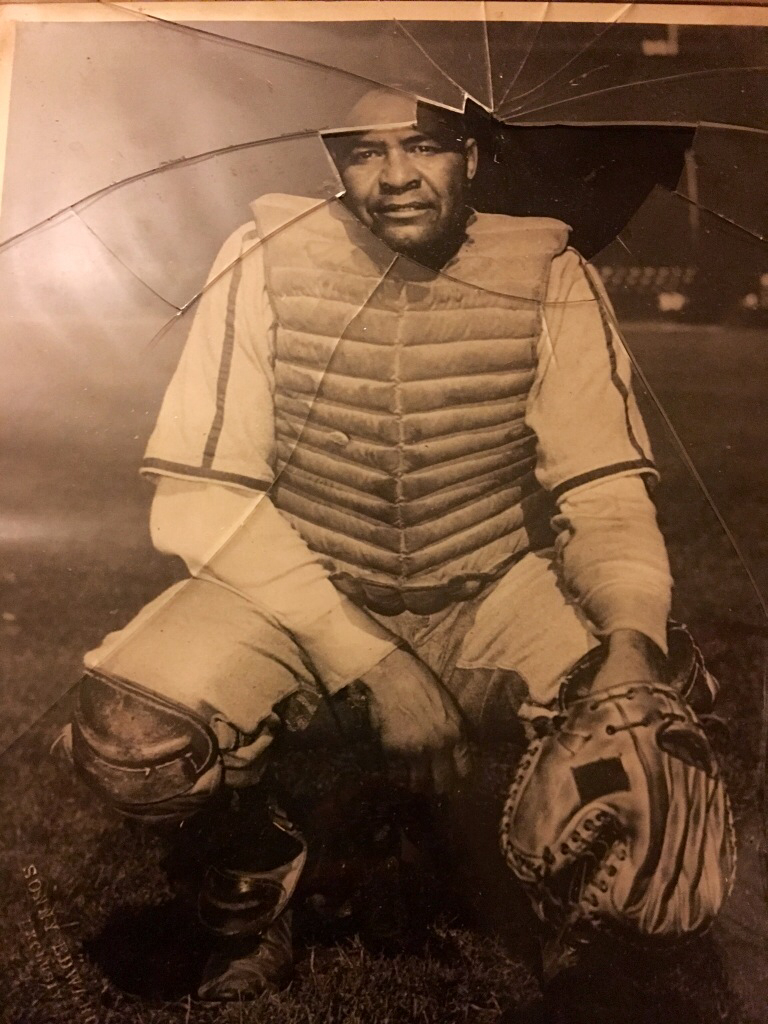
The tradition began in full with Frank Jr., who had the most successful hardball career of the bunch, blossoming into one of the most respected catchers and playing managers for about 15 years in the 1920s and ’30s. He spent the majority of his time with his hometown team, the legendary Kansas City Monarchs, helping the franchise to three straight pennants in the 20s’, then guiding them to a league title and a Negro World Series crown in 1942 as a player/manager.

Frank Sr. supported Junior in the latter’s athletic pursuits, even occasionally keeping Junior company in the dugout.

After serving honorably in the Army during WWII — he excelled as a marksman — Frank Jr. returned to the Monarchs, with whom he won another league crown and helped tutor a young Jackie Robinson. Duncan Jr. turned the managerial reins over to the great Buck O’Neil, then worked as an umpire in the NAL for a while before passing away in his hometown at age 72.

Then came Frank Duncan III, who competed in the Negro Leagues in the 1940s and ’50s, where he and his father performed one of the most unique feats in baseball history — with Frank III as pitcher and his dad behind the plate for the Monarchs, they formed what is believed to be the first father-son battery in professional baseball history in 1941.

Frank III continued his career in the American pastime after, like his father, serving in the Army during WWII, playing largely with the Baltimore Elite Giants. He retired around 1945 or so.

Three generations, three blackball players, three different positions, all for the famed KC Monarchs. It’s a legacy that ensuing generations of Duncans embrace and preserve.

That includes Frank Duncan III’s son, Julian Duncan, who is eminently proud of what his forbears accomplished in the national pastime during the tragic era of segregation.

“I’m extremely proud,” Julian says. “I have an 18-year-old son, and I just try to stress to him how important [baseball] was for the family.”

Although Julian wasn’t born in Kansas City — he grew up in the Motor City — he and his family frequently returned to Kansas City to spend time with several Monarchs legends. As a result, Julian was raised steeped in the ongoing tradition of African-American baseball.

“I called Buck O’Neil Uncle Buck,” Julian says. “That’s how close our families were, and we were close for our whole lives.

“I remember the first time I went to Kansas City, in 1964,” he adds. “We’d go every couple years, and I’d see Satchel Paige, Buck O’Neil, Newt Allen. We were treated as family, and I couldn’t figure out why.”

IMG_2144

Frank Duncan Jr. and Bob Feller

He laughs a bit as he says that, because he eventually understood why — because the Monarchs, and the Negro Leagues as a whole, were a tight fraternity, bonded by trial and tribulation, but also pride and success.

Julian says he played a little baseball himself as a kid, but he didn’t acclimate to it like his ancestors and family. But Julian still knows … He knows how important the legacy is.

For example, when he and his son attended the Major League All Star Game in Detroit’s Comerica Park in 2005, they found the special section of the concourse set aside for an impressive Negro League display. There, front and center, was a photo of Frank Duncan Jr.

The sight touched Julian Duncan deeply, especially because his grandfather had participated in multiple East-West All Star games, which back in the day were the jewels of the Negro Leagues season.

In fact, Julian believes his grandfather compiled a hardball resume — especially as a manager — that could be Hall of Fame-worthy.

However, as of now, Frank Jr. won’t be inducted into the Hall of Fame anytime soon, because the Cooperstown institution retains its closed-door policy on Negro Leaguers and pre-Negro League African-American baseball figures.

Julian acknowledges that he’s a bit biased when it comes to his grandfather, but he firmly believes that Frank Jr. — and especially Buck O’Neil — deserve a shot at the hallowed halls.

But if Frank Jr. was alive today, Julian believes he would modestly and quietly eschew and such praise. Frank Jr., as well as Frank III, were more focused on nurturing their family running smoothly.

“He was quiet. He didn’t talk a whole lot about his career,” Julian says of his grandfather. “He didn’t talk about accolades.”

But, once Julian was schooled in the family’s baseball legacy — and the legacy and importance of the Negro Leagues as a whole — he immediately believed that his grandfather has gotten short shrift by the modern baseball community. It’s a faith that continues to this day.

“There’s not a lot of Negro League players left,” he says. “It’s my job to tell everybody I know, to keep it alive as much as I can.”

Posnanski: Hall of Fame is ‘tone deaf’

redding

Joe Posnanski agrees — Cannonball Dick Redding should be in the Hall.

Joe Posnanski is one of the most respected and most trusted sportswriters in the country, and his blog is one of the most popular online sources for incisive, informative opinions and points of view regarding the modern sports scene.

But in addition to covering current sports like a January blizzard covers the landscape of my hometown of Rah-cha-cha, Joe also frequently addresses issues from our nation’s sportive past and the traditions history has handed down to us.

And one such subject he’s been especially vocal and passionate about is the continued lack of appreciation, respect and knowledge about the Negro Leagues. That includes the Baseball Hall of Fame’s ongoing refusal to re-open its doors to segregation-era African-American players, managers and executives, a subject on which I’ve decided to focus this year in my blog. (I’ve penned a few posts about this already, such as here and here.)

Over the last week, I’ve been extremely fortunate and grateful to conduct an email Q&A with Posnanski about his thoughts concerning the Hall of Fame situation. I was going to synthesize an article about the interview, but since his answers are so incredible, I decided to post the back-and-forth verbatim. I hope you enjoyed it like I did, and I hope it generates some retrospection and discussion. (My questions are in bold, his answers and regular type.)

Do you think the HOF’s current exclusionary policy, as it was outlined to me by a Hall official for my blog, regarding segregation-era African-American baseball figures is fair, especially given that the Hall still maintains a Pre-Integration Committee for white major leaguers from that period?

I think the Hall of Fame is really tone deaf on this topic, based first on the obvious fact that they have a group actually named “Pre-Integration Committee” in charge of trying to pick through the leftovers and elect white Major League players into the Hall of Fame. It’s such a bad look for an institution that celebrates the history of the game. White baseball before 1947 is disproportionately represented in the Hall of Fame already and I have absolutely no idea why they would have a biennial committee especially designed to elect more Major Leaguers from that time.

As far as Negro Leagues players, as everyone knows, 10 years ago the Hall of Fame attempted to put the leagues to rest by hiring a committee of academics and historians and giving them carte blanche power to elect as many Negro Leaguers as they wanted. I do believe it was a well-intentioned attempt to give the Negro Leagues one big Hall of Fame celebration, though it did not turn out that way for various reasons. I suspect the average baseball fan could not name even one of the 17 people elected, though they probably do remember that Buck O’Neil was not elected (and Minnie Minoso was not elected either). So that didn’t work out.

I think the Hall of Fame made a mistake by simply closing the book on the Negro Leagues. That said, if they were going to do that, it would look a lot better if they also would close the book entirely on pre-1947 baseball.

Should the Hall of Fame change that policy to once again allow Negro Leaguers to be considered? Why or why not? And if you feel it should be changed, would it even be feasible at this point?

I think if they are going to have a Pre-Integration Committee they must also include Negro Leaguers. But, as mentioned, I don’t think they should have a Pre-Integration committee at all. I think the Hall should focus much more on the time period after 1947. I would argue that there are at least 10 players from the expansion era who are much better candidates than any player they can find now pre-1947 in black or white baseball. The 1960s, 1970s and 1980s are dramatically underrepresented in the Hall of Fame, in my opinion.

Do you think there are still segregation-era African-American baseball figures who are qualified for the Hall? If so, how many would you estimate, and who are some of the people you would recommend?

I do think there are some who are qualified, absolutely, especially if you use the Veteran’s Committee Standard. How many Negro Leaguers were the equivalent of George Kelly or Rube Marquard? Dozens, probably.

But should that be the standard? Probably not. Those were mistakes. I would say the vast majority of truly great Negro League players are in the Hall of Fame. I obviously believe Buck O’Neil should be in the Hall of Fame for his lifelong contribution to the game but the Hall of Fame has done a wonderful job honoring him. He’s the only figure, I believe, to have a statue in the Hall of Fame. There’s a prestigious award named for him. I commend the Hall for the way they’ve kept Buck’s memory alive.

allenN

Newt Allen (from the NLBM)

I think Minnie Minoso should be in the Hall, but not for his Negro Leagues time.
Buck always felt like Newt Allen should been the Hall of Fame — he was a terrific second baseman. Quincy Trouppe was a terrific defensive catcher, Bingo DeMoss was another great second baseman, Oliver Marcell was called ‘The Ghost” and played a terrific third base. There are some others: Dick Lundy, Cannonball Dick Redding and so on. Any of these and perhaps a half dozen more would certainly enhance the Hall of Fame. But, again, to be fair, I do believe that the very best Negro Leagues players are in the Hall of Fame.

What about the arguments in favor of keeping the policy the same, i.e. there aren’t enough concrete stats, the quality of play was less than in the majors, let’s keep this in the past and let bygones be bygones, etc.?

Well, I don’t buy any those arguments. There aren’t concrete stats but we have plenty of ways to discover and rediscover the greatest players in the Negro Leagues. The quality of play argument is ridiculous and easily disproven — look at the flood of all-time great players to go from the Negro Leagues to the Major Leagues in the first decade of Integration. Was ANYONE in the Major Leagues as good as Willie Mays? Henry Aaron? Jackie Robinson? Don Newcombe won an MVP award. Minnie Minoso immediately became a star and even an aging Monte Irvin was one of the best players in Major League baseball. On and on and on.

I don’t see any viable argument for continuing a whites-only Pre-Integration Committee and pronouncing that the book closed on the Negro Leagues. There’s just no justification for that. But, again, I would be in favor of the Hall of Fame putting a lot more emphasis on post-1947 baseball.

Another take on the Hall policy: Don’t shame, but encourage

Since my initial posts (such as here and here) about the National Baseball Hall of Fame’s policy toward possibly opening its door to segregation-era African-American players, managers and executives, I’ve been soliciting some thoughts from various and sundry fans, officials and others who care about the shining, everlasting legacy and tradition of the Negro Leagues. For example, sometime next week I’m going to write a post about the ideas for blackball managers who might deserve to be in the HOF.

Below (in italics) are the reflections of Dr. Ray Doswell, the curator of the Negro Leagues Baseball Museum, who offers a unique take on the situation. It’s important to note that these are Ray’s personal opinions and not in any way an official statement or position of the Negro Leagues Baseball Museum. So, without further ado, here are his thoughts …

Having worked with the staff at the National Baseball Hall of Fame, I do believe these folks care about the history of the game and presenting all aspects of it. I consider them friends. I don’t think it helps “the cause” to shame or guilt the Hall into including more Negro Leagues players. Having said that, I would like to strongly encourage the Hall to consider the following:

• Create a consistent mechanism for Negro Leagues candidates. Once it was decided to include Negro Leagues players for induction, and taking into account the large number of players still worthy of review, something should be in place for them to be on a ballot. I field questions all the time at the NLBM from patrons as to why there is nothing in place more consistently. These other candidates at least deserve an honest vote, and I would hope that it would not be in just a “one off” ballot. There may be some way to create a committee with a start and sunset over a number of years perhaps? This is the only “classification” of players, currently included in the Hall, that does not get regular consideration.  

• Clarify or explain the “Pre-Integration” committee selection process. This has been commented on a lot recently, but it appears confusing to the public that candidates being considered from this period do not currently include any players or officials from the at least the pre-integration Negro Leagues.

What do you think about Dr. Doswell’s suggestions? I’d love to hear from you!

Who holds Cristobal’s fate?

torriente

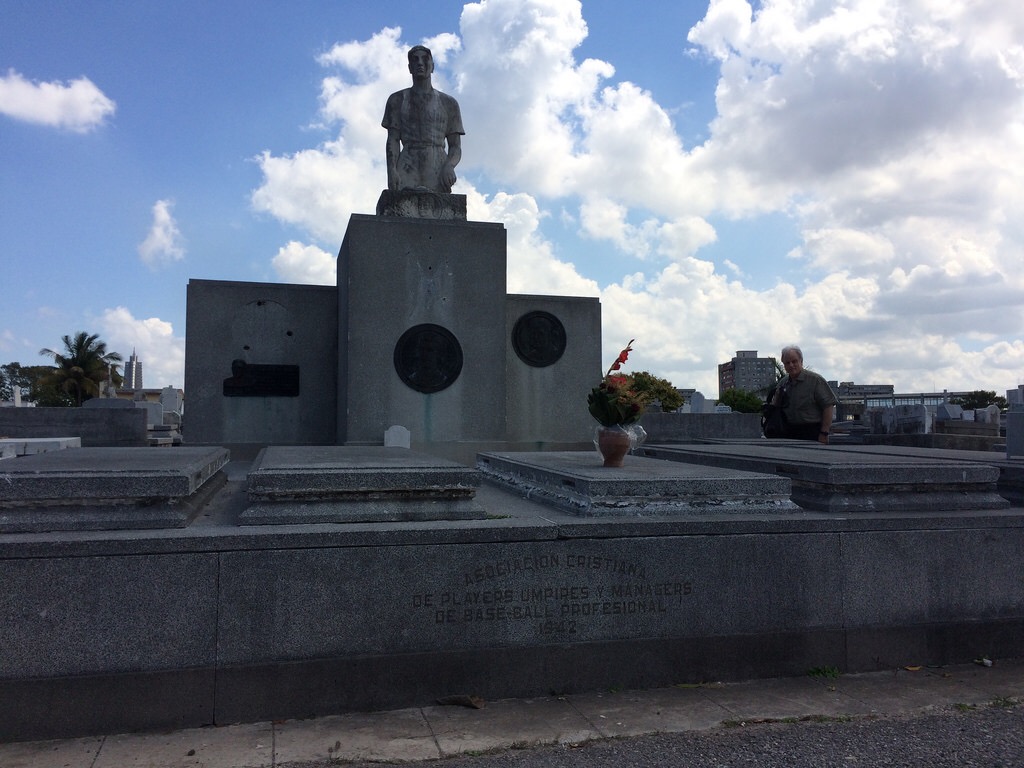
Over the past week, I’ve been trying to keep several pots simmering on burners in an effort to churn out a bunch of posts about two primary subjects — opening the doors of the Hall of Fame once again to Negro Leaguers, and addressing the likelihood that Hall of Famer Cristobal Torriente is buried in a mass, unmarked grave in Queens.

Those multi-pronged efforts are starting to bear fruit, so hopefully I’ll have at least a post every other day through the end of next week. That’s a hefty goal, but I’m trying to keep at it.

Today, though, the focus returns back to Torriente, whose situation I addressed, with valuable help from a few others, in these posts here and here, with the latter being very heavily researched-base.

But beginning last week, I went on an all-out, investigative-journalist blitz to pin down as many officials and media relations folks as I could to see if anyone in New York City might be interested in trying to bring a greater focus to Torriente’s sad situation in Calvary Cemetery in Queens.

Hence, a week ago, I sent out a flurry of emails to various NYC offices and agencies — including the City Council — as well as the Archdiocese of New York. And, after a week of waiting and follow ups, the news ain’t good. It ain’t good at all.

I’d ideally like to start off with the response I got from the City Council, but, unfortunately, I haven’t received any such answer. I sent emails to three officers of the Council’s Black, Latino and Asian Caucus — Co-Chairs Rosie Mendez and Andy King, and Council Speaker Melissa Mark-Viverito — and heard precisely bupkis back.

I also dashed off an email to the Council’s press office, but after several days of waiting, my overture bounced back as undeliverable. So I called the Council press office today, when a staffer there asked me to send an email to her personal address, something I will do later today.

I had a little more luck with the City’s Health Department and with the New York City Health and Hospitals Corp., a non-profit agency formed roughly 45 years ago to administer the city’s 11 public hospitals and other health-care services open to the public.

ramiro_ram%EDrez

Ramiro Ramirez, who reportedly claimed Torriente’s body (from Seamheads)

But before we get into the input from those two agencies, let’s go back a bit and recap what we do know about Cristobal Torriente’s last years, his death and his burial, much of which was uncovered by the Herculean research efforts of friend and fellow SABR member Ralph Carhart of the Hall Ball Project, as well as researcher extraordinaire Gary Ashwill

Somewhere in the mid- to- late-1930s, Torriente, who had settled in NYC after spending much of his playing career there with various teams and (apparently) retiring around 1933, checked into what was Riverside Hospital on the city’s North Brother Island on the East River in July 1937.

Torriente passed away at the hospital on April 11, 1938, with the coroner listing the primary cause as pulmonary tuberculosis. It was thought at the time and for many decades after that Torriente was originally interred at Calvary Cemetery — a massive, sprawling but densely packed (365 acres) Catholic facility owned by the Archdiocese of New York and that today contains the remains of an astounding 3 million people, the most interments of any cemetery in the U.S. — but was disinterred by the Cuban government a short time later and reburied with pomp, circumstance and high honors at the baseball shrine in Havana’s Cristobal Colon Cemetery.

That, though, now appears to be a huge fallacy, one likely originated and fabricated by a dictatorial Cuban government as a PR move to help retain power. Thanks to Ralph Carhart’s efforts, we are know almost positively certain that Torriente’s body was never disinterred from Calvary at all.

The truth is that Torriente, who by his death was, heartbreakingly, indigent and penniless, and was a ward of the state while at Riverside, which seems to have been basically a sanitarium designed to house massive of poor New Yorkers who were suffering from grave diseases and were most likely going to die pretty soon.

(In fact, one of Torriente’s co-residents was Mary Mallon, a.k.a. the infamous Typhoid Mary, patient zero in the typhoid fever epidemic that swept through the city in the first decade of the 20th century. In effect, Riverside was a gigantic hospice/warehouse for sick, poverty stricken people the city deemed unfit to be anywhere near the rest of society. In other words, a very dismal, terrifying place.)

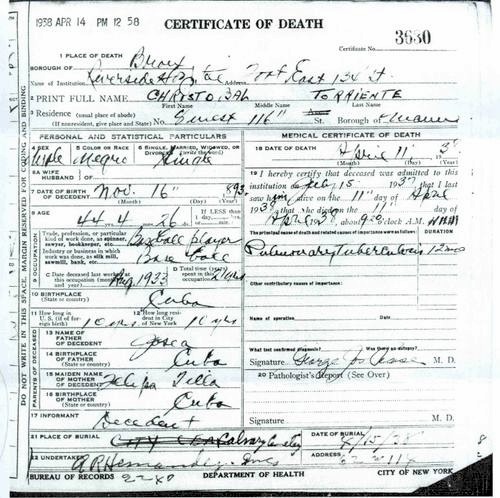
To discern what happened from there, it’s partly a matter of studying Torriente’s death certificate, a copy of which was secured by Gary Ashwill. The record states that the informant of death was, somehow, Torriente himself (not sure how that’s possible, at least in a legal sense), and that the body was claimed by Ramiro Ramirez, a fellow Cuban who, like Torriente, also starred and managed in the Negro Leagues for many years.

6a00d8341ccce053ef01b8d0d0f482970c-500wi

Cristobal Torriente’s death certificate (courtesy Gary Ashwill)

The certificate states that Ramirez, who took charge of the body with his signature, was Cristobal’s “cousin” and nearest next of kin. However, no proof has yet to be uncovered of any familial connection between Torriente and Ramirez, although they were teammates on occasion, I think. (Maybe Gary can confirm this.) That mystery — why Ramirez claimed the body, why he apparently lied about his connection to Torriente, and what Ramirez might have known about this whole situation — is something I’ll explore in an ensuing post.

Anyway, the funeral home in charge is listed on the death certificate as A.R. Hernandez, Inc., a long-time mortuary in Brooklyn that seems to have catered to local Latinos and African-Americans. (I’ve tried to look into why Hernandez was chosen, whether the proprietors have any link to Torriente, and whether the company’s history could uncover any keys to finding descendants or relatives of Torriente. More on that in a while, too, hopepfully.)

Then, crucially, we look at the line on the death cert indicating place of burial — the word “CITY” is crossed out and “Calvary Cemetery” is scribbled in its place. Ralph believes this means that Torriente’s body was originally intended for a city-owned cemetery but that Calvary stepped up and offered to house the remains at their facility. Again, what exactly went down between Torriente’s stated death at 9:20 a.m. on April 11, 1963, at Riverside Hospital and his listed interment date on April 15 is unclear, and it could stay that way.

But here’s the twist — despite what the Batista regime ballyhooed about bringing the Cuba legend back to his own country, Calvary staffers confirmed to me and Ralph that they have no record of Torriente’s remains ever being disinterred, which means he’s still there. Hence yet another question, and perhaps the biggest of all — why was such a legendary, admired baseball hero apparently spurned by his own country and left to tragic anonymity thousands of miles from his beloved hometown of Cienfuegos, Cuba? I’m trying to investigate that as well.

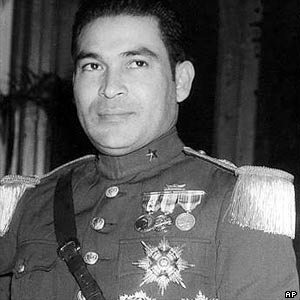
Fulgencio_Batista,_president_of_Cuba,_1952

Cuban dictator Fulgencio Batista

Those Calvary staffers have also said that there’s nothing anything can be done to disinter any of the remains in that grave, an effort that would be necessary to do the required DNA testing on all 18 bodies in it to see which one is Torriente. The cemetery told me — and this could be a very key point — that mass graves like this one are “owned by the city” and, therefore, it’s the city and not Calvary (and, by extension, the Archdiocese) that would have any say on what happens to it and the remains located there.

So … I was hoping that a few inquiries to various NYC agencies and offices might help uncover any details about Torriente’s last days and his fate — as well as work toward hopefully bestowing recognition to the final resting place of a baseball legend.

My inquiries and conversations (both via email and over the phone) with these staffers answered some questions, but they also heaped on a bit more confusion, with the resulting conundrum being this — who controls the fate of that mass, unmarked grave and the body of a Negro Leagues star contained in it?

I managed to communicate with staffers from both the NYC Department of Health and the NYC Health and Hospitals Corp., and from both of those conversations, this is what I gleaned …

That, one, there’s a gargantuan problem right off the bat — that all of this is ancient history, and therefore, will always remain a mystery. Why? Because no one knows of the existence, let alone location, of any records pertaining to Riverside Hospital.

In fact, neither of the people to whom I talked had even really heard about Riverside before my queries, with the NYCHHC rep saying he wasn’t sure who or what owned Riverside at the time and added that he couldn’t venture a guess as to “who made the decision to shut it down or know where to tell anyone to go from here.” That, he said, definitely precludes any possibility of locating hospital records from 1938.

Because no one I’ve spoken with or any online information I’ve researched has been vague, I haven’t been able to discover conclusively who owned and operated Riverside Hospital. North Brother Island is located in the East River between the Bronx and Riker’s Island, where the city’s famous jail is.

Over its century-plus existence, Riverside Hospital/North Brother Island have housed a smallpox facility, an infectious/quarantibable diseases holding bin, and, in the mid-20th century, a treatment facility for teenagers with chemical dependencies, especially heroin addicts. So, again, definitely not a fun place to be.

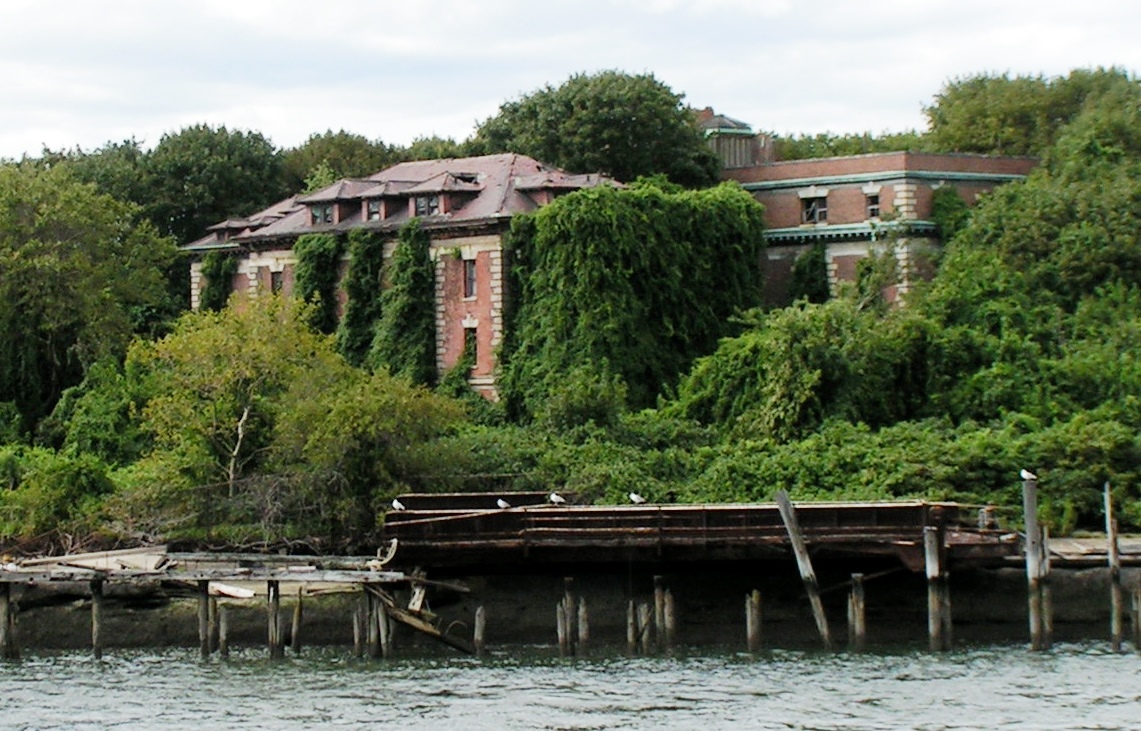
Riverside_Hospital_North_Brother_Island_crop

The remains of Riverside Hospital

Riverside was shuttered for good in the ’60s, thanks to alleged corruption and a general  inability to rehabilitate its young patients. Today, the 20-acre North Brother Island is a bird sanctuary and is completely off-limits and inaccessible to the public, or pretty much anyone. The remains of the hospital are crumbling, heavily deteriorated and completely obscured by dense forest growth.

One has to wonder … might there actually be hospital records contained in the rubble? Could documents, or any evidence, exist among the crumbling brick and mortar that shed light on a Hall of Famer’s final weeks? Due to likely exposure to the elements over at least a half-century, the likelihood of that is quite slim, but it’s still a tantalizing possibility …

But I digress, and back to the health officials … Here’s the email response I received from a source at the City Department of Health about Riverside’s records and the state of Cristobal Torriente:

“The Health Department does not maintain these records. The death record from 1938 is old enough to have been transferred to the New York City Municipal Archives; it is now a public record available through the Archives … You may check with Calvary Cemetery – it is an active cemetery and should maintain records.  We do not have information on Riverside Hospital [my emphasis].

As to your question about mass unmarked graves in New York City, the City has used many burial sites throughout its history. It currently uses Hart Island as its potters’ field, which is maintained by the New York City Department of Correction.  … there is a searchable database available.”

As to the first paragraph, we already have the Torriente’s death record, and we’ve already talked with the cemetery. The last paragraph, though, is quite intriguing … Was Hart Island — where penniless, indigent and/or unclaimed remains in NYC now go — where Torriente’s body was originally supposed to go, and would that online database — which, believe me, I’ll search soon — hold any clues about this mystery?

As a final note, I add that I’ve tried to reach out to the Archdiocese but haven’t had any success yet.

So what is the upshot of aaaaaaalllll this? Here’s a few concluding thoughts, based on my interviews, inquiries and research discussed herein:

• The New York City Council hasn’t gotten back to me about whether it might care about the sad state of a baseball Hall of Fame player.

• There’s in all likelihood no records or other physical documents, aside from the official death certificate that we already have, that could provide any clues about the fate of Cristobal Torriente’s death.

• That includes any conclusive evidence revealing the mechanism and chain of events — commitment to a sanitarium, the claiming of the body by a fellow ballplayer who lied on the record, original designation of the body to a city-owned potters’ field, the change of designated burial spot to a Catholic institution that stands as one of the largest cemeteries in the world, and the reason why Torriente wasn’t brought back to Cuba as previously thought — that landed him in a communal, anonymous grave with 17 other individuals.

We aren’t sure who, exactly, has charge of that grave today — does the grave belong to the city, or to the cemetery and archdiocese — and, subsequently, who would have the theoretical power to do something about it.

Now, any or all of those bullet points could change pending future inquiry and research. One key here is whether we can find any living relative, descendant or other human source who could shed any light on Cristobal Torriente’s death — and who might have the legal and emotional authority to demand something be done. That’s something else I’m working on, and something else I’ll yet again try to detail in later posts.

So, here we are. If anyone has any information, additions, corrections suggestions and/or leads that could help clear this up, please let us know!

Torriente: Slavery, politics, the sugar trade and the search for answers

torriente

In early March 1938, a small cadre of dissidents were caught in an alleged plot to kill Cuban dictator Fulgencio Batista. Among the group of conspirators was Cosme de la Torriente, a diplomat and statesman who had previously held several roles in post-independence Cuban government, including secretary of state and president of the ill-fated League of Nations.

It doesn’t look like de la Torriente suffered too much for his part in the alleged assassination; he went on to live a lengthy, comfortable life before passing away in Havana in December 1956.

Parallel to the machinations of the unsuccessful 1938 coup of Batista, though, was the death, in April of that year, of Cristobal Torriente, a native of Cuba and legendary star of the Negro Leagues and pre-Negro Leagues. By that time, Torriente — who in 2006 would be posthumously and very belatedly inducted into the Baseball Hall of Fame — had faded into penniless obscurity in New York City and withered away from tuberculosis in NYC’s long-since-demolished and rather infamous Riverside Hospital on North Brother Island.

By all appearances, because of Torriente’s status as a pauper and ward of the state, he was unceremoniously dumped in a mass, unmarked, city-administered grave in Calvary Cemetery in Queens.

The fable, as it’s been told for decades, then tells that the Batista government in Cuba had Torriente’s remains disinterred, shipped to Havana and placed in a shrine to Cuban beisbol greats in Cristobal Colon Cemetery.

But, according to recent research I attempted to summarize in this blog post, it looks like that last part never happened — there’s no record of Torriente ever being disinterred from Calvary Cemetery, as cemetery staffers have told both me and fellow researcher Ralph Carhart.

So it looks like the tale told by the Batista government — that Torriente’s body was feted like a national hero when it was brought back to Cuba — was a tall one, fabricated by a brutal dictatorship, possibly as a propaganda effort to secure popular support and bureaucratic stability in the wake of the attempted coup a month prior.

The question in my mind — or rather, one of the many rolling around in my noggin — is whether the political maneuvering of Cosme de la Torriente had anything to do with the unfortunate fate given to Cristobal Torriente? Was the baseball great punished in death by the Batista regime for a relative’s “crime” against the government?

On the one hand, that likelihood appears slim; as fellow baseball researcher and Cuban Leagues specialist Gary Ashwill noted to me, in the Spanish language, “Torriente” is a distinctly different surname from “de la Torriente.” Plus, Cristobal Torriente was from Cienfuegos, Cuba, while Cosme de la Torriente was from Matanzas.

And, finally, Cosme was white. Cristobal was black.

Why, though, does any of this matter? Why is it so important that we try to unlock the historical conundrum of how such a legendary, pivotal Cuban baseball player ended up in an unmarked grave?

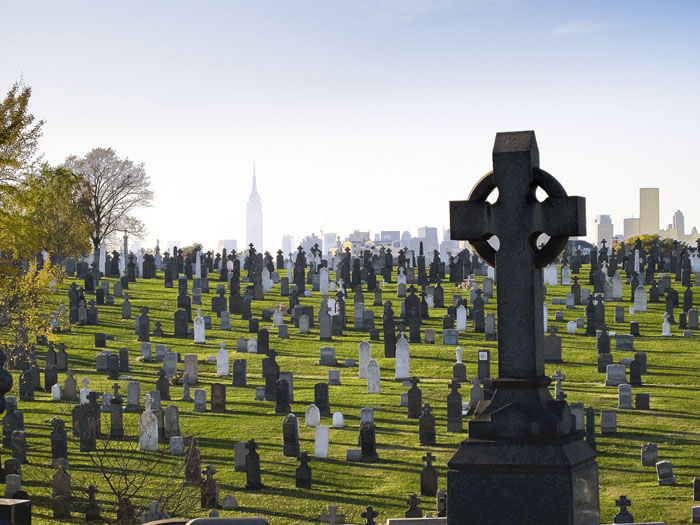
bsQ_calvary_alsmith_001

Calvary Cemetery, Queens

For one, I just like a mystery. Research is fun, investigation is fun, and historical quandaries are fun. And just discovering why history unfolded as it did might help fill in a small, missing piece of the greater baseball — and cultural — puzzle of the Americas.
But two, even beyond that, I feel that we might need to recognize and rectify the apparent fact that such a formidable hardball luminary and cultural ambassador as Cristobal Torriente is entombed in a mass, unmarked, undignified grave thousands of miles from his homeland.

And in my mind, arguably the best way to achieve that recognition is to somehow find a living relative or descendant of Torriente, someone who could personally and powerfully lobby on his behalf, who could draw intimate attention to the sad fate of their legendary ancestor.

To find a living descendant, I’m thinking that if we perchance delve back into history to unearth Torriente’s roots and genealogy, we could then move forward into the present along a divergent but still attached thread of his family.

So far, however, that’s been quite difficult, and I’m resorting to some halfway desperate measures to achieve that goal. In a future post (hopefully next week), I’ll discuss those attempts to find a family member.

And in yet another article, I’ll attempt to review the steps that have been taken to draw attention and recognition to Cristobal Torriente’s tragic postmortem plight.

But for the rest of this post, I’ll embark on an analysis of one chunk of Cuban history that could fill in some of the gaps in Torriente’s background.

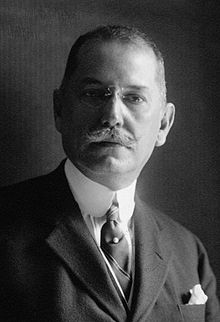
220px-De_la_Torriente,_Cosme

Cosme de la Torriente

One of those chunks is any possible connection between Cristobal and Cosme de la Torriente, and whether the political wrangling of the latter might have affected the post-death destiny of the former. However, that’s not what I’ll be fleshing out today, and I apologize for the bait-and-switch. I just liked the Cristobal/Cosme dichotomy as a method of introduction to the complexities of Cuban history as they relate to the Hall of Famer’s life and death.

Also, that’s not to say that Cosme de la Torriente doesn’t figure into Cristobal’s story somehow; in fact, the two plot lines could very well intersect, because, as I’ve found, there seems to be a lot of plot lines, or at least possible ones, and a bunch of them likely do criss-cross at some point. As a matter of fact, they just might later on in this post.

But, for now, here’s this narrative …

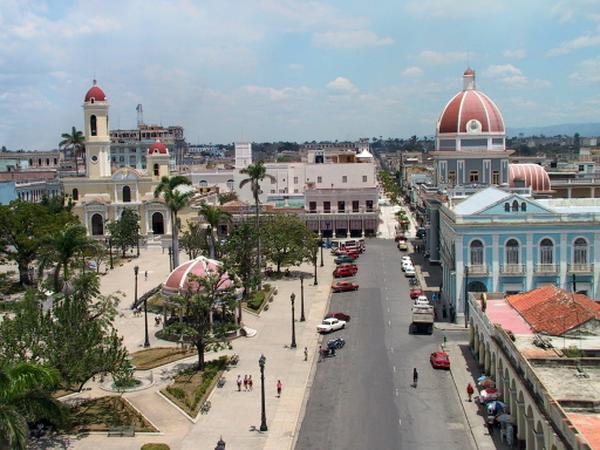
Cristobal Torriente — dubbed, later in life, the Black Bambino and the Cuban Strongman — was born on Nov. 19, 1893, in Cienfuegos, Cuba, a picturesque city on the island’s southern shore that has accumulated so much historical value, especially architecturally, that it’s now a UNESCO World Heritage Site.

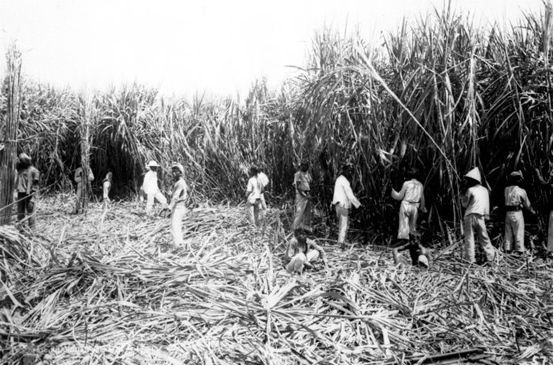
The name Torriente, while a popular one (along with de la Torriente) in Cuba, seems to be and have been especially prevalent in Cienfuegos. Also quite prevalent in the historic city was the sugar trade, including sugar plantations, sugar refineries and American businessmen exploiting the region for its resources and labor. Here’s a description of Cienfuegos from the UNESCO Web site:

“The colonial town of Cienfuegos was founded in 1819 in the Spanish territory but was initially settled by immigrants of French origin. It became a trading place for sugar cane, tobacco and coffee. Situated on the Caribbean coast of southern-central Cuba at the heart of the country’s sugar cane, mango, tobacco and coffee production area, the town first developed in the neoclassical style.

“It later became more eclectic but retained a harmonious overall townscape. Among buildings of particular interest are the Government Palace (City Hall), San Lorenzo School, the Bishopric, the Ferrer Palace, the former lyceum, and some residential houses. Cienfuegos is the first, and an outstanding example of an architectural ensemble representing the new ideas of modernity, hygiene and order in urban planning as developed in Latin America from the 19th century.”

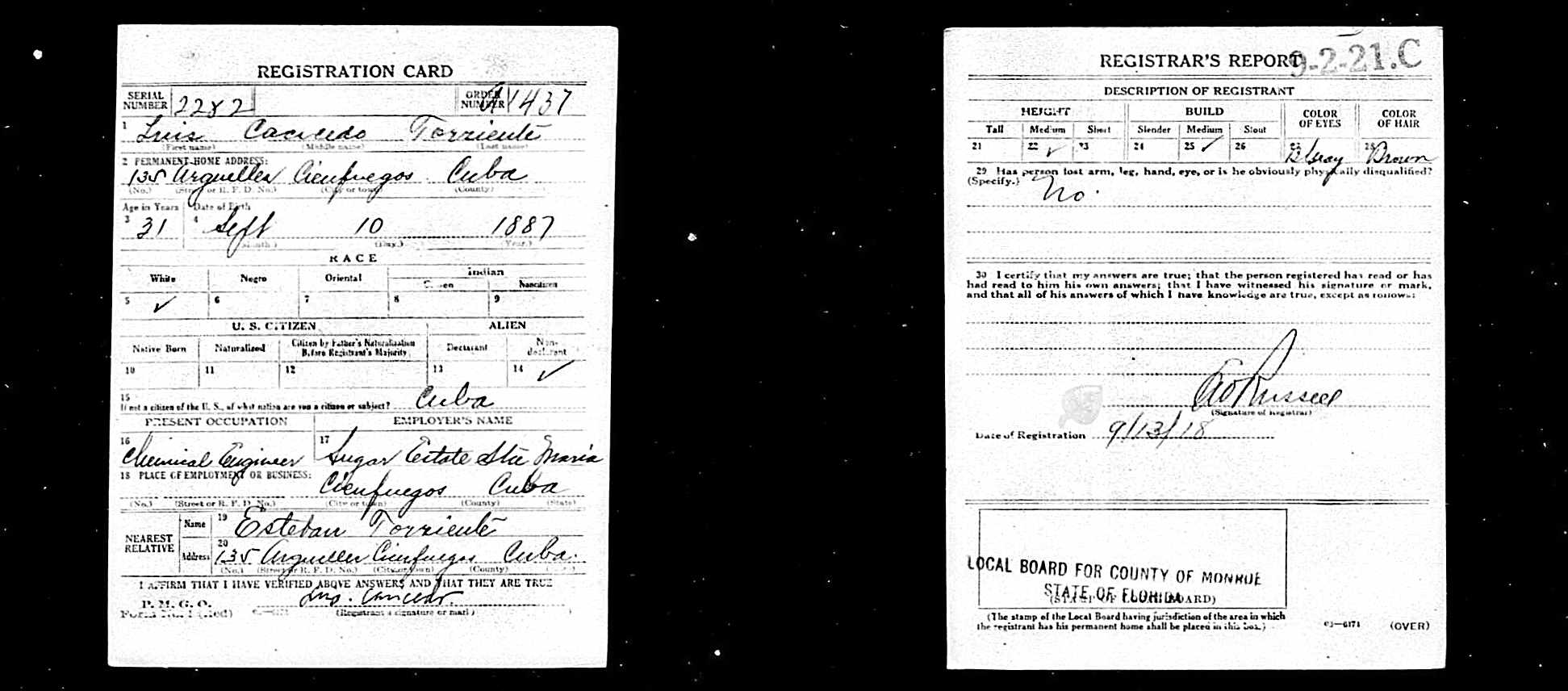
One of those sugar kingpins in the area was a Spaniard named Esteban Cacicedo Torriente, who emigrated to Cuba in 1865 — when slavery was still in full force on the island — and formed a business partnership named Ruesga and Cacicedo in Cienfuegos in the 1870s. Esteban also opened a grocery store in the city a partner named Jose Garcia; the company was also involved in banking, and in 1922 the business was consolidated as Cacicedo & Co.

Esteban Cacicedo Torriente seems to have been a very influential man in Cienfuegos. Here’s a rough translation from an entry on ecured.cu, the Cuban version of Wikipedia. I’ll acknowledge right now that I don’t know a lick of Spanish, so I lamely translated the Ecured entry using a Spanish-to-English Web site:

“He was estimated as one of the richest men in the city. In addition to his large trade house, established in on Argüelles street at the corner D ‘Clouet, up the great central [road] to Santa Maria, since 1909 and under the direction of his son Stephen, he encouraged in the central Carolina the establishment of a pasture whose administration was in charge of his son Isidore, where the big shots and young horse stallion products imported from Europe and United States gave rise to domestic livestock.

“He was a City Councilman in the years 1878 and 1880; Treasurer of the Steering Committee of the Fire Department of Commerce several times; and President of Casino Spanish since 1918. In 1887, he was the deputy of a battalion of volunteers from Cienfuegos and was several times president of the Spanish Casino. …

“[The family] distinguished themselves in Catholic activities and charitable and pious works, contributing to the foundation of Nursing homeless, the institution of the Servants of Mary, the establishment of the Jesuits and others.”

(Yeah, like I said, that translation is quite mangled, for which I apologize, especially if some of it doesn’t make sense. If any of my Spanish-speaking friends reading this could correct me, I’d gladly accept it. 🙂

Anyway, by all accounts, including a bunch of documents I’ve found online, Esteban Torriente Sr., and his son Esteban/Stephen Jr. and Isidore — and therefore likely the whole family — were white. That’s also probably the case because they were direct immigrants from Spain, and because there’s likely no way a person of color would own that much property, and be that rich and powerful, in antebellum Cuba. (Slavery wasn’t abolished there until 1886.)

And here’s another very intriguing note — Esteban Sr. married his cousin, Ramona de la Torriente, the daughter of other wealthy landowners and merchants in Cienfuegos. With that, we have a possible linking between a family grouping with the “de la Torriente” and “Torriente” surnames.

Mushrooming out of that is the fact that the de la Torriente clan, including Cosme, seem to have been major sugar big wigs in Matanzas. So we could, here, have the mixture of several variables that could — and I emphasize could — start to bring some pieces of the Cristobal Torriente puzzle together.

But a little more on Esteban Torriente and the 19th-century Torriente family in Cienfuegos …

cienfuegos-city-center

Cienfuegos, Cuba

I uncovered a 1998 essay by Christopher Harris called, “Edwin F. Atkins and the Evolution of American Cuba Policy: 1894-1902,” in which Harris theorizes that Boston-based entrepreneur Edwin Atkins as well as Edwin’s father, Elisha, established a lucrative trading business — largely sugar-related — in Cienfuegos.

From there, Harris argues, Atkins, thanks to his big bucks and fortuitous political connections, Edwin Atkins greatly influenced the U.S.’s relationship with and approach to Cuba, especially during the crucial period encompassing the island’s war of independence from Spain and the ensuing Spanish-American War, when the States began to seriously flex its imperialist muscles.

In his essay, Harris doesn’t really state whether Atkins’ influence on turn-of-the-century Cuba was a good thing or not; at times the writer seems to hint that the American entrepreneur was a bit weasely (my words) in his dealings and therefore had a somewhat undue influence on the island’s development after independence.

But that’s a side note. For the purposes of this blog, this is the part of Harris’ work that’s important:

“… [Atkins’] company pursued a triangular trade: sending finished New England manufactured goods to Central America, picking up coffee, cochineal and granadilla, usually from Guatemala, and carrying these goods to Cienfuegos or Trinidad to trade for sugar. … The Torriente Brothers of Cienfuegos acted as agents for Atkins and Company [my emphasis], and the families developed strong personal relationships. By the 1860s, Atkins was becoming wealthy, owning a half dozen ships and running over 400 charters a year to Cuba in his own and others’ ships.

“By the mid-1860’s … Atkins’ business began to evolve. From simply trading, shipping and merchandising, the company began to extend credit and financing to planters, both directly and through the agency of the Torriente Brothers, their agents in Cienfuegos [my emphasis]. While under the Refaction Law (until 1880), credit to planters was secured only by a lien on crops, interest rates were high enough to make financing a profitable addition to merchant’s offerings.”

I have yet to conduct a lengthy investigation of the Torriente Brothers company, and when I do, I’ll try to write updates in ensuing posts.

But further on in Harris’ essay, the writer again brings up a variation of the Torriente name:

“With the outbreak of the Ten Year’s War in Cuba (1868-1878), the old Cuban plantation families began to be economically squeezed on all sides. Overseas beet sugar led to increased price competition. To be competitive, the Cuban producers needed new equipment and sugar processing machinery, which required capital. In was in this period that large sugar processing plants, called centrales, began to replace theingenios that formerly processed sugar on each plantation. Those who couldn’t afford to modernize and become centrales, were reduced to being colonos, plantations that only grew sugar cane, without processing it. But as a class, the Cuban planters carried a high level of debt even before the War, owing money, mostly to Spanish financiers and merchants who controlled the trade. To make matters worse, the Revolution itself caused considerable economic dislocation. …

“… Presumably, it was for this reason that Elisha Atkins sent his son Edwin to Cienfuegos in 1869 to learn the business from Ramon de la Torriente [my emphasis] rather than sending him to college. While profits may have been high, the risk from this business was large as well. The son was sent to protect the family’s interests.”

So here’s another cropping up of the Torriente moniker in Cienfuegos. But there’s one more, again from Harris:

“… At the end of the Ten Year’s War, only a few plantations around Cienfuegos continued to operate. … Atkins and Company was, in effect, forced into becoming sugar producers themselves. In 1882, the Atkins began collecting properties by foreclosure. …

“They foreclosed the Soledad and Rosario plantations of the Rosario family, Carlota from the Torriente family [again my emphasis], Caledonia from the estate of Diego Julien Sanchez, Guabairo from Manuel Blanco, and Limones from the Vila family. Vega Vieja and Manaca were purchased from the Yznaga family and Algoba was leased.Santa Teresa was acquired from Juan Perez Galdos, Veguitas from Jose Porroa, Vaqueria from the Barrallaca family and San Augustine from the Tomas Terry family. Leased properties included San Jose, Viamones, San Esteban and Algoba. …”

The whole scheme is summarized on the Web site of the Massachusetts Historical Society, which possesses a large collection of Atkins family documents and papers. States the MHS:

“E. Atkins & Co.’s most frequent business correspondents in Cienfuegos were the Torriente Brothers. After the Ten Years’ war in Cuba (1869-1878), Torriente Bros. had many sugar estates indebted to them, and the firm in turn was indebted to E. Atkins & Co. Torriente Bros. foreclosed on several estates, including the Soledad plantation in Cienfuegos …”

With those generalities established, let’s now take a closer look at a few seemingly loose ends and random strands of personal documents and records that might help to continue connecting the dots.

For example, there’s the fact that Esteban Sr. is referred to as Esteban Cacicedo Torriente, which could be very significant, because — while I again stress that I’m a bit deficient in the Spanish language and its naming traditions/procedures — it looks like that a theme running through many historical documents and records relating to his family members is the interchangeability and malleability of the Torriente and Cacicedo surnames.

sugar_java_cuba_fig7

A Cuban sugar plantation

While Esteban Sr. died in 1932, it looks like several of his children — including Ramon, Esteban Jr. and Luis — filtered into the U.S. throughout the 20th century, some of them landing in Florida (more on that in an ensuing post), and some in New York City.

I think Luis, for example, studied at MIT, returned to Cienfuegos and became an engineer at one of his father’s plantations. Esteban Jr. was also an engineer, it seems, probably on one of his dad’s estates as well, and all of the documents pertaining to the latter son I could find refer to him as white.

The same goes for Luis. But Luis might be an even more fruitful figure to study, for two reasons: One, he traveled to and from New York City a lot, placing him in the same locale as Cristobal Torriente; and two, various documents list his name, somewhat interchangeably, as Luis Torriente, Luis Cacicedo and Luis Cacicedo Torriente.

Take, for example, his U.S. World War I draft card. He’s listed as Luis Cacicedo Torriente, with a permanent residence on Arguelles Street in Cienfuegos (the same street on which his father’s business was located) and a birthdate of 1887. The card lists Luis as white, and his profession is “chemical engineer” on a “sugar estate” in Cienfuegos. His nearest relative is pegged as Esteban Torriente at the same permanent address. (It’s not clear if that’s Esteban Sr. or Jr.)

What’s more, Luis’ listed surname varies from Torriente to Cacicedo on different ship manifests during the first two decades of the 20th century. He also shows up as Luis Cacicedo, a 22-year-old white male, in the 1910 Federal Census of Manhattan, where he’s a lodger on W. 115th Street. Finally, on his 1922 New York marriage certificate to one Rafaela Tess, he’s called Luis Cacicedo.

005150525_03493

But there’s one final component … Both Cristobal Torriente and Luis Cacicedo Torriente had multiple WWI draft cards — I’m not sure why, exactly, except the various ones have different permanent residences for each of them — and these documents could reveal something telling.

On one of Cristobal’s three (!) cards lists his birthdate of Nov. 16, 1893, his birthplace as Cienfuegos, and his current residence as Monroe County, Fla. (which is basically the Florida Keys). His race is stated as black.

Meanwhile, a second card for Luis states his name as Luis Cacicedo Torriente, his birthdate as Sept. 10, 1887, his birthplace/location of relative as Cienfuegos and his residence as … Monroe County, Fla.! The card, further, states that he’s white.

On top of that, the historical record is littered with documents involving various Torrientes or de la Torrientes of both colors living, going to or coming from Monroe County and/or Key West.

Finally (I know I’ve said finally a few times, apologies for the absurd length of this post), I might have come across documented proof that Luis Cacicedo Torriente — son of wealthy, white, 19th-century sugar planter from Cienfuegos — and Cristobal Torriente — black baseball legend and Hall of Famer now resting in a mass, unmarked grave — are indeed on different branches of the same family tree.

Umm, but unfortunately at this point, I can’t, uhh, confirm that last assertion because I haven’t quite figured out the details yet. I know, that’s a bit confusing and likewise a bit tenuous, but rest assured that I’m working to nail it down for certain.

But here’s my hypothesis: That the Negro League great was possibly descended from former black slaves belonging to white Esteban Torriente and his lineage in the city of Cienfuegos, Cuba, where, like much of the country, race and ethnic identity are slippery, elusive and firmly entwined in the complex social, political and economic history of the island nation.

Phew.

Having said that, I invite any other friends, peers or fellow researchers to step in and correct and/or add to my probably spotty interpretation of Spanish-Cuban language, genealogy and other traditions! My email is rwhirty218@yahoo.com, or feel free to leave a comment on this post.

I also stress that, because I’m a relative neophyte in Cuban culture and history, this post was written from a probably narrow, Americanized point of view and, as such, it could omit, gloss over, obscure or obfuscate many points mentioned in the article that could look differently from a Cuba-centric approach. Again, if that is the case, and if anyone reading this can clarify or fill in the narrative, please feel free to contact me.

Over the next week or so, I hope to write two more posts concerning Cristobal Torriente, one that deals with my effort to find a living relative or descendant, and the other detailing the effort to call attention to the deplorable state of his remains in Queens.
Hopefully, somewhere down the road, I’ll be able to somehow pull aaaaaaaall these strands together, but not without help from all of you!

HOF: No more Negro Leaguers, and no changes to policy

… At least for now, anyway.

According to National Baseball Hall of Fame Vice President of Communications and Education Brad Horn, for the foreseeable future, the Hall’s board of directors has no plans to change or even revisit its current policy of keeping additional segregation-era African-American candidates out of Cooperstown.

I spoke with Mr. Horn this morning, and he confirmed what many Negro Leagues enthusiasts have both feared and protested ever since a special committee elected 17 Negro League figures in 2006.

“The board is comfortable with its [election] process at this time,” he said. “It does not have a perpetual process to consider Negro Leaguers. The board said that at the time in 2006, and it hasn’t deviated from that at this point.”

I suggested to him that a few Negro Leagues fans and researchers such as my Malloy roommate Ted Knorr have crunched the numbers and found what they believe to be a woeful under-representation of segregation-era African-American players, managers and executives. Compared to the number of white, pre-1947 Major Leaguers, the number of black candidates in the hall is miniscule.

Mr. Horn said that he and the HOF’s board certainly understand that argument, but he added that despite any such ratios, right now the Hall is sticking to its guns.

“In 2006, the Hall of Fame said [the special committee] served as the final consideration for the Negro Leaguers,” he said.

“But,” he quickly added, “we kept the door open for new research to be considered. [The current policy] doesn’t mean that it won’t happen at some point.”

Still, he said, “At this time, the board is comfortable with the fact that it has given [Negro League and pre-Negro League figures] comprehensive consideration. It does not want to rewrite the policies and procedures.”

I noted to him that because the Hall has a Pre-Integration Committee that continues to elect white Major Leaguers from that era but still has closed the door to Negro Leaguers, many in the blackball community simply feel that such policies and mechanisms are unfair and unjust.

I also asked him whether the Hall feels that there are, in fact, segregation-era African-American candidates out there, but Horn declined to address that directly. He also hedged a bit when asked what it would take to have the policy changed eventually.

“The Baseball Hall of Fame remains committed to an election process that continues to meet the needs of preserving baseball history,” he said. “Certainly the argument that baseball has many individuals who are always going to be good candidates for induction is an argument that is recognized by the Hall of Fame.”

But, he added, “Our job is to allow for the best system possible, and at this point, the board remains dedicated to evaluating how the induction process affects all candidates.

“The board is always willing to consider candidates in its regular course of business, and it has the ability to change the process [at any time]. We continue to encourage baseball fans to send us letters stating their viewpoints and the board will consider them, but there are many fans who each have their opinions of the induction process.”

“At this point,” he concluded, “the board feels there is not the need for an election process that considers new [Negro League] candidates.”

What do you think about the Hall’s policy? Feel free to leave comments on this blog or on the various Facebook pages or to email me at rwhirty218@yahoo.com. I want to hear from you!

A mass grave for a beisbol legend?

torriente

The gentleman above is Cristobal Torriente, a Cuba native and African-American baseball — or beisbol — legend who was elected to the National Baseball Hall of Fame in Cooperstown in 2006, the after which the Hall once again officially and unjustly its doors to segregation-era African-American players.

As I discussed in this previous blog post, in 2016 I’m going to try to sharpen Home Plate Don’t Move’s focus to advocating for two goals: one, to, with your help, get the BHOF to acknowledge its ignorance bigotry and once again allow Negro Leaguers into its hallowed halls; and two, try, again with help, to bring attention to the possibility that Cristobal Torriente, the “Cuban Babe Ruth,” is now the only Hall of Famer buried in an unmarked grave.

What’s worse, said burial location could be a mass grave in which Torriente — who, by the time of his death in 1938, was in all likelihood a penniless pauper (which was tragically the fate of many former Negro League stars — was unceremoniously laid to rest (if you could call it rest) with 16 other anonymous souls at the prestigious Calvary Cemetery in the New York City borough of Queens.

And that discovery right there — that Torriente’s remains are in Queens, not Cuba — represents a stunning and monumental development that completely rewrites what we know about the fate of this outsized beisbol legend. (For example, the esteemed Find A Grave Web site still lists, mistakenly, that Torriente is interred in Cuba.)

Right off the bat, I’m to to credit three baseball researchers/historical enthusiasts with each doing a yeoman’s job in getting the ball rolling on identifying the exact location and status of Torriente’s remains.

The first is John Thorn, Major League Baseball’s official historian, who is arguably the leading light in the area of baseball research. The second is Gary Ashwill, whose incredible — and incredibly researched — blog, Agate Type, is located here. Gary specializes in Negro Leagues and, perhaps more importantly, Cuban beisbol.

The third person is Ralph Carhart, a SABR member and driving force behind the massive Hall Ball project, which is dedicated to criss-crossing the landscape with a baseball to as many Hall of Famers — both living Hallers and the graves of deceased ones — and take pictures with each man or burial location.

It’s a massive, remarkable, and incredibly admirable effort, one that has been underway for several years and one that continues in energetically full force. (Ralph has launched a Go Fund Me effort to help finance his work in this project. If you’re interested in helping out, go here.)

Now that relations between Cuba and the U.S. have thawed a bit, Ralph has zeroed in on bringing the Hall Ball to that once-prohibited island and visit the graves of multiple Hall of Famers from the Caribbean country, such as player, manager and owner of the famed New York Cubans Jose Mendez, and multi-tooled player Martin Dihigo.

Ralph sailed to Cuba last year, one of numerous baseball historians who have been itching for the chance to study the storied Cuban League, which has spawned countless beisbol stars over the years, a voyage I discussed in this blog post.

In his journey to Cuba, Ralph was able to visit Cristobal Colon Cemetery, which includes a towering monument honoring dozens of Cuba’s past baseball legends, including the nation’s Hall of Famers in Cooperstown.

download

The majestic baseball memorial in Cristobal Colon Cemetery (photo courtesy of Ralph Carhart)

Correspondingly, Cristobal Colon Cemetery is the burial location of such beisbol luminaries, including Hall of Fame members Dihigo, Mendez and Cristobal Torriente.

Or so almost all of the baseball history community of researchers and fans thought. But, in a blockbuster revelation, Ralph firmly believes that Torriente is not, in fact, buried there, in his native Cuba, as previously believed.

After a gargantuan amount of research — largely on-site in Cuba and Ralph’s current domain in New York City — Ralph has determined, almost conclusively, that Cristobal Torriente is actually interred at Calvary Cemetery in Queens, one of 17 unknown former NYC residents who died in anonymity.

And, crucially, several historians believe that Torriente is sadly now the only Baseball Hall of Fame inductee buried in an unmarked grave. (Organizations such as SABR’s 19th-Century Baseball Grave Marker Project and Jeremy Krock’s Negro League Baseball Grave Marker Project, have diligently and tireless worked to place markers of dozens of late players’, managers’ and owners’ graves including several HOFers.)

Ralph chronicled this titanic endeavor on his Hall Ball Web site. (If you scroll down a ways to the February 2015 blog entries you’ll find it.)

As that post chronicles, Ralph attempted to jump through numerous bureaucratic hoops — including speaking with staffers at Calvary Cemetery — to determine two things: one, if Torriente was, in fact, buried there; and two, if he is, if it would be possible to place a grave marker on the burial site honoring Torriente.

I spoke with Ralph earlier today to ascertain the status of the answers to both of those questions. As to the first query, Ralph said he is as sure as he can possibly be, given the strict rules employed by Calvary Cemetery and the steep financial necessities of the situation, that Torriente is indeed buried there in Queens, a finding that, at least in the Negro Leagues community, is simply gargantuan.

“I think it would be impossible to determine with the research resources we have at our fingertips now,” he said.

What would it require to definitely determine that Torriente is there? Ralph said, quite simply, that the mass grave must be unearthed and all the remains buried there to be DNA tested to identify which one, if any, is Cristobal Torriente.

Understandably, such an undertaking — especially without the official blessing of the cemetery itself — would require a massive amount of financial and logistical resources, as well as the backing of a hugely influential political, governmental or political figure who could throw his or her weight behind the effort.

And right now, Ralph says, that’s simply not the case, unfortunately.

“I certainly don’t have the resources for that, and I don’t know anyone who does,” he says.

Ralph has contacted and conferred with Jeremy Krock, the founder and driving force behind the nationally-known Negro League Baseball Grave Marker Project, to see if Krock and the NLBGMP could help out at this point.

Ralph says Jeremy is definitely willing and eager to do anything the NLBGMP can. But, given all the aforementioned limitations, what can be done to properly honor this towering baseball luminary?

“We likely can never but a stone at the grave,” he says, “so our best option would be a marker or memorial in the general area of the grave site.

“I’m going to give it a shot.”

At the moment, Ralph encourages anyone who might be interested to pitch in do so, with the best way to help being simply spreading the word about this deplorable situation.

“Advocacy,” he says. “Advocacy will help with that, just making people aware of this.”

If you’re interested in helping out, email me at rwhirty218@yahoo.com, Ralph at thehallballproject@gmail.com, or Jeremy Krock at jlkrock@comcast.net.

But another question remains, one that may never be solved conclusively — why and how did Cristobal Torriente end up buried in an unmarked mass grave in Queens instead of, like other Cuban baseball legends, in a prestigious memorial in an historic cemetery in his homeland?

That, my friends, is a query I’ll attempt to address, however humbly, over the next few weeks and months. It seems to be an intricately woven and at times disheartening tale of governmental inertia, political intrigue, historic economic realities, and racial and ethnic mystery and fluidity.

It involves a brutal dictatorship, the rise and fall of the island’s massive sugar industry, the perhaps undo influence of a handful of American business and political kingpins, and the interweaving of racial and cultural definitions that combine to muddy the picture and prevent us from discovering both Torriente’s familial, geographic and ethnic background, as well as the intricate machinations that took place in the days, months and years after the beisbol great’s all-too-soon passing in 1938.