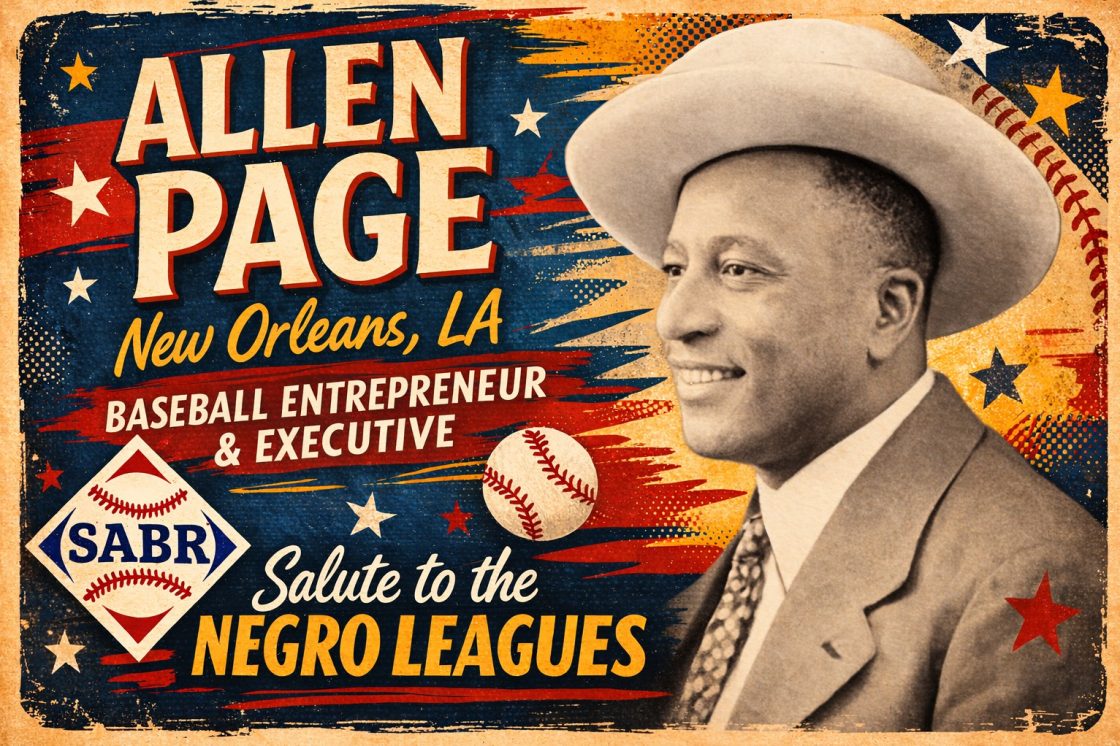

Possibly the most personal and powerful presentation of last week’s SABR Jerry Malloy Negro Leagues Conference in Memphis was the family member panel, during which the relatives of five Negro Leagues greats spoke about their famous family members, the players’ importance to Black baseball, and the influential place the Negro Leagues hold in American culture.
The four panelists were Carlis Wright Robinson, daughter of pitcher Johnny Wright; Dr. Harriet Kimbro Hamilton, daughter of outfielder Henry Kimbro; Julian Duncan, grandson of catcher Frank Duncan Jr. and son of pitcher Frank Duncan III; and Delores Brown, daughter in law of catcher Larry Brown.
Delores Brown said that for a long time, she wasn’t aware of who her father in law was while he and so many other veteran Negro Leaguers were still alive. However, she eventually learned more about Larry Brown and his baseball compatriots and got to know some of them.
“They were all really great guys,” she said. “They told so many stories.”
Some of those stories they told reflected how many challenges they faced, especially bigotry and playing and living conditions.
“They fought a lot,” she said. “Many people don’t realize that. They were really mistreated. But they had the love of the game.”
She said she and other Negro Leaguer family members “are trying to get them the recognition they deserve. We’re not asking for a handout. We’re asking for what they deserve.”
Brown added that her father in law’s career record speaks for itself – he should be in Cooperstown.

“His statistics speak to the kind of player he was,” she said. “I’m never going to drop this ball, because I believe [the Hall] is where he belongs.”
Julian Duncan said that his grandfather, Frank Duncan Jr., rarely talked about his own baseball experiences; Julian said that he learned everything about baseball and his family’s role in the sport from his father, Frank III, who imparted a great deal of insight about the game to Julian.
The youngest Duncan said during the panel that although he researched and read about the Negro Leagues in his younger days, he’d now what to talk to his father about how the game has changed since the latter’s playing days, especially how much fewer Black Americans are playing baseball now.
Julian provided some levity when telling his favorite story about the man he knew as “Uncle Buck” – the great Hall of Famer Buck O’Neil. Julian said Buck would relate how, one time when the Kansas City Monarchs, including Larry Brown, were traveling through a town so small that the only lodging they had was at a Black funeral home. He said that one by one, the creeped out Monarchs would get up and leave the mortuary to sleep on the bus, where the entire team was found the next morning.
Wright Robinson said that growing up, she always knew that her father was a baseball player, but it wasn’t until her high school years that she found out that he pitched in the Negro Leagues. After that, she said, she realized that she needed to get the word out about her father when she visited the Smithsonian Institution, which displayed a picture of Negro Leaguers but identified her father as simply “an unknown Negro League player.”
“From there, I just continued to reach out [to the public],” she said.
She said when he signed with the Brooklyn Dodgers shortly after Jackie Robinson, Johnny wasn’t able to establish a career in so-called “Organized Baseball” after being demoted to the lower minor leagues and out of the system.

“People often think that’s the end of his story,” and it is not. There’s much more to my dad’s story.”
She noted that in addition to his time in Organized Baseball, he starred for several years with the Homestead Grays dynasty, and he was one of the key players on the Navy’s first African-American service team. And now that the Grays are an official Major League team, “my father is now considered a Major League ballplayer.”
Hamilton said that despite all the challenges and even threats Negro Leaguers like her father faced in their travels – “He saw a lot of ugly things,” she said, “especially in the South” – her father was grateful for the opportunity to play the sport he loved for a living.
“My father felt fortunate [to play], and he knew it was a privilege to play baseball, to be a professional baseball player,” she said.
And even though many white Americans still believed that Black Americans were inferior to white players, she said, “my father knew he was a professional baseball player. He knew the cream always rises to the top.”
Hamilton added that she’s trying to change her father’s reputation – “all the books say he was mean” – and that his demeanor was instead determined, devoted and hard-working. He also tried to have no regrets.
“He wasn’t someone who would ever turn and go back to a place he’d been,” she said.
Hamilton concluded the family panel by saying that even though their family members were shunted to the shadows of the national pastime, they’re still legends for their loved ones.
“They played,” she said, “and that made them heroes to us.”
Excellent synopsis, Ryan! Great to read their authentic voices. I was present in Spirit! Keep your pen moving! Be Inspired!
Thank you for keeping my dad’s story alive. CWR
Powerful testimony indeed. It was great to meet Carlis and Delores in Memphis and I really enjoyed the lunchtime conversations with you. Looking forward to keeping more closely in touch.
And I would be remiss if I didn’t also mention how wonderful, in addition to meeting Carlis and Delores, it was to see once again Harriet Kimbro-Hamilton, Julian Duncan and Vanessa Ivy Rose. I was thrilled to trade books with Harriet and Carlis and am eager to begin exploring theirs. And what can I say about the the legendary granddaughter of Norman “Turkey” Stearnes, aka VSPN? To those who observed me limping around the premises during the conference (started physical therapy for my bum wheel early this week), despite the discomfort, among the esteemed Negro Leagues family members I was walking on air!
Pingback: Running down the rest of the Malloy Conference | The Negro Leagues Up Close