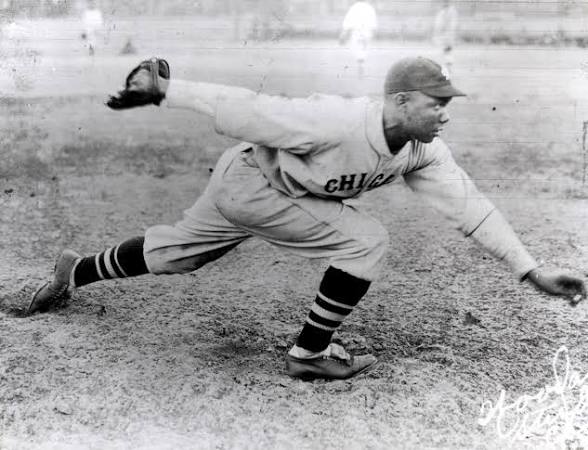
“Big Bill Foster, who has pitched for the famous Homestead Grays, will be on the mound for the Swans and will be tossing his ‘cyclone drop’ at the Virginians.”
— Rocky Mount Telegram, June 10, 1939
In what seems like eons ago, I worked as an assistant editor at the now-sadly-defunct Daily Southerner newspaper in the town of Tarboro, N.C. It was 1996, and I was 23 years old, just a year out of college and only starting to really explore my at-the-time newfound interest in the Negro Leagues.
That’s when William “Bill” Foster came along. Well, not in person, he’d died 18 years earlier. But rather, a story on him dropped in my cub reporter lap when the legendary southpaw hurler was elected to the National Baseball Hall of Fame in Cooperstown.
As is well known, at least by regular readers of this blog and other Negro Leagues fans, Bill Foster pitched mainly for the Chicago American Giants as a pro before retiring to coach and serve as dean of men at his alma mater, Alcorn State College, in Lorman, Miss., where he passed away in 1978.
But what might be less known about Foster that between his stints as a big-time pro pitcher and his administrative tenure at Alcorn, he actually lived in Tarboro with his college sweetheart and wife, Thelma Quigless, a native of the medium-sized town in Edgecombe County, N.C.
Thus, quite naturally for an ambitious, energetic, young newshound, I jumped on the story and reported and wrote an article about Foster’s election to the Hall and his connection to Tarboro for the Daily Southerner. I was ably assisted and encouraged by my co-worker and lifelong friend, Calvin Adkins.
Why do I bring this up now? Well, first, the anniversary of his death was last Friday. But second, he was the subject of my presentation at the 2026 Jerry Malloy Conference a few months ago in Memphis.
So I figured to put out a little post about Foster as a precursor to the conference and in recognition of his birthday. Unfortunately, that 1996 Daily Southerner article isn’t online or in any database that I know of, and I don’t have a hard copy.
However, I did another article about Bill Foster and his connection to Edgecombe County, N.C. — this one from 2013 for the Raleigh News & Observer, involving how he pitched for teams in Princeville, the first town in the country founded by African Americans. (Princeville is located just across the Tar River from Tarboro.) Unfortunately again, the Princeville article is no longer online, either, although it can be found on newspapers.com.

Even though his professional career was over by the time he lived in coastal plains North Carolina, he continued to pitch for various semipro clubs well into his 40s. As mentioned above, he hurled for teams representing historic Princeville, especially the Princeville Grays, in 1940. The Grays were piloted by Roy Matthewson, a member of the influential and popular Matthewson family in Princeville. Roy Matthewson later served as town mayor, as bid Glennie Matthewson and Glennie Matthewson II.

Foster also suited up for teams based in Rocky Mount, N.C., a large town/small city located about 30 minutes west of Tarboro. He pitched for the Rocky Mount Black Swans in 1940, then with the Rocky Mount All-Stars in 1947-50. (Rocky Mount native and NBHOF’er Buck Leonard managed another version of the Black Swans in the 1920s.)
Foster then, unbelievably, climbed the hill for the Tarboro Tars in 1950, when he was 46!

Going through contemporaneous coverage of Foster’s exploits on the diamonds of North Carolina is intriguing because they occurred on such a smaller scale than the one he experienced with the Chicago American Giants. In addition, the wilds of the Tar Heel State were new to him, and he was a new face to the fans of semipro baseball in North Carolina.
On the whole, let’s just say that when he climbed the hill for local town and city teams in North Carolina, it was evident that Foster still had “it” — “it” being his knack for superb pitching and his ability to completely dominate opposing lineups. He might have been swimming in a much smaller pond, so to speak, but he definitely was a big fish in that small pond while in North Carolina.
In 1939, at the age of 35, Foster began hurling for the Rocky Mount Black Swans, who apparently had a little bit of a rivalry with the Kinston Grays. (Kinston is a big town/small city in southeast North Carolina about 60 miles south of Rocky Mount; it’s been home to several lower minor-league teams in organized baseball for decades.)
Foster quickly displayed his mastery on the mound for his new fans — in July 1940, he hurled a gem in the Swans’ 4-3, 15-inning win over the Kinston Grays.
“Lefty ‘Willie’ Foster, formerly of the Chicago American Giants, a new comer [sic] to the Rocky Mount teams, exhibited one of the finest pieces of hurling that has ever been seen in this section of the country,” stated a wire service article about the game that appeared in the Atlanta Daily World.
An article about the contest in the New Journal and Guide newspaper of Norfolk, Va., was similarly effusive in its praise of Bill’s performance. Oddly, the article dubbed him “Big Train” Foster, a nickname for him that I’d never heard before. Reported the Guide:
“… [T]he Swans sent Big Train Foster, former National league ace, to the mound in an effort to get revenge for [a] previous defeat. The giant southpaw sent 18 batters down on strikes in the fifteen innings he worked.”
(For several years, including at least some of Foster’s time with the team, the Black Swans were managed by Buck Leonard’s younger brother, Charlie “Specs” Leonard, who also played shortstop and third base for the team. According to Seamheads, Charlie Leonard appeared in a single game for the Brooklyn Royal Giants in 1933 and a single game for them in 1936. He died in 1952 at the age of just 39.)
While he was playing for the Swans, in 1940 Foster also pitched for the Princeville Grays; he gained the win in the their 3-2 victory over Winton in Tarboro. The Guide noted “the star hurling of Bill Foster, veteran of the big show.” He also dominated the Weldon Black Hawks in Princeville’s 3-2 triumph in which Foster limited the Hawks to three hits.
Later in the decade, when he was in his 40s, Foster anchored the pitching staff of the semipro Rocky Mount All-Stars, for whom he started games and also came on in relief. The All-Stars (sometimes called the Eastern Carolina All-Stars in coverage of in newspaper coverage) were frequently covered by the Rocky Mount Telegram, for which I worked a few months in late 1995 before jumping to the Daily Southerner.
The Telegram gave him several monikers of the seasons, including “Lefty,” “Screwball” and “We[e] Willie,” the last one a little puzzling given that Foster was relatively tall. The All-Stars played teams like the famed semi-pro Greensboro Red Wings, Norfolk Royals, Washington (D.C.) Tigers, Raleigh Tigers, Raleigh Grays, Durham Eagles and Tarboro Tars.
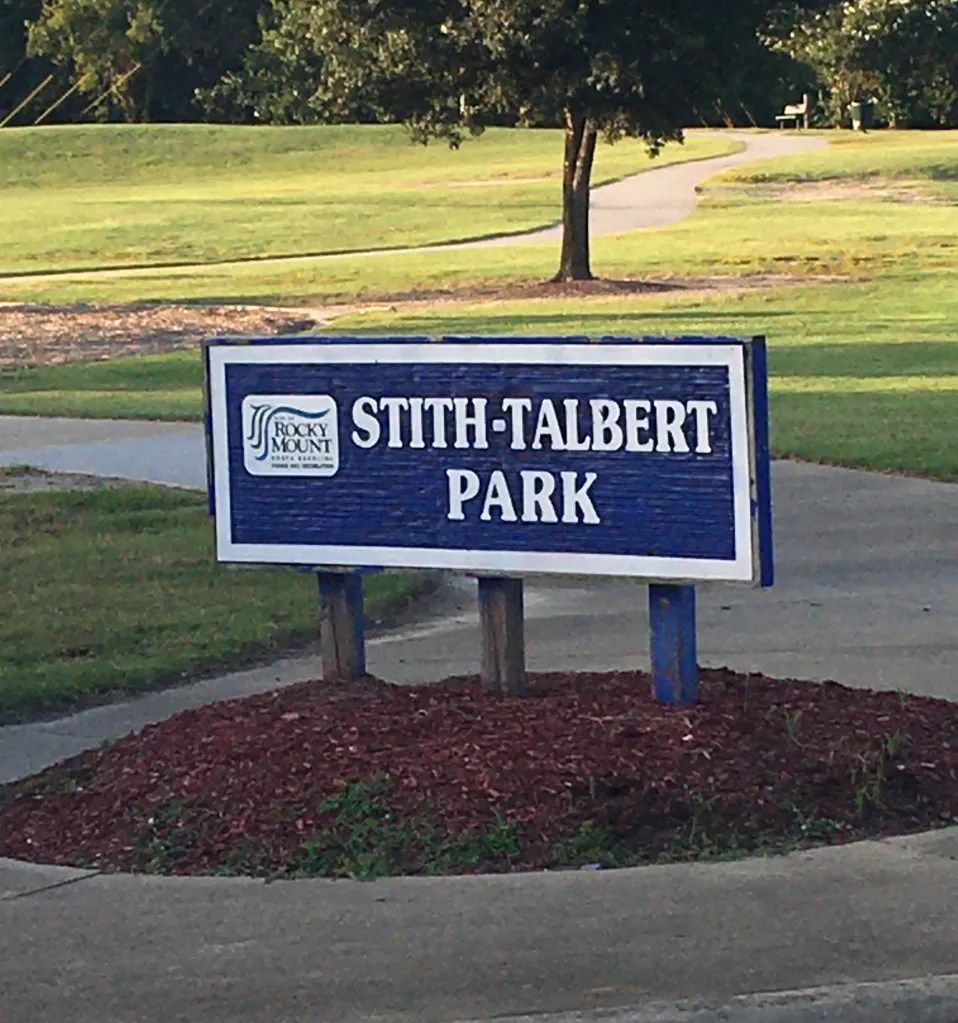
The Rocky Mount club played its home games at Talbert Park, located on the eastern side of the city along the Tar River, but the All-Stars also ventured to places like Tarboro and Goldsboro. Over several years, Foster remained steady on the mound for the All-Stars, frequently coming in from the bullpen to staunch the bleeding, so to speak, when the All-Stars were losing. In a September 1947 loss to the Raleigh Tigers, Foster gave up seven hits and fanned 11 Tigers in the 4-1 defeat; and in June 1950, he allowed only a lone single in relief in the Rocky Mounters 7-4 win over the Tars.
Meanwhile, as Foster was establishing a nice coda to his stories pitching career, he and Thelma became familiar faces around Tarboro. Foster played bridge with clubs attending dances, and in 1948 he spoke at a Tarboro High School ceremony bestowing the school’s football players they’re varsity letters. (He was joined by Buck Leonard as well.) He attended a surprise birthday party in Princeviile for a longtime resident of that town. (I was delighted to see that the party was also attended by Walter Plemmer, who was mayor of Princeville when I was working for the Southerner more than 40 years later.)
Foster also volunteered to be a Little League coach in Tarboro, an activity that was reported in the New Journal and Guide by Thelma, who appears to have occasionally served as a correspondent for the Norfolk newspaper.
“King baseball reigns — reigns in the hearts of all boys from nine to thirteen, as the Little Leaguers open their season with games between the city’s 15 teams,” Thelma wrote. “Manager Bill Foster says, ‘the pint size Jackies, Roys and Lukes are interesting to watch and a pleasure to work with.'”
Tarboro residents seem to have accepted Bill Foster as a resident of the town as well. In December 1941, he was the guest of honor at a reception given for him in Mrs. E.C. Burnett’s home.

On the personal side, Bill Foster married Thelma Quigless, his college sweetheart, on Oct. 16, 1941, in Tarboro. Thelma grew up in Claiborne County, Miss., which is also the home of Alcorn State. As such, it made attending the college a natural for her, and she also got the chance to get to know Bill, who attended at the same time after growing up in the next county over.
However, I’m not precisely sure why the couple ended up in Tarboro. But Thelma’s brother, Dr. Milton D. Quigless, did settle in Tarboro in 1936 to treat the African-American population in the underserved region. Milton would go on to become a revered figure in Edgecombe County. When I worked in Tarboro in the mid-1990s, there were many Quiglesses in the community.
Anyway, according to his World War II draft card, the couple lived at 514 E. St. James St. in Tarboro, right along the Tar River. However, the 1950 federal Census lists them and their son, 7-year-old William, at 906 E. Church St., a couple blocks from their previous home. According to the Census, Thelma was working in her chosen field of education as a grammar teacher at Tarboro High School.
While living in Tarboro, Bill Foster worked as an underwriter for the for the North Carolina Mutual Life Insurance Company, the largest and oldest Black-owned life insurance company in the country. Founded in 1898 and based in Durham, N.C., it was a vital part of that city’s vibrant “Black Wall Street” business district because it sold policies to African Americans who were refused by white-owned companies.
However, I’m not sure how Foster obtained the job at North Carolina Mutual, i.e. if he had any connections, friends or family at the company, or if he was maybe hired because of his athletic fame. Or maybe he just really wanted to sell life insurance.
That’s the rundown on Bill Foster’s time in North Carolina. Eventually he and Thelma divorced, and Bill moved back to Mississippi to begin a fruitful second career at Alcorn State. I know that’s kind of an abrupt ending to this blog post, but I’m honestly really tired and my brain is shutting down.