
For Satchel Paige, 1937 was, shall we say, an unusual baseball season. And given the unpredictable, chaotic, whirlwind life that was Satchel’s, that’s saying something.
After all, it’s not every year that a star baseball pitcher signs up for a dictator’s baseball team and spends a few months in the Caribbean flinging fastballs with the vague threat of physical violence lingering literally just beyond the foul lines.
But that’s what Paige’s summer of ’37 was like when he pitched for the team owned by Dominican Republic strongman Rafael Trujillo and, by the skin of his teeth, helped Ciudad Trujillo win the Dominican league championship. It was a grueling, hair-raising experience for Satch and the Negro League compatriots he convinced to come with him to the DR, especially when Trujillo stationed armed troops around the stadium to make sure the Americans won the championship or else.
But this post will be about how the city of New Orleans fit into Satchel Paige’s nutty 1937.
In one way, the Big Easy did play somewhat of a crucial role in Satchel’s epic voyage to the Dominican Republic – as Averell “Ace” Smith details in his excellent book about the Negro Leaguers who played for Trujillo in 1937, “The Pitcher and the Dictator,” details, it was in New Orleans that Satchel met with representatives of the Trujillo regime and agreed to come pitch in the Dominican Republic.
It might be worth noting that Paige’s spring had already been a little turbulent by the time he arrived at the Dominican Republic in May, namely because he jumped his contract with Gus Greenlee’s Pittsburgh Crawfords of the Negro National League; a fact that ticked off Greenlee and the other power brokers of Black baseball in the States. (In fact, Paige’s clandestine meetings with Dominican agents was facilitated by the fact that Satchel was already in New Orleans with the Crawfords for spring training games.) An article in the May 1, 1937, issue of the Chicago Defender reported that in addition to protests from Greenlee and other NNL officials, “complaint has been made to the president of the Dominican Republic … about player theft from Race baseball clubs.”
This was after a bizarre instance in which rumors started floating around that he was in ill health and near death after what the Chicago Defender termed “an auto mishap,” scuttlebutt that was swiftly shown to be untrue.
But the Crescent City also figured further into Paige’s epic season in ’37 because the legendary hurler actually took the mound for a New Orleans team on his way back from the Caribbean, a fact I’d previously not recognized.
Paige was certainly not unfamiliar with New Orleans; throughout his illustrious career, Satch visited the Big Easy often. He allegedly pitched for the New Orleans Black Pelicans early in his career (circa 1925), something I explored in this ancient blog post; and he pitched a few times in the annual North-South All-Star game, held in New Orleans by promoter Allen Page (more on him in a bit). Later in his life, Satchel came to the Big Easy to take part in one or two of the local Old Timers Baseball Club’s annual reunion and old-timers game at Barrow Stadium.
And, with the arduous experience in the DR safely behind him, Satchel Paige – along with his “personal catcher,” Bill “Cy” Perkins – flew out from Hispaniola, headed Stateside. His destination? Why, New Orleans, of course, where he had signed on to pitch for the New Orleans Senators.
The who?
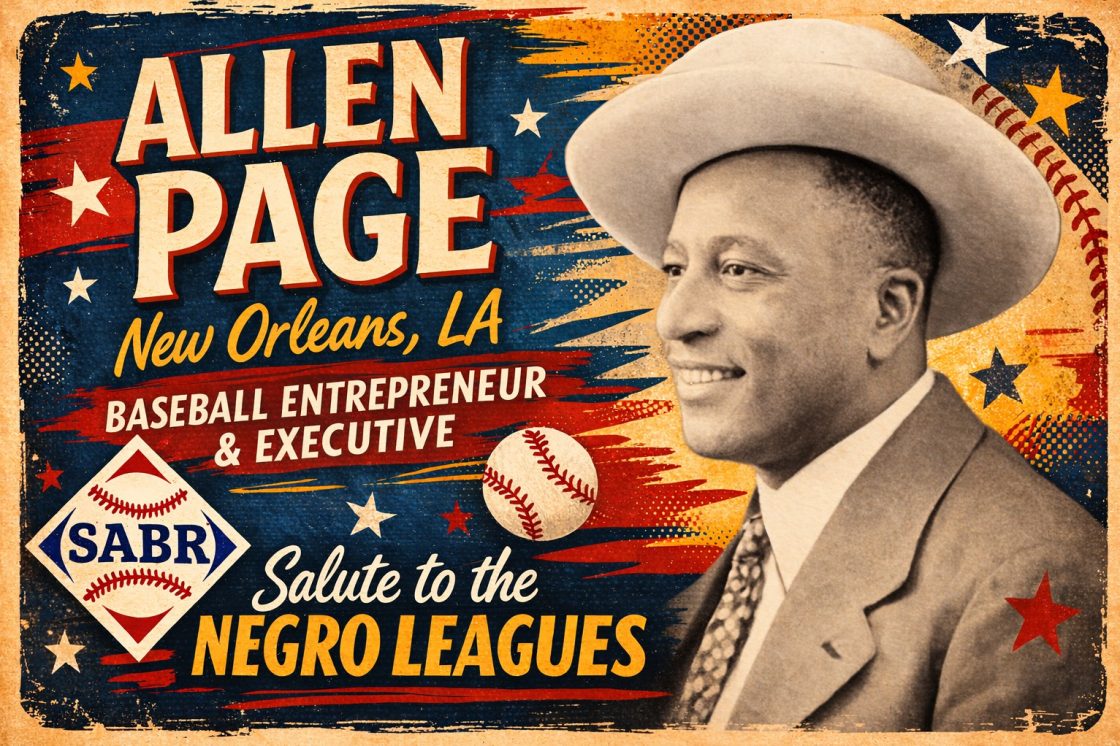
The New Orleans Senators, one of the numerous teams founded, managed, owned and/or operated by the aforementioned Allen Page. I’ve discussed Allen Page many times on this blog, and it’s still not enough, because Page is, in my mind, indisputably the most important figure in New Orleans Black baseball history. As an entrepreneur, baseball magnate, executive and sports promoter, Page is unrivaled in the Crescent City.
And in 1937, he owned the New Orleans Senators, for whom he’d lured Satchel Paige to pitch after the latter’s epic Dominican journey.

Managed by George Sias and previously known as the New Orleans Black Pelicans (one of many team incarnations under that moniker), the Senators played pro and semipro teams in the city, from around New Orleans and into neighboring states. In July of 1937, they squared off against the Oakdale White Sox from Oakdale, La.; later that same month, The Senators grabbed a pair of wins over the Alexandria Black Sports from Alexandria, La., as examples.
The Senators played their home games at Lincoln Park, a private, paid-admission amusement park for the city’s African-American population created in 1902 by the Standard Brewing Company that included a ball field, rides, a skating rink and even hot air balloon ascensions. In addition, the park featured concert and performance facilities, at which early jazz greats like Buddy Bolden, Bunk Johnson and Freddie Keppard played, and that hosted vaudeville shows and prize-fighting. Benevolent societies, labor unions and civil-rights groups also coalesced there.
Thus, wrote Kevin G. McQqueeney in his master’s thesis at the University of New Orleans, titled, “Playing with Jim Crow: African American Private Parks in Early Twentieth Century New Orleans”:
“Lincoln Park, similar to parks in the nineteenth century previously discussed, thus served as a space for African Americans to congregate and advocate for more equal treatment. Parks would later serve as venues for rallies and marches during the Civil Rights era in New Orleans, but their significance for African American identity formation can be seen in this time period, and date back to enslaved gatherings in Congo Square.”
But, McQueeney added, “The park existed until approximately 1930, but its role had changed; during the latter half of its existence it was used primarily as a location for African American baseball league games.”
The Louisiana Weekly excitedly reported on Paige’s imminent arrival. Satchel was scheduled to land in New Orleans from the Caribbean at 6:30 a.m. Saturday, July 18, and added:
“… Satchell [sic] Paige, regarded as the greatest Colored pitcher in the world, will be accompanied by his catcher, Perkins, and will form the batteries in one game for the New Orleans Senators in their doubleheader against the Austin Black Senators …
“Satchell [sic] Paige needs no introduction to Crescent City fans. He has pitched to tremendous crowds here in the past. …”
The Times-Picayune, New Orleans’ most popular newspaper, likewise praised Paige and did a decent job of hyping up his reputation before the contest, noting that Satchel “is hailed as the greatest negro [sic] pitcher in the history of baseball” and that Paige “will show his dazzling speed and curves” in the first game of a doubleheader against the Austin club at Lincoln Park.
The T-P seemingly spoke with Cy Perkins, Paige’s catcher, who asserted, according to the paper, that “Paige’s fast ball [sic] looked just as fast to him as [Bob] Feller’s. He said that Paige gets better as he goes along and is as strong in the ninth inning as in the first. … Perkins says Paige’s fast ball [sic] floats in when pitched overhand and has a wicked bend when from sidearm.”

The Austin Black Senators, meanwhile, had existed off and on and under several iterations and in various leagues, for several decades. The 1937 version was managed (at least at first) by L.S. Cobb and played its home games at Samuel Huston College, a small, private HBCU located right in Austin and now named Huston-Tilletson University. (The school is not to be confused with the much larger, public university Sam Houston University near Houston.)
The 1937 Black Senators seem to be a very tough team, beating various Texas semipro and company nines all spring and summer. In June ’37 the Kansas City Call dubbed the Austin club “one of the strongest semipro teams in the southwest,” while the Corpus Christi (Texas) Caller-Times wrote that the Black Senators were “regarded as one of the strongest semi-pro teams in a state.” The paper added that the team “recently was reorganized and now is at full strength.”
When it came time for Satch to toe the rubber and face down the Austin club, he didn’t disappoint, and despite periodic rain and a resultingly disappointing sized crowd, he definitely sent the New Orleans fans home happy.
The best pitcher in Black baseball hurled four near pristine innings and fanned nine Austin batsmen, including striking out the sides in both the second and third innings. His fantastic flinging paced the home team to a 5-1 win over the hapless Texas lads.
“Seldom has pitching of the brand Paige displayed been seen here,” exclaimed The Weekly. “Though he gave up one hit in the first inning, his dazzling speed and puzzling curves had the Austin batters up in the air throughout his stay on the mound. Coupled with a deceptive change of pace [pitch], it was an exhibition worth going miles to view.”
The New Orleans Senators, with Paige on the mound, were then scheduled to host at Lincoln Park a team called the St. Louis Giants in a contest in which Satchel was advertised to be pitching all nine innings. Unfortunately, that big event had to be called off after several Giants were injured in a bus accident.

(It’s unclear which team the advertised “St. Louis Giants” were, exactly. Some media reports implied that they were members of the Negro American League, but St. Louis’ representatives in the NAL in 1937 were called the Stars, not the Giants. Several articles in 1937 in the St. Louis Argus, a Black newspaper, referred to a “Titanium St. Louis Giants,” which could have been a company team representing the titanium dioxide plant in St. Louis operated by the National Lead Company. Later on in the ’37 season the Argus reported that a team called the “Old St. Louis Giants” team was being formed for exhibition games, including one against the Titanium aggregation; this “old” team was reportedly made up of Black baseball old timers who played for the first St. Louis Giants, a powerful professional Black team from the first two decades of the 20th century. That original Giants team eventually morphed into the original St. Louis Stars, one of the charter teams of the first Negro National League under Rube Foster. But I digress.)
Paige completed his brief post-Trujillo foray with the New Orleans Senators concluded on July 28 of the ’37 campaign by traveling with the Senators to his hometown of Mobile, Ala., to face the Mobile Red Sox. The Louisiana Weekly reported that Satchel pitched four innings with 12 strikeouts – yes, that’s every out he got against the Alabama squad – against only two hits. A crowd of roughly 1,400 showed up to watch the hometown hero perform his feats, and after the game, Paige reportedly stayed in his hometown for a short visit.
Further details about exactly how Satch hooked up with Page and played for the Senators are somewhat murky. Averell includes no information about the New Orleans Senators gig; in his book; neither does Larry Tye in his definitive biography of Paige, “Satchel: The Life and Times of an American Legend.” Moreover, Satchel himself says nothing about the New Orleans Senators stint in his famous autobiography, “Maybe I’ll Pitch Forever.”
However, there is another wrinkle in the tale that is known – that when Paige returned to the States from the Caribbean, he was facing a ban from the formal Negro Leagues for jumping his contract with the Crawfords. Many of his Negro League compadres also were threatened with a ban.
So Satchel gathered many of them together – largely, like him, blacklisted baseball fugitives and “desperadoes,” as Tye calls them – to form a barnstorming club called the Trujillo All-Stars, designed to provide Paige and his peers a little income while they waited out the drama over their blackballing. The team was soon renamed as the Satchel Paige All-Stars, and they turned out to be somewhat successful, winning the Denver Post tournament, the prestigious national showcase of the best in semi-pro baseball.
While other versions of the “Satchel Paige All Stars” did play once in a while in New Orleans and/or against New Orleans clubs at other locales in the country, I’m not sure if this version – the 1937 one formed from the rebellious crews that bolted the American Black leagues for the Dominican Republic – did actually play in New Orleans.
I thoroughly enjoyed this article. I spent two days
Hi Carlis, I’m so sorry it took so long to respond! Thank you very much for your kind words and for reading! I hope you and yours are doing well.
Ryan, Thank you for another great piece of writing. I always appreciate your acknowledgment of my father’s many achievements in and contributions to Negro Leagues baseball and his other entrepreneurial pursuits. I continue to learn new things about my father through your research. His ownership of the NO Senators was a new revelation to me. My beginner’s mind keeps me open and learning.
You are highly esteemed and valued. You are a prized puzzle piece to the mystery and puzzle of my father’s life, and mine. I sincerely Thank You! 🙏🏽
In this blog post, you mentioned Downs Field here in Austin. Here is a little history of Downs field that you can salt away in your research bin.😀
 
On the same site is a mural honoring the Negro Leagues.

Please add this to your blog post comments if that’s legit. I’ll try to get on FB and add this to your posts.
Keep up your great work!
With sincere gratitude,
Rodney Page Life Coach
“A Life is not important except in the impact it has on other lives.” ~ Jackie Robinson
Rodney Page, BCC Life Coach/Consultant 512-922-8897
“A Life is not important except in the impact it has on other lives.” ~ Jackie Robinson
>
Hi Rodney, very good to hear from you! Thank you for the links about Downs Field — I’ll definitely check them out. Is the stadium/ballpark still there, by any chance?
Yes, the stadium is the home field for the Huston-Tillotson baseball team. It has been updated and well-kept. The head coach is the son of Chris Almendarez, RR Express President! Connections abound! Also, the HT Wilie Wells Scholarship fund is now heavily funded by RR Express and Nolan Ryan. It generally goes to an HT baseball player.
Happy Thanksgiving! 🦃
Rodney Page
>
Pingback: The Zulo Hippopotamus of New Orleans | The Negro Leagues Up Close